The marketing manager has a familiar problem. Vendor reports arrive every month, the homepage ranks reliably for the dealership's name, and organic traffic has barely moved while Autotrader and Cars.com capture searches for the vehicles sitting on the lot. Inventory turns over, but the website's visibility doesn't turn with it.
That plateau usually isn't caused by a lack of effort. It comes from treating SEO for auto dealers as a checklist instead of an operating system. A dealer can publish blog posts, adjust title tags, and still lose opportunities because vehicle detail pages are orphaned, manufacturer descriptions are duplicated across the market, and nobody has clear ownership of the Google Business Profile.
The practical system has layers. Technical performance supports crawlability and mobile usability. Strong inventory assets give search engines useful pages to index. Local signals, reviews, and accurate business information establish geographic relevance. Service and buyer content capture broader intent. Entity consistency and structured data then give AI search systems material they can interpret and cite. The order matters, because publishing more content on a weak template rarely fixes the underlying problem.
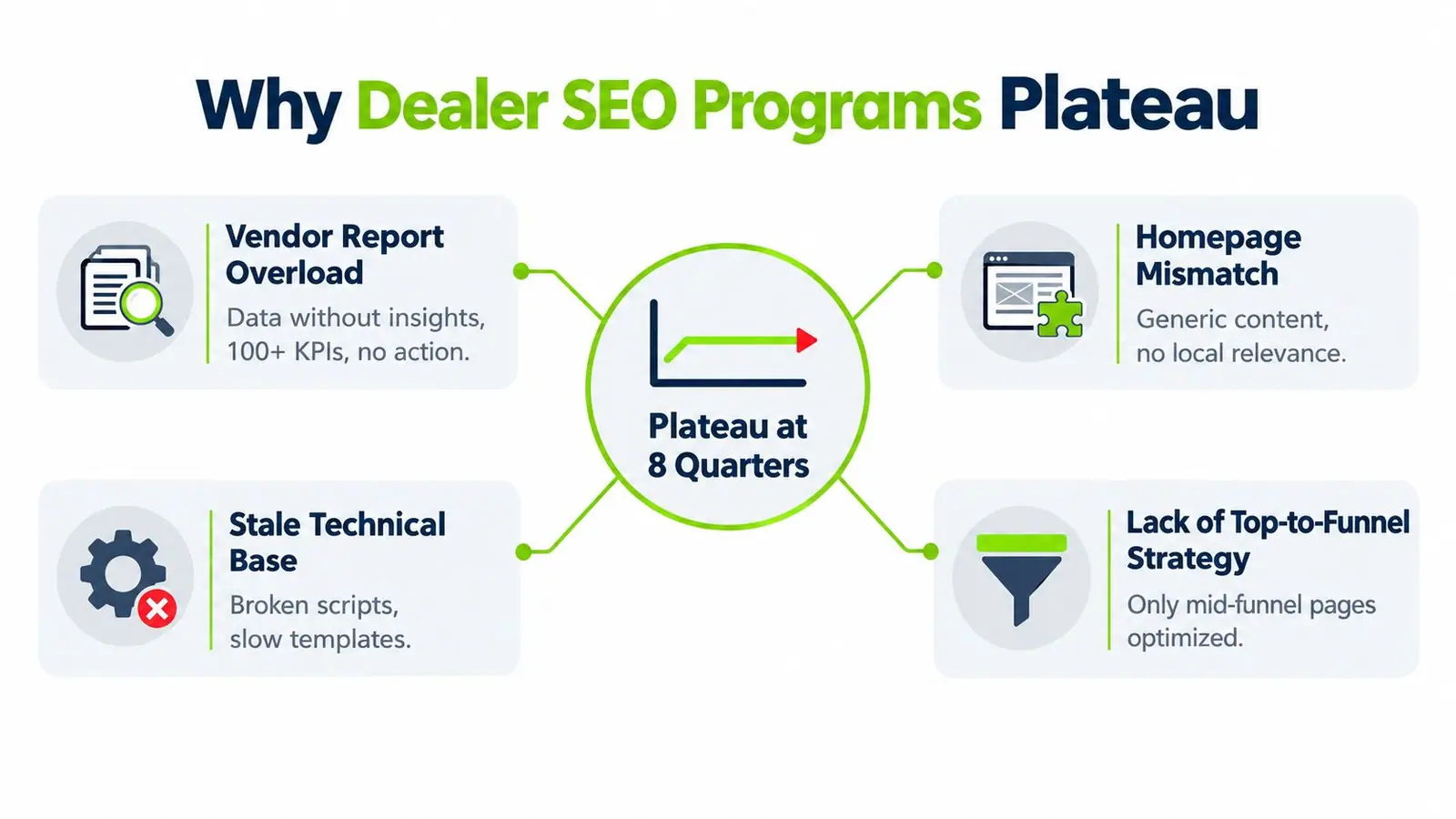
Why Most Dealer SEO Programs Plateau
The report looks busy, but the system stays weak
A typical program measures rankings and sessions without asking whether the right pages are earning visibility. The homepage may perform well for branded searches, while vehicle detail pages receive little internal support, filter URLs multiply, and outdated inventory remains indexed after the car has sold.
Three leaks appear repeatedly:
- Orphaned VDPs: A vehicle page exists in the feed but has no useful links from inventory hubs, body-style pages, or related models.
- Duplicated descriptions: The same feed copy appears on several dealership sites, giving search engines little reason to prefer one page.
- Unmanaged profiles: Nobody checks categories, hours, services, photos, questions, or review responses consistently in the Google Business Profile.
The result is predictable. The agency completes tasks, but the dealer doesn't build a stronger set of search assets.
Practical rule: If the report celebrates published pages but can't show which inventory, local, and service pages gained qualified visibility, it's measuring activity rather than progress.
Build upward from the pages that can compound
Start with the technical base, then improve the pages closest to inventory and conversion. A clean SRP, a fast VDP template, clear internal links, and accurate vehicle data create a platform that can support changing stock. Local profile work strengthens nearby discovery, while service and educational content capture questions that don't belong on an inventory page.
AI visibility sits across all of these layers. Answer engines need consistent business entities, readable facts, structured data, and credible third-party references. That doesn't replace conventional SEO. It makes sloppy conventional SEO more expensive.
Another generic blog post may help eventually, but it shouldn't outrank urgent fixes to VDP discoverability, GBP ownership, or inventory data. Those assets connect directly to what the dealer sells today and can continue working as the inventory changes.
Building a Keyword Map That Actually Matches Shopper Intent
A useful keyword map starts with page ownership, not a spreadsheet full of attractive phrases. Every query should have a logical destination, and that destination should match what the shopper is trying to do.
Separate the four intent layers
| Intent Bucket | Example Queries | Page Type | Funnel Stage |
|---|---|---|---|
| Brand | Dealership name, dealership reviews | Homepage, About, GBP landing page | Trust and navigation |
| Make and model | Toyota RAV4 dealer, Ford F-150 near me | Make, model, or inventory hub | Discovery and comparison |
| Vehicle detail | Used F-150 under $30k, specific year and trim | VDP or filtered SRP | High commercial intent |
| Service and finance | Toyota service center Plano, CPO vs used | Service, finance, or educational page | Purchase support and retention |
Brand terms deserve protection because aggregators and OEM pages can intercept people who already know the store. Make and model terms need pages that reflect actual stock, not broad promises about every vehicle a manufacturer produces. VDP terms should point to live inventory, while finance and service terms need explanations that reduce uncertainty.
For a repeatable research process, use Search Console queries, Google autosuggest, internal sales questions, service adviser language, and competitor page structures. This keyword list building guide is useful for organizing raw ideas before you assign them to page templates.
Prioritize fit over volume
Use a simple scorecard with four columns: search demand, commercial intent, local relevance, and inventory fit. A high-volume head term with weak inventory fit can waste months. A narrower phrase such as “used F-150 under $30k” may be more valuable because the page can show matching vehicles and give the shopper a clear next step.
Suppose research produces fifty terms. Group them into five clusters, such as used trucks, SUVs, make and model, service, and financing. Assign each cluster to one primary page template, then map variants to headings, filters, FAQs, and internal links rather than creating competing pages for every wording change.
Negative keywords matter, too. Exclude searches the dealership can't satisfy, such as models it never stocks, unsupported services, or financing claims that aren't true. A focused map protects budget from content that ranks but doesn't create showroom or service demand.
Winning the Local Map Pack and Nearby Searches
Local visibility is a direct traffic issue for dealers. 97% of consumers search online before visiting a local business, and 76% of smartphone searchers visit a store within 24 hours, according to the automotive local search data summarized by Webtonic's automotive local SEO statistics. The same source reports that 70% of local searches result in clicks on the Google Map Pack, while 28% convert into a purchase within 24 hours.
Those figures explain why a dealership can't treat its website and Google Business Profile as separate marketing projects. A weak profile can lose the nearby shopper before the shopper ever sees the website.
Run the profile like a storefront
Begin with the primary category. Choose the category that best represents the main operation, then add accurate secondary categories without stretching into services the store doesn't provide. Complete hours, holiday hours, phone numbers, appointment links, departments, services, attributes, and descriptions. The landing page should match the profile's purpose, especially when sales and service are distinct operations.
Add real lot, team, facility, and vehicle photos on a consistent schedule. Seed useful questions and answers based on what shoppers ask sales staff, such as trade-ins, test drives, service hours, or financing steps. A practical Google Business Profile optimisation guide from DigiVisi Ltd. offers additional context for managing the profile and local map presence.
Treat reviews as an operating process
Review management works best when it's built into delivery, pickup, service completion, and follow-up workflows. Ask for honest feedback at a moment when the customer can describe the experience clearly, and respond to every review with specific language rather than a repeated template.
Positive responses can mention the department or experience the customer praised. Negative responses should acknowledge the concern, avoid arguing in public, and move the resolution to a private channel. Manufacturer survey rules may limit how staff ask for feedback, so coordinate the review process with compliance and customer experience teams.
Citation work comes after the profile is accurate. Standardize the dealership's name, address, phone number, departments, and hours across major platforms, OEM-required listings, map providers, and automotive directories. Use the Google Business Profile optimization resource to structure the cleanup, then connect profile actions to calls, direction requests, appointment forms, and CRM outcomes.
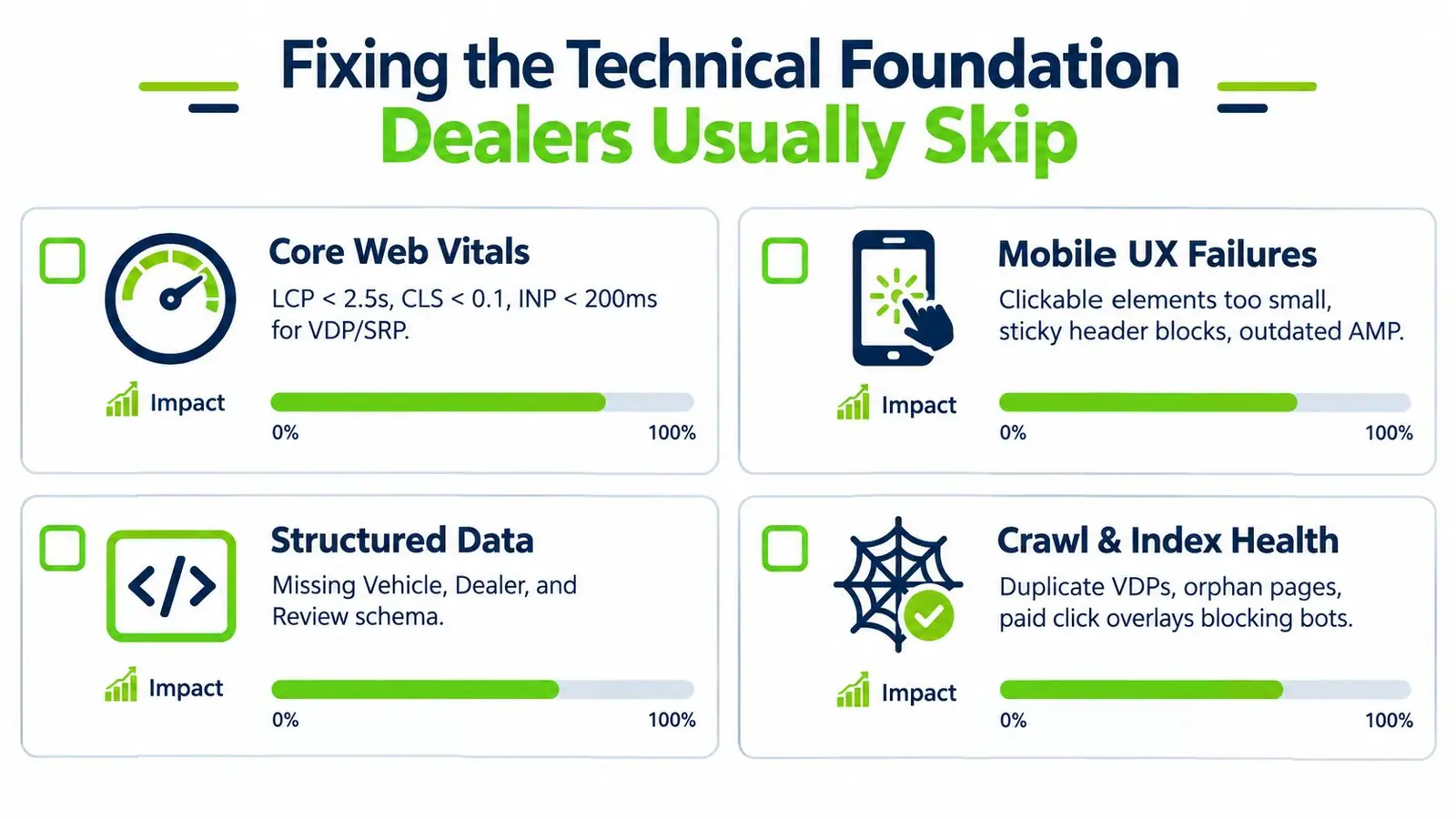
Fixing the Technical Foundation Dealers Usually Skip
Technical SEO for a dealership isn't an audit PDF. It's template engineering that determines whether search engines can crawl, understand, and serve the pages shoppers need.
A 2026 automotive technical SEO benchmark found that only 5% of auto dealer websites pass all three Core Web Vitals, with average Largest Contentful Paint at 12.0 seconds, compared with Google's 2.5-second target. The same benchmark reports that mobile traffic represents 71% of dealer website visits, and vehicle-type schema adoption is about 18%, while top dealers reach 92%. See the automotive technical SEO benchmark for the source data.
Start with VDP and SRP templates
Measure performance on real inventory templates, not only the homepage. Compress hero images, preload the primary vehicle image when appropriate, defer nonessential scripts, and lazy-load gallery images below the initial viewport. The goal isn't a green Lighthouse score for its own sake. Faster templates help shoppers reach photos, pricing, forms, and calls without waiting.
Mobile filters deserve hands-on testing. A shopper should be able to select make, body style, price, and availability without blocked taps, accidental resets, oversized overlays, or sticky elements covering the results.
Control faceted navigation
Filters for trim, color, mileage, price, and features can generate large URL sets. Decide which combinations deserve indexable landing pages, then canonicalize or noindex the rest according to their search value and inventory stability. Year, make, and model combinations should point to a single preferred URL structure when multiple parameter paths describe the same result set.
Audit internal links into search results, sold vehicles, expired campaigns, and account or comparison tools. Remove crawl paths that create no useful search asset. Then add Vehicle, AutoDealer, and relevant Offer properties to pages where the data is present, including VIN, mileage, price, availability, and vehicle identity.
For a practical audit workflow, use this website audit guide to turn findings into owners, deadlines, and ranking-related outcomes.
Turning Inventory Pages Into Real SEO Assets
Most dealerships treat the inventory feed as a publishing system. Search visibility requires treating it as an editorial and data-quality system, too. Independent dealer research found that most AI-driven visits land directly on inventory pages, while one study reported that AI search cited only 0.8% of dealer inventory pages. The findings are summarized in A3 Brands' AI search study.
Give each VDP a reason to exist
Start with the vehicle's actual identity, not a generic description. Rewrite important VDP copy around the make, model, year, trim, body style, ownership context, and buyer questions visible in search suggestions and dealership conversations.
Add dealer-authored details that a syndicated feed can't provide: inspection notes where accurate, service history, reconditioning information, local driving context, warranty terms, trade-in guidance, or a short explanation of who the vehicle suits. Don't invent condition claims. Every statement should come from the vehicle record or a staff member who can verify it.
Implement Vehicle schema with consistent VIN, mileage, price, availability, images, and model data. Feed hygiene matters just as much. Price changes, sold status, images, and availability need to reach the page quickly, because stale inventory creates poor user experiences and weakens trust.
A useful prioritization rule is to rewrite first the VINs with strong margin or strategic relevance, stable availability, existing impressions, and a clear match to local demand. Don't spend equal editorial effort on every vehicle when many will leave inventory quickly.
| Optimization Task | Expected Lift | Effort |
|---|---|---|
| Correct title, headings, and vehicle facts | Improve relevance and clarity | Low |
| Unique description and dealer context | Differentiate the page | Medium |
| Vehicle schema and feed validation | Improve machine understanding | Medium |
| Internal links from SRPs and related pages | Improve discovery | Medium |
| Ongoing status and price synchronization | Protect accuracy | Ongoing |
The principles in this product page optimisation advice transfer well to VDPs, especially the focus on unique value, clear information architecture, and conversion-ready content. For large inventories, programmatic SEO guidance can help create repeatable templates without turning every page into identical copy.
Getting Cited in AI Overviews and Answer Engines
Searchers increasingly receive summarized answers instead of choosing from a page of blue links. For dealerships, that creates a second visibility problem: a page can rank traditionally yet fail to supply the clear, corroborated information an answer engine needs to cite.
Recent coverage of automotive AI search suggests AI Overviews appear meaningfully across automotive queries, with stronger presence for informational and commercial-intent searches than transactional searches. The practical implication is simple. Dealer SEO needs to prepare content for retrieval and citation, not only ranking.
Make the dealership easy to identify
Entity consistency is the first lever. The dealership name, address, phone, departments, hours, About information, and ownership details should agree across the site, Google Business Profile, map listings, automotive directories, and credible local references. Inconsistency forces systems to reconcile conflicting identities, which makes confident citation harder.
Structured data supplies the second lever. Use LocalBusiness for dealership facts, Vehicle for inventory, and FAQPage only where the page visibly answers genuine questions. Mark up service hours, departments, appointment information, and vehicle availability when those facts are current and supported on the page.
Publish answers with a clear source
A service page for “same-day oil change near me” should state the department's actual hours, appointment process, supported vehicles, and location. An FAQ block can answer service questions in plain language, while links to booking and contact pages provide the next action.
Earned mentions supply the third lever. A credible local outlet, community organization, or automotive publication that describes the dealership can strengthen the entity beyond owned properties. The AI search coverage for car dealerships explains why citations, structured data, and consistency deserve attention alongside local rankings.
Measuring Results Without Drowning in Dashboards
Dealer SEO reporting should answer an economic question: is qualified demand reaching sales and service teams? Sessions and average position matter, but they're diagnostic signals. They don't replace form quality, call quality, appointments, store visits, or sold units.
Separate early signals from business outcomes
Leading indicators show whether the system is becoming healthier. Track indexed VDPs, inventory-page impressions, citation velocity, review velocity, Map Pack visibility, branded search movement, and the appearance of the dealership or its pages in AI answers.
Lagging indicators show whether that visibility is producing commercial value. Use qualified form submissions, phone calls that meet the dealership's definition of a meaningful conversation, appointment requests, store visits, service bookings, and units sold. Connect each outcome to its source and landing page where the systems allow it.
| Category | Leading KPI | Lagging KPI | Source of Truth |
|---|---|---|---|
| Inventory | Indexed VDPs and impressions | Qualified vehicle leads and sold units | Search Console and CRM |
| Local | Map Pack visibility and review activity | Calls, directions, and store visits | GBP, call tracking, CRM |
| Service | Service-page visibility and appointment clicks | Completed service bookings | Analytics and DMS or CRM |
| AI visibility | Cited pages and entity mentions | Assisted leads influenced by AI discovery | AI monitoring and CRM |
| Technical | Crawl errors, index coverage, template performance | Conversion rate from affected templates | Search Console, analytics, QA |
A workable dashboard needs one source of truth for each job. Use GA4 for traffic and conversion events, Search Console for queries and pages, a local rank tracker for Map Pack and organic results, call tracking for phone attribution, and the CRM for lead-to-sale progression. Track rankings by brand, make, model, model plus city, service plus city, and a focused money-keyword set. Don't let a single blended average hide the difference between local pack visibility and traditional organic rankings.
Use a meeting rhythm that forces decisions
A weekly snapshot should flag major inventory indexing changes, technical errors, profile issues, review activity, and lead anomalies. Keep it short. The purpose is escalation, not analysis.
The monthly review should answer:
- Which VDP, SRP, service, or local pages gained qualified visibility?
- Which pages received impressions but failed to earn clicks or leads?
- Did inventory status, price, or schema data become stale?
- Which Map Pack queries moved by location?
- Which calls and forms reached the CRM, and which didn't?
- Did AI answers mention the dealership, its inventory, or competitors instead?
The quarterly business review should connect trends to inventory strategy, sales priorities, service capacity, and budget allocation. Delete three reports that commonly create noise: the all-keyword ranking dump, the traffic-only channel report, and the page-count production report. Replace them with decisions tied to pages, leads, and operational follow-through.
Execute a realistic 90-day rollout
Days 1 to 15, audit and instrument
- Access control: Confirm ownership of Google Business Profile, Search Console, analytics, call tracking, the website, and the domain.
- Measurement setup: Validate GA4 events for calls, forms, directions, inventory interactions, and service appointments.
- Baseline capture: Record current rankings by segment, indexed inventory, citations, review activity, technical errors, and AI visibility.
- Inventory review: Identify orphaned, duplicated, expired, and high-priority VDPs.
Days 16 to 45, repair the foundation
- Local cleanup: Correct GBP categories, services, hours, photos, questions, and landing pages.
- Reputation process: Establish a compliant review request and response workflow.
- Technical repairs: Resolve the highest-impact template, mobile, crawl, canonical, and schema problems.
- Entity consistency: Synchronize business information across important listings and third-party references.
Days 46 to 90, scale useful assets
- VDP production: Create a controlled description process for priority vehicles and validate structured data.
- Content clusters: Build service, financing, body-style, and make-model pages around real inventory and customer questions.
- Internal linking: Connect hubs, SRPs, VDPs, service pages, finance pages, and local resources.
- AI preparation: Strengthen factual answer blocks, entity references, third-party mentions, and citation monitoring.
Correct the recurring failure modes
Publishing hundreds of templated VDPs won't solve a differentiation problem. Improve the pages that have inventory fit and commercial potential, then scale the editorial pattern only after quality is proven.
Technical repairs alone won't create demand if the agency never improves inventory pages. A fast site with empty or duplicated VDPs is still a weak showroom.
Reviews can't be left to chance while competitors build trust in the Map Pack. Assign ownership, make requests part of the customer workflow, and review performance at the same cadence as leads.
Your next quarter's checklist is straightforward: verify access, baseline the data, fix the templates, clean the profile, establish review operations, prioritize VDPs, deploy schema, build intent-led service and inventory hubs, connect calls to the CRM, and test how the dealership appears in AI answers. Keep only the metrics that help someone decide what to do next.
Surnex brings traditional SEO reporting and AI search visibility into one workspace, including rankings, audits, local visibility, and citation monitoring. Visit Surnex to see how your dealership or agency can track the pages and entities that matter across classic search and emerging answer engines.