Forty-six percent of all Google searches have local intent, according to BrightLocal's summary of local search statistics. That makes Google Business Profile optimization far more important than keeping a business directory entry tidy. Your profile can determine whether a nearby customer discovers your business, trusts it, calls, visits, or moves on to a competitor.
The practical mistake is treating the profile as a publishing channel. Posts and photos have their place, but the strongest programs manage Google Business Profile as an operating system for trust and entity consistency. Business details, categories, reviews, services, location signals, customer communication, and external references must agree with one another.
Why Google Business Profile Optimization Matters More Than Ever
Seventy percent more likely to visit, 50% more likely to consider purchasing, and 2.7 times more likely to be considered reputable are the reported outcomes associated with complete Business Profiles. (BrightLocal's local SEO statistics) The figures do not guarantee higher rankings. They show why profile completeness matters after discovery, when a customer decides whether a nearby business appears legitimate, relevant, and ready to serve them.
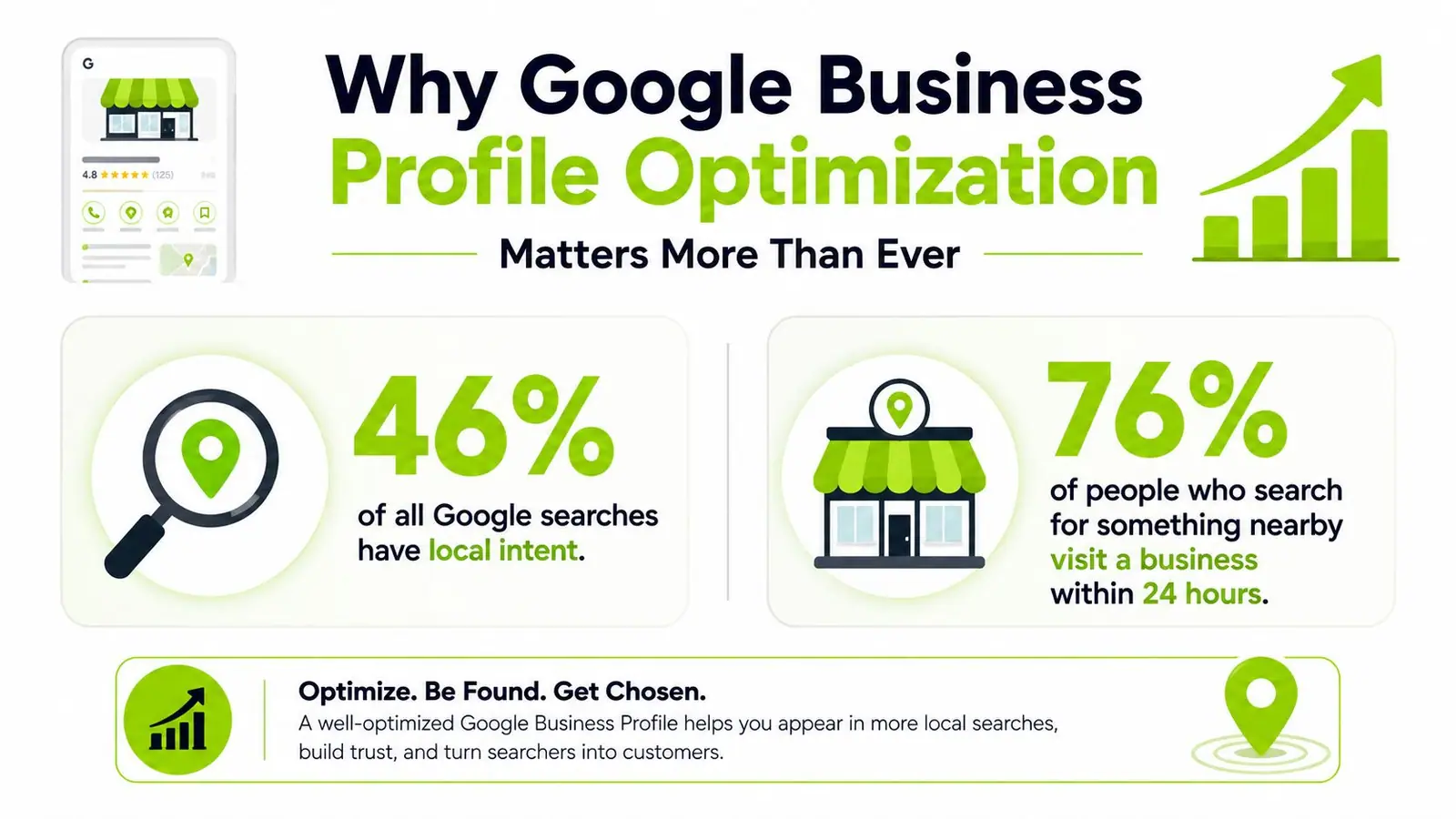
Google Business Profile sits where local discovery becomes a business decision. Search and Maps users can see the business name, category, hours, location, reviews, services, photos, and contact actions without opening a website. Google's Business Profile performance guidance connects profile interactions with actions such as calls, website visits, and direction requests. Accuracy is therefore a commercial operating requirement, not a box to check for SEO.
A profile is an entity record
A well-managed profile gives Google and customers the same description of one real-world business. The name should match signage and the website. Location, phone number, service area, hours, categories, and services should reflect how the company operates. Conflicting details create uncertainty for customers and for systems that connect business information across search surfaces.
That consistency matters as local search becomes more conversational. QuickFeedback's analysis found that Google AI Overviews can combine information from Business Profiles, Maps, Yelp, Reddit, news, and websites, while estimating that 7.9% of local searches triggered an AI Overview in its cited analysis. (QuickFeedback's analysis of AI Overviews and local search) The practical priority is not chasing every generated answer. It is keeping the underlying business entity accurate wherever search systems retrieve it.
Scale changes the operating problem
By 2026, industry reporting estimates more than 200 million Google Business Profile listings globally, with roughly 76% verified and about 28,000 new profiles created every day. The same report estimates an average business receives about 1,009 monthly profile searches, including roughly 157 direct searches and 852 discovery searches. (Posterly's Google Business Profile guide)
For agencies managing multiple locations, the risk is operational. A small naming error, outdated hour, duplicate listing, or unsupported category can spread across a location group and consume time in remediation. Prioritize identity, accuracy, access, and policy compliance before publishing more content.
Practical rule: Treat every profile field as part of the business's public identity. Publish only what the company can verify, maintain, and deliver.
Setting Up Your Profile for Maximum Impact
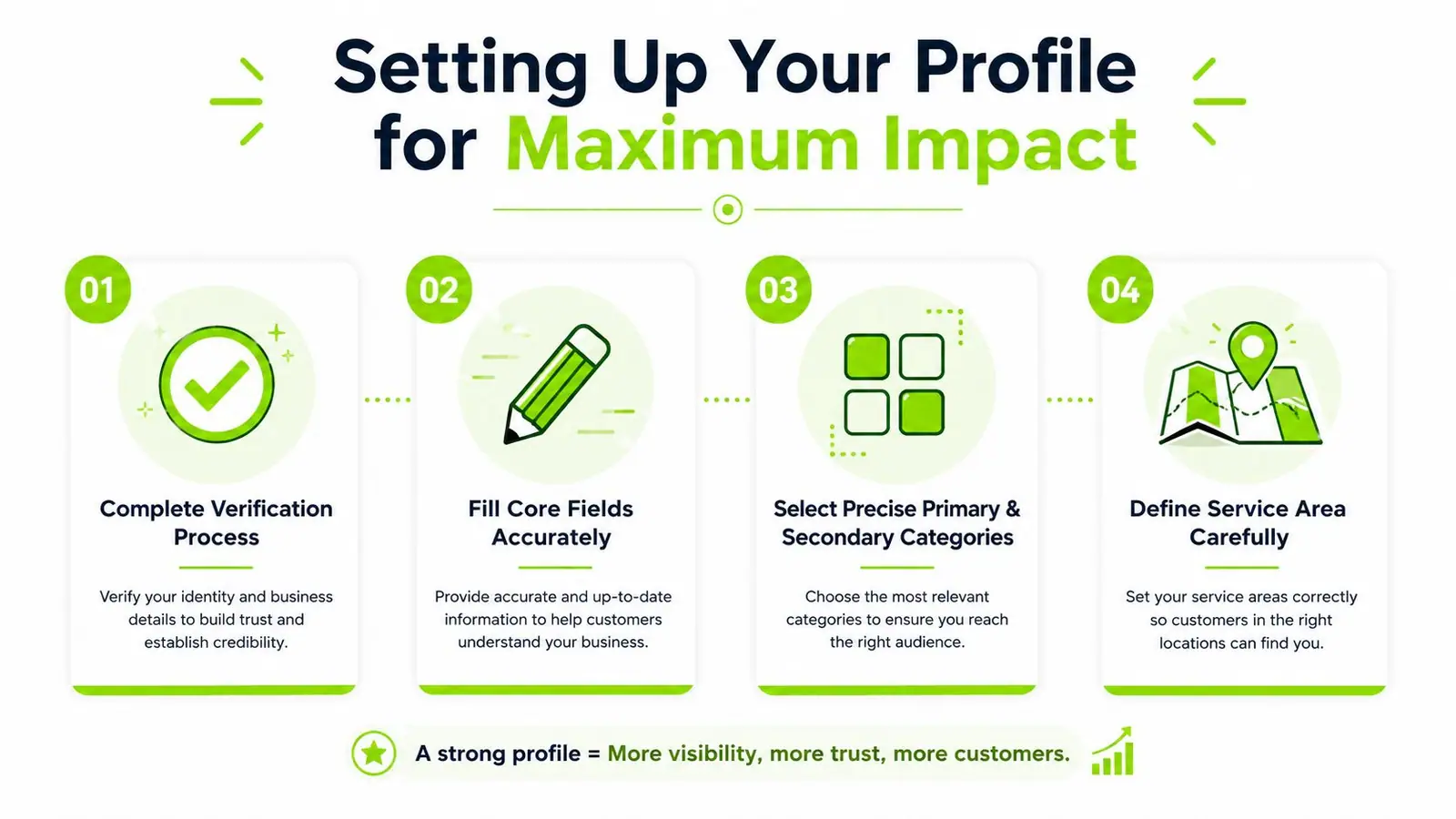
A Google Business Profile is only as reliable as its ownership, verification, and maintenance process. Confirm who owns the listing, who has manager access, and which account remains available when employees or agencies change. For agencies, this access record prevents a location from becoming dependent on one departing contractor or client contact.
Build the factual foundation first
Complete the operational fields before publishing content. Enter the business name, accurate address or service-area configuration, phone number, website, regular and holiday hours, services, and relevant attributes. Google's official Business Profile best-practices playbook emphasizes accuracy, one profile per business, and using only the categories needed to describe the company.
The profile should match the business's other public records. Compare the name, address, phone number, website, hours, and service details with the company website and major directories. Inconsistent entity data creates avoidable review work for multi-location teams and can confuse customers about which location they are contacting.
Write the description for customers. Explain what the company does, who it serves, and where it operates. Natural service terms improve clarity, while location strings or repeated phrases forced into the business name can create a compliance risk.
For a practical setup walkthrough, Silva Marketing's local SEO guidance connects profile fields with the customer actions those fields support. Use it as a reference, then check every recommendation against Google's current guidelines and the client's actual operating model.
Choose categories with restraint
The primary category should describe the core business, not the service with the highest search demand. A dental clinic should not choose a cosmetic procedure as its primary category when general dentistry is the central operation. Secondary categories can clarify legitimate adjacent services, but they should not list every task the company has performed.
Categories influence relevance and customer expectations. A category that promises a service the company does not routinely provide can attract unsuitable searches and produce weak conversions.
Separate storefronts from service-area businesses
A customer-facing location needs an address that represents the business and can meet Google's verification requirements. A service-area business should configure the areas it serves instead of publishing a residential address, P.O. box, or virtual office where customers cannot visit.
Review the business name, address, phone number, and service areas across the website and important directories. Surnex's guide to local business search offers further context on how local entities appear across discovery systems. The setup should represent the operation that exists, not the market the company hopes to serve.
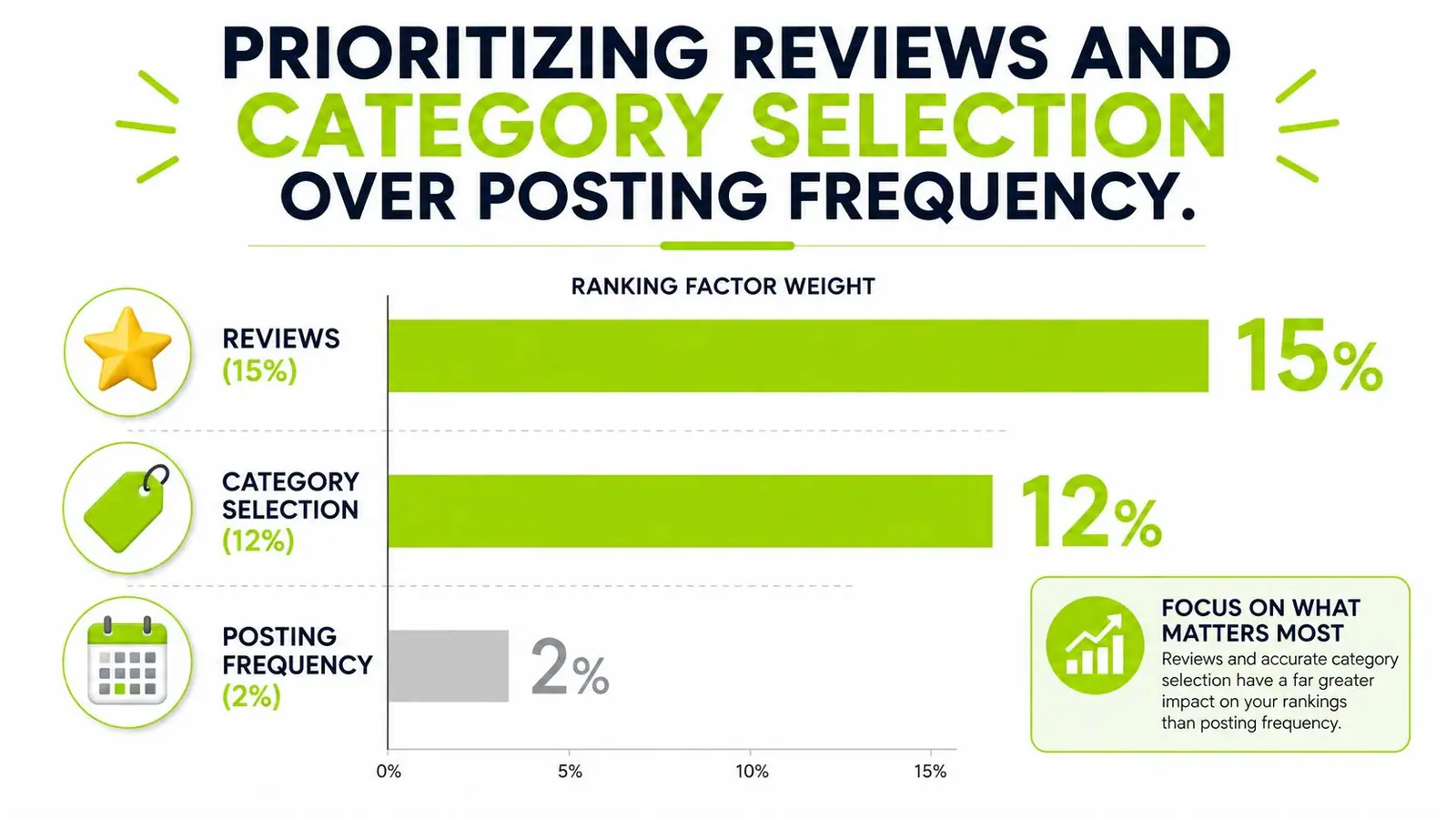
Prioritizing Reviews and Category Selection Over Posting Frequency
Posting more often isn't a substitute for relevance or trust. A large analysis of 3,269 local businesses attributed about 48% of ranking influence to proximity, 21% to industry type, 11% to review keywords, 8% to review count, 7% to business-name matching, and only about 2% to 3% combined to profile and website optimization. (Newsworthy's analysis of Google Business Profile ranking factors)
Those figures don't make posts useless. They put posting frequency in its proper place. A post can communicate an offer or answer a timely question, but it won't overcome weak category relevance, thin review evidence, or an address that places the business far from the searcher.
Put review acquisition inside the customer journey
The best review process asks for honest feedback soon after a completed interaction. Send customers to the direct review link, explain that you welcome candid feedback, and make the request easy to complete. Don't offer rewards for positive reviews, ask staff to create reviews, or filter unhappy customers away from Google. Those shortcuts create policy and reputation problems.
Review content matters because customers describe the services, locations, and experiences in their own language. A business can't script genuine feedback, but it can deliver clear service and ask at an appropriate moment. Review responses should acknowledge the customer, address the specific issue, and avoid exposing private information.
Negative reviews deserve operational attention rather than defensive copy. A concise public response can acknowledge the concern and move the conversation offline. Internally, the team should identify whether the complaint reveals a recurring problem with scheduling, communication, pricing, or service delivery.
Make category selection a customer-intent decision
Ask what customers hire the business to do most often. Compare that answer with Google's available categories and the language customers use in calls, forms, and reviews. Then select the most specific accurate primary category and add only secondary categories that describe meaningful, ongoing offerings.
The profile should reflect the business customers encounter, not every keyword the agency wants to capture.
Review management and category work belong in the same priority queue. Agencies that need a centralized process can also use reputation management tools for monitoring and responding to reviews, provided the workflow preserves human approval and follows Google's policies.
Watch the practical explanation below, then apply it to the client's service model rather than copying a generic posting calendar.
Maintaining Freshness with Photos, Posts, and Messaging
Fresh content helps customers confirm that a business is active and gives search systems current context. Treat it as part of the operating workflow, not a publishing quota. For agencies managing several locations, collecting useful material during normal service delivery is more reliable than creating separate campaigns for every profile.
Use photos to remove uncertainty
Upload real images that answer practical customer questions:
- Exterior and access: Show the entrance, storefront, parking context, and identifying signs.
- Interior and experience: Let visitors assess the space, layout, cleanliness, and atmosphere.
- People and work: Include staff, equipment, completed work, and service-in-progress images where appropriate.
- Customer perspective: Invite authentic user-generated photos when customers choose to share them.
A professional cover image establishes context, while a believable, current gallery often supports conversion more effectively than a polished hero shot alone. Avoid stock photography and images that suggest facilities, products, or services the business does not provide. Those mismatches weaken trust and can create complaints.
Keep posts useful
A post earns its place when a customer can act on it. Use an offer with clear terms, an event when the date and location matter, or an update when the business has changed something customers need to know. Generic motivational copy adds little value and creates maintenance work.
Build the editorial queue from real business events, seasonal services, new products, common questions, and operational updates. Batch approvals across client accounts to reduce production time, but customize copy when branches differ in hours, inventory, staffing, or service coverage. Identical posts across locations may be efficient, yet they can make profiles look disconnected from the businesses they represent.
Respond where customers are asking
If messaging is available and the business can answer consistently, assign an owner and set response expectations. An unattended channel creates frustration instead of trust. Review Q&A regularly, correct inaccurate answers, and address recurring questions about booking, accessibility, payment, parking, and service boundaries.
Freshness matters when it improves a customer decision. If an update does not clarify the offer, reduce uncertainty, or support an action, prioritize core business data, hours, categories, and reviews first. That order protects the profile's role as a dependable trust and entity record, rather than turning optimization into a content checklist.
Avoiding Suspensions and Common Optimization Mistakes
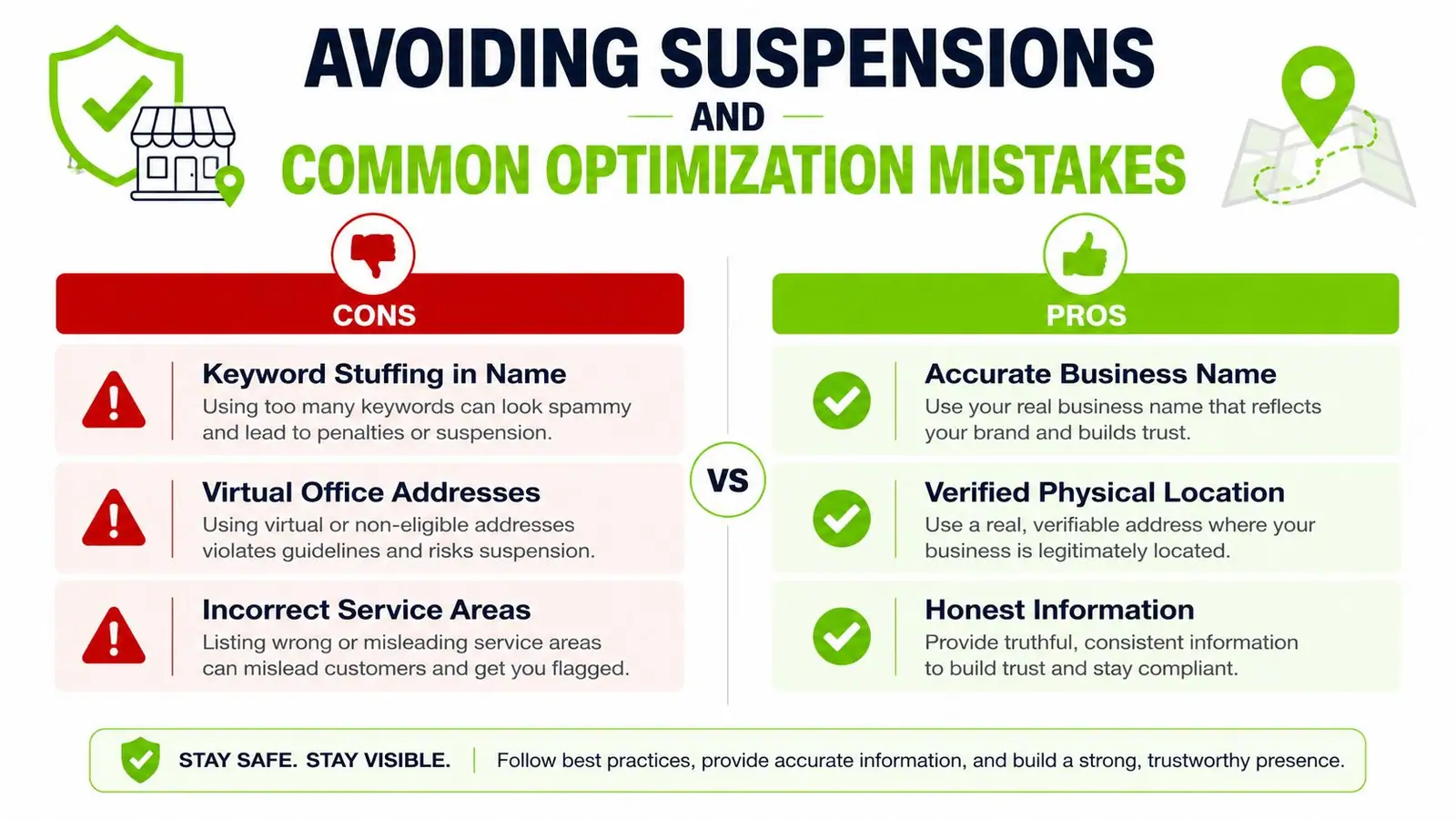
Aggressive optimization often creates more risk than value. The most serious errors usually happen when an agency tries to manipulate identity signals instead of documenting the actual business.
Audit the identity before editing
Check these items before making changes:
- Business name: Remove marketing phrases, service lists, and location additions that aren't part of the name.
- Address: Confirm that the location exists, represents the business, and is eligible for customer visits when shown publicly.
- Duplicates: Search Maps for alternate profiles, old addresses, and variations created by former staff or agencies.
- Categories: Remove categories that don't accurately describe the current operation.
- Ownership: Record the verified owner and ensure agency access doesn't depend on one employee's personal account.
Keyword stuffing in the business name is a common suspension trigger because it changes an identity field into an advertising field. Virtual offices and P.O. boxes can also create verification problems when they don't represent a staffed, eligible location. Duplicate profiles split authority and confuse customers.
Choose compliance over volume
More categories don't automatically create more visibility. Daily posting isn't a requirement for a credible profile, and a large photo count doesn't compensate for inaccurate hours or weak reviews. Google's guidance favors accuracy, restraint, and one profile per business, so agencies should be cautious with advice that promises results through sheer volume. (Google's official Business Profile best-practices playbook)
A profile audit should compare the listing with the website, signage, customer communications, legal business information, and actual service coverage. Fix the highest-risk mismatch first, document the change, and preserve evidence that the business is represented accurately.
Handle suspension methodically
Don't create a replacement profile immediately. Identify whether the problem concerns ownership, verification, address eligibility, duplicate listings, business-name formatting, or a policy violation. Correct the underlying issue, gather relevant business evidence, and use Google's official reinstatement process.
When a tactic feels clever because it disguises the business, it probably creates more risk than ranking value.
Optimizing for AI Overviews and Emerging Search Surfaces
Local search now extends beyond the traditional map result. Recent reporting indicates that Google AI Overviews can draw local information from Business Profiles, Maps, Yelp, Reddit, news, and websites. The cited 2026 analysis estimates that 7.9% of local searches currently trigger an AI Overview, so AI visibility is meaningful but not a reason to abandon established local SEO fundamentals. (QuickFeedback's local AI search analysis)
The useful strategy is entity consistency. A profile that says one thing, a website that says another, and review platforms that show an outdated address give synthesis systems conflicting evidence. Keep the business name, services, location details, hours, and customer-facing claims aligned across the sources customers and search systems consult.
Write for answers, not keyword theatre
Describe services in plain language. Add useful detail to service entries, respond to common questions, and make website pages support the same claims as the profile. Reviews can't be manufactured, but authentic customer language can help clarify what the business does and which needs it serves.
Freshness also has a role. Google's 2026 official playbook continues to emphasize timely updates, offers, and customer communication. That supports a maintenance approach, not an endless publishing schedule.
The shift is covered in more detail in this guide to Google AI Overviews and SEO. Agencies should track whether a client appears in traditional local results and AI-generated answers, then fix citation gaps and inconsistent entity information before producing more content.
Measuring Results and Scaling Across Multiple Locations
A useful report connects profile visibility with customer actions. Separate discovery searches from direct searches, then track calls, direction requests, website clicks, bookings where available, and message activity. Google's performance report provides a first-party baseline for a selected period within Business Profile and Maps. Google's Business Profile performance report guidance
Do not judge a single month alone. Compare equivalent periods and annotate changes to hours, location, category, review activity, promotions, and seasonality. Each report should explain what changed, why it likely changed, and what action follows. Distinguish shifts in discovery, conversion, and tracking.
Create a repeatable location workflow
Multi-location accounts need central governance with local accuracy. Keep a source-of-truth record for every location, covering the approved name, address, phone, hours, services, categories, landing page, service area, and ownership status. Give one person approval authority for sensitive edits, especially names, addresses, categories, and ownership changes.
Bulk verification can simplify management for eligible organizations, but it does not replace location-level review. Local teams should provide current photos, promotions, holiday hours, and customer questions. Central teams should audit consistency, check suspension risk, and monitor performance trends.
Use citation tools, review platforms, rank tracking, and AI visibility monitoring only when each serves a defined reporting need. Surnex's multi-site management guidance offers relevant controls for agencies managing many locations. Automate distribution and alerts, while keeping humans responsible for factual approval.
Surnex combines traditional SEO metrics with AI search visibility in one dashboard. Agencies can monitor Google AI Overviews, ChatGPT-driven discovery, rankings, backlinks, audits, and citation gaps across client accounts. Visit Surnex to assess a unified workflow for measuring and scaling Google Business Profile optimization.