A marketing manager opens the morning dashboard and sees green arrows everywhere. Impressions are up, rankings look stable, and the reporting deck is ready. Yet qualified leads are barely moving, a competitor appears in more AI-generated answers, and nobody can explain whether the site is gaining ground.
That's the problem performance benchmarking solves. Instead of reading your numbers in isolation, you compare current results with a defined baseline, a relevant competitor or standard, and a consistent time window. The comparison reveals whether a result is strong, ordinary, deteriorating, or pointing to an opportunity.
For SEO teams, the old benchmark was often a ranking report. In 2026, the picture also includes AI Overview presence, citations in generated answers, brand mentions, referring domains, technical experience, and conversion outcomes. A useful benchmark connects those signals rather than letting one attractive metric dominate the conversation.
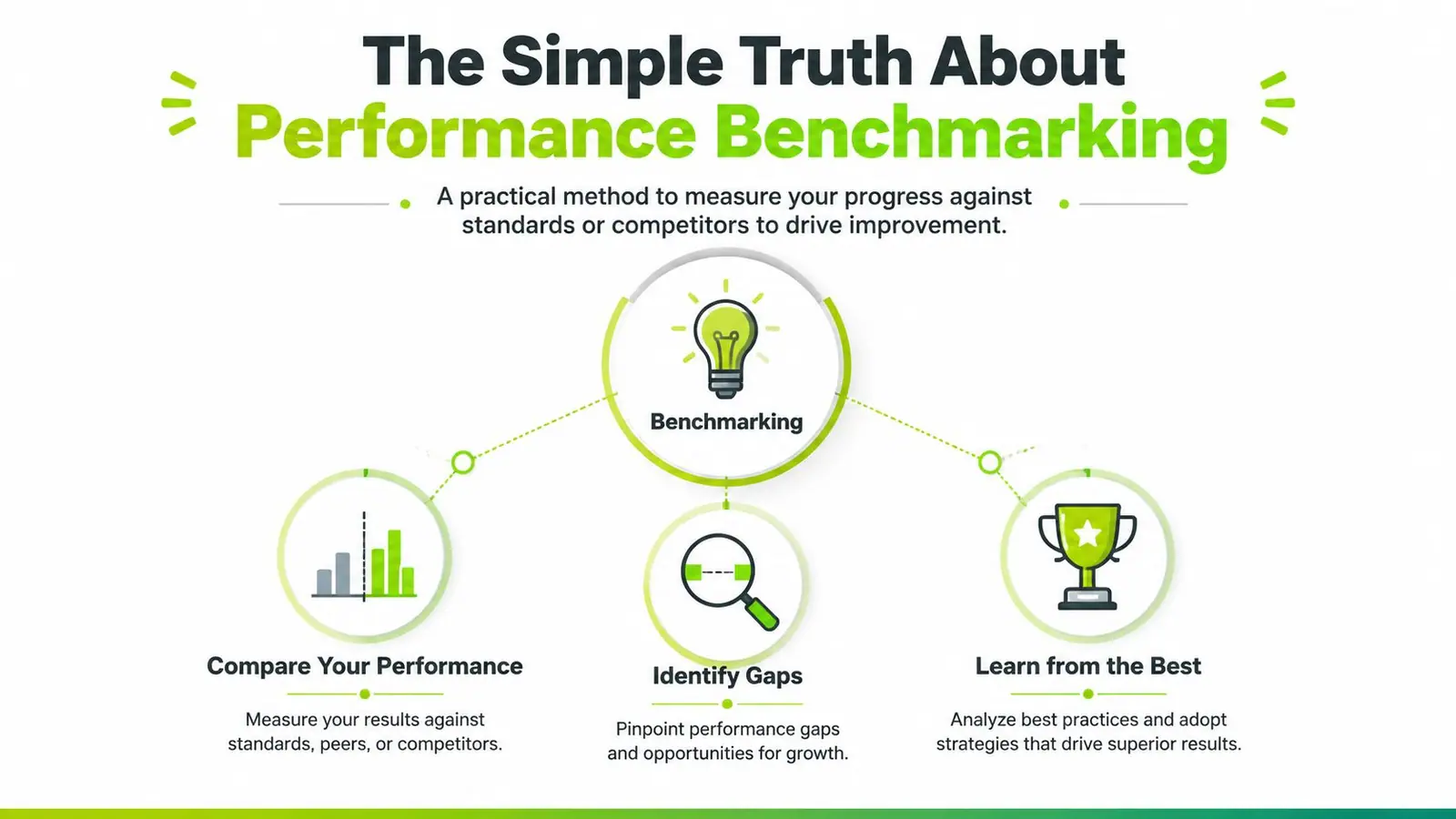
The Simple Truth About Performance Benchmarking
Performance benchmarking means comparing your current results with a known standard so you can find meaningful gaps and opportunities. The standard might be your own previous performance, a direct competitor, an industry reference, or a clearly defined target. The comparison matters more than the dashboard itself.
Every useful benchmark has three ingredients:
- A baseline: The starting result you'll use for comparison, such as organic clicks before a site migration.
- A comparator: The reference point, such as the same site last quarter, two direct competitors, or a sector benchmark.
- A time window: The period in which you'll collect and compare results, such as a month, quarter, or campaign cycle.
Without all three, teams often mistake movement for progress. A ranking can rise while conversions fall. A traffic increase can look impressive until you compare it with stronger growth from relevant competitors. A new AI citation can be encouraging, but it means more when you track whether the brand appears consistently for the queries that influence buyers.
Reporting tells you what happened
A report records events. It might show clicks, impressions, average position, backlinks, page speed, or conversions. That information is useful, but it doesn't tell you whether the outcome is acceptable.
Benchmarking adds judgment through comparison. It asks:
- Is the result better or worse than the baseline?
- Is the gap caused by content, technical performance, demand, or competition?
- Which change deserves attention first?
- What does the strongest comparable performer do differently?
This distinction is central to search intelligence. Search intelligence helps you understand the environment around your numbers, while benchmarking gives you a repeatable way to measure your position within that environment.
Practical rule: A number becomes a benchmark only after you define what it should be compared with and what decision the comparison will support.
The rest of this guide turns that definition into a practical program for traditional SEO and AI visibility, from choosing metrics to scheduling recurring comparisons.
Where Performance Benchmarking Came From
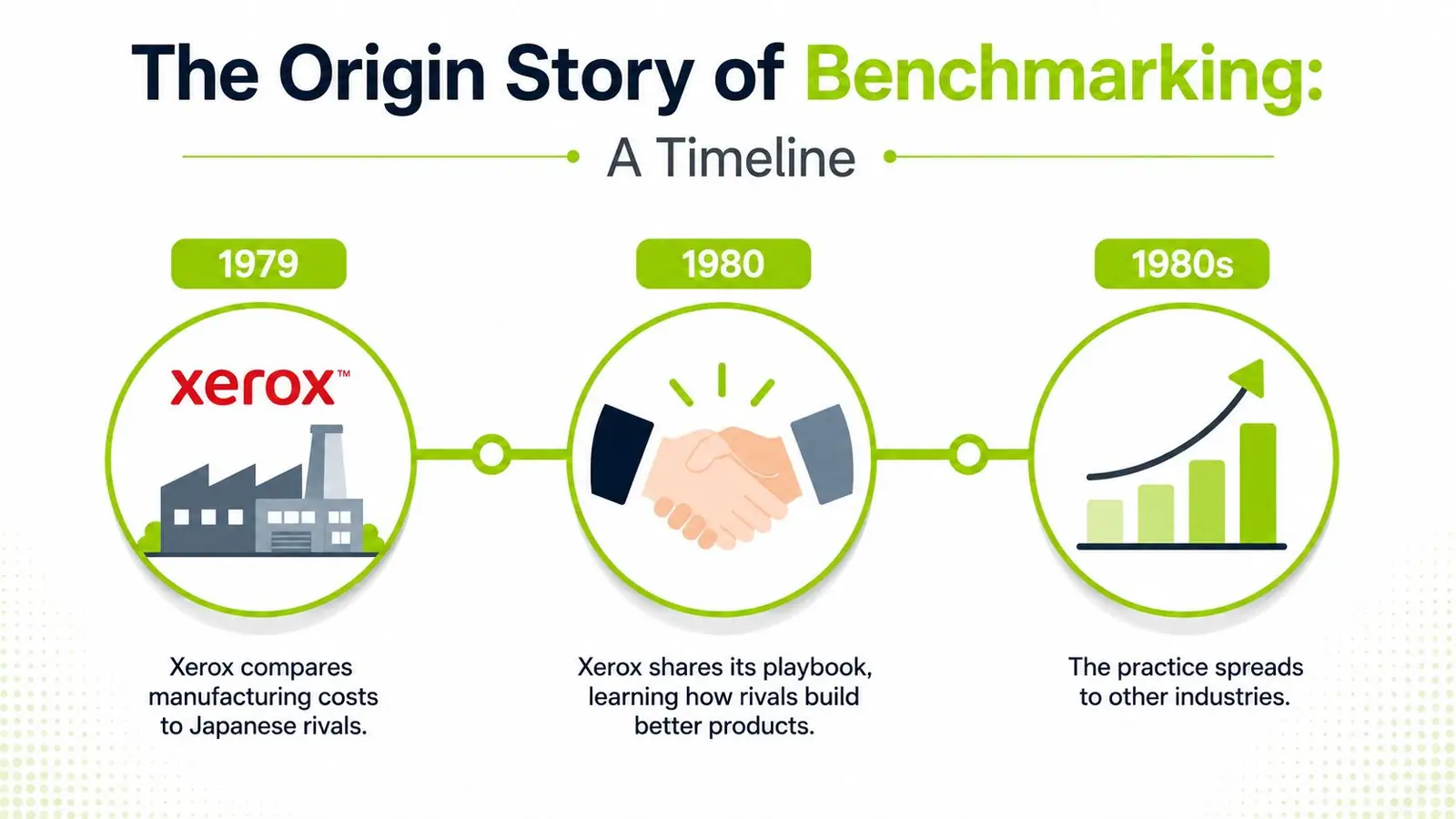
Modern benchmarking became a recognizable management discipline through Xerox's work in the late 1970s. The company popularized systematic comparisons with industry leaders to identify competitive gaps, and the practice spread more widely during the 1980s as organizations compared price, quality, speed, reliability, and service features across products and processes. EBSCO's history of benchmarking places Xerox at the center of this modern milestone while also noting that comparison methods have older industrial roots.
The important lesson wasn't that Xerox compared itself with other manufacturers. The company treated external performance as a source of learning. Instead of asking only whether its own factory was improving, managers asked how comparable organizations achieved different results and which processes could be adapted.
From factory operations to digital channels
That approach moved beyond manufacturing into corporate strategy, service operations, technology, and marketing. Digital channels made the process easier to repeat because teams could collect comparable information from analytics platforms, search results, websites, content libraries, and backlink indexes.
A modern SEO team can compare a category page with direct competitors, review shared keyword coverage, inspect referring-domain gaps, and monitor whether the same brands appear in AI-generated responses. The underlying discipline is unchanged. Teams still define a comparison, identify a gap, learn from stronger performance, and decide what to change.
The speed of search makes this discipline more important. Rankings can shift, competitors can publish new content, and AI interfaces can answer a query without sending a traditional click. A team that only reviews its own historical traffic may miss a decline in visibility even when its internal dashboard still looks healthy.
Benchmarking literature also separates performance benchmarking, which compares operating statistics and product or service attributes, from best-practice benchmarking, which looks at how stronger performers achieve their results. A published survey cited in that literature found that 49% of organizations used performance benchmarking and 39% used best-practice benchmarking. The benchmarking literature explains these distinctions.
The practice is no longer limited to large operations teams. Any organization competing for attention in search needs a clear reference point. Without one, “improvement” can mean little more than a favorable interpretation of isolated numbers.
The Three Main Types Every Team Should Know
Teams usually choose among internal, competitive, and industry benchmarking. The three methods answer different questions, so combining them can provide context without confusing their purposes.
| Type | What You Compare | Best Used When | Example |
|---|---|---|---|
| Internal | Current performance against your own historical results | You need to measure the effect of a redesign, migration, or content program | A SaaS blog compares organic clicks and trial sign-ups before and after a migration |
| Competitive | Your performance against named rivals | You compete for the same audiences, queries, or commercial opportunities | An ecommerce team compares category-page rankings, backlinks, and AI visibility with two direct competitors |
| Industry | Your results against sector-level reference points | You need outside context for planning, board reporting, or positioning | A B2B publisher evaluates its authority and visibility against relevant industry benchmarks |
Internal benchmarking
Internal benchmarking is the cleanest place to start because your team controls the site, data definitions, and reporting process. Compare the same page groups, query sets, devices, and conversion events across consistent periods. This approach can show whether a technical release, content refresh, or information-architecture change produced the intended result.
The main limitation is context. Your own performance may improve while the market improves faster, so internal benchmarking shouldn't replace external comparison.
Competitive benchmarking
Competitive benchmarking focuses on organizations that compete for the same demand. A named rival is useful only if it targets similar users, products, locations, or search intent. Compare shared keywords, ranking distribution, referring domains, content coverage, SERP features, and appearances in AI answers.
A competitor doesn't need to sell the same product to compete for visibility. A publisher, review site, marketplace, or software directory may occupy the same answer space for an important query.
Industry benchmarking
Industry benchmarking gives leadership a wider frame. It can help answer whether your visibility, technical experience, or content output is reasonable for your sector, though the comparison must account for business model and market maturity. Industry benchmarking guidance is useful when you need to build that external reference set deliberately.
Use the three types together, but label them clearly. “Up from last quarter” is an internal result. “Behind a direct rival” is competitive context. “Below the sector reference” is an industry observation. Each supports a different decision.
Metrics That Reveal What Matters
A useful benchmark connects each metric to a decision. Group the measurement system into three views: search visibility, technical performance, and AI visibility. Each view reveals a different gap. Together, they provide a clearer picture than any single proxy for business performance.
| Category | Key Metrics | Why It Matters |
|---|---|---|
| SEO and visibility | Organic impressions, click-through rate, average position, share of voice, referring domains | Shows whether searchers can find the site and whether competitors occupy more of the available demand |
| Technical performance | Core Web Vitals, Time to First Byte, server response time, mobile usability scores | Identifies experience and delivery issues that can weaken usability and search performance |
| AI and LLM visibility | AI Overview citations, brand mentions, mention sentiment, share of conversational queries answered | Shows whether AI systems include, describe, and support the brand for important questions |
SEO and visibility metrics
Organic impressions show exposure. Click-through rate shows whether that exposure earns attention. Average position supplies a ranking view, while share of voice adds competitive context by showing how much of the tracked query set belongs to your brand compared with others.
Referring domains help explain authority and discovery. They cannot establish that a page will rank, yet a persistent gap can point to stronger competitor relationships, references, or editorial coverage. Keep the keyword set stable, group terms by intent, and separate branded from non-branded demand.
Technical performance metrics
Technical metrics show whether users can reach and use content efficiently. Core Web Vitals, Time to First Byte, server response time, and mobile usability can expose problems that ranking reports leave unexplained. Benchmark by page template and device, rather than reducing every URL to one site-wide average.
Teams building a diagnostic layer can use The OKR Hub performance diagnostics to connect operational measurement with goals and decisions. Set an owner for each threshold before collecting results, so a failed measure leads to a defined action.
AI and LLM visibility metrics
AI visibility calls for a broader search measurement routine. Track whether AI Overviews cite your content, whether generated answers mention your brand, how those mentions are framed, and which conversational queries produce answers that include you. Record the cited source pages as well. A brand mention without a reliable citation may create less trust or discovery than a supported answer.
The 2026 AI Index reports that frontier models meet or exceed human baselines on long-running benchmarks including ImageNet, SuperGLUE, and MMLU, while still lagging in autonomous software engineering and agentic computer use. It also reports that SWE-bench Verified rose from about 60% in 2024 to close to 100% in 2025. The AI Index technical chapter documents this uneven progress. Strong benchmark results still do not establish dependable performance in every deployment. Your search program should measure real query behavior alongside published capability results.
Use content performance metrics to connect visibility with page-level outcomes. A page that earns impressions but no qualified action needs a different response from a page that converts well yet remains difficult to find.
A Practical Framework to Run Your First Program
Treat benchmarking as a recurring operating process, not a presentation assembled once per quarter. A five-stage cycle keeps the work tied to decisions.
1. Define the business question
Start with the outcome. Suppose a SaaS startup wants more trial sign-ups from organic search. The benchmarking question might be: “Which query groups and landing-page templates have the greatest gap between visibility and qualified sign-ups?”
That question is better than “How is SEO doing?” because it tells you what to collect and what not to collect. It also prevents the team from celebrating traffic that doesn't support acquisition.
2. Choose the comparison set
Select the reference points that can answer the question. For the SaaS example, use the company's own pre-program performance, direct software competitors for shared commercial queries, and a carefully defined industry group for outside context.
Don't compare every possible competitor. Choose a set that reflects the market your buyers evaluate. Record the inclusion rules so the comparison remains stable when someone rebuilds the report.
3. Standardize collection
Apples-to-apples comparison requires consistent definitions. Fix the query list, page groups, device segments, country settings, attribution rules, and reporting dates. For technical tests, measure a clearly defined workload under predetermined conditions. Performance benchmarking guidance emphasizes consistent workloads, rules, and metrics.
For AI visibility, standardize prompts, platforms, language, location, and recording rules. Save the answer text or an approved snapshot where possible, then note citations and brand framing separately.
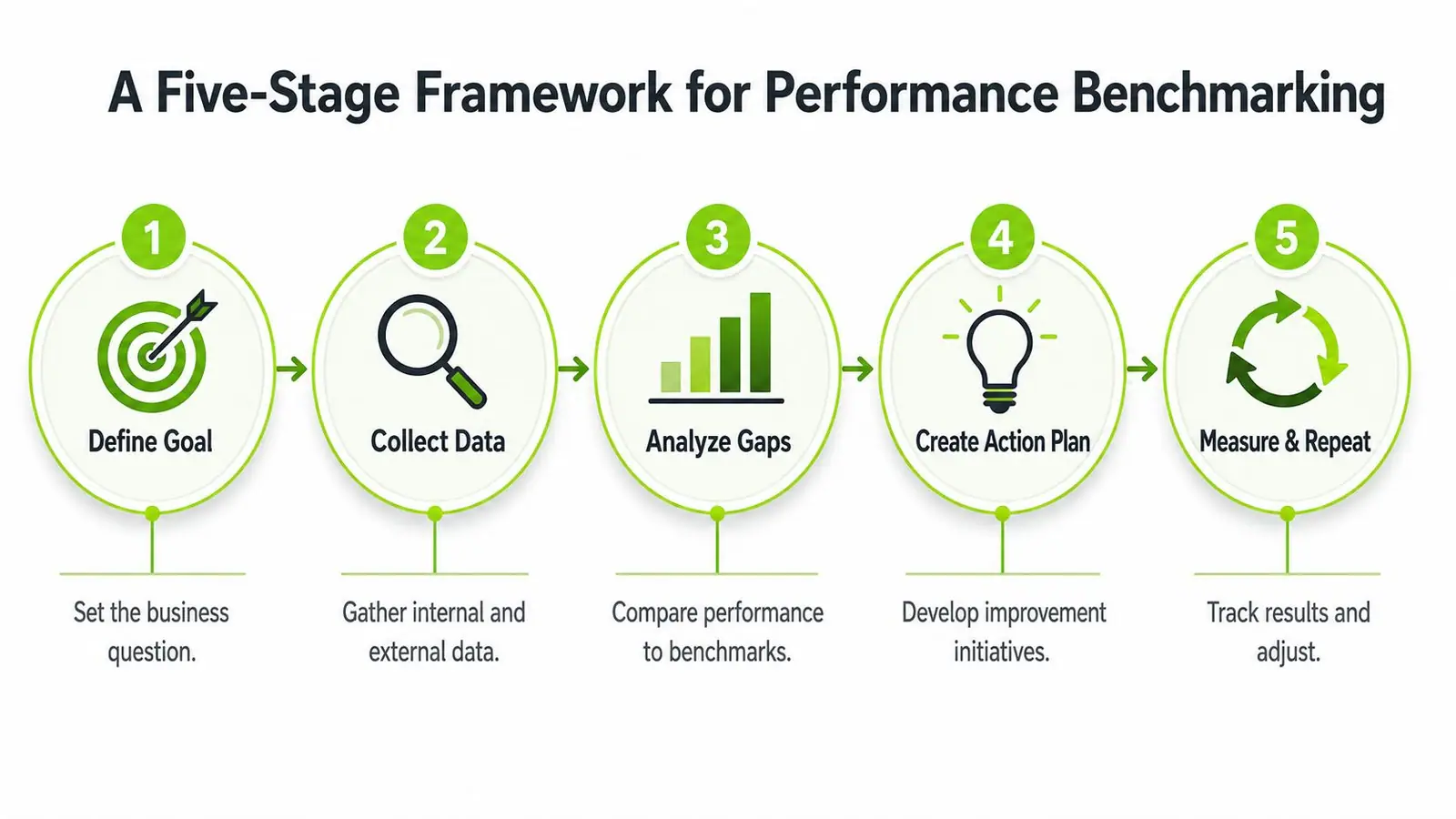
4. Analyze gaps
Separate signal from noise. A small movement in one query may not justify a project, while a repeated weakness across an entire template may deserve immediate attention. Rank opportunities by business relevance, size of the gap, confidence in the diagnosis, and effort required.
The SaaS team might find that comparison pages rank well but don't earn trials, while product-led pages convert when found but rarely appear in AI answers. Those are different problems and need different owners.
5. Act, assign, and repeat
Turn findings into named actions. A content lead might own missing comparison pages, an engineer might address a slow template, and a digital PR specialist might pursue relevant referring domains. Define the next measurement date before the work begins.
Use workflow optimization guidance to make ownership, handoffs, and recurring review part of the operating rhythm. The next cycle should feed new results into the same benchmark, so the team can see whether actions narrowed the gap rather than starting over with a new spreadsheet.
A benchmark compounds when definitions stay stable and decisions become more precise.
Tools and How Surnex Fits Into the Stack
A benchmarking stack needs more than one report. It needs reliable collection, comparable segments, historical storage, and a way to connect findings with action.
| Capability | Common Tool Examples | What to Capture |
|---|---|---|
| Rank tracking | Ahrefs, Semrush, Google Search Console | Position, impressions, clicks, query groups, and landing pages |
| Competitive visibility | Ahrefs, Semrush | Shared keywords, ranking gaps, share of voice, and referring domains |
| Technical experience | Google Search Console, Lighthouse-based tools | Core Web Vitals, mobile usability, and page delivery signals |
| Reporting | Looker Studio | Consistent dashboards, filters, annotations, and scheduled views |
| AI visibility | AI search and LLM monitoring platforms | AI Overview presence, answer mentions, citations, and citation changes |
| Automation | APIs, exports, scheduled workflows | Repeatable snapshots and cross-client or cross-site comparisons |
Google Search Console provides first-party search performance data for your property. Ahrefs and Semrush can support competitor and backlink analysis. Looker Studio can turn approved data sources into dashboards that stakeholders can review without opening several specialist tools.
The difficult part is not finding another metric. It's keeping the definitions aligned. A ranking export may use one keyword set, an AI review may use another prompt set, and a backlink report may cover a different market. If those datasets don't share clear scope, the final dashboard creates false precision.
Surnex fits as an AI search and SEO platform that brings traditional benchmarks and emerging AI visibility into one workflow. Its capabilities include ranking and backlink views, audits, content opportunities, Core Web Vitals review, Google AI Overview monitoring, ChatGPT-driven discovery tracking, and comparisons of answer framing, brand mentions, and citation patterns across major AI platforms.
That setup supports practical questions. Which competitor gets cited for a priority query while your page ranks nearby? Which content themes produce brand mentions but no source citation? Which technical templates need attention before a content team invests in more pages?
Scheduled benchmark snapshots also reduce manual spreadsheet work. Agencies can use a consistent view across accounts, while in-house teams can preserve the same query groups and comparison rules from one review cycle to the next.
Useful design principle: Choose tools that preserve the question, scope, and comparison set alongside the metric. A number without its measurement context is difficult to audit and easy to misread.
Common Pitfalls and Real-World Lessons
Benchmarking fails when teams measure what is easy instead of what helps someone decide. The most visible metric often wins the meeting, even when it has little connection to revenue, qualified demand, or durable visibility.
Vanity metrics replace outcomes
A SaaS team may celebrate raw traffic while trial sign-ups remain flat. The correction is to connect the benchmark to the funnel. Track impressions and clicks, but prioritize the page groups, query intents, and actions that bring qualified users.
The competitor set doesn't match the market
A startup may benchmark domain authority against a large enterprise rival and feel encouraged by a similar score. Later, the team discovers that the enterprise competitor ranks for transactional queries the startup hasn't targeted at all. Authority alone didn't answer the strategic question.
Choose competitors based on shared audiences, intent, geography, and product context. Compare the pages and queries that overlap, not just the brands that look familiar.
A short sample becomes a false trend
An ecommerce team can review rankings every week and still miss a content gap that becomes obvious only across a longer history. Short windows are useful for detecting abrupt events, but they can exaggerate normal volatility. Keep a stable trend view and annotate migrations, releases, promotions, and major algorithm or interface changes.
AI visibility stays outside the dashboard
A site may retain traditional rankings while competitors become the sources cited in generated answers. If the team tracks only blue-link positions, it won't know whether the brand is being included, described accurately, or omitted from conversational discovery.
Use a defined prompt set and record citations, mentions, sentiment, and answer coverage. Treat AI results as an additional visibility layer, not a replacement for search analytics.
Data produces no owner or action
A benchmark report can identify a gap and still change nothing. If nobody owns the response, the next review will show the same problem with a newer date.
Decision test: Every benchmark finding should end with a named owner, a proposed action, and a future check. If it has none of these, it's an observation, not an operating insight.
The final mistake is treating a benchmark as truth without context. A benchmark measures the workload and conditions you define. A classic benchmarking checklist asks whether a test resembles the user environment, what it measures, and whether it represents real workloads. The benchmarking checklist discusses those questions directly.
Use the benchmark to investigate, not to declare victory. Visit Surnex to see how its AI search and SEO platform can track rankings, backlinks, technical signals, AI Overview presence, LLM mentions, and citations in a shared benchmarking workflow. Start by defining your priority queries, establish the comparison set, and build the first recurring snapshot around the decisions your team needs to make.