Ranking first on Google is no longer a reliable definition of being visible. A brand can hold a strong organic position, publish technically sound pages, and still disappear when an AI system summarizes the category, compares vendors, or recommends a product.
Brand visibility in AI search now includes several outcomes: being named, being cited, being included in a comparison, and being recommended for a relevant task. Those outcomes don't always go together. AI Overviews may cite a third-party review instead of the brand's own page, while a chat-first assistant may recognize a company without providing a direct URL or placing it on a buyer's shortlist.
The popular advice, “just optimize for the top result,” is too narrow for this environment. Search-grounded systems and standalone assistants retrieve, interpret, and present information differently. Agencies that keep reporting only rankings will miss the shift until clients ask why their traffic, citations, and recommendations no longer line up.
Why Ranking First No Longer Means Being Seen
The old search model gave teams a relatively clear objective. Earn a high position for a query, win the click, and measure progress through rankings, impressions, and organic sessions. Those metrics still matter, but they describe only the link layer of search.
AI answer engines introduce another layer between the query and the website. Google AI Overviews, ChatGPT-style discovery, and Perplexity-style responses can combine information from multiple sources, summarize it, and decide which brands deserve attention inside the answer. A user may never scan a conventional results page, even when the underlying sources were discovered through search.
Google's AI Overviews moved from an experiment to a major search feature in less than two years. Independent measurement found AI Overviews on 18.76% of U.S. SERPs in November 2024, up from 12.47% in August 2024, while later tracking placed them at more than 11% of Google queries in May 2025. The same BrightEdge analysis of Google AI Overviews reported that longer, more complex queries had risen 49% in AI Overviews since May 2024.
That changes what “visibility” means. A brand can rank below a cited source and still appear prominently in the generated response. It can also rank well and receive no mention because the system selected other sources as more useful, clearer, or more authoritative for that particular answer.
The ranking illusion
Classic SEO asks, “Where does this page rank?” AI visibility asks a wider set of questions:
- Recognition: Does the system know the brand exists?
- Context: Does it understand what the brand offers and who it serves?
- Citation: Does it use the brand's content or cite a source about the brand?
- Recommendation: Does it include the brand when the user signals purchase intent?
- Competitive position: Does it mention the brand instead of, or alongside, competitors?
A practical resource such as Reviewbird's 2026 review tool tips illustrates why third-party context matters. Buyers often encounter software through review pages, comparison content, and editorial evaluations, not only through vendor pages. AI systems use that wider information environment too.
Practical rule: Treat rankings as one input to AI visibility, not as proof that the brand is present in the answer layer.
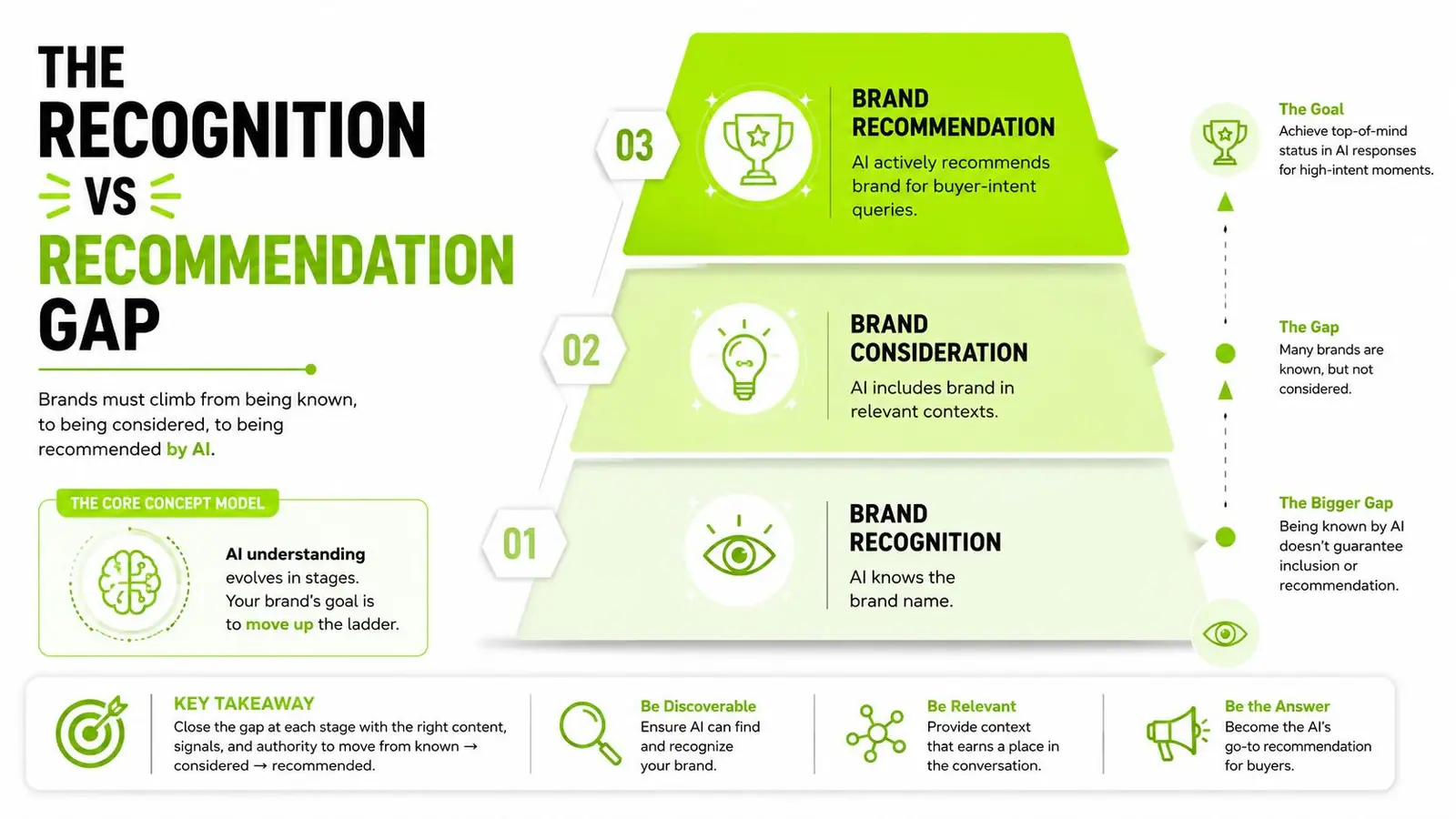
The central problem is a recognition-versus-recommendation gap. An assistant may correctly identify a brand when prompted directly, yet omit it when asked to recommend options for a specific use case. The rest of the program should measure and improve those two outcomes separately.
How AI Search Differs from Traditional SERPs
Traditional search generally matches a query against indexed documents, evaluates relevance and authority, and orders links on a results page. AI search adds interpretation and synthesis. The system may classify the user's intent, expand the question into related sub-queries, retrieve supporting material, generate a response, and attach citations only where its interface supports them.
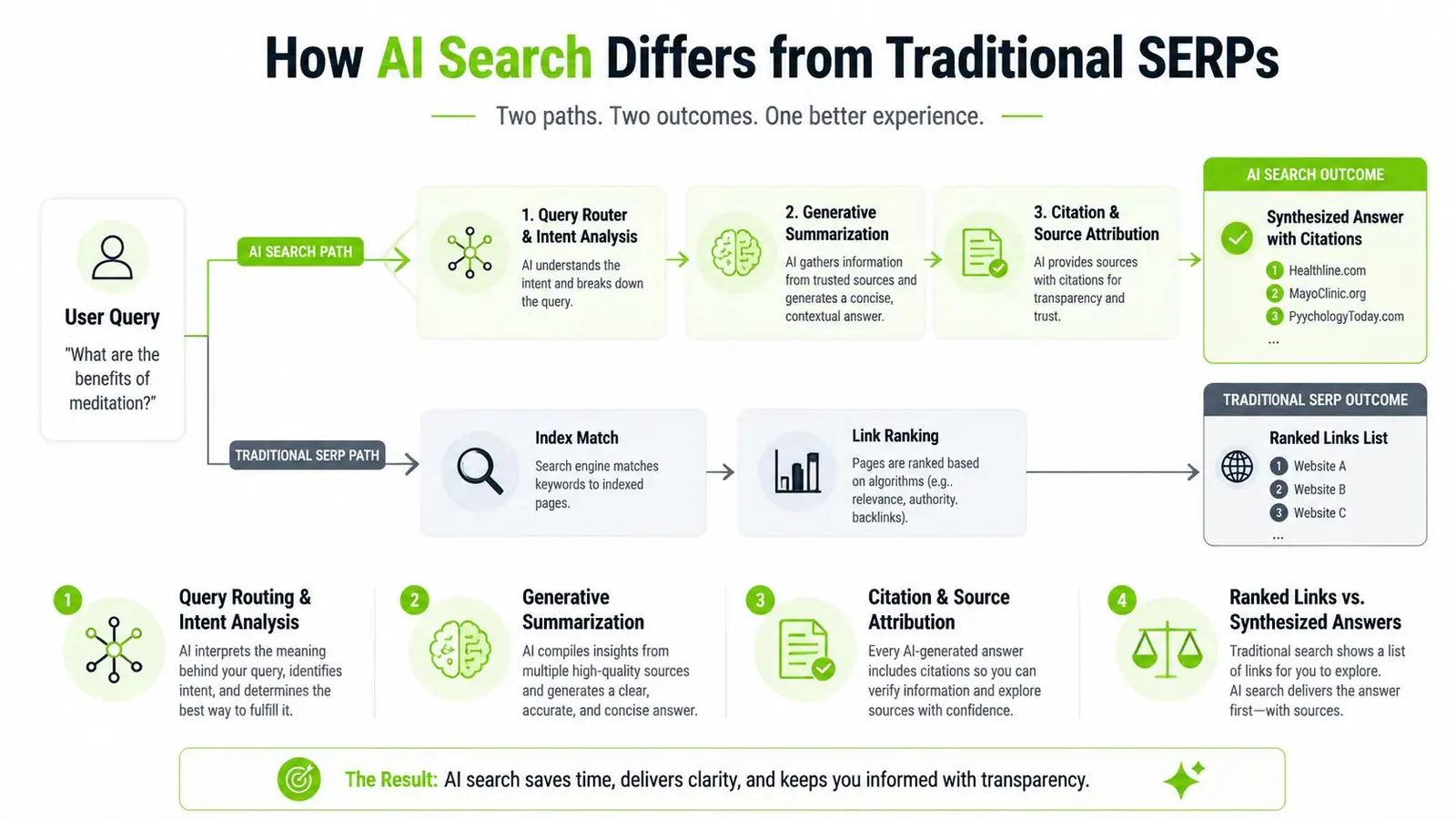
Four structural differences
Query routing and intent analysis come first. A conventional result can match the words on the page, while an answer engine may infer that “best review software for a distributed support team” requires evaluation criteria, product categories, and practical recommendations. The brand must be relevant to that interpreted need, not merely contain the keyword.
Generative summarization changes how content is consumed. Instead of presenting a list of pages for the user to inspect, the system extracts passages and combines them into a response. Clear definitions, direct answers, structured comparisons, and evidence-rich pages are easier for a model to use than vague positioning copy.
Citation behavior varies by surface. One analysis found that AI Overviews cited brand URLs in 28.7% of responses, while Claude and Gemini produced URL citations at 0.08% and 0.10%, respectively, and GPT-4.1 at 2.3%. The analysis of measurement across AI answer engines makes the operational implication clear: teams must track mentions and citations as separate events.
Ranked links and synthesized answers serve different user journeys. In a SERP, the user chooses which result to open. In an AI response, the system has already made an editorial selection about what deserves inclusion. Resources explaining search engines and AI for creators provide useful context for understanding that broader shift, but the measurement model still needs to distinguish the platforms.
Why a single-platform view misleads
Google's AI Overviews are search-grounded, so source-level citation capture matters. Chat-first models may mention a brand without exposing a clickable source, which makes direct citation counts look weak even when brand recognition is present. The opposite can also happen. A brand may collect citations in one search experience and receive little recommendation visibility in a conversational assistant.
This is why a search generative experience explanation should be treated as a starting point, not a complete reporting framework. Search teams need platform-specific observations, consistent prompts, and a record of the answer context. A single manual query tells you what happened once. It doesn't tell you whether the brand is consistently present, whether competitors are replacing it, or whether the platform is less citation-oriented.
The Recognition vs Recommendation Gap
AI systems don't treat brand knowledge as a purchase endorsement. A model might answer a direct question about a company accurately, describe its category, and still recommend another provider when the prompt adds constraints such as team size, budget, integrations, or implementation needs.
That distinction creates a useful three-stage model:
- Recognition: The system knows the brand name and can describe it.
- Consideration: The system includes the brand in relevant category or comparison answers.
- Recommendation: The system actively selects the brand for buyer-intent prompts.
Brand stature creates a starting advantage
A 2026 arXiv study found a three-tier ladder in first-run AI search visibility. Global household brands such as Stripe and Nike appeared in 73% of relevant AI answers, established mid-market and regional brands appeared in 44%, and niche or small brands appeared in 11%. The study on brand visibility in AI search describes the pattern as a structural advantage, not random variation.
Large brands benefit from repeated mentions, broad editorial coverage, recognizable entities, and established associations between their name and category. Smaller brands can't copy the publishing volume of a global company. They need to make their positioning consistent and make independent sources easier for AI systems to discover and interpret.
A July 2026 analysis reported that brands with fewer than 2,000 indexed pages mentioning them were named in AI answers only 3% of the time, and that 99.99% of citations behind AI answers pointed to third-party sites rather than the brand's own domain. Those figures come from coverage of the AI brand visibility gap, and they point to a counterintuitive conclusion: the brand's own site may explain the product, but independent sources often validate whether the product belongs in the answer.
Citation authority connects recognition to recommendation
Recognition comes from consistent entity signals. Recommendation requires stronger evidence:
- Category clarity: Multiple sources describe the brand using compatible language.
- Use-case relevance: Independent pages connect the brand to the problem buyers are trying to solve.
- Comparative evidence: Reviews and evaluations explain where the brand fits, and where it doesn't.
- Citation diversity: The model encounters the brand across editorial, review, community, and industry sources.
Teams often call this brand monitoring, but AI visibility requires a more specific lens. A practical brand monitoring framework can show where people discuss a company, while AI prompt testing shows whether those discussions influence generated answers. The two datasets should inform each other, but they shouldn't be merged into one vague “awareness” number.
KPIs That Actually Measure AI Visibility
A useful AI visibility report separates four outcomes that traditional SEO dashboards tend to collapse. Mention rate measures whether the brand appears at all. Citation rate measures whether the answer points to a source associated with the brand. Recommendation rate measures whether the system selects the brand for a high-intent prompt. Share of model compares the brand's presence with competitors across a defined prompt set.
The platform distinction matters. One 2026 industry source reported that 45% of marketing leaders can't accurately measure brand visibility in AI answers, while only 9% have tools that track all relevant metrics across platforms. The same source noted that citation rates can vary by as much as 615x between AI platforms, reinforcing why a single score is unreliable. See the industry coverage on AI brand visibility measurement for that context.
AI Visibility KPI Framework
| KPI | Where It Matters | How to Measure |
|---|---|---|
| Mention rate | ChatGPT, Claude, Gemini, Google AI Overviews | Run a fixed prompt set, record whether the brand appears, and classify the answer context |
| Citation rate | Google AI Overviews, Perplexity, other search-grounded systems | Record cited URLs, source type, page relevance, and whether the brand's own domain or a third party received credit |
| Recommendation rate | Buyer-intent prompts across all monitored engines | Ask category, comparison, and use-case questions, then count answers that recommend the brand |
| Share of model | Competitive prompts across multiple platforms | Compare brand presence with named competitors using identical prompt categories and time windows |
Build a repeatable benchmark
Start with a synthetic prompt set rather than random checks. Include informational questions, category definitions, comparison prompts, “best for” prompts, alternatives prompts, and problem-specific buyer questions. Store the exact wording, platform, date, answer, cited sources, brand position, competitor mentions, and sentiment.
Then split the prompts into intent groups. A brand can have strong recognition in informational questions and weak recommendation visibility in commercial questions. Combining those results produces a flattering average that hides the actual business problem.
A practical guide to tracking brand mentions in AI search can support the monitoring design, but the operating principle is simple: repeat the same tests over time, compare platforms separately, and preserve the answer evidence. Manual checks are useful for exploration. They aren't sufficient for agency reporting because models, citations, and answer wording change.
Tactics That Move AI Visibility Metrics
Improving AI visibility isn't about inserting a brand name into every paragraph. The work is closer to building a reliable evidence network. Owned content explains the offering, technical markup clarifies the entity, and independent sources establish why the brand deserves inclusion.
Make owned content easy to extract
Write pages that answer one decision at a time. A strong comparison page defines the category, states evaluation criteria, shows trade-offs, and identifies the right fit for each option. Tables help users scan, while concise explanatory paragraphs give answer engines self-contained material to summarize.
Use clear headings, answer-first openings, descriptive product language, and visible update dates where appropriate. Publish original findings only when the methodology is transparent and the claims can be checked. Unsupported superlatives may sound persuasive to a human reader, but they provide weak evidence for a system deciding which source to trust.
Build distributed brand references
The Ahrefs analysis of 75,000 brands found branded web mentions correlated with Google AI Overview visibility at Spearman 0.664, compared with 0.218 for referring domains. The comparison of brand mentions and backlinks indicates that broad discussion may be roughly 3x more strongly associated with visibility than link volume alone.
That doesn't make links irrelevant. It changes the priority. Digital PR, editorial reviews, expert commentary, product comparisons, community discussions, and partner pages can create the repeated context that a link-only campaign misses. Ask whether each placement explains the brand's category, audience, differentiator, or use case. A bare mention adds less meaning than a precise description on a credible page.
Clarify the entity and monitor the outcome
Use consistent organization, product, author, and review schema where it accurately reflects the page. Keep names, descriptions, category labels, and key product facts aligned across the site and external profiles. Structured data won't force a recommendation, but it reduces ambiguity about what the brand is and how its pages relate.
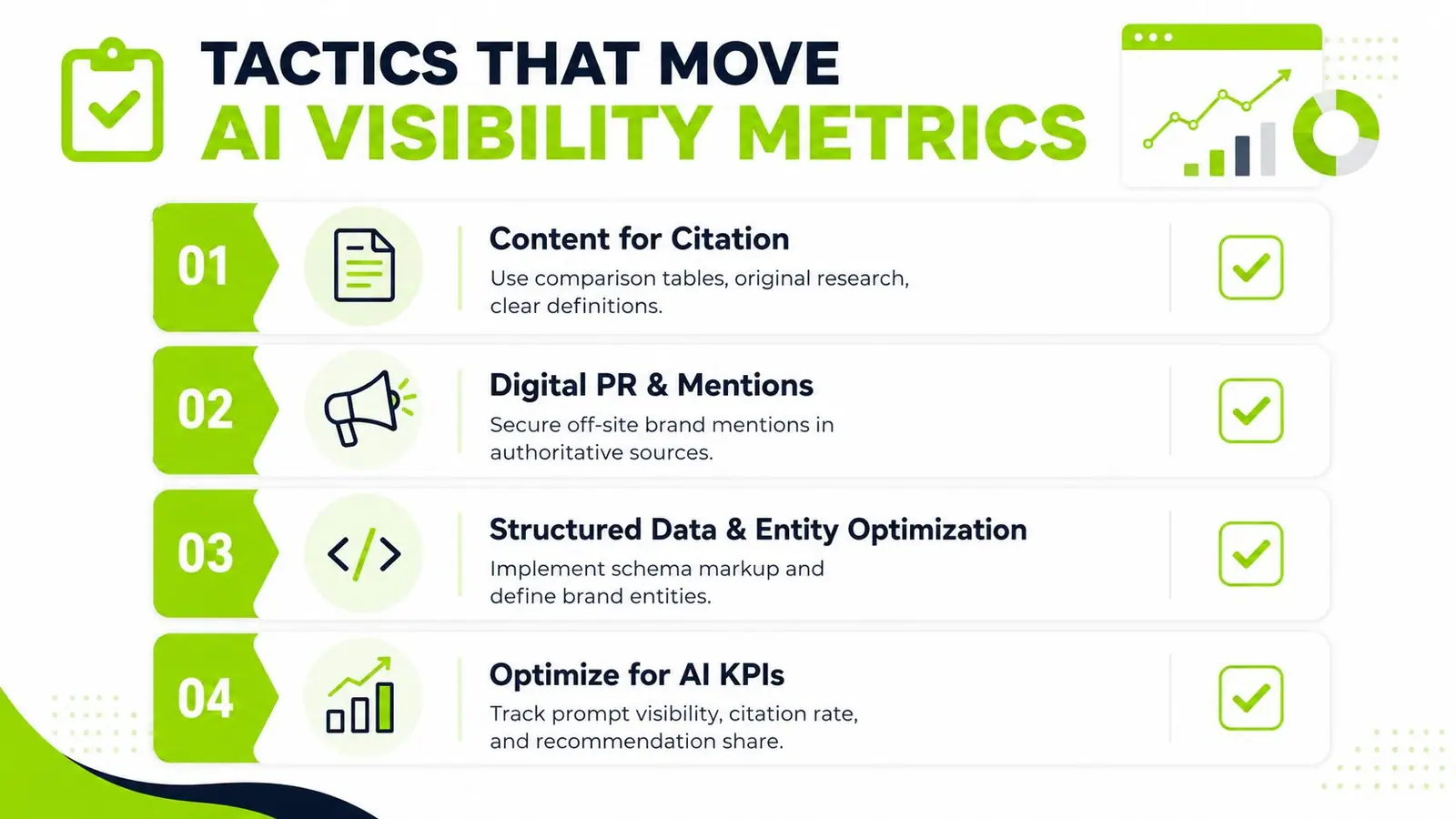
Finally, test the prompts that matter to buyers. Don't optimize for a generic brand question if revenue depends on comparison or implementation questions. Tools such as Surnex can monitor brand presence across AI search, compare competitors, inspect Google AI experiences, and connect those findings with traditional SEO metrics. The correct tactic is the one that moves a defined KPI, not the one that produces the most content.
A Weekly Workflow for Agencies and In-House Teams
A workable program doesn't require a separate research project every week. It needs a fixed cadence, shared ownership, and enough evidence to distinguish a real change from an answer that happened to vary.
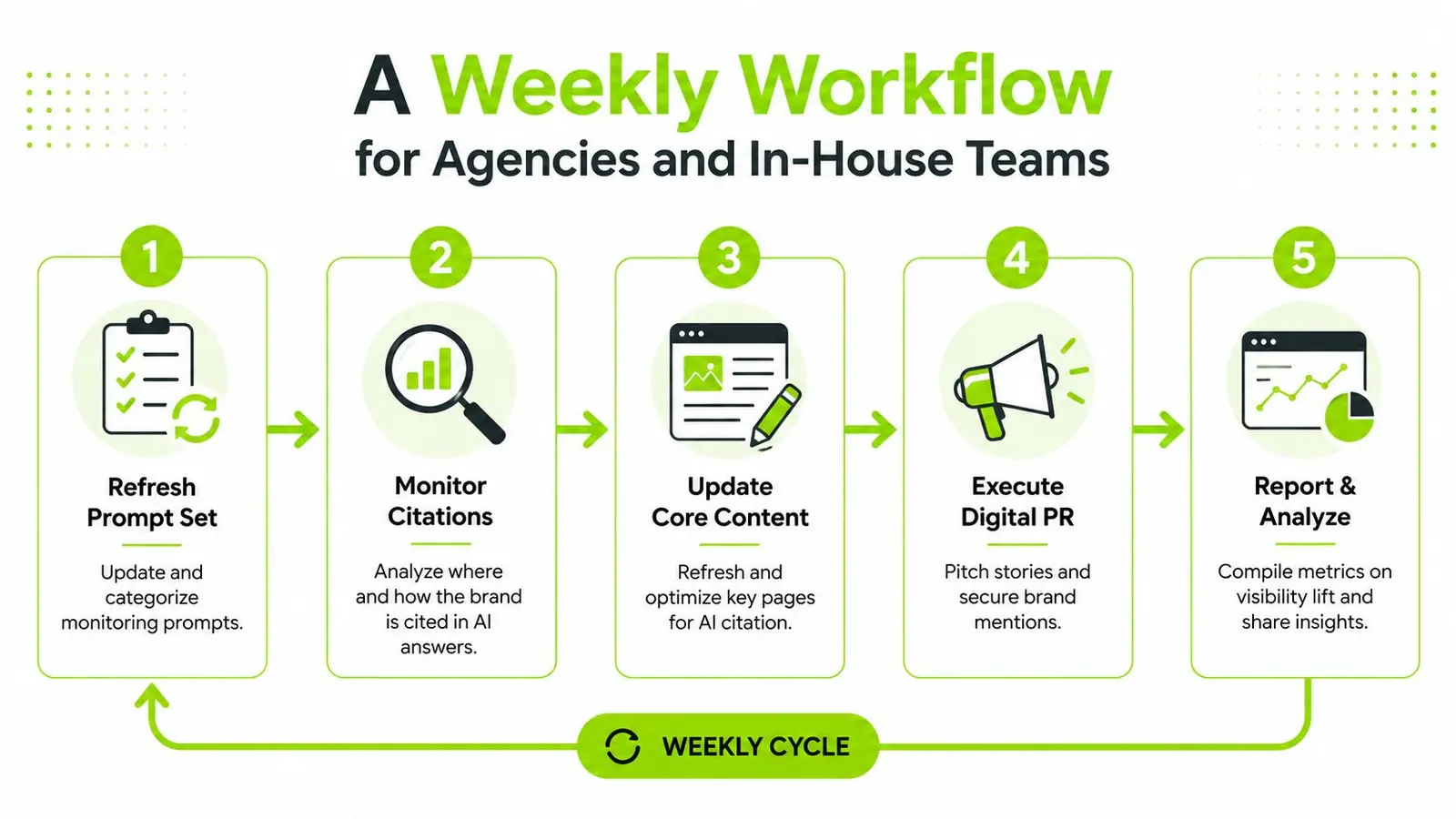
Monday, refresh the prompt set
Review new products, competitor claims, seasonal demand, support questions, and sales objections. Add prompts that reflect how buyers speak, then tag each prompt by intent, product line, audience, and platform. Keep a stable core set so week-to-week comparisons remain meaningful.
Tuesday, inspect mentions and citations
Run the monitored prompts across Google AI Overviews, ChatGPT, Perplexity, Gemini, and other priority surfaces. Save the full answer, cited URLs, competitors, recommendation language, and notable changes. Separate “brand mentioned” from “brand cited,” since those events describe different stages of visibility.
Wednesday, update the highest-value content
Choose pages connected to lost prompts or weak citations. Improve definitions, comparison evidence, source references, and content structure. Don't rewrite every page. Prioritize material that could answer a recurring question or clarify a positioning gap.
Thursday, activate digital PR
Give PR and partnerships a specific evidence brief. It might request an independent comparison, an expert quote, a benchmark contribution, or a review that accurately describes the product's use case. Track which external sources appear in AI answers, not just how many links the outreach team secured.
Friday, report the business meaning
Executives don't need a dump of model responses. They need a concise view of platform coverage, recommendation movement, citation quality, competitor changes, content actions, and next decisions. A unified dashboard that places AI visibility beside rankings, technical issues, backlinks, and content opportunities reduces tool sprawl and makes the shift easier to explain.
Reporting standard: Show the answer evidence behind the metric. A rising mention rate means little if the brand appears in a negative or irrelevant context.
Common Pitfalls and How to Avoid Them
A team that checks only Google AI Overviews may overinvest in citations and miss recognition gaps in chat-first assistants. A team that checks only ChatGPT may see brand mentions but fail to understand which third-party pages generate clickable visibility in search-grounded answers. The remedy is platform-specific benchmarking, not a universal visibility score.
Another common mistake is treating AI visibility as a one-time audit. Prompts change, competitors publish new material, and answer engines update their retrieval and generation behavior. Use a stable prompt set for trend reporting, then add a smaller discovery set when sales, product, or customer-support teams surface new questions.
On-site SEO alone creates another blind spot. Your pages can explain the product perfectly while independent reviews, comparison pages, and industry discussions determine whether the model recommends it. The evidence on third-party citation dominance and branded mentions makes off-site authority part of the core program, not an optional PR add-on.
| If your team does this | Replace it with this |
|---|---|
| Reports one AI platform | Benchmarks several engines separately |
| Counts every brand mention as success | Separates recognition, citation, and recommendation |
| Runs an annual AI audit | Maintains a recurring prompt and citation monitor |
| Focuses only on owned pages | Builds consistent third-party evidence |
| Reports a single visibility score | Shows platform, intent, competitor, and source context |
Key takeaway: Ranking still supports discovery, but AI visibility depends on whether systems recognize, contextualize, cite, and recommend the brand across the surfaces buyers use.
Surnex helps agencies and in-house teams monitor brand visibility across AI search, compare competitors, inspect citations, and connect AI findings with familiar SEO metrics. Visit Surnex to build a repeatable multi-engine workflow instead of relying on one-off AI checks.