ChatGPT handles about 2.5 billion prompts each day, according to independent 2025 industry estimates, or roughly 18% of Google's daily search volume (Semrush's ChatGPT search analysis). A 2025 U.S. survey found that 77% of ChatGPT users use it as a search engine, while 36% discovered a new product or brand through ChatGPT (ChatGPT usage statistics).
That changes the question. You're not only trying to rank a page. You're trying to make your brand understandable, retrievable, and worth mentioning when ChatGPT answers a conversational prompt. The practical playbook combines classic SEO authority, entity consistency, extractable writing, and measurement that tracks appearances rather than pretending an AI answer has a conventional position.
Why ChatGPT Optimization Is a Different Game
Traditional SEO gives you a ranked list. ChatGPT often returns a synthesized answer, with or without citations. The practical objective is therefore broader than securing a fixed position. Your brand must be easy for the system to retrieve, understand, describe, and mention.
The commercial case is already clear. 2025 estimates put ChatGPT at about 1.625 billion search-equivalent queries per day when prompts are filtered for search-like intent (Semrush). A U.S. survey found that 24% of respondents go to ChatGPT first when looking for information online, while 30% trust it more than other search engines (Resolve AI's survey summary). These users compare vendors, learn unfamiliar categories, and discover brands. Visibility depends on entity presence across those tasks, not on citation formatting alone.
Three retrieval paths create three optimization problems
ChatGPT can draw on several information paths:
- Live web retrieval brings in current pages and citations. Crawlability, relevance, technical access, and source quality affect inclusion.
- Connected tools or integrations expose product data, documents, and services through structured interfaces. Clear schemas, stable naming, and usable documentation matter here.
- Model knowledge reflects information absorbed during training. Consistent brand mentions, third-party coverage, reviews, and durable entity associations can matter more than a page published yesterday.
The paths behave differently. A 2026 analysis found that web search was enabled on 34.5% of queries, down from 46% in late 2024, so a strategy built only around live citations misses part of the discovery process. As noted in the earlier Semrush analysis, citation coverage is only one part of the visibility problem.
Practical rule: Make the page easy to extract, then make the wider brand easy to recognize.
Replace rank tracking with presence tracking
A prompt does not produce a stable blue-link position. Responses vary with wording, account, geography, model, browsing state, and time. “Rank number” is therefore a weak primary KPI for ChatGPT work.
Track whether ChatGPT:
- Mentions the brand for relevant prompts.
- Describes the brand accurately.
- Connects it with the correct category, audience, and use case.
- Cites the brand's page, or relies only on competitors and third-party sources.
- Includes the brand across branded, category, and comparison prompts.
Test model differences with a practical guide to top ChatGPT versions for founders, then document which environments belong in your testing set. The broader discipline is often called generative engine optimization. The label matters less than the workflow: strengthen authority, clarify the entity, write extractable answers, test recurring prompts, and connect visibility changes to qualified traffic or conversions.
Building an Extractable Content Foundation
A page can be factually strong and still be difficult for an AI system to interpret. The fix usually isn't more prose. It's clearer relationships between the page, the organization behind it, the author, the product, and the question being answered.
Start with the technical layer.
Give machines a clear entity map
Use structured data that reflects the page and the entities it discusses:
- Article identifies the content type, author, headline, and dates.
- FAQPage defines genuine visible questions and answers.
- Organization connects the company name, logo, website, and authoritative profiles.
- Person clarifies the author's identity and professional context.
- Product identifies the product, brand, features, and relevant properties.
Schema doesn't guarantee a ChatGPT mention. It reduces ambiguity. If your company has a common name, your founder shares a name with another professional, or your product name overlaps with a generic term, consistent entity markup gives retrieval systems more usable context.
Keep the page's canonical URL correct, especially when content appears in campaign paths, syndicated versions, or parameterized URLs. Treat llms.txt as a consideration rather than a magic switch. If you publish one, use it to provide clear guidance about important resources, but don't assume its presence replaces crawl access, quality content, or external authority.
Write headings like prompts
A keyword heading names a topic. A conversational heading defines a task.
Before: Best CRM Software
After: Which CRM software works best for a 10-person sales team in 2026?
The second heading gives the page a tighter retrieval target. It also forces the writer to define the audience and decision criteria instead of producing a generic list.
Place a self-contained answer directly below the heading:
For a small sales team, the right CRM should combine contact management, pipeline visibility, simple reporting, and a workflow the team will actually maintain. Compare products by sales process fit, integration needs, administration effort, and total cost rather than feature count alone.
The answer should stand on its own if extracted without the next paragraph. Keep supporting detail nearby, then add evidence, limitations, and alternatives. For a deeper technical model, use this guide to web page architecture to audit hierarchy, internal relationships, and page clarity.
Remove accidental extraction barriers
Check the basics before rewriting everything:
- Robots directives: Confirm that your directives don't block the crawlers or user agents needed for discovery.
- Rendered content: Make key answers available in accessible HTML rather than hiding them entirely behind client-side interactions.
- Canonical consistency: Ensure the preferred page contains the current version of the facts.
- Navigation: Link related pages with descriptive anchors so the topic cluster is easy to interpret.
- Visible schema alignment: Don't mark up questions, products, or claims that users can't find on the page.
The foundation is simple. Make the page's subject, author, organization, answer, and supporting evidence unambiguous.
Why Brand Mentions Often Beat Citations
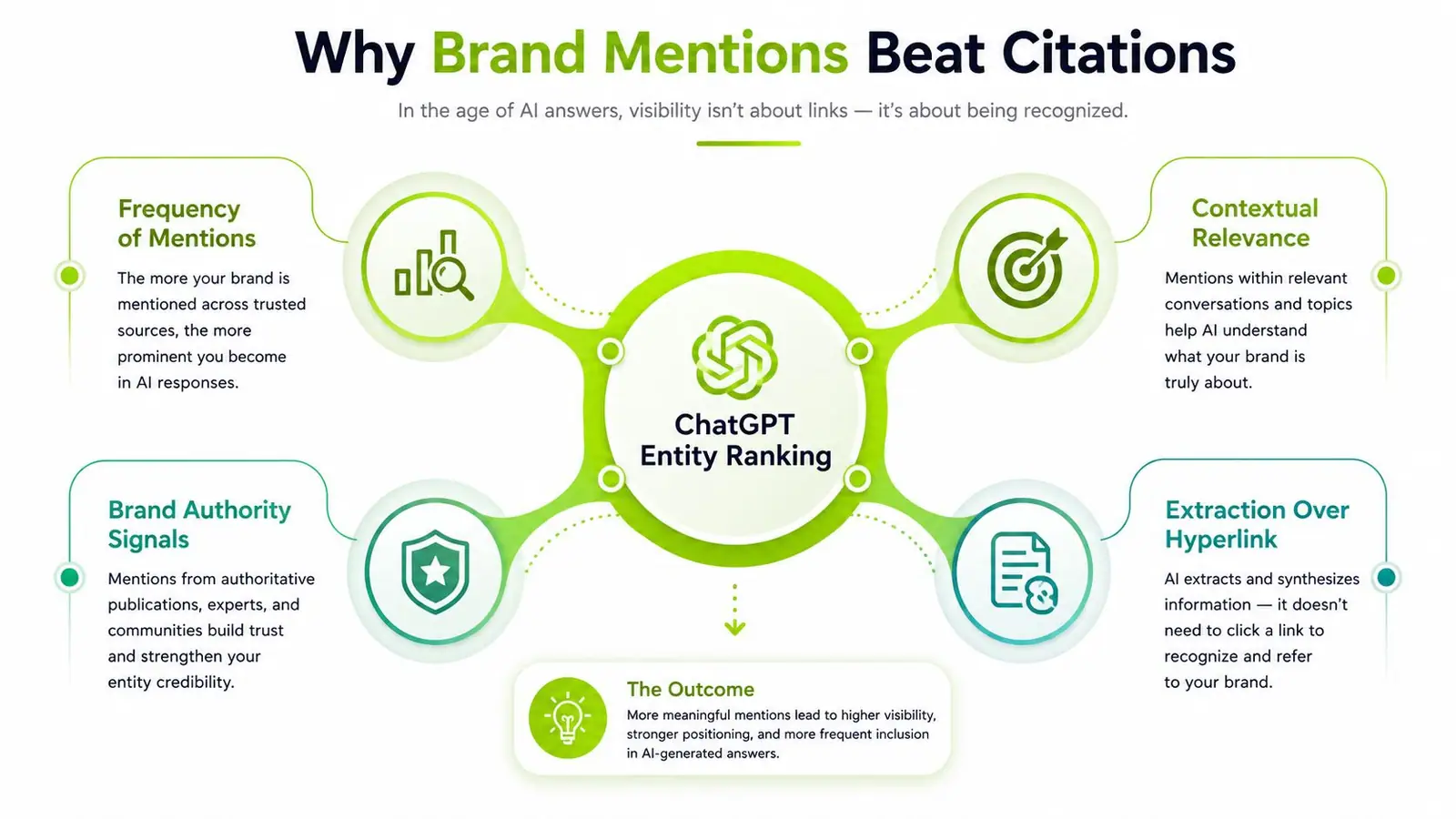
“Add FAQ schema” is useful advice, but it's incomplete. A perfectly formatted FAQ page won't create strong brand visibility if almost nobody associates your brand with the category, problem, or use case outside your own website.
One independent analysis of ChatGPT Search reported 4.01 brand mentions per prompt compared with 1.72 link citations (Otterly's AI search study). That doesn't mean links are irrelevant. It means teams should stop treating citation formatting as the whole optimization strategy.
ChatGPT needs to identify an entity before it can recommend or describe it. Repeated, contextually accurate mentions across different sources help establish that identity. A product mentioned by an industry publication, a review site, a podcast transcript, a community discussion, and a partner page has a broader evidence footprint than a product mentioned only on its own FAQ page.
Build contextual presence, not empty repetition
The useful signal isn't raw name repetition. It's the combination of brand, category, audience, problem, and proof.
A mention such as “Acme is a software company” is weak. A mention such as “Acme helps distributed revenue teams manage approval workflows” gives the model a more useful relationship to preserve.
Prioritize sources that add independent context:
- Industry PR: Pitch a specific insight, launch, or original finding rather than a company announcement with no news value.
- Podcasts and webinars: Provide transcripts so the brand is connected to the spoken topics in searchable text.
- Reddit and community threads: Participate transparently in discussions where the product solves the stated problem.
- Wikipedia: Pursue inclusion only when the company meets editorial notability requirements. Promotional editing can damage trust.
- Review platforms: Keep descriptions, product categories, and feature terminology consistent across profiles.
- Partner ecosystems: Publish integration pages and co-marketing content that describe the relationship precisely.
Teams working on off-site authority can evaluate services such as backlinks for AI startups, but a directory listing won't substitute for credible editorial coverage. The strategic principle is broader entity presence, as discussed in this guide to brand visibility in AI search.
Writing for Retrieval, Summarization, and Quotation
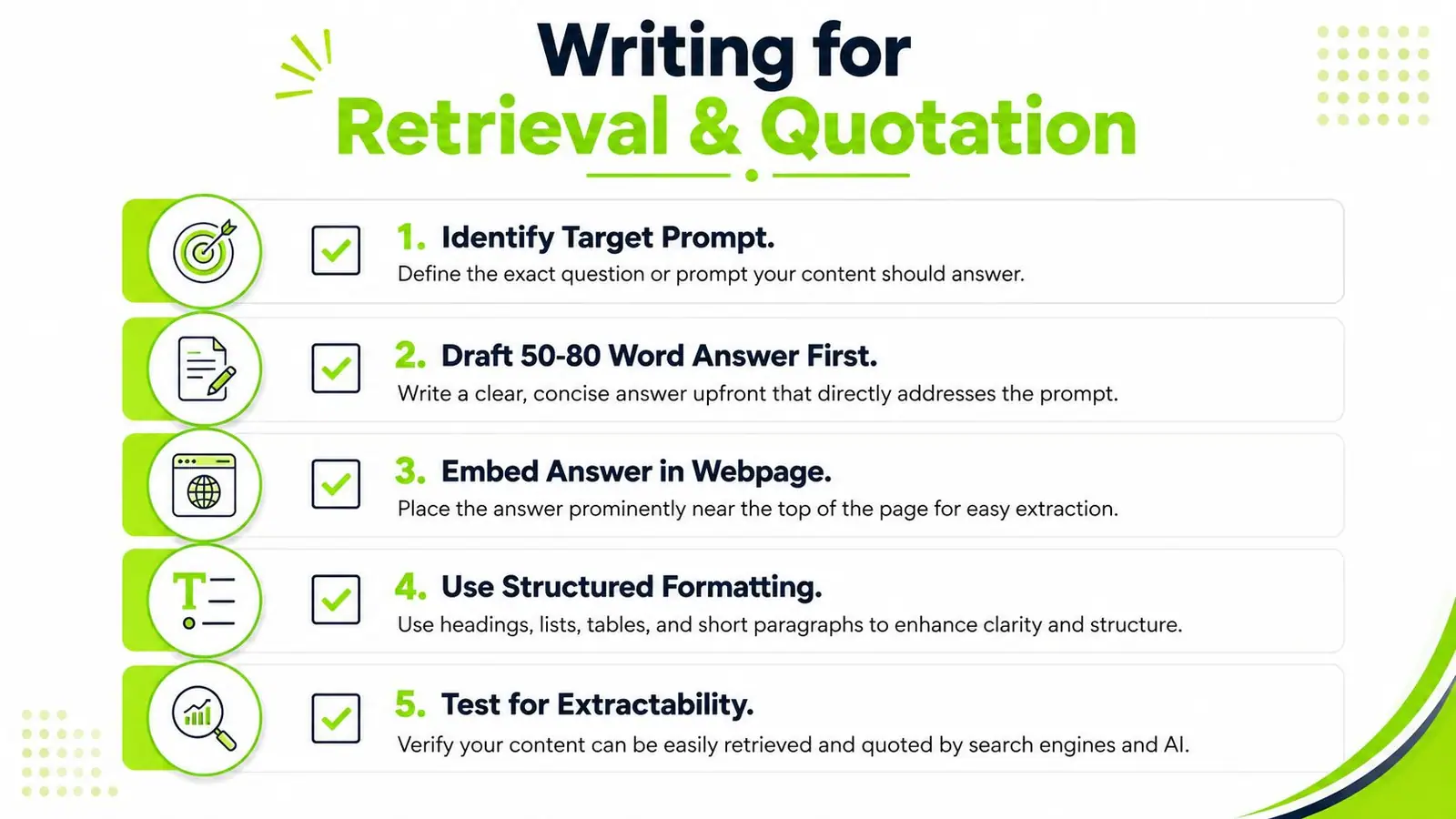
The most reliable writing workflow starts with the answer an AI system should quote, then builds the page around it.
Choose one target prompt. Draft a concise answer that resolves the prompt without relying on surrounding context. Then add the reasoning, evidence, qualifications, examples, and links that support the answer.
Use constrained prompts during content production
AI can help draft extractable content, but only when the brief controls its behavior. These templates are useful starting points:
Definition prompt
Act as a subject-matter editor. Define [term] for [audience] in a self-contained answer of 50 to 80 words. Use plain language. Separate established facts from interpretation. Don't invent examples, statistics, quotes, or sources. If a claim needs verification, mark it for review.
Comparison prompt
Compare [option A] and [option B] for [audience and use case]. Start with a direct recommendation condition, not a generic introduction. Cover strengths, limitations, implementation considerations, and who should avoid each option. Use only the supplied evidence and identify every unsupported claim.
How-to prompt
Explain how to [task] in a sequence suitable for a practitioner. Give each step a descriptive heading, state the action first, include dependencies and failure conditions, and distinguish required work from optional improvements. Don't invent outcomes or performance data.
The prompts protect against a common failure. A fluent paragraph can sound authoritative while making claims the source material doesn't support.
Make the quotable sentence self-sufficient
Weak copy depends on context:
We've seen this work well for many clients, and it can be a great option for growing teams.
The subject is vague, the claim is personal, and there's no verifiable support.
A stronger version states the proposition directly:
Conversational headings help content match user prompts more precisely because they identify the question, audience, and task in one line. Use them to narrow the page's topical focus, then answer the question immediately below the heading.
That sentence contains no first-person claim and can survive summarization without losing its meaning. If it includes a factual claim, place the source link in the same passage. Name the organization, product, date, and qualification instead of hiding them in a distant references section.
Run a quotability edit
Before publishing, check each priority block:
- Can the answer be understood without the paragraph before it?
- Does the first sentence address the prompt directly?
- Are pronouns such as “it,” “they,” and “this” clear?
- Does the block distinguish fact, recommendation, and opinion?
- Are dates and changing product details visible?
- Is the source attached to the claim it supports?
- Does the surrounding page explain limitations rather than oversell the answer?
For a visual walkthrough of this workflow, watch the embedded video below.
What the Citation Data Actually Rewards
Citation data gives a more nuanced answer than “write longer content.” A large analysis of 16,851 ChatGPT queries found that the top retrieval result was cited 58% of the time. It also found that pages tightly matching the query in headings and topical focus outperformed broader guides, while pages between 500 and 2,000 words performed best in that analysis (Search Engine Land's citation study).
A separate study covering 129,000 domains linked stronger citation performance with classic authority signals, including large referring-domain profiles and high Domain Trust scores. That study also associated recently updated pages with stronger results when those pages combined substantial depth and factual detail (Etavrian's citation ranking study).
The studies point in different directions only if you reduce them to word count. The operational lesson is to match scope to intent, maintain authority, and make the answer easy to locate.
Translate the findings into page decisions
| Ranking Factor | What Google Rewards | What LLMs Reward |
|---|---|---|
| Topical relevance | A page that satisfies the query and fits the site's topic | A passage that answers the exact prompt with little interpretation required |
| Authority | Links, reputation, and site-level trust | Authority plus a source that clearly supports the extracted claim |
| Content depth | Coverage that addresses related subtopics | Enough context to validate the answer, without burying the answer |
| Freshness | Current information and maintained pages | Visible update signals and facts that remain accurate |
| Headings | Semantic organization and keyword relevance | Questions and labels that mirror conversational tasks |
| Citations | References can support expertise and trust | Named, nearby sources that can be preserved in a response |
Long-form pillar pages aren't automatically strong AI sources. A high-authority domain in isolation doesn't guarantee that a specific page will be cited. Keyword-stuffed headings can make a page less natural without improving the model's understanding.
Apply the minimum viable update
For a page that performs in classic search but rarely appears in AI answers, make targeted changes first:
- Rewrite the main heading around the actual user task.
- Add a direct answer near the top.
- Narrow the page if it tries to answer unrelated questions.
- Add named sources beside important factual claims.
- Clarify the author, organization, product, and publication dates.
- Refresh outdated sections and remove unsupported assertions.
- Strengthen internal links to closely related pages.
Don't expand a page merely to hit a word target. The citation evidence supports precision and useful context, not padding.
Measuring AI Visibility Without Flying Blind
Manual prompt testing is a valid starting point, but it becomes unreliable when every analyst uses different wording, models, settings, and recording habits. A useful measurement system treats prompts as a panel and responses as observations.
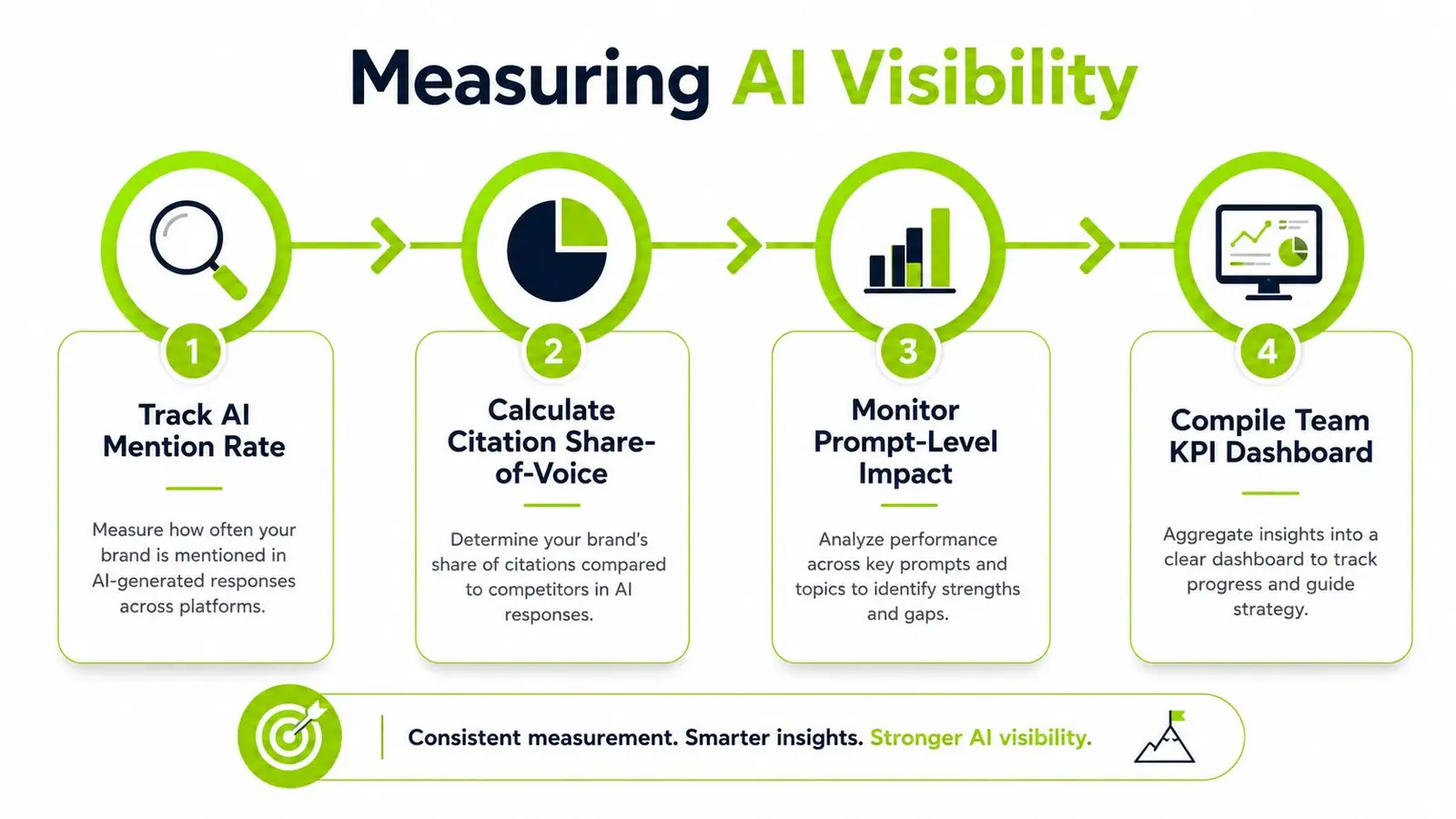
Track four practical indicators:
- AI mention rate: The share of tested responses that name your brand.
- Citation share of voice: The share of visible source citations attributed to your domain within a prompt category.
- Prompt-level visibility index: A consistent score that combines presence, position in the answer, and relevance to the prompt.
- Citation gap: The difference between your source presence and the presence of named competitors for the same question set.
Don't treat these as universal industry benchmarks. They're internal operating measures, so consistency matters more than a complicated formula.
Build a prompt bank that reflects buying behavior
Organize prompts into branded, category, comparison, problem, and use-case groups. Include questions such as:
- “What tools help a small agency monitor AI search visibility?”
- “Which platforms track brand mentions in ChatGPT?”
- “What should an in-house SEO team measure beyond Google rankings?”
- “Compare [brand] with [competitor] for a multi-client agency.”
- “What are the limitations of AI visibility tracking?”
A weekly sweep catches meaningful changes. Refresh the prompt bank quarterly because user language, products, competitors, and model behavior change. Avoid testing only prompts that contain your brand. Unbranded category prompts reveal whether your entity has earned broader recognition.
Choose the right level of automation
Manual spreadsheets work for an early audit. They become fragile when the team tracks multiple prompt categories, competitors, markets, and response versions. At that point, a platform such as Surnex can automate multi-prompt tracking, competitor comparisons, historical storage, and citation-gap review. Its AI Overview tracker is one example of connecting AI visibility signals with broader search reporting.
Use a maturity model:
- Manual: Analysts run prompts, save responses, tag mentions, and record citations.
- Semi-automated: A shared prompt library and scheduled collection reduce repetitive work, while people still classify responses.
- Fully automated: A platform stores historical results, groups response themes, benchmarks competitors, and feeds dashboards or APIs.
Turn observations into business reporting
Start with a baseline. Record the prompt, date, model or search mode, brand mention, competitor mentions, citations, factual errors, and resulting action. Then group prompts into response clusters such as category education, vendor comparison, implementation, pricing, and alternatives.
Board-ready reporting should connect visibility to business evidence without claiming causation that the data can't prove. Compare AI-referred sessions, assisted conversions, branded search behavior, demo requests, and pipeline notes against the prompt trends. If mention share rises but qualified visits don't, investigate the answer's audience and message. If citations improve while the brand disappears from recommendations, your source footprint may be growing without entity salience.
Your 90-Day ChatGPT Optimization Roadmap
A useful rollout starts small and produces a client-ready deliverable at every stage. It shouldn't begin with a wholesale rewrite of the entire site.
Weeks 1 to 2 build the audit
Inventory priority pages, existing schema, canonical signals, author information, brand descriptions, third-party profiles, and crawl directives. Test a representative prompt set across branded, category, comparison, and problem queries.
Deliver an AI visibility baseline containing current mentions, citations, competitor presence, factual inaccuracies, and the pages most likely to improve quickly.
Weeks 3 to 6 rewrite priority content
Select pages that already have authority or address commercially important questions. Rewrite headings to reflect conversational intent, put direct answers near the top, attach sources to claims, clarify entities, and remove unsupported language.
Deliver a citation-ready content plan with revised outlines, answer blocks, schema requirements, source gaps, and an off-site mention plan. Don't confuse depth with expansion. A focused page can be more useful than a large guide that covers every adjacent topic.
Weeks 7 to 10 launch measurement
Run the prompt bank consistently and record both mention and citation outcomes. Add competitor comparisons, classify answer themes, and flag descriptions of your brand that are incomplete, outdated, or incorrect.
Deliver a prompt monitoring report that shows where the brand appears, where competitors appear instead, which sources ChatGPT uses, and which content or authority action addresses each gap.
Weeks 11 to 13 iterate and extend
Review prompt-level changes, test new wording, update pages where facts have changed, and expand into secondary topics only after the core entity associations are clear.
Use this cadence:
- Weekly: Run prompt sweeps and inspect material answer changes.
- Monthly: Audit mentions, citations, source diversity, and brand accuracy.
- Quarterly: Review the prompt taxonomy, competitors, content priorities, and measurement model.
Watch for warning signs. A falling mention rate despite stronger citations suggests an entity problem. Repeated hallucinated facts about the company point to inconsistent or weakly sourced information. Competitors overtaking core prompts signals a need to improve relevance, third-party presence, or both.
Automation should remove collection and reporting labor, not replace editorial judgment. Analysts still need to decide whether a mention is accurate, whether a source deserves pursuit, and whether a new page will change the answer users receive.
Surnex brings AI visibility tracking and traditional SEO metrics into one workspace, including brand presence in ChatGPT-driven discovery, competitor benchmarking, citations, rankings, backlinks, audits, and content opportunities. Visit Surnex to build a repeatable prompt-monitoring workflow and connect AI search visibility with the performance data your team already reports.