Your Monday SEO meeting starts with a familiar question: why did rankings fall, which technical issues matter, and are customers finding the brand in AI-generated answers? The answers sit across rank trackers, crawl reports, backlink tools, content platforms, analytics dashboards, and a new layer of AI visibility reports. By the time someone assembles the data, the opportunity may already have changed.
An automated SEO platform should solve more than repetitive work. It should give agencies and in-house teams a shared operating layer for traditional search and AI-driven discovery, with clear ownership of data, alerts, prioritization, and reporting. That shift matters because the global SEO automation tools market was valued at $803 million in 2024 and is projected to reach $1.5 billion by 2028, according to SEO automation market statistics. SEO automation has become infrastructure, not merely a convenience.
Why Teams Are Rethinking Their SEO Tool Stack
An agency lead can lose the first half of a client day reconciling dashboards. One tool tracks keyword positions, another monitors backlinks, a crawler reports canonical and indexation problems, a content platform finds topic gaps, and a separate product checks whether an AI answer mentions the client. Each system may produce useful data, yet the team still lacks one reliable queue of priorities.
In-house teams encounter the same fragmentation across departments. Marketing needs traffic and leads, content needs briefs, engineering needs reproducible technical tickets, product needs search insights for feature decisions, and executives need a concise account of business impact. Disconnected tools turn routine questions into manual data-joining work.
The buying question has therefore changed from “Which SEO tool should we add?” to “Which workflows should one platform own?” Broader adoption supports that shift. 47% of marketers reported using automation to make processes more efficient in 2026, as documented in the SEO automation statistics report.
Search visibility now has more than one surface
Traditional rankings still matter, but they describe only one route by which buyers discover a brand. In January 2025, AI Overviews appeared in 30% of Google search results. Independent reporting found that users clicked a traditional result on 8% of visits with an AI summary, compared with 15% without one, according to Link Assistant's SEO statistics roundup.
The operational impact is clear. A page can keep its ranking while the surrounding search experience changes, reducing the need for a click or directing attention toward cited sources. Teams must track where they rank and whether their brand is mentioned, recommended, cited, or absent in AI-generated answers.
Practical rule: If rankings, technical health, content opportunities, and AI mentions run through separate reporting cycles, your team is measuring search in fragments.
An automated SEO platform should connect these workflows rather than bolt AI visibility onto a traditional dashboard. The practical value is a shared chain from observed change to likely cause, assigned response, measured result, and client-ready explanation. That reduces repeated analysis and gives teams a consistent operating model for both search results and AI-generated discovery. For context on the wider field, review this guide to digital marketing technologies.
Core Features of a Modern Automated SEO Platform
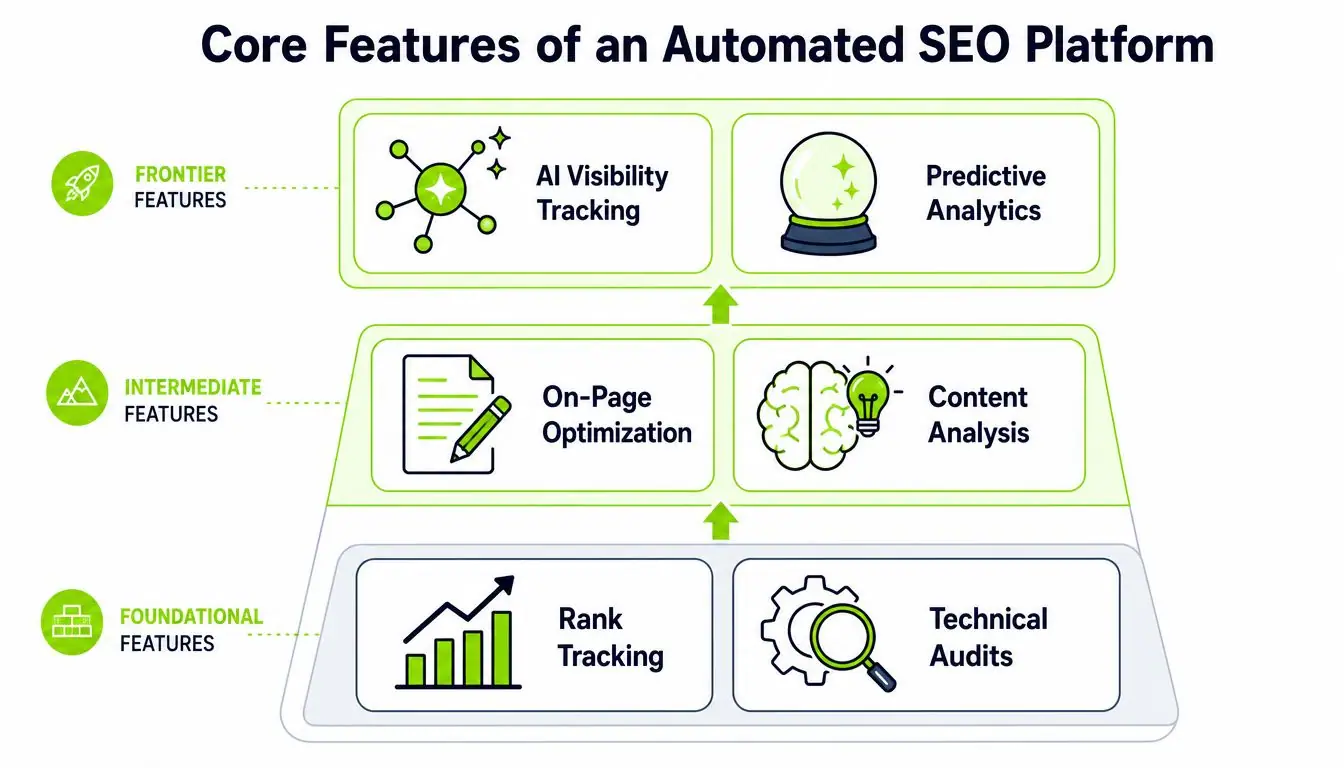
A complete platform should move from dependable data collection to decision support. Rank tracking and technical auditing establish the foundation. Content intelligence and AI visibility tracking extend that system into newer search environments, where rankings, citations, and brand mentions influence discovery together.
Start with the foundations
Rank tracking should monitor target queries across relevant locations, devices, search features, and competitors. Automation replaces periodic manual checks with a history of meaningful movement. The useful output includes the pages that gained or lost visibility, query groups that shifted together, and the effect on commercial priorities.
Technical audits should crawl defined site areas on a schedule, detect changes, and group issues by severity, template, and URL pattern. Hundreds of isolated warnings create extra work when the platform cannot show shared causes. Strong automation identifies whether one template is producing duplicate URLs, broken internal links, missing canonicals, or indexation barriers across many pages.
Backlink monitoring adds the off-page layer. The platform should track new and lost links, referring-domain changes, competitor link activity, and the context around important mentions. Discovery and alerting can be automated. Outreach quality and link relevance still require human judgment.
Turn data into content decisions
Content opportunity identification should combine keyword themes, existing performance, competitor coverage, search intent, and business value. The system should help the team choose among improving an existing page, creating a new one, consolidating overlapping content, or leaving an opportunity alone. Mechanical keyword repetition is a poor substitute for that decision.
For drafting support and editorial planning, teams can use RewriteBar SEO copywriting prompts as structured starting points. Human review remains responsible for accuracy, positioning, originality, and brand voice.
Automated reporting connects these inputs to different audiences. An SEO specialist may need query groups and issue details. A client or executive usually needs a concise view of visibility, priority changes, and decisions awaiting action. Configurable reporting keeps each audience focused on the information it can act on.
Treat AI visibility as a core workflow
AI visibility tracking sits alongside rank tracking as a core workflow. The system should test relevant prompts and monitor whether the brand appears in responses from Google AI Overviews, ChatGPT, Gemini, Perplexity, and other important discovery surfaces. It should record mentions, citations, competitors appearing in the same answers, and gaps where authoritative brand content receives no reference.
This layer needs history and comparison. A single prompt result is an observation, not a strategy. Teams need patterns across prompt groups, markets, products, and competitors, then a way to connect citation gaps with content, entity, technical, or reputation work. The operating model should support automated SEO monitoring, so traditional SEO signals and AI-search visibility can be reviewed through the same workflow.
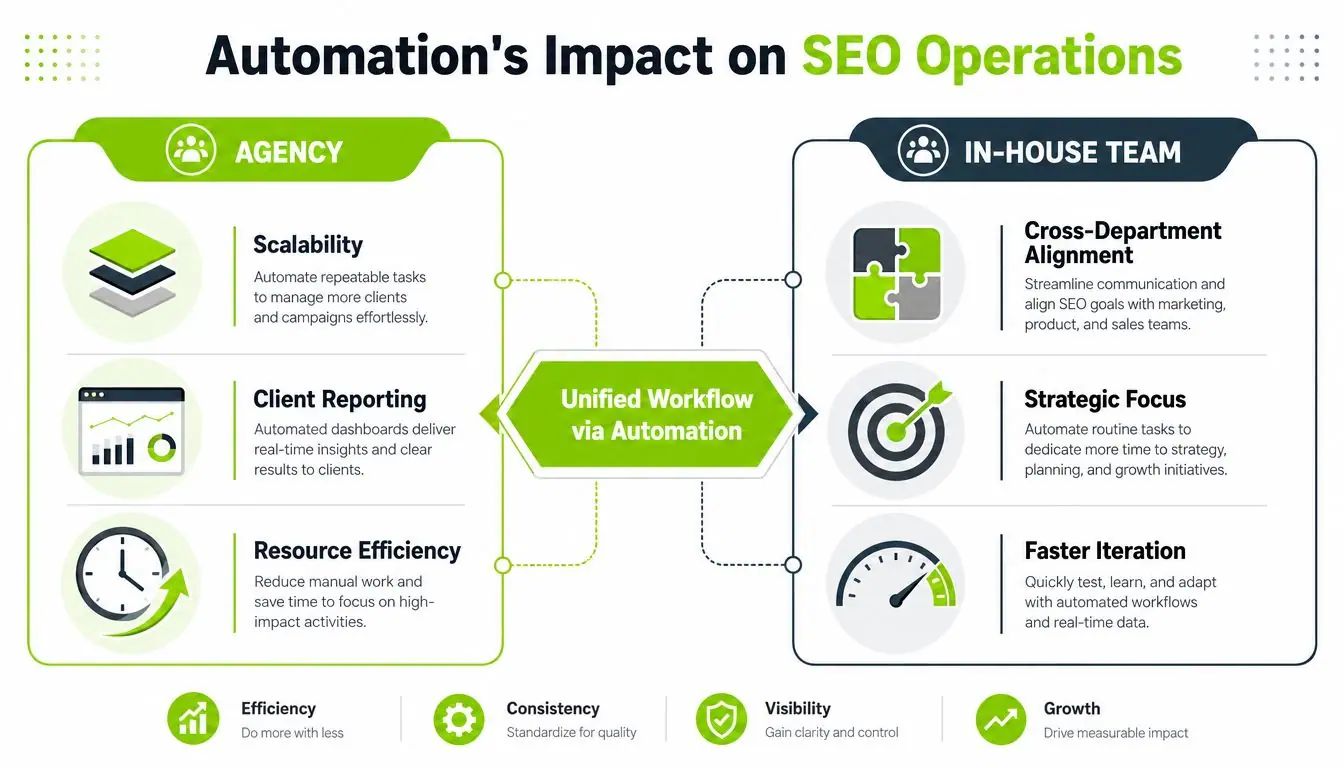
How Automation Changes Agency and In-House Team Operations
Automation changes the unit of work. Instead of asking an analyst to collect information, clean it, and prepare a report, the team starts with an identified condition and spends its time deciding what to do.
For agencies, that distinction affects account capacity and consistency. A shared platform can apply the same crawl rules, naming conventions, alert logic, and reporting structure across client accounts while preserving account-level data boundaries. The account strategist can spend more time interpreting a competitor shift or shaping a content roadmap instead of copying figures between spreadsheets.
Agency workflows become repeatable
A practical agency workflow looks like this:
- Detect change: A scheduled audit, ranking monitor, backlink feed, or AI prompt test identifies a movement.
- Classify impact: The platform groups the event by account, template, query cluster, business priority, and probable cause.
- Assign ownership: Technical issues go to development, content gaps go to editorial, and reporting notes go to the account team.
- Show progression: The next crawl or visibility check records whether the issue remains open, changed, or resolved.
That sequence creates a defensible client narrative. The agency can explain what changed, why it matters, what action was recommended, and how the next measurement will validate the decision. It also reduces the temptation to send a report full of unprioritized alerts.
In-house teams gain an operating rhythm
An in-house team benefits from continuous monitoring because site changes rarely wait for a monthly audit. A deployment can alter internal links, metadata, rendering, canonicals, or URL behavior. Automated checks surface those changes while the context is still available to the people who made them.
The platform also gives engineering, product, and marketing a shared evidence layer. Developers can receive grouped technical tickets rather than broad SEO complaints. Product teams can see where users encounter AI-assisted discovery. Content leaders can connect declining visibility with pages that need revision, consolidation, or stronger evidence.
The strongest implementation doesn't remove specialists. It removes the manual queue that prevents specialists from applying their judgment.
The business case is therefore operational rather than purely numerical. Teams reduce repeated collection work, shorten the time between detection and response, and make decisions from the same definitions. Automation doesn't fix weak prioritization or unclear ownership. It makes those weaknesses visible, which is why governance and workflow design must accompany the platform.
Evaluation Criteria for Choosing the Right Platform
A polished demo can conceal shallow data, weak integrations, and reporting limits. Evaluate the platform against the work your team performs each week, including traditional SEO monitoring and AI-search visibility tracking. The right system should connect those workflows rather than placing AI visibility in a separate dashboard.
Use the evaluation matrix
| Criterion | What to Look For | Red Flags |
|---|---|---|
| Data coverage and accuracy | Clear source definitions, historical context, crawl controls, reproducible measurements, and transparent refresh behavior | Unexplained discrepancies, vague freshness claims, or metrics that can't be exported |
| AI visibility coverage | Monitoring across the AI surfaces and language or market combinations relevant to your audience, with mentions and citations separated | One generic AI score, no prompt history, or no citation detail |
| Technical auditing | Scheduled crawls, configurable scope, JavaScript handling where needed, issue grouping, and prioritization by impact | Large warning lists without ownership, templates, or recommended sequence |
| API flexibility | Documented REST, GraphQL, or equivalent access, stable identifiers, useful pagination, and predictable rate behavior | API access restricted to premium tiers or limited to static exports |
| Multi-account management | Account separation, permissions, reusable settings, white-label reports, and client-safe views | Shared data exposure, duplicated setup, or no agency hierarchy |
| Reporting customization | Role-based dashboards, annotations, scheduled delivery, exports, and business-oriented summaries | Fixed PDF layouts, no commentary layer, or ranking-only reporting |
| Commercial scalability | Pricing that reflects sites, crawl volume, tracked queries, users, API usage, and AI monitoring needs | Sudden limits, unclear overage rules, or pricing based on features your team can't test |
Treat AI visibility as a first-class evaluation area. A platform may track rankings accurately yet provide little evidence about which prompts produce brand mentions, which sources receive citations, or how competitor coverage changes. That gap forces analysts to reconcile separate datasets manually.
Test the platform with real work
Bring a representative site, a real reporting template, and a real set of AI prompts to the trial. Ask the vendor to show how the platform handles a recurring crawl, a template-level issue, a lost backlink, a ranking change, and an AI answer that cites a competitor instead of your brand.
Check the output at three levels:
- Analyst view: Can a specialist investigate the underlying URLs, queries, prompts, and sources?
- Workflow view: Can someone assign, annotate, resolve, and recheck the issue?
- Executive view: Can a decision-maker understand the consequence without learning the platform?
A platform that performs well at only one level creates handoffs. Agencies should test white-label controls, account isolation, and the time required to onboard a new client. In-house teams should test permissions, API access, alert routing, and whether engineering can consume the data without manual exports.
The final question is practical: does the platform reduce tool sprawl, or add another dashboard? If it cannot combine crawl findings, ranking changes, and AI citation evidence into one operating view, its feature breadth becomes another source of fragmentation.
Integration Patterns and Implementation Workflows
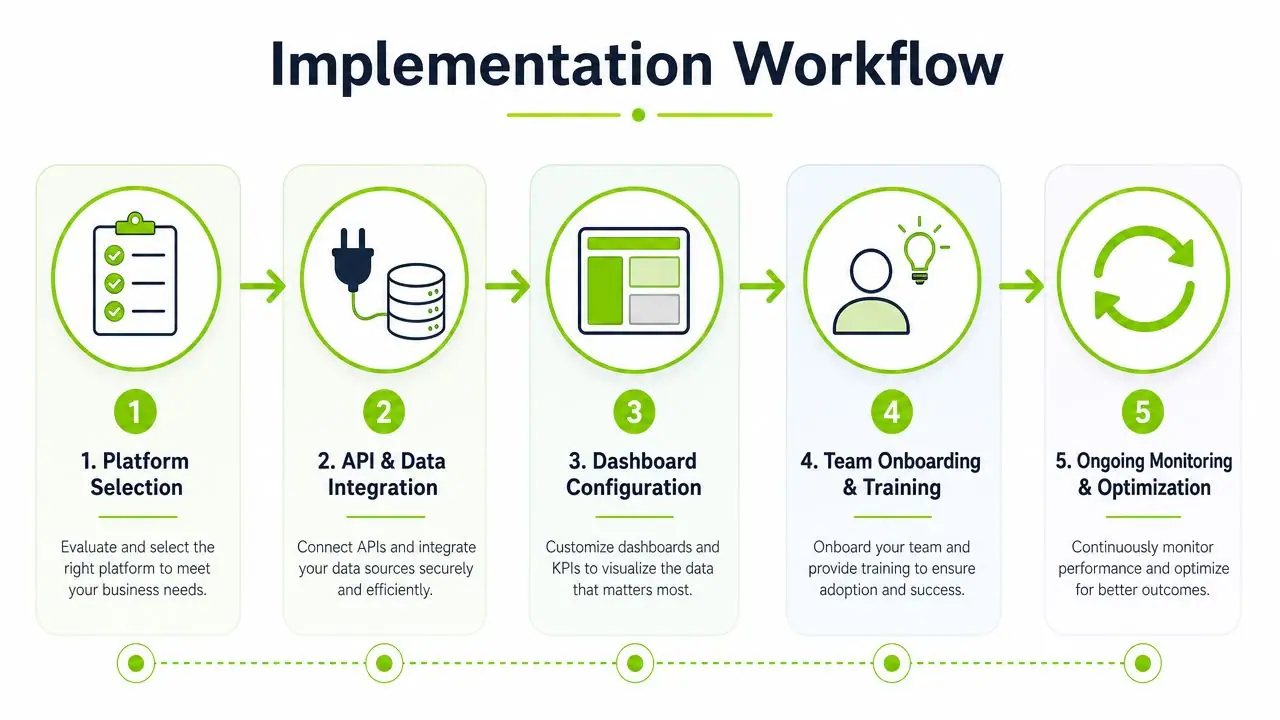
Implementation works best when the platform fits existing systems instead of asking the team to rebuild every process around a new interface. Start by mapping inputs, decisions, actions, and outputs.
Build the data path first
An API-first design lets developers send SEO and AI visibility data into internal dashboards, warehouses, product interfaces, or agent workflows. The important questions concern stable identifiers, historical access, authentication, error handling, and whether the API exposes the same detail visible in the interface.
Webhook-based alerts complement scheduled reporting. Use them for material events such as a critical template change, a major indexation problem, a lost strategic link, or a meaningful shift in AI citations. Route each event to the system where action happens, such as a ticketing platform, collaboration channel, or incident workflow.
For teams designing broader data pipeline automation, avoid treating SEO as a final report export. Search data can become an input for editorial planning, product research, engineering prioritization, and customer-facing reporting.
Make crawling crawl-aware
Google describes crawl budget through crawl capacity limit and crawl demand, and notes that soft 404s, duplicate URLs, unnecessary parameters, and bloated URL inventories can consume fetching resources. The Google crawl budget guidance discussed by the SEO community supports a crawl-aware model that combines server logs, sitemaps, robots directives, canonicals, and crawl statistics.
A useful configuration should:
- Schedule by risk: Crawl frequently changing or commercially important sections more often than stable archives.
- Group by pattern: Identify whether an issue comes from a template, parameter, locale, or isolated page.
- Compare intended and observed crawling: Use server logs and crawl data to see which URLs search engines fetch.
- Prioritize remediation: Fix indexation blockers, wasteful URL patterns, and high-value page defects before low-impact warnings.
- Respect infrastructure: Coordinate crawl timing and scope with server capacity, especially on large or dynamic sites.
Google also notes that hostload and slow responses can constrain crawling, while better content quality and cleaner URL structures can increase demand for pages worth indexing. The platform should make these relationships visible rather than presenting crawl counts without context.
Roll out in controlled stages
For agencies, begin with one account or account group. Establish naming rules, permission roles, report templates, alert thresholds, and data retention before adding more clients. White-label reporting should be configured after the underlying definitions are stable, otherwise the agency scales inconsistent reporting.
For in-house teams, connect the platform to one technical workflow and one content workflow first. Train people on how to interpret an alert, not just how to open a dashboard. Then expand into API delivery, automated reporting, and AI visibility monitoring once ownership is clear.
Common Pitfalls and How to Avoid Them
Automation creates little value when nobody has defined the next action. A platform may crawl, alert, classify, and report continuously, yet unclear ownership turns those capabilities into background noise.
Automating everything at once
Symptom: The team receives a flood of alerts, exports, and AI recommendations, then ignores the system.
Cause: The rollout began with the full feature set rather than one high-impact workflow.
Countermeasure: Select one operational bottleneck, such as technical monitoring for critical templates or recurring client reporting. Set the owner, response time, required evidence, and success condition before adding more workflows.
Treating AI visibility as decoration
Symptom: The platform tracks rankings carefully, while AI answers receive attention only during occasional experiments.
Cause: The team measures visibility through positions and clicks, although AI summaries can change how users encounter information.
Countermeasure: Build a monitored prompt set covering products, categories, competitors, and customer questions. Track mentions and citations over time, then connect gaps to content and authority work. The AI search visibility coverage discussed by industry sources shows why AI visibility belongs in regular operations alongside conventional SEO reporting.
Adding another dashboard
Symptom: Analysts keep the old rank tracker, crawler, content tool, and spreadsheet while placing the new platform on top.
Cause: The evaluation covered features without assigning ownership for each metric and workflow.
Countermeasure: Create a source-of-truth map. Document each metric's owner, definition, refresh behavior, and destination. Retire overlapping tools only after the replacement produces trusted outputs.
Ignoring crawl scheduling and triage
Symptom: Automated audits detect issues quickly, but developers receive long lists without sequence or context.
Cause: The team configured recurring crawls without scope rules, template grouping, or impact prioritization.
Countermeasure: Set crawl frequency by risk, group defects by URL pattern, and rank fixes by indexation impact, business importance, and repeatability. Seobility's automated crawl approach and SE Ranking's scheduled-audit guidance reflect the practical need to pair detection with triage. The same operating discipline should apply to AI-search monitoring, where prompt coverage and citation changes also need owners, review intervals, and follow-up actions.
How Surnex Unifies SEO and AI Search Intelligence
Surnex brings traditional SEO metrics and AI-search monitoring into one workflow. Its platform covers rankings, backlinks, site audits, keyword research, content opportunities, and AI visibility, with an agent-ready API for teams building custom search or reporting workflows.
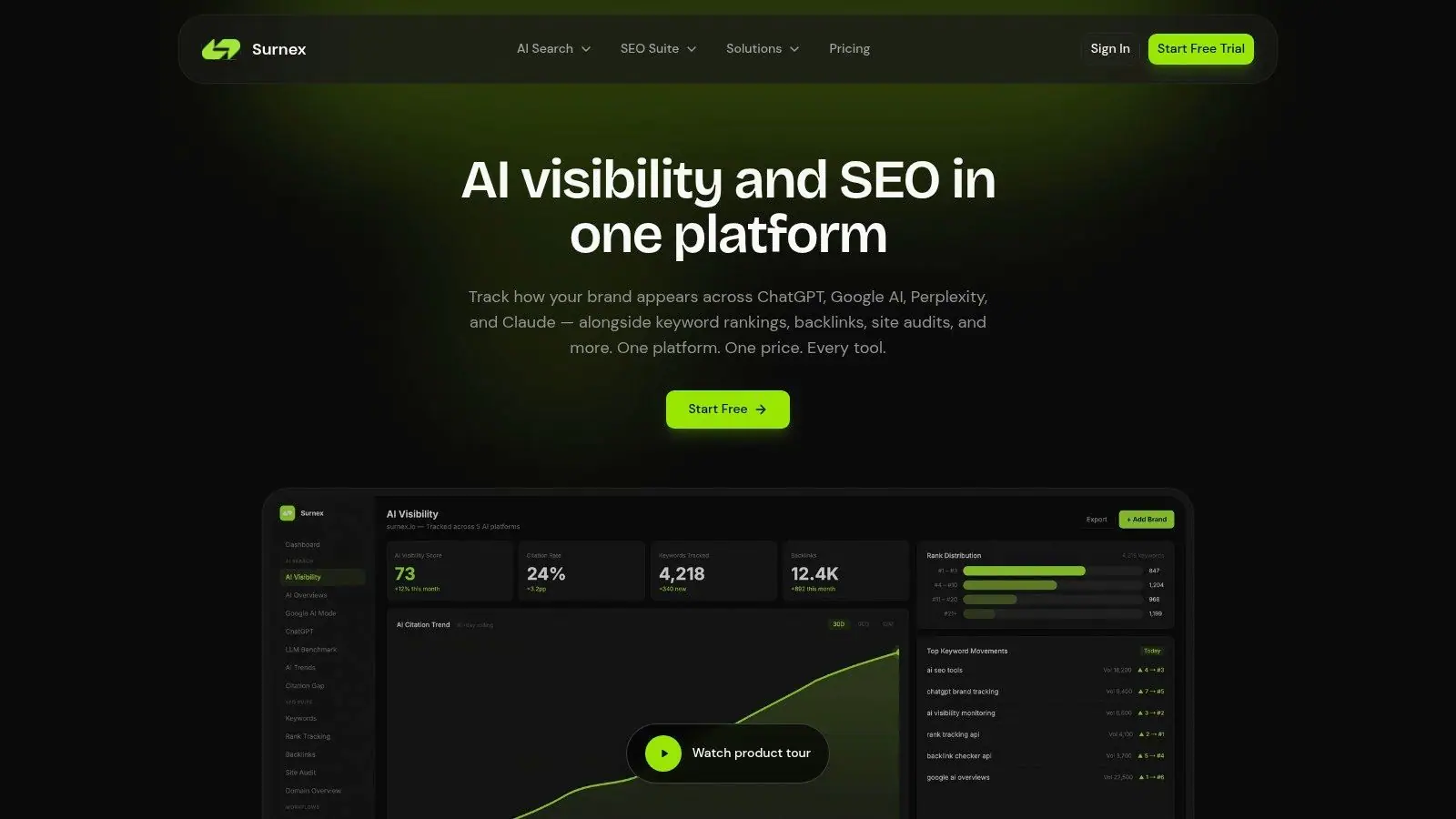
The AI layer monitors brand appearance in Google AI Overviews and newer AI experiences, tracks presence in ChatGPT-driven discovery, benchmarks visibility across leading language models, and surfaces trends and citation gaps. That structure lets an agency explain a change in search behavior without sending clients through several disconnected reports.
Teams evaluating AI adoption can also review this practical guide to AI features for SaaS founders, especially when product and marketing teams need to connect search intelligence with application workflows.
The familiar SEO foundation lowers adoption friction. Flexible APIs and automated reporting support multi-account agency operations, internal dashboards, and repeatable prioritization. For a broader view of the platform's approach to search marketing intelligence, the central idea is straightforward: rankings and AI answers should inform one operating model.
A short product walkthrough can help teams assess that workflow in context.
Surnex combines rankings, audits, backlinks, content opportunities, and AI-search visibility in one automated SEO platform with an agent-ready API. Visit Surnex to see how your agency or in-house team can replace fragmented reporting with a clearer workflow for traditional and AI-driven search.