You probably know the feeling. One tab shows ad spend. Another shows rankings. A third tracks email journeys. Your CRM has one version of the customer, your analytics platform has another, and your reporting deck has to turn all of it into a single story by Friday.
That's where many teams are right now. They don't lack tools. They lack a system.
A few years ago, adding another platform felt like progress. Today, it often creates more friction. The hard part isn't finding software for SEO, automation, analytics, or paid media. The hard part is making those systems work together so your team can see what's happening, act quickly, and explain results clearly.
Navigating the Digital Marketing Tech Explosion
A marketing manager at a mid-sized company might use Google Analytics for traffic, HubSpot for lifecycle stages, Meta Ads Manager for paid social, Google Ads for search campaigns, a rank tracker for SEO, an email platform for nurture flows, and a BI tool for leadership reporting. None of those tools are wrong. The problem starts when each one answers a different question with slightly different numbers.
That confusion matters because the category is massive. The global digital marketing market reached $456.7 billion in 2025 and is projected to surge to $1.2 trillion by 2034, while digital channels account for 67% of all media spend globally, according to Foursets' digital marketing statistics roundup. This isn't a side function anymore. Digital marketing technologies sit at the center of modern revenue generation.
Why marketers feel buried
Organizations don't wake up and choose a messy stack. They inherit one.
A company buys an email platform because it needs faster campaigns. Then it adds a social scheduler, then a landing page builder, then a reporting tool because leadership wants cleaner dashboards, then an SEO tool because organic traffic slips. Each purchase solves a real problem. Over time, the stack starts looking like a garage filled with good tools tossed into random drawers.
Practical rule: If your team has to export data into spreadsheets just to explain performance, your stack is fragmented.
The shift happening now is bigger than another round of software consolidation. Search itself is changing. Your brand may still rank well in traditional results while disappearing inside AI-generated answers, summaries, and conversational discovery tools. A team can be visible in one layer of search and invisible in another without realizing it.
What a clearer approach looks like
A useful stack does three things well:
- Measures reality: It gives your team a trusted view of performance across channels.
- Connects actions: It moves data between systems so campaigns react to customer behavior.
- Tracks new discovery surfaces: It shows whether your brand appears where people now get answers, not just where they click links.
That last point is the new pressure point. Old-style SEO reporting doesn't fully describe modern visibility anymore. If AI systems summarize, cite, or skip your brand, that affects demand generation, brand recall, and content strategy.
The rest of this guide treats digital marketing technologies as a connected operating system, not a shopping list. That's the difference between owning tools and running a workshop.
The Core Categories of Digital Marketing Technology
Think of digital marketing technologies like a mechanic's workshop. A great workshop doesn't rely on one magic tool. It uses a set of tools, each built for a specific job. A wrench doesn't replace a diagnostic scanner. A lift doesn't replace a torque wrench. The same logic applies to martech.
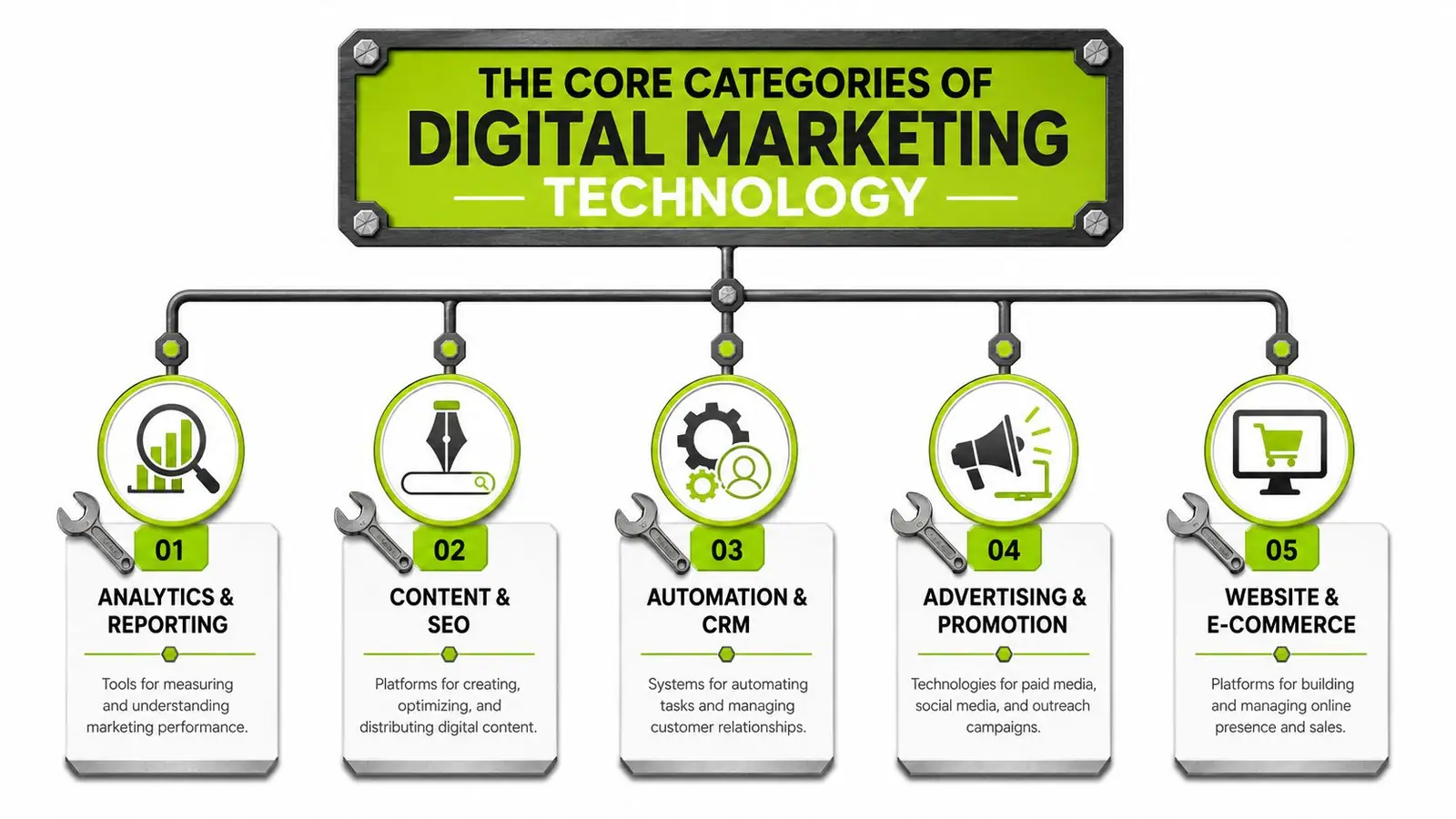
The main tool benches in the workshop
Some categories are familiar. Others have changed shape because AI is changing how people discover brands. AI has made 85% of marketing tasks automatable, AI-generated summaries appear in 50% of search results, and 67% of consumers discover brands through a mix of social media and AI, according to WSI's digital marketing trends and stats. That means the category map still matters, but the lines between categories are getting thinner.
Here's a simple way to think about the main groups.
| Category | Primary Job | Example Tool |
|---|---|---|
| Analytics and Reporting | Measure traffic, conversions, revenue, and channel performance | Google Analytics 4 |
| Content and SEO | Create, optimize, and improve discoverability of content | Semrush |
| Automation and CRM | Trigger workflows and manage contacts, leads, and lifecycle stages | HubSpot |
| Advertising and Promotion | Run paid campaigns and audience targeting across channels | Google Ads |
| Website and E-commerce | Publish pages, manage experiences, and support transactions | Shopify |
| Customer Data Platforms | Unify customer data across systems for activation and analysis | Segment |
| Attribution and BI | Connect channel activity to pipeline, revenue, and executive reporting | Looker Studio |
What each category is really for
Analytics and reporting tools answer, “What happened?” They help you see sessions, conversions, campaign performance, and channel trends. They become more valuable when they're tied to revenue instead of only traffic.
Content and SEO platforms answer, “What should we publish and optimize so people can find us?” That now includes traditional ranking signals and newer visibility patterns in AI-led search. If you're sorting through options, this guide to SEO visibility tools is useful because it frames visibility as a broader problem than keyword positions alone.
Automation and CRM systems answer, “What should happen next for each contact?” They handle nurture flows, lead routing, reminders, and triggered messages. For teams thinking in APIs instead of only drag-and-drop builders, Mallary.ai's automation API implementation offers a practical look at how automation can be structured when you want systems to communicate cleanly.
A healthy stack doesn't just store customer data. It moves that data into the next useful action.
Advertising and promotion tools answer, “How do we buy attention efficiently?” These platforms manage audience targeting, bidding, creatives, and budget pacing across search, social, display, and video.
Website and e-commerce platforms answer, “Where does the experience happen?” They're where your messaging, forms, product pages, and conversion paths come together. If this layer is disconnected from analytics or CRM, every downstream insight gets weaker.
Why categories matter less than connections
The common mistake is evaluating each category in isolation. Marketers ask whether a tool is good at email, SEO, or reporting. The better question is whether it plays well with the rest of the workshop.
A strong category tool does its own job well. A strong stack makes the handoff between jobs nearly invisible.
How Different Teams Use These Technologies
A fast-moving agency and a large in-house brand team can use many of the same platforms, but they won't organize them the same way. Their pressure points are different. One lives inside account switching and client reporting. The other deals with system depth, internal governance, and cross-department alignment.
Agency teams need repeatable workflows
An agency usually values speed, consistency, and multi-client visibility. The account team has to open a dashboard and understand what changed for Client A, Client B, and Client C without rebuilding the same report each week.
That makes these needs stand out:
- Multi-account oversight: Agencies need one place to review rankings, paid activity, content opportunities, and emerging AI search presence across clients.
- Reporting discipline: Client-facing work depends on clear narratives, not just raw exports.
- Scalable execution: When campaigns repeat across accounts, automation saves time.
IBM notes that marketing automation platforms using machine learning can reduce routine task execution time by 40 to 60%, and AI-assisted virtual agents enable 90% faster content iteration cycles compared to manual workflows, in its overview of digital marketing and AI capabilities. For agencies, that matters because time saved on operations can be reused for strategy, client communication, and testing.
If an agency is already adjusting its workflows around newer search behavior, this breakdown of using AI in SEO helps clarify where the operational changes usually show up first.
In-house teams need deeper integration
An in-house enterprise team usually has the opposite problem. It doesn't just need faster execution. It needs systems that can survive legal review, data governance, sales alignment, and region-specific reporting needs.
A brand team may have one platform for analytics, another for consent management, a CRM managed partly by sales operations, and an automation platform owned by lifecycle marketing. In that setup, the question isn't “Which tool should we buy next?” It's “Which system owns the truth?”
Here's the contrast in plain terms:
| Team Type | Main Pressure | Typical Stack Priority |
|---|---|---|
| Agency | Handle many accounts efficiently | Shared workflows, unified reporting, account switching |
| In-house brand | Align many departments and systems | Data governance, integration depth, role-based access |
Agencies often optimize for repeatability. In-house teams often optimize for reliability.
Same categories, different operating model
Both teams use digital marketing technologies for analytics, automation, content, and promotion. The difference is how they connect the parts.
An agency might favor tools that reduce context switching and make client explanations easier. An in-house team might accept more complexity if it gains tighter control over customer data and workflow permissions. Neither model is automatically better. The right fit depends on how many stakeholders touch the stack and how often those systems need to talk to each other.
Choosing and Integrating Your Tech Stack
Buying software is the easy part. Making it useful is harder.
Many stacks fail before launch because the team chooses based on feature lists alone. A platform can look strong in a demo and still become a burden if nobody trusts the data, the workflows stay manual, or the tool duplicates what another system already does.
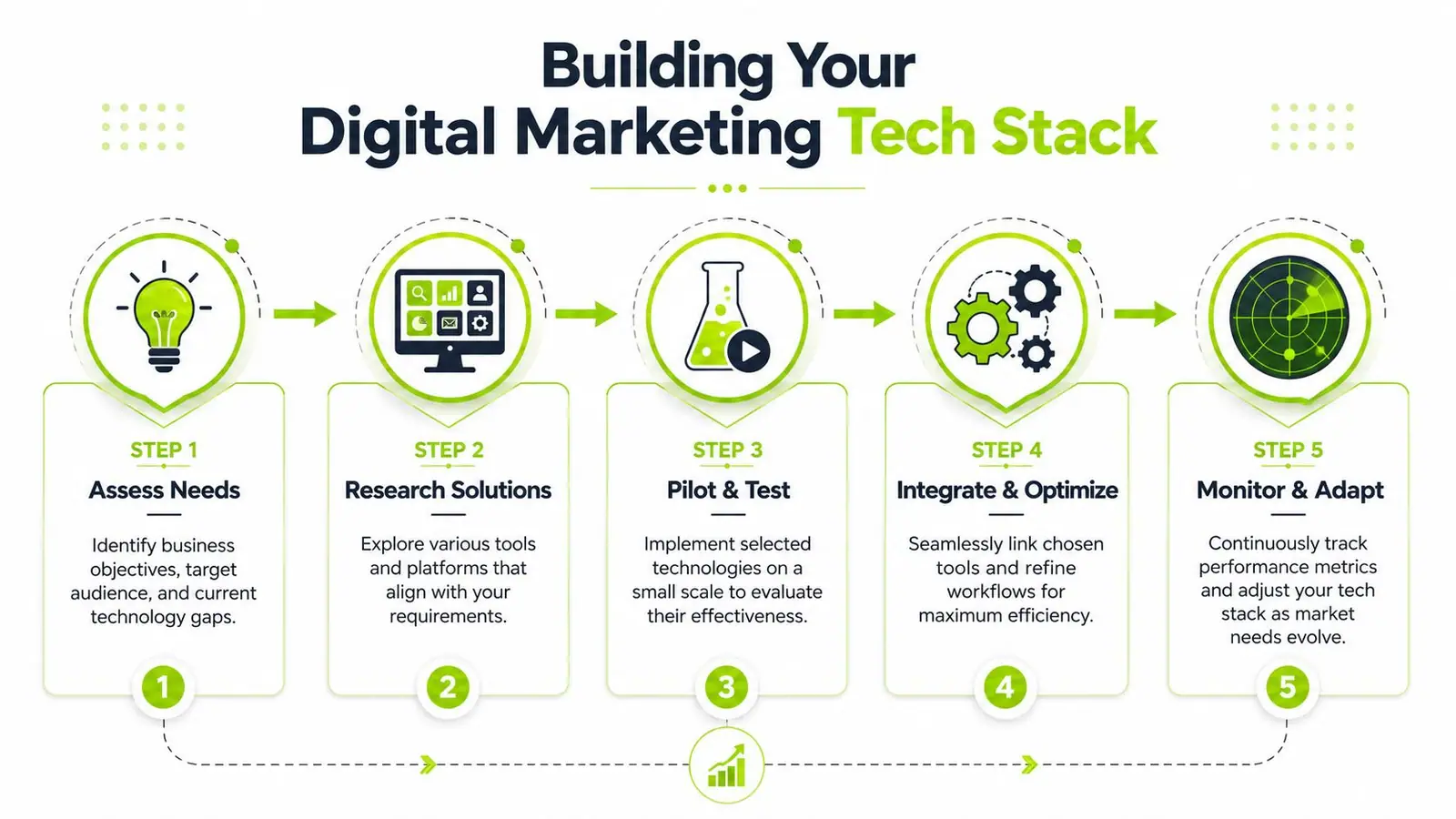
What to check before you commit
A useful evaluation starts with a short checklist.
- Business fit: Does the tool solve a current problem your team feels, or a hypothetical future one?
- Ease of adoption: Can marketers use it without heavy dependence on engineering for everyday work?
- Integration depth: Does it connect cleanly to your CRM, analytics, ad platforms, and content systems?
- Reporting clarity: Can it feed a shared view of performance instead of creating another isolated dashboard?
- Cost beyond license price: Consider implementation effort, admin burden, training time, and reporting overhead.
If your team is building around automation or custom workflows, API depth becomes a real selection criterion, not a technical footnote. This explainer on an SEO tool API is a good reference for understanding how APIs change what a marketing stack can do day to day.
Build from a source of truth outward
The cleanest integrations usually start with one decision. Choose the system that will anchor measurement.
For some teams, that's a CRM. For others, it's an analytics warehouse, a CDP, or a BI layer. The point is not to choose the “perfect” center. The point is to avoid letting every tool define the customer differently.
A simple integration sequence often works best:
- Name the source of truth. Decide where revenue, lead status, and channel performance will be reconciled.
- Map the essential events. List the actions that matter, such as form submits, purchases, trial starts, qualified leads, or booked meetings.
- Connect only the systems that support those events. Don't integrate everything at once.
- Standardize naming and ownership. Campaign names, conversion definitions, and reporting fields need shared rules.
- Review handoffs monthly. Most breakdowns happen where one tool passes data to another.
Working principle: A smaller connected stack beats a larger disconnected one.
The biggest integration mistake
Teams often stack specialized tools without deciding how insights will travel between them. That creates tool sprawl. One system identifies an audience. Another system sends messages. A third system reports conversions. Nobody can explain the differences when numbers don't match.
Integration is less about plumbing than governance. Every tool should answer one of three questions clearly: Does it create data, activate data, or report data? If the answer is fuzzy, the stack probably needs simplification.
The New Frontier of AI Search and Unified Analytics
Traditional SEO reporting still matters. Rankings, backlinks, technical issues, and content gaps haven't disappeared. But they no longer describe the full search environment.
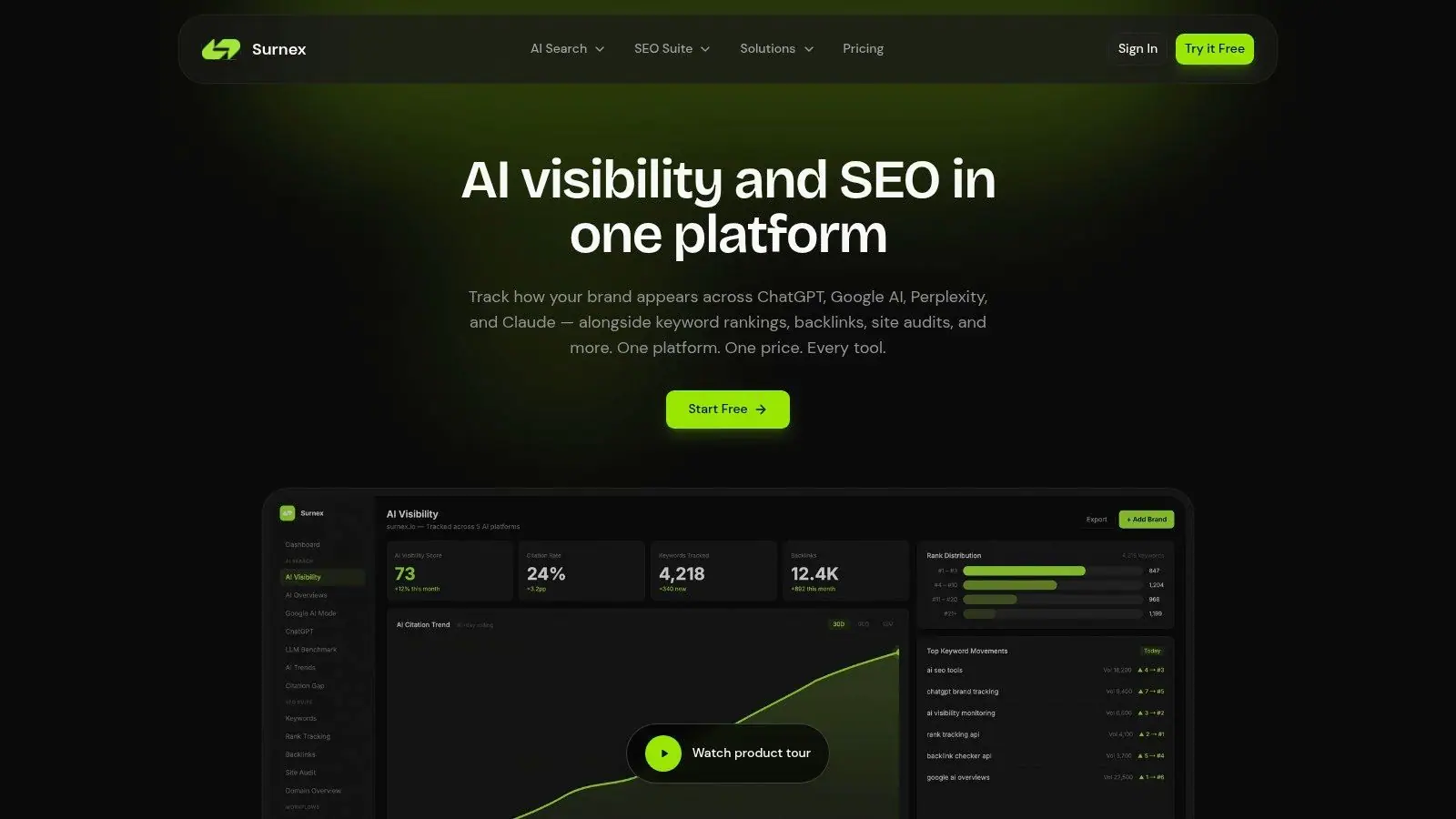
The biggest blind spot now is whether your brand appears inside AI-generated answers. A page can rank, yet your brand can still be absent from the answer layer that many people see first.
Why old SEO metrics are incomplete
Koozai identifies a critical AI Visibility Verification gap in marketing tech and notes that SEO must adapt to become the answer source for zero-click environments, while few platforms offer unified tracking of AI visibility alongside core metrics. As a result, teams often jump between tools to explain these changes to clients, as described in Koozai's analysis of undervalued digital marketing areas.
That gap changes what “visibility” means. Marketers now need to know more than:
- Did we rank?
- Did traffic increase?
- Did backlinks grow?
They also need to ask:
- Were we cited in AI-generated answers?
- Did the answer mention our brand accurately?
- Which competitors appeared when we didn't?
- Did our visibility change across different AI-driven environments?
Unified search intelligence offers greater utility than a collection of single-purpose tools. A platform such as Surnex combines traditional SEO metrics with AI visibility tracking, including appearance in AI Overviews and ChatGPT-driven discovery, so teams can review both layers in one workflow instead of treating them as separate reporting problems.
What teams should verify in AI search
AI visibility isn't only a reporting concern. It affects content planning, brand safety, and client communication.
Look at these checks as part of modern search intelligence:
| Area to Verify | Why It Matters |
|---|---|
| Brand appearance | Confirms whether your company is present in AI answers at all |
| Citation gaps | Shows where competitors are referenced and your content isn't |
| Message accuracy | Helps catch outdated or misleading brand descriptions |
| Cross-platform patterns | Reveals whether visibility is concentrated in one environment and missing in others |
A related discipline is attribution. If your team is already trying to connect top-of-funnel discovery to downstream outcomes, this guide to omnichannel marketing KPIs and attribution is useful because it frames measurement across channels instead of treating each platform in isolation.
Unified analytics is the control panel
The reporting layer has to evolve too. AI search data shouldn't sit in a side spreadsheet owned by one curious SEO manager. It belongs in the same decision system as rankings, content performance, and channel analysis.
For teams building that reporting logic, this resource on data for SEO is a practical reference because it treats search data as something to operationalize, not just inspect.
A short demo helps make the shift more concrete.
If your reporting can explain clicks but can't explain AI answers, it no longer reflects how search works.
Measuring Success with Technology Governance
A stack can look modern and still underperform. The usual reason isn't missing software. It's weak governance.
Governance sounds administrative, but it directly affects marketing outcomes. When teams don't define ownership, refresh expectations, or reporting rules, performance conversations drift into opinion. One person trusts the CRM. Another trusts the ad platform. A third trusts the spreadsheet they cleaned by hand.
What governance actually covers
A practical governance model focuses on a few operational questions:
- Data freshness: How quickly should key events appear in reporting?
- Metric ownership: Which system defines conversions, revenue, and customer stages?
- Tool overlap: Are multiple platforms doing the same job with slightly different logic?
- Usage discipline: Which tools does the team actively use, and which are mostly shelfware?
Adobe benchmark data cited by Aidigital shows that inconsistent data freshness with latency greater than 15 minutes reduces machine learning model precision in predicting user behavior by 12 to 18%, which is why marketers need a unified reporting layer for revenue and channel performance, as outlined in Aidigital's guide to marketing technology governance.
That point is easy to underestimate. If your data arrives late or inconsistently, AI-driven personalization, lead scoring, and forecasting don't fail dramatically. They just get a little less accurate, a little less trusted, and a little harder to act on.
A simple review rhythm
Quarterly reviews work well because they create enough time for patterns to appear without letting problems drift too long.
A useful governance review might ask:
- Which tools changed decisions this quarter? If nobody used the insight to act, the tool may not justify its place.
- Where do numbers conflict? Every recurring discrepancy points to a definition or integration issue.
- What broke in the handoffs? Most reporting issues begin between systems, not inside them.
- Which teams rely on exports instead of live connections? Manual workarounds often reveal structural weakness.
Governance isn't a finance exercise. It's how marketers keep automation and analytics trustworthy.
What success looks like
Strong governance doesn't mean fewer tools at any cost. It means each tool has a clear role, the data arrives when it should, and leadership can trace outcomes back to channel activity without debate.
When that happens, measurement improves in a practical way. Teams stop arguing over which number is “right” and start asking better questions about what to change next.
The Future of Digital Marketing Technology
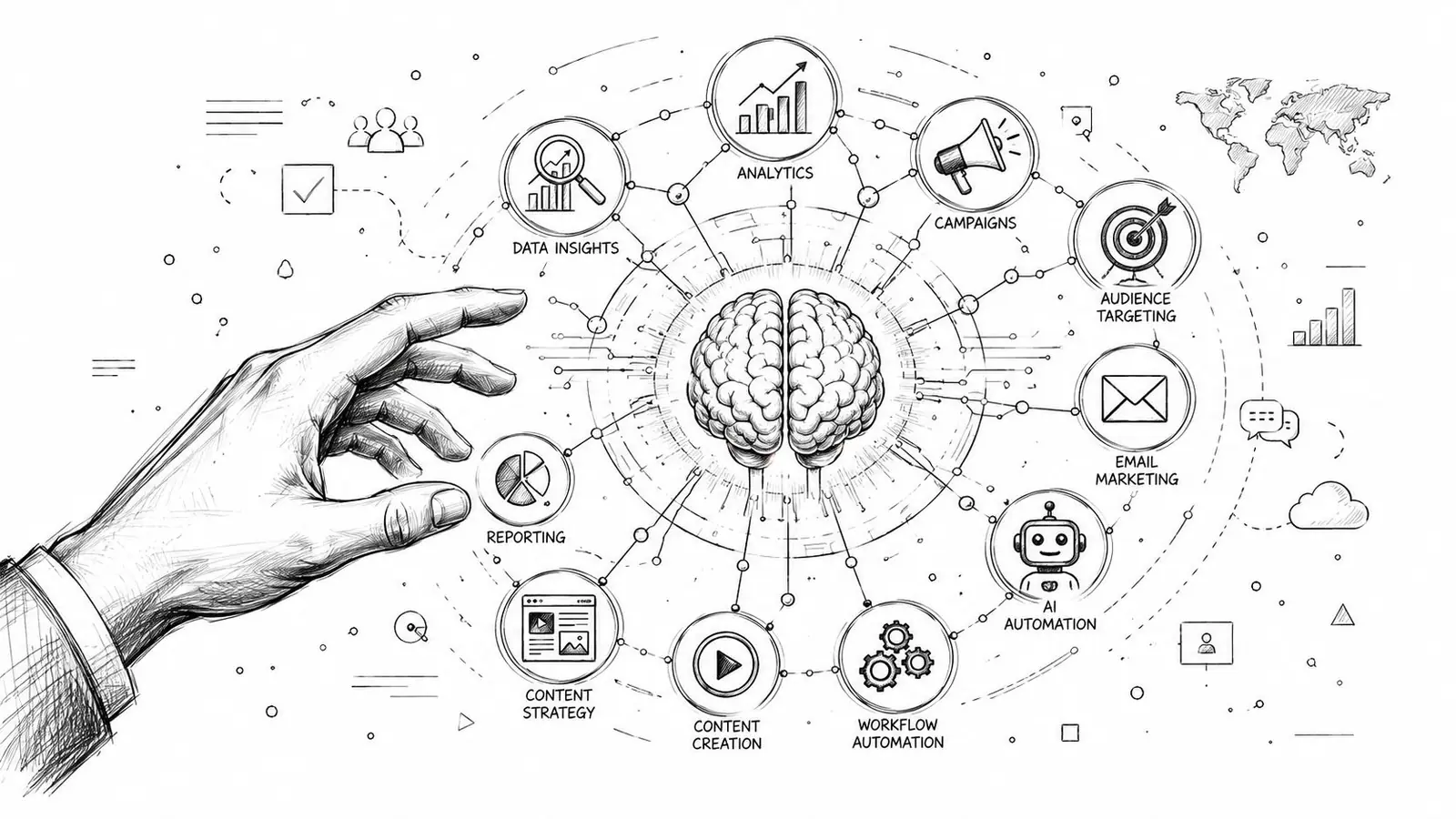
The future of digital marketing technologies won't be defined by who owns the most dashboards. It will be defined by who can turn connected data into timely action.
That changes the marketer's daily workflow. Instead of opening five tools to investigate a drop in performance, teams will increasingly ask one system a question in plain language and receive a structured answer, a recommendation, and a next action. The interface becomes more conversational. The primary advantage, though, still comes from the quality of the connected data underneath it.
What will change in practice
Three shifts are already easy to see.
First, search intelligence will expand beyond the search results page. Visibility will include rankings, citations, summaries, mention quality, and presence across AI-driven answer environments.
Second, automation will become more event-driven. Instead of scheduling campaigns in batches, marketers will trigger actions based on behavior, context, and system signals moving through connected APIs.
Third, reporting will become more predictive. Teams won't only review what happened. They'll use platforms that surface likely risks, emerging content gaps, and changes in brand visibility before those trends hit a monthly report.
What won't change
The basics still matter.
A weak message won't become strong because an AI assistant wrote it faster. A messy customer record won't become useful because a new dashboard visualized it. And a disconnected stack won't become strategic because it now includes a chatbot interface.
The future belongs to teams that simplify first, then automate.
The best preparation isn't buying every new category that appears. It's building a stack that can adapt. That means fewer silos, clearer ownership, and a better understanding of how discovery, analytics, and activation now connect.
Frequently Asked Questions
What are digital marketing technologies in simple terms
They're the software systems marketers use to plan, publish, measure, automate, and improve digital campaigns. That includes analytics tools, CRM platforms, SEO software, ad platforms, content systems, and reporting layers. The easiest way to think about them is as a workshop of specialized tools that should work together around one customer and performance story.
Where should a small team start
Start with a small connected core, not a broad stack. Organizations need a way to measure performance, manage contacts, publish content, and run campaigns. If those basics are disconnected, adding more software usually creates more noise instead of more value.
A good first pass is:
- One measurement layer: Choose the platform your team will trust for reporting.
- One customer system: Keep contact and lifecycle information in a defined home.
- One activation path: Make sure campaigns can act on the data you collect.
What's the biggest mistake teams make
They buy tools by channel instead of designing a system.
That sounds reasonable at first. One tool for SEO, one for email, one for reporting, one for paid media. But when each system defines success differently, the team spends more time reconciling data than improving marketing. The bigger mistake isn't tool count by itself. It's adding tools without deciding how information moves between them.
How often should you review your stack
Review it regularly enough to catch drift, but not so often that the team is constantly reorganizing. A quarterly review works well for most organizations because it gives you time to assess usage, overlap, data quality, and business impact.
Use that review to ask a few direct questions:
- Which tools are actively shaping decisions
- Which integrations are fragile or manual
- Where reporting confidence is weak
- Which newer search surfaces are not being tracked
Do traditional SEO tools still matter
Yes. They still help teams understand rankings, backlinks, site issues, and content opportunities. The change is that they no longer cover the full visibility problem by themselves. Modern teams need to understand both classic search performance and how brands appear inside AI-driven answer environments.
How do you know your stack is too fragmented
You usually see the symptoms before you name the cause. Reports conflict. Teams export data into spreadsheets to “fix” numbers. Campaign insights arrive too late to act on. Search reporting explains rankings but can't explain whether the brand appears in AI-generated answers.
When those signs show up together, the issue usually isn't effort. It's architecture.
If you're trying to reduce tool sprawl and understand how your brand appears across both traditional search and AI-driven discovery, Surnex is worth a look. It brings AI visibility tracking together with core SEO workflows so agencies, in-house teams, and developers can work from a clearer view of modern search.