You've built the spreadsheet. It has thousands of keywords, impressive volume estimates, and a few obvious head terms that everyone in your market wants to rank for. Then the content team asks the practical question: which terms should we target first?
That's where highly searched keywords become difficult. Search volume can reveal demand, but it doesn't tell you whether the query matches your offer, whether your site can compete, or whether Google's results will send visitors to your page at all. Modern keyword research has to account for intent, click concentration, competition, trend stability, and AI Overview exposure before a term earns a place on your roadmap.
Why Chasing Volume Alone Wastes Your Keyword Research
A client asks for more organic traffic. The team exports the industry's largest keywords, sorts them by volume, and marks the apparent winners. Then the SERP review begins. The biggest terms often belong to established brands, utilities, marketplaces, or publishers with years of authority behind them.
Some queries are navigational. Others serve people seeking a quick definition, calculation, or answer rather than a product, service, or consultation. The keyword tool shows market demand without showing attainable opportunity. It also says little about whether an AI Overview, featured result, or other SERP feature will absorb attention before a page receives a click.
Classify each high-volume query before deciding how to pursue it:
- Query class: Separate navigational, informational, commercial, and transactional searches.
- Audience problem: Identify who searches and what decision or task sits behind the wording.
- Competitive path: Compare the current results, content depth, authority, and page formats with your site's capabilities.
- Visibility risk: Check how prominently organic listings appear and whether AI Overviews can answer the query directly.
A practical low-competition keyword framework helps teams find demand they can realistically capture. A lower-volume commercial or transactional term may connect more directly to a buyer's problem, produce better-qualified visits, and support a long-tail cluster. Head terms still deserve attention when they define the market, support category authority, or offer a credible route to strong visibility. They should not automatically lead the publishing queue.
Key takeaway: Judge highly searched keywords by intent, attainability, and AI visibility risk before using volume to set priorities.
Ranking position changes the traffic calculation. Backlinko's analysis reports an average 27.6% click-through rate for the first organic result, while the top three results receive 54.4% of clicks together. The same Google CTR analysis says the first result is about 10 times more likely to receive a click than the tenth result. A small improvement near the top can therefore matter, although a page-one result with weak intent alignment or heavy AI Overview exposure may deliver fewer visits than its ranking suggests.
The useful question is not “Which keyword has the largest number?” Ask which query class offers a credible path to visibility, qualified clicks, and business value.
What Highly Searched Keywords Really Look Like Today
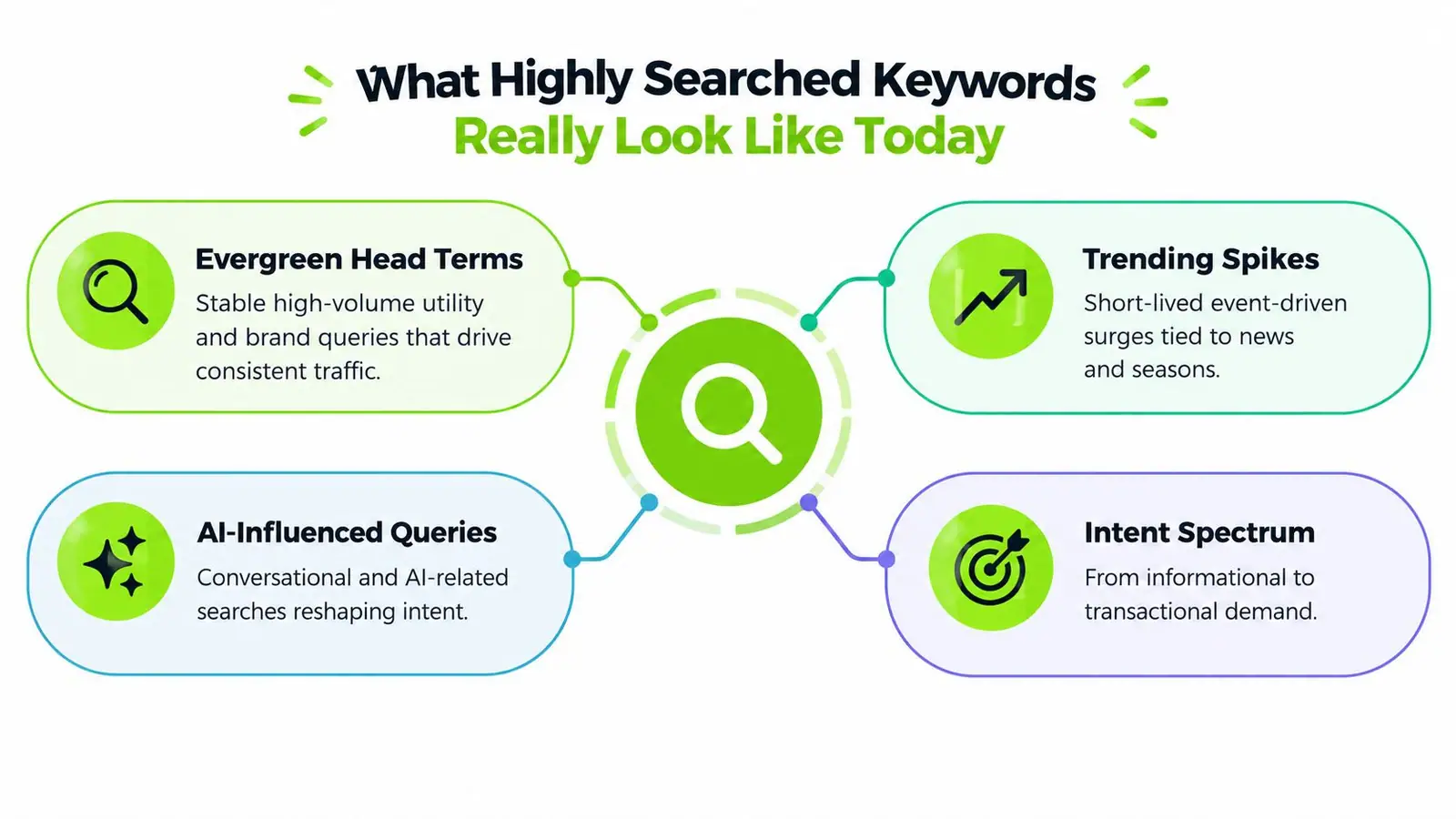
A keyword can attract massive demand and still be a poor target. Search behavior falls into distinct classes, and each class calls for a different SEO response. Brand and utility terms such as YouTube, Amazon, weather, or Wordle often send users directly to a destination or tool. Trending queries can surge around a tournament, product launch, political event, or entertainment release. AI-related searches can move from specialist interest into everyday behavior quickly.
A 2025 ranking of popular Google keywords placed YouTube at about 102.1 million monthly searches, followed by Amazon at 79.95 million, Wordle at 53.3 million, weather at 28.62 million, and ChatGPT at 27.63 million, according to Siegemedia's keyword analysis. Another 2025 dataset reported higher global volumes for related terms, including YouTube at 579.3 million, WhatsApp Web at 528.6 million, and Translate at 278.4 million. The gap between datasets is practical evidence that methodology, market scope, and database coverage affect volume estimates.
These examples show why head terms need context. The largest queries are often familiar brands, tools, shortcuts, and utilities rather than commercial phrases. Ranking for one can expose a site to substantial demand, but strong relevance, authority, and intent alignment are usually required. An AI Overview may also answer an informational query before a user reaches an organic result, reducing the value of raw volume.
Demand changes shape
Evergreen head terms provide a relatively stable baseline. Trending queries behave differently. Google's Year in Search 2025 summary reported Gemini as the top global trending search query, ahead of India vs England, Charlie Kirk, Club World Cup, India vs Australia, Deepseek, Asia Cup, Iran, iPhone 17, and Pakistan and India. The list shows how technology, sports, news, and culture can redirect attention with little warning.
Long-tail demand supplies the less visible opportunities beneath those peaks. RankTracker's 2025 keyword research summary reports that 91.8% of search queries are long-tail, while only 0.0008% of keywords exceed 100,000 monthly searches. It also reports that 94.74% of keywords have 10 or fewer monthly searches. The market is therefore highly uneven: a small set of terms draws enormous attention, while specific queries provide broader coverage and often clearer intent.
Use head terms to define a market and organize topic clusters. Build long-tail pages where the question, need, and likely next action are specific. This approach balances reach with attainable rankings and gives content a better chance of contributing to organic traffic and AI visibility.
How to Discover High Volume Keywords Without Guesswork
A reliable workflow starts with ideas, not with a volume filter. Volume estimates are useful only after you've established the audience, product category, customer language, and search context.
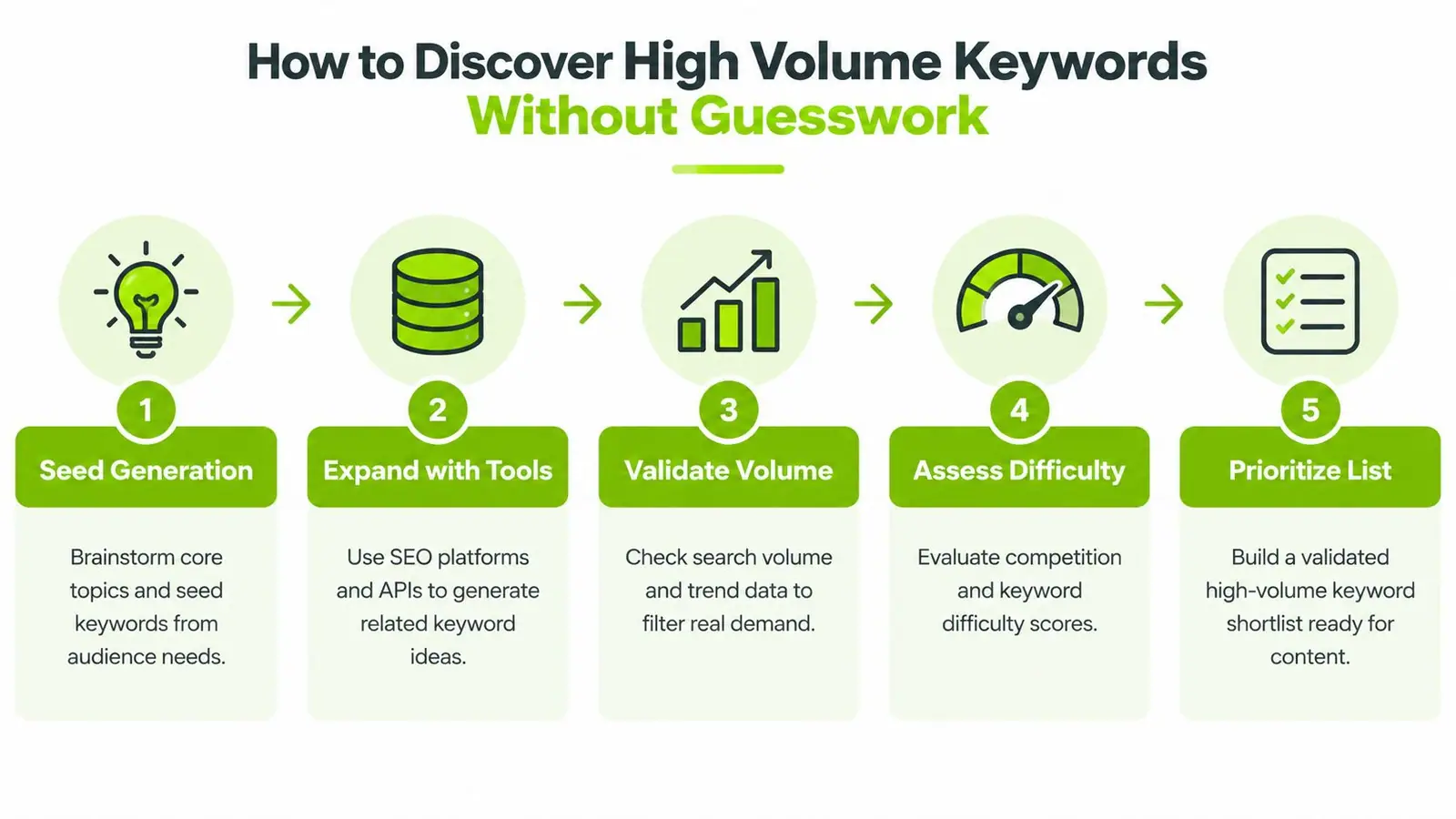
1. Build a seed set from real demand
Start with the words customers use, not the words your internal team prefers. Pull language from sales calls, support tickets, product navigation, reviews, paid-search campaigns, and competitor category pages. Separate core entities from modifiers. For example, an agency selling technical SEO may begin with “technical SEO,” “site audit,” “crawl errors,” and “structured data,” then expand each seed by audience, task, problem, format, and commercial stage.
Keep branded and non-branded seeds separate. A branded term measures existing demand and navigational behavior. A non-branded term is more useful for assessing category reach and new-customer acquisition.
2. Expand with platforms and APIs
Use a keyword database, Google Search Console where available, competitor research, and an API to expand each seed. Look for related phrases, questions, synonyms, comparison terms, and modifiers such as “software,” “template,” “agency,” “pricing,” “for ecommerce,” or “for enterprise.”
Competitor gap analysis is particularly useful here. Export the queries that competing pages rank for, remove terms unrelated to the client's offer, and compare the remaining ideas with existing content. For a repeatable process, use this keyword list building workflow to keep seeds, variants, intent labels, and target URLs organized from the start.
3. Validate volume and trend behavior
Check volume in the target country, language, device context, and date range. Don't treat one estimate as a universal truth. Compare the tool's figure with trend movement, current result pages, Search Console impressions, and observed seasonality.
A keyword with steady demand may support an evergreen guide. A term rising because of a current event may need rapid publishing and frequent monitoring. A falling term may still matter if it represents a strong product category, but it deserves a different forecast and content investment.
4. Inspect the actual SERP
Search the term manually in an incognito window or through a location-specific SERP tool. Record the dominant result types:
- Brand pages: A navigational query may be difficult and commercially irrelevant.
- Product or category pages: Transactional intent usually needs a page built to help users compare or buy.
- Editorial guides: Informational intent may support a detailed article, glossary, or tutorial.
- Forums and mixed results: The query may be unresolved, ambiguous, or suitable for a focused answer.
- AI Overviews and other features: The visible search experience may reduce the number of users who reach traditional listings.
Don't rely on keyword difficulty alone. Difficulty scores summarize competitive signals, but the SERP tells you what Google is rewarding right now and whether your proposed format belongs there.
5. Apply operational filters
Create a shortlist only after combining the evidence. Useful columns include keyword, cluster, intent, location, volume estimate, trend direction, current rank, target URL, business value, competitor examples, SERP format, AI Overview presence, and next action.
A weekly agency workflow can then assign each term to one of three outcomes:
- Pursue now: Strong intent fit, realistic competition, and a clear page type.
- Support through a cluster: Valuable head term that needs related pages and internal links before a direct push.
- Monitor only: Trending, highly competitive, or weakly relevant demand that doesn't justify immediate production.
Use the volume figure as evidence, not as the decision itself. The best shortlist is small enough for a team to execute and detailed enough for every keyword to have an owner, URL, format, and review date.
The discovery process should also include a visibility check for AI-generated search features. Long-tail, question-based searches are more likely to trigger AI Overviews, while one-to-two-word and transactional queries are less likely to do so, according to SearchLab's AI Overview statistics. That distinction belongs in the research sheet before writers receive their briefs.
How to Prioritize Keywords for Content and AI Visibility
A keyword with heavy demand can still be the wrong assignment for this quarter. Prioritization determines which terms receive budget, writing time, design support, links, and measurement.
Score each keyword against five practical criteria: intent match, business value, ranking feasibility, click potential, and AI visibility risk. A high, medium, or low rating works if the team applies it consistently and records the reason. The score should guide a decision, not replace judgment.
Intent match comes first. A broad informational query may support awareness, while a smaller commercial query may deserve priority when the business needs qualified leads. Business value should reflect the page's likely contribution to the customer journey, not the keyword's popularity.
Click potential requires a SERP review. A first-place result can attract substantially more attention than lower organic positions, as the Backlinko data cited earlier demonstrates. A page competing with answer features, video blocks, shopping results, or dominant navigational listings may receive fewer clicks than its position suggests.
A practical comparison
| Keyword Example Type | Intent and Business Value | Difficulty vs Opportunity | AI Visibility Risk |
|---|---|---|---|
| Broad category head term | High market relevance, but intent may be mixed and conversion distance longer | Usually difficult because established sites target the same phrase | Review the SERP. Broad short terms are often less exposed than question-led searches, but results vary |
| Branded or utility query | Strong navigational value for the brand owner, limited value for unrelated businesses | Often unattainable without brand relevance | Usually less useful as a generic content target |
| Specific commercial phrase | Clearer product or service fit and a shorter path to action | Often more attainable than the broad category term | Transactional patterns are generally less exposed than long question queries, according to the SearchLab analysis |
| Long-tail question | Useful for education, problem solving, and topical coverage | Lower individual demand, but broader cluster value | Higher exposure to AI summaries, so plan for citations, original detail, and follow-up paths |
| Trending event term | Value depends on timing, relevance, and publishing speed | Competition can rise quickly during the spike | Monitor results continuously because search features can change with the event |
Head terms and long-tail terms serve different jobs. A head term can anchor a pillar or category page, while specific variations support it through focused articles, comparison pages, FAQs, templates, or use-case content. As noted earlier, RankTracker data shows that only 29% of high-volume keywords contain three or more words. Build the connection between broad demand and specific language instead of expecting one page to satisfy every variation.
Treat AI visibility as a separate outcome
Organic ranking and AI visibility overlap, but they are not identical goals. A page can rank without being selected as a source in an AI-generated summary. Improve its selection prospects with clear definitions, direct explanations, evidence, first-hand detail, useful examples, and a structure that makes key answers easy to extract without making the page shallow.
AI Overview risk should change the content plan, not automatically remove a query from it. An informational question with strong summary exposure may justify an original, citation-friendly answer and a clear path to related resources. A commercial head term may still deserve a direct push when its business value and ranking feasibility outweigh weaker AI exposure.
Pew's analysis found that users clicked a traditional result 8% of the time when an AI Overview was present, compared with 15% when one wasn't present, as reported in this AI Overview statistics review. Click risk is real, yet visibility can still support brand recognition, citations, and a well-positioned follow-up offer.
Use SEO content gap analysis to find where competing pages cover a topic but lack original evidence, clear steps, useful comparisons, or a strong next action. Those gaps often provide a more attainable route to rankings and AI citations than a volume-only filter. A head term can remain the long-term target, while a long-tail cluster creates the coverage and supporting relevance needed to pursue it.
Putting It Into Practice With Real Workflows and Platforms
Keyword strategy becomes useful when it fits the team's operating rhythm. A spreadsheet can support an initial audit, but agencies and in-house teams need a system that connects discovery, page assignments, rankings, SERP changes, and AI visibility.

The agency workflow
When an agency takes on a new account, the first pass should create a baseline rather than a giant content backlog. Export the client's ranking keywords, identify competitors by search results, group terms by intent, and flag pages that already sit close to meaningful visibility. Then review the SERP for priority clusters and note AI Overview presence, citations, result formats, and content weaknesses.
The account lead can turn that review into a short action board:
- Protect: Improve titles, descriptions, internal links, and content for pages already aligned with valuable queries.
- Build: Create cluster content around a strategically important head term.
- Refresh: Update pages where the topic, result format, or user expectation has changed.
- Watch: Track trending or AI-exposed queries before committing to a large production cycle.
A platform such as Surnex can bring keyword research, intent, difficulty, trend movement, rankings, competitor comparison, AI Overview monitoring, citation gaps, and API-driven reporting into one operating view. The point isn't to add another dashboard. It's to reduce the number of disconnected decisions between research and client reporting. For teams building broader AI-search workflows, they can also visit the blog for practical material on AI-driven discovery and support experiences.
The in-house sprint workflow
An in-house team can run a similar process around a defined content sprint. Start with business priorities, select a few topic clusters, and assign each keyword to an existing URL, a new page, or a monitoring queue. Before production begins, the SEO lead should confirm the intent, SERP format, target audience, internal links, conversion path, and AI visibility objective.
After publishing, monitor more than rankings. Track impressions, clicks, landing-page behavior, conversions where available, competing URLs, featured result changes, AI Overview appearances, and whether the brand or page earns citations. A ranking report without a visibility context can make a page look healthy while organic clicks decline.
Automation helps when it delivers decisions rather than noise. Schedule reports that highlight new ranking movement, competitor changes, emerging terms, citation gaps, and pages requiring review. Keep the automated SEO platform workflow tied to owners and deadlines, so every alert leads to an action or gets removed.
Smart Next Steps for Turning Keyword Demand Into Results
Highly searched keywords deserve attention, but they shouldn't control the entire roadmap. The strongest programs use broad terms to understand the market, specific clusters to build attainable coverage, and SERP monitoring to account for changing click conditions.
Use this checklist during your next planning session:
- Reject vanity volume: Remove terms with weak relevance, unclear intent, or no credible route to visibility.
- Match the page to the search: Choose a category page, product page, guide, comparison, tool, or answer based on the actual results.
- Cluster deliberately: Connect one strategic head term with related long-tail pages that address distinct needs.
- Check AI exposure: Record AI Overview presence and decide whether the page should pursue clicks, citations, brand visibility, or all three.
- Review on a schedule: Revisit rankings, trends, competitors, and SERP features before each content cycle.
The next week's work can be simple. Audit your current keyword list, label every term by intent and query class, assign a business value rating, and inspect the results for your highest-priority clusters. Then select a manageable group of pages with clear owners and measurement criteria.
Volume creates attention. Intent creates relevance. Visibility conditions determine what you can capture.
Surnex brings keyword volume, intent, difficulty, trends, rankings, competitor signals, and AI visibility monitoring into a single SEO and AI Search workflow. Use Surnex to turn a raw list of highly searched keywords into prioritized content opportunities, track citation gaps, and report on the visibility that matters.