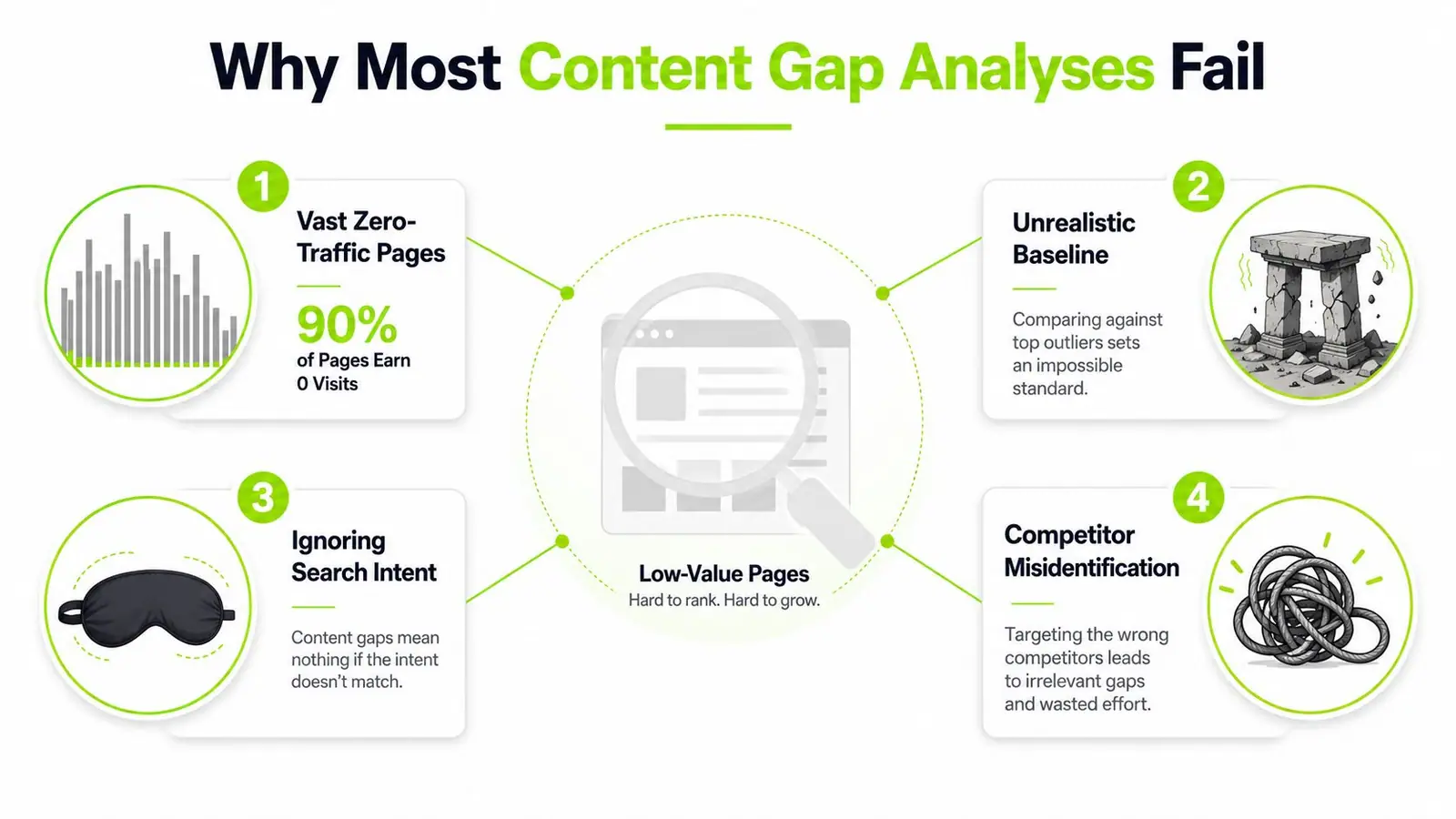
More than 90% of web pages get zero organic traffic from Google according to Ahrefs-based analysis summarized here. That one number changes how you should think about SEO content gap analysis. The problem usually isn't a few missing keywords, it's that most sites are carrying around a much larger inventory of thin, misaligned, or invisible pages than they realize.
A modern gap analysis looks beyond keyword exports. It compares your coverage against true search competitors, checks whether your pages match search intent and SERP format, and now has to account for AI visibility gaps as well. If AI Overviews or LLM-driven discovery are answering the query without your brand, ranking alone isn't enough.
Why Most Content Gap Analyses Fail Before They Start
Most gap analyses fail because teams start with the wrong assumption. They treat the exercise like a keyword spreadsheet exercise, then act surprised when the results don't move revenue. That misses the reality that most pages never earn search traffic in the first place, so the primary job is finding the few gaps that can create meaningful visibility as summarized in Ahrefs-based coverage.
The real scope is wider than keywords
A proper seo content gap analysis is a structured audit of what your site is missing, what it covers poorly, and where it's invisible in both search and AI answers. That includes keyword coverage, search intent alignment, SERP format matching, technical health, and AI visibility. If you only compare rank positions, you miss pages that technically rank but fail to win the click because the result type doesn't fit the query.
I've seen teams spend weeks chasing “missing” keywords on pages that were already broken by canonical problems, weak titles, or low engagement. That's a bad trade. A page that can't be indexed cleanly or doesn't convert its traffic doesn't deserve priority just because a competitor ranks for the same term.
Practical rule: if a gap can't be tied to a business outcome, it's probably not a gap worth fixing yet.
Why the five-dimensional view matters
The practical model is simple. First, ask whether you're missing the topic at all. Second, ask whether your existing page answers the right intent. Third, check whether the dominant SERP format is a snippet, PAA box, video result, image pack, or standard blue link. Fourth, make sure the page is technically healthy enough to compete. Fifth, test whether you're visible in AI-generated answers and citations.
That last layer matters more than most older guides admit. Search has moved from pure ranking competition to a mix of ranking, citation, and answer inclusion. Brands that ignore that shift end up optimizing for yesterday's search behavior while competitors win visibility in the surfaces that users see first.
Website audit basics help here, because content gaps and technical gaps usually overlap more than teams expect. If the crawl is incomplete, the gap list won't be trustworthy.
Assembling Your Data Foundation Before Comparing Anything
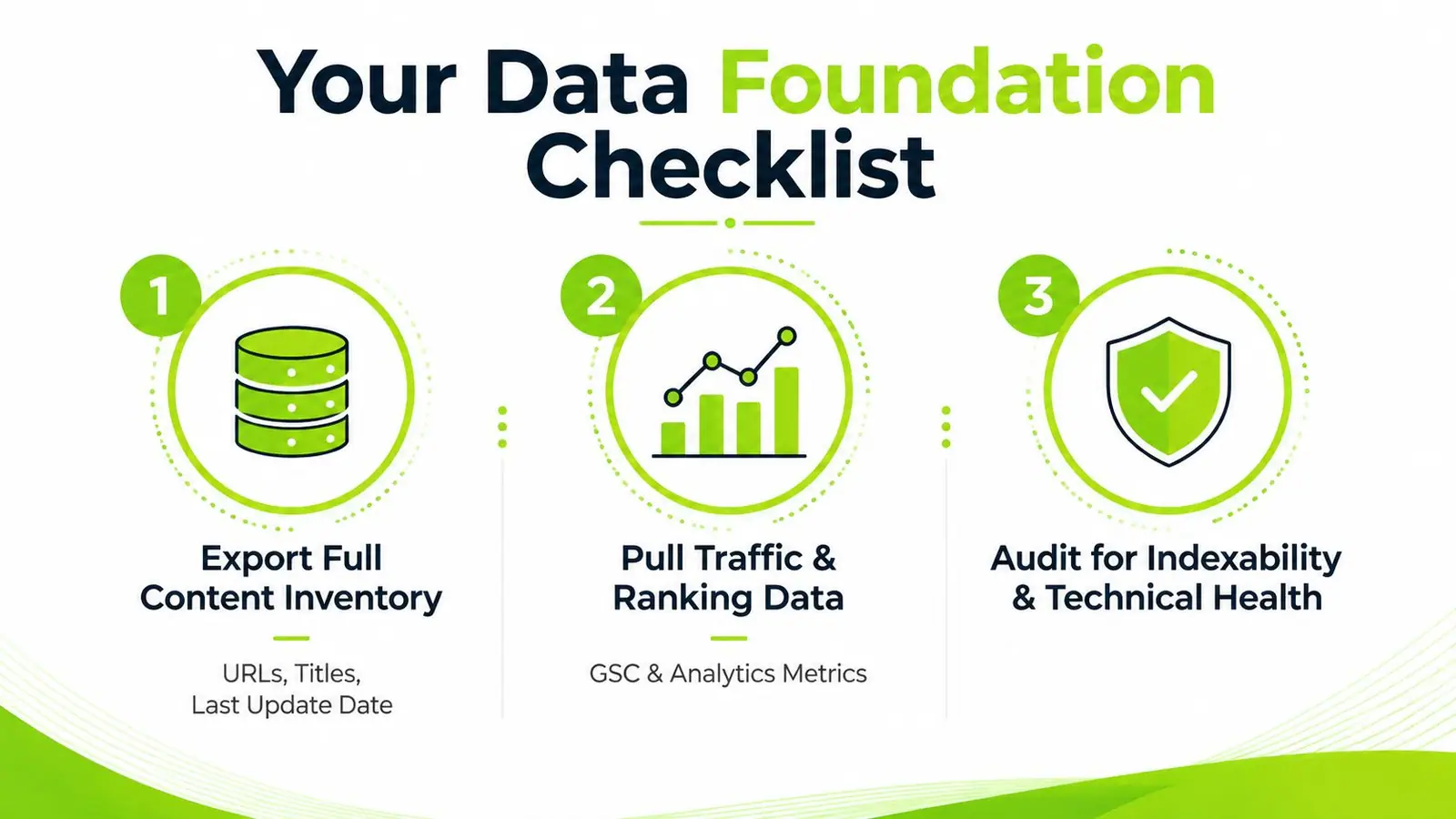
A useful gap analysis starts with a complete inventory of what already exists. Without that, you'll mistake old pages for missing ones, overlook pages with weak technical health, and prioritize topics that look attractive in a keyword tool but are weak in practice. The cleanest workflow is to build a URL-level master sheet first, then enrich it with search, analytics, crawl, and AI visibility fields.
Build the master inventory first
Export crawl data with at least these fields, indexable URL, meta title, meta description, H1, canonical, and response code. Then join that export with 90 to 365 days of Google Search Console data, including queries, impressions, CTR, and average position. Add GA4 engagement and conversion metrics so you can sort pages by actual business value, not just visibility. If your team tracks AI surfaces, include columns for AI Overview presence and citation signals too, because those gaps now sit beside traditional keyword gaps in the same analysis.
That sounds basic, but plenty of teams skip the join step and jump straight to keyword research. That is where bad recommendations start. If a page already gets impressions but has a weak click-through rate, it needs a different fix than a page with zero visibility and no useful intent fit. The same is true for AI citations. A page can rank decently and still be absent from the answer layer, which means the opportunity is not a keyword gap alone.
Use a template, but do not stop there
A good starting point is a structured worksheet like the content gap analysis template by Outrank. Use it to organize the work, not to replace judgment. The template is only useful if you layer in crawl status, conversion data, intent notes, and AI visibility notes before you decide what belongs in the roadmap.
Pages with traffic are not automatically valuable, and pages with no traffic are not automatically bad. The data has to show both opportunity and fit.
Segment before you score
Once the inventory is assembled, segment pages by intent. A product page, a comparison guide, and a support article should never compete in the same bucket. If you ignore that distinction, you'll end up comparing pages that answer different jobs and then drawing the wrong conclusions about content gaps.
For teams that want a tighter data pipeline, this SEO data workflow guide is a practical companion. It reinforces the same principle, gather the raw fields first, then let the analysis layer decide what matters. If the underlying crawl, performance, and citation data are incomplete, the rest of the process gets noisy fast.
The simplest internal question is this, does this page have the technical health, search evidence, AI visibility potential, and business relevance to justify more work? If the answer is unclear, the page should not be treated as a content gap candidate yet.
Identifying True SERP Competitors and Extracting Keyword Gaps
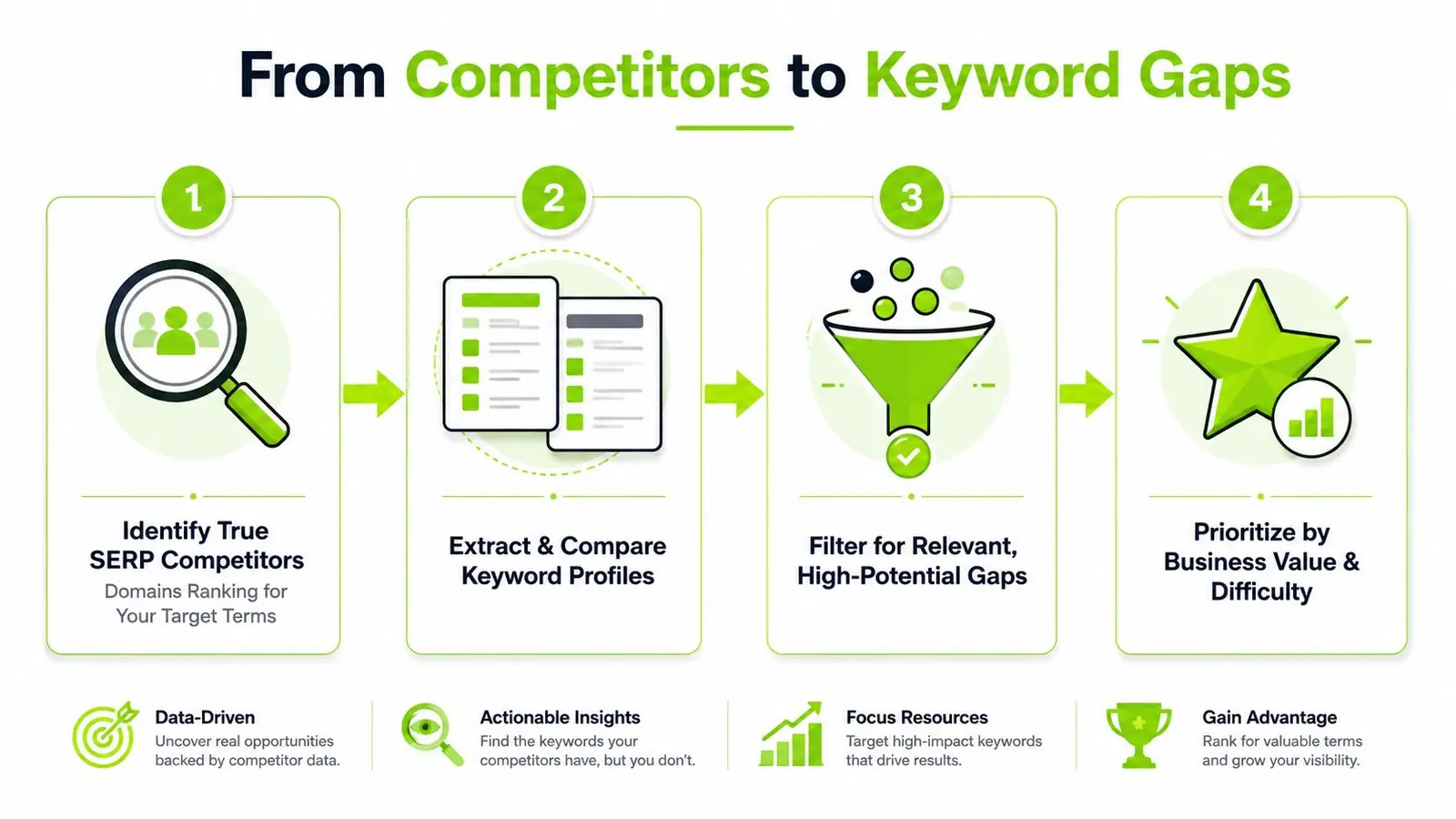
Business competitors and search competitors are rarely the same thing. A sales team may care about a handful of direct rivals, but the SERP can be dominated by publishers, directories, forums, marketplaces, and video pages that your commercial team barely knows. If those domains own page one, they're your real competitors for that topic.
Start with the domains that actually win page one
Identify the domains that repeatedly appear for your target terms, then compare them against your ranked keyword set. The most useful gaps show up here, especially when a competitor ranks in positions 1 to 10 and your site sits outside the top 20. Those terms usually signal high intent, but only if the page type and search intent are aligned.
I prefer to look at the SERP itself before I trust any tool export. If the top results are listicles, comparison pages, or video results, that tells you a lot about the format users want. A generic blog post may be on-topic and still miss the job entirely.
Filter for relevance before volume
The best filter is not “biggest keyword volume.” It's “closest commercial fit.” Pull the competitor keyword sets, then isolate terms where you're absent or weak while the SERP competitors are consistently visible. That's where the work is worth doing.
A few practical checks help keep the list honest:
- Position gap: prioritize terms where competitors are in the top results and you aren't.
- Format gap: note whether the query is dominated by featured snippets, People Also Ask, video packs, or image results.
- Intent gap: separate educational queries from commercial or transactional ones.
- Page fit: decide whether the topic belongs on a blog post, landing page, comparison page, or support page.
Practical rule: if the query intent is clear but your current content type is wrong, rewrite the format before you write more words.
Keep the workflow ongoing
The biggest mistake here is treating competitor research like a one-time export. Search competitors change, result formats shift, and the page one environment moves constantly. Search Engine Land's gap-analysis guidance also recommends checking AI Overview inclusion, because a competitor can win attention there even when the classic ranking picture looks stable Search Engine Land's gap-analysis workflow.
This competitor-finding guide is useful when you need to separate market rivals from SERP rivals. Once the true competitor set is clear, keyword gaps become much easier to trust, and far easier to prioritize.
The AI Visibility Layer Most Gap Analyses Still Ignore
A page can rank and still miss the answer layer. Search Engine Land's guide on gap analysis says modern reviews should cover content, keywords, links, technical health, and search visibility, while also checking which competitors show up in AI Overviews Search Engine Land's guide. That matters because when an AI Overview sits above the organic results, the click pool shifts fast, and the top organic listing can lose a large share of its traffic Pew Research Center.
What an AI visibility gap looks like
An AI visibility gap is the distance between the topic you should own and the sources the model cites. Your brand may be missing from the answer entirely. A competitor may be named first. Your page may rank, yet the AI still chooses a different source to support the response.
That is a different problem from a classic keyword gap. A page can satisfy the ranking system and still lose the citation layer. In practice, the analysis has to check whether you appear in search and whether answer engines are using your content as a source.
Track citations, not just mentions
Manual prompt checks still matter because they show how the answer is built. Look at which brands are mentioned, which sources are cited, and whether your own content appears in either place. Then compare your page with the pages that do get cited. In many cases, the reason is plain enough. The cited page is clearer, more specific, or easier for the model to extract.
For teams that want a tool-driven workflow, browse LLM SEO with Ryware is useful when the goal is prompt-level monitoring instead of occasional spot checks. It fits best when you need a repeatable process for tracking how AI systems surface your content across answer surfaces.
A page that is not cited in AI answers may still support discovery, but rank alone no longer covers the full visibility picture.
This AI overview tracker guide fits into that reporting layer because the questions are the same. Where do you show up, where do you disappear, and which competitors take the slot. Once that layer is measured consistently, the gap list changes quickly.
A better way to read 2026 search is to separate classic gaps from AI gaps. Traditional gaps show where you are absent from the results. AI gaps show where you are absent from the explanation. Brands that ignore both are optimizing for visibility that users may never see.
Prioritizing Gaps That Actually Drive Revenue
Finding gaps is easy. Choosing which ones deserve the next content sprint is where teams get stuck. A strong priority list balances business value, intent quality, and technical feasibility. That mix usually surfaces the work that matters in revenue terms, not just traffic terms.
Score every gap against three realities
First, ask whether the topic connects to a product, service, or conversion path. Second, ask what kind of intent the query carries, informational, commercial, or transactional. Third, ask whether the site can realistically compete given the current content depth, authority, and resource limits.
A simple matrix keeps the decision honest.
| Content Gap Prioritization Matrix | Business Value Score | Intent Type | Competition Level | Priority Action |
|---|---|---|---|---|
| Product comparison topic tied to a core offer | High | Commercial | Moderate to High | Build or refresh a comparison page |
| Support question that blocks conversion | High | Transactional | Low to Moderate | Create a help page or FAQ section |
| Broad educational topic with weak product linkage | Medium | Informational | High | Delay unless it supports a funnel path |
| Keyword with visible SERP competitors and weak fit | Low | Mixed | High | Skip or reframe before production |
Use quick wins and long bets together
Quick wins matter when a team needs momentum. These are usually gaps where the SERP is clear, the intent is narrow, and the site already has enough authority to compete. Long bets are different. These are the topics where the commercial upside is strong, but the site needs more depth, proof, or supporting pages before it can win.
The trap is assuming every gap deserves a new page. Sometimes the better move is to improve an existing one, add a comparison section, or create a supporting asset that helps the main page rank and convert. If the page already has some traction, updating often beats starting from scratch.
Don't let volume outrank fit
Practical rule: if a keyword is big but disconnected from revenue, it is a distraction, not a priority.
A lot of teams overvalue “easy” informational wins because they are easy to justify in a deck. The problem is that those wins often do not move pipeline. A smaller, sharper opportunity tied to buyer intent usually does more for the business than a broad topic with no path to conversion.
Ranking well is necessary, but it is insufficient without citation presence in AI Overviews and other answer surfaces. A page can sit on page one and still miss the explanation layer that shapes user clicks and model citations. That matters more every time search results blend organic links with generated answers.
The best gap lists feel slightly uncomfortable because they force trade-offs. That is a good sign. If every item looks equally urgent, the scoring system is probably too soft.
Turning Analysis Into Actionable Reports and Automated Workflows
A gap analysis only matters if someone can act on it without rereading the spreadsheet three times. The report needs a short narrative, a ranked opportunity list, and a clear recommendation for each item. If the output feels like a data dump, the strategy won't survive the meeting.
Structure the report around decisions
Start with an executive summary that says what's missing, why it matters, and what should happen first. Then add a prioritized opportunity table with columns for page type, intent, business value, effort, and recommended action. That keeps the conversation grounded in decisions instead of abstract findings.
Turn the report into a monitoring system
Once the initial analysis is done, make it recurring. Competitors publish new content, AI citations shift, and pages drift in or out of visibility. A living workflow catches those changes before the next quarterly review.
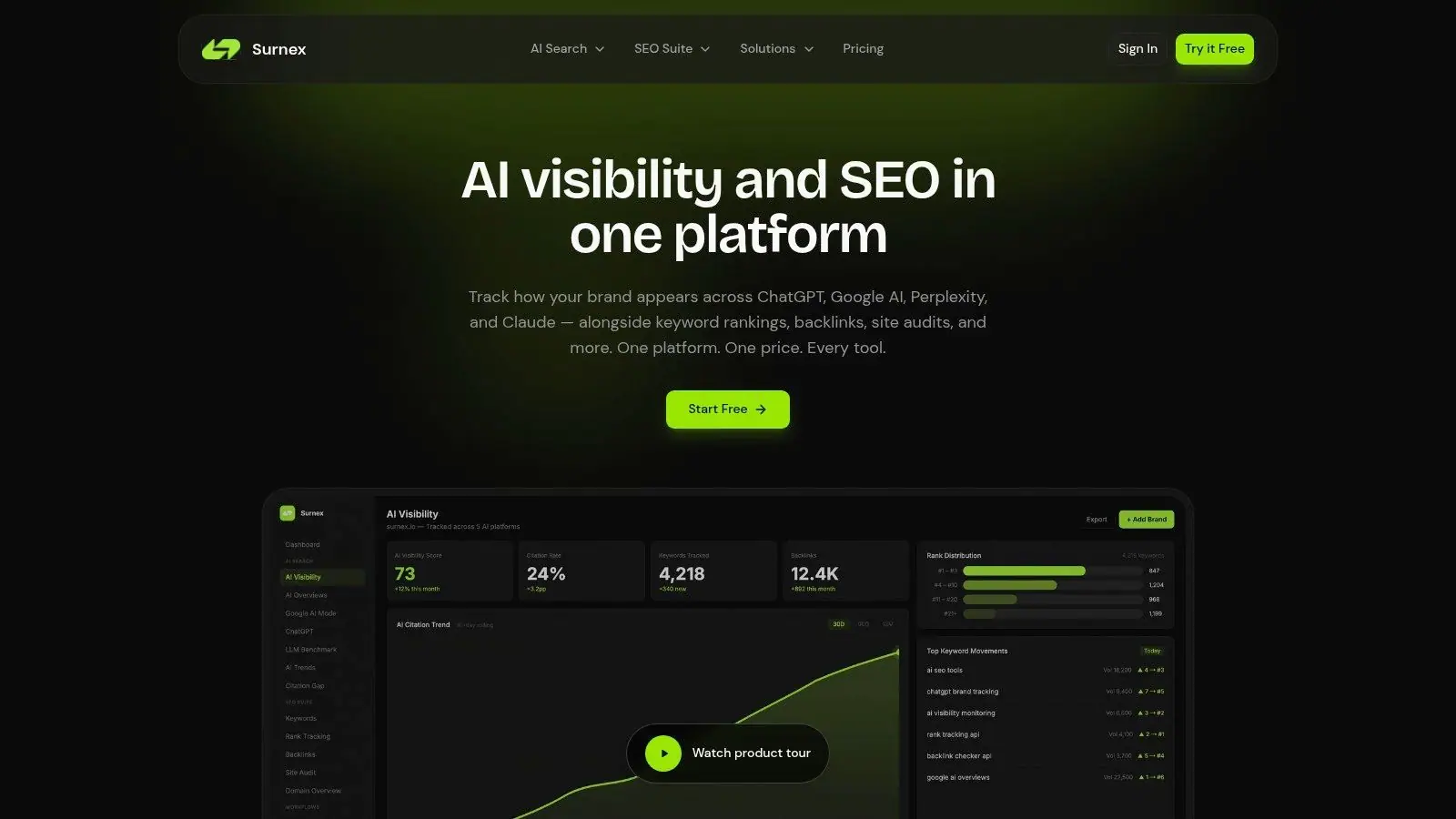
That's where a platform like Surnex fits naturally, because it unifies AI visibility tracking with rankings, backlinks, audits, and content opportunities in one place. It also supports an agent-ready API, which matters for teams that want to automate recurring checks instead of rebuilding the analysis manually every month.
Make the handoff easy for content and SEO teams
The most useful report format is simple:
- Executive summary: the few issues that matter most.
- Opportunity table: the ranked gaps and the recommended page type.
- Content notes: what the page must include to match intent and format.
- Tracking plan: which queries, competitors, and AI surfaces to monitor next.
For a broader operational reference, the SEO audit guide is a solid companion because the handoff logic is similar. Audit the issue, define the fix, assign the owner, then track whether the fix changes visibility.
If the process is done well, the gap analysis stops being a one-off deliverable. It becomes a repeatable system for finding missing topics, catching AI citation shifts, and deciding what the next content move should be.
If you want a cleaner way to track keyword gaps, AI citation gaps, and technical issues in one workflow, Surnex gives teams a single place to monitor visibility and spot new opportunities as search changes. It's built for agencies, in-house SEO teams, and developers who need reporting that keeps up with both classic rankings and AI search surfaces.