Your reporting stack says rankings are steady, technical health is fine, and backlinks are growing. Then the sales team asks why branded traffic is flat while prospects keep mentioning ChatGPT, Perplexity, and Google AI Overviews. That disconnect is why "SEO visibility" needs a stricter definition than it did a year ago.
Classic rank tracking still matters. It just misses part of the picture now. A page can have modest organic positions and still surface in AI-generated answers, while a page that ranks well can disappear from those answer layers entirely. If a tool only reports blue-link performance, it leaves a blind spot in the channels leadership now cares about.
That is the lens for this guide. I am not treating these products as one big feature pile. I am separating them into All-in-One Platforms, Enterprise Suites, and Specialist Trackers, because those categories solve different operational problems. I am also judging them on a newer requirement that many teams are still underestimating: whether they can help you monitor and improve AI search visibility alongside traditional SEO metrics.
If you are still sorting out what that newer layer should include, this overview of AI search visibility tools and what they actually measure is a useful starting point.
The practical question is not which tool has the longest checklist. It is which one matches the way your team works, the reporting your stakeholders expect, and the level of accuracy you need before making decisions on content, technical fixes, and competitive monitoring. That is where the trade-offs show up, and that is what this comparison is built to clarify.
All-in-One Platforms
1. Surnex
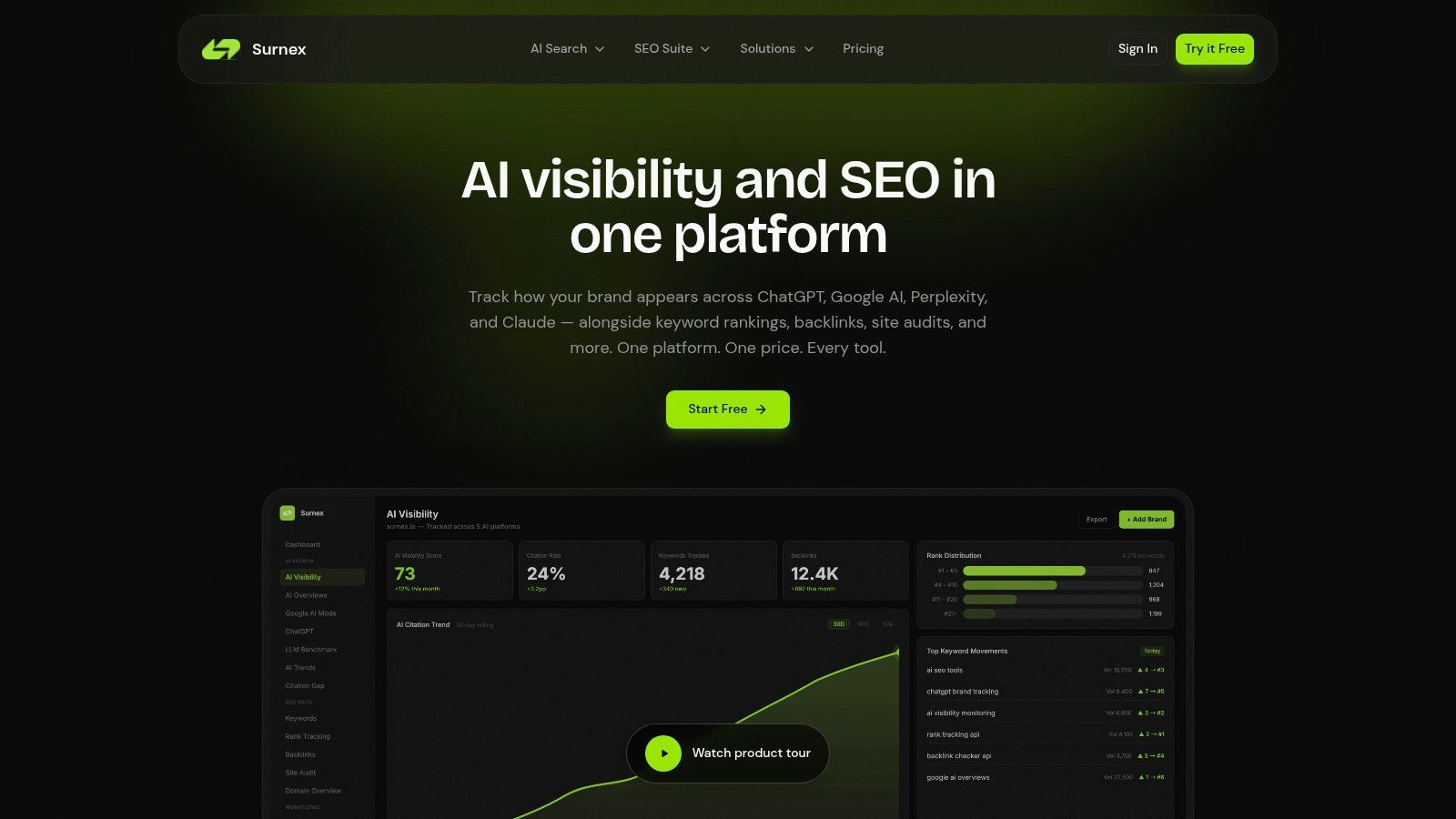
Surnex is the tool I'd put at the top of the list if your problem is tool sprawl. It combines AI search visibility tracking with the core SEO stack organizations commonly require: rankings, backlinks, audits, Core Web Vitals, domain snapshots, and reporting. Instead of forcing a separate workflow for “AI search” and “SEO,” it treats them as part of the same operating system.
That matters because search behavior has changed faster than reporting practices have. A lot of platforms added AI widgets on top of legacy rank tracking. Surnex feels more purpose-built. You can see where your brand appears across Google AI Overviews, AI Mode, ChatGPT, Perplexity, Claude, and other LLM-driven surfaces, then compare that visibility with your conventional SEO signals in the same dashboard.
Where Surnex stands out
The strongest differentiator is side-by-side LLM benchmarking. If a competitor gets cited in one model and disappears in another, that difference is useful. It tells you whether you have a content problem, an authority problem, or a formatting problem. Citation Gap analysis is also indeed practical. It helps teams spot where competitors are being mentioned in AI answers and where their own domain is missing.
A second strength is workflow design. Agencies can run repeatable audits, produce white-label reports, and keep AI visibility reviews tied to rank and backlink reviews instead of making them a separate service line. Developers and product teams also get an API-first setup, which is rare enough to matter.
Practical rule: If your team is exporting data into other dashboards, building client portals, or feeding search data into internal tools, API access isn't a bonus feature. It's part of the buying decision.
Surnex also fits the current market direction. SEO teams are adapting quickly to AI search, and 71% of SEOs have already adjusted their processes to account for it, according to the same SNS Insider market summary.
Best fit and trade-offs
Surnex is a strong fit for agencies, in-house teams, and technical teams that want one platform instead of a stitched-together stack. It's especially useful if you need to explain AI search visibility to clients or non-SEO stakeholders in a way that connects to rankings, links, and technical health.
The trade-offs are straightforward:
- Unified workflow: You get AI visibility and traditional SEO in one place, which reduces context switching.
- Useful AI diagnostics: LLM benchmarking and citation gap analysis are more actionable than generic “AI presence” views.
- Automation-ready: The REST API makes it easier to build reporting or product integrations.
- Pricing opacity: The site mentions a free plan or trial and positions itself as one platform with one price, but detailed public tiers aren't clearly laid out.
- Young signal set: AI search is still moving fast, so you should validate model coverage and query sampling against your own market before standardizing on any platform.
If this category is your priority, review Surnex alongside its own take on AI search visibility tools, then test it with live brand queries before you roll it across accounts. You can explore the platform at Surnex.
2. Semrush
A common mid-market scenario looks like this: the team needs rankings, keyword research, site audits, backlink checks, competitor monitoring, and reports that a director can read without a walkthrough. Semrush is often the tool that gets shortlisted first because it covers all of that in one system and is easy to roll out across mixed-skill teams.
That broad coverage is still its main advantage. Semrush handles day-to-day SEO operations well, especially for agencies and in-house teams that want one platform instead of stitching together separate tools for rank tracking, technical crawling, and competitive research. Its AI visibility features also matter now because they let teams evaluate traditional search performance and AI search presence in the same workflow, which is the primary pressure point for many SEO programs.
The trade-off is depth.
Semrush does a lot well, but specialist tools can still beat it in narrow areas. Dedicated rank trackers usually give you tighter controls and cleaner alerting. Purpose-built link tools can be better for forensic backlink work. If backlinks are a major part of your workflow, it helps to compare Semrush against other backlink analysis tools for SEO teams before you standardize on one stack.
What it does well
Semrush is strongest when the job is operational coverage, not niche excellence. Keyword research, position tracking, backlink analysis, site auditing, content support, local features, and reporting are all mature enough to support a real team process. That matters more than feature count alone. A tool can have twenty modules and still fail if the workflow breaks once you involve account managers, writers, and executives.
I usually recommend Semrush when reporting discipline is already in place or when a team is ready to build it. Otherwise, the platform can become expensive shelfware. The issue is rarely missing capability. The issue is paying for breadth that nobody owns.
Its AI visibility layer is also worth evaluating carefully rather than treating it as a checkbox. For teams trying to measure brand presence in AI-generated answers alongside rankings and clicks, Semrush is more useful than older suites that still separate AI search from the rest of SEO reporting. You still need to validate the query set against your market, especially if you work in a niche B2B category or outside the US.
Best fit and trade-offs
Semrush fits agencies, marketing teams, and growing in-house SEO functions that want a mature all-in-one platform and can accept some overlap with specialist tools.
- Broad day-to-day coverage: Good fit for teams managing rankings, content research, links, technical issues, and competitor monitoring in one place.
- Usable reporting: Dashboards and exports are easier to hand to clients or senior stakeholders than many specialist products.
- Strong ecosystem: Integrations, add-ons, and API options support more advanced reporting once the default interface is no longer enough.
- Cost expansion: More users, extra projects, and premium modules can raise the total cost quickly.
- Feature overlap: Teams already using a dedicated rank tracker or backlink platform may end up duplicating spend.
- AI search is improving, not settled: The AI visibility features are useful, but they still need manual validation before you treat them as a source of truth.
If the goal is one platform that can run a large share of your SEO program, Semrush remains a practical choice. If the goal is best-in-class depth in one discipline, compare it carefully against the enterprise suites and specialist trackers later in this list. Main site: Semrush.
3. Ahrefs
Ahrefs remains one of the cleanest tools to use when link intelligence and SERP research are central to your workflow. Its interface is fast, its backlink data is trusted by a lot of practitioners, and it has done a better job than many older platforms at adding AI and LLM visibility features without making the product feel bloated.
If Semrush is the broad operations suite, Ahrefs is often the sharper analyst's tool. Site Explorer, Keywords Explorer, Rank Tracker, and Site Audit cover the essentials well. Brand Radar and prompt tracking make it more useful for teams that want to watch how their brand appears in AI-driven discovery without leaving their main research environment.
Where Ahrefs fits best
Ahrefs is strongest when you care about competitive SEO research and backlink quality more than white-label workflow. I'd pick it for content-led teams, consultants, and in-house SEOs who spend a lot of time diagnosing why competitors win.
Its plan structure is also relatively easy to understand compared with some enterprise suites. That makes budgeting simpler, especially for smaller teams trying to avoid quote-only procurement.
A practical caveat: heavy technical teams need to watch crawl credits and usage limits closely. Ahrefs is powerful, but it's not the kind of platform you buy and forget. If you run large audits often, usage planning matters.
- Backlink strength: One of the better choices for link analysis and competitive gap work.
- Good AI additions: Brand Radar and prompt tracking are useful, not decorative.
- Clearer plan logic: Easier to model cost than many enterprise tools.
- Premium tiers: Advanced use gets expensive.
- Usage constraints: Big crawls and larger environments need planning.
For teams where links still drive a lot of strategy, I'd compare Ahrefs against this roundup of backlink analysis tools before deciding. Main site: Ahrefs.
4. SISTRIX
SISTRIX has a very specific appeal. If you care about historical visibility trends, international benchmarking, and a consistent visibility metric that many experienced SEOs already understand, it's a serious option. It feels less like a marketing platform and more like a measurement toolbox.
That can be a plus or a minus depending on your team. Some people love the directness. Others want more guided workflows and friendlier reporting layers. SISTRIX doesn't try very hard to be flashy, which is part of its value.
Why practitioners still like it
The Visibility Index is the main draw. Teams use it to benchmark domains over time, compare competitors, and spot trend changes without reinventing the metric every quarter. For European and international SEO work, that consistency can be very useful.
It also gives you enough around the core metric to stay productive: keyword research, domain analysis, backlink data, project monitoring, and reporting. API credits and exports are visible by tier, which makes planning easier than in products where quotas stay vague until sales calls.
If your reporting culture already revolves around visibility trend analysis, SISTRIX can be easier to defend internally than a broader suite with too many competing metrics.
Best fit and trade-offs
SISTRIX is best for consultants, agencies, and in-house teams that want clean historical benchmarking and don't need hand-holding.
- Reliable visibility framing: Great for trend analysis and competitor benchmarking.
- Strong historical depth: Helpful when diagnosing long-term movement.
- Transparent quotas: Easier export and API planning.
- Less guided UX: Newer users may find it more functional than intuitive.
- Regional pricing complexity: Euro-based pricing can complicate budgeting across markets.
Main site: SISTRIX.
5. Similarweb
Similarweb sits in a different lane from pure SEO suites. It's more useful when SEO visibility is only one part of the competitive picture and you also care about traffic sources, audience patterns, channel mix, and broader digital market intelligence. That makes it valuable for growth teams and enterprise marketers who need context, not just rank charts.
Its AI Search Intelligence angle also deserves attention. If your leadership team wants to understand where brand exposure is shifting across LLM-driven discovery, Similarweb gives you a wider frame than most SEO-first products.
When Similarweb is the right pick
I usually recommend Similarweb when the question isn't “how do we improve rankings?” but “how visible are we compared with the market, and where is that visibility moving?” SEO teams inside larger organizations often need that larger story.
The downside is familiar. Estimated traffic tools never line up perfectly with first-party analytics. You need calibration and restraint. It's best used for directional insight and competitive benchmarking, not as a replacement for your own analytics stack.
A practical point in its favor is data delivery. If your data team wants feeds, APIs, or MCP-style integrations, Similarweb is built for that kind of environment better than many SEO-native tools.
- Broader market view: Good for combining SEO, traffic, audience, and AI visibility signals.
- Useful AI coverage: Helpful for brand and citation tracking beyond classic search.
- Enterprise data options: Better than many SEO tools for data team workflows.
- Estimate limitations: Needs cross-checking against first-party data.
- Quote-heavy pricing: Business and enterprise buying can take time.
Main site: Similarweb.
Enterprise Suites
6. BrightEdge
BrightEdge fits organizations where SEO has already outgrown a single practitioner workflow. It is built for teams that need approval layers, formal reporting, and a platform that can support both day-to-day optimization and board-level performance discussions.
For that job, BrightEdge is one of the more established enterprise suites. Data Cube X covers keyword and domain research at scale, while AI Hyper Cube adds visibility into AI search presence and citation patterns. That mix matters because enterprise teams now need to track two things at once: traditional search demand and whether their brand shows up in AI-generated answers.
The primary advantage is operational discipline. BrightEdge gives large teams a way to standardize reporting, forecast opportunity, and keep stakeholders aligned across SEO, content, and leadership. I see it work best in environments where the SEO lead has to defend budget, explain forecast assumptions, and keep multiple business units working from the same view of performance.
There are trade-offs.
- Strong executive reporting: Useful for forecast models, recurring stakeholder reviews, and performance storytelling.
- AI visibility coverage: Better suited to modern search reporting than enterprise tools that still focus only on rank tracking.
- Support beyond software: Its services and customer support structure can help during rollout and change management.
- Longer buying process: Sales, procurement, and implementation usually take time.
- Heavy for smaller teams: If you mainly need rank tracking and quick competitor checks, the platform can feel oversized.
BrightEdge makes the most sense for enterprise brands that want governance as much as data. Smaller teams can get similar tactical SEO answers from cheaper tools, but they usually will not get the same level of reporting structure or internal accountability.
Main site: BrightEdge.
7. Conductor
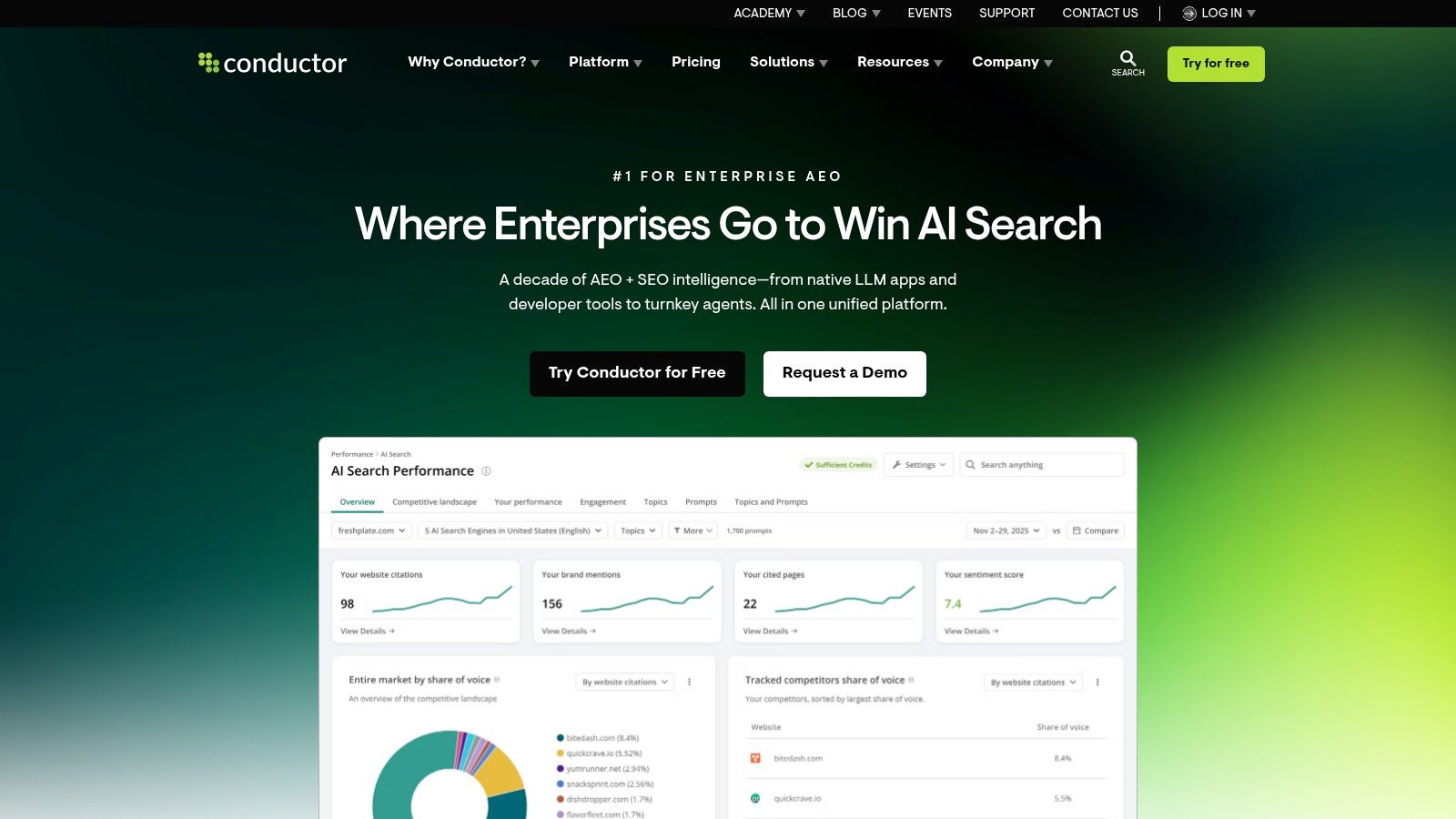
Conductor is one of the more convincing answers to the SEO plus AEO convergence. It doesn't just bolt AI visibility onto an old reporting model. It tries to connect AI visibility, content workflows, and technical monitoring into one enterprise process.
That matters if your content, SEO, and web teams already work in parallel and need a shared system. Conductor Intelligence handles AI and search visibility across LLMs and web search, while Creator and Monitoring tie that insight to content production and always-on technical health.
Why some enterprise teams prefer it
Conductor feels especially useful for organizations that are already thinking in “answer engine optimization” terms. If your team is trying to understand how brand presence changes across ChatGPT, Gemini, Claude, Copilot, and traditional search, the framing is clearer than in some older enterprise suites.
Its integration posture is also strong. Developer-friendly API and MCP options matter in larger environments where search data has to flow into internal platforms or broader analytics systems.
One practical point stands out: many teams still struggle to connect AI visibility changes to page-level edits. That diagnostic gap is real, and 68% of marketers struggle to attribute AI visibility improvements to specific page edits, according to Style Factory's review of AI visibility tools. Conductor is at its best when your team is mature enough to close that loop operationally, not just observe it.
- Strong AI plus SEO framing: Better fit for teams explicitly building AEO processes.
- Workflow alignment: Useful for connecting insights, creation, and monitoring.
- Integration-ready: Good for complex stacks.
- Enterprise-only buying motion: Public pricing is limited.
- Needs process maturity: Best results come when content and technical teams are already coordinated.
Main site: Conductor.
8. STAT Search Analytics by Moz
STAT is not trying to be your all-in-one SEO platform. That's why the right teams love it. It focuses on high-volume rank tracking, SERP analytics, and feature-level monitoring for large keyword sets across locations and devices.
If you manage many markets, local variants, or large client portfolios, STAT is one of the cleaner specialist choices. Agencies often use it because they need consistency at scale more than they need a bundled backlink index.
Where STAT is strongest
Daily tracking, granular segmentation, and SERP feature monitoring are the core strengths. If your reporting depends on who owns local packs, featured snippets, shopping blocks, or other search features across many cities or regions, STAT does that job well.
The API is also mature enough for teams that want to move rank and feature data into BI tools. That's a big reason it stays relevant even in stacks where other tools handle content, links, and audits.
Use STAT when ranking precision is the service. Don't use it if you want one product to handle your whole SEO program.
Best fit and trade-offs
STAT is best for enterprise SEO teams and agencies that need serious rank monitoring infrastructure.
- Excellent rank tracking depth: Built for large-scale SERP and position monitoring.
- Strong location and device segmentation: Useful for multi-market reporting.
- API-friendly: Works well in custom reporting setups.
- Narrow scope: You'll still need tools for links, audits, and AI-specific diagnostics.
- Enterprise-oriented pricing: Usually not a fit for smaller teams.
Main site: STAT Search Analytics.
Specialist Trackers
9. AccuRanker
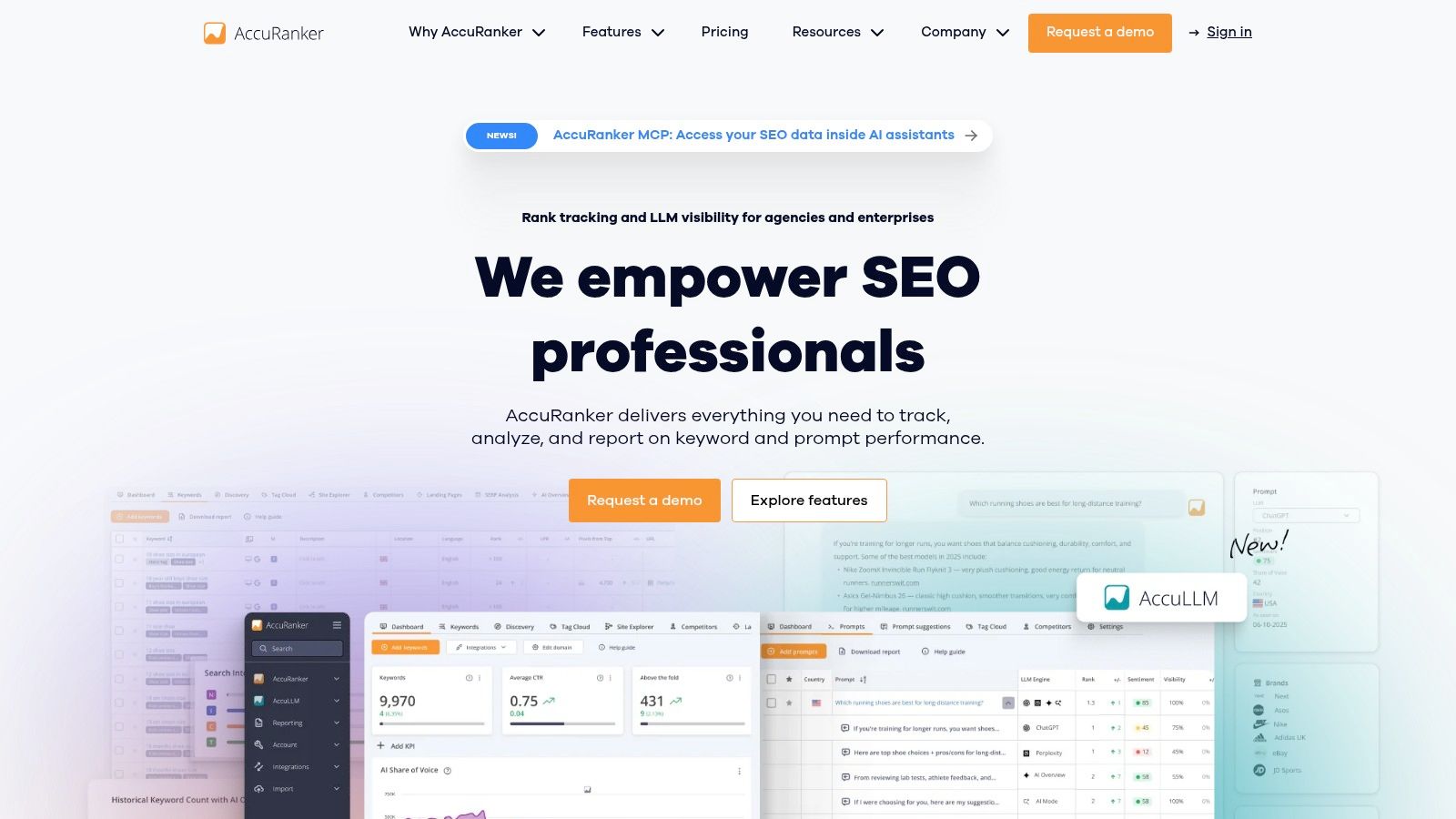
AccuRanker is one of the easiest specialist tools to recommend when rank tracking is the essential core of your workflow. It's fast, clean, and built for teams that want accurate rank data with strong segmentation, tagging, and reporting. Agencies like it because the deliverables are straightforward.
It also does a good job of staying useful without pretending to be everything. You get integrations, reporting, and traffic-modeling support, including AI CTR and AI search volume estimations, but the product still knows its lane.
Why teams choose it
AccuRanker is the kind of tool that makes sense when your main frustration is unreliable or slow rank reporting from broader suites. If you need quick updates, flexible tags, and white-label outputs, it often feels better than all-in-one platforms trying to serve too many use cases at once.
That focus is both the strength and the limit. You won't buy AccuRanker to replace backlink analysis, crawling, or broader content intelligence. You buy it because rank tracking needs to be sharp and easy to operationalize.
Another useful angle is agency workflow. Dynamic tagging and connectors make recurring reports less painful, especially if you're slicing by location, intent, device, or client segment.
- Fast and focused: Great for rank data, tagging, and reporting.
- Agency-friendly output: White-label features and exports are strong.
- Good integrations: API and Looker Studio support help with dashboards.
- Limited breadth: It is often paired with other SEO tools.
- Can get expensive: Higher keyword volumes raise the bill quickly.
If rank tracking is the category you're shopping first, compare it with other rank checker software options. Main site: AccuRanker.
10. seoClarity
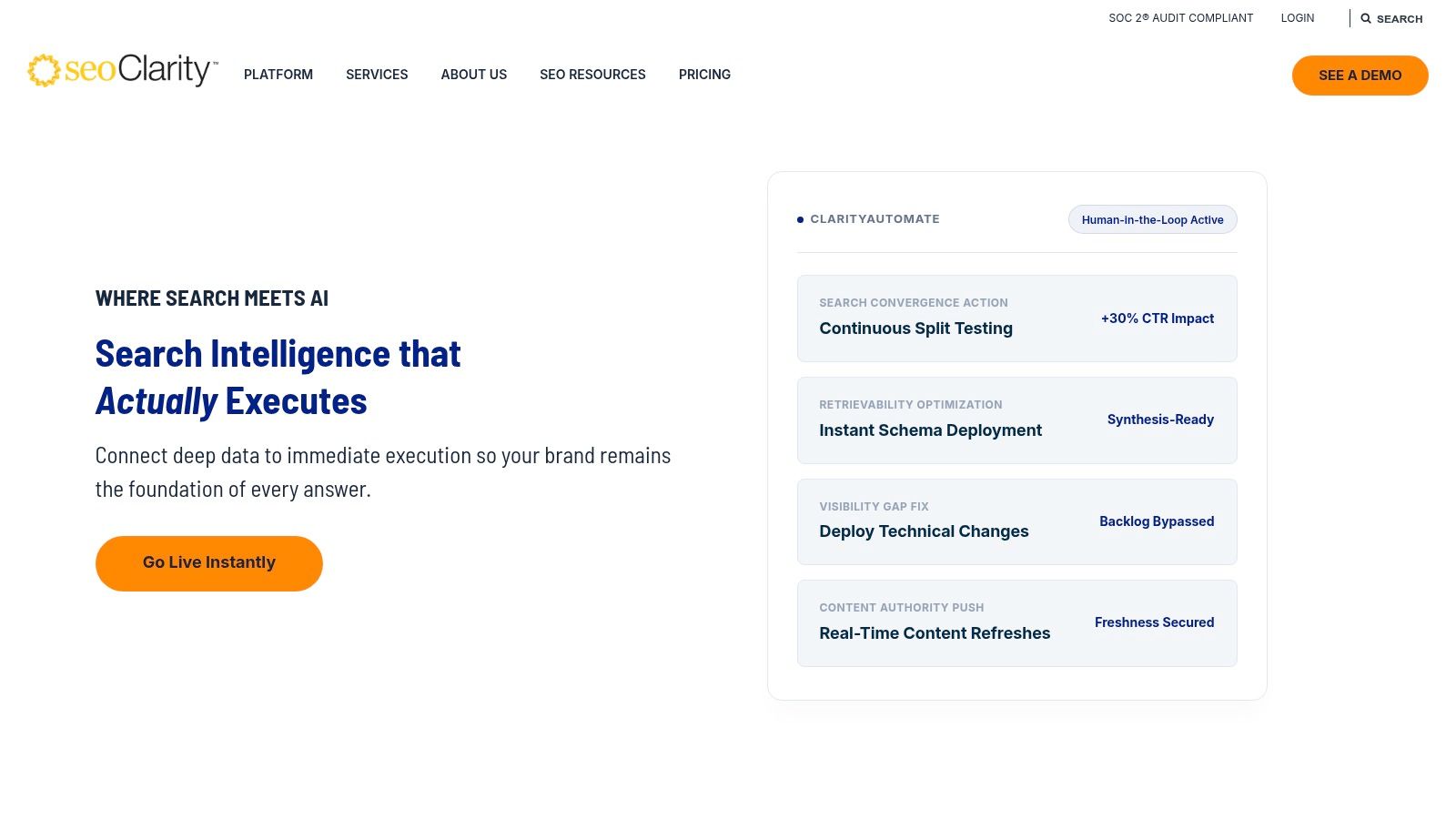
seoClarity is a deep enterprise platform for teams that want to unify rank intelligence, technical SEO, content workflows, and integrations inside a customizable system. It's not the simplest tool on this list, but it can be one of the most capable for large sites and multi-country operations.
The feature that often catches attention is Visibility Share. It reframes ranking into on-screen presence, which is often easier to explain to stakeholders than a list of average positions. For teams dealing with SERP features and cluttered result pages, that framing is practical.
What makes it different
seoClarity is strong when technical SEO and reporting need to live close together. You can combine crawler data, page speed analysis, JS rendering insights, rank intelligence, and content workflows without constantly handing off between tools.
This matters more in the current search environment because AI visibility isn't just about prompts and citations. Technical readiness is part of the equation. Pages with FAQ, Service, and LocalBusiness schema are cited 3 to 5 times more often in AI Overviews and LLM responses, according to SEO Hacker's analysis of AI visibility gaps. Teams that track visibility but ignore structured data audits leave a real gap unresolved.
Best fit and trade-offs
seoClarity is best for enterprise teams with technical depth and strong reporting needs.
- Deep enterprise coverage: Strong across technical SEO, content, and rank intelligence.
- Useful visibility framing: Visibility Share translates better than position charts in many reports.
- Flexible integrations: Good option for centralized reporting environments.
- Higher ownership cost: Quote-only pricing and onboarding make it a serious commitment.
- Needs enablement: Teams have to invest time to get full value.
Main site: seoClarity.
Top 10 SEO Visibility Tools Comparison
| Product | Core features ✨ | UX & Quality ★ | Value & Pricing 💰 | Target & USP 👥🏆 |
|---|---|---|---|---|
| Surnex 🏆 | Unified AI + SEO (LLM benchmarking, Citation Gap, ranks, backlinks, audits, API) ✨ | Single dashboard, agency workflows, API‑first ★★★★ | One platform + free trial; plans $49–$399/mo 💰 | 👥 Agencies, in‑house teams, devs, AI visibility + automation 🏆✨ |
| Semrush | Rank tracking, backlinks, audits, AI Visibility toolkit, API ✨ | Mature UI & reporting, client dashboards ★★★★ | Tiered plans; can scale costly by seats/usage 💰 | 👥 Agencies/in‑house, broad all‑in‑one SEO coverage |
| Ahrefs | Backlink index, Keywords/Explorer, Rank Tracker, Brand Radar ✨ | Fast UI, deep datasets, SERP history ★★★★ | Transparent plans & limits; starter/free tiers 💰 | 👥 SEOs needing backlink & SERP depth, dataset excellence ✨ |
| SISTRIX | Visibility Index, wide international coverage, historical trends ✨ | Repeatable visibility metric, strong history ★★★ | Clear euro‑priced plans with API/export quotas 💰 | 👥 International SEOs, benchmarking & trend analysis |
| Similarweb | Traffic & channel intelligence + AI Search Intelligence ✨ | Holistic competitive dashboards, enterprise feeds ★★★ | Enterprise/quote pricing; useful free utilities 💰 | 👥 Market analysts & enterprises, cross‑channel visibility |
| BrightEdge | Data Cube X, AI Hyper Cube, forecasting, content recs ✨ | Executive dashboards, revenue narratives ★★★★ | Quote‑only enterprise pricing; long procurement 💰 | 👥 Large brands, enterprise forecasting & governance 🏆 |
| Conductor | AEO + AI visibility, Creator, Monitoring, AgentStack, API ✨ | End‑to‑end insight→action workflows ★★★★ | Enterprise pricing; free AI visibility report 💰 | 👥 Enterprise content teams, AEO‑first workflows & integrations |
| STAT (Moz) | Daily granular rank & SERP feature tracking, API ✨ | Very reliable high‑volume rank data ★★★★ | Enterprise seat/pricing model; focused scope 💰 | 👥 Agencies with large keyword portfolios, scale rank monitoring |
| AccuRanker | Fast daily rank tracking, tagging, CTR/volume estimates, API ✨ | Very fast, accurate, agency reporting ★★★★ | Higher tiers for scale; focused rank product 💰 | 👥 Agencies & in‑house teams needing precise rank data |
| seoClarity | Rank Intelligence, crawler/audits, content workflows, Visibility Share ✨ | Deep enterprise features, Visual Rank framing ★★★ | Quote‑only; higher TCO, onboarding required 💰 | 👥 Large sites/multi‑country portfolios, customizable enterprise SEO |
How to Choose the Right SEO Visibility Tool for You
A bad tool choice usually shows up six months later. Rankings are in one dashboard, AI citations in another, technical issues in a crawler nobody checks, and reporting turns into spreadsheet work every month. Choose based on the job the tool needs to do inside your team, not the size of the feature list.
Start with the category. All in One Platforms fit teams that want one system for rankings, audits, backlinks, competitor monitoring, and now AI search visibility. They reduce handoffs and usually make onboarding easier. The trade-off is depth. A platform that does five jobs well may still lose to a specialist on one job, especially rank tracking or enterprise workflow control.
Enterprise Suites make sense when SEO data has to travel across content, analytics, product, regional teams, and leadership. In that setup, governance matters as much as raw visibility data. Approval flows, permissions, forecasting, and integrations often justify the higher cost. The downside is slower setup, more training, and a higher total cost if your team only needs a few core SEO functions.
Specialist Trackers win when one metric has to be exact. Agencies with large keyword sets, ecommerce teams watching category terms daily, and consultants running market-level rank tracking often get better results from a focused product than from an all-purpose suite. The catch is stack sprawl. Once you add a rank tracker, backlink tool, auditor, and AI visibility layer, the cheaper option can stop being cheaper.
AI search should be part of the shortlist now. Earlier in the article, we noted that AI Overviews are expanding quickly and that AI-driven visits can carry different conversion value than standard organic traffic. That shifts the buying criteria. A useful visibility tool should show where your brand appears in AI answers, which pages get cited, how competitors displace you, and whether those appearances connect to traffic or revenue.
That last point matters.
Some platforms added AI visibility as a reporting widget. Others built workflows around it. If your team is actively trying to win citations in AI Overviews or answer engines, check whether the tool helps diagnose missed inclusion, not just count mentions. Page-level evidence, intent clustering, schema checks, citation-source tracking, and competitor gap analysis are far more useful than a single trend line.
Then look at operating fit. Agencies usually need client-safe exports, tagging, report automation, and enough simplicity that account managers can work without constant analyst support. In-house teams often care more about collaboration, executive reporting, and connecting visibility changes to content updates or site releases. Developers and technical SEOs tend to care about APIs, crawl controls, and whether the data can be pushed into their own reporting environment.
Budget should be measured at stack level, not plan level. One tool with good enough rank tracking, auditing, backlink data, and AI monitoring can cost less than three specialist subscriptions plus the time required to reconcile conflicting data. But if your revenue depends on precise daily rankings across thousands of keywords, paying for a specialist tracker and keeping the rest of the stack lighter is often the better buy.
Use a trial with your own queries, your own competitors, and your own reporting workflow. Test branded terms, non-branded terms, local queries, and AI-search prompts. Try to answer a real diagnostic question, such as why one page lost visibility while a competitor gained it. If the tool can surface the cause quickly, it is probably a fit. If it only shows charts, keep looking.
If you want an outside comparison before you shortlist vendors, the Miles Marketing SEO tools comparison guide is a useful additional perspective.