You win the enterprise account, then the rank tracking brief lands in your inbox. It includes multiple countries, several business units, different devices, local variations, product families, and a competitor list that keeps growing every time a stakeholder joins the kickoff call.
That's where most agency systems break. Not because the team can't do SEO, but because the operating model was built for smaller accounts. A few dashboards, a spreadsheet export, and a monthly rank report work fine until the client asks why one product line gained visibility in mobile search in one market while another lost presence in AI answers somewhere else.
Agency rank tracking for enterprise companies needs a different playbook. The job isn't just collecting positions. It's deciding what deserves daily tracking, what belongs in grouped reporting, how to separate market noise from real movement, and how to explain all of it to executives who care about business impact, not keyword lists.
The New Reality of Enterprise Rank Tracking
Enterprise rank tracking used to be easier to explain. You tracked a keyword, recorded a position, compared it to last month, and called it progress or decline.
That model doesn't hold up now.
One industry analysis reported that Google AI Overviews appeared in 18.76% of search results, which means agencies now need to monitor visibility in AI-generated answers alongside standard rankings, as noted in this enterprise rank tracking analysis. A meaningful share of search visibility no longer lives only in the classic list of organic blue links.
For agencies, that changes both operations and expectations. Clients aren't just asking, “Did we move from position six to position three?” They're asking why a competitor appears in an AI answer, why a branded query shows a featured snippet in one market but not another, and why mobile performance looks stronger than desktop for one business unit but weaker for another.
Why old reporting breaks at enterprise scale
A spreadsheet can hold rankings. It can't hold context well.
Enterprise programs need segmentation across business units, product lines, markets, devices, and search surfaces. That means the old habit of rolling everything into one average rank creates false clarity. A blended average hides local problems, masks category wins, and usually starts arguments in stakeholder meetings because each team sees a different reality.
This is why a clear definition of what rank tracking is matters more at enterprise level than it does for smaller accounts. You're not measuring one number. You're building a visibility system.
Practical rule: If a report can't show who owns the problem, where it happened, and which search surface changed, it isn't enterprise-ready.
What agencies are really managing now
The primary shift is from rank tracking to search visibility management.
That includes standard organic positions, but it also includes featured snippets, People Also Ask, shopping environments, AI answer surfaces, and competitor presence across those layers. Agencies that still treat enterprise reporting like a monthly keyword export usually end up over-reporting noise and under-reporting business risk.
The strongest teams build a framework before they touch tooling. They decide how the account will be segmented, how search surfaces will be grouped, and how the client will consume the data. That's what makes the system scalable. The tool matters, but the operating design matters more.
Defining Your Enterprise Tracking Blueprint
Most enterprise tracking problems start in discovery, not in reporting. The agency says yes to “full rank tracking,” the client assumes that means everything, and nobody defines what “everything” is.
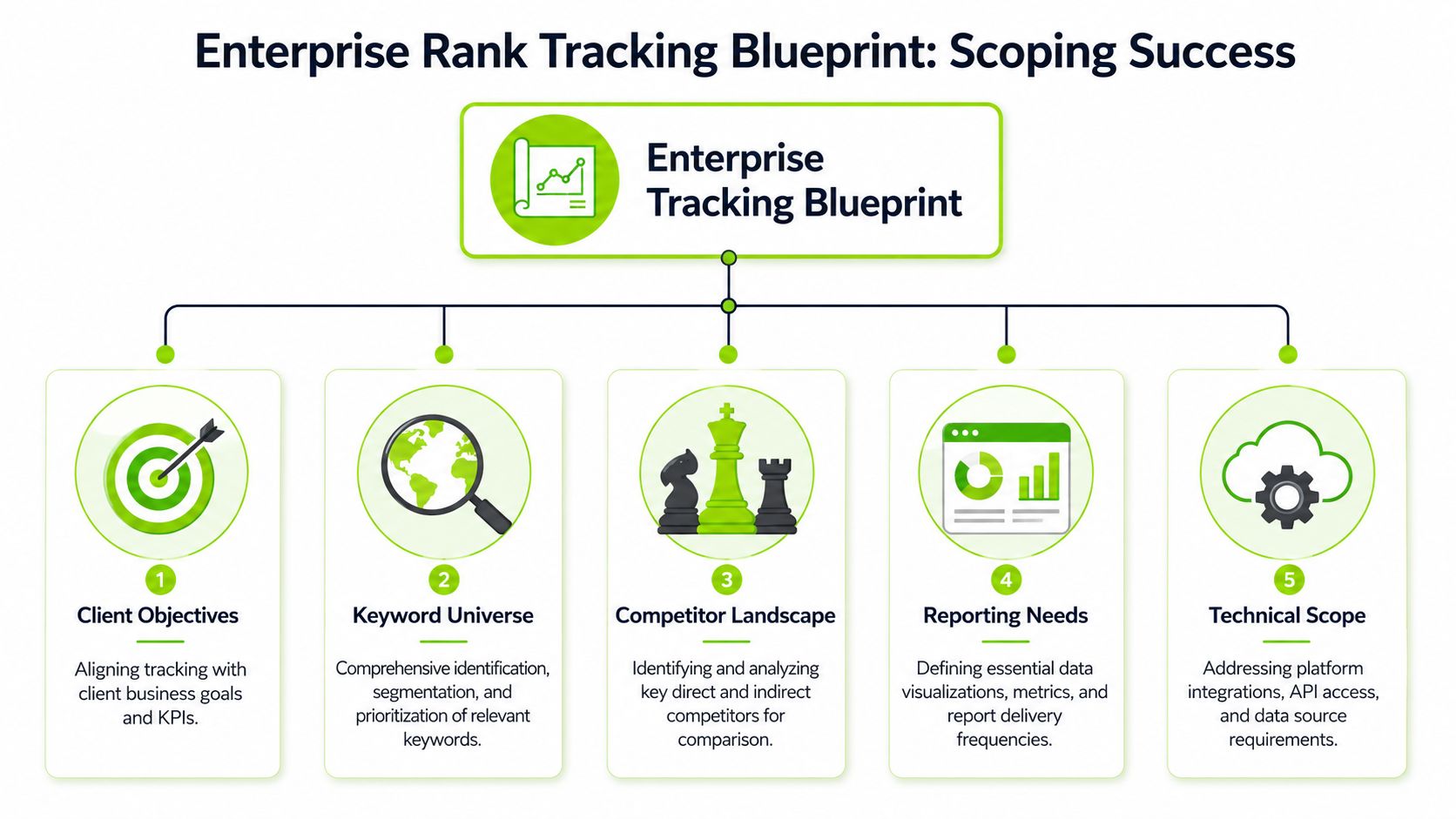
A better start is to build a blueprint that turns a vague request into a scoped measurement plan.
Start with the business map
Before choosing keywords, map the business as the client operates it. Not how the website is organized. Not how the org chart looks in a pitch deck.
Ask for the P&L view. Which business units own revenue? Which product lines matter most? Which regions have separate targets? Which teams need their own scorecards? Enterprise SEO reporting breaks when agencies track the site structure instead of the business structure.
I usually want these answers pinned down first:
- Revenue ownership. Which teams will be judged on this data.
- Market boundaries. Countries, regions, and local markets that need separate reporting.
- Intent priorities. Whether the client cares more about awareness, demand capture, or both.
- Search surface priorities. Whether executive attention is on classic organic visibility, SERP features, AI answers, or a mix.
- Decision cadence. Who needs daily monitoring versus monthly summaries.
Build segments before keywords
Keyword scoping should follow segments, not lead them.
A common mistake is importing a huge keyword universe and trying to organize it later. That creates tagging cleanup, duplicate reporting, and endless rework when stakeholders ask for views by brand, region, or funnel stage.
Use a structure like this:
- Business unit segments for separate product divisions or brands
- Market segments for country, region, or city-level reporting
- Intent segments for informational, commercial, and branded demand
- Device segments for desktop and mobile comparisons
- Surface segments for organic, SERP feature, and AI visibility layers
If a keyword can't be assigned to an owner, a market, and a reporting use case, it probably doesn't belong in the primary tracking set.
Define the competitor model early
Enterprise competitor tracking gets messy fast because different products compete with different sites. The company's board may think in terms of business rivals, but the SERP often includes publishers, marketplaces, review sites, or aggregators.
That's why each segment needs its own competitor set. One product line may compete against a direct vendor. Another may lose visibility to editorial sites. A third may be squeezed by marketplace pages and answer-driven search features.
When teams compare tools during this stage, I usually point them toward a broader review of rank checker software options for different workflows, but the tool shortlist should come after scoping. Otherwise the platform starts driving the strategy.
Lock the reporting contract
The blueprint isn't complete until reporting expectations are written down. That includes dashboards, ownership, update cadence, escalation rules, and historical views.
A simple discovery checklist helps:
- Executive layer with market visibility and competitive movement
- Channel layer with SEO team views by segment and surface
- Business-unit layer with product-specific reporting
- Operational layer with issue detection and alert ownership
- Technical layer with API, export, and warehouse requirements
This upfront work feels slower in week one. It saves months of cleanup later.
Choosing a Data Collection and Sampling Strategy
Once the blueprint is set, the next question is volume. Enterprise clients often ask to track everything daily. That sounds thorough. It usually isn't the smartest use of budget or analyst attention.
Modern enterprise platforms can track up to 15,000 keywords daily and monitor 20 competitors per project, as described on SE Ranking's enterprise platform page. That scale is useful, but scale alone doesn't answer the harder question, which is what should be checked every day.
Two models that agencies use
The practical choice usually comes down to complete tracking versus strategic sampling.
| Strategy | Best For | Pros | Cons |
|---|---|---|---|
| Comprehensive tracking | High-priority enterprise programs with broad reporting demands | Strong daily coverage, easier market comparisons, faster issue detection | Higher cost, more noise, larger reporting burden |
| Strategic sampling | Accounts with budget constraints or very large keyword universes | Better focus, cleaner analysis, easier rollout by segment | Less granularity, slower detection on lower-priority terms |
| Hybrid model | Most enterprise agency engagements | Balances cost and insight, supports tiered monitoring, easier to scale over time | Requires disciplined segmentation and governance |
When comprehensive tracking makes sense
Daily tracking across a very large set is justified when the client has frequent executive scrutiny, multiple active markets, and high sensitivity to search movement. It also makes sense when the agency is expected to spot competitor changes quickly across priority categories.
But there's a catch. More daily data creates more false urgency. Teams start reacting to small movement on terms that don't deserve action. Analysts spend time explaining normal volatility instead of investigating meaningful change.
Why hybrid sampling usually wins
Most agencies do better with a tiered model.
Track the money terms daily. That usually means core commercial keywords, major brand-plus-category terms, flagship product queries, and the highest-risk competitor phrases. Then place the broader supporting universe on a slower cadence such as weekly or bi-weekly, depending on how the client uses the data.
A practical version looks like this:
- Tier one for core revenue-driving queries and high-visibility brand terms
- Tier two for strategic category clusters that need trend monitoring
- Tier three for long-tail discovery, content support, and research coverage
This approach keeps the daily dataset focused while still preserving broad market intelligence.
Plan the warehouse before the keyword count explodes
A lot of agencies obsess over collection volume and ignore storage design. That's backwards. If the client account is going to expand, you need a clean data model early.
For teams designing reporting infrastructure, this overview of AI data warehouse architectures is useful because it pushes the conversation beyond dashboard exports and into durable data pipelines. Enterprise rank data becomes far more valuable when it can be joined with market, product, and performance dimensions in one warehouse.
What works: daily checks for decision-critical segments, slower refreshes for exploratory segments, and warehouse-ready tagging from day one.
The operational question agencies should ask
Don't ask, “Can the platform track this many keywords?”
Ask, “Which keywords need fast feedback, which need trend visibility, and which only need periodic checks?” That's the difference between a search intelligence system and a giant pile of exports.
If your team is building custom ingestion or layered reporting, an API matters as much as the interface. For this reason, guides on using a Google rank tracker API for automated workflows become relevant, because enterprise reporting usually ends up living outside the native dashboard anyway.
Integrating AI and LLM Visibility Signals
A lot of teams make the same mistake with AI search. They treat it like one more rank column.
It isn't.
AI visibility behaves differently from classic rankings because the response format is different, citation patterns can change quickly, and presence is often partial rather than cleanly ranked. A brand might be cited in one answer, absent in the next, mentioned for one subtopic, and ignored for another even when organic rankings look stable.
Emerging 2026 guidance says teams should optimize for visibility, share of voice, SERP features, and AI citations rather than isolated keyword positions, according to Dageno's enterprise rank tracker roundup. That matches what agencies are seeing operationally. AI search needs its own measurement layer.
Treat AI visibility as a separate reporting object
Instead of forcing AI signals into a traditional rank report, build a separate AI visibility view with its own definitions.
That usually includes:
- Citation presence for whether the client appears at all
- Citation frequency for how often the brand or page is referenced across prompts or query sets
- Competitor citation gaps for where rivals appear and the client doesn't
- Surface context for which AI environment produced the mention
- Topic-level share for categories, not just isolated queries
This helps clients understand that AI visibility is not a clean ladder of positions. It is closer to monitored presence within dynamic answer environments.
What agencies should actually review
The useful questions are different from classic SEO questions.
Don't stop at “Were we mentioned?” Ask whether the right page was cited, whether the answer framed the brand correctly, whether competitors owned more of the answer space, and whether citation patterns match organic strengths or reveal a gap.
For teams building repeated AI monitoring tasks across clients, workflow discipline matters. If the process is still manual, it becomes slow fast. I've found that resources on how to achieve faster, reliable AI workflows are helpful when agencies start operationalizing AI visibility checks across many accounts.
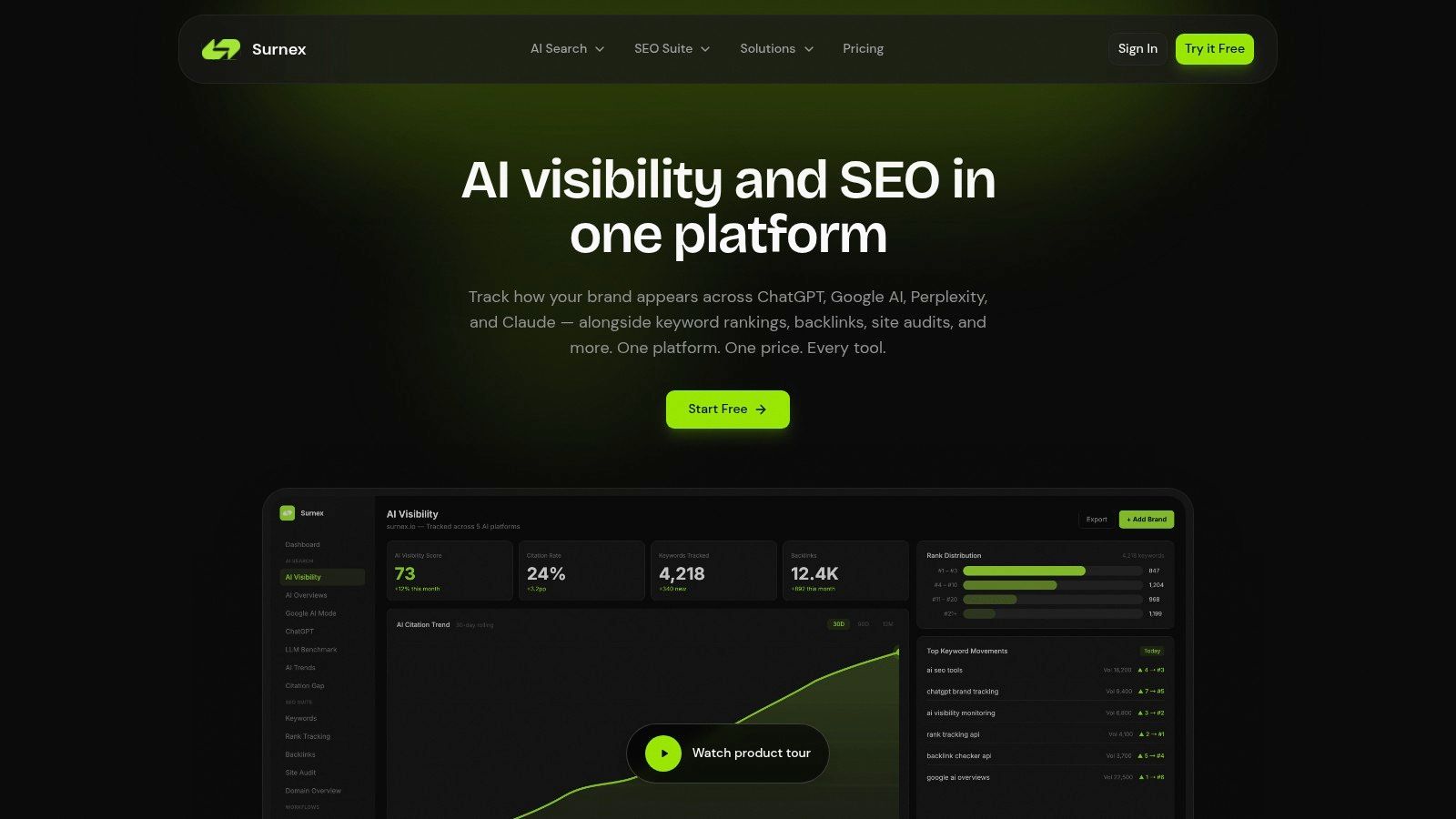
A practical dashboard can unify these signals with standard SEO reporting. One option in this category is Surnex, which combines traditional SEO metrics with AI visibility tracking in one interface and API for agency and enterprise workflows.
If you want to see how teams are approaching this monitoring layer, this overview of an AI Overview tracker is a useful reference point for how AI appearance differs from classic rank measurement.
A short walkthrough helps make that distinction more concrete:
AI visibility should be reported like a changing answer environment, not like a fixed list of ranked URLs.
How to keep clients from misreading AI data
Client communication matters here. If you label AI visibility as “ranking,” they'll assume the same stability and meaning as organic positions. That creates confusion and overreaction.
Use separate labels. Define the methodology in plain language. Show patterns over time, competitor gaps, and recurring citation themes. That gives stakeholders something actionable without pretending the data is more settled than it is.
Building Your Automation and Alerting Engine
Enterprise rank tracking fails when the workflow depends on people remembering to export files. It also fails when the only alert is “keyword dropped.”
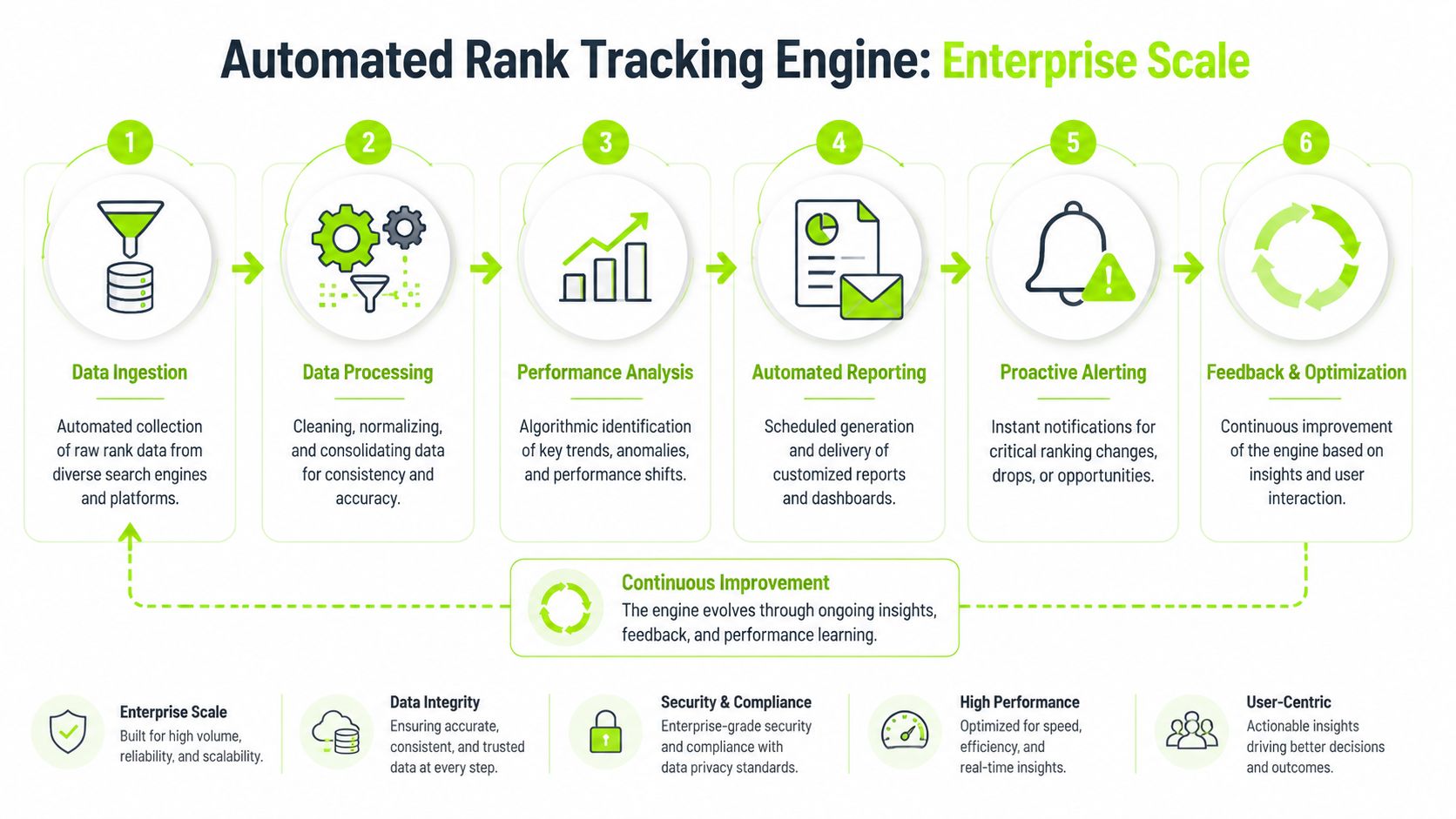
At scale, the system needs automation from collection through reporting.
A common failure in enterprise tracking is using spreadsheets instead of automated pipelines into BI or BigQuery, which breaks historical consistency and makes cross-market comparisons unreliable, as explained in TapClicks' guide to enterprise rank tracking.
Build the pipeline in layers
The best agency setups are boring in the right way. Data flows on schedule, dimensions stay consistent, and dashboards don't depend on manual cleanup every month.
The operating stack usually has these layers:
- Collection layer that pulls rankings, SERP feature presence, competitor data, and AI visibility signals.
- Normalization layer that standardizes market names, device labels, ownership tags, and date logic.
- Storage layer in a warehouse or BI-ready environment.
- Visualization layer for stakeholder-specific reporting.
- Alert layer for meaningful changes.
- Governance layer for version control and metric definitions.
Agencies skip the normalization step too often. That's where reporting quality usually falls apart. If one market is tagged three different ways across exports, every dashboard becomes a cleanup exercise.
Alerts should track business risk, not just rank movement
A raw rank drop is rarely enough to justify an alert on its own. Enterprise teams need alerts that reflect actual risk or opportunity.
Better alert logic includes:
- Priority term movement on revenue-critical keyword groups
- Competitor gains on terms tied to strategic products
- SERP feature ownership changes when a snippet or answer surface shifts
- AI citation loss on monitored category prompts
- Coverage gaps when a market, device, or business unit stops reporting correctly
Operational note: The best alert is one that already tells the account team what to investigate first.
Set roles before alerts go live
Alerting gets noisy when no one owns response paths. Every enterprise account should define who receives what.
For example:
- SEO leads handle trend-level visibility alerts
- Content owners review query cluster changes
- Product marketers monitor brand and category presence
- Technical teams receive data integrity and indexing-related escalations
- Client stakeholders get summaries, not every fluctuation
That division keeps the agency from becoming a relay desk for every automated notification.
Keep historical consistency sacred
Historical data becomes more valuable every quarter. It gives context for market seasonality, site changes, product launches, and platform shifts. But that value disappears when naming conventions change, exports break, or teams rebuild reports from scratch every month.
That's why automation isn't just about efficiency. It protects the integrity of the story you'll tell later. If the client asks how one business unit has performed across regions over time, you need a dataset you trust.
Client Reporting and Communicating ROI
Rank tracking data doesn't prove value by itself. A client can stare at hundreds of keywords and still have no idea whether the agency is helping the business.
The agencies that keep enterprise accounts don't just report movement. They explain meaning.
Executives don't want keyword dumps
An executive report should be short, comparative, and tied to business priorities. It should answer a few direct questions.
Where did visibility improve? Where did it weaken? Which competitors gained ground? Which product line or market needs attention next?
That's why executive reporting should emphasize:
- Market-level visibility shifts by business unit or region
- Competitive change in the categories that matter most
- Search surface ownership where presence affects demand capture
- Risk areas that need action, with clear ownership
- Business interpretation in plain language
A deck full of position charts usually confuses non-SEO stakeholders. They need a narrative, not raw exports.
Build different report layers for different readers
One report format won't work for everyone in an enterprise account. Product teams, channel leaders, and executives all need different views.
A practical agency model uses three layers:
Executive summary
This is the boardroom version. Keep it high-level. Show overall visibility by market, by business line, and against competitors. Use plain language. If a region is underperforming, say that directly.
Working report
This is for the marketing and SEO teams. It includes segment views, query clusters, competitor changes, and surface-level details. Here, diagnosis takes place.
Action report
This is the operating list. What changed, who owns it, what should happen next, and when the team will review the impact.
The report becomes persuasive when every metric is attached to a decision, not when every metric is included.
Frame visibility in business language
If your report says “non-branded rankings improved,” that's fine. If it says “the brand gained visibility in a category tied to a core product line in two target markets,” that's better. If it says “the gain improves discoverability where the sales team is trying to grow pipeline,” now the client sees business relevance.
That shift matters because enterprise stakeholders usually fund SEO from broader growth goals, not from affection for rank tracking.
Use language like:
- stronger category presence
- weaker competitive coverage in a priority market
- loss of answer-surface visibility on high-intent topics
- improved search presence for a product line with regional targets
This keeps the conversation grounded in commercial context.
Show confidence, limits, and next actions
Good reporting also admits what the data can and can't say. AI visibility, for example, should be presented with the right caveats. So should highly localized ranking movement. Clients trust agencies more when the interpretation is precise instead of overconfident.
The report should end with a simple decision framework:
- what changed
- why it matters
- what the agency recommends
- who owns the next step
- when results will be reviewed
That's how rank tracking becomes business intelligence instead of a monthly artifact.
If your team needs one system for tracking traditional search visibility and emerging AI answer presence, Surnex is worth a look. It gives agencies and in-house teams a way to unify rankings, competitor monitoring, and AI search visibility in one platform, which makes enterprise reporting easier to scale and easier to explain to clients.