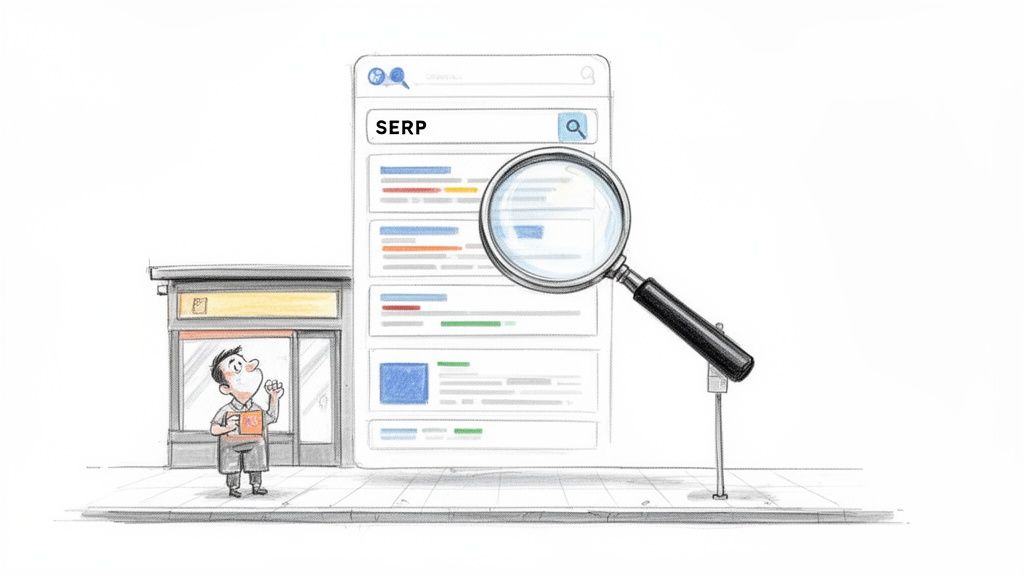
At its most basic, rank tracking is the process of monitoring your website’s position on search engine results pages (SERPs) for the keywords that matter to your business. Think of it like a shop owner checking their storefront's visibility on a busy digital street. Are you front and center, or tucked away in a side alley where no one can see you?
What Is Rank Tracking and Why It Matters Now
Think of rank tracking as your SEO performance dashboard. It’s the feedback loop that tells you if all your hard work is actually moving the needle. Without it, you’re flying blind—investing time and money into content and technical fixes without knowing if they’re actually improving your visibility in Google.
By consistently tracking your keyword positions, you get the hard data you need to make smarter decisions. It helps you:
- Measure SEO Performance: See the direct impact of your optimization efforts on your search rankings.
- Identify Competitors: Uncover who you’re really competing against for valuable customer attention.
- Spot Content Opportunities: Find keywords where you’re on the cusp of page one and just need a little push to get there.
- Detect Ranking Drops: Get an early warning when a page suddenly loses visibility, so you can diagnose and fix the problem quickly.
To give you a clearer picture, here’s a quick summary of the key ideas we'll be discussing.
Quick Overview of Rank Tracking Concepts
This table gives you a scannable summary of the core ideas in modern rank tracking, helping you grasp the key concepts before we dive deeper into the details.
| Concept | What It Means for You | Why It's Important in 2026 |
|---|---|---|
| Rank Position | Your website's numerical placement in organic search results for a specific keyword. | Still a core metric, but its value is now shared with other SERP features. |
| SERP Features | Non-traditional results like Featured Snippets, Local Packs, and AI Overviews. | These features compete for clicks, making "Position 1" less of a guarantee for traffic. |
| Share of Voice (SoV) | A holistic metric that estimates your visibility across a set of keywords versus your competitors. | Provides a more accurate view of your market presence in a crowded SERP environment. |
| AI Overviews | Google's AI-generated answers that appear at the top of the SERP. | A major disruptor that can directly answer user queries, potentially reducing clicks to organic results. |
These concepts paint a much different picture from the early days of SEO. Let's look at how we got here.
From Ten Blue Links to AI Overviews
Rank tracking got its start back in the 2000s, when Google’s results were a simple, predictable list of "ten blue links." In that world, getting into the top few spots was everything—those first organic results often pulled in over 50% of all clicks. The value of a high rank was crystal clear.
Fast forward to today, and the game has changed entirely.
The modern SERP isn't a simple list anymore. It’s a dynamic and crowded space filled with ads, featured snippets, "People Also Ask" boxes, local maps, and now, Google's AI Overviews. This makes understanding your true rank more complex—and more critical—than ever before.
For example, the click-through rate (CTR) for the #1 organic position has dropped steadily over the years. One study found that paid ads alone could slash the top organic result's CTR by nearly 30%. With AI-generated summaries now sitting at the very top, you have to track more than just a single number to know if you're truly visible. If you're curious, you can explore the current state of SERP complexity to see just how much has changed.
How Rank Tracking Actually Works Today
You might be tempted to just Google your own keywords in an incognito window to see where you stand. We've all done it. But that's the old-school way, and frankly, it’s a terrible gauge of your actual performance. It’s like trying to get a bird's-eye view of a city by peeking out your own apartment window—you only see a tiny, skewed fraction of the whole picture.
The problem is, search results are anything but standard. What you see is tailored to you based on your location, past searches, and whether you're on a laptop or a phone. Your search for "best coffee shop" in downtown Chicago will pull up a completely different list than what a tourist sees just a few miles away on their iPhone. Your manual check isn't what your customers see.
The Shift to Automated Tracking
So, how do we get a real, unbiased look at our rankings? That's where automated rank tracking software comes into play. The difference is like switching from a hand-cranked engine to a modern electric one. Sure, both get you moving, but one provides the precision, speed, and deep data you need to actually compete.
These tools don't just "Google" your keywords. They use a smart system to mimic real, impartial searches on a massive scale.
- Proxies: They use a network of proxies, which are basically servers that act as stand-ins, to check your rankings from any location you want—a specific city, state, or even another country.
- User Agents: They also switch up their user agents, which tells Google whether the search is coming from a desktop, an Android phone, or an iPad.
This approach strips away all the personalization that clouds manual checks. It gives you a clean, objective view of how you’re really ranking for the people you want to reach. You can finally see your position in Dallas on an iPhone versus London on a desktop, all in one place. Having this kind of detailed oversight is essential, which is why we've built workflows for rank monitoring and tracking changes right into our platform.
This technology didn't just appear overnight. In the early days, SEOs really were stuck with manual checks for a few keywords. By the mid-2010s, automated tools were crawling the search results daily, but even that was a simpler task. A search result page in 2010 was a simple list, about 375 pixels tall. By 2020, that same page had exploded to 2,938 pixels, packed with images, videos, maps, and other features. If you're curious about this evolution, check out these insights on the history of rank tracking.
Automation takes you from guessing to knowing. It lets you track thousands of keywords across every location and device that matters—a job that’s literally impossible to do by hand. This isn't just a convenience; it's the foundation of modern SEO.
Fixating on that coveted #1 spot is a classic SEO mistake. It’s like judging your entire financial health by looking at just one stock in your portfolio. Sure, it’s an important piece of the puzzle, but it definitely doesn't give you the full picture.
To really get a handle on how you're doing, you need to zoom out and look at a whole range of metrics. This is what separates reactive SEOs from strategic ones.
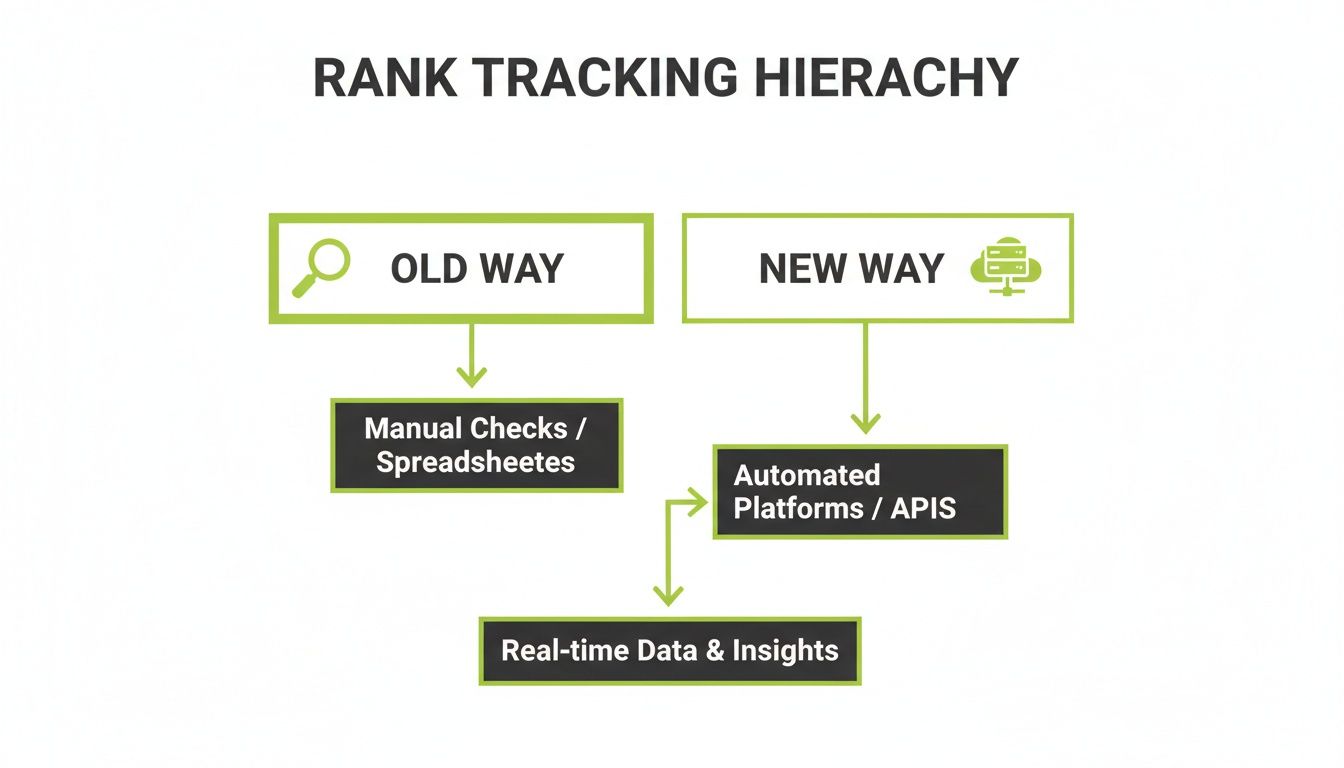
The old way of tracking focused on a single position, but today's search landscape is far too complex for that. Modern tools give us a much richer, more holistic view of our actual presence on the SERP.
What to Measure Instead of Just Rankings
Good rank tracking is about more than just a number. It’s about collecting the right data points that, together, reveal your true standing in the market. This is where you can finally start making smart, strategic moves instead of just reacting to the daily ups and downs.
Here are the metrics that really matter to experienced SEOs today:
- Average Position: Don't get hung up on a single keyword. This metric gives you your average rank across a whole group of related terms. It’s a much more stable and realistic way to see how you’re performing for a specific topic.
- Share of Voice (SoV): Think of this as your market share in the search results. It estimates how visible you are for a set of keywords compared to your competitors, answering the critical question: "Of all the potential clicks out there, what percentage are we actually capturing?"
- SERP Feature Ownership: Are you showing up in featured snippets, image packs, or "People Also Ask" boxes? These features often sit above the traditional organic results, so winning them is a huge deal. This metric tracks how often you're capturing that valuable real estate.
These metrics help you build a smarter strategy. For example, even if you don't rank #1 for a major keyword, owning the featured snippet for it can drive a ton of traffic and establish your authority. This same strategic thinking applies when you learn more about our approach to backlinks; it's the quality and context that count, not just the raw numbers.
Why Every Spot on Page One Matters
While a single rank isn’t everything, don't get me wrong—every single position on the first page is incredibly valuable. Data shows that the top organic result alone gets a staggering 39.8% of all clicks.
The drop-off is steep. Moving from the second to the first position can boost your clicks by 74.5%. On average, every single spot you climb on the first page increases your click-through rate by 32.3%. With the top three results getting almost 75% of all clicks, keeping a close eye on your exact position is essential for growth. You can dive deeper into these numbers and discover more SEO statistics and insights on aioseo.com to see the data for yourself.
The goal of modern rank tracking isn't just to see where you are, but to understand your overall visibility portfolio. It helps you identify strengths, weaknesses, and opportunities in a search landscape where every pixel of screen real estate counts.
The way we measure SEO success has changed dramatically. We've moved from a narrow focus on rankings to a much broader understanding of search visibility, as the digital shelf gets more and more crowded.
Traditional vs Modern SEO Metrics
| Metric | Traditional Focus (Pre-2020) | Modern Focus (2026 and Beyond) |
|---|---|---|
| Primary Goal | Achieving the #1 ranking for a few "money" keywords. | Gaining overall visibility and market share across topic clusters. |
| Key Metric | A single keyword's position. | Share of Voice (SoV), Average Position, and SERP Feature Ownership. |
| Competitor View | Tracking a handful of known direct competitors. | Analyzing the entire SERP, including indirect and content competitors. |
| Data Scope | Desktop rankings in a single location. | Device-specific (desktop/mobile) and hyper-local (city/zip code) data. |
| Success Signal | Hitting position #1. | Consistent presence in the top 3, owning snippets, and growing SoV. |
This shift shows that success in SEO is no longer about winning a single race; it's about consistently performing well across the entire competition.
Tracking Visibility in the Age of AI
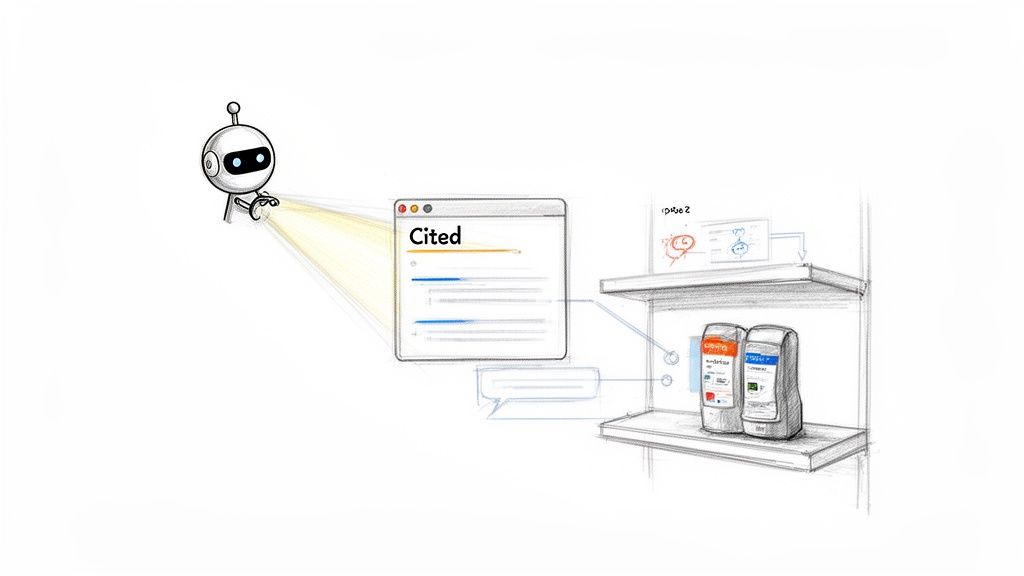
We're in the middle of the biggest shake-up in search since the beginning, and it’s completely changing what "visibility" even means. Focusing on a list of ten blue links just doesn't cut it anymore. Today, success means earning a spot inside an AI-generated answer.
This new fight is all about AI visibility. It's about measuring how often your brand, content, or products get cited as a source or mentioned as a solution within AI conversations, like the ones you see in Google’s AI Overviews or get from ChatGPT.
Here’s a good way to think about it: traditional SEO is like getting your product on a store shelf. Sure, people can see it, but it’s just one option among many. Being featured in an AI answer is more like getting a personal recommendation from a trusted expert on a primetime show. That endorsement carries real weight, cutting through the noise to influence decisions directly.
The Problem With AI Inconsistency
Now, here's the tricky part. Tracking this new kind of visibility is tough because AI answers are all over the place. Unlike the relatively stable list of search results, AI-generated responses can be wildly inconsistent.
Recent studies have shown that if you ask an AI the same question 100 times, you might get 100 different lists of recommendations, often in a slightly different order.
AI models are probability engines, not databases. They rarely give the same list of recommendations twice, and almost never in the same order. This makes tracking a "ranking" within an AI answer a fool's errand.
So, if the order is basically random, what are you supposed to measure? The answer is to stop obsessing over ranking position and start focusing on frequency of appearance.
Measuring Presence and Share of Voice in AI
The new job for rank tracking is to monitor how often you simply show up in these AI-generated conversations. While the order might change with every query, the brands that are consistently part of the AI's training data will appear far more frequently over time.
This means we need to look at new metrics for AI visibility:
- Mention Frequency: What percentage of the time does your brand appear in AI answers for a specific set of keywords or prompts?
- Citation Share of Voice: How does your mention frequency stack up against your direct competitors for the same topics?
- Sentiment: When you are mentioned, is the context positive, neutral, or negative?
This approach reveals how often a brand is part of the AI's "consideration set"—a much more stable and meaningful metric than trying to nail down a specific, randomized rank. It’s a completely different way of thinking, but it’s essential for staying relevant. You can learn more about how to master AI visibility and track your presence in this new world.
Any rank tracker that only looks at the old blue links is completely missing this data, leaving you blind to the most important conversations now happening in search.
Practical Use Cases for Agencies and In-House Teams
Knowing the theory behind rank tracking is one thing, but putting that data to work to get actual results is where things get interesting. This is where teams stop just watching the numbers and start actively shaping their own success.
Let's look at how this plays out in the real world for two different groups: marketing agencies and in-house teams.
For a marketing agency, reliable rank tracking is the bedrock of client trust. It’s the hard proof that shows their efforts are paying off. Instead of just saying, "we're doing SEO," they can present clear reports that visualize progress, justify their fees, and draw a straight line from their work to the client's business goals.
This data is also a secret weapon for winning new business. By quickly analyzing a prospect’s current rankings, an agency can pinpoint exactly where their competitors are eating their lunch. The pitch then becomes a targeted strategy to steal that market share, not just a generic promise of "better SEO."
How Agencies Drive Client Success
When you can track both traditional search results and AI-powered visibility, you give clients a complete picture. This helps agencies prove their value in a few critical ways:
- Finding Quick Wins: Spotting keywords where a client is stuck on the second page and knowing a small push could land them on page one for a significant traffic boost.
- Playing Defense: Getting an early warning when a competitor suddenly appears for a client's most important terms, giving them time to react before losing ground.
- Explaining the Unseen: Confidently explaining why traffic might have shifted—like the rollout of AI Overviews—using solid data instead of guesswork.
Empowering In-House SEO Teams
For SEOs working inside a company, rank tracking data is the key to getting buy-in and budget from leadership. It translates technical SEO work into a language the whole business can understand. One of the most powerful things an in-house team can do is benchmark their visibility against their top rivals, identifying strategic weaknesses they can exploit.
This data also brings much-needed focus to content creation. By seeing which topics are trending or where competitors are vulnerable, content teams can stop guessing and start creating articles and pages that are almost guaranteed to move the needle. You can discover how Surnex empowers in-house marketing teams with these exact capabilities.
The real goal here is to connect SEO performance directly to business KPIs. When you can show that improving rankings for high-intent keywords led to more demo requests or sales, you’re no longer just asking for a budget—you’re proving a clear return on investment.
Just look at the e-commerce site Jardindeco. By consistently tracking their rankings and focusing their content strategy, they grew their first-page keywords from 500 to 2,000. This boosted their monthly organic traffic by 3.5 times, from 13,000 to 47,000 visits. An analysis on iPullRank.com shows how this kind of success is repeatable when you combine traditional rank tracking with insights on AI visibility.
Choosing the Right Rank Tracking Solution
So, how do you pick the right rank tracking tool? It really comes down to what your team needs and what you're trying to accomplish. There's no single "best" tool out there—it's all about finding the right fit for your workflow. Generally, your options fall into two camps.
On one hand, you have integrated platforms. These are your all-in-one, out-of-the-box solutions with a friendly dashboard. For most marketing agencies and in-house teams, this is the way to go. You can track keywords, spy on competitors, and pull reports for your boss without ever touching a line of code.
Platforms vs. APIs: A Quick Comparison
On the other hand, you have a more hands-on, developer-friendly option: an Application Programming Interface (API). An API isn’t a dashboard you log into; it’s a direct pipeline to the raw search data. This lets your developers and data scientists pull search intelligence right into the custom tools you already use.
- Integrated Platform: Perfect for teams who need actionable insights and reports right now, without any technical headaches. You get instant access to charts, trend graphs, and competitor analysis.
- API Solution: The go-to for large companies or tech-savvy agencies that want to feed ranking data into their own dashboards, business intelligence (BI) tools, or other custom-built systems.
Think of it this way: an integrated platform is like buying a fully-built car, ready to drive off the lot. An API is like getting a high-performance engine—you get to build your own custom vehicle around it.
The choice between a platform and an API really boils down to this: Do you need a ready-made reporting suite, or do you need raw data to power a custom system? There’s no wrong answer, it just depends on your team’s resources and goals.
An API gives you total flexibility. You can build almost anything you can imagine, as this snippet from API documentation shows.
This is what a developer sees—the exact instructions for requesting SERP data programmatically. For any organization building its own marketing stack, this kind of control is crucial for weaving search data into a broader business intelligence strategy.
Frequently Asked Questions About Rank Tracking
Alright, so you're on board with the 'what' and 'why' of rank tracking. But how does this all work in the real world? Let's tackle some of the practical questions that always come up when teams start getting serious about monitoring their search performance.
How Often Should I Check My Keyword Rankings?
This is a classic question, and the answer really depends on what you're trying to accomplish.
For most businesses, weekly tracking is the sweet spot. It gives you a clear view of performance trends without getting bogged down by the minor, day-to-day jitters of the search results. You'll see the meaningful shifts, not just the noise.
However, there are times when you need to zoom in. We recommend daily tracking in a few specific scenarios:
- For your most valuable "money" keywords that drive direct revenue.
- During a site migration to immediately spot any indexing or ranking problems.
- Right after a major content launch to see how Google is reacting.
In these cases, daily checks act as an early warning system. Anything less frequent, like monthly tracking, is simply too slow. In today's search environment, you'd be flying blind.
Can I Just Use Google Search Console for Rank Tracking?
We love Google Search Console (GSC). It's a fantastic, free tool that gives you data straight from the source. But for serious rank tracking, it has some significant blind spots.
GSC provides average position data, which is a whole different beast than a true rank.
The data in GSC is often delayed by several days, averaged across different locations and devices, and doesn’t give you a clean, real-time ranking for a specific market. It also offers zero insight into competitor performance or your visibility in AI Overviews.
A dedicated rank tracker fills these gaps. It’s built to give you the precise, daily, and competitive data you need to make fast, smart decisions.
Why Do My Rankings Look Different When I Check Manually?
If you've ever typed your own keyword into Google and seen a different result than your software shows, you're not alone. This happens all the time, and the reason is SERP personalization.
Google doesn't show a single, universal set of results anymore. The SERP you see is tailored just for you based on:
- Your physical location (down to the city or even neighborhood)
- Your past search history
- The device you're using (mobile vs. desktop)
Professional rank tracking tools work by stripping all of this away. They use depersonalized, geo-specific settings to get an objective baseline of how you really rank for a general audience. Trusting your own manual searches can give you a skewed picture and lead you to make the wrong calls.
Ready to move beyond guesswork and see your true visibility across both traditional search and AI? Surnex provides one unified platform to track rankings, monitor competitors, and measure your presence in AI Overviews, giving you the clarity needed to grow. Explore our platform today.
Published via Outrank tool