You're staring at a dashboard that has too many tabs, too many site owners, and too many “quick fixes” that turned into permanent exceptions. One region wants local control, another wants brand approval, and leadership still wants one clean report that says what's healthy, what's drifting, and what needs attention right now. That's the core multi site management problem in 2026, not a CMS feature question, but an operating question.
At enterprise scale, the portfolio itself keeps getting bigger. Acquia says large enterprises manage an average of 268 customer-facing websites, and centralized multisite governance can cut maintenance costs by up to 40% while improving time-to-market across many digital properties (Acquia). Independent industry reporting cited by BizTechnoSys adds that 47% of companies work with multiple content management systems, 91% want to use more headless CMS next year, and large organizations adopting multi-site strategies are expected to grow from 76% to 85% during 2024 (Acquia). That's why this discipline matters now, it's become the practical way to govern many digital properties under one business model.
What Multi Site Management Really Means in 2026
The best way to define multi site management is to stop treating it like a CMS checkbox. It's the operating discipline for coordinating many digital properties under shared standards for content, design, infrastructure, security, and performance. The CMS sits inside that system, but the discipline sits above it, because the core work is deciding who owns what, what can vary locally, and how teams prove the whole portfolio is healthy.
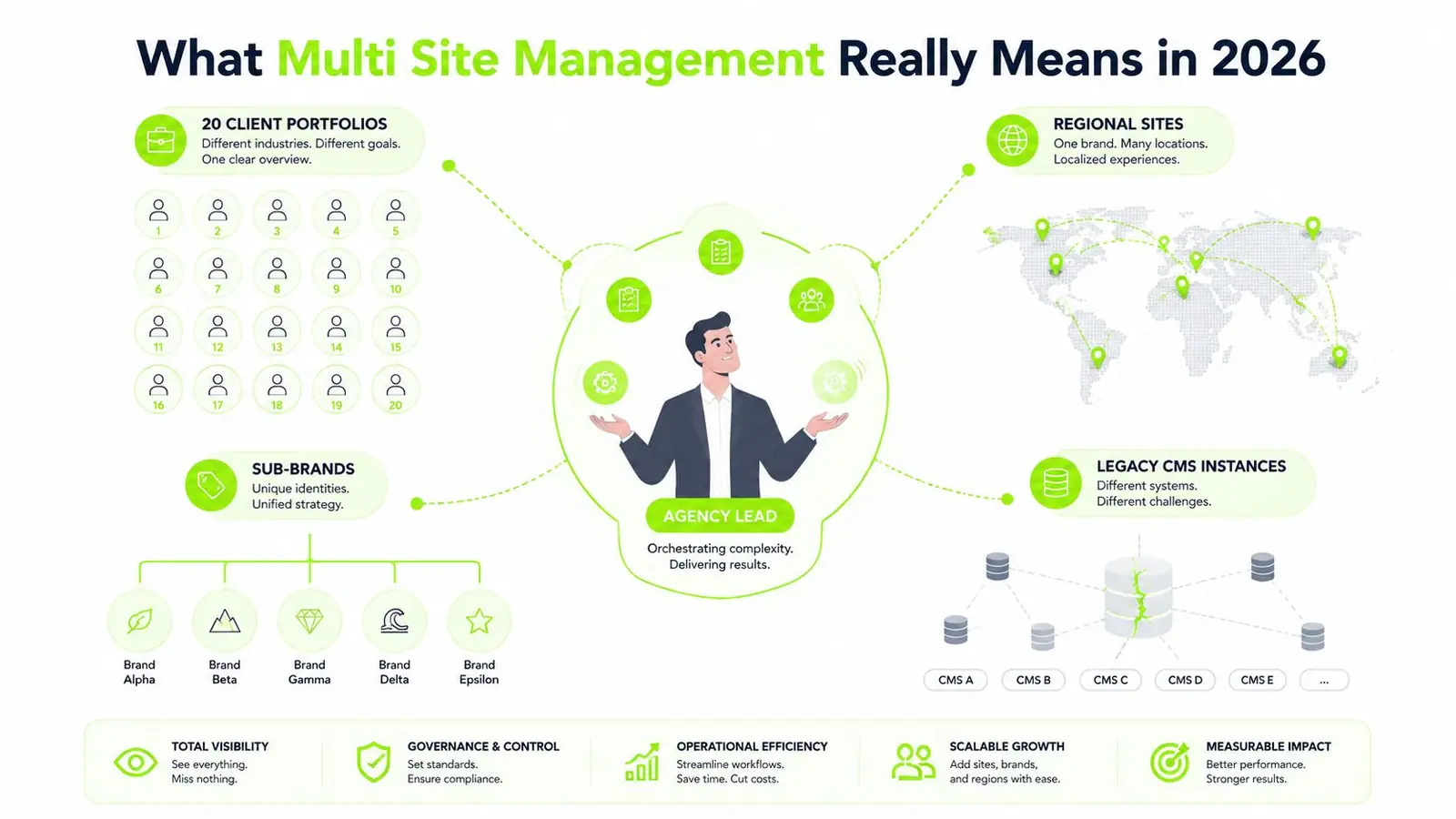
A useful working definition is this. Multi site management is the coordinated governance of multiple websites, brands, or regional experiences so they behave like one system even when different teams touch them. That's why the architecture for multiple sites resource from Webtwizz is worth a look when teams start mapping structure and ownership, especially if they're deciding where standardization should stop and local variation should begin (architecture for multiple sites).
Where It Sits In The Stack
Think of the stack in layers. Business strategy sets the market goals, the operating model defines ownership and guardrails, and the CMS or platform executes delivery. If the platform is the only thing you change, the same fragmentation comes back through a different interface.
That's also why AI visibility now belongs in the definition. Classic SEO reporting still matters, but it's no longer enough to know where a page ranks in blue links. Teams now need to understand how brands appear in Google AI Overviews, ChatGPT-driven discovery, and other LLM experiences, because that visibility is part of how discoverability gets measured and reported.
The Practical Test
If you can answer these questions clearly, you're managing a portfolio, not a pile of sites.
- Who owns global standards? The answer should be named, not implied.
- What can local teams change? Variation needs rules, not ad hoc approval.
- How is performance measured? The scorecard should cover more than traffic.
- Where does AI visibility land? If it's missing, discovery reporting is incomplete.
For teams building their digital operating model, the broader technology stack often matters as much as the CMS. A good starting point is the digital marketing technologies ecosystem, because multi site management usually lives in the middle of content, analytics, SEO, and automation tooling.
Practical rule: if a site can be launched, updated, and audited without a shared governance model, the portfolio will drift even if the CMS itself is modern.
The Core Challenges That Break Multi Site Programs
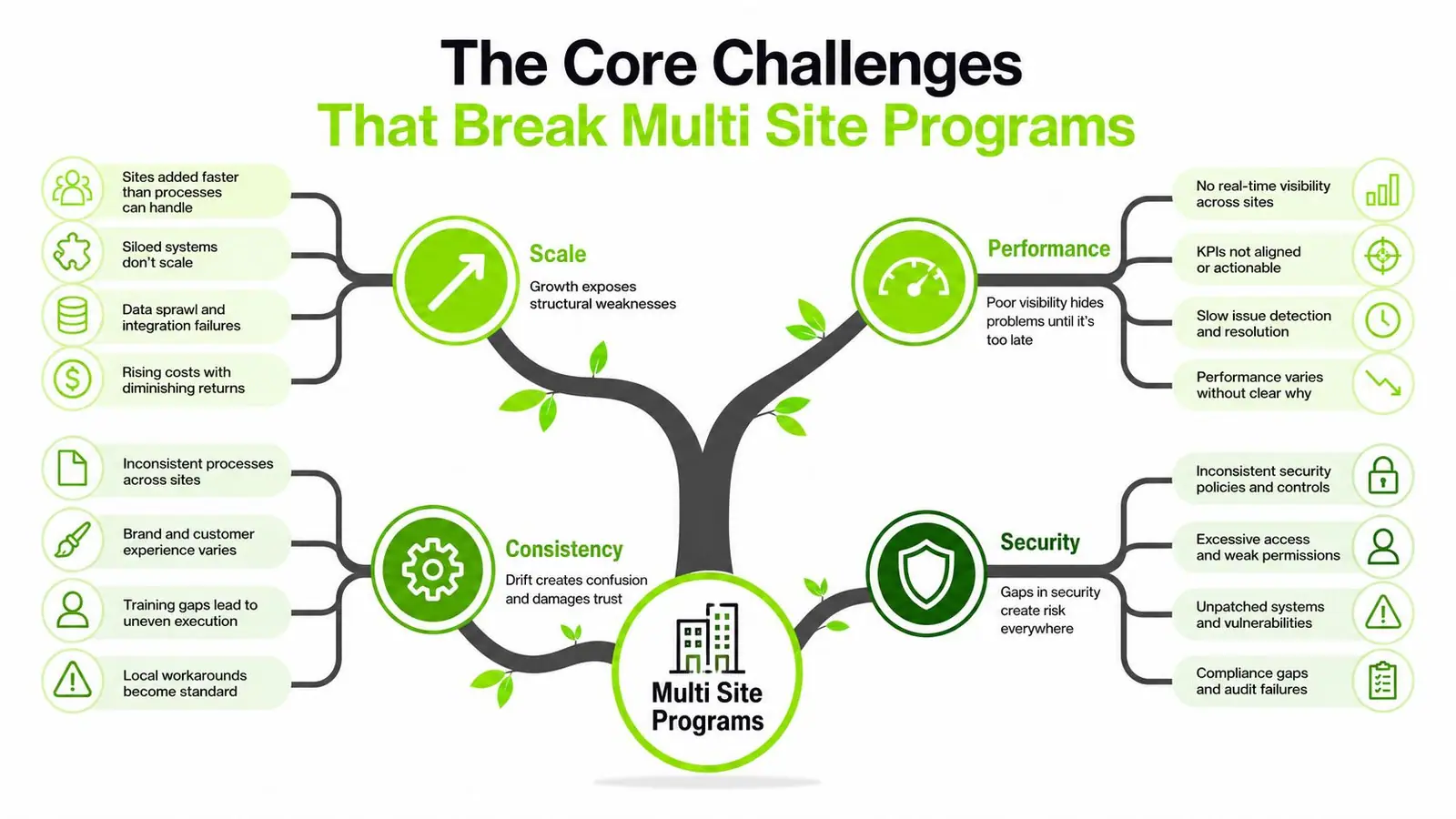
The failures that show up in multi site programs usually look separate at first. One team complains about speed, another about brand drift, a third about security reviews, and someone else says the reporting is unusable. In practice, they usually come from the same root cause, decentralization.
Scale And Consistency Drift Together
As site count grows, content volume grows with it, and so does asset sprawl, owner confusion, and approval overhead. The issue isn't just more pages, it's more decisions. Without explicit reuse rules, local teams start cloning templates, renaming taxonomy labels, and inventing their own page patterns because the central path feels too slow.
That's how consistency breaks. Brand voice, schema, navigation labels, and component behavior all drift when each site is allowed to adapt in isolation. Claromentis points to this fragmentation directly, noting that governance overhead rises as content, workflows, and infrastructure spread out across sites (Claromentis).
Performance And Security Get Harder At The Same Time
Infrastructure gets more fragile as the portfolio grows. Contentful's technical guidance notes that bandwidth constraints, latency, congestion, and inconsistent policy enforcement become more likely as site count rises, because every added site increases the volume of content, visitors, devices, protocols, and configurations IT has to support (Contentful). That's not a platform problem alone, it's a monitoring and standardization problem.
Security follows the same pattern. More sites mean a larger attack surface and more chances for identity and access controls to diverge between teams. If one market launches faster than the others, security exceptions often get normalized as “temporary” and then never removed.
A video walkthrough can help stakeholders understand how the failure modes connect across a portfolio.
Operational insight: once a multi site program depends on tribal knowledge to keep standards intact, the portfolio is already paying a decentralization tax.
What These Constraints Mean In Practice
A good multi site model doesn't pretend those problems disappear. It decides how each one will be absorbed.
- Scale needs reuse rules. Otherwise every launch becomes a rebuild.
- Consistency needs ownership. Otherwise local convenience wins over brand clarity.
- Performance needs centralized monitoring. Otherwise teams only react after users complain.
- Security needs standard controls. Otherwise every exception becomes a future incident.
If you're auditing the current state, the SEO audit framework is useful because it forces teams to separate symptoms from causes before they start buying more tooling. The key question is whether the portfolio has explicit operating rules, or just a collection of sites that happen to share a logo.
Governance Models And Workflow Patterns That Scale
A multi site program lives or dies on governance. The operating model decides who can change what, who approves it, and how quickly work moves from request to live site. In practice, the trade-off is clear, tighter central control improves consistency and reporting, while broader local autonomy improves speed and relevance. Trying to get both without explicit boundaries is where portfolios drift into inconsistent standards and expensive rework.
Three Models Worth Comparing
Centralized governance puts one team in charge of standards, templates, approvals, and reporting. It fits portfolios with strict brand control, high risk, or heavy compliance pressure. The trade-off is familiar, local teams can feel blocked, and changes often move more slowly because every request routes through the same approval path.
Federated governance keeps shared standards at the center while local teams handle execution inside defined guardrails. It works well for regional portfolios, multilingual sites, or business units that need room to adapt without rewriting the operating model each time. The weak spot is reporting discipline, because the model breaks down fast if ownership and review paths are unclear.
Hybrid governance usually gives global brands the best balance. A center of excellence owns the rules, templates, and technical guardrails, while regional operators own approved variations and local activation. That structure works best when the portfolio needs one standard for quality and measurement, but not one team making every market decision.
For teams managing many access boundaries and account permissions, the Sota Proxy secure framework is a useful reference point for compartmentalized control, even if the use case is different from web governance.
The Workflow Primitives That Hold The Model Together
A governance model only works if the workflow is defined in advance. Reusable component libraries stop every market from inventing its own hero module. Taxonomy ownership maps reduce duplicate labels and broken reporting. Release approval gates make sure changes move through the right review path. Rules for local variation tell teams what they can adapt and what stays locked.
Practical rule: centralize standards, federate execution. That saves more rework than any tool purchase because it forces the hard decision up front.
The delivery side of the operating model needs the same discipline. A shared process for intake, review, and launch keeps site teams from guessing their way through handoffs, and the project management for SEO resource is a useful reference for structuring that work.
If you want a simple decision test, use this. Regulated portfolios and tightly controlled brands should lean centralized. Highly local portfolios that can tolerate variation should lean federated. If both are true in different parts of the business, hybrid is the practical answer, but only if the boundary lines are written down clearly.
An Implementation Roadmap For Multi Site Management
A multi site program usually fails when teams jump straight to platform consolidation before they know what they own. Start with inventory, because you can't govern what you haven't mapped. That inventory should include domains, CMS instances, content types, site owners, traffic, and AI visibility, so the team has a single source of truth before decisions start.
Phase One Audit And Inventory
This phase is about visibility, not optimization. Capture every site, every owner, every platform dependency, and every content family that gets reused across markets. If one market has a shadow CMS or a one-off template, note it now instead of discovering it during rollout.
Exit this phase when the portfolio map is complete and the gaps are explicit. If ownership is unclear, the program isn't ready for standards design yet.
Phase Two Standards Design
The standards phase turns the portfolio map into rules. Define the design system, content model, SEO and schema templates, and the approved boundaries for local variation. Teams decide which modules are global, which are localized, and which can never be changed without review.
A strong standards layer keeps local teams fast because they're not reinventing basic structures. It also makes QA more predictable, since every site is working from the same patterns instead of a patchwork of near-matches.
Phase Three Platform And Tooling Consolidation
Only after the standards exist should tooling be rationalized. That may mean consolidating CMS instances, aligning deployment pipelines, unifying identity management, and standardizing monitoring. If the tools are merged before the operating model is set, teams usually just centralize the mess.
This is also where monitoring discipline matters. Multi site environments need alerting that shows drift across the portfolio, not just isolated site health checks. Standardized security controls belong here too, because any variation in access paths creates future cleanup work.
Phase Four Rollout And Optimization
Rollout needs change management, not just publishing support. Train site owners on the new rules, give local teams clear escalation paths, and keep a tight feedback loop on what breaks in the first releases. Then measure the program against the KPIs that matter, including uptime, crawl coverage, schema consistency, and AI visibility.
A practical rollout is never "done" at launch. The first release is where the process debt shows up, and the governance model either absorbs it or amplifies it.
Tooling Categories And Integration Patterns
Tooling should map to the operating model, not the other way around. In a healthy multi site stack, each category owns a different layer of the problem, and all of them feed the same reporting spine. The goal isn't to collect more dashboards, it's to reduce the number of places a team has to check before taking action.
| Category | What It Owns | Integration Role |
|---|---|---|
| Content and CMS | Pages, components, content models, approvals | Publishes reusable content and enforces structure |
| Deployment and DevOps | Releases, environments, code promotion, rollback | Keeps change delivery consistent across sites |
| Monitoring and observability | Uptime, errors, health, drift, security signals | Surfaces operational issues across the portfolio |
| SEO and AI visibility | Rankings, audits, backlinks, AI presence, citation gaps | Connects discovery performance to site and content changes |
The best stack usually mixes standardization with selective best-of-breed choices. Content teams need a CMS that supports shared models and local overrides. Engineers need deployment and identity systems that can scale without brittle manual steps. Analysts need one reporting layer that brings together SEO, audit, and AI visibility signals.
That integration layer matters more than most vendors admit. Without it, every agency ends up stitching together exports before the Monday meeting. A better approach is to use an API-first platform that can normalize site, content, and performance data into one source of truth, so the stack can change without forcing a re-platform every time a new market or LLM surface appears.
For teams comparing modern visibility stacks, the SEO visibility tools resource is a practical way to think about feature overlap, especially where classic search metrics and AI discovery tracking now sit side by side. The point is to standardize the data layer, keep enough flexibility in the execution tools, and avoid the false comfort of disconnected best-of-breed point solutions.
Rule of thumb: if a new tool makes reporting harder to unify, it's probably adding operational weight, not removing it.
KPIs, Automation, And AI Visibility Reporting
The easiest way to ruin a multi site reporting model is to split it into separate slides for SEO, technical health, content, and brand visibility. The better approach is a hierarchy. Start with portfolio health, move to site-level outcomes, and then layer in emerging visibility signals.
The KPI Hierarchy That Holds Up
At the portfolio level, track uptime, crawl coverage, and security posture. Those are the indicators that tell leadership whether the system is stable enough to support growth. At the site level, report organic traffic, conversions, and schema coverage, because those metrics tell you whether the individual properties are doing their job. Then add emerging visibility, such as share of voice in AI Overviews, brand mentions in LLM responses, and citation gaps.
That structure keeps stakeholders from mixing operational problems with commercial outcomes. A site can have good traffic and still be weak in AI discovery, just as it can rank well while being technically fragile.
Automation That Reduces Drag
Automation should remove repetitive work, not hide accountability. Scheduled audits can catch drift before it spreads. Alerts can flag template changes, accessibility regressions, or security exceptions. Automated schema and metadata rollouts keep updates consistent across markets, while weekly AI visibility deltas give stakeholders a reliable pulse on discovery changes.
If accessibility is part of the reporting standard, a guide for ADA compliance audits is a useful cross-check for teams that need a structured lens on page-level issues. Accessibility doesn't belong in a separate silo when the portfolio is meant to behave as one system.
Reporting insight: one unified scorecard per client beats five separate dashboards because it forces the team to explain the whole system, not just the part that looked good that week.
The best monthly review usually fits on one first slide. Show what changed, what drifted, what needs intervention, and what the next action is. If the report can't support a decision, it's just documentation.
Common Pitfalls And How To Mitigate Them
The most expensive mistake is treating multi site management like a migration project. It is an operating model that has to hold up through launches, rebrands, regional exceptions, and staff turnover. When leaders miss that, they buy tools, rename the program, and still end up with fragmented ownership and unclear accountability.
The Mistakes That Kill Programs
Over-centralizing looks tidy at first, then it starts slowing the portfolio down. Central teams lock down every decision, local teams stop contributing market-specific relevance, and launches drag while performance flattens in regions that need flexibility. The fix is a written local-variation policy that states what can flex, what stays fixed, and who approves exceptions.
Under-investing in change management is just as costly. If site owners do not understand the workflow, they keep using old habits under pressure, even when the new process is cleaner on paper. A training cadence, with onboarding for new owners and refreshers for current ones, keeps the operating model in use after launch. It also gives agency teams a clean way to report adoption, not just compliance.
Ignoring AI visibility until a reputation issue shows up is a newer failure point, and it is already affecting how brands are discovered. If the team does not know how the brand appears in AI-generated answers, it cannot spot citation gaps, message drift, or content blind spots early enough. A standing AI visibility review belongs in the monthly rhythm, with the same discipline used for rankings, traffic, and conversion review.
Buying tooling without integration review creates sprawl faster than teams expect. Every extra dashboard introduces another version of the truth, and performance, content, and site data stop lining up in a way stakeholders trust. Any new tool should pass a mandatory integration review before purchase, with a clear answer on how it feeds the portfolio scorecard and which KPI it affects.
A fast readiness check helps here.
- Governance charter in place.
- Local variation policy documented.
- Training and onboarding cadence defined.
- AI visibility review scheduled.
- Integration review required before new tools are approved.
If those five items are not real yet, the program is still early. That is workable, but the next step is governance design and workflow discipline, not another software trial.
If you're trying to bring order to a portfolio of sites, Surnex gives you a single place to track SEO performance, audits, backlinks, and AI visibility without jumping between disconnected tools. Visit Surnex to see how a unified reporting layer can support multi site management, especially when your team needs clearer governance, faster reviews, and a cleaner way to explain what is changing across the portfolio.