You’re usually not starting an SEO audit from a clean slate.
You’re opening a client account where rankings dipped, leads flattened, reporting is split across five tools, and nobody can answer a simple question with confidence: what’s holding this site back? In 2026, that question is broader than it used to be. You’re not just checking rankings and crawl errors anymore. You’re also checking whether the brand appears in AI Overviews, whether competitors are getting cited in AI-driven discovery, and whether your reporting setup can explain those shifts to a client without turning into a spreadsheet mess.
That’s why how to do an seo audit has changed. The core work still matters. Technical health, indexation, content quality, and backlinks are still the foundation. But agencies now need a process that connects those fundamentals to AI visibility and client-ready reporting.
Organic search still carries most of the click opportunity, and the top of the SERP still matters most. Google’s top three organic search results capture 68.7% of all clicks, while organic search accounts for 94% of total clicks on search results, according to AIOSEO’s SEO statistics roundup. If a site has technical drag, weak content targeting, or poor authority signals, the loss is immediate. If it also misses AI citations, the visibility gap gets wider.
Defining the Scope and Goals of Your SEO Audit
A good audit starts before the crawl.
Most weak audits fail in the kickoff call, not in Screaming Frog. The team jumps into diagnostics without agreeing on what the business needs. That’s how you end up with a polished report full of issues that nobody prioritizes because none of them connect to revenue, leads, pipeline quality, or sales capacity.
Start with business outcomes, not SEO tasks
Ask direct questions that force clarity:
- What changed recently: New CMS, migration, product launch, traffic decline, lead quality drop, or pressure from leadership.
- What matters most to this client: Demo requests, qualified leads, ecommerce revenue, local visibility, branded demand, or market expansion.
- Which pages matter commercially: Service pages, category pages, location pages, product pages, comparison pages, or high-intent content.
- What’s already constrained: Dev resources, content team bandwidth, approval cycles, legal review, regional teams.
Those answers shape the audit. A lead-gen B2B site needs a different emphasis than a publisher or a multi-location brand. If the client sells through a handful of commercial pages, the audit should weight crawl access, internal linking, intent match, and conversion paths around those assets. If the site depends on a large content library, then duplication, pruning, consolidation, and topical structure matter more.
Practical rule: If you can’t explain why each audit stream matters to the business model, the scope is still too vague.
Set the KPI baseline before making recommendations
Before changing anything, capture a benchmark set from Google Analytics 4 and Google Search Console. That baseline gives you a way to measure progress later and keeps the audit grounded in reality instead of opinion.
Use a simple baseline sheet with these fields:
| Metric area | What to capture |
|---|---|
| Organic performance | Organic traffic trends, landing pages, conversions |
| Search visibility | Queries, impressions, clicks, CTR, average position |
| Technical health | Coverage issues, indexed pages, crawl behavior |
| Experience signals | Load time patterns, mobile usability, page templates |
| Authority context | Referring domains, top linked pages, branded mentions |
The point isn’t to make the kickoff appear overly complex. The point is to avoid vague goals like “improve SEO.” Replace that with something you can act on, such as improving visibility on commercial queries, reducing wasted crawl paths, recovering underperforming templates, or increasing discoverability in AI-driven search experiences.
Define what’s in scope and what isn’t
This matters more for agencies than is generally acknowledged. Without a scope line, audits sprawl into redesign feedback, analytics cleanup, CRO consulting, and content strategy workshops.
I usually lock scope around five questions:
- Which subdomains, folders, or markets are included
- Whether the audit covers local SEO signals
- Whether AI visibility is included
- Whether competitor benchmarking is light or deep
- Whether the final output is diagnostic only or includes a remediation roadmap
That last point changes the workload a lot. A diagnostic-only audit tells you what’s wrong. A useful agency audit tells the client what to fix first, who should own it, and how you’ll measure progress after launch.
Build a timeline that matches reality
A rushed audit creates false confidence. You need time to validate findings manually, compare templates, review key pages, and pressure-test assumptions with stakeholders. The larger the site and the more fragmented the data, the more important sequencing becomes.
Use a workflow like this:
- Kickoff and access collection
- Baseline pull from GA4 and GSC
- Technical crawl and indexation review
- Content and on-page assessment
- Backlink and competitor review
- AI visibility check
- Prioritization and reporting
That order keeps the work practical. If a site can’t be crawled properly, content recommendations are often premature. If the reporting layer is weak, even strong recommendations won’t land well with the client.
Executing the Core Technical and Indexation Analysis
Technical and indexation work usually explains why a site with decent content still stalls.
A new client will often say, "the pages are live, the pages are optimized, and Google has had time." Then we crawl the site and find three versions of key URLs, orphaned money pages, faceted combinations eating crawl budget, and canonicals pointing somewhere else. That is why I treat this part of the audit as the control layer. If search engines cannot reach, interpret, and prioritize the right URLs, every later recommendation gets weaker.
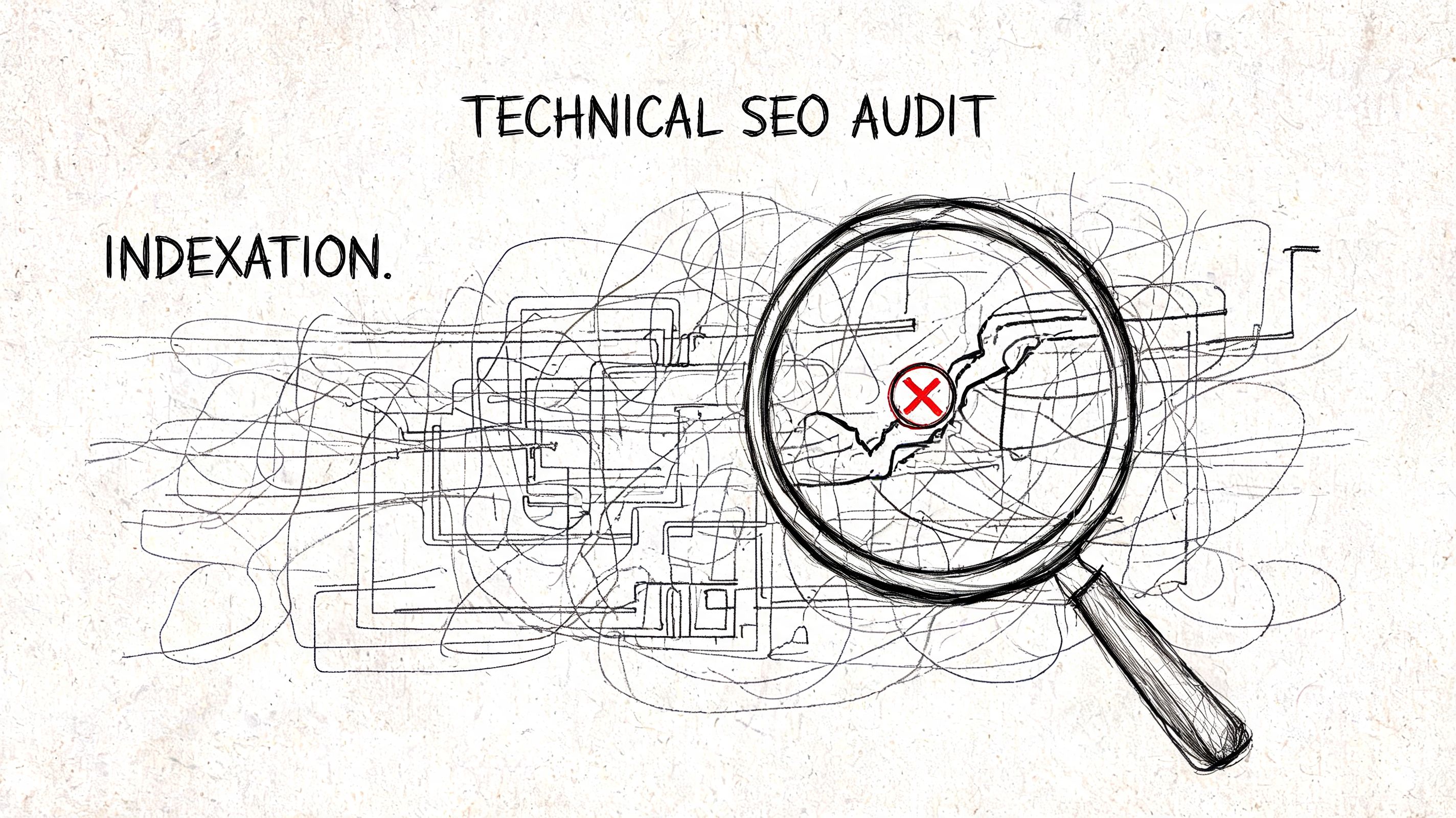
I start by comparing four versions of the same site. What the CMS says exists. What the XML sitemap says matters. What the crawler can reach. What Google has indexed. On larger accounts, we also add a fifth layer. Which URLs are being cited, summarized, or ignored in AI search surfaces such as AI Overviews and ChatGPT. That matters because the same technical confusion that hurts indexing also weakens entity clarity and citation eligibility.
Check crawlability first
Start with Google Search Console and keep the review focused on evidence, not assumptions.
Look at:
- XML sitemap status and coverage
- Crawl Stats trends
- Discovered but not crawled URLs
- Crawled but not indexed URLs
- Server and redirect errors
- Patterns in excluded pages
Then run a full crawl in Screaming Frog and compare the output against sitemap exports, analytics landing pages, and indexable URL exports from the CMS if you can get them. The mismatches tell the story faster than any single dashboard. You will usually find one of three problems. Important pages are hard to reach. Low-value URLs are too easy to reach. The site sends mixed signals about which version should rank.
One useful outside reference for practitioners is UFO Performance Marketing's audit process, especially if you want another practical checklist to compare against your own workflow.
Audit indexability and duplication
A crawl only shows what exists. The audit has to decide what deserves indexation.
Review these elements together:
- Canonical tags
- Meta robots directives
- Robots.txt rules
- Pagination and faceted navigation
- Parameter handling
- Soft 404 patterns
- Redirect chains and inconsistent status codes
In this context, judgment matters. I do not treat every indexable URL as a win. Ecommerce sites, publishers, SaaS help centers, and multi-location businesses all generate pages that are technically valid and strategically useless. Filter combinations, duplicate tag archives, empty local pages, internal search results, and thin support variations often end up in the index because nobody set a rule for them.
The fix is usually reduction, not expansion.
For repeatability, teams often formalize this work inside a dedicated technical site audit workflow, especially when multiple analysts need to review sites the same way and roll findings into one reporting layer.
Review architecture and click depth
Technical SEO also includes how importance is expressed through structure.
In Screaming Frog, sort pages by crawl depth and segment the ones that matter commercially. Service pages, category pages, high-converting resources, and key comparison pages should not sit four or five clicks away with weak internal links. If a page is buried, Google usually treats it that way. AI systems often do too, because buried pages attract fewer links, weaker engagement signals, and less consistent internal context.
Check the hierarchy directly:
| Area | What good looks like | What usually goes wrong |
|---|---|---|
| Main structure | Homepage to category to subcategory to page | Inconsistent folder logic and overlapping paths |
| Navigation | Key pages linked clearly from primary navigation or strong hubs | Revenue pages hidden in menus, utilities, or footer clutter |
| Internal hubs | Related pages grouped by topic and intent | Orphaned pages or clusters with no clear parent |
This is one of the trade-offs I explain to clients early. Flat architecture is not always better. Large sites still need depth. The goal is controlled depth, with clear parent-child relationships and deliberate internal linking to the pages that need authority.
Here’s a useful walkthrough if you want a visual refresher on technical audit thinking before presenting findings to a client:
Test performance and mobile usability
Performance checks work best at the template level.
Use PageSpeed Insights, Lighthouse, and Search Console to review page groups rather than chasing a perfect score on one URL. On agency audits, I care more about repeated failures across category templates, article templates, product pages, and location pages than isolated test results. Heavy JavaScript, unstable layout components, oversized media, delayed rendering, and intrusive interstitials usually show up as system problems, not page-level accidents.
That same template view helps with AI visibility too. If the pages that should earn citations load poorly, hide the main answer below interactive clutter, or render important content late, they are less likely to be parsed cleanly by both crawlers and answer engines.
Do not optimize every page equally. Prioritize the templates tied to revenue, indexable demand, link equity, and AI citation opportunities. That is the work that tends to change outcomes fastest.
Auditing On-Page Factors and Content Effectiveness
A new client audit often reaches this stage with a familiar pattern. The site is crawlable, key templates are indexed, and performance issues are documented, but rankings still stall because the wrong pages are trying to win the wrong searches.
That is usually an on-page and content problem, not a technical one.
This part of "How to Do an SEO Audit" isn’t a grammar check. It is a page-by-page review of intent fit, content quality, internal support, and duplication risk. The goal is to decide which URLs should keep their role, which need stronger execution, and which should stop competing for attention.
Classify pages by performance and purpose
Start with landing page and query exports from Google Search Console, then add engagement and conversion data from GA4. In agency work, I also tag each page by business role: revenue page, supporting educational page, comparison page, local page, or low-value legacy asset. That framing matters because a page can have traffic and still be the wrong asset to invest in.
I sort URLs into four working buckets:
| Bucket | What it means | Typical action |
|---|---|---|
| Keep | Page performs and matches intent | Maintain, monitor, strengthen internal links |
| Improve | Page has traction but underdelivers | Refresh, expand, tighten structure, improve snippets |
| Merge | Multiple pages compete for the same intent | Consolidate and redirect |
| Prune | Page has no strategic value | Noindex, remove, or fold into a stronger asset |
This is also where unified reporting helps. In Surnex, for example, we can map rankings, page intent, conversions, and optimization status in one view so recommendations are easier to prioritize across teams. The point is not prettier dashboards. The point is faster decisions on which pages deserve resources.
Check intent before changing copy
Teams waste time rewriting pages that are structurally wrong for the SERP.
Review the target query set for each key page, then compare the page type, angle, and depth against what currently ranks. A service page aimed at a comparison query will usually struggle. An informational article aimed at a transactional term often earns impressions and little else. AI Overviews add another layer here because pages that answer the query clearly, early, and with usable structure are more likely to surface as citation candidates.
A useful benchmark from Neil Patel’s SEO website audit guide is that post-audit content optimizations yield 30-50% organic growth in 6 months for agencies, and top performers achieve a 70%+ intent match rate versus the 45% industry average. I do not treat those numbers as a promise. I use them as a reminder that intent alignment usually separates pages that rank from pages that just look optimized in a content brief.
One correction often beats a rewrite. Change the page type, narrow the query set, strengthen the opening answer, and rankings can move without touching every paragraph.
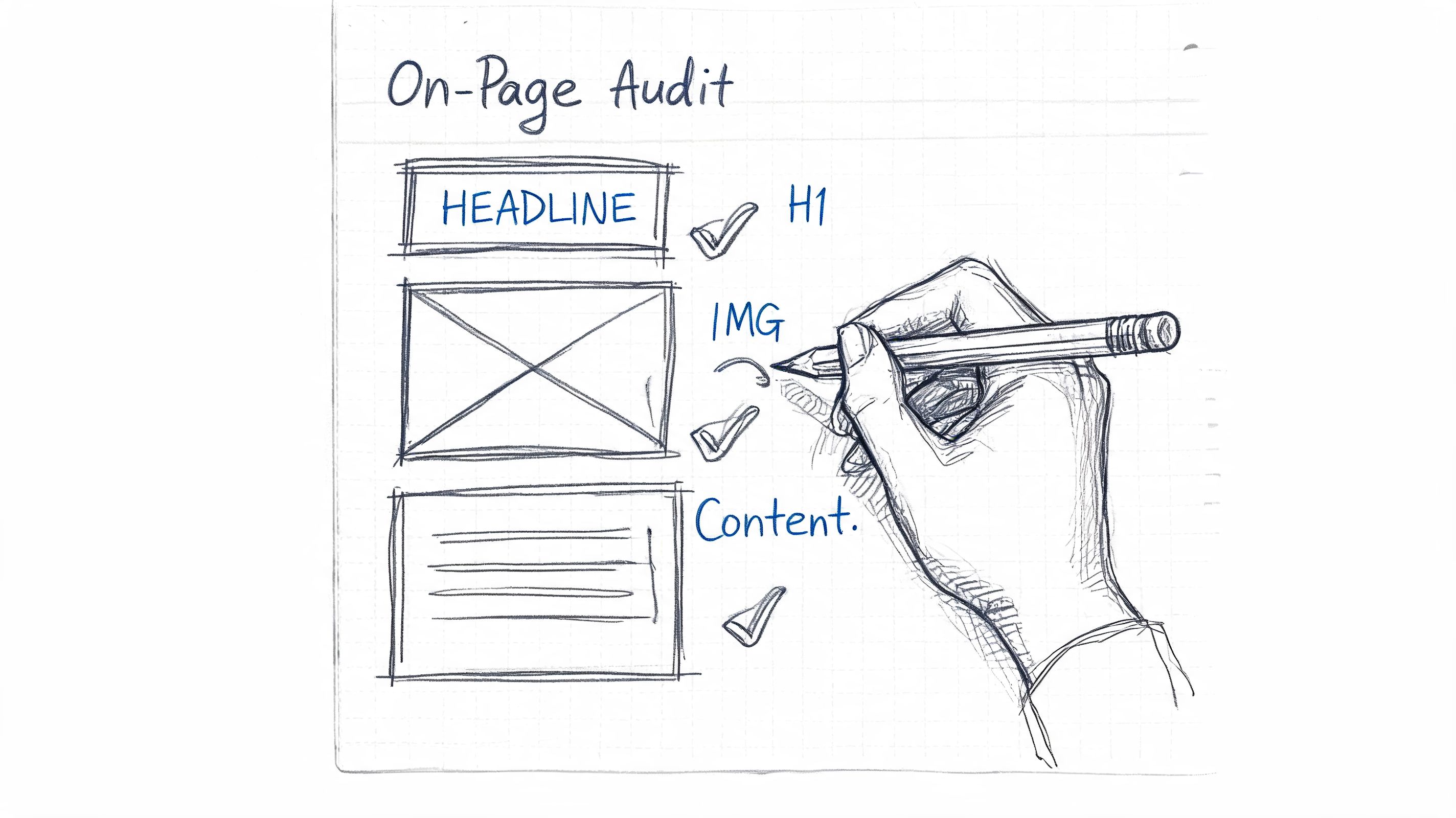
Review the page elements that influence ranking, clicks, and citations
Once the page is targeting the right job, review execution. I assess these elements together because they affect both classic rankings and AI retrieval:
- Title tags and meta descriptions for relevance and click appeal
- H1 and subheading structure for clarity and scanability
- Primary topic coverage that answers the query without repetition
- Internal linking from related pages and from pages with authority
- Visual support such as screenshots, comparison tables, examples, and diagrams
- Trust signals including author information, references, proof points, and update quality
- Answer formatting that makes key points easy to extract in search features and AI summaries
Metadata still matters, especially on pages that already earn impressions. Search engines may rewrite snippets, but weak titles and vague descriptions lower the odds of winning the click and can reduce message control on commercial pages. I treat metadata as a prioritization issue, not a bulk-edit exercise. High-impression URLs go first.
If your team needs a consistent way to map topics, cluster queries, and assign a primary target to each URL before rewriting, use a documented keyword research workflow. It reduces overlap and keeps page purpose clear across large accounts.
Evaluate depth, consolidation, and internal link flow
Longer content is useful when the query needs comparison, explanation, evidence, or steps. It is a liability when the page buries the answer under filler.
I look for three things. First, does the page complete the searcher’s task? Second, is the page materially better than adjacent pages on the same site? Third, does internal linking reinforce its role in the topic cluster? If any of those answers is no, the page usually needs more than line edits.
Pages worth expanding tend to share the same traits:
- They answer the full query, not just the headline version of it
- They include original proof, examples, screenshots, or local detail
- They receive contextual internal links with descriptive anchors
- They sit inside a cluster that supports the same topic from adjacent angles
Pages worth consolidating also follow a pattern. They chase slight keyword variations with near-identical copy, split links and impressions across multiple URLs, and create reporting noise. In those cases, merging content into a stronger page usually improves both ranking signals and editorial quality.
For stakeholders who need a simple explanation of how authority flows into content decisions, it can help them understand your backlink profile before you connect links, internal architecture, and page performance in the final recommendations.
A strong content audit is editorial judgment backed by query data, conversion context, and a realistic view of what can win in both search results and AI-generated answers. That is why this part of the audit still separates experienced operators from template-driven checklists.
Reviewing Your Backlink Profile and Off-Page Authority
A backlink audit should answer a practical question: which pages on this site receive authority, and does that authority support the queries and revenue lines that matter?
I see the same failure pattern often. A client has a respectable domain-level score, but the links sit on old blog posts, press releases, or pages that no longer align with the business. Rankings stall because the pages expected to win competitive terms have little external support and weak off-page trust compared with the domains already in the top results.
If you need a plain-English resource for stakeholders before you get into the audit itself, this guide can help them understand your backlink profile.
Review links at the page level, not just the domain level
The first pass is about distribution.
In Ahrefs or Semrush, export referring domains, top linked pages, anchor text, newly won links, lost links, and links by target folder. Then map those exports against the pages that drive leads, sales, or high-intent traffic. That is where the trade-offs become visible. Some sites have strong editorial coverage but little support for service pages. Others have links pointed at assets that no longer rank, which means authority is sitting in the wrong places.
Three checks usually surface the underlying issues:
- Relevance: Are linking sites and pages connected to the client’s market, geography, or subject area?
- Support: Do priority commercial pages attract external links directly, or do they rely entirely on internal linking from informational content?
- Pattern risk: Do anchors, source types, or link bursts suggest old paid activity, sitewide placements, or low-trust campaigns?
A backlink profile can look healthy in aggregate and still be misaligned with the pages that need to perform.
Benchmark against real search competitors
Use the domains that consistently occupy the result set for your priority queries. Ignore giant publishers unless they repeatedly block the client on commercially important terms.
I compare competitor profiles across a few lenses:
| Audit lens | What to compare |
|---|---|
| Referring domains | Which competitors earn links from industry-relevant sites, not just more domains overall |
| Top linked assets | Which content types attract citations, references, and editorial links in the category |
| Commercial page support | Whether key money pages have direct links or depend on blog content to pass authority |
| Brand mention gap | Where competitors are referenced in articles, reviews, and roundups while the client is missing |
Off-page authority also includes signals that shape brand trust beyond classic backlinks. Reviews, third-party mentions, and inclusion in credible directories matter most for local businesses, SaaS companies with comparison-page exposure, and service brands that depend on reputation during the decision phase. I include them because they influence both click behavior and the likelihood of being cited across search and AI-assisted discovery.
Separate cleanup from opportunity
Teams lose time when every off-page issue gets dumped into one list. I split recommendations into cleanup, reclamation, and growth.
Cleanup covers manipulative patterns, spam clusters, hacked-page links, and legacy campaigns that still distort the profile. Reclamation covers broken backlinks, unlinked brand mentions, image attributions, and links pointed at URLs that now redirect poorly or return errors. Growth covers the assets and pages worth promoting next, based on ranking upside, conversion value, and linkability.
That structure also makes reporting easier. In Surnex, we group link findings alongside page targets, competitor gaps, and owner status so the client sees which fixes protect existing equity and which ones create new gains. For teams running this process across multiple accounts, a documented backlink review and opportunities workflow keeps the audit tied to execution instead of ending as another export in a folder.
The point of this section is prioritization. A good backlink audit does not stop at “you need more links.” It shows where authority is missing, what can be recovered quickly, and which off-page signals are likely to improve both organic rankings and broader visibility.
Auditing for AI Visibility and Modern User Experience
A new client can show stable rankings, healthy traffic on brand terms, and no obvious technical failures, then still lose share on high-intent queries because Google answers the question before the click and AI tools pull in competitor sources instead. That gap does not show up in a traditional rank report. It shows up when you audit search results, AI citations, and page usability together.
I treat AI visibility as its own review layer inside the audit. The goal is simple. Find where the brand appears in AI-assisted discovery, where it does not, and which pages are strong enough to earn inclusion more often.
That starts with the query set. I check which priority searches trigger AI Overviews, which domains get cited repeatedly, whether the client is named directly or only referenced through third-party sites, and what type of page Google seems to prefer as a source. Some topics pull in glossary-style definitions. Others favor product comparison pages, documentation, original research, or publisher coverage. Those patterns affect what you fix first.
I run the same review outside Google. ChatGPT, Perplexity, and other answer engines do not behave identically, but they reward many of the same inputs: clear entities, consistent facts, strong source pages, and a site structure that makes relationships between topics obvious. A documented AI visibility audit workflow helps agencies track those findings in one process instead of spreading them across screenshots, prompt logs, and separate spreadsheets.
The useful part of this audit is the connection back to familiar SEO work. Citation gaps usually trace to one of a few causes. The page does not answer the query cleanly. The entity signals are weak. Supporting pages are thin or disconnected. Another publisher has the clearer source.
For citation-candidate pages, I look for:
- A direct answer near the top of the page
- Heading structure that reflects how users phrase the question
- Definitions, steps, comparisons, or summaries stated plainly
- Facts and claims that are specific enough to quote
- Visible authorship, sourcing, and trust signals
- Internal links that reinforce the topic cluster
- A page type that matches the intent behind the query
User experience belongs in the same review because retrieval and comprehension problems often start on the page itself. If the layout buries the answer under banners, if mobile rendering breaks the content flow, or if the page forces users through clutter before they reach the useful part, both human visitors and machine systems get a weaker signal. I care less about trendy "AI optimization" tactics and more about whether the page is easy to parse, easy to trust, and worth citing.
Agency reporting has to reflect that reality. A client may see rankings hold steady while AI visibility drops on the same topic set. If reporting lives in separate tools, that story gets missed. In Surnex, we tie AI citation findings to the target query, landing page, owner, and remediation priority so the team can see whether the fix belongs to content, technical SEO, UX, or digital PR. That turns AI visibility from an abstract concern into a work queue.
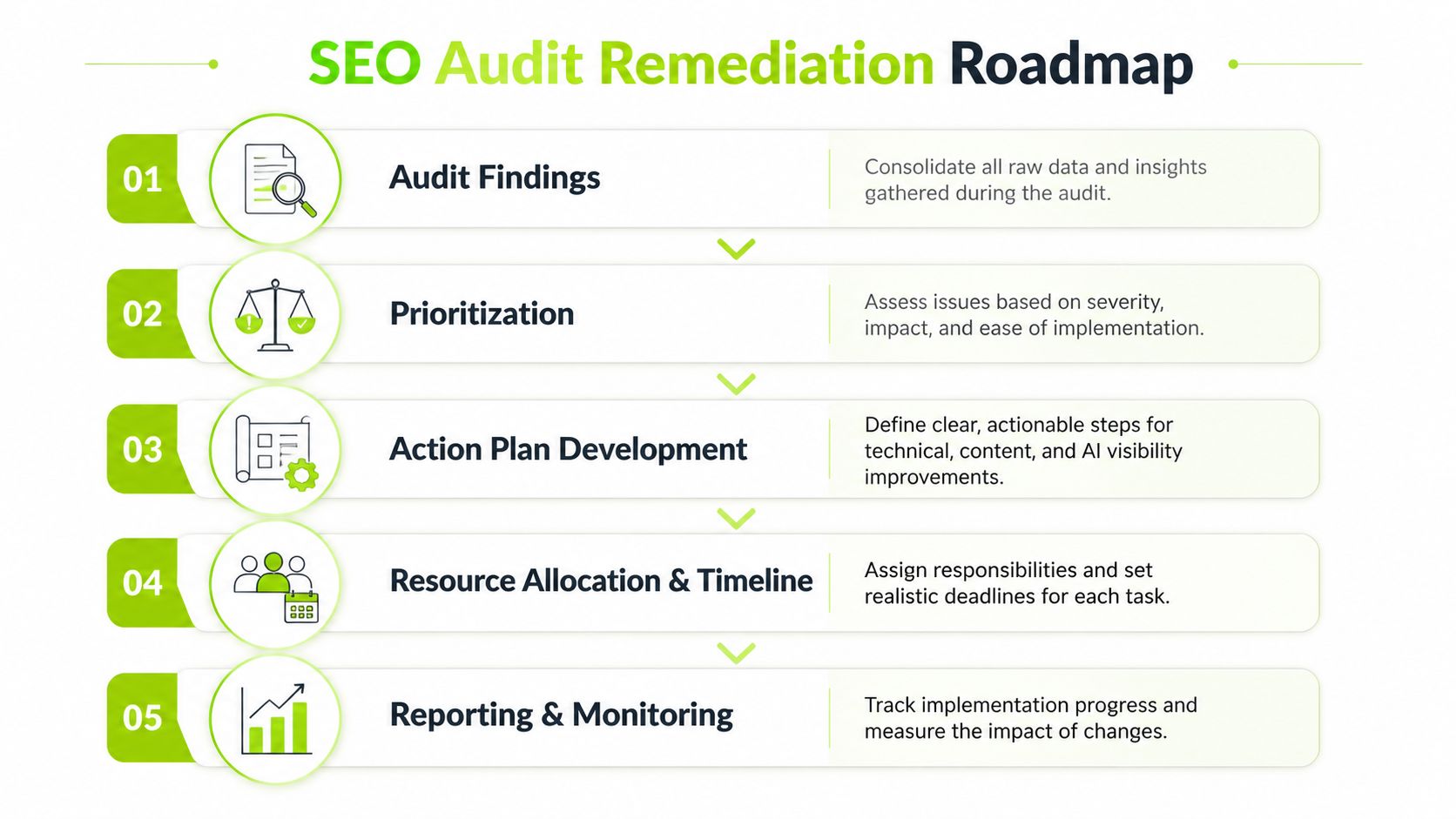
Building Your Remediation Roadmap and Reporting Results
An audit isn’t finished when the slides are done.
It’s finished when the client knows what to fix first, who needs to do it, how success will be measured, and why the order makes sense. That’s the part many audits skip. They hand over a long issue list and call it strategy. It isn’t. A document without prioritization usually creates delay, internal debate, and selective implementation.
For agencies, this problem gets worse across multiple clients. A key underserved need is multi-account prioritization, including identifying citation gaps in AI where competitors may be cited 5x more, and reporting via APIs. That capability is absent in 90% of generic audit guides, according to Digital Analyst Team’s reporting article. That gap is real. Organizations typically don’t struggle to find issues. They struggle to decide what matters now and communicate it cleanly at scale.
Turn findings into a decision system
Use an Impact vs Effort model. It’s simple, but it forces discipline.
Score each recommended action based on likely business impact and implementation effort. Keep the scale lightweight so teams will use it.
| Task Category | Example Fix | Impact (1-5) | Effort (1-5) | Priority Score (Impact/Effort) |
|---|---|---|---|---|
| Technical SEO | Fix blocked commercial URLs in robots settings | 5 | 2 | 2.5 |
| Technical SEO | Clean sitemap and remove low-value URL submissions | 4 | 2 | 2.0 |
| Content | Merge cannibalized service pages and redirect | 5 | 3 | 1.67 |
| Content | Refresh high-impression pages with weak intent match | 4 | 3 | 1.33 |
| Internal Linking | Add contextual links to revenue pages from strong hubs | 4 | 2 | 2.0 |
| Off-page SEO | Reclaim unlinked brand mentions | 3 | 2 | 1.5 |
| AI Visibility | Rework citation-target pages for clarity and extractability | 4 | 3 | 1.33 |
| Reporting | Consolidate SEO and AI metrics into one client dashboard | 4 | 2 | 2.0 |
Call this your SEO Audit Prioritization Framework. It keeps the roadmap rational when the client asks for everything at once.
Group recommendations by implementation owner
Clients don’t execute audits. Teams do.
That means every recommendation should map to someone who can act on it. I like to group recommendations by owner rather than by SEO category in the final action sheet.
For example:
- Developers handle crawl blocking, rendering issues, template performance, canonicals, redirects
- Content teams handle rewrites, consolidations, metadata, heading structure, trust improvements
- Design or UX teams handle page layout, navigation, readability, mobile friction
- Digital PR or outreach teams handle reclamation and authority-building work
- Marketing leadership approves priorities, budget, and sequencing
This sounds obvious, but it changes adoption. A client can ignore “fix indexation bloat.” It’s much harder to ignore “development team to remove duplicate filter paths from indexable state in sprint two.”
The strongest audit recommendation is specific enough that a team can turn it into a ticket without rewriting it.
Build a roadmap, not a backlog dump
A good roadmap has sequencing logic.
Start with the issues that unblock everything else. Then move to the improvements that amplify commercial performance. Then tackle longer-term authority and AI visibility initiatives that benefit from a cleaner foundation.
A simple roadmap often looks like this:
First wave
These are the blockers.
- Critical crawl and indexation fixes
- Canonical and duplication cleanup
- Broken internal link corrections
- Template-level mobile and performance issues on key pages
Second wave
These improve ranking quality and conversion relevance.
- Refresh underperforming commercial pages
- Merge cannibalized assets
- Strengthen internal linking from authority pages
- Improve snippets on high-impression URLs
Third wave
These widen visibility and make reporting stronger.
- Backlink reclamation and targeted authority building
- AI citation gap improvements
- Unified dashboards for SEO and AI metrics
- Ongoing benchmark tracking against competitors
That sequence works because it respects dependencies. There’s no point polishing citation-target content if the page is blocked, unstable, or buried.
Report in layers for different stakeholders
A single client report should serve more than one audience, but not in the same way.
Use three layers:
| Audience | What they need |
|---|---|
| Executive stakeholders | Risks, opportunities, priorities, expected business effect |
| Marketing leads | Channel context, page groups, content actions, competitor gaps |
| Technical teams | Precise issue definitions, affected templates or URLs, implementation notes |
This is why unified reporting matters so much now. Agencies already juggle rankings, backlinks, crawl data, GA4 performance, and content plans. Add AI visibility and citation benchmarking, and scattered reporting becomes a credibility problem. Clients don’t want six exports. They want one clear explanation of where visibility stands and what happens next.
Track outcomes after fixes go live
The post-audit phase is where many teams lose momentum. Recommendations get implemented, but nobody closes the loop.
Create a simple monitoring layer tied to the baseline from the kickoff:
- Indexation and crawl health after technical fixes
- Ranking movement on priority query sets
- Click and conversion changes on optimized pages
- Backlink and mention gains
- AI citation presence on tracked queries
That tracking matters because audits aren’t just diagnostic anymore. They’re part of a service narrative. Clients want proof that the priorities were right, the fixes landed, and the market response is visible.
Thought leadership content can yield 748% returns, according to AIOSEO’s SEO statistics roundup, but those gains are hard to defend if reporting is fragmented and disconnected from actual implementation. The same is true for technical and AI visibility work. If you can’t show the before, the change, and the result, the strategy will always look softer than it is.
The best audit output is simple to describe: a prioritized plan, assigned owners, a reporting framework, and a measurement loop. That’s what gets work done.
If you’re trying to audit traditional SEO and AI visibility without juggling disconnected tools, Surnex gives agencies and in-house teams one place to track rankings, backlinks, audits, and emerging AI search presence together. It’s built for teams that need clearer prioritization, cleaner reporting, and a better way to explain where search is heading next.