Let's get real for a minute: throwing random SEO tactics at the wall to see what sticks just doesn't work anymore. With AI Overviews and constantly changing search behavior, the only way to get predictable growth is through disciplined, organized execution. This is where solid project management for seo stops being a "nice to have" and becomes your most valuable asset.
Why SEO Project Management Is Your New Competitive Edge

The days of getting by with a messy, "we'll get to it when we can" approach to SEO are long gone. To succeed today, you need a structured, coordinated plan that gets every team member and every single task pulling in the same direction. That's the heart of modern SEO project management.
It's about shifting from constant firefighting to building a reliable system that delivers results time and time again. Think of it as the brain of your search strategy, making sure the content team, developers, and outreach specialists are all on the same page. Without a clear system, handoffs get fumbled, deadlines are missed, and brilliant ideas die in a mess of forgotten emails and outdated spreadsheets.
Moving Beyond Disconnected Tasks
One of the biggest hurdles I see teams face is working in silos. A technical audit is worthless if the dev team never has the bandwidth to implement the fixes. An amazing keyword strategy is just a document if your writers don't have clear briefs to work from. Good project management builds the bridges between these functions.
This playbook is for any team, whether you're in-house or at an agency, that's ready to build those bridges. We're going to walk through how to set up a system that actually works—one that:
- Creates clarity and accountability: Everyone knows exactly what they need to do, what’s most important, and when it’s due.
- Keeps teams in sync: Your content, technical, and marketing folks all work from the same plan, which means fewer delays and smoother launches.
- Connects daily work to real results: You can finally draw a straight line from the tasks you complete to the performance metrics that matter, proving the value of your work.
The single biggest mistake is treating SEO as a one-off project. The real wins come from building an agile, ongoing process of improvement, not just checking off a finite list of tasks.
Building a Framework for Scalable Growth
To truly scale your SEO efforts, you need to build a system. Below are the fundamental pillars that form the foundation of any successful SEO project management process.
| Pillar | Objective | Key Activities |
|---|---|---|
| Clear Scoping & Kickoff | Establish project goals, deliverables, and get stakeholder buy-in from day one. | Audits, client interviews, defining KPIs, setting expectations. |
| Task Breakdown & Timelines | Deconstruct large initiatives into actionable tasks with realistic deadlines. | Creating a work breakdown structure (WBS), sprint planning, Gantt charts. |
| Roles & Responsibilities | Define who is responsible, accountable, consulted, and informed for every task. | Creating a RACI chart, defining team roles, establishing points of contact. |
| QA & Implementation | Ensure all work is executed correctly and meets quality standards before going live. | Pre-launch checklists, staging environment reviews, post-launch monitoring. |
| Reporting & Communication | Track progress against KPIs and keep all stakeholders informed and aligned. | KPI dashboards, weekly/monthly reports, regular status meetings. |
| Tools & Automation | Use technology to automate repetitive work and create a single source of truth. | Project management software, workflow templates, reporting automation. |
Getting these pillars right is what separates the teams that struggle from the ones that consistently deliver.
The ultimate goal here isn't just to get organized—it's to build a machine that drives organic growth predictably. A well-oiled project management system lets you take on more campaigns without just throwing more people at the problem. By creating templates and automating repeatable tasks, your team can spend less time on admin and more time on high-impact strategy.
This is what sets top-performing SEO teams apart. It's how you manage your visibility in a world of traditional search and new AI-powered results, keeping stakeholders happy and delivering the business impact everyone wants to see.
Turning SEO Goals into a Real-World Plan
Every great SEO campaign I've ever run started with a solid plan, not just a vague hope to "rank higher." A detailed project blueprint is your best tool for avoiding the classic project killers: scope creep, blown budgets, and clients who feel like you're not on the same page. It’s all about turning big ideas into a checklist of what needs to get done.
This whole process kicks off with discovery. And I don't mean a quick 30-minute kickoff call. It’s a proper investigation to figure out what the client actually wants to achieve. Are they after more leads? Higher e-commerce sales? Or just getting their brand name out there? You have to dig in to understand their business, the technical mess you might be inheriting, and who they’re up against.
A project plan without a real discovery phase is just a wish list. You have to nail down the "what" and the "why" before you can even think about the "how."
From Big Ideas to Small, Actionable Tasks
Once you know the end goal, it's time to break that intimidating mountain of work into smaller, more manageable hills. This is where a Work Breakdown Structure (WBS) is an absolute lifesaver for managing SEO projects. Think of it as a family tree for your project, showing how every single deliverable connects back to the main goal.
For example, a "Comprehensive Content Overhaul" is not one task. It's a massive undertaking with a ton of moving parts. A WBS lets you map out every single piece of the puzzle, so nothing gets missed. You’re not just making a to-do list; you're creating a blueprint for the entire project.
Here’s a simple visual of how a WBS breaks a big project down into deliverables you can actually tackle.
This kind of visual hierarchy makes it crystal clear how everything is connected. It simplifies assigning tasks and, just as importantly, estimating how long it will all take.
How to Build Your Work Breakdown Structure
Spending the time to create a WBS forces you to think through every single step. This is absolutely critical for setting realistic timelines and assigning the right people. Let's map this out for a common project: a technical site audit and the follow-up implementation.
- Level 1 (The Project): Technical SEO Overhaul
- Level 2 (Major Deliverables):
- Crawlability & Indexing Audit
- Site Speed & Performance Analysis
- Schema Markup Implementation
- Level 3 (Work Packages/Tasks):
- Under Crawlability Audit: Check the
robots.txtfile, analyze the XML sitemaps, hunt down crawl errors in Google Search Console, and look for nasty redirect chains. - Under Site Speed Analysis: Run a Core Web Vitals report, get those images compressed, enable browser caching, and minify CSS/JS files.
- Under Schema Markup: Find opportunities for schema (like Product, Article, or FAQ), generate the code, and get it deployed via GTM or on the page, then double-check it with the Rich Results Test.
- Under Crawlability Audit: Check the
This kind of detailed breakdown does a lot more than just keep you organized. It gives you the clarity you need to estimate how much effort each part will take. It also flags dependencies right away—for instance, you can't add schema to a page that you've accidentally blocked from being crawled. For many projects, this level of planning starts with understanding the search landscape, which is why a comprehensive keyword research process is often the first major deliverable.
When you put in the work upfront to build this blueprint, you take a fuzzy strategy and turn it into a concrete action plan. This document becomes your guide, keeping your team focused, managing expectations, and setting your SEO project up for a win from day one.
Structuring Sprints for Predictable SEO Results
A great SEO blueprint is just a wish list until you put a timeline on it. This is where we stop planning and start doing. We're going to turn that static document into a living, breathing workflow that actually gets things done.
Forget the old, rigid annual roadmaps. The best way to manage SEO projects today is to borrow a page from the software development playbook: agile sprints. By working in sprints, you’re constantly shipping improvements—whether it's new content, technical fixes, or linkable assets—and you stay flexible enough to pivot when Google throws a curveball or business goals change.
It's all about finding a steady rhythm of execution that delivers tangible results and keeps everyone in the loop. This process starts long before the first sprint, flowing from discovery to a detailed breakdown of work, which then feeds the plan.
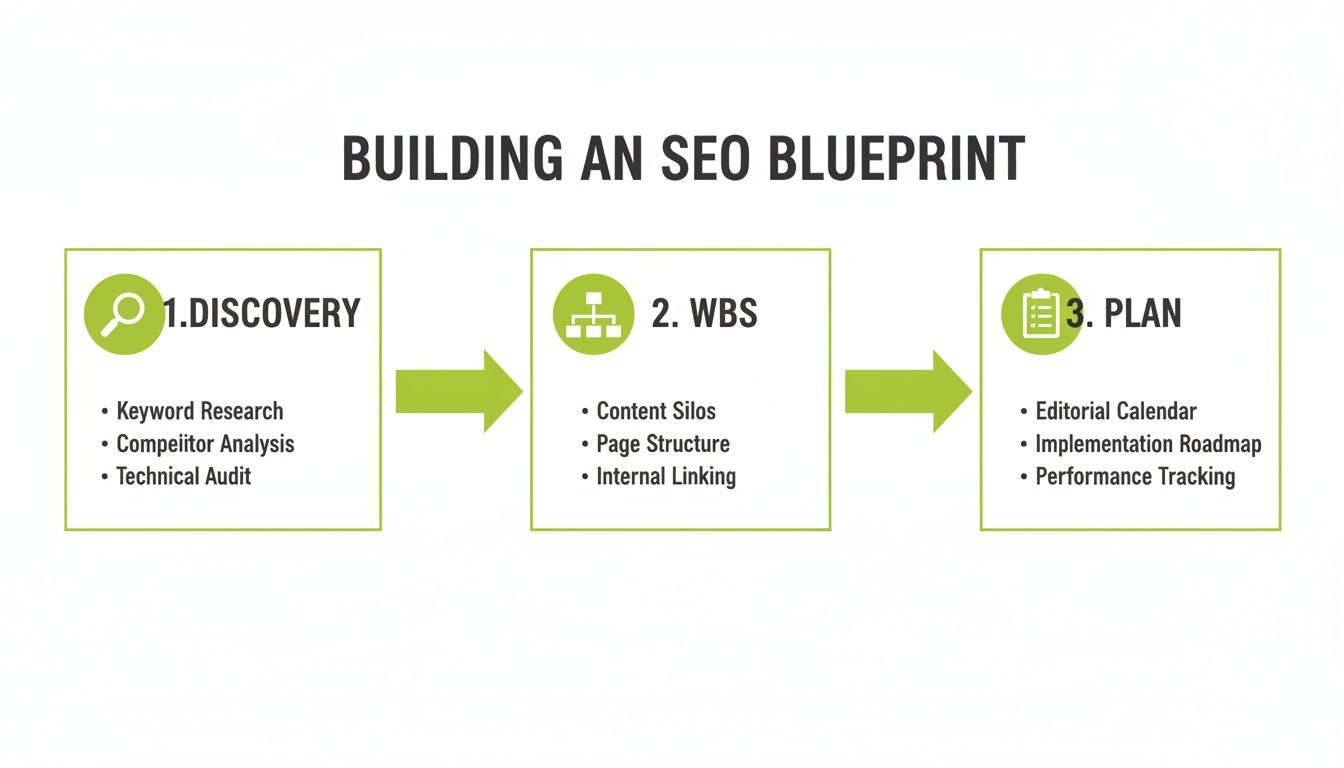
As you can see, a productive sprint doesn't happen in a vacuum. It’s the direct result of solid discovery and careful planning upfront.
Breaking It Down Into Two-Week Cycles
For most SEO teams, the two-week sprint is the sweet spot. It’s just enough time to tackle meaningful work but short enough to stay agile. This cadence transforms your huge Work Breakdown Structure into a series of focused, achievable mini-projects.
So, what does a typical two-week SEO sprint actually look like in practice?
- Sprint Planning (Monday, Week 1): The team huddles up to pull tasks from the project backlog. The key is to be realistic and select a handful of high-priority items you can confidently complete in the next ten working days. You walk out of this meeting with a clear commitment.
- Execution (The 10 Days): This is heads-down time. The content writer might be drafting two blog posts, the technical SEO is implementing new schema, and the outreach specialist is focused on landing three high-quality backlinks. Everyone has their mission.
- Sprint Review & Retrospective (Friday, Week 2): First, the team shows off what they’ve accomplished. Then, you have an honest conversation about what worked and what didn't. This is non-negotiable; it's how you get better with every single sprint.
Prioritizing What Really Matters
Let's be honest: your backlog will always have more tasks than you have time for. That's why being ruthless with prioritization is a superpower. I'm a big fan of using a framework like the RICE model (Reach, Impact, Confidence, Effort) to take the guesswork out of it. It forces you to think objectively instead of just running with what feels important.
The point of a sprint isn't to be busy—it's to be productive. By knocking out high-impact, low-effort tasks first, you create momentum and score early wins. This is absolutely critical for keeping stakeholders happy and invested.
This disciplined approach protects your team from the chaos of constantly changing demands. But it also requires a smart strategy for how you allocate your team's time. In 2026, with studies showing a staggering 40% of SEO projects fail from poor communication and scope creep, a balanced portfolio is essential. Top teams dedicate 60-70% of their effort to short-term wins (like content updates), 20% to essential maintenance, and just 10% to big, long-term experiments.
This is how you ship valuable work, build trust, and deliver measurable ROI sprint after sprint.
The data you get from each cycle is gold. You can see which activities are actually moving the needle on your KPIs. To really tighten that feedback loop, you can connect sprint tasks directly to performance metrics. For a great walkthrough, see how to implement effective rank monitoring and tracking changes to measure the impact of your work almost immediately. The results from one sprint then directly tell you what to prioritize in the next one.
Choosing Your SEO Project Management Tech Stack
The tools you choose can either be a massive help or a major roadblock. So many teams start out using general project management tools like Trello or Asana. While they're fine for basic task lists, they just weren't built for the unique demands of an SEO project.
The real problem is the disconnect. You can't see how the task you just completed in your project board actually affected your rankings or traffic. This forces you to constantly jump between your project plan, a rank tracker, a site audit tool, and your analytics. That back-and-forth is a huge time-suck and makes it almost impossible to connect your work to a tangible result.
What to Look For in an SEO-Specific Tool
When you're ready to move past generic to-do lists, you need to find a platform that acts as a single source of truth for your entire SEO operation. You’re not just managing tasks anymore; you’re managing performance.
Here are a few non-negotiables:
- Connected Performance Data: You should be able to see keyword rankings, site health scores, and traffic data right next to the tasks designed to improve them. This is how you finally close the loop between your actions and their outcomes.
- Built-in SEO Workflows: Look for pre-built templates for common projects. Think technical audits, content optimization checklists, or link-building outreach campaigns that you can launch in a couple of clicks.
- A True Content Calendar: This should be more than just a list of dates. It needs to be a central hub that tracks everything—from keyword research and content creation to on-page optimization, publishing, and promotion—all in one place.
- AI Visibility Monitoring: The search landscape is changing. A modern tool needs to show you where you stand not just in the classic blue links, but also in AI Overviews and other new search features.
The whole point is to move from a jumble of disconnected spreadsheets and tools to a single command center. When your project platform speaks the same language as your SEO tools, you spend less time digging for data and more time actually moving the needle.
This is exactly what specialized platforms are built to do. A tool like Surnex, for example, is designed to tie core SEO workflows directly to visibility tracking across both traditional and AI-driven search.
It brings all your key SEO functions into one clean interface.
Bringing everything under one roof eliminates the chaos of bouncing between different tools. For agencies and in-house teams, this is a massive efficiency boost.
The Real-World Impact of a Unified Tech Stack
Switching to software that’s actually built for SEO pays off in a big way. We're not just talking about convenience. Teams using integrated platforms report finishing tasks like content refreshes 35% faster and see a 28% improvement in collaboration between writers, SEOs, and developers.
Plus, with AI-powered workflows, you can cut down on manual data entry by up to 40%, which often speeds up entire campaign timelines by an average of 25-30%. You can dig into more of the findings about SEO project management software to see just how big the difference is.
This shift helps your entire operation become more scalable and effective. For an agency, this kind of consolidation is a game-changer. It slashes the time spent on manual reporting and empowers you to tell a clear, confident story about performance. You can explore how to build the right SEO tech stack to make this a reality for your team.
Executing and Reporting to Get Stakeholder Buy-In

This is where the rubber meets the road. All the planning, scoping, and sprint-building culminates in the actual day-to-day work. But simply getting tasks done isn’t enough. True success comes from doing them right and then proving their value in a way that resonates with your stakeholders.
That's where quality assurance (QA) comes in. It’s the safety net that prevents a simple oversight from derailing an entire campaign. We’ve all seen it happen—a new page goes live with the wrong schema, or a batch of internal links is forgotten, quietly sabotaging your efforts. This is exactly why simple, repeatable checklists are a non-negotiable part of solid project management for seo.
Practical Checklists for Flawless Execution
Checklists are your best defense against human error. They transform best practices into standard operating procedures, ensuring nothing gets missed, especially when you're juggling multiple projects and clients. It's about building a system so your team can focus on execution, not on remembering every single step from scratch.
Here’s a look at a basic checklist we use for publishing new content:
- Final SEO Check: Is the main keyword naturally placed in the title, H1, and the opening paragraph?
- Meta Elements: Are the meta title and description unique, compelling, and within character limits?
- Internal Linking: Have you added at least 3-5 relevant internal links to other important pages?
- Image Optimization: Are images compressed, and do they have descriptive alt text?
- Schema Markup: Is the right schema (like Article or FAQ) applied and validated?
- URL & Indexing: Is the URL slug clean, and is the page set to "index"?
You can—and should—create similar checklists for technical fixes, site migrations, and just about any other recurring SEO task. This discipline is the bedrock of consistent, high-quality results.
Reporting That Goes Beyond Clicks and Ranks
In today's search world, reporting on traffic alone is a fast track to losing a client or your budget. You absolutely have to connect your work to the metrics the business actually cares about. It’s time to move past vanity metrics and start telling a story about real business value.
The rise of AI-driven search makes this more critical than ever. Some data suggests AI Overviews and other zero-click features could cut click-through rates by a staggering 34.5% by 2026. This forces us to pivot from chasing raw traffic to proving visibility and demonstrating conversion intent. As you can discover in more detail from ProRealTech's 2026 trends report, the smartest teams are already tracking things like brand mentions in SERPs and focusing on high-impact strategies that earn both links and AI citations.
Your reports must answer the "So what?" question. Don't just show that rankings improved. Explain how that new visibility is driving qualified leads, boosting branded search, or putting money in the bank.
Connecting Your Work to Business Outcomes
The most persuasive reports are the ones that draw a straight line from the tasks you completed to the performance gains you delivered. A good project management dashboard is perfect for this, letting you visually tie a sprint goal like "Implement Product Schema on 50 Pages" to a KPI like a "15% Increase in Rich Snippet Clicks."
Think about framing your reports this way for maximum impact:
| Old Metric (What We Did) | New Metric (The Business Impact) |
|---|---|
| We published 4 blog posts. | Our content drove a 20% increase in demo requests. |
| We fixed 25 technical errors. | Our site speed improvements lowered the bounce rate by 10%. |
| We acquired 5 backlinks. | Our domain authority grew, leading to top-3 rankings for our money terms. |
This approach instantly shifts your report from an activity log into a powerful argument for ROI. It shows stakeholders that SEO isn't just a line item; it's a strategic engine for growth.
To make this even easier, you can build out client-ready reporting workflows that handle the data-pulling for you. That automation frees you up to focus on what really matters: crafting the narrative that proves your undeniable value.
Common Questions About SEO Project Management
Once you start trying to wrangle SEO with a real project management mindset, a lot of practical questions are bound to come up. Let's dig into some of the most common hurdles I see teams face when they get serious about organization.
What Is the Biggest Mistake Teams Make?
The single biggest trap is thinking of SEO as a one-and-done project. It’s not like building a house where you finish, hand over the keys, and walk away. SEO is a living, breathing process that demands constant testing, learning, and fine-tuning.
I’ve seen so many teams follow a rigid checklist, get some early wins, and then watch them slowly fade. Why? Because while they were checking boxes, their competitors were innovating and Google's algorithms were shifting. You have to move beyond a finite task list and embrace a mindset of continuous improvement.
How Do You Handle Unexpected Algorithm Updates?
This is precisely why agile methodologies are perfect for SEO. If you have a rigid, year-long plan locked in, a major algorithm update will blow it to smithereens. But if you work in short, focused sprints—say, two-week cycles—you have the built-in flexibility to pivot without creating total chaos.
An algorithm update shouldn't derail your strategy; it should inform it. Use it as a trigger for an immediate re-prioritization meeting to analyze the impact and adjust your sprint backlog.
Instead of panicking, your team can take a deep breath and assess what's changed. Maybe that new blog post you planned can wait. It might be more important to spend this sprint updating older articles that were hit by the update. A good system lets you make these strategic calls on the fly without tanking your entire quarter.
What Is the Best Way to Manage SEO for Multiple Clients?
For any agency, it really boils down to two things: standardization and centralization. Trying to juggle a dozen clients with a dozen different ad-hoc systems is a fast track to burnout and missed deadlines. The goal is to build an efficient machine without delivering cookie-cutter results.
Here’s how you do it:
- Templated Project Plans: Build out master templates for your core services, like a technical audit or a link-building campaign. When a new client signs on, you just clone the template and customize it. This alone can save you dozens of hours.
- Centralized Dashboards: You need a single source of truth. Use a project management tool with a portfolio view that shows you all client projects at a glance. It immediately highlights where your team is over-allocated or which project is starting to fall behind.
- Standardized Reporting: Create a core report template for efficiency, but always spend your time on the most valuable part: customizing the analysis and strategic recommendations to match each client’s specific KPIs and business goals.
This is how you scale your operations and deliver consistent quality without driving your team crazy.
How Do I Convince My Boss to Invest in Software?
If you want to get buy-in for a real SEO project management platform, you have to frame it as a business investment, not just a "nice-to-have tool." You need to connect it directly to ROI by showing how it solves expensive problems.
Start by auditing the "soft costs" of your current workflow. Get specific and calculate the hours your team wastes every single month on things like:
- Manual Reporting: How much time does it take to pull data from Ahrefs, Google Analytics, and Search Console just to populate a spreadsheet?
- Tool Juggling: How much focus is lost when your team has to constantly switch between platforms to connect a task to its actual performance?
- Chasing Down Updates: How many hours are burned just clarifying who was supposed to do what and when?
Once you put a dollar figure on the time you're losing, you can show how a unified platform turns that wasted time back into billable, revenue-generating work. Back it up with data. Point to studies showing a 25-30% faster campaign delivery or a 28% boost in collaboration. You're not asking for a tool; you're presenting a solution to improve efficiency, boost client retention, and prove your team's value.
Ready to stop juggling spreadsheets and start managing SEO with a single source of truth? Surnex is an AI Search and SEO platform that unifies visibility tracking, project workflows, and reporting. See how you can deliver confident, data-backed results by exploring the Surnex platform today.
Crafted with Outrank app