Your reporting team has a familiar problem. A client record sits in the CRM, case activity lives in a service platform, billing data remains in an older system, and campaign performance arrives through yet another application. Someone exports files, renames columns, resolves duplicate names, and explains why yesterday's dashboard doesn't match this morning's spreadsheet. Meanwhile, leadership wants automated recommendations and AI agents that can act on trusted, current information.
That's why data integration challenges have become an operating constraint, not an occasional engineering nuisance. The hard part isn't only moving records between systems. It's deciding what each field means, which system owns it, how fresh it needs to be, who can use it, and whether another connection will improve the workflow or make the estate more fragile.
Why Data Integration Is Now a Structural Bottleneck
A client report can look correct in each department and still fail as a shared decision tool. The CRM may hold one account name, finance another billable entity, and the project system a different status. Their records describe related work through different identifiers, timing rules, and definitions. Reconciliation then becomes part of every reporting cycle.
The first technical fix is often a connector. An export becomes an API call, then another connector joins the workflow. Soon the pipeline must handle authentication changes, rate limits, deleted records, late updates, schema changes, and exceptions that staff once corrected manually. A small request has become an operational product requiring an owner, monitoring, tests, documentation, and change management.
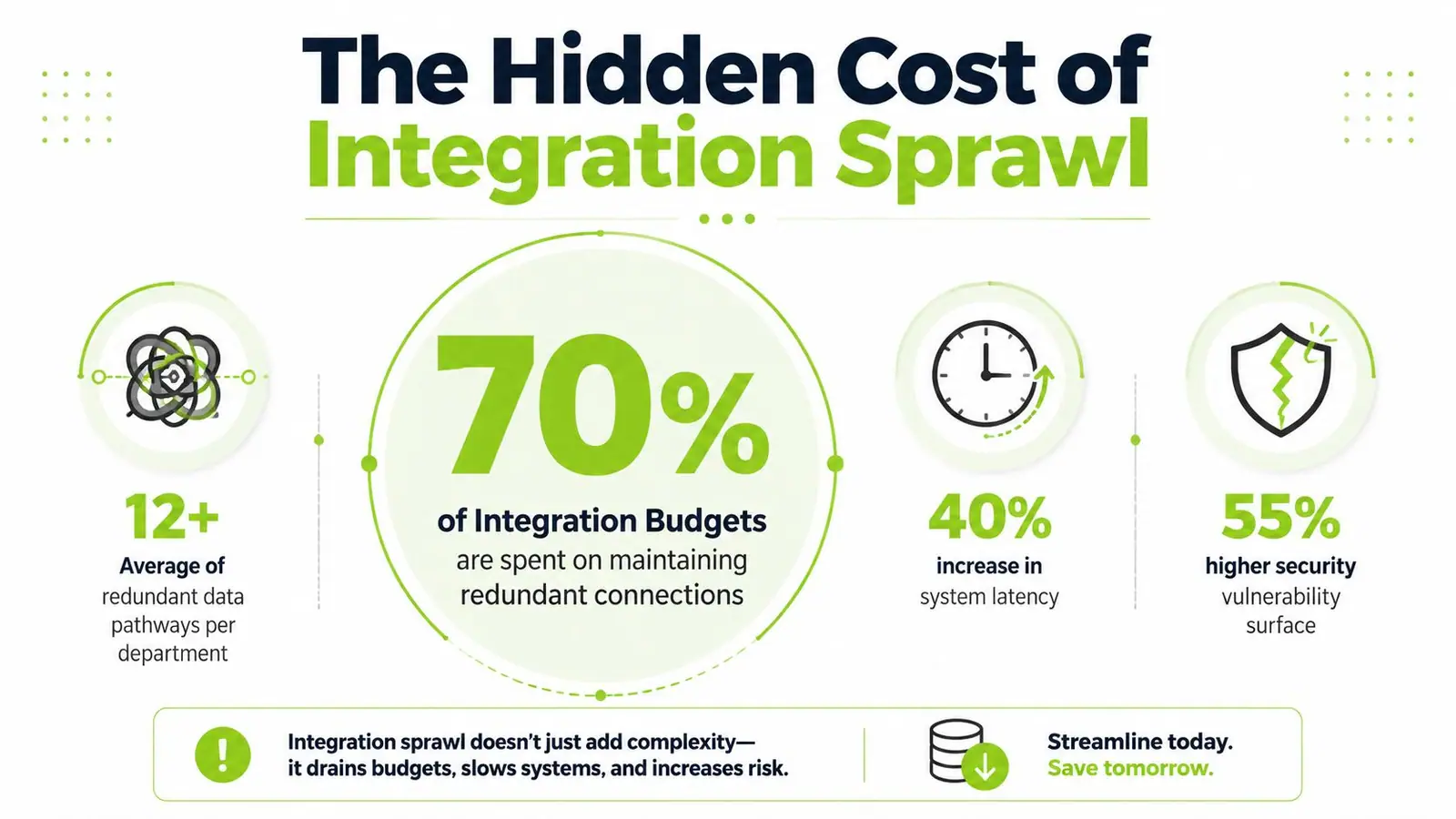
That integration sprawl creates a hidden cost: every connection adds a contract to maintain. It also increases the number of failure paths that an engineer must trace before a dashboard, automation, or client deliverable can be trusted. More connections can improve access while making the overall system harder to change safely.
A 2021 TDWI survey of 244 respondents found that access to new data sources and IT capacity to answer business requests were significant obstacles to timely data use (TDWI survey findings). The finding matters beyond its original survey context. As demand grows, each new source adds ownership, testing, support, and coordination work, not merely storage and transport.
Practical rule: Treat every integration as a maintained interface with an owner, a service expectation, a test strategy, and a retirement path.
A pipeline can complete successfully and still fail its users. It may arrive after a reporting deadline, omit records without an alert, or produce a dataset that analysts cannot reconcile. Teams can apply performance benchmarking guidance to compare workload, responsiveness, and operational capacity instead of judging success by completion alone.
The effects reach beyond reporting. Fragile connections slow automation, extend delivery cycles, and leave AI agents without dependable, current context or clear ownership for the data they consume. Integration is now part of the product architecture, because every downstream feature inherits the assumptions and failure modes of its source systems.
The Three Core Categories of Integration Challenges
The Bank for International Settlements' 2024 framework groups integration problems into fragmented information standards and identifiers, IT infrastructure challenges, and statistical quality issues, alongside ethical, legal, and organizational concerns. The classification helps teams diagnose the failure before choosing a technical fix. A broken connector is only one possibility.
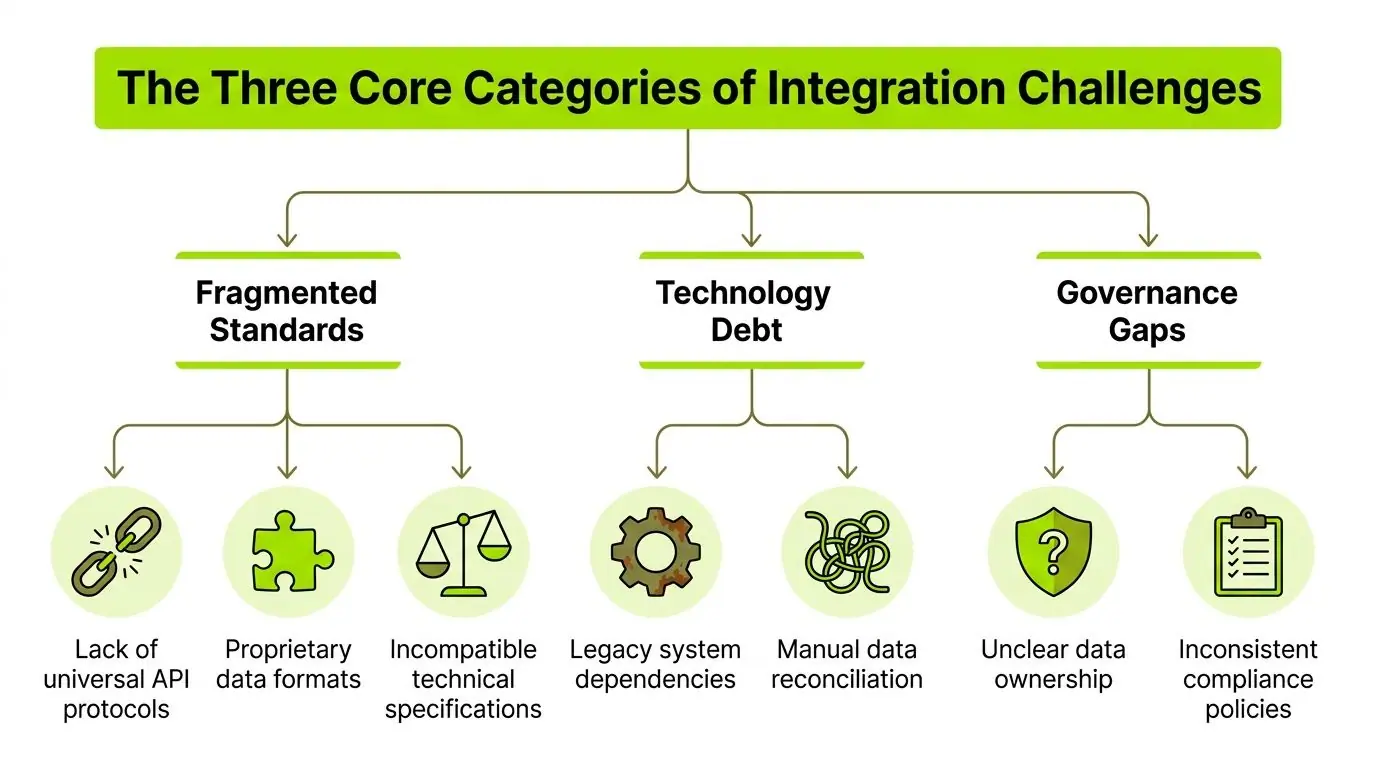
Fragmented standards and identifiers
Two systems can both store a customer ID while applying different formats, scopes, or assignment rules. One may identify a legal organization, another a billing account, and a third an employee or contact. Joins then create duplicates, omissions, or false matches even though every field appears populated.
Record linkage becomes harder when unique identifiers are absent or entered manually. A connector can transport those values accurately and still produce the wrong relationship. Data movement does not correct identity ambiguity.
Use a controlled identity model. Define canonical entities, document source-specific keys, preserve original identifiers, and make match decisions visible. Do not overwrite uncertain matches. Send them for review, or label them with confidence and provenance so downstream users can judge the result.
IT infrastructure constraints
Legacy and on-premises systems may expose limited interfaces, depend on batch windows, or require specialized operational knowledge. As noted in the earlier TDWI findings, these environments remain difficult integration targets. The problem is the combination of undocumented behavior, fragile dependencies, restricted network paths, and change processes that move more slowly than modern product teams.
A stable extraction boundary can be safer than a rushed replacement. Use read-only access where possible, isolate source-specific logic in a reusable adapter, and record reconciliation results at that boundary. Downstream consumers then avoid inheriting every quirk of the source.
That boundary also improves AI-agent readiness. Agents need current, interpretable records with known ownership and predictable refresh behavior. A legacy feed that arrives inconsistently, exposes unclear identifiers, or lacks change history can make automated decisions difficult to audit, even when the transfer itself succeeds.
Statistical quality and governance
Completeness, timeliness, and consistency determine whether an integrated dataset fits its intended use. A missing optional field may be acceptable for exploratory analysis but unsafe in an automated eligibility workflow. A delayed record may have little effect on a monthly report and affect a real-time operational decision.
Governance answers questions engineering cannot settle alone. Who owns the definition? Is the use legally permitted? Which fields require masking? What evidence must an auditor review? The BIS framework places quality, ethics, legal requirements, and organizational responsibility within the same operating model.
A connector-first project often fails when it moves data before resolving those decisions. Define ownership, shared meanings, access rules, quality checks, and agent-use constraints in the integration design. Those controls belong at the boundary, not after the first incident.
The Hidden Cost of Integration Sprawl
More connections do not automatically produce better data. They add paths that can fail, credentials that must be rotated, mappings that require review, and places where teams may interpret the same field differently.
Recent reporting describes enterprises managing an average of 897 to 957 applications, with only about 27% to 29% integrated (analysis of integration sprawl). That gap does not prove every system needs another connector. Some applications should remain loosely coupled because deep synchronization would add risk without improving a meaningful workflow.
Connectivity creates an operating surface
Every integration has a lifecycle. Someone must understand the source contract, test changes, monitor failures, investigate mismatches, manage permissions, and decide when the connection should be retired. Point-to-point links spread those responsibilities across scripts, workflow tools, warehouse jobs, and application settings.
A centralized integration layer can reduce duplicated work, but consolidation does not correct poor design. One platform with undocumented transformations still creates a broad failure surface. The practical target is fewer, clearer contracts, not just fewer products.
The same analysis reports that 53% of executives said legacy-system integration derailed AI outcomes, while 80% of data-governance initiatives were projected to fail by 2027 (integration and governance analysis). These figures highlight a prioritization problem. Teams can keep adding links while ownership, lineage, and exception handling remain unresolved.
Choose selective connectivity
Start with business capabilities, not an application inventory. For each proposed connection, ask:
- Decision value: Which decision or workflow becomes materially better?
- Freshness requirement: Does the consumer need an event, an hourly update, or a periodic snapshot?
- Failure tolerance: What happens when the source is unavailable or sends incomplete data?
- Ownership: Who approves definitions and accepts operational responsibility?
- Retirement path: What condition would justify removing the integration?
A daily snapshot may be safer than bidirectional synchronization for reporting. An event stream may suit an agent that must react to state changes, but not a dashboard that users check periodically. Loose coupling preserves resilience when systems do not need transactional coordination.
The same discipline applies to reporting assets. A well-designed data analytics dashboard should show freshness, source coverage, and known limitations instead of presenting a precise-looking view assembled from ungoverned pathways. That visibility helps teams judge whether an integrated result is ready for operational use or requires investigation first.
Legacy Systems and the AI-Readiness Gap
A legacy integration can appear stable until an AI agent must act on its data. The agent may need current account status, recent activity, approved terminology, and permission-aware access. If those details span a mainframe, an on-premises application, and a SaaS platform, the problem involves identity, latency, semantics, security, and whether the data supports a safe action.
The historical difficulty is documented in the TDWI survey findings presented earlier. Mainframes, legacy applications, and on-premises business systems remain harder to connect than modern services. AI workflows make the consequences more immediate. Stale or ambiguous data can produce an incorrect recommendation, an unnecessary escalation, or an action against the wrong entity.
AI readiness depends on workflow design
Recent reporting found that 96% of IT leaders said agentic AI's long-term effectiveness depends on data integration. It also reported that only 27% of applications are connected in the average organization, while 64% of IT leaders worry that data barriers could block AI implementation goals (AI-agent integration reporting).
The practical response is to define the smallest reliable context and action path for one workflow. An agent that summarizes approved campaign data may need read access to a curated warehouse and a content system. An agent that changes a customer record needs stronger identity resolution, authorization, auditability, and rollback.
AI readiness starts with a bounded workflow, not a giant integration diagram.
Test each candidate source for usable context. A field named “status” may represent a sales stage, payment state, or service condition. The integration must preserve those distinctions or expose a canonical interpretation. It should also show the agent when the data was refreshed and which system supplied it.
Operational ownership matters just as much. Someone must decide whether a stale record blocks the action, which source wins when values conflict, and how failures reach a human operator. Without those rules, adding an agent increases the number of paths that require monitoring and review.
Technical readiness also depends on discoverability. Teams building search and AI-assisted content workflows can use data for SEO to structure inputs, reporting requirements, and repeatable data flows.
The video below offers a visual perspective on legacy systems, pipelines, and AI-agent access.
Schema Heterogeneity and Data Quality Realities
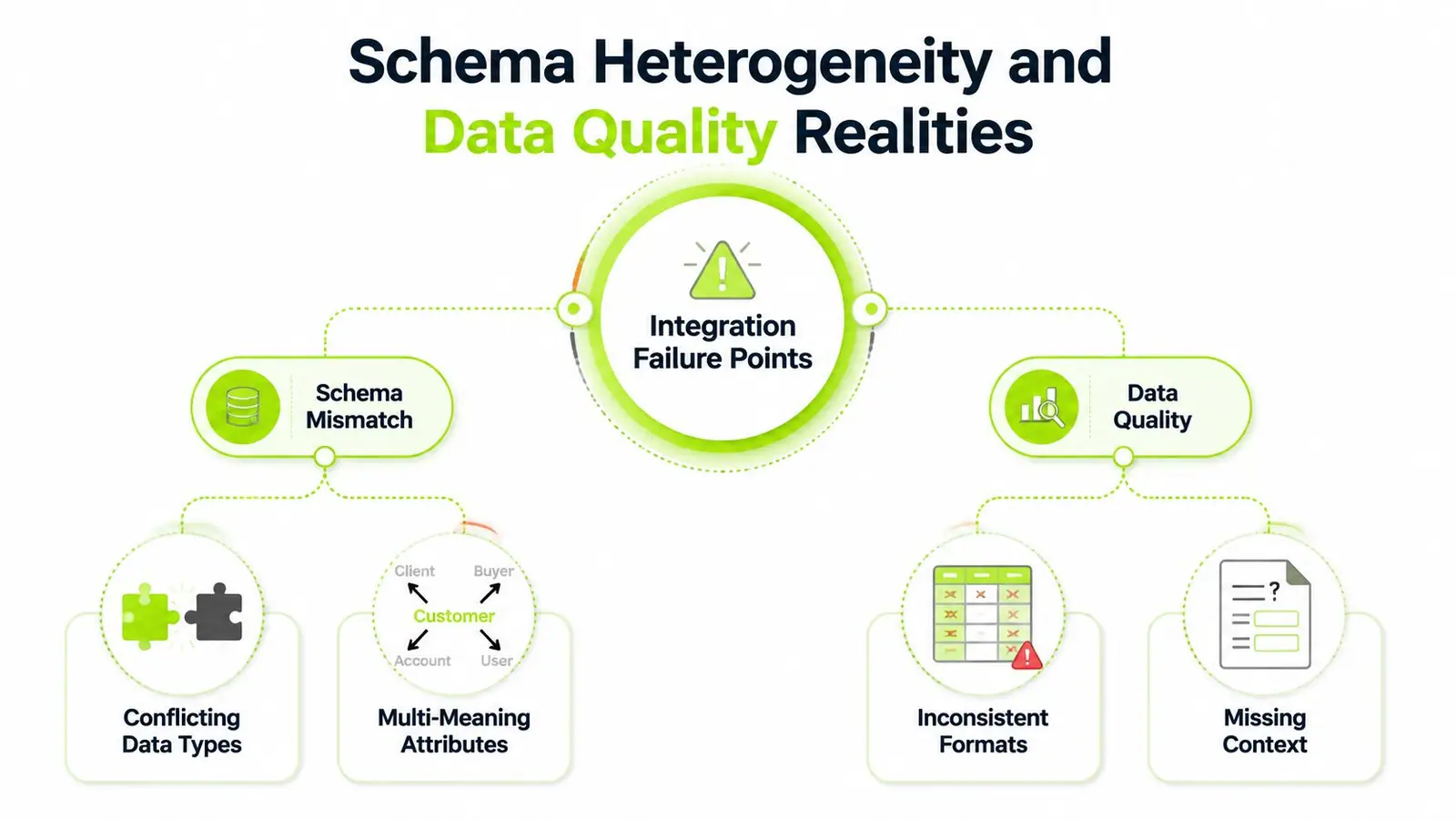
A pipeline may complete successfully and still deliver unusable data. The source sends a value, the transformation accepts it, and the destination stores it. The operational failure appears later, when analysts group incompatible values or an automated workflow assigns conflicting meanings to the same attribute.
A 2026 review describes TPC-DI as an industry benchmark for data integration and ETL performance. It also identifies multi-meaning attributes and inconsistent schemas as source-side problems that reduce downstream analytics and mining quality. The review highlights completeness, timeliness, and consistency as quality dimensions teams need to manage according to the use case (2026 review of integration quality).
Separate structural and semantic mismatches
Structural mismatches are usually visible. A source may send a date as text while the destination expects a timestamp. One system may store an address as a nested object while another expects separate columns. Handle these differences with schema contracts, validation, and transformation tests.
Semantic mismatches need an accountable business decision. “Active customer” could mean a recent purchase, an open contract, or an enabled account. Renaming the field changes nothing. Document each source definition, preserve its original meaning, and publish a canonical field only after an owner approves the rule.
Fix quality at the right layer
Assign each problem to the layer that can control it:
- Source correction: Fix errors at the source when a value breaks a business rule and the source team can prevent recurrence.
- Transformation handling: Normalize formats, units, casing, and known code mappings in a governed transformation layer.
- Consumer qualification: Retain imperfect data when it remains useful, but expose freshness, completeness, and confidence so consumers can judge whether it fits the decision.
A clean destination proves only that it accepted the payload. It does not prove that the integration preserved meaning.
Publish quality signals beside the data, then set thresholds according to the consequences of each decision. Benchmarking can compare pipeline behavior under representative workloads, but performance tests cannot validate business meaning. Pair throughput and latency checks with reconciliation, schema-change tests, null handling, duplicate detection, and lineage checks. Those controls expose failures before an analyst, workflow, or AI agent turns ambiguous data into an action.
Comparing Integration Patterns for Modern Teams
A team can choose the technically impressive pattern and still create an expensive system to run. The decision should follow freshness requirements, source capability, consumer behavior, failure tolerance, and the team's ability to support the resulting connections.
| Pattern | Best For | AI Readiness | Governance Overhead |
|---|---|---|---|
| Batch ETL | Periodic reporting, controlled extracts, legacy sources | Moderate for scheduled use cases | Moderate |
| Event-driven streaming | State changes, operational reactions, near-real-time workflows | High when events are reliable and meaningful | High |
| ELT with cloud warehouses | Analytical consolidation and flexible transformation | High for governed analytical context | Moderate to high |
| API-led connectivity | Reusable access to operational capabilities | High for bounded agent actions | High |
Batch ETL
Batch ETL fits scheduled reporting and sources that provide dependable extracts. It is usually easier to reconcile, replay, and audit than a continuously moving stream. The cost is older data between runs and processing demand concentrated into defined windows. It also leaves AI agents without current state unless the schedule matches the action.
Event-driven streaming
Streaming fits workflows that react to meaningful events, such as a state transition or approved update. Production operation requires ordering, replay, deduplication, schema evolution, and coordination among consumers. Streaming every table because the platform supports it creates monitoring and incident work without necessarily improving decisions.
ELT with cloud warehouses
ELT suits teams that need to retain source detail while analytical transformations change over time. Raw inputs can remain available, governed models can serve several consumers, and new use cases do not require rebuilding every extraction path. A warehouse can still become another silo when definitions, ownership, access, and freshness remain unclear.
Teams using Snowflake can review ways to optimize operations with Snowflake while assessing warehouse-centered designs. Judge the architecture by freshness, cost controls, lineage, and operational ownership, not platform popularity. Warehouse consolidation also does not automatically produce the governed context an AI agent needs.
API-led connectivity
APIs fit consumers that need a controlled business capability rather than a raw data dump. Authorization and validation can stay close to the operational system, which helps agents perform bounded actions safely. The trade-off is dependence on availability, versioning, throttling limits, and carefully designed payloads. APIs also add call-by-call latency and failure handling that batch consumers may avoid.
For every pattern, automate repeatable safeguards without hiding their results. Data pipeline automation can standardize scheduling, validation, and operational handling, provided runs remain observable, failures have owners, and automation does not conceal stale or partial data.
Building a Governance-First Integration Strategy
A campaign report breaks after a CRM field changes, while an AI agent continues using an outdated definition. The fix starts with an inventory, but an application list is insufficient. Map critical workflows, field ownership, dependencies, failure consequences, and the operational cost of each connection. Rank integrations by business value, AI workflow relevance, data risk, and fragility.
Make governance executable through metadata. Record definitions, lineage, freshness, access requirements, transformation rules, and known quality limits. Reusable connectors and templates reduce maintenance only when teams apply versioning, testing, ownership, monitoring, and retirement criteria. Otherwise, integration sprawl becomes a collection of lightly documented exceptions that agents cannot safely interpret.
Start the audit with three questions:
- Which three connections support the most important decisions or workflows?
- Which connections fail often, lack clear ownership, or duplicate another path?
- Which AI use case has a bounded context and a credible action or reporting outcome?
Choose a small, governed pilot where reliable data removes a measurable bottleneck. Define the agent's permitted sources, actions, escalation path, and audit record before production access. Retire pathways that duplicate data without improving a decision. Keep systems loosely coupled when deep synchronization would add fragility without a clear benefit.
Surnex provides search intelligence features, including visibility tracking, rankings, backlinks, audits, content opportunities, and APIs. Those interfaces can connect reporting tools, internal workflows, and AI agents when ownership, permissions, and output definitions are documented.