
The search for extraterrestrial intelligence is often envisioned as mainly about giant dishes pointed at the sky, waiting for a dramatic ping from the stars. That picture is no longer enough.
Today, search extraterrestrial intelligence is also a problem of filtering noise, ranking anomalies, managing massive datasets, and making sure the public understands what scientists found. In other words, it has become partly an astronomy story and partly a data science story.
That shift matters. We aren't just asking whether anyone is out there. We're asking how a civilization on one small planet can detect a faint, possibly deliberate signal hidden inside an ocean of natural radio emission, satellite interference, and machine-generated false leads. And once we do that work, we face a second challenge much closer to home. How do reliable explanations compete with speculation in AI-driven search, summaries, and chat tools?
The Enduring Quest to Find Our Cosmic Neighbors
The deepest power of SETI comes from how simple its core question is: Are we alone? Children ask it. Philosophers circle it. Scientists try to turn it into a testable problem.
SETI, short for the Search for Extraterrestrial Intelligence, isn't a hunt for movie monsters or tabloid mysteries. It's a disciplined attempt to detect evidence that another civilization uses technology in a way we could notice from far away. That evidence might be a radio transmission, a laser pulse, or some other technosignature, meaning a measurable sign of technology.
What makes the field so compelling is that it sits at the meeting point of humility and ambition. Humility, because space is vast and our own technology is young. Ambition, because we have reached the point where we can listen.
Why the search is scientific
SETI works like any other branch of science. Researchers make a hypothesis, choose instruments, gather data, test candidate signals, and try to rule out ordinary explanations first. A strange signal doesn't become "aliens" because it sounds exciting. It becomes interesting only after every boring explanation has been pushed aside.
The real miracle of SETI isn't that we've found a signal. It's that we built tools capable of asking the question in a measurable way.
There's also a sobering lesson in the scale of the problem. Even after decades of work, the portion of the Milky Way meaningfully probed remains tiny. According to Britannica's overview of SETI, it was still less than 0.001 percent by the early 21st century. That doesn't mean the search failed. It means the search has barely begun.
Why AI changes the story
Older public narratives cast SETI as patient listening. That image still has truth in it, but it misses what modern researchers increasingly face. They don't just need sharper telescopes. They need better ways to process floods of information and explain null results clearly in a world where automated summaries often flatten nuance.
So the search for intelligence in the cosmos now reflects two kinds of human curiosity at once. One asks what may exist beyond Earth. The other asks whether our own information systems can help us recognize the answer without distorting it.
From Science Fiction to Scientific Method
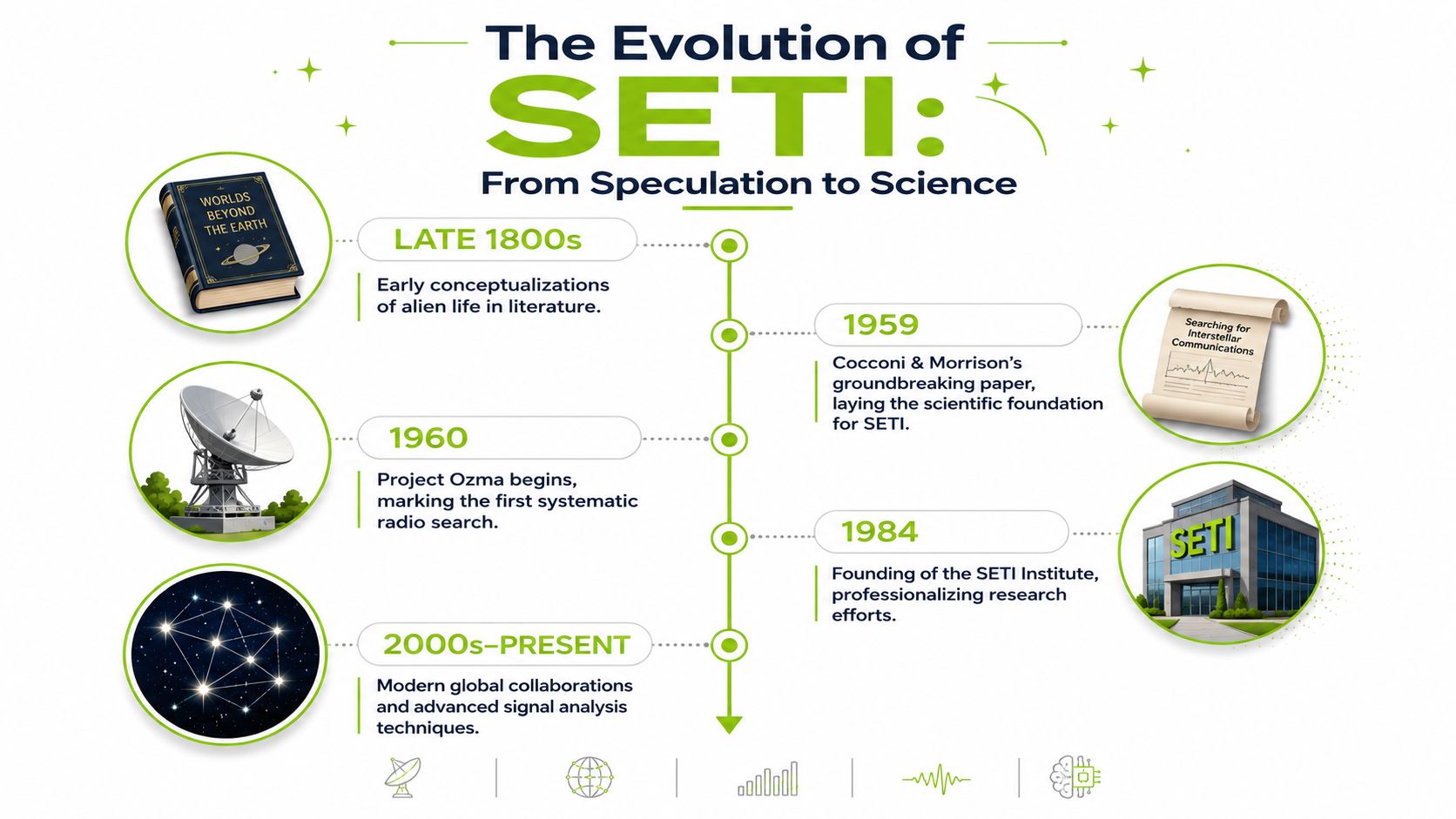
Long before SETI became a scientific field, writers imagined inhabited worlds. Fiction gave people the emotional shape of the question. Science had to supply the method.
That method took a decisive step in 1960, when Frank Drake carried out Project Ozma, widely regarded as the first modern scientific SETI effort. At the National Radio Astronomy Observatory in Green Bank, West Virginia, Drake used an 85-foot radio telescope to observe Tau Ceti and Epsilon Eridani, two nearby Sun-like stars, for about 150 hours near the 21 cm hydrogen line. Britannica describes this experiment as the foundational moment when SETI became a real scientific search rather than a thought experiment in print: Project Ozma and the history of SETI.
Why that first experiment mattered
Project Ozma sounds modest by modern standards. Two stars. One telescope. A relatively narrow radio search. But that's exactly why it mattered. Drake wasn't trying to "search everything." He was testing a reasoned idea.
The logic went like this:
- Choose plausible targets. Sun-like stars seemed like sensible places to start.
- Listen at a meaningful frequency. The hydrogen line is a natural landmark in radio astronomy.
- Search for narrow-band signals. Nature usually spreads energy across a range of frequencies. A sharply focused transmission can look artificial.
That was a profound shift. SETI stopped being a vague hope and became an experiment built on assumptions that other scientists could evaluate, repeat, and improve.
The hydrogen line as a cosmic meeting point
Readers often get stuck here. Why would another civilization choose the same frequency we would?
No one knows. But the hydrogen line has a certain universal logic. Hydrogen is common throughout the universe, and its signature near 21 centimeters is prominent in radio astronomy. If two civilizations have never met and need a natural reference point, a conspicuous frequency associated with the most abundant element in the cosmos is a reasonable place to try.
Think of it as agreeing to meet in the most famous square in a city neither of you built.
Practical insight: SETI doesn't assume aliens think exactly like us. It asks whether there are shared physical landmarks that any technically capable civilization might notice.
The broader public still tends to associate extraterrestrial research with spectacle. But progress has always been driven by methodological restraint. You start with a narrow question, define what a detectable signal would look like, and accept silence as data too.
That approach still shapes the field. The tools are newer, the datasets are larger, and the public now discovers science through AI-generated summaries as much as through articles or documentaries. If you're interested in how machine-generated discovery changes what people see first, this overview of search generative experience and modern AI-first search behavior adds useful context.
How We Listen for Signals Across the Void
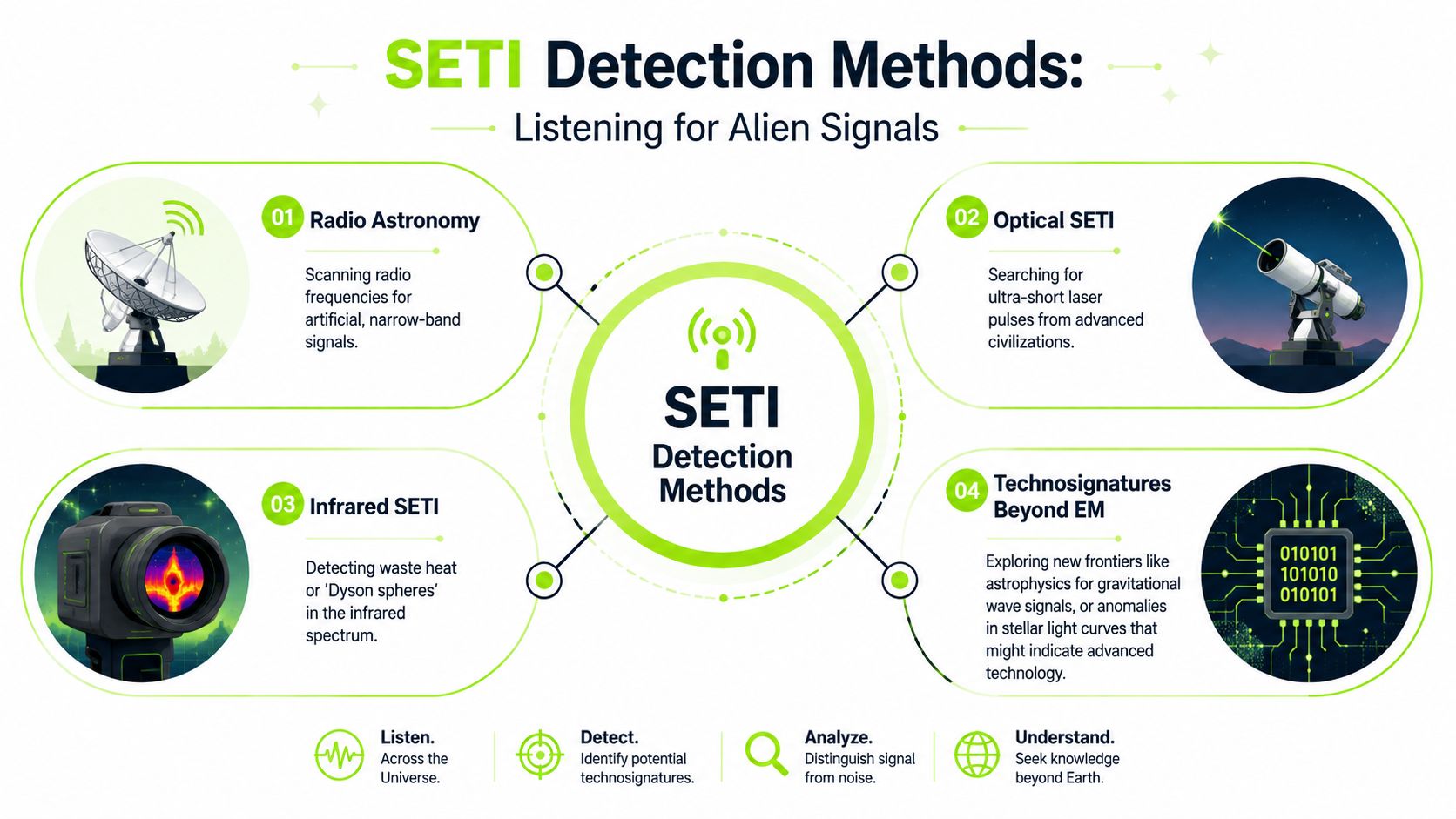
If Project Ozma established the basic logic, modern SETI has expanded the toolkit. Scientists don't just "listen for aliens." They search for signals that stand out from nature.
The easiest analogy is radio. If you spin through a crowded dial, most stations blur into a wash of sound. But a clean, deliberate broadcast snaps into focus. SETI tries to find the cosmic equivalent of that clean broadcast.
Radio SETI and the microwave window
Most radio SETI work concentrates on the 1 to 10 GHz microwave window, where background conditions make long-range detection more practical. In that range, narrowband searches with large telescopes can reach sensitivities of 0.7 to 2×10⁻²⁴ W/m²/channel, according to this overview of SETI methods and frequency strategy.
That number can feel abstract, so here's the plain-language version. Scientists are trying to detect signals that are extraordinarily faint by the time they cross interstellar distances. The telescope matters, but so do the observing strategy, the channel width, and the amount of time spent on a target.
Three trade-offs dominate:
| Question | Why it matters |
|---|---|
| How wide a band do you search? | A wider band covers more possibilities but creates more data and noise to sort through. |
| How long do you dwell on one target? | More time improves sensitivity, but it reduces the number of targets you can observe. |
| How narrow is the channel? | Narrow channels are better for spotting artificial carriers that don't look like natural astrophysical emission. |
Optical and infrared searches
Radio isn't the only game in town.
Optical SETI looks for extremely brief, powerful laser flashes. If radio is like tuning a dial, optical SETI is like scanning a dark coastline for a lighthouse beam. A laser pulse could be short, bright, and intentional.
Infrared approaches ask a different question. Advanced technology uses energy, and used energy often leaves behind waste heat. So some researchers examine infrared observations for unusual signatures that might point to very large engineered systems.
The broader idea of technosignatures
The public conversation often lags behind the science. SETI isn't limited to one type of signal. The umbrella term technosignature includes any observable sign that technology altered an environment in a detectable way.
That could include:
- Structured radio emissions that look unlike natural astrophysical sources
- Optical pulses that resemble deliberate laser signaling
- Infrared anomalies suggestive of large-scale energy use
- Puzzling patterns in astronomical data that merit deeper testing
Not every strange signal is interesting, and not every interesting signal is artificial. SETI lives in that uncomfortable middle ground.
Why scientists still miss things
People sometimes assume that if a signal exists, a telescope will just find it. But a telescope is only the front door. The much harder task is deciding whether a detected pattern is local interference, a natural event, an equipment artifact, or something unexplained.
That's why modern SETI blends physics with statistics, software, and signal classification. The search extraterrestrial intelligence has become less like waiting for a ringtone and more like scanning an impossibly large archive for one line of text written in the wrong alphabet.
The Global Efforts Scanning the Skies
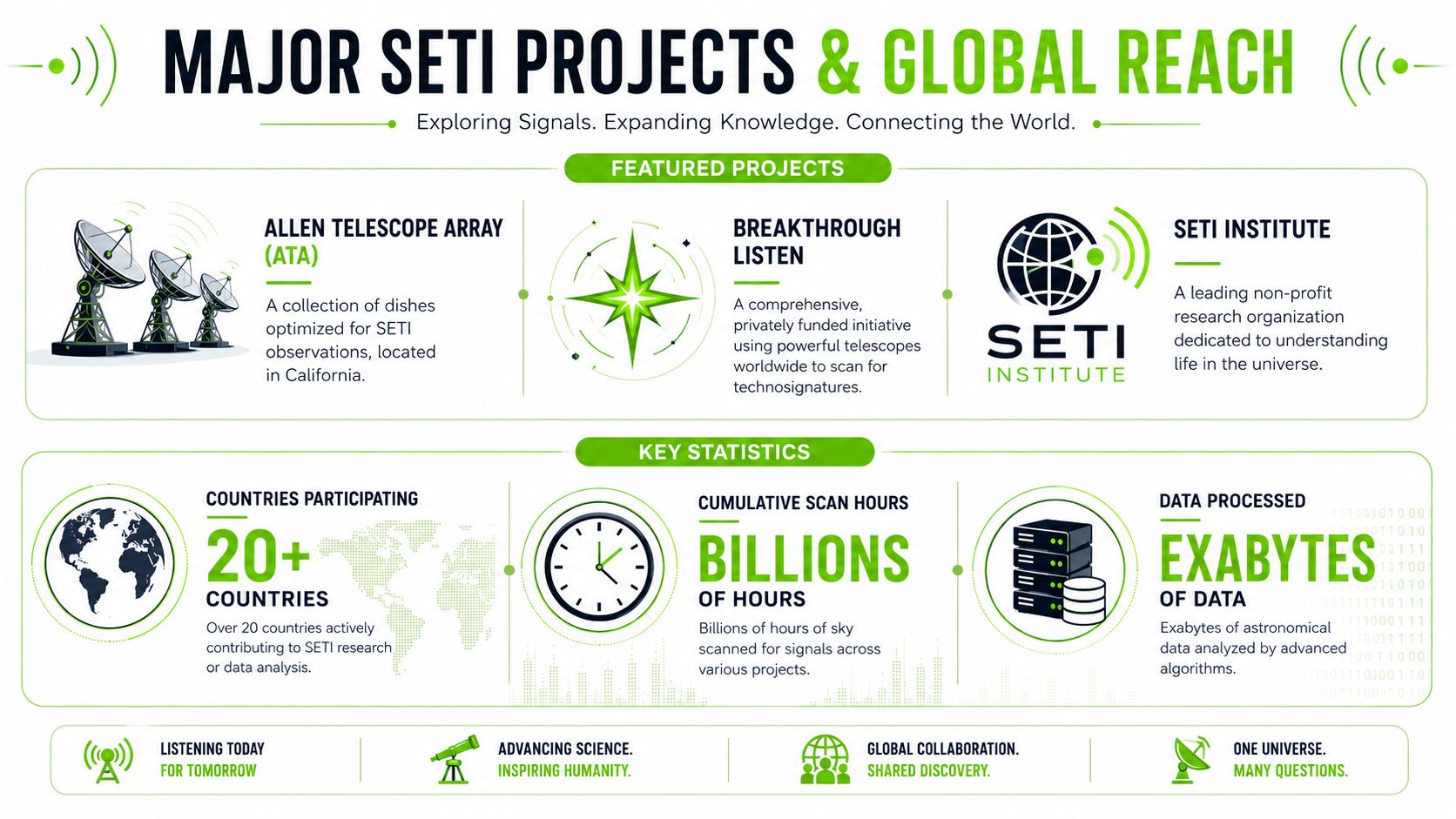
SETI isn't one institution with one telescope. It's a patchwork of observatories, nonprofit research groups, software systems, and public participation. Some efforts focus on targeted observations. Others build infrastructure, tools, or new analysis methods.
The public often sees the dish. The field itself sees a workflow.
Institutions and programs that shaped the field
A few names come up repeatedly because they represent different parts of the SETI ecosystem.
The SETI Institute helped professionalize and sustain research around life in the universe. It has long served as a visible public face for the scientific search.
The Allen Telescope Array is notable because it was designed with SETI observing in mind. Instead of treating SETI as a side project, it provides the search with a more specialized instrument base.
Breakthrough Listen reflects the newer scale of technosignature work. It pushes toward large surveys, broader searches, and more data-intensive analysis.
Each of these efforts addresses a different bottleneck. One builds institutions. Another builds hardware. Another expands data collection and processing.
SETI at home and the public computer as telescope assistant
The clearest example of SETI becoming a public computing effort was SETI@home. Between 1999 and 2020, it enrolled more than 5.2 million participants worldwide, letting volunteers donate spare computing power to analyze telescope data. Over its lifetime, the project sifted through roughly 12 billion individual signal detections, according to the project review available at the SETI@home retrospective on arXiv.
That scale is important for two reasons.
First, it showed that the computational side of SETI could become as important as the observing side. Second, it made the public part of the machinery. People didn't need access to a radio dish. They could contribute by helping computers sort candidate signals while idle.
What these efforts reveal
Taken together, major SETI programs reveal a field under pressure from abundance rather than scarcity. The challenge isn't only that signals may be rare. It's that candidate events, interference patterns, and raw observations arrive in forms that require organized filtering.
Here's a straightforward explanation:
- Observatories collect the sky
- Pipelines reduce the data
- Algorithms rank the anomalies
- Researchers investigate the survivors
Main takeaway: Modern SETI succeeds only when astronomy, computing, and careful validation work together.
That structure also explains why the search hasn't ended in a confirmed detection. More data doesn't automatically produce more certainty. Sometimes it produces more ambiguity that must be sorted patiently, one candidate at a time.
The Technical and Philosophical Hurdles
SETI sounds romantic until you watch how many ordinary things can fake an extraordinary signal.
A radio telescope doesn't observe the universe in isolation. It observes through a haze of human technology. Satellites pass overhead. Earth-based transmissions leak into the band. Hardware introduces artifacts. Software can over-rank noise. The result is a constant risk of false positives.
Interference is the first suspect
Researchers call this radio frequency interference, or RFI. In plain English, it's the clutter made by our own civilization. A candidate signal might look exciting at first glance and then collapse under scrutiny because it came from something terrestrial.
That makes SETI a lot like forensic work. The first duty isn't wonder. It's elimination.
A useful parallel appears in modern analytics systems. Many teams discover that automated tools produce attractive patterns that vanish when someone checks assumptions, joins the right tables, or tests edge cases. This breakdown is common enough that a guide on common AI agent data analysis issues is surprisingly relevant to SETI thinking. In both cases, the system can surface anomalies faster than humans can verify them.
Why verification is so hard
A believable technosignature would need to survive repeated testing. Scientists would ask questions like these:
- Can another instrument detect it?
- Does it appear again when the target is reobserved?
- Does it move with the sky rather than with local equipment?
- Could known interference produce the same pattern?
The deeper problem is that "interesting" isn't a scientific category. It only means the signal hasn't been explained yet.
The human questions begin after the technical ones
Suppose a signal did survive every technical objection. The next layer of difficulty wouldn't be physics. It would be governance, ethics, and language.
Who confirms the result publicly? Who decides whether Earth should reply? Who translates uncertainty for a global audience without either minimizing the discovery or overselling it?
These are communication problems as much as scientific ones. They resemble, in some ways, the challenge of organizing meaning across many related signals, which is why thinking about latent semantic indexing and topic relationships in search can be surprisingly helpful as a metaphor. A confirmed detection wouldn't arrive as one isolated sentence. It would arrive as a web of evidence that the public would try to interpret all at once.
A signal from another civilization would not only test our instruments. It would test our institutions.
That's part of what makes SETI such a profound enterprise. The search asks whether intelligence exists elsewhere. It also exposes how difficult it is for intelligence on Earth to separate signal from noise, both technical and social.
The Future of SETI in the Age of AI
The future of SETI may depend less on building a single colossal telescope and more on teaching machines how to notice patterns humans would miss.
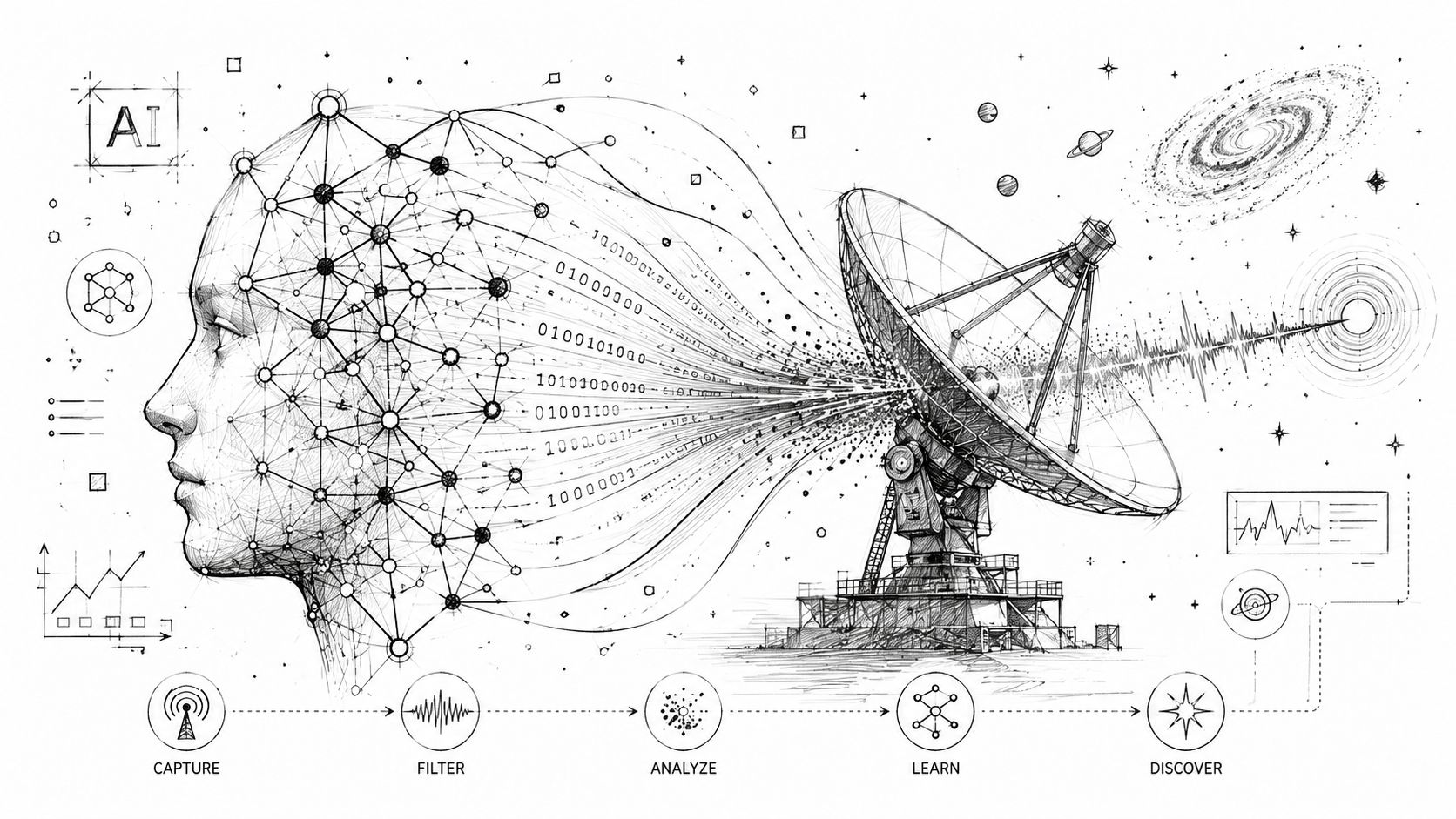
That's the field's most important shift. The frontier is moving from simple beacon-listening toward data-driven technosignature hunting, where researchers use machine learning to sort enormous datasets and flag unusual events that older pipelines overlooked. Recent work in this area has shown that machine-learning systems can identify anomalous signals in large surveys that traditional analysis missed. In practical terms, that turns SETI into a discipline that increasingly resembles commercial-scale data mining.
SETI now looks like a modern data problem
This change is easy to underestimate. People still imagine astronomers manually reviewing a handful of suspicious blips. In reality, a modern technosignature search can involve pipeline design, anomaly detection, ranking systems, storage decisions, and repeatability checks.
AI's best contributions are:
| AI role | Why it matters in SETI |
|---|---|
| Pattern recognition | It can scan large signal collections for structures that don't match standard categories. |
| Anomaly detection | It can surface outliers that may deserve human review. |
| Triage | It helps researchers decide which candidates to inspect first. |
| Reanalysis of archives | It can revisit older observations with better methods than were available when the data was first processed. |
This doesn't mean AI "finds aliens." It means AI helps humans search more intelligently through overwhelming complexity.
Bigger telescopes still matter, but software matters more than many people realize
An observatory produces raw material. Interpretation happens later.
That's why the skills shaping the future of SETI now include signal processing, scalable storage, model evaluation, and workflow automation. If you've followed debates about the future of AI automation in real-world workflows, the resemblance is striking. In both fields, the bottleneck often shifts from data collection to trustworthy orchestration.
The same is true for public visibility. AI systems increasingly summarize scientific topics before readers ever reach an institution's website. That creates a new burden for SETI organizations. They need clear, durable explanations that can survive extraction, summarization, and remixing without losing accuracy.
The next contest is partly informational
This is the overlooked part of the story. SETI researchers don't only compete against noise in the sky. They also compete against noise in the information environment.
Those seeking alien life may encounter speculative summaries before they encounter careful reporting. Large language models can compress uncertainty into something that sounds more decisive than it is. They can also give fringe claims equal narrative weight if the source context is weak.
That makes visibility strategy more than a marketing issue. It becomes part of scientific stewardship. Institutions need content that is understandable to humans and legible to AI systems. For teams thinking about that practical side, this guide to LLM optimization options for AI visibility tools maps the broader challenge well.
A useful rule: In the age of AI, finding a signal and explaining a signal are becoming inseparable tasks.
The search extraterrestrial intelligence is still about the cosmos. But more than ever, success depends on very terrestrial capacities: good data hygiene, strong models, careful communication, and systems that reward accuracy over drama.
How You Can Follow the Search for Life
You don't need a PhD in radio astronomy to follow SETI well. But you do need one habit that matters more every year. You have to distinguish careful uncertainty from confident speculation.
That matters because the modern information environment doesn't always reward restraint. A key challenge for SETI organizations is that AI-driven search and LLM-based summaries can amplify fringe claims or misrepresent null results, while authoritative explanations remain less visible. For anyone tracking developments in the search extraterrestrial intelligence, that means source quality isn't a side issue. It's part of the subject itself.
How to stay grounded
A few practices help:
- Follow institutions, not just headlines. Research organizations and observatory teams are usually clearer about uncertainty than viral accounts are.
- Treat null results as progress. In SETI, ruling things out is real scientific work.
- Look for methodology. If an update doesn't explain how a signal was tested, be cautious.
- Notice language. "Candidate," "anomalous," and "unexplained" don't mean "confirmed extraterrestrial intelligence."
Ways to participate without becoming gullible
You can engage with the field in practical ways.
Read long-form updates from established scientific organizations. Watch for papers, observatory announcements, and technical discussions rather than only social posts. If you work in software, data engineering, or analytics, pay attention to the computational side of SETI. The field increasingly needs people who understand pipelines, anomaly detection, and reproducibility.
There's also a public communication angle. As AI-generated search experiences become more common, accurate science needs stronger visibility. Keeping track of new mentions and topic shifts is useful, whether you're following SETI or any specialized research area. A simple monitoring workflow, such as the one described in this guide to managing Google Alerts for ongoing topic tracking, can help you spot when important stories break or when fringe narratives start outrunning the evidence.
What curiosity looks like now
The best modern SETI follower is part skeptic, part dreamer.
You need the dreamer's openness to ask whether another intelligence might exist somewhere beyond our world. And you need the skeptic's discipline to say, "Not yet," when the evidence doesn't hold. That balance is the healthiest way to meet one of humanity's oldest questions.
If a genuine signal ever arrives, it probably won't look like a movie scene. It will look like teams checking instruments, rerunning analyses, comparing notes, and explaining uncertainty in public. That may sound less dramatic. It is also more beautiful, because it shows science doing exactly what it should do.
Surnex helps teams track how brands and topics appear across AI search experiences and traditional search from one place. If your organization cares about accurate visibility in Google AI Overviews, ChatGPT-driven discovery, and classic SEO reporting, Surnex offers a practical way to monitor citation gaps, benchmark presence, and turn search intelligence into a workflow your team can use.