Most search competitive analysis advice still starts with the same question: who ranks number one? That question matters, but it no longer tells you who captures the opportunity. A competitor may rank below you in a traditional result and still win the customer through an AI-generated answer, a citation, a brand mention, or a result that keeps the searcher from clicking anywhere.
Modern analysis has to follow the click, not just the position. That means comparing ranking coverage, page quality, authority, AI citations, and the traffic that remains available when search engines summarize answers before users reach a website. The practical question is no longer just, “Who outranks us?” It's “Which competitor consistently earns attention, citations, trust, and downstream visits across the search experiences our audience uses?”
Why Traditional Competitive Analysis Falls Short Today
The classic workflow is familiar. Export competitor keywords, compare estimated traffic, review backlink counts, inspect domain authority, and build a list of topics where another site ranks higher. That process still produces useful evidence, but it often produces the wrong conclusion when teams treat rankings as the final measure of success.
Search has become a multi-surface discovery environment. A traditional organic result can compete with featured answers, shopping modules, local results, video, knowledge panels, and AI-generated summaries. The competitive set also changes by query intent. A product company may compete with another vendor on a commercial term, a specialist publication on an informational question, and a review site when a buyer is comparing options.

Rankings are inputs, not outcomes
AI Overviews make this shift visible. Data from Semrush's study of AI Overviews shows that AI Overviews appeared for 6.49% of keywords in January 2025, reached nearly 25% in July, and then eased to 15.69% in November. Navigational queries triggering these summaries also rose from 0.74% in January to 10.33% in October, according to the same study.
That movement changes the value of a ranking position. Pew found that when an AI summary appeared, users clicked a traditional result on 8% of visits, compared with 15% without a summary, and ended the session on 26% of visits, compared with 16% without one. The figures come from Pew Research Center's analysis of Google AI summaries.
Practical rule: Treat position as a visibility signal. Treat clicks, citations, qualified visits, and conversions as competitive outcomes.
A useful audit therefore asks four questions for every important query:
- Who ranks: Which domains repeatedly appear in the traditional results?
- Who gets cited: Which sources does the AI answer layer select?
- Who receives the click: Which result still attracts visits when a summary appears?
- Who converts: Which competitor appears to own the strongest journey after discovery?
Teams that want a broader view of this shift can use search marketing intelligence to connect rankings with market signals, brand presence, and emerging search surfaces. The point isn't to discard conventional SEO. It's to stop using one metric to represent an entire search journey.
Understanding the Search Market Landscape
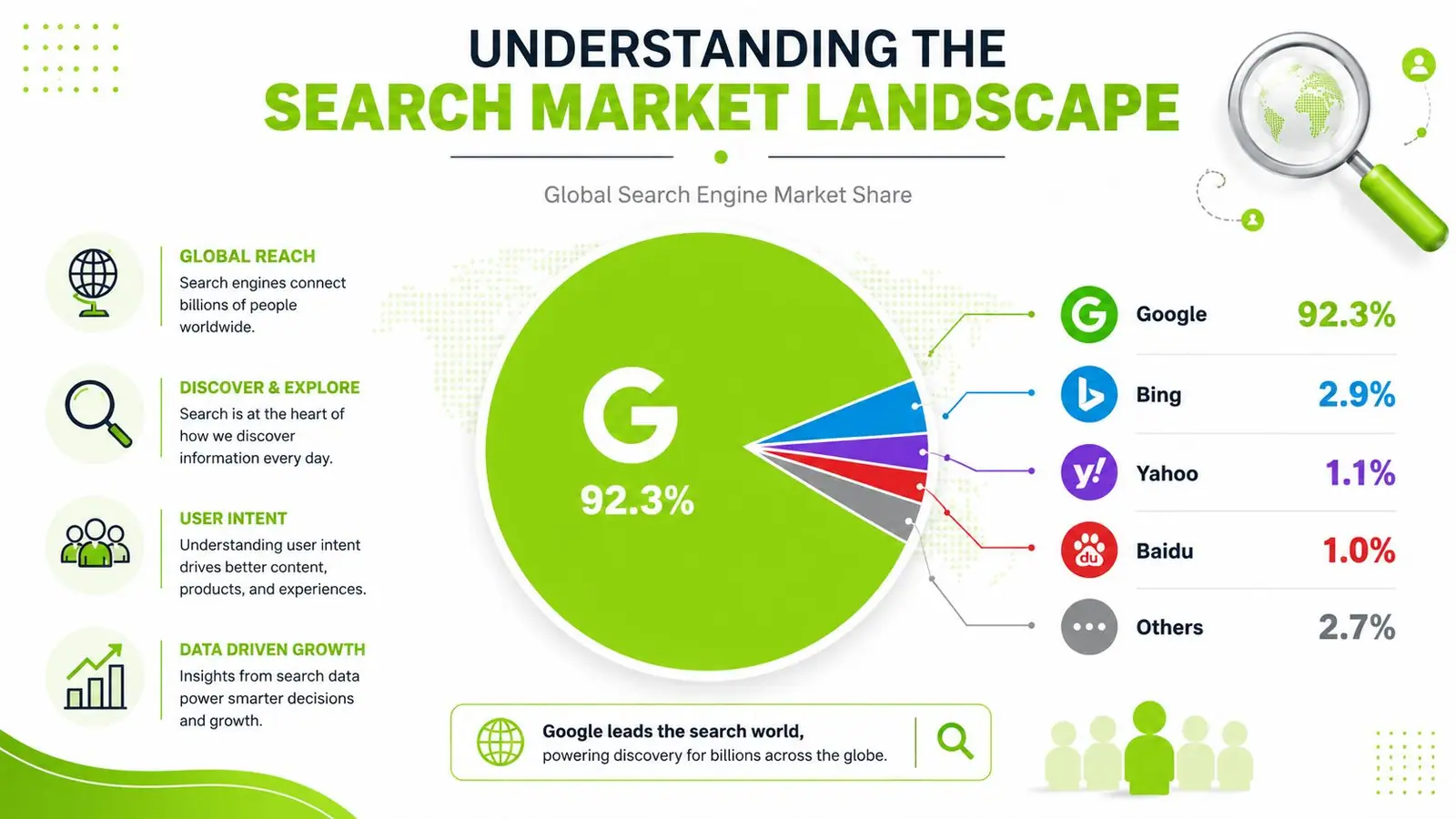
Search competitive analysis operates inside a concentrated market. StatCounter's July 2026 worldwide data reports Google at 91.31%, Bing at 4.47%, Yahoo! at 1.24%, YANDEX at 1.00%, DuckDuckGo at 0.65%, and Baidu at 0.50% of global search share. These figures are available in StatCounter's worldwide search engine market share data.
The concentration has practical consequences. Most brands aren't choosing between many equally sized search ecosystems. They're measuring performance inside Google, then adapting their analysis for a smaller group of secondary platforms, regional engines, and emerging AI discovery surfaces.
Why concentration changes the baseline
The historical pattern is unusually stable. Statista reported that in January 2025, Google held about 89.62% of the global search market across devices, while Bing held 4.04%, Yandex 2.62%, and Yahoo! 1.34%, as summarized in the StatCounter market share reference. StatCounter's historical data also shows Google's annual worldwide share generally stayed between about 89.8% and 92.6% from 2010 through 2026.
That stability means search competitive analysis shouldn't begin with a speculative platform strategy. It should begin with a clear Google baseline, then add the surfaces that matter for the audience, geography, and query set. A small ranking improvement inside a dominant platform can affect substantial demand, but only when the result still earns a click.
The emerging AI category adds fragmentation. Independent 2026 reporting described AI search as holding about 0.9% combined global share, with 0.7 percentage-point year-over-year growth, while Google held 89.3% in that report. Those figures come from MpgOne's search engine market share analysis.
Use this market context to decide where to invest tracking effort:
- Primary search: Monitor Google rankings, SERP features, snippets, AI Overviews, and branded results.
- Secondary ecosystems: Include Bing, Yahoo!, Yandex, Baidu, or DuckDuckGo when audience or regional strategy justifies it.
- AI discovery: Track citations, brand mentions, prompt coverage, and competitor recommendations rather than treating AI as another rank position.
A market view prevents two opposite mistakes. Some teams ignore AI surfaces entirely. Others spread resources across every platform without enough demand to support the work. Industry benchmarking helps teams keep comparisons grounded in the market they serve.
Identifying Your True Search Competitors
Your business competitors and your search competitors aren't always the same. A company may sell the same service as you but rarely appear for your target queries. Meanwhile, a publisher, directory, community, or specialist site may occupy the results your content needs to win.
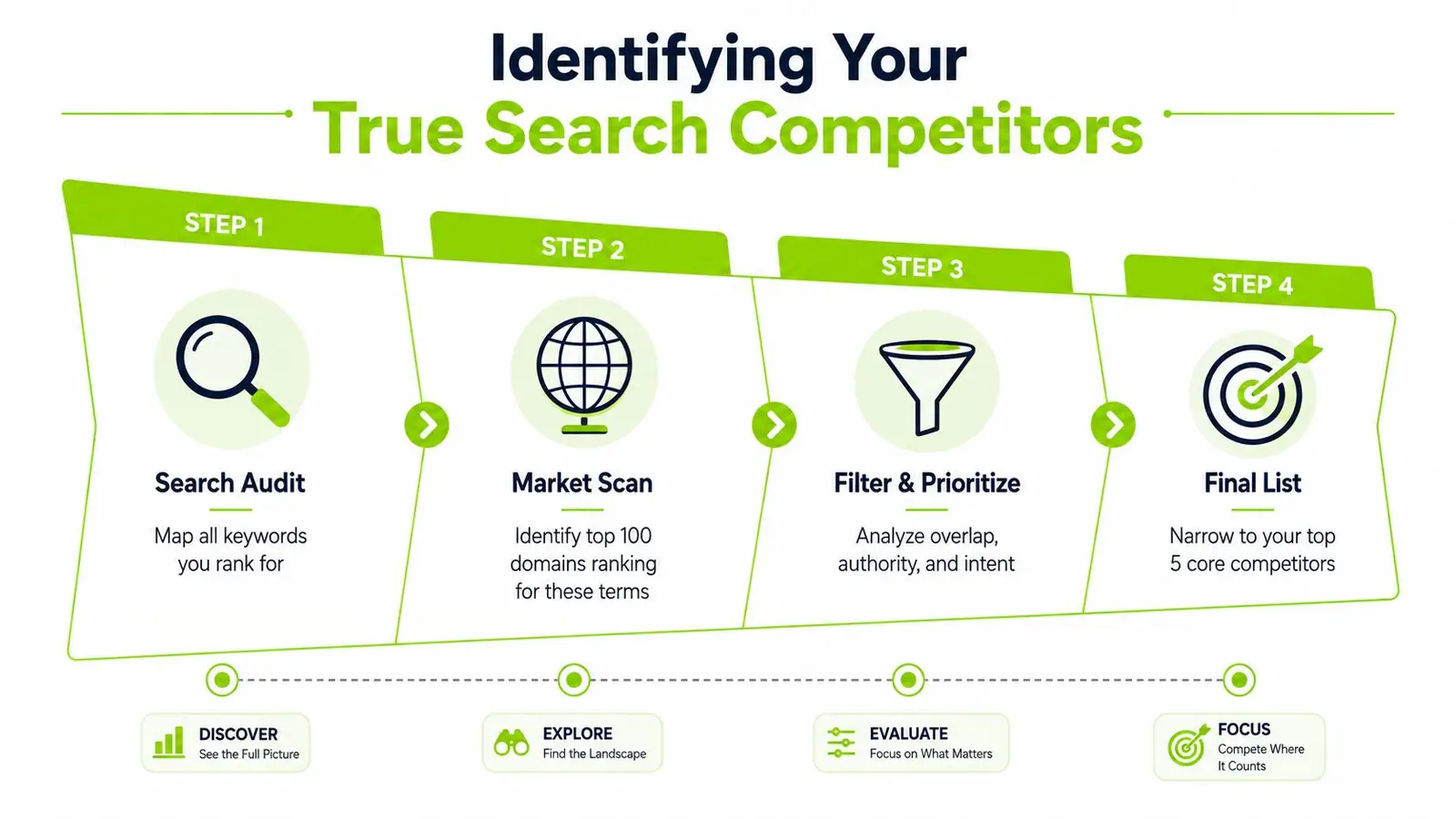
The reliable starting point is the SERP. A practical SEO competitor analysis framework recommends keeping the competitor set tight, often around five domains, using a stable keyword set, and analyzing ranking coverage buckets such as top-three, top-ten, top-twenty, and top-fifty positions.
A SERP-first selection process
Start with a representative keyword universe. Include branded terms, commercial queries, problem-aware searches, comparison terms, local variations, and questions. Don't build the list from search volume alone. A lower-volume query with strong buying intent and a realistic authority gap may deserve attention before a broad, high-volume phrase dominated by entrenched publishers.
Then record the domains that appear repeatedly. Look at the page type, not just the domain name. A competitor that ranks with product pages may require a different response from one that ranks with editorial guides or comparison content.
A useful filtering sequence looks like this:
- Map existing visibility. Export queries from Google Search Console and your rank tracker. Mark terms where your pages appear, especially those sitting outside the strongest result ranges.
- Scan the SERPs. Search priority terms manually or through a SERP API. Record recurring domains, page formats, SERP features, and AI citations.
- Group the domains. Separate direct competitors from publishers, directories, review sites, forums, and aspirational brands. Each group reveals a different type of gap.
- Score strategic relevance. Compare keyword overlap, intent alignment, content quality, internal linking, entity coverage, backlink authority, and commercial proximity.
- Keep the core set focused. Choose the domains that repeatedly compete for valuable queries. Keep emerging or indirect competitors in a watchlist rather than allowing them to distort the main analysis.
Why raw gap volume misleads
Sorting a keyword gap by search volume alone creates a seductive but weak backlog. High-volume terms often require major authority, extensive content investment, and patience. A smaller group of highly relevant queries may offer a clearer path because your existing site already demonstrates topical alignment.
Use coverage buckets to make the opportunity visible. A competitor with many top-fifty rankings but few top-ten results may be expanding into your subject area. A domain with consistent top-three coverage is a more serious benchmark for content quality, authority, and intent satisfaction.
For local campaigns, prioritise SEO keywords locally by adding location, service area, and local intent signals to the gap analysis. Finally, find competitors of a website through recurring SERP overlap rather than relying only on the competitors a generic SEO platform suggests.
Metrics That Actually Matter for Modern Analysis
Ranking reports remain useful because they show whether a page is eligible to receive attention. They don't show whether searchers saw the brand, whether an AI system cited it, or whether the resulting visit produced business value.
The modern scorecard needs two layers. The first measures conventional visibility. The second measures what happens when an AI answer changes the amount and distribution of available clicks.
| Metric Category | Traditional KPI | AI-Era KPI | Why It Matters |
|---|---|---|---|
| Visibility | Average position and top-result coverage | Citation frequency and prompt coverage | Shows whether the brand appears in both result and answer layers |
| Demand capture | Organic clicks and click-through rate | Traffic resilience when AI Overviews appear | Separates durable demand from visibility that disappears behind summaries |
| Authority | Referring domains and relevant backlinks | Citation quality and recurring source selection | Indicates whether trusted sources support the brand's presence |
| Intent | Keyword rankings by cluster | Citation and click performance by intent | Reveals whether informational, commercial, and navigational searches behave differently |
| Business value | Leads, sales, and assisted conversions | Conversion rate after AI-influenced visits | Connects visibility to outcomes instead of stopping at exposure |
Citation capture needs context
Citation frequency is a useful starting point, not a standalone target. One study reported that pages cited in AI Overviews received 35% more organic clicks and 91% more paid clicks than pages not cited, while other research found AI Overviews reduced the click-through rate for the number-one result from 7.3% to 2.6% and cut clicks by 34.5% on average. The mixed evidence is discussed in Search Engine Land's reporting on AI Overview data.
That conflict is the point. A citation may improve discovery in one context and coincide with severe click loss in another. Don't optimize for citation count without recording the query, intent, cited page, answer position, brand sentiment, and post-click behavior.
A citation is a doorway, not a destination. Measure what happens after the answer names you.
Build a balanced decision model
For each priority prompt, compare your brand with competitors across four questions:
- Frequency: How often does each brand appear or receive a citation?
- Quality: Does the cited source directly support the answer and represent the right product or expertise?
- Resilience: Does the brand continue receiving clicks when an AI summary appears?
- Conversion: Do cited or AI-influenced sessions assist meaningful actions?
Share of search can help frame the traditional visibility layer, but the operational decision should come from the combined picture. A competitor with fewer first-place rankings may deserve more attention if it earns stronger citations and retains more valuable traffic.
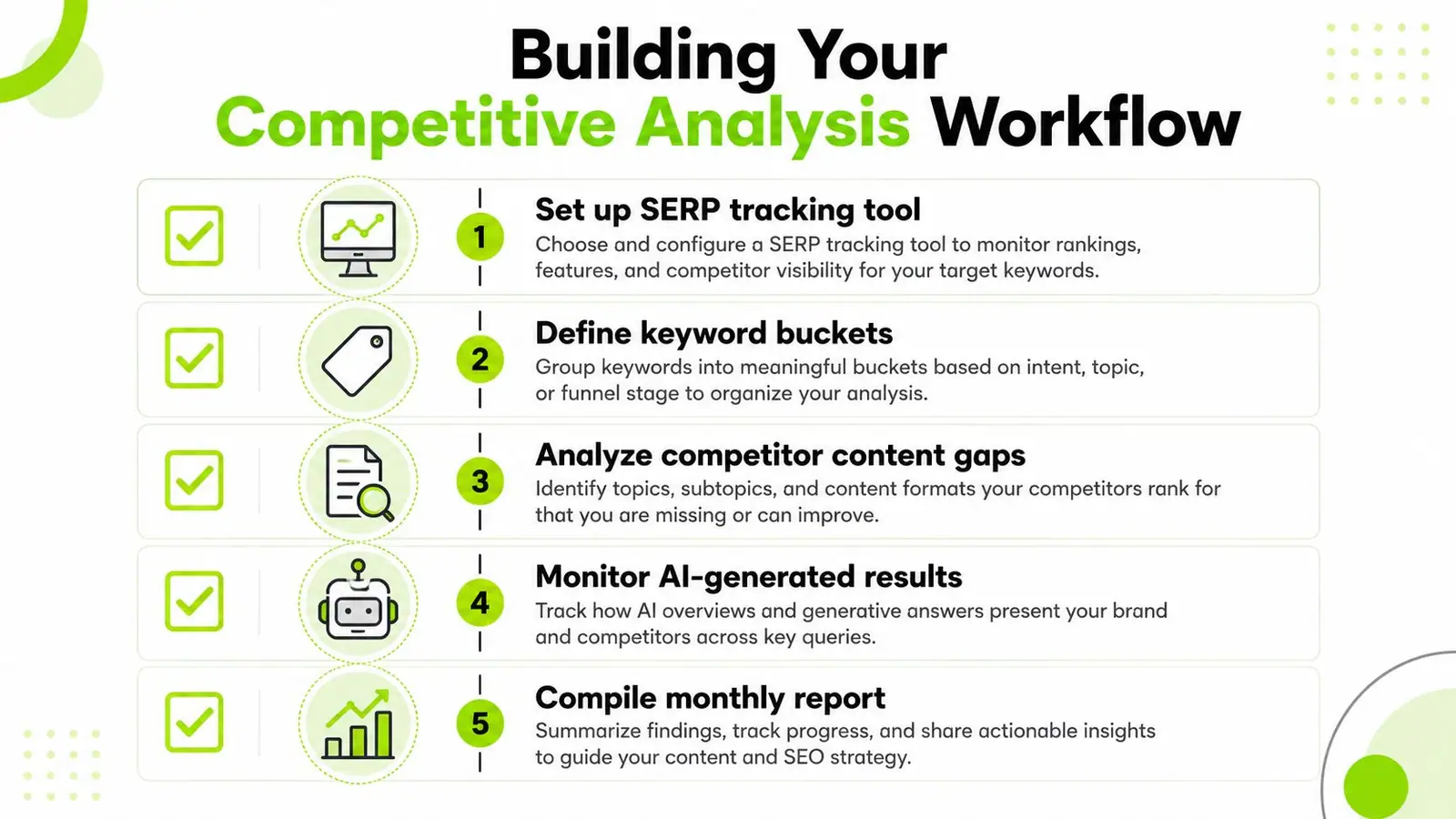
Building Your Competitive Analysis Workflow
A dependable workflow separates collection from interpretation. Tools should gather repeatable evidence, while strategists decide which patterns deserve investment.
Establish the data foundation
Create one master sheet or database with a stable record for every keyword and prompt. Include the query, intent, country, device, current page, ranking position, SERP features, competitor domains, AI summary presence, cited URLs, clicks, conversions, and review date.
Use Google Search Console for first-party queries and clicks. Pair it with a rank tracker such as Semrush, Ahrefs, or another platform that supports competitor visibility. A SERP API becomes useful when manual checks can't provide consistent scale. Teams comparing collection options can check out MapLeads' Serpapi alternative when evaluating API-based workflows.
Run the workflow in five passes
- Define the universe. Combine business priorities with actual Search Console queries, customer language, sales objections, and relevant questions. Tag each item by intent so commercial opportunities don't disappear inside an informational average.
- Capture the SERP. Record rankings, page types, features, and recurring domains. Store the result date because search pages change.
- Analyze the gaps. Compare missing keywords, underperforming pages, internal linking, content coverage, structured answers, and relevant backlink sources.
- Monitor AI answers. Run a fixed prompt set across the AI surfaces relevant to the audience. Log citations, mentions, competitor recommendations, source changes, and whether the brand appears for non-branded prompts.
- Score the opportunities. Combine business value, intent fit, authority feasibility, content effort, citation potential, and traffic resilience. Send only the highest-priority actions into the production roadmap.
Automate collection, not judgment
Schedule rank exports, backlink alerts, competitor content monitoring, and prompt checks through APIs or reporting connectors. Normalize URLs before comparing competitors, preserve historical snapshots, and flag material changes for human review.
A monthly report should show movement from the prior period, but it shouldn't become a decorative dashboard. The analyst still needs to inspect important SERPs, read cited pages, and explain why a competitor gained attention. Automation reduces repetitive work. It doesn't replace editorial judgment or conversion analysis.
Turning Data Into Actionable Strategy and Reports
A competitive report should end with decisions, not a larger spreadsheet. Stakeholders rarely need every keyword a rival ranks for. They need to know which competitive move affects the business, what the team should do, and how success will be judged.
Start each report with an executive summary built around three points:
- The change: Which competitor, query group, or AI surface shifted?
- The implication: What does that change mean for clicks, qualified demand, or brand consideration?
- The response: Which action should the team fund, defer, test, or stop?
Turn gaps into ranked bets
A useful opportunity record includes the target query or prompt, intent, competitor evidence, current brand position, recommended page or asset, technical dependencies, content effort, citation potential, and measurement plan.
Don't present “competitor ranks above us” as a strategy. Translate it into a diagnosis:
- Intent gap: The competing page answers a more specific need.
- Coverage gap: Your page omits questions or supporting entities that users expect.
- Authority gap: Relevant sources link to or cite the competitor more often.
- Format gap: The competitor uses a structure better suited to the SERP or AI answer.
- Conversion gap: Your page receives attention but gives users a weaker next step.
Report for the audience in front of you
Agency clients usually need a clear explanation of why rankings alone understate competitive risk. Show one query cluster with traditional positions, AI citations, estimated click behavior, and the proposed response. In-house executives may need a portfolio view, with opportunities grouped by expected business value and delivery effort.
A visual report works best when every chart answers a decision question. Use a competitor matrix for strengths, a trend line for visibility movement, a citation-gap view for AI coverage, and a prioritized action table for ownership and deadlines. For teams comparing monitoring platforms, Captapi's competitor software review offers useful context for evaluating tracking capabilities and reporting workflows.
Reporting standard: Every chart should make it easier to approve an action, assign an owner, or reject a low-value task.
Close the report with a testable plan. Define the page changes, outreach or authority work, prompt set, measurement window, and conditions that would cause the team to revise the approach. That structure keeps competitive analysis connected to execution rather than letting it become a quarterly ritual.
Real-World Applications Across Team Types
An agency managing many accounts needs consistency more than an enormous data set. The strategist can use a shared keyword and prompt taxonomy, then customize the competitor set for each client. A monthly narrative might show that a direct rival still leads traditional rankings, while a publisher owns citations for the questions buyers ask before they compare vendors. That gives the client a clearer investment choice than a generic authority chart.
An in-house SEO team can use the same framework to defend content priorities. Suppose a product page loses clicks after AI summaries begin appearing for category searches, while a competitor's comparison guide continues to earn citations. The response may involve improving the product page, creating a transparent comparison resource, strengthening third-party evidence, or measuring assisted conversions before abandoning the topic.
Growth marketers often need a faster loop. They can select a narrow set of high-intent prompts, inspect which competitors receive citations, and use the findings to refine positioning, paid-search messaging, landing pages, and lifecycle campaigns. The key is to treat AI visibility as a demand signal, not as a vanity score.
Developers and data engineers approach the problem differently. They may build an ingestion pipeline that collects SERP results, stores competitor URLs, tracks cited sources, and sends material changes into a reporting system. Their main risk is building an impressive data layer without a prioritization model. A clean API doesn't tell the team which content to publish or which competitor deserves a response.
Across all four team types, the same mistakes recur. Teams track too many domains, sort gaps by volume, copy competitor pages, and report rankings without clicks or conversions. The stronger approach keeps the competitor set focused, preserves query intent, reviews citations alongside positions, and assigns every insight to a concrete action.
Search competitive analysis now measures where attention goes, not merely where a page ranks. Teams that connect rankings, citations, traffic resilience, and conversion behavior can make sharper decisions even as search surfaces continue to change.
Surnex gives agencies, in-house teams, and developers one place to compare traditional SEO performance with AI visibility, including competitor citations, prompts, rankings, backlinks, and content opportunities. Visit Surnex to see how its citation-gap and competitive workflows can turn search intelligence into a prioritized action plan.