Asking ChatGPT the same question 100 times produced fewer than a 1-in-100 chance that any two answer sets returned the same brand list. That's why how to rank in ChatGPT is really about earning citation and mention visibility across repeated prompts, not chasing a fixed keyword position.
Why ChatGPT Ranking Looks Nothing Like Traditional SEO
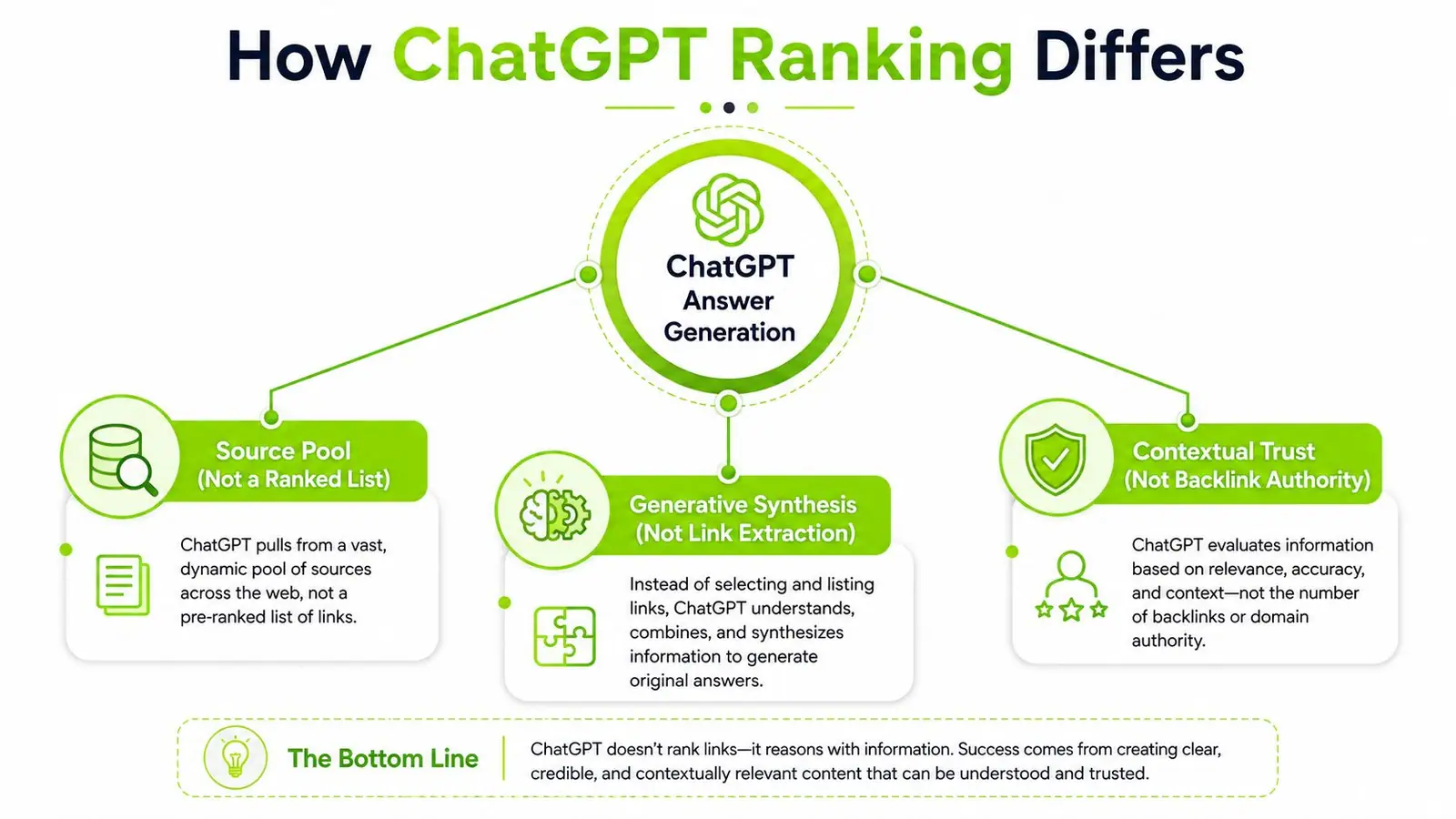
Traditional SEO assumes a stable results page. ChatGPT does not work that way. It synthesizes an answer from retrieved material, and the output shifts with prompt wording, account context, source availability, and model state, so a single check can make visibility look stronger or weaker than it really is.
That changes what you should measure. The useful question is not “What rank are we?” It is “How often does the model name us when the prompt is repeated in a controlled set?” SparkToro's repeated testing shows why spot checks break down, because the same prompt can return different brand lists across runs. That makes share of voice a better unit of measurement than a static keyword slot. SparkToro testing and repeated prompt behavior
Practical rule: If you only test once, you are measuring randomness, not visibility.
What this means operationally
You have to treat ChatGPT like a probabilistic distribution, not a crawler with one clean ranking. The same page can surface, disappear, or come back depending on how the question is phrased, which means the task is less about tuning a single page for one keyword and more about building a source the model keeps selecting across repeated prompts.
That also changes how teams evaluate progress. Old language around “page one” and “position one” falls apart quickly because the model can cite multiple brands, rewrite phrasing, or omit a source entirely. The practical target is repeatable appearance across a frozen prompt set, with enough consistency to matter in real use.
How to think about the target
The cleanest mental model is simple. Google ranks documents. ChatGPT assembles responses. If you keep trying to “rank” a page in the old sense, you will keep optimizing the wrong thing.
A better question is whether your brand appears as a cited or named source when people ask the kinds of questions that matter to your category. That is the bridge from classical SEO to Generative Engine Optimization, and it is the foundation for every workflow that follows. It also explains why a page can be technically strong and still miss the answer set if the model sees it as hard to extract or irrelevant to the prompt.
For teams that want to validate structure before they chase mentions, a quick pass with structured data testing helps confirm that the page is readable in the ways machines expect. A clean page does not guarantee citation, but a messy one gives the model less to work with.
The writing matters too. The HumanizeAIText SEO guide is useful if your team tends to sand down useful specificity and leave pages sounding generic, because generic copy is easy for models to skip.
Making Your Content Crawlable and Citation-Ready for LLMs
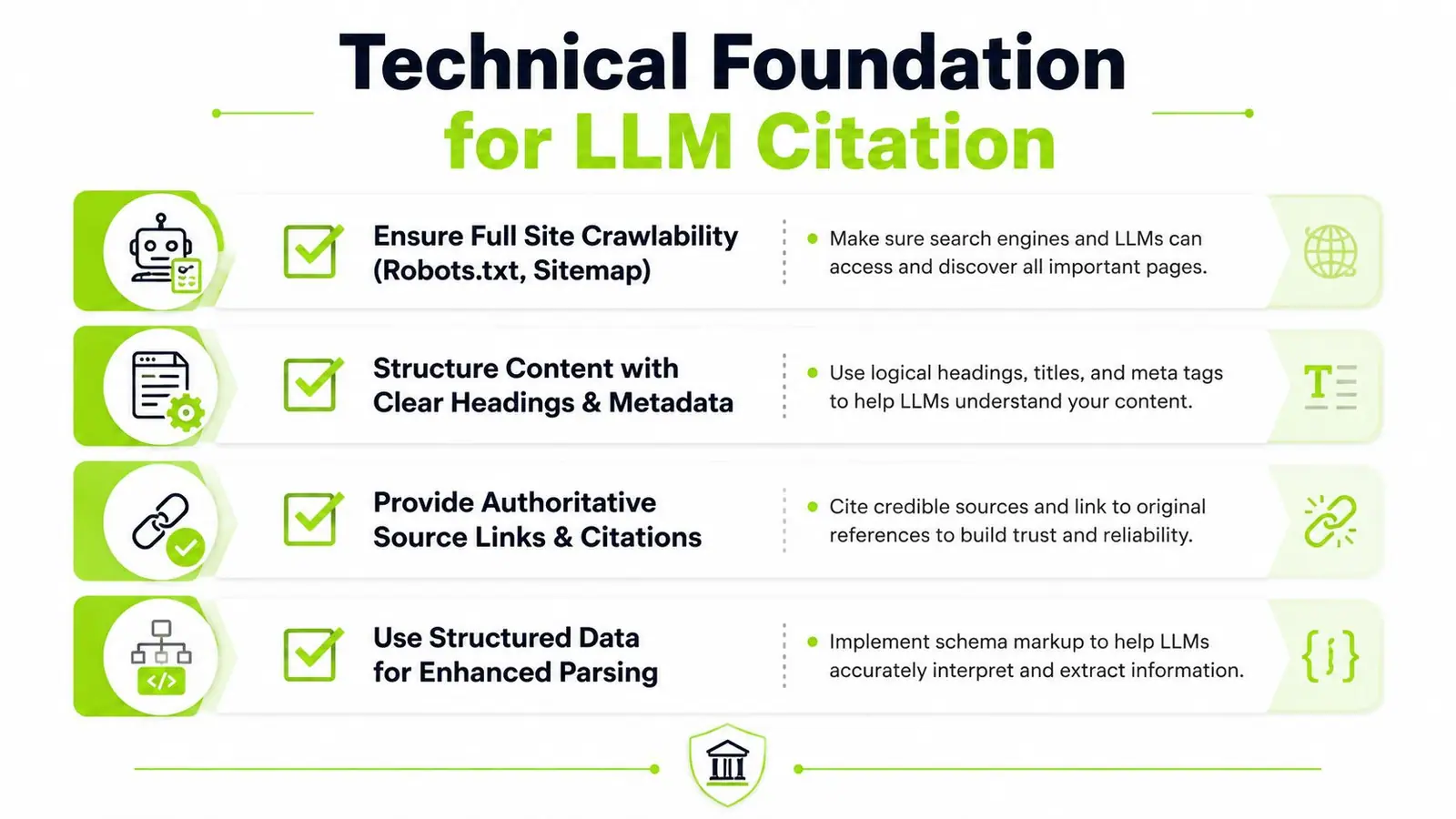
LLMs can't cite what they can't retrieve. They also won't trust content that's hard to parse, vague, or buried in fluff. The technical foundation comes first, because no amount of clever wording helps if the model can't reach the page or extract a clean answer from it.
Start with crawl access
The first thing to check is whether GPTBot is blocked in your robots.txt. If it is, you've cut off a major ingestion path before the model has a chance to see the page. That doesn't guarantee visibility, but it removes an obvious failure point.
After that, make your site easier to interpret. Organization schema tells systems who's speaking, and FAQPage schema maps neatly to conversational queries. If you have product, review, or other relevant structured markup, use it where it's accurate, because clear entities and machine-readable fields make extraction cleaner.
A useful companion read on the SEO side is the HumanizeAIText SEO guide, especially if your team tends to over-edit pages into generic, model-unfriendly copy.
Write for extraction, not just readability
The strongest pages usually place the direct answer early, ideally in the opening 40 to 60 words or within the first 150 words. That gives the model a concise passage it can lift without heavy paraphrasing. It also reduces the chance that a good answer gets lost under product marketing, scene-setting, or an overlong introduction.
Headings matter too. Use clear, hierarchical structure that mirrors how people ask the question. Named entities, explicit comparisons, and verifiable claims give the model anchors it can trust. Vague prose might read smoothly to a human and still be nearly useless for citation.
Make validation part of the build
You don't want to guess whether a page is parseable. Test it. The structured data testing workflow at Surnex's schema testing guide is the kind of check that should happen before publication, not after a page has already underperformed.
One more practical detail, freshness matters. Pages that are updated regularly, with stable terminology and clear source references, are easier for AI systems to reuse. If your page says something precise, supports it with context, and stays current, it's much more likely to be treated as a source worth citing.
The operational test is simple. If a model were scanning the page in seconds, would it know exactly what you do, what the answer is, and where the support lives? If not, the page still needs work.
Structuring Content That AI Systems Pull From
A crawlable page still won't win citations if the structure makes extraction painful. The model needs a page that answers fast, stays on topic, and signals that it knows the subject thoroughly enough to be trusted. That's where page architecture starts to matter more than polished marketing language.
Lead with the answer
The strongest pattern is still the same, put the answer first. If a user asks a direct question, the model looks for a direct passage, not a narrative that circles the point. Pages that bury the answer under introductions or brand messaging often get paraphrased badly or skipped.
A practical way to think about this is to write the first paragraph as if it had to stand alone in a response box. Then let the rest of the page expand, qualify, and support that answer. That keeps the core claim easy to extract while still giving a human reader enough depth to trust it.
A page doesn't need to sound robotic to be extractable. It needs to be explicit.
Build topic density without bloating the page
LLMs respond better to pages that cover a topic thoroughly, with named entities and clear relationships between ideas. That doesn't mean padding the page with keywords. It means showing that the page understands the surrounding context, the sub-questions, and the adjacent terms people ask about.
Internal linking becomes useful when related pages point to each other in a way that reinforces topical coverage, not just navigation. For editorial teams, the simplest pattern is a pillar page with supporting articles that each own a narrow question, then cross-link those pages where the entities overlap.
One of the best habits is to audit before publishing. Check the top 10 to 15 queries you care about across ChatGPT, Perplexity, and Gemini, and note which domains are being cited. Then publish content that fills the observed gaps with direct answers, named entities, and claims you can support.
Write for the passage the model wants to reuse
A lot of pages fail because they sound persuasive to humans but too soft for a model to quote. You want passages that are concrete enough to be reused without losing meaning. That means less marketing language, more exact definitions, better subheadings, and cleaner terminology.
For teams trying to systematize this, the how to write SEO content guide is a useful internal reference point because it reinforces the same editorial habit, structure first, clarity second, ornament last.
The page that gets cited is usually the one that makes the model's job easiest. That's not the flashiest page. It's the page with the clearest answer, the cleanest terminology, and the least resistance to extraction.
Building the Authority Signals LLMs Trust
A clean page with no external credibility often loses to a less perfect page that's widely referenced. That's the part teams still underestimate. LLMs don't cite in a vacuum, they lean on signals that suggest the source is known, echoed, and credible outside its own domain.
Third-party mentions beat self-assertion
Backlinks still matter, but not as a magic token. What matters is that other sites, especially relevant ones, independently mention your brand, your data, or your ideas. Review sites, industry publications, partner mentions, conference pages, and earned media all create a web of trust that makes your content easier to select.
That's also why digital PR still belongs in the modern playbook. If your brand keeps appearing on reputable domains, the model has more reasons to treat you as a source worth surfacing. A page that lives alone on your site is harder to trust than a page reinforced by third-party evidence.
For teams building product-level visibility, the deploy chatbots with Cypher article is a useful reminder that graph-connected systems depend on relationships, and AI visibility works similarly. The model is reading relationships between sources, not just a page in isolation.
Authority changes the odds
There's a real trade-off here. You can often improve a weak page with structure and schema, but it still may not win if another source has stronger external authority. In generative search, that gap matters more than it does in traditional SEO because the model is trying to reduce uncertainty. When there are several plausible sources, it tends to lean on the ones already backed by wider references.
That's why reviews, publication mentions, and strong backlinks aren't “nice to have” extras. They help establish a source as the kind of page a model can trust when it's synthesizing an answer. If you want to rank in ChatGPT, you need enough external validation that your page looks less like a claim and more like a known reference point.
What to prioritize first
Not every authority tactic pays off equally fast. The best starting points are the ones that already align with your real market presence, such as:
- Earned mentions in relevant publications, because they show the brand exists in the discourse the model is already reading.
- High-quality backlinks from topic-aligned sites, because they reinforce the subject area rather than just the domain.
- Independent reviews and comparison pages, because they mirror how users phrase product or vendor questions.
- Conference talks and author bylines, because they attach named experts to the brand and reduce ambiguity.
If you want a tighter operational layer for this, the unlinked brand mentions guide is worth keeping in the workflow because it addresses one of the easiest authority wins teams miss.
The bottom line is simple. On-page improvements can make you readable. External authority makes you believable.
Measuring Your Visibility Across AI Models
A single ChatGPT query is not a benchmark. If you want a real read on visibility, you need repeated prompts, consistent logging, and comparisons across time. The answers are probabilistic, so the only useful signal comes from patterns, not one-off screenshots.
Use a fixed prompt set
Start with a stable set of prompts that reflects the questions buyers ask. Keep that set unchanged. If the prompts keep shifting, you lose the ability to tell whether a visibility change came from your content work or from a different query shape.
A practical measurement setup usually begins with a focused list of prompts, then tracks citation frequency, citation position, and share of voice over time instead of pretending traditional rankings still apply. That method keeps the comparison clean. It also gives you a baseline you can revisit after each content or authority change. Fixed prompt sets and visibility tracking
Repeat the same query enough times
Prompt repetition matters because model outputs vary with wording and available sources. In practice, teams often run each prompt multiple times, sometimes 10 or more, and more again when the answer set looks unstable. The point is not to pressure the model. It is to separate durable visibility from normal answer volatility. Repeated prompt testing and share of voice baselines
Measurement rule: One answer is anecdote. Repeated answers are data.
Once the tests are running, log whether your brand appears, where it appears in the response, and which competitors are listed beside it. Those three notes tell you far more than a single screenshot ever will. They also make it easier to explain progress to clients or leadership without overstating what changed.
Benchmark across more than one model
ChatGPT is only one surface. The same prompt should be checked across other AI systems where the use case calls for it, because visibility can shift sharply from one interface to another. A brand can appear consistently in one model and disappear in another, which is exactly why cross-model measurement matters.
That is why tracking workflows built for this space are getting more attention. tips for AI-driven product visibility is a useful reference for teams that need a practical process instead of ad hoc prompt checks.
If you need a place to centralize the work, Surnex's AI Overview tracker fits the same measurement mindset. The goal is not only to find where you appear, but to prove whether visibility is moving.
Putting It All Together with a Repeatable Workflow
The teams that get traction in ChatGPT don't treat this as a one-time optimization project. They run a loop. They measure, identify gaps, improve the pages and authority signals that matter, then measure again with the same prompt set. That rhythm is what turns a probabilistic system into something you can manage.
Start with a baseline
Lock your prompt set, run the tests, and log every appearance. You're looking for three things, where you show up, where you don't, and where competitors keep appearing instead. That baseline becomes the reference point for every change you make afterward.
Once you have it, split the work into two buckets. The first is content, meaning pages that need a better answer-first structure, stronger entity coverage, or clearer schema. The second is authority, meaning the domains that already cite your competitors and are likely to matter for your own visibility too.
Fix the pages that are already close
The fastest wins usually come from pages that almost qualify. They have the right topic, but the answer is buried. Or the coverage is decent, but the page lacks schema. Or the content is strong, but the wording is too soft for a model to quote cleanly.
These are the pages to update first because they're already near the citation threshold. You're not starting from zero. You're removing friction. A lot of teams miss this and keep publishing net-new content when the better move is to tighten the pages that are almost eligible.
Build a monthly operating cadence
A workable cadence is straightforward. Test, update, publish, re-test. Then repeat on a fixed schedule, usually monthly, so your numbers reflect actual movement rather than short-term answer noise. That cadence also makes reporting easier because you can compare the same prompts across time instead of improvising a new benchmark every cycle.
A platform can reduce the manual drag here. Surnex tracks visibility across ChatGPT and other AI search surfaces, combines it with traditional SEO metrics, and helps teams keep a single view of rankings, backlinks, audits, and citation gaps without bouncing between spreadsheets and prompt logs. That matters if you're reporting for clients or managing multiple markets, because the workflow gets messy fast once the prompt set grows.
Keep the loop small enough to run
The best system is the one your team will maintain. Don't build a measurement framework so heavy that nobody runs it twice. Keep the prompts stable, keep the logging simple, and keep the update list focused on the pages and mentions most likely to affect visibility.
If you want a cleaner way to manage that cycle, visit Surnex and see how AI visibility tracking, SEO metrics, and citation-gap monitoring can sit in one workflow instead of three separate tools.