AI Overviews appeared on 13.14% of all U.S. desktop searches in March 2025, up from 6.49% in January, a 102% increase in two months, according to Semrush's AI Overviews analysis. That movement changes the job. Google AI Overview tracking isn't a one-time visibility check. It's a weekly system for finding which query groups have newly become vulnerable to answer summaries, which sources Google cites, and whether your organic reporting still explains what users see.
A rank can stay stable while a competitor enters the generated answer above it. A page can earn a citation without producing a corresponding visit. The teams that handle this well separate detection, metrics, tooling, and reporting, then connect each change to a practical SEO action.
Why AI Overview Tracking Is Now a Core SEO Workflow
AI Overview coverage can shift from 6.49% of keywords in January 2025 to nearly 25% in July, then 15.69% in November, according to the Semrush study. Those figures come from one tracked dataset, so they should not be treated as a universal market rate. The practical point is more important: weekly monitoring must show which query classes changed, in which markets and devices, rather than reduce visibility to a single headline percentage.
AI Overviews also behave differently from familiar SERP features. A featured snippet usually highlights one primary result, People Also Ask presents expandable questions, and a knowledge panel follows an entity-focused information structure. An Overview can combine several pages, change its citation set for the same query context, and cite a source that does not appear in the organic top 10.
Google launched AI Overviews in the U.S. on May 14, 2024, after introducing the feature as Search Generative Experience in 2023. Google said “hundreds of millions” of users would have access that week and expected to reach over a billion people by the end of 2024, as documented in Google's launch announcement. That reach makes AI visibility part of recurring SEO operations, not a one-off experiment.
A useful dashboard should answer four operational questions:
- Detection: Which tracked query classes gained or lost an Overview this week?
- Metrics: How did cite-share, source divergence, intent coverage, and citation movement change?
- Tooling: Did collection preserve the target market, language, device, and date?
- Reporting: What changed beside organic performance, and what action follows?
A citation alone is a weak success signal. A brand may appear in the answer while receiving no measurable visit, while a stable organic rank may sit below a newly generated response. Review query class, market, language, device, and date together.
The priority is finding newly exposed informational, commercial, and transactional groups, then checking whether your brand appears in the answer and whether the cited page deserves an SEO or content response. For background, read this explanation of what Search Generative Experience means for search.
Detecting When and Where AI Overviews Appear
Detection should fit the query set and the decision it supports. A small audit can use manual checks, while recurring programs need consistent collection. Larger portfolios also require controls for geography, device, language, search type, and failed responses. The objective is not to record whether an Overview appeared. Track which query classes became newly exposed each week, then connect that change to the reporting clients already receive.
Start with the lightest method that answers the question
Manual SERP checks suit small samples and editorial review. Search each query in the same market, record whether the panel appears, save cited URLs, and capture nearby organic results. The process is slow and variable, but it lets a strategist inspect wording, citation placement, and a competitor's answer directly.
Browser extensions make ad-hoc research faster. Use them to check a competitor's query set or validate a suspected change, not as the agency's source of record. Logged-in status, personalization, location, and browser conditions can change the result.
Log file inference supports diagnosis rather than direct detection. Server logs show Googlebot activity and requested pages, which may help explain later citation changes. They cannot reliably identify the user query that triggered an Overview or capture every generated answer and citation.
SERP APIs are the practical option for recurring, larger-scale pulls. Keep country, language, device, search type, and query spelling constant. Store the raw SERP, Overview panel, cited-source set, and collection status. APIs add vendor costs and can return incomplete rendering, so failed and partial responses need separate status fields.
| Method | Setup Effort | Cost per 1k Queries | Max Scale | Best For |
|---|---|---|---|---|
| Manual SERP checks | Low | Variable | Small samples | Editorial validation and a 50-keyword audit |
| Browser extensions | Low to moderate | Variable | Small to medium | Ad-hoc competitor research |
| Log file inference | Moderate | Variable | Existing site traffic | Corroborating crawl and citation patterns |
| SERP APIs | High | Vendor-dependent | Large recurring sets | 5,000-query programs and enterprise pulls |
A real estate team trying to get found in ChatGPT and AI Overviews should validate buyer-focused query classes before automating collection. Start with locations and intents that produce useful signals, then add recurring checks. For implementation options, compare these tools for monitoring AI Overviews.
The main failure is treating an API response as ground truth without recording its conditions. If one week uses mobile results from one country and the next uses desktop results from another, the apparent trend reflects collection inconsistency rather than Google's behavior. A weekly report should flag that break before anyone interprets a query class as newly at risk.
The Metrics That Actually Move Decisions
Raw impressions are a weak starting point because they combine exposure in classic results with exposure inside an AI-generated answer. A better measure is cite-share, the proportion of observed Overview citations owned by your brand or domain across the tracked query set. It tells the team whether the brand is earning a meaningful share of the answer surface, not merely appearing somewhere on the page.
Organic rank is also an imperfect proxy. One large analysis found that only about 38% of cited pages also ranked in the organic top 10, down from roughly 76% earlier in the rollout, according to Slate's summary of AI Overview statistics. A page can therefore gain citation exposure without moving into the conventional top results, while a strong organic ranking doesn't guarantee inclusion in the generated response.
Build the dashboard around decisions
AI Overview presence rate by intent belongs on the operating dashboard. Slice informational, commercial, and transactional queries separately, then compare the rate by market and device. If informational queries trigger summaries frequently while transactional queries remain stable, content and measurement priorities shouldn't be identical.
Cite-share belongs on the client or leadership dashboard. Track your share against named competitors and retain the query IDs behind every movement. A lost citation on a high-priority product question deserves attention even if total organic impressions remain steady.
Citation-source divergence belongs in a trend view. Compare the domains cited in Overviews with the domains appearing in the classic SERPs. A growing gap can justify digital PR, expert contributions, partnerships, or backlink work aimed at sources Google already uses in answer construction.
Citation position and source mix belong in the diagnostic layer. Record whether a citation appears prominently or only after expansion, and group sources by domain type, publisher, retailer, forum, or institutional site. The same brand citation can carry different traffic expectations depending on where it appears and what the answer already satisfies.
| Metric | Definition | Decision It Drives | Reporting Cadence |
|---|---|---|---|
| Cite-share | Brand citations divided by all recorded citations in the query set | Which pages and competitors need attention | Weekly and monthly |
| Presence rate by intent | Overview-triggering queries divided by tracked queries in each intent group | Which query classes carry new risk | Weekly |
| Citation-source divergence | Difference between Overview sources and classic SERP competitors | Whether PR, authority, or content investment should change | Quarterly |
| Citation position | Location and visibility of a brand citation within the panel | Which cited pages need stronger answer support | Weekly |
| Source domain mix | Distribution of cited domains by type and topic | Which source relationships and content formats matter | Monthly |
Click behavior makes this separation essential. Ahrefs reported a 34.5% click reduction associated with AI Overviews, while a randomized field experiment found organic clicks to external websites fell 38% on triggered queries and zero-click searches rose from 54% to 72%, as summarized in Ahrefs' analysis. Visibility and traffic now need separate lines in the same report.
Choosing Between Trackers, APIs, and Custom Pipelines
Tooling choices usually fall into three groups. Legacy rank trackers add an AI Overview flag to an established position workflow. AI-native trackers treat generative SERPs as the primary object. Custom pipelines collect results through APIs, browser automation, and proxy infrastructure owned by the team.
Feature count matters less than what must remain trustworthy under scale. An agency needs account separation, exports, stable scheduling, and enough query breadth across clients. An in-house enterprise team may accept engineering overhead for unusual markets, internal joins, or high query volume. The practical test is whether the system can expose newly at-risk query classes each week, rather than only report a general visibility score.
Compare the operating trade-offs
| Criterion | Rank Tracker + AI Mode | AI-Native Tracker | Custom SERP Pipeline |
|---|---|---|---|
| Citation capture latency | Usually tied to scheduled rank pulls | Designed for generative SERP collection | Controlled by internal architecture |
| Query volume ceiling | Often constrained by existing plans | Better for structured AI visibility sets | Highest potential, with infrastructure cost |
| Source attribution accuracy | Can be shallow if AI mode is an add-on | Usually central to the product model | Depends on parser and validation |
| Geo-device fidelity | Familiar location controls | Often detailed, verify before purchase | Fully configurable, hardest to maintain |
| Export flexibility | Strong for standard SEO reports | Strong for AI visibility fields | Highest, with engineering work |
| Best fit | Teams adding AI signals to existing reporting | Dedicated AI visibility programs | High-stakes domains with engineering capacity |
For agencies managing several client accounts, a tracker-plus-API hybrid is usually more durable than forcing one platform to handle every task. Keep rankings, backlinks, audits, and standard reporting in the established tracker. Use an AI-focused system or API for citation-level data, then join records through query IDs, market fields, and intent labels. That structure makes weekly changes in query-class exposure visible inside reports clients already recognize.
AI-native products can underrepresent long-tail question clusters when their default datasets favor head terms. Custom pipelines address that coverage gap, while creating operational work around proxy rotation, CAPTCHA handling, parser changes, retries, storage, and quality assurance when Google changes the Overview layout.
A custom collector is an engineering product. Budget for maintenance, not only the first successful pull.
A custom pipeline can suit a single high-stakes domain with capable engineers because it gives the team control over sampling and data joins. Without that capacity, it may be more efficient to hire a fractional CTO for AI projects before adopting a system nobody can maintain.
Surnex offers AI Overview presence and citation data alongside traditional SEO metrics, with dashboards and API-oriented workflows. Teams building their own collection layer can apply data pipeline automation to reduce repetitive analyst work, provided the workflow preserves collection conditions and uncertainty. Whichever stack you choose, document those conditions and manually validate a sample before trusting trend lines.
Building a Weekly Monitoring Workflow
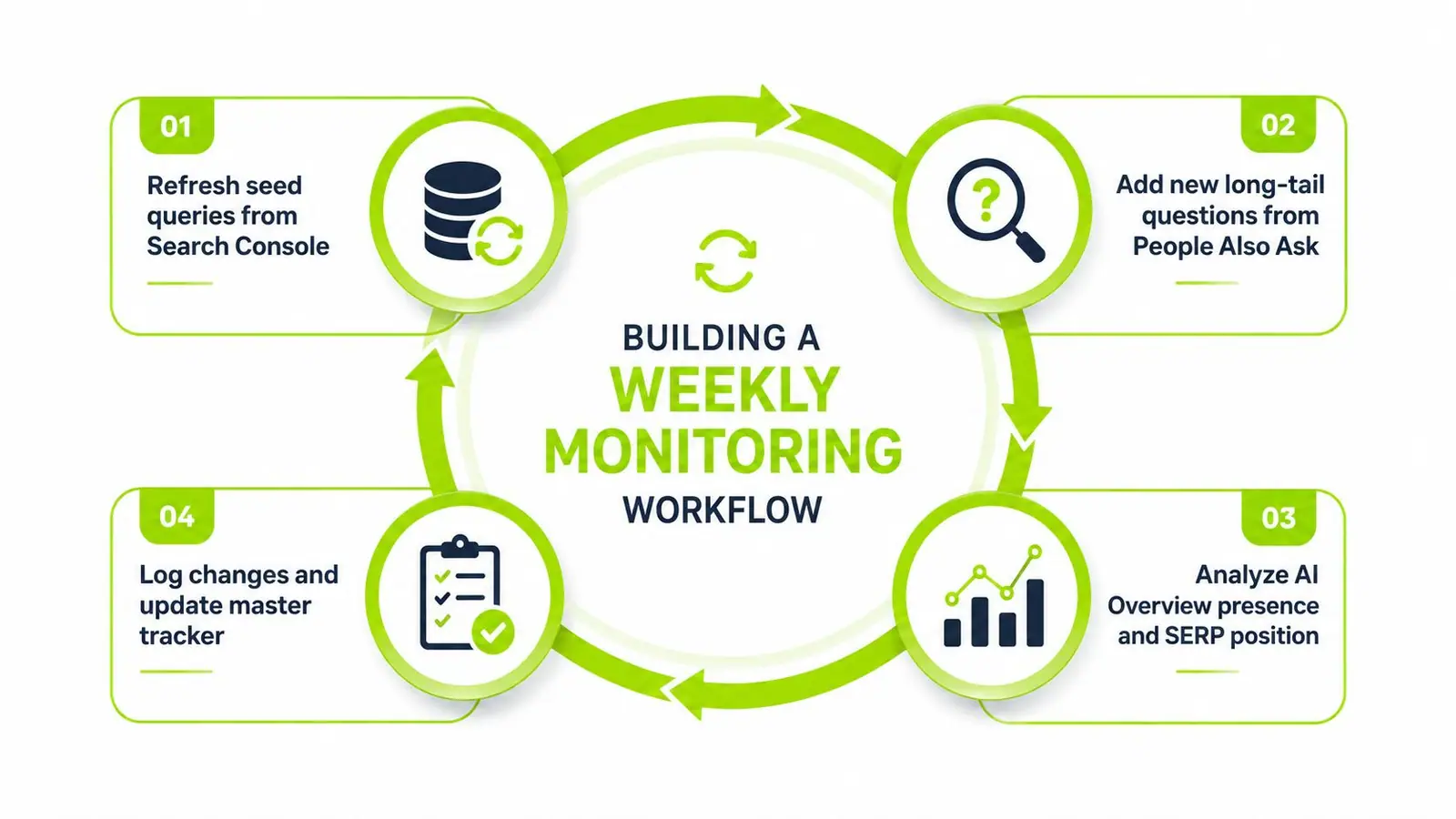
A weekly workflow should answer one operational question: which query classes became more exposed since the previous pull? The process doesn't need to consume an analyst's entire week. A carefully limited seed set, consistent collection conditions, and automated change flags create more value than a massive unreviewed export.
Refresh the queue before you collect
Start with queries that already produce meaningful Search Console impressions or clicks, then add new long-tail questions from People Also Ask mining, sales calls, support tickets, and content briefs. Assign every query an intent label, market, language, device, landing page, and business priority. Don't let the list become a static keyword archive.
Schedule the main pull for Monday at 06:00 local time in each priority market. Store the raw response, the parsed Overview text, every cited URL, the organic top 10, and a collection-status field. Consistent timing won't eliminate volatility, but it makes week-over-week comparisons interpretable.
Diff, triage, and assign
Compare this pull with the prior one and flag four changes:
- New appearance: The query didn't return an Overview before, but does now.
- Lost citation: Your page or domain was cited previously, but disappeared.
- Source shift: The panel remains, but Google replaced or reordered cited domains.
- Organic divergence: Citation status changed while the classic ranking stayed broadly similar.
Put each delta into one of three queues:
- Action this week: Your brand is absent from a high-value Overview, or an important page lost a citation.
- Monitor: A competitor gained a citation, but the query has limited commercial importance or unstable results.
- Ignore: The change is low-priority noise, duplicated across variants, or tied to a failed collection.
Attach a proposed action to every escalation. That might be a clearer answer block, stronger entity references, expanded schema, improved internal linking, or a PR review of the sources Google cites. The analyst shouldn't deliver a red flag without enough context for the content or technical team to act.
A structured weekly agency reporting process can absorb these deltas without creating a separate manual presentation. The report should show the trend, the affected query IDs, the cited competitors, and the owner of the next action.
Reporting AI Visibility to Clients and Stakeholders
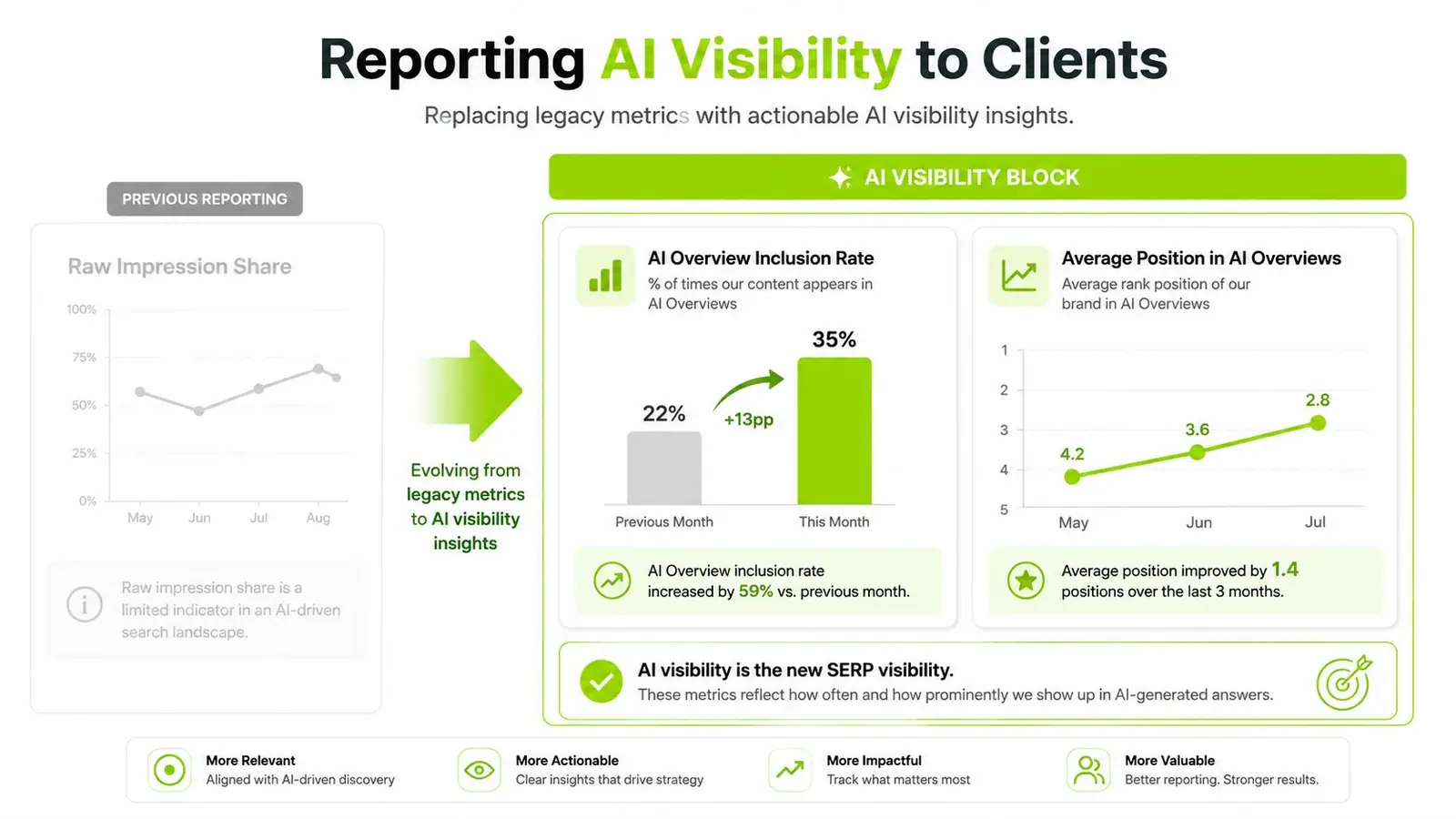
Clients don't need a second version of the SEO report. They need a clearer explanation of why organic rankings, AI citations, and traffic can move independently. The cleanest retrofit replaces one legacy slide, usually raw impression share, with a compact AI visibility block.
Use the first slide for a cite-share trend against the top three competitors. Keep the underlying query IDs available in a linked detail view, but show the business-level movement first. The second slide should be a heatmap of coverage gaps by query class, market, and intent, with high-priority absent citations separated from low-value noise.
Define the KPI before showing the trend
Call the metric AI visibility, not organic traffic. Define it in the footnote as the brand's measured presence or citation share across the specified tracked queries, markets, devices, and collection date. Then state separately that organic sessions and clicks reflect visits, while AI visibility reflects inclusion in a search answer surface.
That distinction matters because click behavior changes when summaries appear. Pew found users clicked a traditional result in 8% of visits with an AI summary versus 15% without one, according to Pew Research Center's analysis. A citation can support brand recognition or later research without producing an immediate organic session, so the commentary should explain the disconnect rather than label it a reporting failure.
Use consistent footnote language across accounts:
- Definition: AI visibility measures recorded presence in tracked Overview results, not visits.
- Scope: The report names the markets, devices, languages, and query classes included.
- Comparison: Week-over-week changes use the same collection conditions wherever possible.
- Action: Each material gap links to the affected query IDs and proposed owner.
The executive summary should lead with the business read. “The brand lost citations across priority comparison queries while organic rank remained stable” is more useful than a paragraph about parser versions. Methodology belongs in an appendix, where technical stakeholders can inspect it without forcing every client to learn the collection stack.
Where AI Overview Tracking Goes From Here
The next stage of Google AI Overview tracking is less about another isolated dashboard and more about continuous visibility infrastructure. Teams that record raw SERPs, cited URLs, query classes, markets, and collection conditions now will have cleaner historical data when Google's interfaces and APIs mature.
Three transitions deserve attention. First, teams will want to move from fragile SERP collection toward Google's AI Mode API as access and capabilities stabilize. That change should improve operational consistency, but it won't remove the need for query taxonomy or quality checks.
Second, schema and entity work will become part of citation readiness rather than a separate technical checklist. Structured content can help systems understand relationships, products, authors, and organizations, but tracking still has to confirm whether Google selects those pages as sources.
Third, agent-driven reporting will reduce the value of static monthly summaries. An agent can identify a new risk cluster, retrieve the affected citations, compare the relevant pages, and create a recommended task. Human review remains essential because not every citation change warrants content or technical intervention.
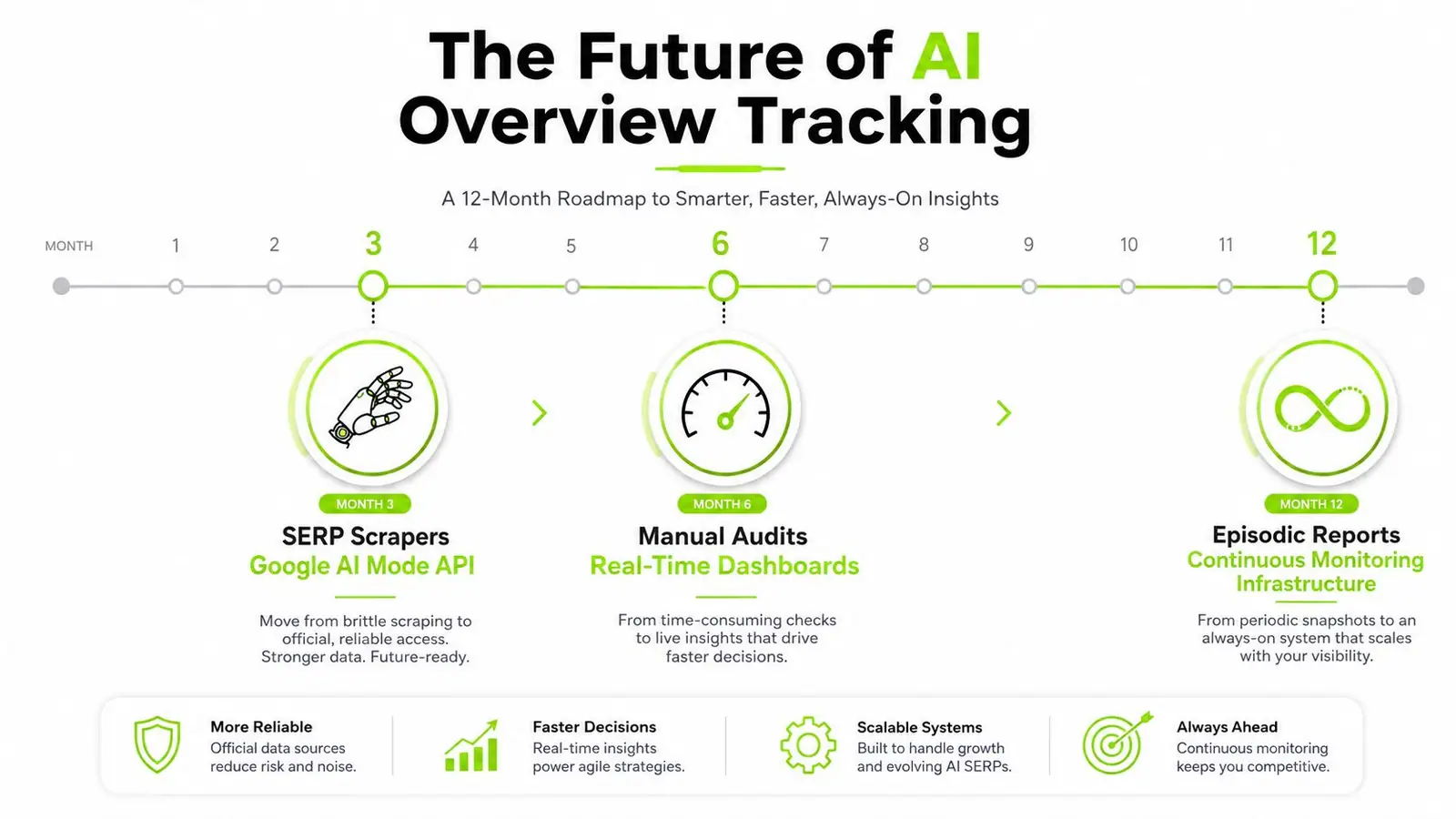
The teams that wire monitoring into their existing rank-tracking and reporting pipelines will avoid a future migration from disconnected spreadsheets. They'll already have stable identifiers, documented query classes, and a history of citation-source divergence.
The operating principle is simple: instrument query-class risk every week, not just brand presence. That's how an SEO team sees a newly exposed question cluster early enough to decide whether content, schema, authority, or reporting needs to change.
Surnex brings Google AI Overview visibility, citation monitoring, rankings, backlinks, audits, and content opportunities into one platform for agencies and in-house teams. Visit Surnex to connect weekly query-class monitoring with the SEO reporting workflows your team already uses.