Organic search accounts for about 43% of ecommerce traffic and 48% of conversions, according to recent ecommerce SEO benchmarks. That makes ecommerce keyword research more than a ranking exercise. It's a portfolio allocation decision: which product, category, comparison, and AI-discovery queries deserve your team's limited publishing, development, and optimization capacity?
The wrong portfolio can produce impressive visibility and weak sales. The right one connects search demand to pages that help shoppers choose, compare, and buy. This guide lays out a revenue-led process built around first-party signals, page intent, realistic competition, and measurement that reaches beyond rankings.
Why Ecommerce Keyword Research Is a Revenue Decision
Ranking first for a broad head term can be less valuable than earning a modest position for a specific query from someone ready to choose a product. Search volume estimates opportunity, but orders, revenue per organic session, and page-level conversion behavior decide whether that opportunity deserves budget and production time.
Organic search brings shoppers to the store without requiring a new payment for every visit. Industry summaries place it at about 43% of ecommerce traffic and 48% of conversions, while benchmark conversion rates range from 1.8% to 4.2%, depending on factors such as schema quality, mobile speed, and intent alignment. The same analysis reports a 1.39% conversion rate for non-branded organic sessions across 94 ecommerce brands and 9.46 million sessions. That supports targeting searches describing a product, problem, or buying decision, rather than relying only on brand demand. (Visionary Marketing)
Treat the keyword set as a portfolio across product, category, comparison, informational, and AI-discovery surfaces. Each group competes for the same limited resources: page creation, merchandising input, technical work, internal linking, and ongoing optimization. A high-volume category term may justify investment, while a lower-volume product or comparison query can produce revenue sooner. The right call depends on first-party performance, page fit, and the commercial value of the shopper behind the query.
Allocate effort across the revenue mix
A revenue-aligned keyword portfolio usually prioritizes:
- Product queries: Searches for a named SKU, model, material, size, or feature.
- Category queries: Searches describing a product group, use case, audience, or filter combination.
- Comparison queries: Searches that help buyers evaluate competing products, brands, or specifications.
- Informational queries: Supporting content that answers real questions and moves suitable visitors toward commercial pages.
- AI-discovery queries: Natural-language prompts that ask for recommendations, alternatives, product fit, or comparisons across shopping surfaces.
A widely cited benchmark reports that 70% of ecommerce searches are transactional. That helps explain why product modifiers, category terms, and comparison phrases often deserve more attention than a blog calendar built around generic awareness topics. The same historical analysis reports that an average ecommerce brand ranks for 1,783 organic keywords and generates an estimated 9,625 monthly visits, illustrating the value of systematic query coverage rather than dependence on a few head terms. (Charle Agency)
| Intent Bucket | Share of Organic Traffic | Share of Organic Orders | Avg Conversion Rate |
|---|---|---|---|
| Product | Not consistently benchmarked | Not consistently benchmarked | 1.8% to 4.2%, depending on implementation and intent alignment |
| Category | Not consistently benchmarked | Not consistently benchmarked | 1.8% to 4.2%, depending on implementation and intent alignment |
| Comparison | Not consistently benchmarked | Not consistently benchmarked | Qualitatively commercial, without a verified general benchmark |
| Informational | Not consistently benchmarked | Not consistently benchmarked | Qualitatively lower and indirect, without a verified general benchmark |
Public benchmarks do not reliably divide traffic and orders into these same intent buckets. Do not fill that gap with invented precision. Use analytics to measure revenue per organic session by page template and query cluster, then compare those results with assisted conversions and product-level margin where available.
Practical rule: A keyword earns a place in the roadmap when you can explain which page will satisfy it, which shopper it represents, and how that page could influence an order.
Keyword selection is the first portfolio allocation call in an SEO program. Exporting thousands of terms, sorting by volume, and treating the spreadsheet as strategy wastes time. Start with first-party demand, then use external tools to expand, validate, and rank opportunities by commercial fit. Marketplace teams can apply the same discipline to paid search. Actionable Amazon PPC strategies can help separate discovery terms from product-specific buying terms across paid and organic programs.
Building Your Seed List from First-Party Demand
Your seed list should begin with language connected to real commercial behavior. Third-party tools can expand coverage later, but they often surface familiar head terms that are difficult to rank for and too broad to guide a purchase. Organic queries, internal search records, support conversations, reviews, and product feedback reveal how existing shoppers describe needs, objections, and product attributes.
Pull demand from four controlled sources
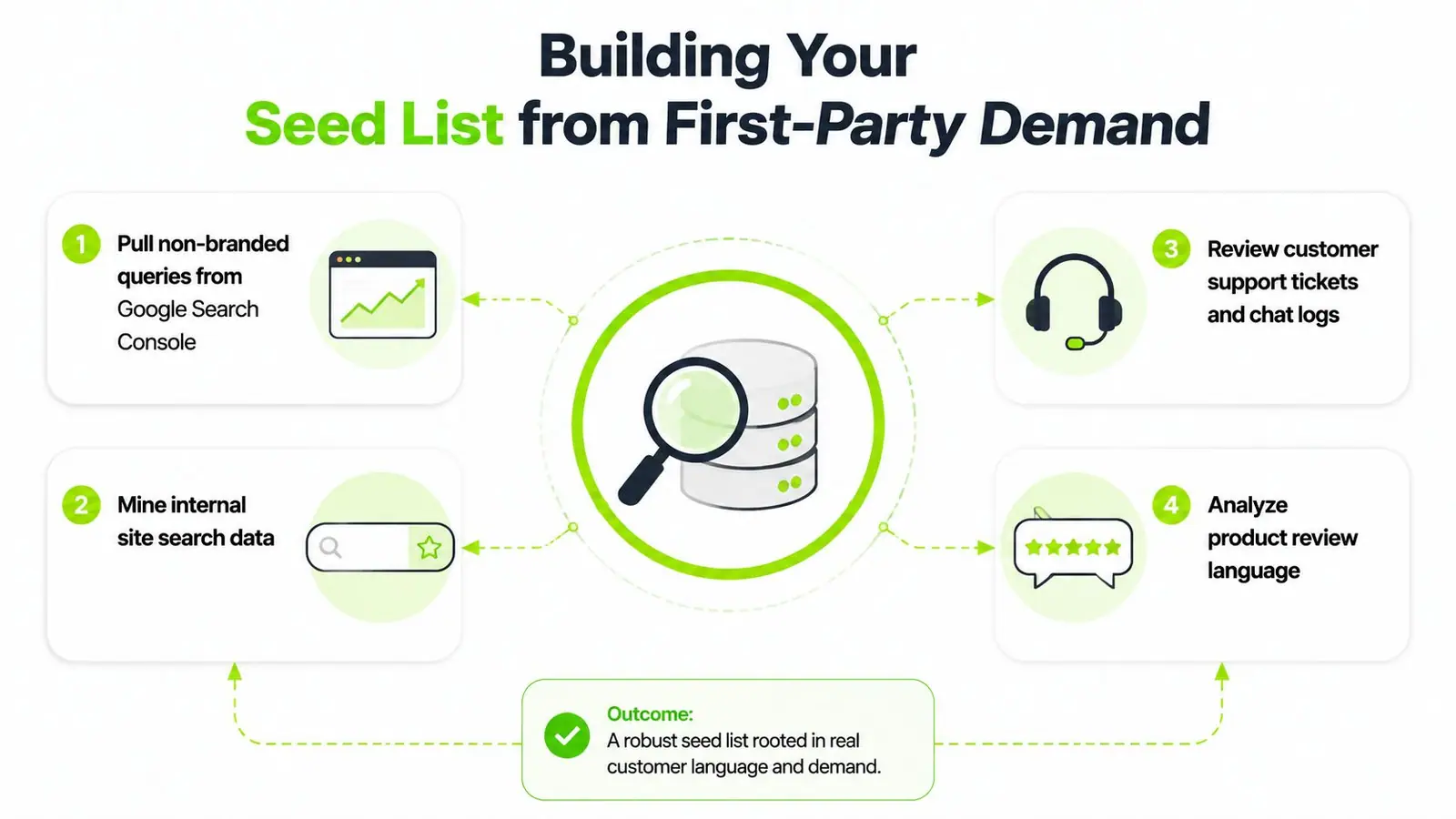
Start in Google Search Console. Export queries by organic landing page, then apply filters for non-branded queries, meaningful impressions, and pages tied to revenue or priority products. Keep the landing page, impressions, clicks, position, country, and device fields. A query already receiving impressions gives you a tested starting point, not a disconnected tool suggestion.
Use a targeted search to surface phrasing in your own content: site:yourdomain.com intext:"fit for". Replace the phrase with terms such as “compatible with,” “for small spaces,” or “works with” when the catalog calls for them. This can expose customer language quickly, especially for compatibility, sizing, and use-case modifiers that navigation may hide.
Mine internal site search next. These logs show what visitors look for after arriving, including attributes missing from category copy or filters. Group spelling variants, singular and plural forms, and equivalent wording, while preserving distinctions such as “waterproof hiking boots” and “water-resistant hiking boots.”
Review filter and navigation combinations. Color, size, capacity, activity, compatibility, and audience modifiers may indicate category opportunities, but do not create indexable URLs for every combination. Keep a combination when it represents distinct demand, a useful product set, and a page shoppers can understand.
Reviews, product questions, chat transcripts, and support tickets add the language behind the query. A question about whether a backpack fits a specific laptop size can inform a product FAQ, comparison angle, or category filter.
Tag, clean, and expand
Assign each seed three labels:
- Intent: Product, category, comparison, or informational.
- Page type: Product detail page, category page, comparison guide, buying guide, or support content.
- Demand signal: Existing impressions, internal searches, customer language, or no first-party signal.
A strong first-party collection may produce hundreds of commercially useful seeds, depending on catalog size, traffic, and data quality. Do not optimize for spreadsheet volume. Optimize for coverage of language your inventory and pages can satisfy.
Normalize case, punctuation, plurals, and close variants before deduplicating. Cluster terms that share the same search result page and page purpose. Remove irrelevant brands, unsupported features, unavailable products, and modifiers the catalog cannot serve before adding external suggestions.
For documentation, this guide to building a keyword list can support a repeatable workflow. Marketplace sellers can separate product themes from audience themes, including research on best niches for Merch by Amazon. The allocation principle stays consistent: prioritize demand signals that connect a searchable need with products you can sell.
Matching Intent to the Right Page Type
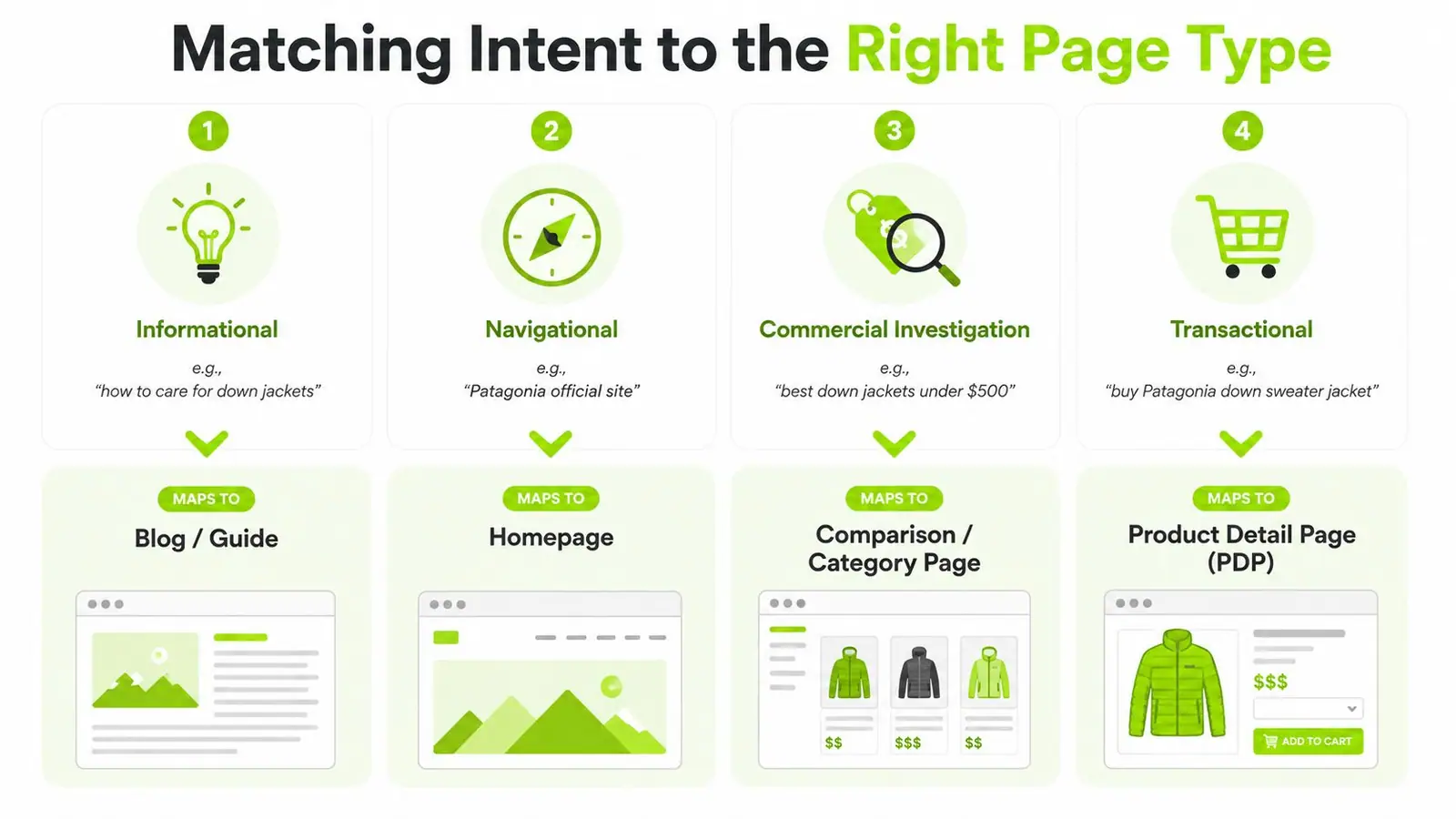
A keyword earns a page assignment only when the page can satisfy its underlying job. Product intent belongs on a product detail page, category intent on a collection or category page, comparison intent on a buying guide or comparison hub, and informational intent in supporting content. Treat these as portfolio decisions across product, category, comparison, and discovery surfaces. Clear ownership also prevents multiple URLs from competing for the same demand.
Product and category intent
Product intent names a model, SKU, or highly specific item. Examples include “Patagonia Down Sweater Jacket,” “Braun Series 3 replacement foil,” and “Garmin Forerunner 265 price.” These searches usually need a PDP with availability, specifications, delivery information, reviews, structured data, and a direct purchase path. Product results, review stars, prices, and merchant listings often appear in the SERP, so the page must make those details easy to verify.
Category intent describes a product set, such as “black running shoes,” “women's waterproof hiking boots,” or “coffee grinders for espresso.” Send these queries to a PLP or category page where shoppers can refine the available assortment. Include useful introductory copy, crawlable product links, controlled filter logic, and titles that match the inventory rather than an imagined range.
Do not create two category URLs for “black running shoes” because the filter order differs. Consolidate duplicate intent, apply canonicalization where appropriate, and let each indexable category page represent a distinct assortment.
Comparison and informational intent
Comparison queries include “Garmin Forerunner 265 vs 965,” “best espresso machine under 500,” and “Sony WH-1000XM5 alternatives.” These shoppers need trade-offs, specifications, use-case guidance, and a clear path to relevant products. A comparison guide or commercial hub normally fits better than a PDP forced to answer a broader evaluation question.
Informational searches include “how to clean trail running shoes,” “how often should I replace a water filter,” and “what grind size is best for pour-over coffee.” Use a blog, guide, or help-center page, then link naturally to relevant categories and products. An article can attract impressions while still failing commercially if shoppers must search again for the item they intended to buy.
| Intent | Example | Suitable Page | Typical SERP Pattern |
|---|---|---|---|
| Product | “Patagonia Down Sweater Jacket” | PDP | Product results, reviews, price, merchant listings |
| Category | “black running shoes” | PLP or category page | Shopping results, category pages, filters |
| Comparison | “Garmin Forerunner 265 vs 965” | Comparison guide or hub | Reviews, comparison pages, video results |
| Informational | “how to clean trail running shoes” | Blog or help center | Guides, question features, videos |
Pull session-level conversion rates from analytics by landing-page template and intent bucket. Use those figures to set realistic targets for each keyword cluster, then compare page types on revenue contribution rather than traffic alone. A product cluster may justify PDP work, while a comparison cluster may need an editorial page that assists later product sessions.
Page assignment rule: If a query contains buying language and identifies a product or product set, send it to a PDP or PLP first. Use editorial content only when a commercial page cannot satisfy the searcher's question.
For a practical explanation of assigning terms to page purposes, see how to use keywords for search engine optimization.
Evaluating Volume Difficulty and Seasonality
Volume tells you how often a term is searched, not how valuable each search is. “Running shoes” may attract broad interest, while “women's stability running shoes for flat feet” can reveal a much clearer product need. Difficulty scores add competitive context, but they're estimates based on the current results, authority signals, and page strength. A niche PDP can sometimes compete where a generic score makes the opportunity look unattractive, particularly when the existing results don't satisfy the exact use case.
A practical benchmark used by ecommerce teams places many useful terms in the roughly 500 to 5,000 monthly search range, because that band can balance meaningful demand with manageable competition. (First Page Australia) Treat it as a screening range, not a rule. A smaller term with strong commercial intent can beat a larger term that brings researchers, students, or shoppers looking for a product category you don't stock.
Read the SERP, not just the export
For every serious candidate, inspect the results manually:
- Page composition: Are the top results PDPs, PLPs, editorial guides, marketplaces, or forums?
- Product alignment: Do the ranking pages sell the same type of product with similar attributes?
- SERP features: Are shopping results, videos, reviews, local results, or AI summaries taking attention?
- Content weakness: Do current pages omit specifications, comparisons, images, availability, or buying guidance?
- Business fit: Can your inventory, margin, shipping model, and brand authority support the query?
Seasonality needs the same discipline. Use at least 24 months of historical data when available, then separate an evergreen baseline from recurring peaks, unusual spikes, and fading demand. A holiday gift query may justify a seasonal landing page, while a product with steady demand deserves an evergreen URL updated before its peak.
| Keyword | Monthly Volume | Difficulty | Seasonality | Best Page Type |
|---|---|---|---|---|
| “running shoes” | High | High | Broad and variable | Core category page |
| “women's stability running shoes for flat feet” | Moderate | Moderate | Likely evergreen | Filtered or dedicated category page |
| “best trail running shoes” | Variable | Moderate to high | Research before purchase periods | Comparison guide with product links |
Don't use unverified values for the table. Pull the actual volume and difficulty from your selected tool, and record the date and market. The table's purpose is to show how the dimensions interact. A term with moderate volume, clear fit, stable demand, and a weak SERP can be the stronger launch candidate.
Scoring and Prioritizing Keywords That Move Orders
A keyword list becomes useful when it tells the team what to do first. The most practical approach combines demand, commercial intent, order value, current visibility, and the quality of the existing page. This stops volume from dominating the decision and gives priority to terms where a realistic improvement could affect revenue.
One expert ecommerce workflow uses search volume × estimated conversion rate × average order value, then adds current ranking position and content-gap considerations to push high-value, close-to-win queries forward. (Ecom SEO)
Build a transparent score
Use a spreadsheet or database with these fields:
- Blended volume: Combine close variants only when they share the same intent and SERP.
- Intent-adjusted conversion rate: Use your own rate by page type where possible. If you don't have enough data, use qualitative tiers rather than invented universal percentages.
- Average order value: Apply the relevant category or product-group AOV, not a company-wide average that hides major differences.
- Ranking distance: A page ranking near the first page may be a closer opportunity than a page with no visibility.
- Content gap: Score whether the current page lacks essential information, internal links, structured data, or assortment depth.
- Business fit: Remove terms for products you can't stock, ship, price, or support profitably.
A simple internal formula is:
Priority score = volume × estimated CVR × AOV × ranking opportunity × content-fit factor
Keep each multiplier documented. The score doesn't need to predict exact revenue. It needs to make trade-offs visible and consistent.
| Keyword | Volume x CVR x AOV | Rank Gap | Content Gap | Priority Score |
|---|---|---|---|---|
| “running shoes” | High base value, broad intent | Large | Medium | Medium |
| “women's stability running shoes for flat feet” | Moderate base value, strong fit | Near-page-one opportunity | High | High |
| “best trail running shoes” | Commercial research value | Moderate | High | High |
| “how to clean trail running shoes” | Indirect value | Variable | Low to medium | Lower |
Use actual tool and analytics values in the production sheet. The worked example intentionally avoids fabricated numbers because the correct CVR and AOV belong to your store, not to a generic benchmark.
Reject attractive distractions
Reject a keyword when its volume comes mainly from audiences you can't serve, the SERP is dominated by incompatible page types, or the query has no plausible route to a product. Also reject terms that would force you to create a thin page for a filter combination with little assortment.
A five-figure-volume head term can look impressive in a client presentation while producing poor commercial outcomes. A focused group of lower-volume product and comparison queries can offer clearer intent, stronger page fit, and more defensible optimization work. For additional opportunity-finding ideas, low-competitive keywords can help teams expand beyond the obvious head terms without abandoning commercial relevance.
Adding AI Discovery and Comparison Queries to the Mix
Search discovery is no longer limited to a traditional results page. Google AI Overviews, ChatGPT shopping answers, and Perplexity recommendations can summarize options before a shopper visits a retailer. That makes comparison language a core part of ecommerce keyword research, not an optional editorial layer.
In a large analysis, 26.3% of retained keywords were evaluation or comparison queries, and AI Overviews expanded fastest on intent-rich searches such as “best [product]” and comparison terms rather than pure product pages. Shopping-query AI Overviews reached 14% overall by early 2026, while “best [product]” queries reached 83% AI presence in late 2025 and transactional queries remained near 13% to 14%. (BrightEdge)
Create an AI-discovery keyword bucket
Add phrases that mirror how shoppers ask for recommendations:
- Best-of queries: “best espresso machine under 500,” “best trail shoes for wide feet.”
- Comparison queries: “Garmin Forerunner 265 vs 965,” “Brand A versus Brand B.”
- Alternative queries: “alternatives to [product],” “similar to [model] but lighter.”
- Decision questions: “which air purifier is quietest,” “what should I buy for a small kitchen?”
- Constraint prompts: “best [product] for beginners,” “best [product] with replaceable parts.”
These terms need more than keyword placement. They require structured comparisons, clear product attributes, balanced pros and cons, evidence for claims, and links to pages where shoppers can verify pricing and availability. The content should make entities and relationships easy to interpret, while still reading naturally for a human buyer.
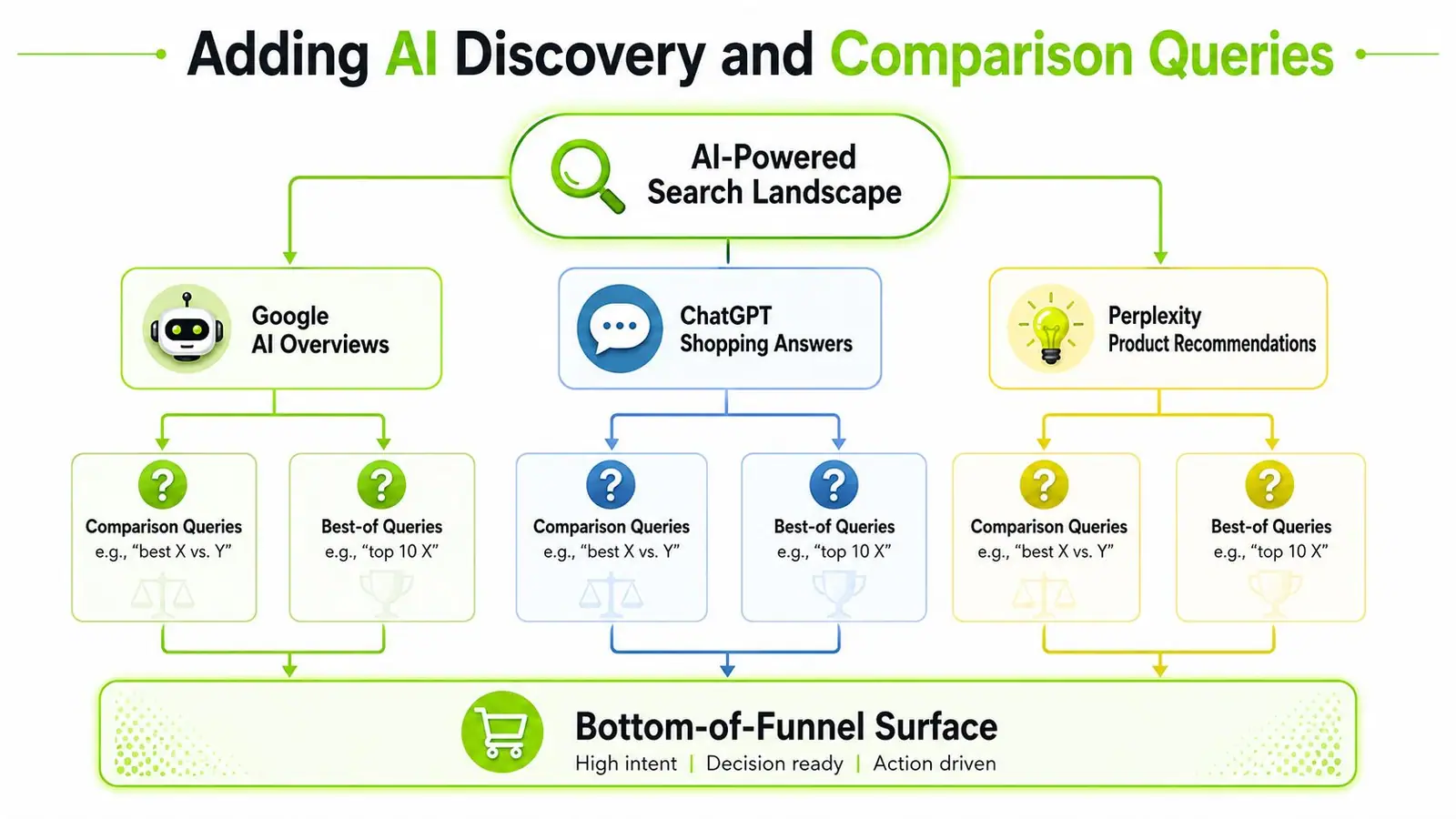
Recent reporting found direct referrals from AI engines to ecommerce brands rose 752% year over year during the 2025 holiday season. The same report found AI Overviews on shopping queries grew from 2.1% in November 2025 to 14.0% by March 2026 across 20.9 million shopping keywords, showing why teams should measure assistant visibility alongside conventional rankings. (Search Engine Land)
Track the prompt, market, cited brands, cited URLs, recommendation position, and whether the answer includes a product or category page. A tracker for AI citations and recommendation share lets the portfolio evolve with shopper language rather than only with typed Google queries. For implementation guidance, optimizing for ChatGPT is a useful companion to traditional technical and content work.
Mapping Keywords to Pages Briefs and Measurement
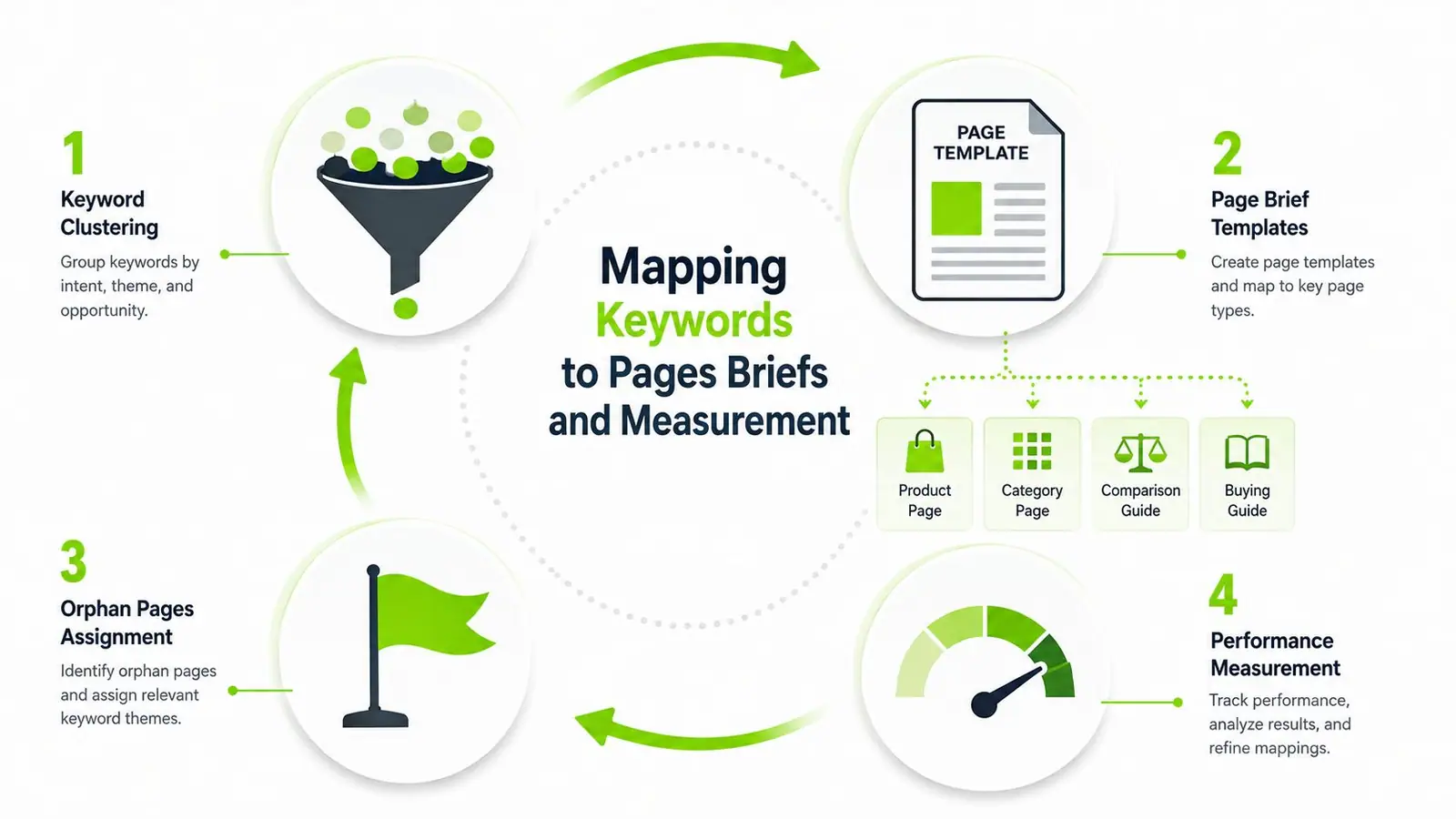
The final spreadsheet should assign every priority cluster to a URL or identify the need for a new page. Orphan keywords are not automatically content opportunities. Some reveal missing category architecture, while others are duplicates that should strengthen an existing PDP or PLP.
Turn clusters into briefs that can ship
A useful brief includes:
- Primary query and supporting variants: Keep terms together only when they share intent and SERP behavior.
- Page template: Product page, category page, comparison guide, buying guide, or support content.
- SERP features to address: Product results, reviews, videos, shopping modules, questions, or AI summaries.
- Required information: Specifications, compatibility, sizing, use cases, comparisons, delivery, returns, and availability.
- Internal link targets: Link upward to the parent category, sideways to related products, and downward to the relevant buying path.
- Structured data requirements: Match markup to the page and its visible content. Don't add schema only because a tool recommends it.
- Primary KPI: Use add-to-cart rate, checkout progression, revenue per organic session, or assisted revenue, depending on the page's role.
A product page brief should protect against thin or duplicated manufacturer copy. A comparison brief should identify the exact decision criteria shoppers use. A category brief should define which products belong, which filters matter, and which combinations deserve indexable URLs.
Measure the portfolio, not just positions
Check the highest-priority terms weekly for ranking movement, page changes, SERP composition, and competitor gains. Review revenue per organic session monthly by template, category, and intent cluster. Run an AI citation and recommendation audit quarterly, recording which brand and product pages appear in Google AI Overviews and assistant-led shopping answers.
A practical 30-60-90 day cycle looks like this:
- First 30 days: Audit Search Console, internal search, existing templates, cannibalization, and revenue by organic landing page.
- Next 60 days: Publish or improve the highest-priority PDPs, PLPs, and comparison pages, then connect them with deliberate internal links.
- By 90 days: Compare organic orders, revenue per session, page engagement, rankings, and AI citation presence against the baseline. Re-score the remaining portfolio using what the first releases taught you.
For teams reviewing broader planning considerations, this ecommerce keyword strategy for 2026 provides additional context. Surnex is one option for combining keyword ideas, demand, intent, difficulty, trend data, rankings, and AI visibility in a single workflow, while teams can also use Search Console, analytics, and specialist SEO platforms according to their reporting needs.
Surnex helps agencies and in-house teams connect ecommerce keyword opportunities with rankings, revenue-oriented SEO metrics, and visibility across Google AI Overviews and ChatGPT-driven discovery. Visit Surnex to evaluate your current keyword portfolio, identify citation gaps, and build a measurement workflow that shows which search surfaces contribute to growth.