Most competitive intelligence advice is too neat for how search works now. A fixed spreadsheet of rivals still has value, but it misses the competitors people discover through AI answers, community threads, creator recommendations, and search behavior that never touches a classic comparison page.
That matters because competitive intelligence is already mainstream in large enterprises, not a niche hobby. Industry roundups say 90% of Fortune 500 companies use it to gain advantage, and a 2020 Crayon-based report found 94% of businesses planned to invest in it, with 57% of companies ranking competitive advantage among their top three priorities and 56% of executives using CI to monitor rivals and plan expansion within three years (eValueserve's competitive intelligence statistics roundup). The discipline is established. What's changing is where the useful signals show up.
Why Your Competitor List Is Already Outdated
A lot of teams still treat competitive intelligence like a quarterly hygiene task. They pick ten named rivals, paste them into a sheet, and call it coverage. That approach misses how buyers now move through fragmented discovery paths, especially when AI answers, search snippets, forums, and recommendation engines all shape the shortlist before a sales call even starts.
The bigger problem is that competitors aren't always companies anymore. Sometimes they're communities, publishers, creators, or niche products that intercept the query before a user ever reaches your site. The set shifts by intent, geography, and format, which is why a static list can look precise while hiding the threat.
Search behavior now changes the competitive set
If someone asks a broad informational query, an AI answer might surface a publisher or a tool review site. If they ask a high-intent comparison query, the answer might favor a direct product, a marketplace listing, or a community discussion. Those are different competitive environments, even if the brand names in your spreadsheet stay the same.
Modern discovery work has to start with a practical approach: mapping the market around actual query patterns, not just around known brands. If you need a starting point for that kind of mapping, the workflow in how to find competitors of a website is a more useful lens than a static rivalry list.
Practical rule: If a competitor never shows up in search, AI citations, or buyer conversations, it may be a legal rival but not a commercial one.
That distinction changes budgeting, content planning, and sales positioning. You don't need to track every company in the category, you need to track the names and sources that interrupt discovery and conversion.
Unknown competitors are often the early warning system
The best CI programs watch for clues before a competitor looks obvious. Job postings, GitHub activity, patent filings, employee moves, investor decks, and forum chatter often reveal a strategic shift before a brand publishes a launch page or a comparison article. Guidance on identifying unknown competitors and adjacent substitutes points to exactly those signals as a way to catch market movement early (Rivalyze's source list for little-known competitive intelligence inputs).
That matters in search and AI visibility because the substitute may not be a direct vendor at all. It might be a community thread, a template library, or an AI-generated answer that users trust more than a branded result. If your team only tracks named rivals, you'll see market changes late, after the citations and recommendations have already shifted.
What Competitive Intelligence Actually Means Today
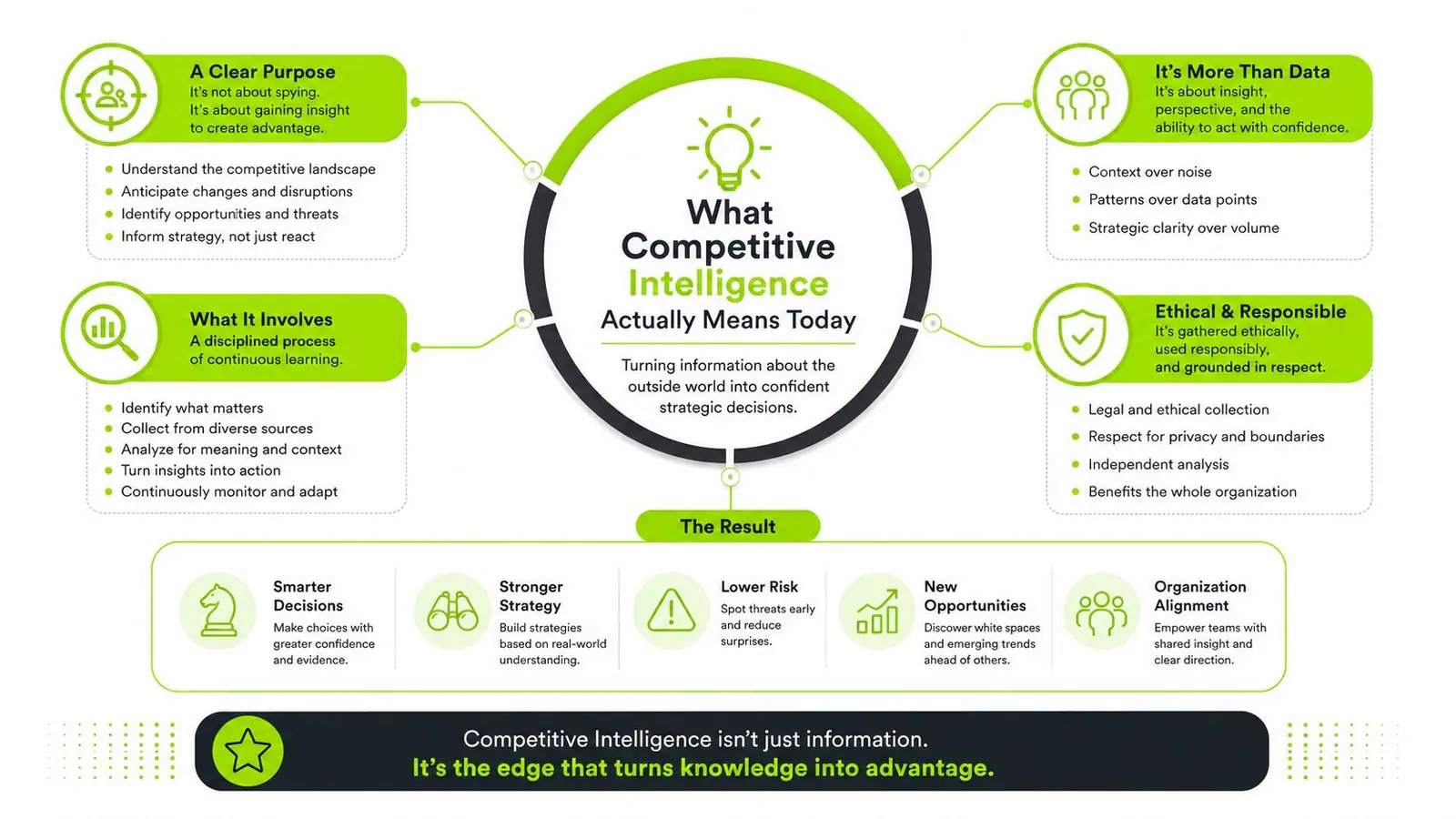
Competitive intelligence is not just monitoring. It's the discipline of capturing market signals, validating what matters, and routing the insight to the person who can act on it. That sounds simple, but many still confuse raw collection with usable intelligence.
The difference shows up in daily work. Basic monitoring tells you a competitor changed a pricing page. Real CI asks whether that change is part of a new segment launch, a partner motion, a regional expansion, or a quiet packaging test. The same visible change can mean different things depending on context.
CI is an operating function, not a research project
The strongest CI programs are designed to support decisions, not reports. They help product teams anticipate feature moves, sales teams defend deals, and marketing teams position against a threat before the market fully reacts. Industry guidance also recommends combining public web data, third-party benchmarks, and internal win-loss evidence so intelligence ties back to measurable outcomes like win-rate, deal length, average deal size, and competitive displacement (Coresignal's competitive intelligence guide).
That combination matters because search and AI discovery have widened the signal surface. A ranking shift, a citation gap, or a new answer surface is not just an SEO event. It can be an early commercial signal that someone else is shaping buyer perception first.
The working definition that holds up in practice
Competitive intelligence today means systematic decision support. It is broader than competitive monitoring, which just tracks activity. It is narrower than general business intelligence, which can get lost in internal reporting. CI sits in the middle, focused on the external market, the internal response, and the timing of both.
A useful way to think about it is this, CI answers three questions:
- What changed? Identify the move, signal, or shift.
- Does it matter? Validate whether the change is real and strategic.
- Who should act? Route it to the right owner with context.
Intelligence only becomes useful when someone can do something with it before the opportunity closes.
That's why AI visibility and LLM citations now belong inside the CI definition. If buyers learn about a category through answer engines, community references, or publisher mentions, then those surfaces are part of the competitive field. The discipline hasn't changed in purpose, but it has expanded in scope.
Building a Competitive Intelligence Pipeline
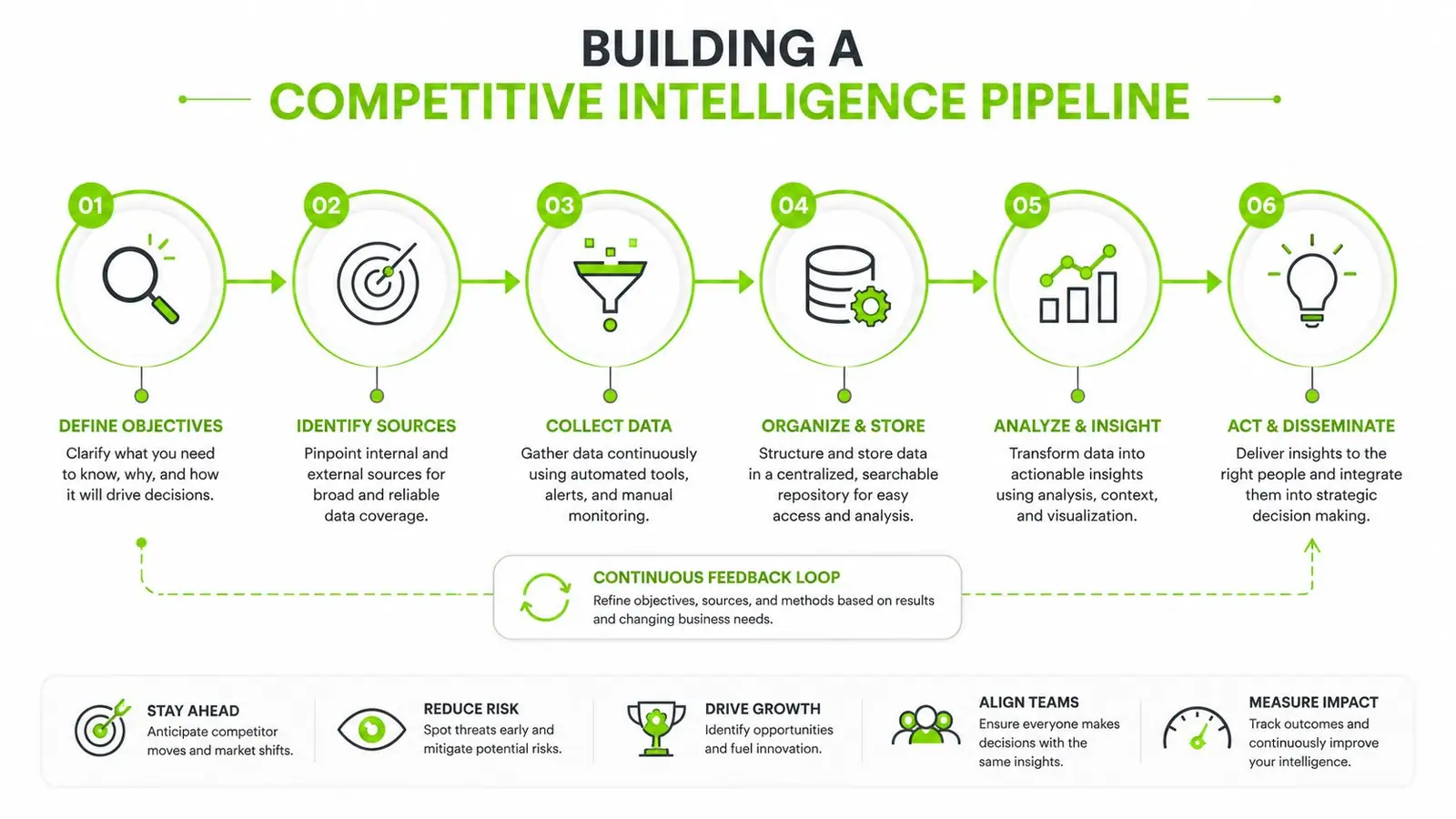
A good CI system behaves like a pipeline, not a pile of alerts. The core sequence is signal capture, context validation, and decision routing. If you skip the second step, you create noise. If you skip the third, you create trivia.
The capture stage is where teams collect observable changes. That includes pricing, packaging, feature releases, messaging, partnerships, regional expansion, legal updates, SLA changes, and even changes in how a brand appears in AI answers or search snippets. The point is not to capture everything. The point is to cover the surfaces that can alter buyer behavior.
Validation decides whether a signal deserves attention
Most programs break here. A pricing-page edit may be important, or it may be a typo fix, a temporary experiment, or a one-line copy refresh. Validation means checking whether the change is real, whether it's material, and whether it lines up with another market signal.
Cross-referencing is usually enough to separate the meaningful from the useless. If a pricing update appears at the same time as a new partner directory listing or an API integration page, that's a different story than a lone wording change. The same logic applies to AI visibility work, where a citation shift may matter only if it also coincides with content updates, schema changes, or a broader search presence shift.
A simple way to reduce alert fatigue is to require two independent confirmations before escalating anything strategic. That can be web evidence plus CRM notes, or public signals plus support feedback. The method doesn't have to be fancy. It just has to be consistent.
The practical implementation often lives inside automation. Teams that want to scale this kind of work usually need a data pipeline that can fetch, compare, tag, and route alerts without human babysitting, which is why automation thinking matters in data pipeline automation.
Routing turns intelligence into ownership
Routing is where CI becomes operational. A feature release should not go to every stakeholder. It should go to product if the feature is strategically relevant, to sales if it changes battlecard guidance, and to marketing if it affects positioning or content priority. One alert, one owner, one next step.
That's also where workflow discipline matters more than tooling. A clean Slack alert is useful only if the recipient knows whether to ignore it, investigate it, or act on it. Without routing rules, the system becomes a notification machine. With routing rules, it becomes a decision support layer.
Data Sources That Predict Moves Versus Creating Noise
The wrong instinct is to collect more sources and call it intelligence. In practice, the useful work is separating inputs that predict movement from inputs that only generate activity. The key test is predictive value, freshness, and false-positive risk.
Strong CI programs pull from more than one channel because no single source captures the full picture. Public web data, third-party benchmarks, and internal commercial evidence need to sit together so you can compare what competitors claim with what buyers do. That matters in search and AI visibility work, where a surface signal can look strong while demand stays flat.
High-signal inputs usually come from behavior, not promotion
Win/loss interviews usually give more signal than generic social monitoring because they explain why a buyer switched or stayed put. Support forums and customer reviews help when you filter for repeated complaints and repeated feature requests. Internal CRM notes matter because they show what sales keeps hearing and where deals keep slipping.
The trade-off is straightforward. Social chatter is easy to collect, but it is often ambiguous. Win/loss evidence takes more work to gather, but it maps more directly to market behavior. The strongest source mix includes both public signals and internal evidence, because each one answers a different part of the same question.
For teams that need lighter monitoring around social activity and competitor messaging, a practical companion resource is social media competitor tools for small businesses. Use it for public-facing comparison work, not as proof that every post reflects a strategic move.
Practical rule: Treat social signals as clues, not conclusions.
A usable source-prioritization lens
A source earns a place in the workflow when it can do at least one of three jobs well.
| Source type | What it usually tells you | What to watch for |
|---|---|---|
| Win/loss evidence | Why deals are won or lost | Repeated reasons, not anecdotes |
| Customer reviews and forums | Friction, missing features, switching triggers | Patterns across multiple posts |
| Public web updates | Pricing, packaging, launches, expansion | Validation against another signal |
| SEO and AI visibility signals | Which sources shape discovery | Citation gaps and answer coverage |
| Internal CRM and call notes | Real objections and competitor mentions | Sales-team consistency |
| Social/community mentions | Narrative shifts and emerging chatter | Noise, sarcasm, and one-off reactions |
The category that gets ignored most often is visibility data from search and AI surfaces. Track share of search metrics to understand visibility shifts across AI and traditional search through share of search. That tells you whether a competitor is gaining discovery, not just attention.
Vanity visibility still misleads a lot of teams. A competitor can have strong social engagement and weak commercial traction. Another can stay quiet in public but appear constantly in sales conversations and AI citations. If you want a useful comparison, internal search behavior and AI answer surfaces often tell a truer story than follower counts.
The goal is to assign each source a job. Public signals point to change. Internal and customer evidence show whether the change matters.
Metrics That Connect Intelligence to Business Outcomes
CI reporting fails when it measures activity instead of impact. A dashboard full of monitored competitors, captured pages, and alert volume does not tell leadership anything useful unless it connects to commercial outcomes. The strongest metrics are the ones that help a team make a decision, not just show that the team was busy.
Leading indicators and lagging indicators do different jobs
Leading indicators help you spot movement early. That can include share of voice shifts, AI citation gaps, feature parity differences, or changes in branded search demand. Lagging indicators tell you whether the market responded, which is where win-rate changes, competitive displacement, deal length, and average deal size become more useful.
The mistake is treating one category as enough. Leading indicators without lagging context become speculation. Lagging indicators without leading context become postmortems. You need both if you want to know whether your intelligence work is helping.
A practical reporting table
| CI Metrics by Business Impact | Example Metrics | Business Outcome Link | Tracking Frequency |
|---|---|---|---|
| Discovery | AI citation coverage, search presence, share of voice | Awareness and consideration | Weekly or monthly |
| Positioning | Feature parity, message overlap, pricing stance | Differentiation and objection handling | Monthly or quarterly |
| Pipeline | Win-rate shifts, competitive displacements | Revenue performance | Monthly |
| Deal quality | Deal length, average deal size | Sales efficiency and expansion | Monthly or quarterly |
| Threat detection | New competitors, new substitutes, new messaging | Early response planning | Ongoing |
This is also where benchmark design matters. If you compare competitor metrics only against each other, you can miss whether your own position is improving or slipping. Compare competitor behavior against your baseline, your category expectations, and the specific segment you care about.
Reporting format should match the stakeholder. C-suite readers need a short view of the threat, the opportunity, and the recommendation. Sales leaders need battle-ready context. Product teams need the signal behind the request. A useful internal model for that kind of formatting is the reporting discipline in agency client reporting, even when the audience is internal rather than external.
Real Scenarios Where CI Changes Strategy
The most useful CI work doesn't stay in a dashboard. It changes what teams do next. A few patterns come up again and again in agency and in-house work, and they all depend on treating signals as triggers, not trivia.
An unannounced pivot appears before the launch page does
A team notices a competitor hiring for roles tied to a new buyer segment, then finds patent activity and a shift in the wording of investor materials. None of those signals alone proves a launch is coming, but together they point to a strategic move. The response is not panic, it's repositioning, because the team now knows where the competitor is heading before the public announcement lands.
AI citation gaps become content opportunities
Another team watches which sources show up in AI answer surfaces for high-intent category queries. They find that competitor pages are being cited while their own technical content is missing. The fix is not just more content, it's better-aligned content, including answers, comparison language, and source formats that are more likely to be referenced.
Win-loss evidence changes the pricing conversation
A sales team keeps losing to a rival after pricing changes, but the first explanation they hear is usually too shallow. When CI combines CRM notes, call recordings, and customer feedback, the pattern is clearer. The rival's price isn't the only issue, the packaging and perceived risk are doing some of the work, so the rebuttal has to address both.
Community chatter reveals a substitute, not a rival
A product team tracks a forum where buyers keep recommending a workflow template, not a direct competitor. That alternative keeps appearing in purchase conversations because it solves the same job at a lower friction point. The team changes messaging and content to address the substitute directly, instead of spending time on a rival that isn't winning the comparison set.
These scenarios share one thing. The signal is never enough by itself. The team validates it, ties it to a business decision, and acts before the market settles around a new default.
Templates and Prioritization Frameworks You Can Use Now
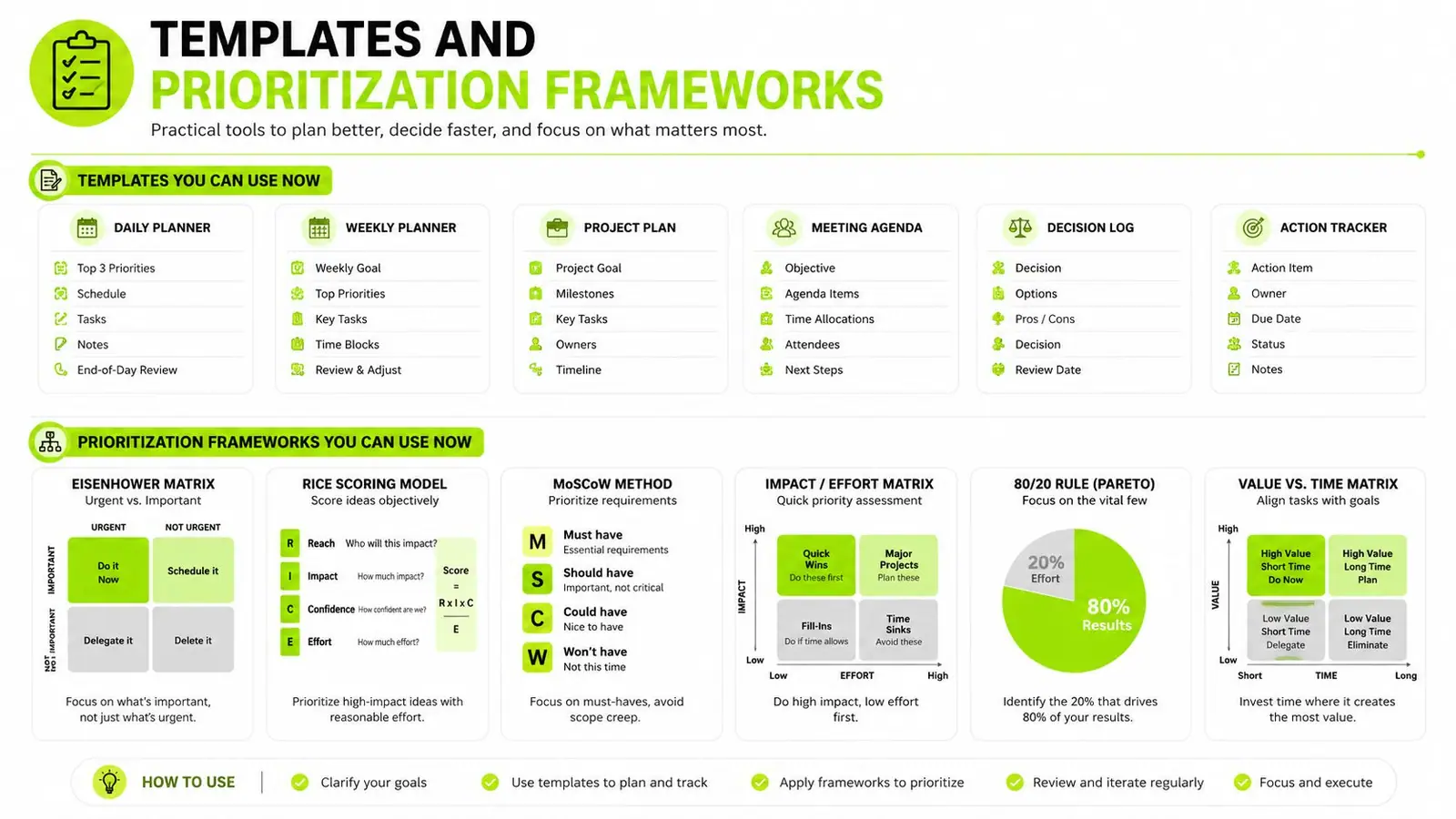
A useful CI program needs templates, or it slowly turns into a loose collection of interesting observations. The simplest starting point is a signal scoring template with four fields, source, freshness, confidence, and expected business impact. If a signal can't be scored in a sentence, it probably isn't ready for escalation.
A prioritization matrix keeps the team honest
Use a two-axis view, impact and urgency. High-impact, high-urgency signals get immediate routing. High-impact, low-urgency items become strategic watchlist entries. Low-impact items stay archived unless they start repeating.
A lightweight reporting template can be even simpler:
- Signal summary: What changed, in one sentence.
- Why it matters: The business risk or opportunity.
- Evidence: The source set that validated the change.
- Recommended action: Who should do what next.
- Owner and due date: So the alert doesn't disappear.
A quarterly CI audit should ask five blunt questions. Are we tracking the right competitors, including unknown ones? Are our sources still predictive? Are we routing alerts to the right people? Are we connecting findings to pipeline, positioning, or retention? Are we collecting anything we never act on?
If you need to scale collection and distribution, API-driven workflows help. They let teams pull in search, web, and AI visibility data without manually stitching together reports every week. One option in that category is Surnex, which tracks AI visibility, traditional SEO metrics, competitor presence, and citation gaps in one place, so teams can connect search intelligence with broader competitive monitoring.
Practical rule: If a CI process can't answer what changed, why it matters, and who owns the next step, it isn't a process yet.
The pitfall is over-collecting. Teams often add more sources before they define decision criteria, which only increases noise. Start with a small set of signals, tie them to a business action, and expand only when the team proves it can use what it already sees.
If you're building a competitive intelligence workflow that has to account for search behavior, AI citations, and shifting competitor sets, Surnex can help centralize those signals without forcing your team to jump between disconnected tools. Visit Surnex to see how modern search intelligence can support the way you track competitors, validate signals, and report what matters.