If you're managing client accounts where every dashboard says something slightly different, you already know the problem isn't “checking rankings.” The problem is keeping hundreds or thousands of keywords, locations, devices, and search engines aligned so the numbers mean something when a client asks what changed this week. A bulk keyword position checker is the difference between a one-off lookup and a repeatable ranking workflow you can trust.
Why Bulk Keyword Position Checking Matters at Scale
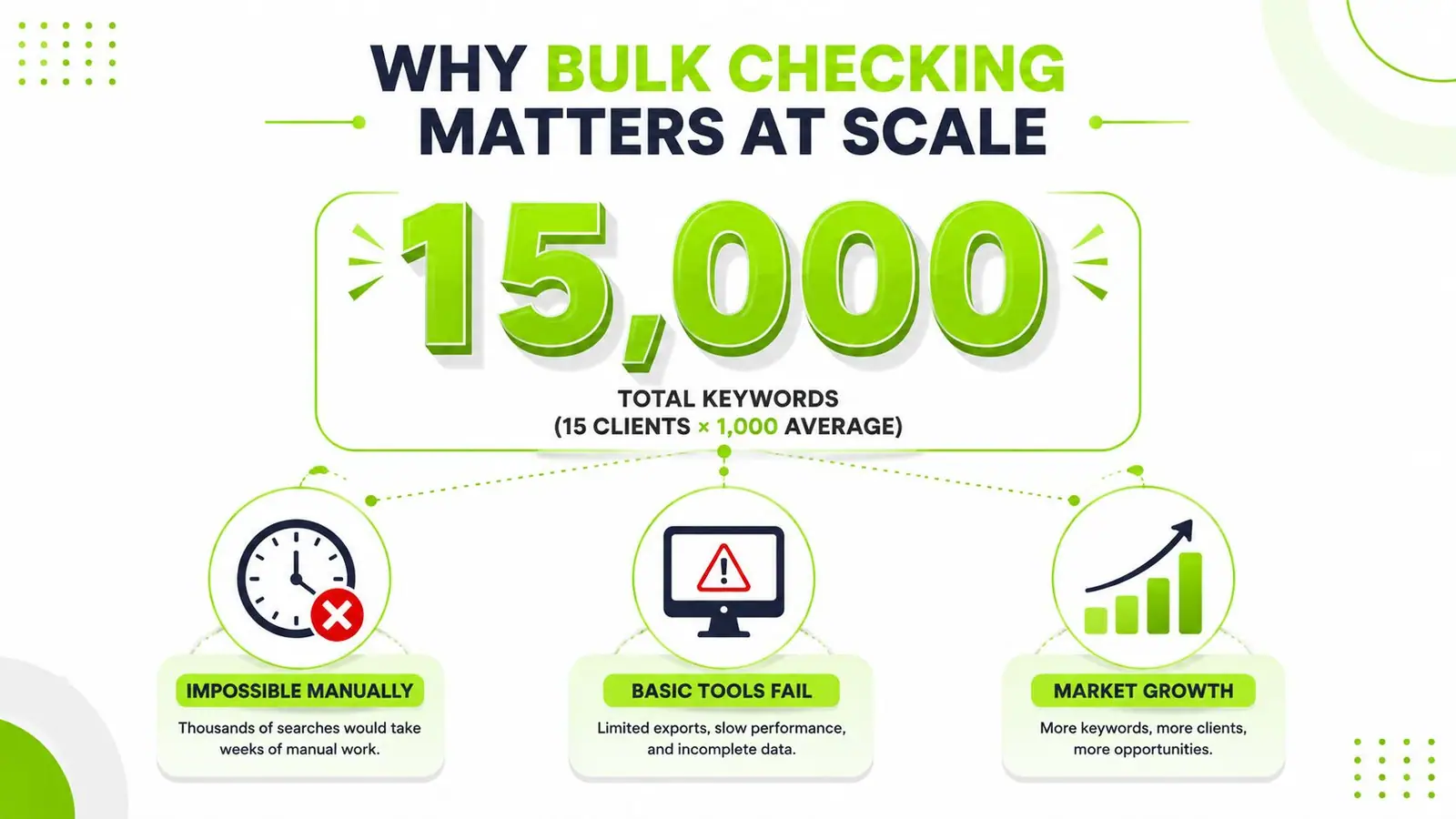
Managing 15 client accounts with 500 to 5,000 target keywords each stops being a reporting task and becomes an operations problem. Manual spot-checks fall apart fast because rankings vary by country, device, language, and search engine, and bulk tools only help if they preserve that context consistently. In practice, the work is keeping the same keyword set, market, and crawl rules aligned across every run so the numbers mean something when a client asks what changed this week. That is why modern rank tracking has moved beyond single-query lookups into historical and multi-engine tracking, with systems that compare month-by-month and year-over-year movement rather than just showing a snapshot. Ahrefs says its keyword rank checker can show historical rankings “as far back as 2015”, while SpyFu says it has tracked the SERPs of “millions of keywords for 20 years”. Ahrefs keyword rank checker
Snapshot checks don't survive real workloads
A toy checker can tell you where one term sits today. A production workflow has to answer what moved, where it moved, and whether that movement held after the next crawl. That is a data pipeline problem as much as a reporting one, because bulk checking only matters if the output stays comparable across runs.
Practical rule: If a rank checker can't preserve history, segment by market, and keep the same context on every run, it's not fit for agency reporting.
That context matters because tools now monitor positions across the top 100 results on Google, Bing, and YouTube, on both desktop and mobile, plus AI surfaces such as ChatGPT, Perplexity, and Google AI Overviews. In practice, that means the system isn't only storing positions, it's storing a time series that can survive client questions, algorithm updates, and site releases.
What changes when bulk tracking becomes operational
The shift is procedural. Teams stop asking, “What's our rank?” and start asking, “What changed in this market, on this device, after this deployment?” Bulk keyword position checking becomes the baseline for audits, dashboards, and client-ready trend analysis.
The more keywords you manage, the more that workflow needs structure. A bulk keyword position checker is only useful when it can batch thousands of terms, keep the inputs stable, and let you compare the output over time without rechecking everything by hand.
Choosing Your Approach to Bulk Rank Tracking
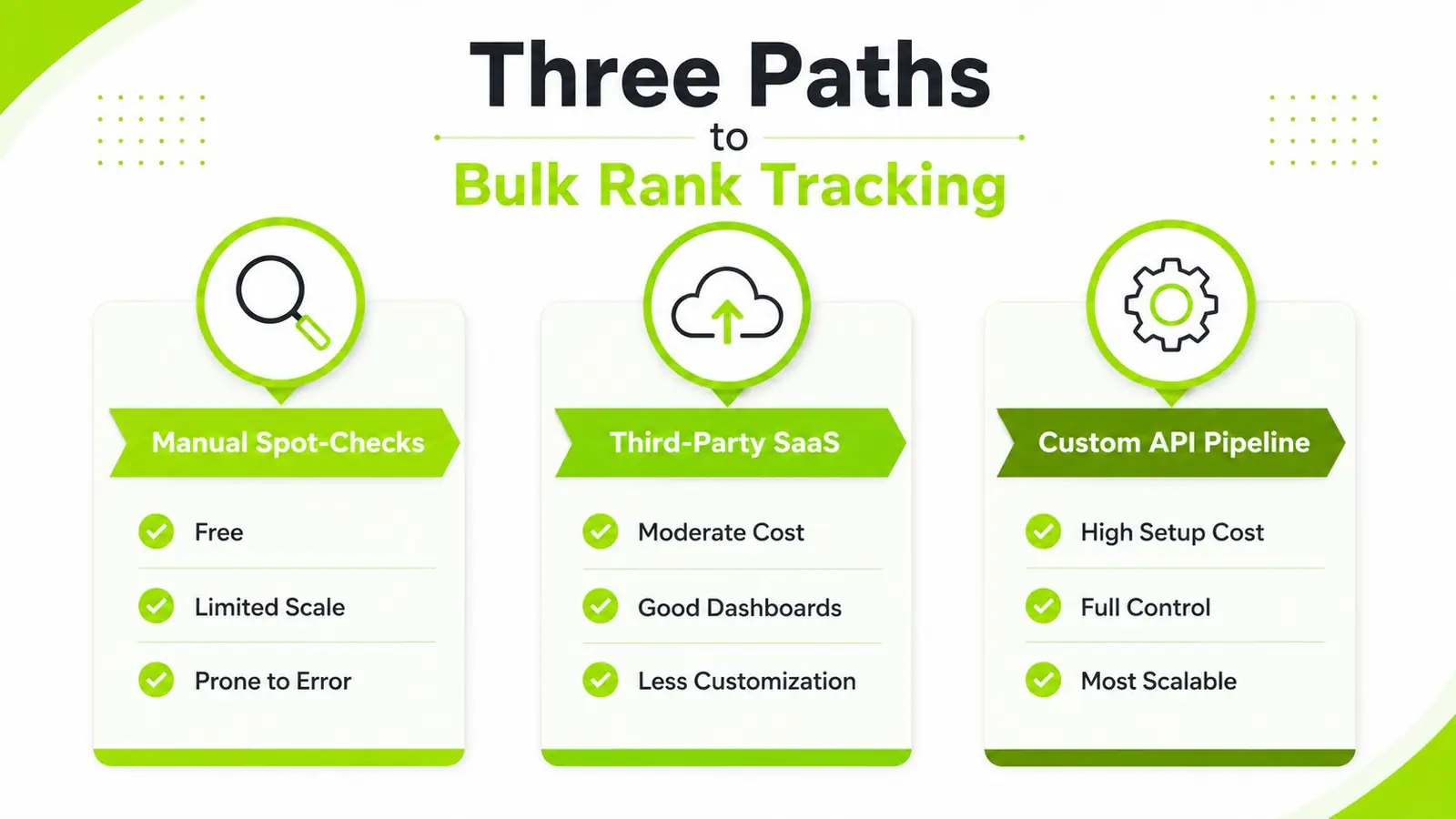
There are three realistic ways to run bulk rank tracking, and the right choice depends on how much control you need. Some teams start with Google Search Console because it is a first-party source of ranking data and the Performance report can filter Average Position across thousands of queries simultaneously, then export the results for analysis. Google Search Console ranking workflow Other teams use a dedicated platform because it already handles bulk uploads, dashboards, and recurring checks. Teams with engineering support often build a custom API pipeline because it gives control over context, storage, and downstream reporting.
Google Search Console works when you need first-party data
Search Console is the cleanest source when you want ranking data that comes directly from Google. It fits best when the main need is query analysis rather than multi-engine comparison, because the bulk workflow centers on export and filtering.
The trade-off is operational. Search Console gives you data from one engine, and you still have to shape it for repeatable reporting. That works for a lean team, but it is not a full solution if you need cross-market rank simulation or device-specific checks.
SaaS rank trackers reduce setup, but cap flexibility
Dedicated rank tracking platforms are the fastest path to a working bulk workflow. They usually accept CSV or TXT uploads, ask for a location, and then keep the recurring checks running on schedule. That makes them useful for agencies that care more about dependable reporting than pipeline customization.
The trade-off is clear. You get easier dashboards, but less freedom over how data is stored, normalized, or joined with other systems. For many teams, that is acceptable. For teams that want custom alerts, special segmentation, or internal BI integration, it becomes limiting.
API pipelines fit teams that need control
A custom pipeline is the most scalable option when rank tracking has to fit into a broader data system. API-based setups let you define exactly how keywords are grouped, when checks run, where results land, and how historical baselines are preserved. That matters when the reporting layer needs to serve clients, developers, and analysts at the same time.
One useful reference point is Surnex's keyword position checker API workflow, which shows the API-first model clearly. If you need to track Google, Bing, or AI surfaces in one place, the API path is usually the only one that avoids stitching together disconnected tools.
Building an API-Based Tracking Pipeline
The cleanest API setup starts with a strict input schema. Every batch should include keyword, target URL, location, device, and search engine, because rankings change materially when any of those variables shift. Professional rank-checking guidance explicitly recommends fixing the target country or location and keeping conditions consistent. DataForSEO bulk keyword ranking workflow
A batch payload should not be just a flat keyword list. It needs enough context for the checker to return the same result every time under the same search conditions.
Use a predictable request shape
A workable structure looks like this in practice:
- Keyword list: The terms to check in bulk
- Target URL: The page you want to compare against, if relevant
- Location: Country, city, or other geographic scope
- Device: Desktop or mobile
- Search engine: Google, Bing, YouTube, or an AI surface where supported
That structure keeps deduplication sane later, because the same keyword can exist in multiple markets without being treated as a duplicate row. It also lets you compare campaigns across devices without mixing apples and oranges.
Separate collection from ingestion
The request lifecycle should be split into three layers. First, a scheduler submits batches. Second, the API returns result payloads, sometimes with organic positions and SERP feature signals. Third, an ingestion job normalizes those responses into your storage schema.
That separation matters because API responses are not reporting tables. They're raw observations. If you store them unchanged, every dashboard downstream has to solve the same cleanup problems again.
Practical rule: Don't let your reporting layer talk directly to the API. Put a normalization step in the middle, or your history will become inconsistent the first time a provider changes response shape.
For teams that want a single place to unify traditional SERP tracking with AI visibility, a platform like Surnex can sit in the workflow as one API source instead of a stack of separate tools. The useful part isn't the label, it's having one data contract for repeatable rank checks.
Watch for edge cases early
The things that break naive pipelines are usually boring, not dramatic. You'll see empty responses, duplicate jobs, partially complete batches, and fields that shift type between runs. Handle those before you build client reporting on top of them, or you'll end up chasing phantom rank changes that are really ingestion bugs.
Handling SERP Features and Data Storage Challenges
Raw rank numbers are incomplete if they ignore what's sitting above or around the organic result. A position 3 result can be pushed below a local pack, sponsored listings, featured snippets, or AI Overviews, which means the number looks good while the page feels invisible. Bulk rank tracking only becomes useful when the storage layer captures that context alongside the rank itself. SERP feature tracking guidance
Store the context, not just the position
A practical schema should track the current rank, previous rank, position change, and a notes field for anomalies or campaign context. The goal is to make trend analysis readable without forcing anyone to reconstruct history from raw exports.
| Field Name | Data Type | Purpose | Example |
|---|---|---|---|
| Keyword | Text | Identifies the query | bulk keyword checker |
| Target URL | Text | Maps the keyword to a page | /rank-tracking |
| Location | Text | Stores market context | United Kingdom |
| Device | Text | Separates desktop and mobile behavior | Mobile |
| Search Engine | Text | Distinguishes the source surface | |
| Current Position | Integer | Latest observed rank | 4 |
| Previous Position | Integer | Prior observed rank | 6 |
| Position Change | Integer | Movement between runs | +2 |
| SERP Features | Text | Captures visible result types | Local pack, ads |
| Notes | Text | Adds operational context | Post-launch fluctuation |
Deduplicate by context, not by keyword alone
The same keyword can appear in multiple cities, on multiple devices, and across multiple engines. If you dedupe only on the keyword string, you'll collapse valid rows and destroy your history. The safer rule is to treat keyword plus location plus device plus engine as the key, then store the time-series observations against that composite identity.
That's where master-sheet discipline helps. A simple export with the right columns beats a clever spreadsheet that can't explain what changed between runs. High-volume guidance also recommends maintaining a file with current position, previous position, change, and notes because it reduces mapping errors and supports trend analysis more reliably than isolated spot checks. Bulk rank checker storage guidance
Avoid false stability
If a rank stays the same while the result page changes shape, the business meaning may still change. That's especially true when sponsored results or local features appear above the organic listing. The storage model has to preserve those signals so reporting reflects visibility, not just a numeric slot.
Scheduling Checks and Managing API Throttling
A bulk keyword position checker falls apart fast if every keyword runs on the same schedule. Some clients need frequent checks because rankings affect launches, recovery work, or revenue reporting. Other sets can sit on a slower cadence without losing useful signal. The schedule should follow business value and pipeline cost, not a fixed routine. Bulk ranking cadence guidance
Put volatile terms on a faster schedule
Keywords with unstable intent need more attention. Branded terms, launch pages, and high-value commercial queries can move quickly, so they deserve tighter monitoring than evergreen informational clusters.
A practical schedule usually looks like this:
- High priority: Daily or near-daily checks for launches, recoveries, and sensitive campaigns
- Standard priority: Weekly monitoring for steady client reporting
- Low priority: Slower checks for long-tail terms that rarely affect decisions
That tiering keeps the queue readable and the budget in line while still protecting the rows that matter most.
Throttle the pipeline on purpose
Large batches should be spread across time windows instead of sent in one burst. That lowers the chance of rate-limit responses and makes failures easier to isolate when something breaks. If the API returns a limit warning, back off, retry later, and keep the same batch ID so duplicate jobs do not creep into your history.
A queue that retries blindly creates noise. A queue that respects backoff stays manageable.
Queue everything, then reconcile
The safest pattern is to queue all planned checks first, then reconcile completed batches against the expected set. Missing rows, partial completions, and delayed runs become visible before the report leaves the system. That matters because high-volume tracking usually fails at the edges, not in the happy path.
Cost planning also depends on the API model you choose. If the platform bills by request, batch size and cadence change the economics quickly, so pricing should be part of the schedule design. SERP API pricing considerations
Validating Accuracy Across Locations and Devices
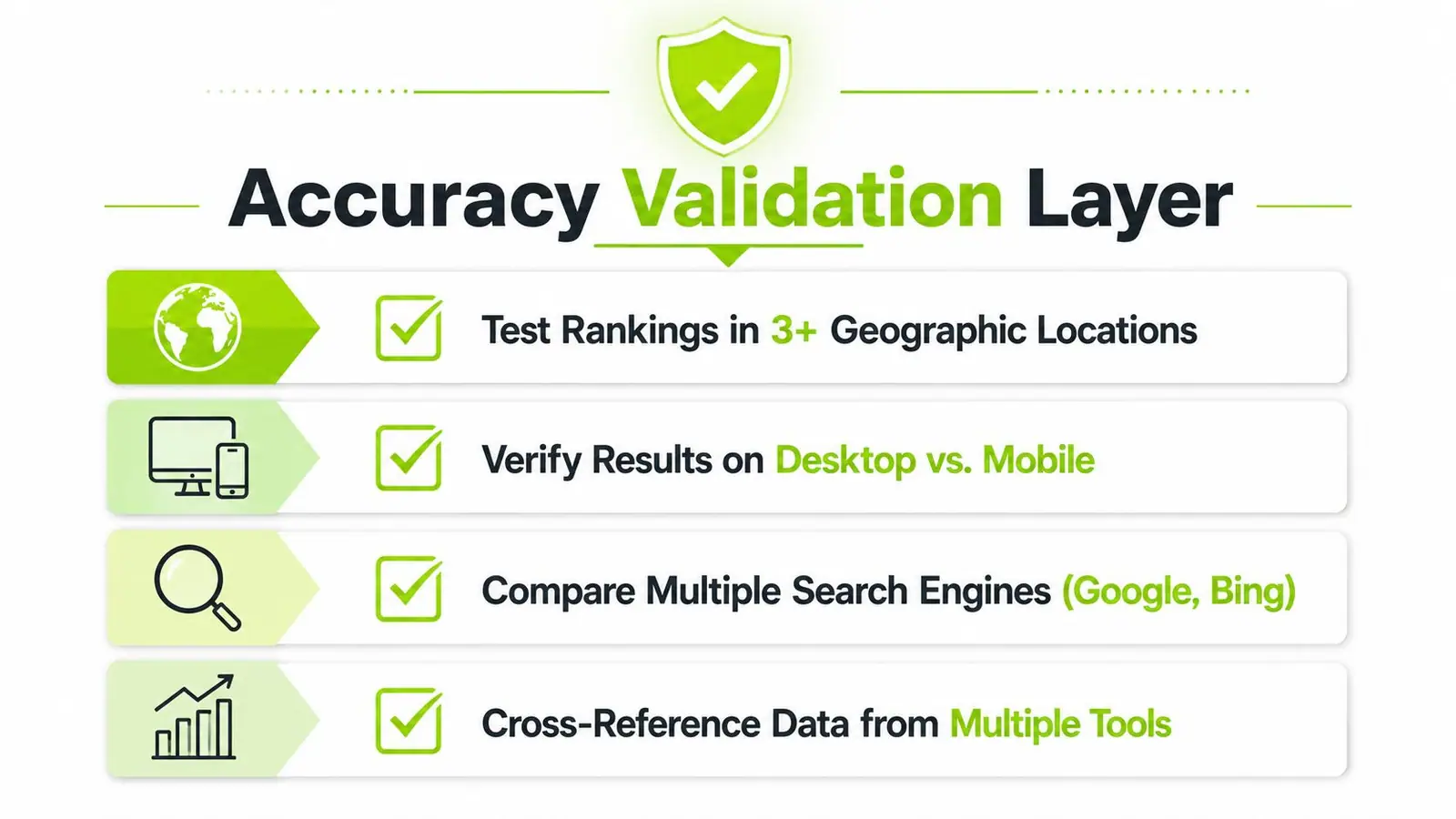
A bulk keyword position checker is only trustworthy when the results match how users search in specific places and on specific devices. Rankings vary materially by geography, device type, and search engine, so a single global rank number can hide more than it reveals. Geo and device controls in bulk rank checking
Validate against real search conditions
The first check is simple. Make sure your automated settings reflect the market you care about, then spot-check those same queries manually in the same geography and on the same device type. If the manual result and the automated result disagree, treat that as a pipeline issue before you treat it as a ranking issue.
This is also where multi-engine coverage matters. If one tool only checks Google and your client cares about Bing or AI discovery surfaces, your validation is incomplete by default. The rank number itself is less important than the context around it.
Compare multiple tools when the result looks odd
A useful validation layer cross-references one checker against another before the result reaches a client. That doesn't mean trusting every tool equally. It means identifying outliers, then tracing whether the mismatch came from location settings, device settings, or response interpretation.
When teams segment by market and device, the patterns usually become clearer. A keyword might look weak globally but strong in one city, or strong on desktop but less visible on mobile. That's the difference between a dashboard that reports numbers and one that supports action.
Build validation into the workflow
Validation shouldn't be a one-time audit. It should sit inside the pipeline as a recurring quality check, especially when new markets or devices are added. If the rank tracker can't verify its own assumptions, client reports will eventually drift away from reality.
Turning Rank Data into Client-Ready Reports
Agency reporting fails when it shows every ranking change with equal weight. Clients don't need a wall of positions, they need a clear story about what moved, what stayed stable, and what deserves attention. A structured report should foreground position trends, market segments, and meaningful movements, then leave the raw rows in the background. Agency reporting workflow
Show movement, not noise
The most useful dashboards emphasize direction over clutter. Trend lines, grouped keywords, and market slices help account managers explain changes without forcing clients to parse every fluctuation. If a movement is temporary, say so. If it lines up with a site release or an algorithm update, note that in the same view.
Clients also understand reports better when the same template is reused across accounts. That makes comparisons easier and reduces the time spent rebuilding dashboards from scratch every month.
Connect rank changes to the business layer
Ranks matter because they affect visibility, which in turn affects traffic potential and conversions. Your reporting should bridge those layers without pretending every movement has a direct revenue effect. Use ranking data as the diagnostic layer, then pair it with analytics data where the story requires it.
For teams that need one platform to centralize ranking, AI visibility, and SEO reporting, Surnex provides rank tracking inside a broader SEO and AI search workflow. That's useful when the reporting stack has to support both traditional search and newer discovery surfaces without forcing manual exports between tools.
Keep the report readable
The report should answer three questions fast, what changed, where it changed, and whether it matters. If a client has to decode the dashboard to get that answer, the workflow has failed. Good reporting turns a bulk keyword position checker into something an account team can act on without opening a spreadsheet for every conversation.
If you want a rank tracking setup that's built for bulk inputs, API workflows, and AI-aware visibility monitoring, take a look at Surnex. It's designed for agencies and technical teams that need one place to manage keyword positions, search signals, and reporting without rebuilding the pipeline every time the stack changes.