Trying to make sense of SERP API pricing can feel overwhelming. But once you get past the marketing noise, you’ll find that most providers follow a few standard approaches. The final cost almost always comes down to how many searches you run and how complex those searches are.
Understanding SERP API Pricing Models
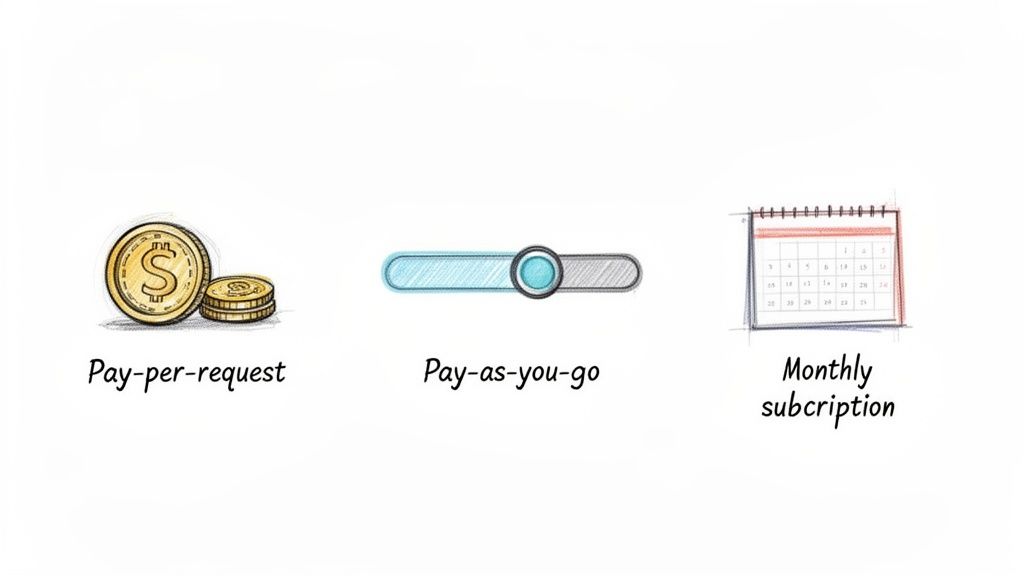
When you're shopping for a SERP API, you're going to run into a few common billing structures. Each one is built for a different kind of user, whether you’re a solo developer running a small project or an enterprise team pulling massive amounts of data every day. Figuring out which model fits your workflow is the first step to setting a realistic budget and, more importantly, avoiding surprise bills.
Think of it like other utility-based services. The AWS cloud services pricing models, for example, also balance predictable subscription costs against flexible, usage-based fees. SERP APIs are no different. You'll typically see:
- Pay-As-You-Go (PAYG): You’re billed only for what you actually use. This gives you ultimate flexibility, which is great if your data needs are sporadic or unpredictable.
- Monthly/Annual Subscriptions: You commit to a fixed price for a certain number of requests or credits per month. This model delivers predictability and usually comes with volume discounts, making it a solid choice for teams with steady workloads.
- Hybrid Models: Some providers mix the two. You get a base subscription and can buy extra credits on a PAYG basis if you have a busier-than-usual month.
Key Pricing Structures Explained
The most popular option you'll see is the monthly subscription. You pay a recurring fee for a block of API calls or credits. For agencies tracking daily rankings or businesses doing constant competitor analysis, this is usually the most cost-effective route. A typical plan might offer 100,000 requests per month for $99.
On the other hand, pay-as-you-go is built for one-off jobs or projects with inconsistent needs. You might buy a bundle of credits with no monthly commitment and just use them whenever you need to. The cost per request might be a bit higher, but you won't waste money on a subscription you aren't fully using.
Key Insight: The "best" SERP API pricing model is the one that matches your real-world usage. A subscription that’s a bargain for a high-volume agency is just a waste of money for a freelancer who only needs data once in a while.
SERP API Pricing Models At A Glance
To make the decision a little easier, let's break down who each model is really for and what to watch out for.
| Pricing Model | How It Works | Best For | Key Consideration |
|---|---|---|---|
| Subscription | Fixed monthly or annual fee for a set number of requests. | Agencies, in-house teams, and businesses with consistent, high-volume needs. | Potential for unused credits if your monthly volume is lower than planned. |
| Pay-As-You-Go | Pay per API call or credit bundle with no recurring commitment. | Developers, researchers, and projects with unpredictable or low-volume needs. | The cost per request is typically higher than subscription tiers. |
| Hybrid | A base subscription plan with PAYG options for overages. | Teams with a stable baseline usage but occasional spikes in demand. | Overages can be more expensive than upgrading to a higher-tier plan. |
In the end, choosing the right plan starts with an honest look at your data needs. Once you understand these core structures, you can look beyond the headline price and find a provider that offers real value for what you're trying to accomplish—whether that's simple keyword tracking or monitoring the latest AI Overviews in 2026.
Beyond the Sticker Price: Uncovering the Real Costs of a SERP API
That low cost-per-thousand-requests price you see advertised? It's rarely the final number on your invoice. The truth is, many factors can inflate your SERP API bill, and what looks like a bargain can quickly become a major expense.
To budget accurately and avoid any nasty surprises, you need to look past the advertised rate and understand what really drives up the cost. It’s not just about how many requests you make; it’s about how complex those requests are.
Request Speed and Priority
One of the first places you’ll see costs diverge is in request speed. Speed costs money. Most providers split their offerings into two tiers that determine how fast you get your data back.
- Standard (Asynchronous) Requests: These are the budget-friendly option. Your requests get added to a queue and are processed when resources free up. This is fine for many tasks, but the potential delays make it a poor fit for anything time-sensitive.
- Real-Time (Synchronous) Requests: These jump to the front of the line, giving you data almost instantly. That priority comes at a premium because it requires dedicated, on-demand resources from the provider. Expect to pay 2x to 5x more than you would for a standard request.
For instance, a standard query might run you $1.00 per 1,000 requests, but switching to real-time for the exact same query could easily cost $3.00. That difference adds up fast when you're dealing with serious volume.
Data Format and Specificity
The next big cost factor is the type of data you ask for. Are you getting a raw data dump or clean, structured information?
A request for the raw HTML of a search results page will almost always be cheaper. The catch? Your team is now on the hook for parsing all that messy code to find the data you need. This means more development hours and constant maintenance as Google changes its layout.
On the other hand, requesting structured JSON data costs more upfront because the API provider has done all the hard work for you. You get clean, parsed data for organic results, local packs, and other SERP features, ready to be used immediately. You're essentially paying for convenience and saving your engineers a massive headache.
Key Takeaway: Choosing between raw HTML and structured JSON is a classic "build vs. buy" decision. Paying more for structured data can save your team dozens of hours in development, often resulting in a lower total cost of ownership.
Advanced Targeting and Complex Features
This is where the most significant hidden costs usually live. Advanced targeting and scraping complex, dynamic SERP elements are resource-intensive for the provider, and you can bet that cost gets passed on to you.
Common Premium-Priced Features:
- Geographic Targeting: Pulling results from a specific city or zip code is far more complicated than a general country-level search, so it almost always costs more.
- Device and Browser Specificity: Simulating a search from an iPhone on Safari versus a desktop user on Chrome requires different proxy configurations, which often carry extra fees.
- AI Overviews and Specialized Results: Scraping JavaScript-heavy elements like AI Overviews, knowledge panels, or shopping carousels is a huge technical challenge. Many providers use a credit multiplier for these tasks, where a single request might burn the equivalent of 5 or 10 standard credits.
If you don't account for these multipliers, you can burn through your monthly credits in a flash. An agency planning to run a local campaign, for example, has to factor in the higher cost of those geo-specific queries. You can see how this plays out in our guide to performing a citation gap analysis for local SEO.
Before you commit to any plan, always run a few cost calculations based on your most complex use cases. It’s the only way to build a truly realistic budget.
Comparing The Top SERP API Providers Of 2026
Picking a SERP API provider is a big decision. It’s not just about cost; it’s about finding a partner whose data quality, reliability, and pricing model actually fit how you work. On the surface, many services look the same, but once you dig in, you find they’re built for very different kinds of users. Let's break down what really matters.
We’re going to look at three of the biggest names in the SERP API space for 2026: Bright Data, DataForSEO, and Traject Data (Value SERP). I’ll cut through the marketing fluff to compare their core pricing, how they scale, and whether they can handle modern search features like AI Overviews.
Bright Data: The Success-Based Model
Bright Data has carved out a space as a premium, high-reliability provider. Their whole philosophy is built on a success-based pricing model, which is a game-changer for many teams. Put simply, you only pay for data that is successfully retrieved. No more burning your budget on failed or blocked requests.
Their pricing is typically based on a cost-per-thousand (CPM) results. For instance, Bright Data's pay-as-you-go SERP API starts around $1.50 per 1,000 results. If you’re operating at scale, that price drops significantly—down to $1.00 per 1,000 once you hit two million results a month for $1,999. This model is a perfect match for Surnex's own large-scale operations, especially for agencies managing SEO for multiple clients, which account for roughly 70% of the market. It gives you precise cost control for huge crawls, like those needed for our LLM benchmarking, without wasting a dime.
Key Differentiator: Bright Data’s “pay-for-success” approach is its biggest strength. For any business where every single data point is critical, paying a bit more for a guarantee of delivery is a smart investment. It completely removes the risk of paying for nothing.
DataForSEO: The Bulk Data Powerhouse
If your top priority is getting massive amounts of SERP data for the lowest possible price, then DataForSEO is probably on your radar. Their model is all about volume. It’s less focused on a 100% success rate for every request and more on giving you affordable access at a scale that’s hard to find anywhere else.
DataForSEO uses a pay-as-you-go credit system. You buy credits upfront and spend them as you make requests. The real savings come from their asynchronous requests for standard data, which can be incredibly cheap. This makes them a go-to choice for anyone doing broad market research, tracking millions of keywords, or feeding data into their own tools.
When to Choose DataForSEO:
- High-Volume, Low-Margin Projects: If you just need a ton of data and can build in your own logic to retry the occasional failed request, their pricing is tough to beat.
- Cost-Sensitive Startups: New SEO tools and platforms can get off the ground without a huge upfront investment in data costs.
- Data Science Applications: For researchers who need giant datasets to spot trends, the cost-per-result is extremely compelling.
Looking at how other data services structure their costs, like Statspresso's pricing models, can give you a broader perspective on the different ways providers bill for data.
Traject Data (Value SERP): Predictability For Agencies
Traject Data, with its Value SERP API, speaks directly to digital marketing agencies and SEO professionals. Their main selling point is predictability. Instead of complicated credit systems or per-result costs, they offer straightforward monthly subscriptions with a set number of searches included.
This approach gives you total budget certainty, which is a huge relief for agencies juggling multiple client accounts and budgets. A typical plan might offer something like 500,000 searches per month for a single flat fee, with a clear overage rate if you happen to go over. They've found a sweet spot between cost, reliability, and pure simplicity that resonates with their target audience.
The infographic below shows just how much small parameters like speed, location, or data format can drive up your final bill with any provider.
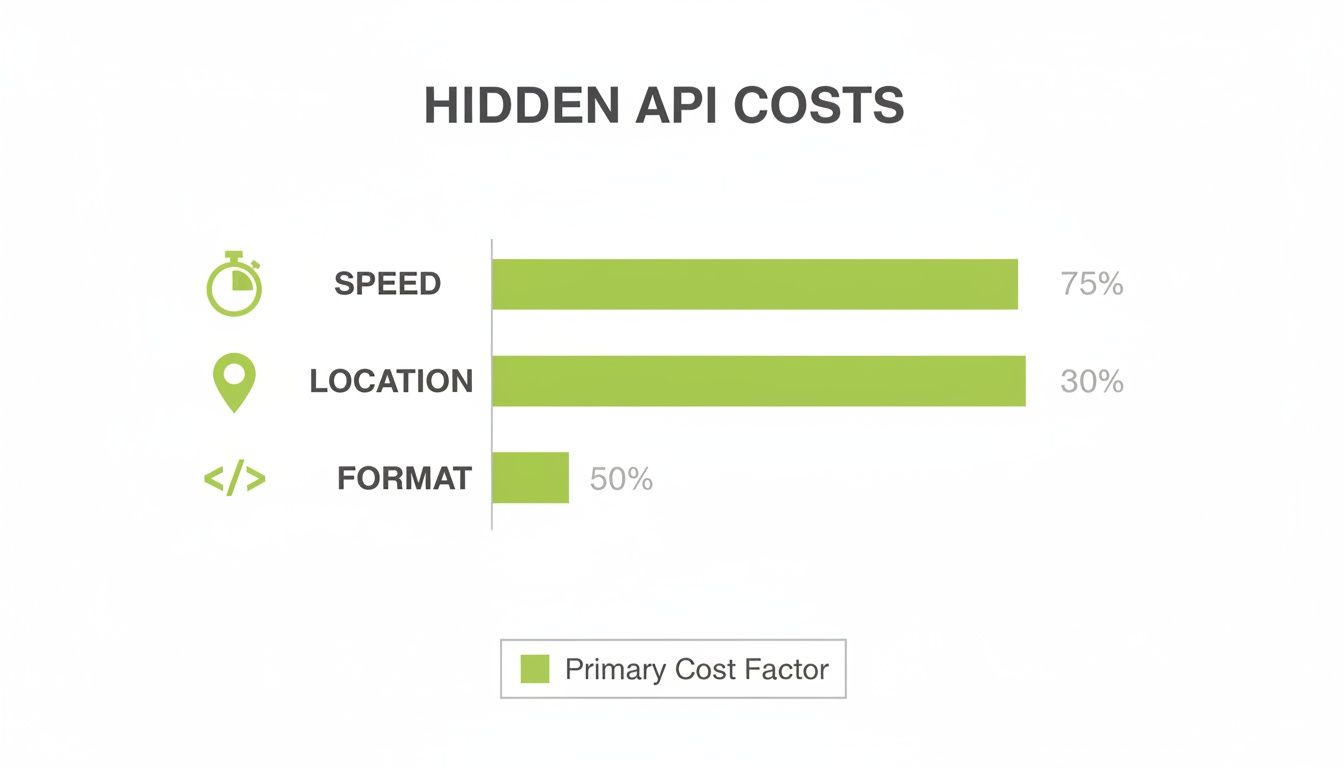
As you can see, something as simple as asking for real-time results can have a major impact on your costs. It really drives home the importance of digging into the fine print on every provider’s pricing page.
Provider Pricing Feature Snapshot
To make things clearer, here’s a quick head-to-head look at how these providers compare on the metrics that matter most. The cost example is just an illustration; your actual price will depend on your volume and the specific features you need. Surnex's platform can help you make sense of all this data—see how we do it in our LLM benchmark analysis.
| Provider | Base Pricing Model | Cost per 1M Requests (Example) | Supports AI Overviews | Key Differentiator |
|---|---|---|---|---|
| Bright Data | Pay-for-Success (PAYG) | ~$1,300 | Yes | Reliability; you only pay for successfully delivered data. |
| DataForSEO | Pay-As-You-Go (Credits) | ~$600 | Yes | Extreme affordability for high-volume, bulk data collection. |
| Traject Data | Subscription Tiers | ~$1,200 | Yes | Predictable monthly costs and simplicity for agency workflows. |
So, which provider is best? It all comes down to your specific needs. If you can’t compromise on reliability, Bright Data is a fantastic choice. If you’re chasing massive volume at the lowest price point, DataForSEO is in a class of its own. And if you’re an agency that craves predictable costs and a simple workflow, Traject Data offers a perfectly balanced solution.
Calculating Your SERP API Costs with Real Scenarios
Understanding the different SERP API pricing models is one thing, but figuring out what you'll actually spend is where the rubber meets the road. The best way to get a handle on your costs is to map your day-to-day needs onto a provider's price list.
Let's walk through three common scenarios to see just how much the final bill can change based on the job. These examples will give you a blueprint for estimating your own expenses and help you steer clear of any nasty budget surprises.
Scenario 1: Marketing Agency Rank Tracking
Imagine you're a digital marketing agency tracking daily keyword rankings for 20 clients. Each client has 50 keywords you need to monitor across three key cities (like New York, Chicago, and Los Angeles). This is a bread-and-butter task for most agencies, where consistency is king.
Here’s a quick breakdown of the API calls you'd need:
- Keywords per client: 50
- Number of clients: 20
- Geographic locations: 3
- Tracking frequency: Daily (30 days/month)
Total Monthly Requests: 50 keywords × 20 clients × 3 locations × 30 days = 90,000 requests
For this kind of steady, predictable workload, a subscription model is almost always the right call. A plan offering something like 100,000 requests for $99/month would fit perfectly, giving you a bit of a buffer for any extra checks. If you went with a pay-as-you-go provider charging $1.50 per 1,000 requests, you’d end up paying $135 for the same volume. The subscription is the clear winner here.
You can learn more about building a modern rank tracking workflow in our dedicated guide.
Scenario 2: In-House Enterprise Content Audit
Now, let's switch gears. An in-house SEO team at a big company is doing a huge content audit. They need to pull the top 100 search results for 50,000 keywords just one time to see what competitors are doing.
Total One-Time Requests: 50,000 keywords × 1 request each = 50,000 requests
This is the perfect job for a pay-as-you-go or credit-based system. Locking into a big monthly subscription would be a total waste of money since this is a one-and-done project.
Using a provider that charges around $1.00 per 1,000 requests, the entire audit would only cost $50. This really shows how valuable flexible pricing can be when you're not dealing with ongoing, daily tasks.
Key Insight: Always try to match your project's timeline to the pricing model. For one-off deep dives, pay-as-you-go saves you from paying for a subscription you don't need next month. For consistent, daily work, subscriptions deliver much better value.
Scenario 3: App Developer Monitoring AI Overviews
Here’s a more modern challenge. A developer is building an app to watch for brand mentions in Google's AI Overviews. They need to check 1,000 keywords every single hour to give their users real-time alerts. Scraping AI Overviews is tricky, and most APIs charge a premium for it.
Let's do the math:
- Keywords: 1,000
- Frequency: Every hour (24 times/day)
- Days per month: 30
Total Monthly Requests: 1,000 keywords × 24 hours × 30 days = 720,000 requests
Now, here's the catch. Let's say the provider applies a 2x multiplier for parsing AI Overviews. That means your 720,000 raw requests actually burn through 1,440,000 credits from your plan.
At this kind of volume, a tiered subscription is essential. For example, a provider like Traject Data has a Value SERP API pricing structure that scales for high-volume agency needs. Their plans often come with higher rate limits and batching capabilities, which are ideal for something as demanding as real-time AI tracking. Picking the right plan at this scale can make or break the project's profitability.
How to Maximize Your SERP API Investment
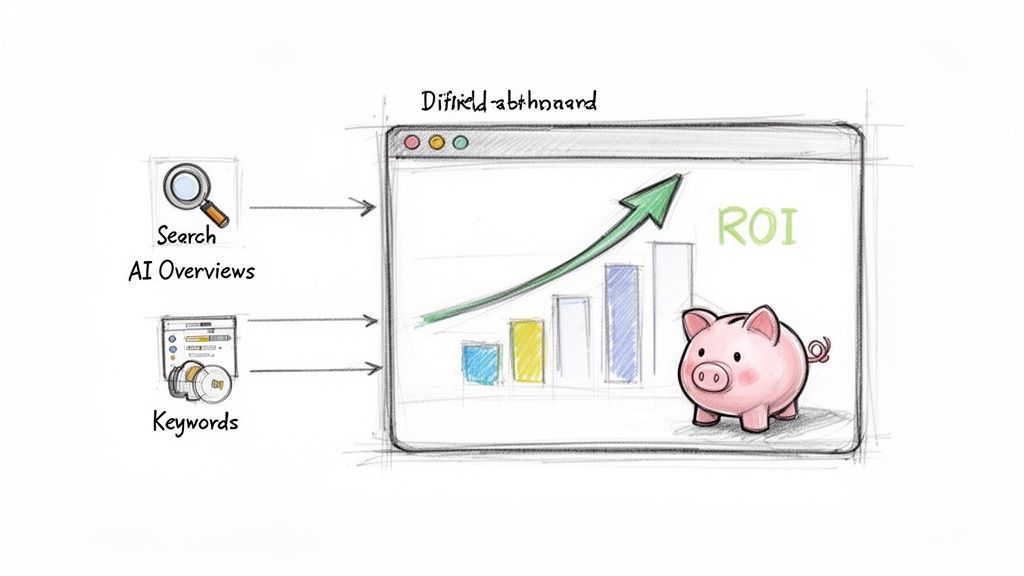
Buying access to a SERP API isn't a strategy in itself. The real win comes from turning that raw data into a genuine competitive advantage. To get the most from your investment, you need a platform that not only fetches data efficiently but also connects it to insights that actually drive growth and prove ROI.
This is exactly why we built Surnex. We saw teams drowning in data but struggling to find clear actions. Surnex is designed to turn your SERP API from a data expense into a strategic asset. By pulling all your search data into one unified dashboard, you can finally ditch the patchwork of disconnected tools, cutting software costs and making your team more effective overnight.
From Raw Data to Strategic Intelligence
Let’s be honest: the true cost of a SERP API isn't just the price per request. It’s the hours your team spends trying to make sense of it all. Surnex closes that gap by automatically translating raw SERP information into clear, actionable performance metrics.
Instead of wrestling with spreadsheets and flipping between different dashboards, everything is connected in one place. You can instantly see how your keyword rankings, competitor activity, and visibility in AI Overviews all fit together. That unified view gives you the context to make confident, data-backed decisions without burning hours on manual analysis.
By 2026, the SERP API pricing market has evolved to support large-scale, AI-driven SEO. For instance, some providers now offer standard queue requests for as little as $0.0006 per SERP, or $600 per million SERPs. This affordability is what allows Surnex users to integrate real-time search data from key global markets—like the US (60% of queries), Europe (25%), and Asia (15%). This helps reduce tool sprawl by up to 50% while grounding client reports in fresh, global statistics. You can find out more about how this affordability changes SERP data integration.
Unifying Workflows to Cut Costs
One of the biggest silent killers of an SEO budget is "tool sprawl"—that collection of single-purpose subscriptions that don't communicate with each other. Surnex tackles this head-on by combining several critical functions into one cohesive platform.
- AI Visibility Tracking: See exactly where your brand appears in Google's AI Overviews and other AI-powered search features.
- Core Rank Tracking: Keep a close watch on your traditional keyword rankings across any device or location.
- Content Opportunity Identification: Use real-time ranking data to spot gaps in your content strategy and find your next big win.
This consolidation means your team just moves faster. An analyst can spot a ranking drop, investigate whether a new AI Overview is the cause, and identify a content opportunity to respond—all without ever leaving the Surnex platform.
Automating for Scale and Confident Reporting
As your agency or in-house team grows, manual processes quickly become a bottleneck. The automation inside Surnex is built to help you scale your efforts without friction. Automated data collection and reporting free your team to focus on high-value strategy instead of the drudgery of pulling data.
This automation also makes your reporting shine. With Surnex, you can generate clear, confident reports that show the direct impact of your work. By connecting your data spend to real-world outcomes, you ensure every dollar invested in your SERP API contributes directly to a stronger, more profitable search strategy.
A Simple Framework for Choosing Your SERP API
Picking a SERP API can feel overwhelming. With so many providers and pricing models, it's easy to get lost in the details. But getting this decision wrong can be costly, leading to surprise bills and frustrating technical roadblocks. The key isn't to find the absolute cheapest plan, but the one that offers the best value for your specific situation.
So, where do you start? It all begins with a realistic look at your data needs. A little bit of estimation upfront can save you a massive headache later and immediately help you filter out plans that just aren't a good fit.
First, Figure Out What You Actually Need
Before you even look at a pricing page, you need a rough idea of your usage. This is the single most important step in the whole process.
Think through these three areas:
- Your Query Volume: How many searches will you really run? A marketing agency tracking 1,000 keywords every day has completely different requirements than a developer doing a one-off audit on 10,000 URLs. Get a daily or monthly estimate.
- How Fast You Need Data: Is real-time data a must-have? If you're powering a live rank-tracking dashboard, you'll need synchronous requests that deliver results instantly. But for a weekly report, slower (and much cheaper) asynchronous requests will do the job just fine.
- The Complexity of Your Data: Are you just grabbing standard blue-link rankings? Or are you digging into more complex SERP features? Scraping dynamic elements like AI Overviews, detailed product carousels, or local map packs almost always costs more, either in credits or per-request fees.
Answering these questions gives you a clear profile of your needs. If your usage is high and consistent, a subscription plan is probably your best bet. If it's sporadic and project-based, a pay-as-you-go model makes more sense.
Expert Tip: Don't get lured in by a low advertised price. Your ideal plan is the one whose structure matches your usage. Focus on how a provider’s pricing aligns with your expected volume, speed, and data complexity.
Then, Evaluate the Technical Fit and Scalability
With a clear picture of your data needs, it's time to think about the technical side of things. A cheap API that requires weeks of development to integrate isn't a bargain. You need a solution that fits your team's workflow and can grow with you.
Ask yourself these questions about your team and future plans.
Key Technical Questions:
- What’s your team’s technical skill level? If you're a lean team, paying a little extra for well-structured JSON data is a no-brainer. It saves a huge amount of development time compared to parsing raw, messy HTML.
- What kind of support will you need? For mission-critical projects, having a dedicated support channel or a service-level agreement (SLA) is non-negotiable. These features are usually part of higher-tier enterprise plans, but they're worth it when something goes wrong.
- How might your needs grow? If you expect to scale up your operations in the next year, look for a provider with a clear and affordable upgrade path. Pay close attention to their overage fees and the price jumps between subscription tiers.
This isn't just about buying a tool; it's about finding a long-term partner. Choosing an API that meshes with your tech stack and has room for you to grow prevents the painful and expensive process of switching providers down the road. You can see how a solid API becomes the backbone of a modern SEO technology stack by reading more on our blog.
Frequently Asked Questions About SERP API Pricing
It's natural to have questions about SERP API pricing before you commit. After all, you need to know exactly what you're paying for and what value you're getting in return. We’ve answered some of the most common questions we hear to give you the clarity you need.
Let's dig into the details so you can make a smart choice for your budget and your project.
What Is The Average Cost Of A SERP API?
Everyone wants to know the bottom line, but the truth is, there's no single "average cost." It really depends on the provider, the pricing model, and how much data you actually need.
Think of it in terms of common pricing structures you'll encounter:
- Pay-as-you-go plans are great for projects with fluctuating needs. You'll typically see prices around $1 to $5 per 1,000 requests.
- Subscription plans offer more predictability. These can start at just $50 per month for smaller projects and go up into the thousands for large-scale enterprise use.
The best approach is to estimate your monthly needs first. Once you have a rough idea of your volume, you can compare pricing tiers and see which plan fits best. This simple step helps you avoid paying for capacity you don't use or getting surprised by overage fees.
A key piece of advice: Stop looking for an "average cost." Instead, focus on your own usage. The right plan for a big agency tracking thousands of keywords is almost never the right plan for a solo developer building a new tool.
Can I Get SERP Data For Free?
You'll find some providers offering free trials or very basic free tiers, but there’s no way to get high-quality, reliable SERP data for free at any real scale. These free plans are really just for testing the waters.
They're not built for serious work because they come with some major limitations:
- Strict usage caps that are incredibly easy to hit, even on small projects.
- Slower performance, since paying customers always get priority in the queue.
- Bare-bones features, meaning no access to advanced options like precise geo-targeting or parsing for specific SERP features.
If you're building a client report, monitoring competitors, or powering a feature in your own product, a paid plan is non-negotiable. It’s the only way to ensure the data is accurate, fast, and always available when you need it.
How Does Tracking AI Overviews Affect API Costs?
Pulling data from AI Overviews and other complex, dynamic SERP features will almost always cost you more than fetching a simple list of organic results. That higher price tag reflects the significant technical challenge of reliably scraping and making sense of these elements.
Providers account for this in different ways, but the result is the same: these requests are more expensive. A common method is using a credit multiplier, where one call for AI data might burn through the same number of credits as 5 or 10 standard organic requests.
When you're comparing providers, always read the fine print on how they bill for AI-driven results. Forgetting to account for this is a surefire way to blow your budget.
Ready to turn raw data into actionable insights without the complicated pricing? Surnex unifies AI search visibility and core SEO metrics in one platform, giving you a clear view of performance while cutting tool costs. See how we make search intelligence simple at https://surnex.io.