Tracking SERP features means you’re keeping an eye on your brand's visibility in all the special elements Google now shows, like AI Overviews, Featured Snippets, and Local Packs. It’s about looking past the classic blue links to see where you really show up on the page.
Why SERP Feature Tracking Is a Must for Modern SEO
Think of Google's results page as prime real estate. For years, a top-ranking blue link was like owning a nice plot of land. But today, that neighborhood is full of skyscrapers (AI Overviews), busy shopping centers (Product Carousels), and flashy billboards (Featured Snippets). Just tracking your blue link position doesn't give you the full picture anymore.
SERP feature tracking is your modern map to this crowded landscape. It’s the only way to know if your brand is getting a mention in an AI-generated answer, if a rival just snatched your spot in the Local Pack, or if your content is the source for a Featured Snippet. This isn't some niche tactic anymore; it's a fundamental part of any solid SEO strategy.
Moving Beyond Blue Link Visibility
We used to measure SEO success by how high you ranked in the top 10 blue links. That mindset is dangerously out of date. Many search results now push the traditional organic links far down the page, putting dynamic, eye-catching features right at the top where users are looking.
Monitoring these features helps you:
- Understand True Visibility: You might be getting seen above the fold even if your classic organic rank is #8.
- Diagnose Traffic Drops: A sudden dip in traffic might not be a lost ranking. It could be a new SERP feature that just appeared and is now pushing your result down.
- Spot New Opportunities: See which features your competitors are winning and figure out how to target them with better content.
Simply tracking your position for a keyword isn't enough. You have to track your presence within the features that dominate that keyword's SERP. This shift in thinking is critical to surviving and growing in search today.
And these features are everywhere. An analysis from November 2022 showed just how common they’ve become. For example, People Also Ask (PAA) boxes appeared in 48.7% of all queries, local packs were in 14.2% of results, and featured snippets showed up 12.3% of the time. You can dig into more historical data on feature prevalence to see these trends for yourself.
Gaining a Competitive Edge
Good SERP feature tracking is basically competitive intelligence. When you monitor which features your rivals own, you can start to reverse-engineer their strategy and find the gaps in yours.
This kind of dashboard, for instance, lets you visualize who is winning or losing ground across different SERP features over time.
A report like this makes it painfully obvious where competitors are getting stronger and where new opportunities might be opening up. By analyzing this data, you can build a smarter content plan that targets the most valuable real estate on the results page—not just a high-ranking position that might be buried anyway. You can learn more about how this works with a complete rank tracking system. In the end, it’s all about making better decisions with real data to get more clicks, build your brand, and drive better results.
The Most Important SERP Features to Track in 2026
Let’s be honest: not all SERP features are created equal. The ones that matter most really depend on your specific industry, who you're trying to reach, and what you want to achieve. That's why smart serp feature tracking always starts with prioritization.
The easiest way to think about it is by looking at what the user is trying to do. Are they looking for information, ready to buy something, or searching for a local spot? This is the key to focusing your efforts where they'll have the biggest impact.
Today's search results page is a world away from the simple list of ten blue links we used to know. It’s a mix of those traditional links and a whole host of richer, interactive features that compete for attention.
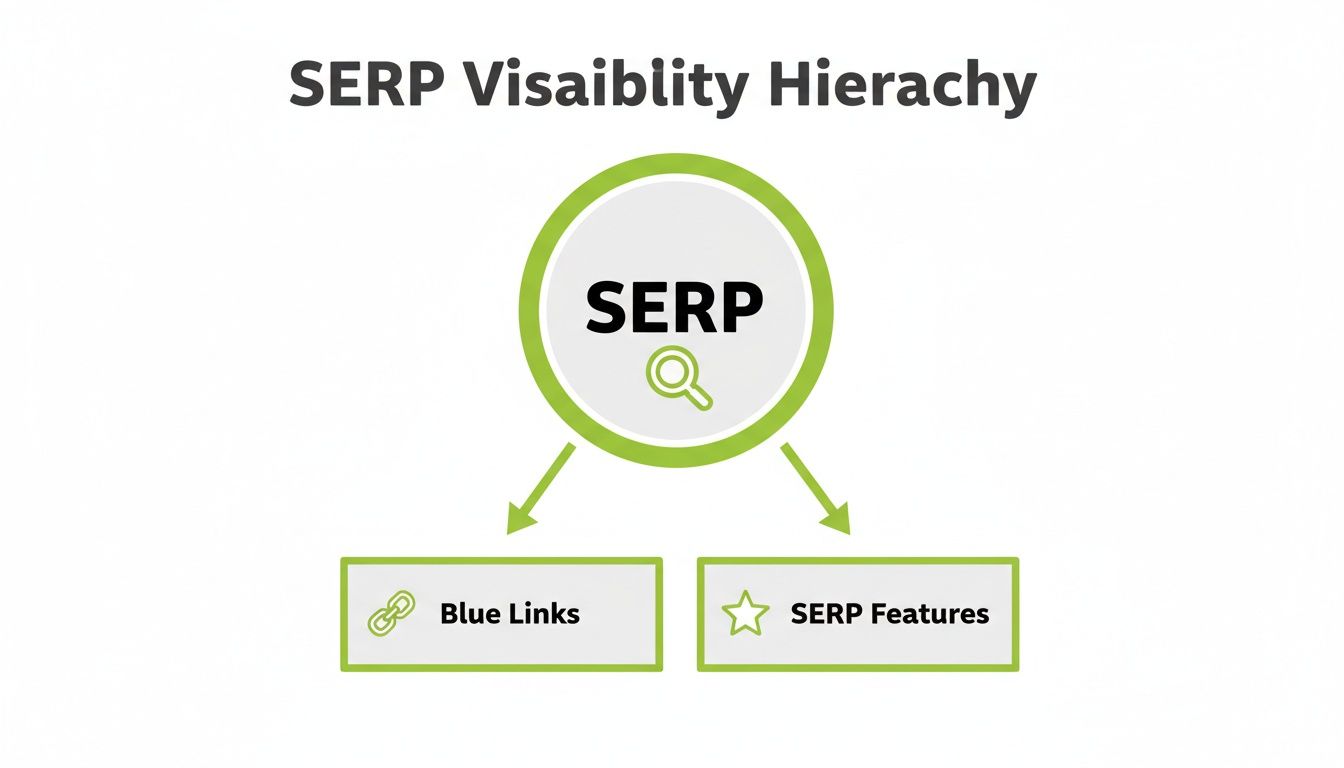
While the classic blue links are still the bedrock of SEO, it's often the SERP features that grab a user's eye first. Think of them as prime real estate you can't afford to ignore.
Informational and Authority-Building Features
When people are in research mode, they’re looking for trustworthy answers. Showing up in these features is how you prove your brand is a credible source and a leader in your space. They are the foundation of any solid content strategy.
- AI Overviews: These AI-powered summaries appear right at the top of the page, giving users instant answers. Getting your brand cited here is a powerful signal to Google—and to users—that you're an authority on the topic.
- Featured Snippets: You've seen these before—they're the direct answer boxes at "position zero." Winning a Featured Snippet can be a game-changer, rocketing your visibility and positioning your site as the definitive answer.
- People Also Ask (PAA): This is the accordion-style box of questions that people click to expand. Appearing here is your chance to answer follow-up questions and draw users further into your content.
Here's something to keep in mind: these spots are incredibly volatile. For high-volume keywords, our data shows that who owns the Featured Snippet can change every single week in as many as 25% of cases.
This constant churn is actually a huge opportunity. We've seen that winning a Featured Snippet often correlates with an 8-12% bump in organic click-through rates. The competition also changes by location—US SERPs average 3.2 features per page, while Europe sees just 2.8. A platform like Surnex helps you stay on top of your presence across all these features, even in new AI search modes. You can learn more about how we use historical SERP analysis to uncover these kinds of insights.
To help you prioritize, here’s a quick breakdown of common SERP features and the strategic value they hold.
Key SERP Features and Their Business Impact
| SERP Feature | Typical Prevalence | Primary Business Goal |
|---|---|---|
| AI Overviews | High (for informational queries) | Build brand authority and be seen as a primary source. |
| Featured Snippets | Moderate | Drive high-intent traffic and establish expertise. |
| People Also Ask | Very High | Capture mid-funnel users and answer related questions. |
| Product Carousels | High (for commercial queries) | Increase product visibility and drive direct sales. |
| The Local Pack | High (for local queries) | Drive foot traffic and dominate local search. |
| Review Snippets | Moderate | Build trust and improve click-through rates. |
Tracking these features isn't just about collecting data; it's about connecting your SEO efforts to real business outcomes, from building your brand to making the sale.
Transactional and E-commerce Features
If you sell products or services online, you need to be obsessed with the features that show up when someone is ready to buy. These directly influence a customer's journey to checkout.
- Product Carousels & Shopping Ads: These are the visual, swipeable product listings that appear for commercial searches. For any e-commerce business, you have to watch your product visibility, pricing, and reviews here like a hawk. It’s a direct line to sales.
- Review & Rating Snippets: Those little gold stars under a search result are powerful. They build instant trust. You need to be tracking if your review schema is working correctly and how your ratings stack up. It can be the one thing that makes a user click on your link instead of a competitor's.
Local Intent Features
For any business with a physical location, winning at local search means owning a very specific set of SERP features that Google rolls out for "near me" or location-based searches.
- The Local Pack: This is the money spot for local businesses—the map with three listings right at the top of the page. It's the most valuable piece of digital real estate you can own in your community.
- Map Results: It's not just about the Local Pack. You also need to make sure your business is visible when people are browsing the map directly. This is essential for bringing customers through your front door.
By tying your serp feature tracking strategy to these different user intents, you stop chasing vanity rankings and start targeting the exact SERP elements that move the needle for your business. Whether you want to build authority, drive sales, or get more foot traffic, it all starts on the SERP.
Choosing Your Method for Effective Feature Tracking
So, you've figured out which SERP features you want to win. The big question now is, how do you actually keep track of them? The best method for SERP feature tracking really comes down to your team's size, budget, and what you’re trying to achieve. Your options range from completely free to incredibly powerful and automated.
Let's start with the most basic approach: doing it by hand. This just means typing your keywords into Google and literally looking at the results to see where you pop up. It’s free and doesn’t require any special software, but honestly, it’s not a practical strategy for anyone serious about SEO.
The SERP is constantly shifting. Results change based on where someone is searching from, what device they're on, their search history, and even the time of day. What you see from your desk in Chicago is likely different from what a customer sees on their phone in Miami. Manual checks are inconsistent, a huge time sink, and just don't give you the reliable data you need to make good decisions.
Scaling Up with Raw Data Collection
For any team that needs reliable data, automation is the only way to go. This is where you move from spot-checking to systematically gathering the raw data needed to analyze SERP features at scale.
There are two main ways to get this raw data:
- SERP APIs: Think of these as a direct line to search engine results. You can programmatically ask for the SERP for any keyword, location, and device, and you get clean, structured data back in return.
- Automated Scrapers: These are custom-built bots that crawl Google's results and pull out exactly the information you need. They give you total control, but they're a headache to build and maintain since you constantly have to update them as Google changes.
Both options give you the building blocks for tracking, but that’s all they are—building blocks. You get the raw HTML or JSON, but it's still on you to parse it, store it, and build the dashboards and reports to make any sense of it. That can quickly become a major engineering project.
Dedicated Platforms for Comprehensive Tracking
This is exactly why most agencies and in-house teams opt for dedicated SERP tracking tools or unified platforms. These services handle all the messy work of data collection, parsing, and storage, serving up clean, actionable insights from the get-go.
It's like this: a SERP API gives you a pile of lumber, a box of nails, and a blueprint. A dedicated platform gives you a fully-built house. You can move right in and start analyzing trends and spotting opportunities without having to build the whole thing yourself.
Enterprise-grade tools have completely changed how brands monitor features. Some platforms handle millions of keywords, updated daily, across all major global markets. According to a 2026 review from sites like Scrapx.io, top-tier platforms excel in detailed SERP feature tracking for elements like featured snippets (tracked in 92% of competitive keywords), People Also Ask, and local packs. They can even reveal that mobile SERPs feature 28% more local packs than desktop—a game-changing insight for any local business.
These platforms do more than just report rankings. They deliver the context you need for smart decisions, like daily monitoring, historical data, and direct competitor benchmarks. If you're managing complex campaigns, you can see how this works in practice by checking out our guide on the workflows for rank monitoring and spotting changes.
The Rise of AI in Feature Analysis
The latest leap forward in tracking uses Artificial Intelligence (AI) and Large Language Models (LLMs) to analyze the actual content inside the SERP features. A traditional tool can tell you if you're in an AI Overview, but it often can't tell you how your brand is being portrayed.
Modern AI-powered platforms are starting to do just that. They can:
- Identify Sentiment: Figure out if a mention of your brand within an AI-generated answer is positive, negative, or neutral.
- Analyze Context: Understand the surrounding text to see how your product or service is positioned.
- Track Citation Sources: Pinpoint exactly which of your web pages are being used as the source for AI answers.
This level of detail is becoming essential. It helps you understand not just your visibility, but your brand's reputation and authority in an era of AI-driven search. It’s the difference between knowing you were mentioned and knowing what was actually said.
Turning Raw SERP Data into Actionable Reports
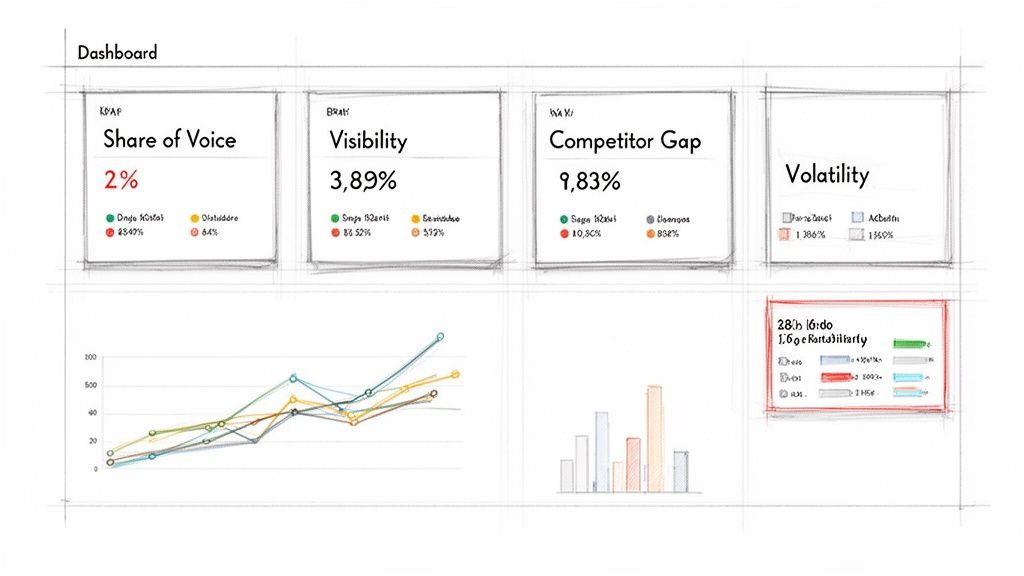
Collecting data from your SERP feature tracking is really just the starting line. On its own, raw data is messy and overwhelming—a wall of numbers that doesn't tell you much. The real magic happens when you turn that noise into a clear story that drives smart decisions. To get clients and executives on board, you have to connect your data to key performance indicators (KPIs) they actually care about.
It’s easy to get stuck on simple "yes/no" questions, like whether you own a Featured Snippet. That's a decent starting point, but it barely scratches the surface. If you want to justify your SEO budget and make real strategic moves, you need to dig deeper into KPIs that show context, momentum, and your true standing against the competition.
Moving Beyond Simple Presence to Performance
Going beyond basic metrics means looking at your visibility in a more sophisticated way. It’s not just about having a seat at the table; it's about understanding how big your slice of the pie is. This is where we shift our focus to KPIs that measure momentum and competitive pressure.
These are the metrics that truly move the needle:
- Share of Voice (SoV) within Features: This calculates the percentage of a specific SERP feature you own across a keyword set. For instance, maybe you own the Featured Snippet for 30% of your high-intent commercial keywords. This is a far more powerful way to measure market dominance than just looking at traditional blue links.
- Competitor Presence Rate: This metric shows you exactly how often your main rivals appear in valuable SERP features where you’re nowhere to be found. It’s a direct way to spot gaps in your content strategy and see who’s beating you to the punch.
- Feature Volatility: This tracks how often the owner of a key SERP feature changes. A highly volatile Featured Snippet or AI Overview is a golden opportunity. It signals that no single brand has a firm grip on it, meaning it's ripe for the taking.
Tracking these advanced KPIs is like upgrading from a basic weather app that says "rainy" to a full-blown meteorological forecast with precipitation probability, wind speeds, and a Doppler radar. One tells you what's happening now; the other tells you what to do about it.
This level of detail is what allows you to build a proactive SEO strategy. Instead of just reacting to traffic drops, you can see competitive threats coming and target unstable SERP features before your rivals even know what's happening.
How to Build a Powerful SERP Feature Report
A great report doesn't just present data; it turns that complex information into clear, actionable business intelligence. It should be scannable for high-level takeaways but also have the depth needed to back up your recommendations. Ultimately, a strong report guides stakeholders from "what happened?" to "so what?" and finally to "what's next?"
An automated dashboard should organize these insights logically, telling a story that makes sense. Here’s what a comprehensive report from a platform like Surnex can look like.
The dashboard above pulls all the essential feature metrics—like your overall visibility and how you stack up against competitors—into one place. This lets your team quickly see what’s working and what needs attention, without having to mess around with a dozen different spreadsheets.
A solid report template should always include these sections:
- Overall Feature Visibility Summary: Start with the big picture. Show the total number of SERP features you own now compared to the last period, plus your overall Share of Voice.
- Performance by Keyword Segment: Break down feature ownership by strategic keyword groups, like brand vs. non-brand or informational vs. transactional. This shows you exactly where in the customer journey you’re winning.
- Competitor Gap Analysis: Use visuals to compare your feature presence against your top three competitors. Point out the "greenfield" opportunities where no one dominates and the "red alert" areas where a competitor is winning big.
- Actionable Recommendations: This is the most important part. End with clear, data-driven next steps. For example: "Competitor X owns the 'People Also Ask' box for five of our target keywords. We need to create FAQ-style content to target these questions and reclaim that space."
This structured approach transforms your SERP feature tracking data from a boring report card into a strategic roadmap. For teams managing multiple clients, you can explore ways to create client-ready reporting workflows that automate this entire process and prove the value of your SEO work, month after month.
Practical Use Cases for Agencies and In-House Teams
Knowing the theory is one thing, but the real magic of SERP feature tracking happens when you put it to work. How does all this data actually help you win? The answer really depends on who you are—an agency's needs are quite different from an in-house team's.
But for both, this goes way beyond just watching your rankings go up or down. It's about having the proof to justify your budget, showing your boss or your client that you're delivering real value, and finding clever ways to outflank the competition. It’s the difference between reacting to problems and proactively hunting for opportunities.
Agency Workflows That Prove Value
If you work at an agency, SERP feature data is your best friend. It’s the hard evidence you need to show clients that your work is paying off in ways that a simple number in a rank report just can't capture. It helps you tell a much richer story about their visibility on Google.
Here's how that plays out in the real world:
- Spotting New Service Opportunities: Did a competitor just snag all the "People Also Ask" boxes for your client's most important topics? Don't see it as a threat—see it as a new project you can pitch. You can go to your client with a proposal for an FAQ content project designed specifically to win back that prime SERP real estate.
- Creating Reports That Actually Impress: Forget reporting that just says "you ranked #5." Imagine showing them, "You now own the Featured Snippet, which means you're sitting above the #1 result." Tracking feature ownership lets you highlight big wins even when traditional rankings haven't budged, proving your worth in a much more powerful way.
- Benchmarking Across Your Client Roster: When you manage multiple clients, you can start to see bigger trends emerge. If you notice video carousels are suddenly showing up for one client's keywords, you can get ahead of the curve and advise other clients in similar industries to start investing in video.
By building SERP feature data into your reporting, you stop being just another SEO vendor. You become a strategic partner who truly gets the search landscape. You can confidently explain why traffic dropped—maybe a new AI Overview appeared—and immediately present a data-backed plan to adapt.
In-House Team Strategies for Growth
For in-house SEOs, SERP feature data is often the key to getting things done. It’s the concrete evidence you need to get buy-in from leadership for your projects and to work more effectively with other departments.
Here are a few ways in-house teams can put this data to good use:
- Securing Budget for New Content: We've all been there—trying to sell a new content idea can be tough. But what if you could walk into a meeting and say, "We have zero visibility in the AI Overviews for our top 20 revenue-driving keywords, and our main competitor is cited in 60% of them"? Suddenly, you have a compelling business case that’s almost impossible to ignore.
- Prioritizing Your Workload: The SEO to-do list is always a mile long. Knowing what to tackle first is a constant battle. But if your tracking data shows you just lost a valuable Featured Snippet for a high-conversion keyword, that task shoots straight to the top of your list. This helps you focus your limited time on fixes that will actually move the needle on revenue.
- Collaborating with Product and Content Teams: Is the product team about to launch a new feature? You can analyze the SERPs for related terms and see what's already ranking. If you find that the results are filled with "how-to" videos and PAA boxes, you can give the product and content teams a clear roadmap for the exact types of content they need to create for a successful launch.
Whether you're at an agency or on an in-house team, these strategies can help you work smarter. To see how a unified platform makes these workflows even easier, explore our specialized solutions for in-house marketing teams.
How a Unified Platform Simplifies Search Intelligence
Let's be honest—cobbling together reports from different tools is a pain. You have one tab open for rank tracking, another for your site audit, and a third for checking SERP features. When your data is scattered, you're not just wasting time; you're missing the story.
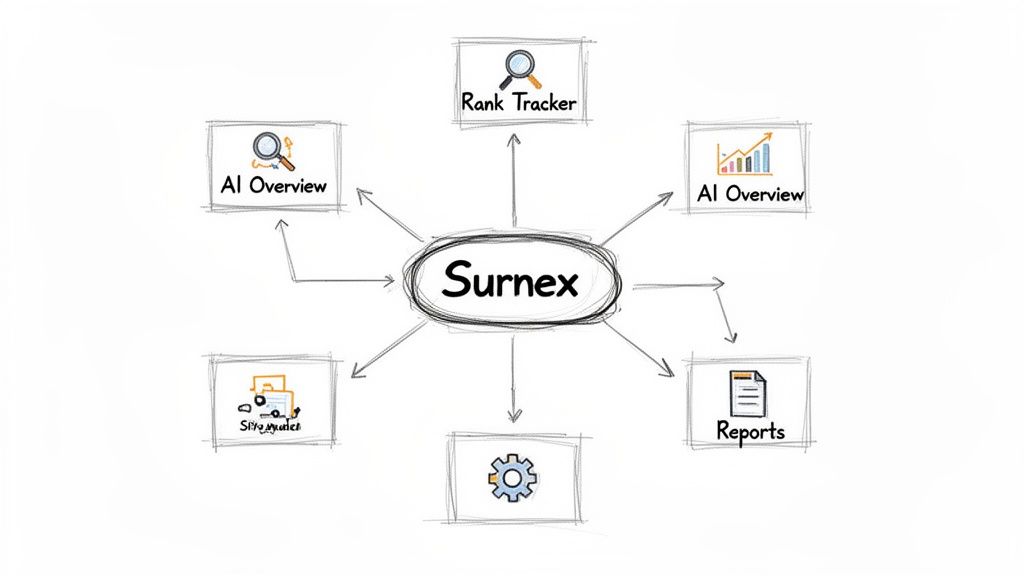
This is where a truly unified platform like Surnex changes the game. It’s designed to bring all your search intelligence into one place, so you can finally see how everything connects. Instead of hopping between five different tools, you get a single, coherent view that blends traditional SEO with modern must-haves like AI Overview tracking.
One Platform for Modern Search
Today's search results are more complicated than ever. A unified platform is built for this reality. It goes far beyond just telling you if you’re ranking number three; it shows you your entire footprint on the page.
For agencies, this is a lifesaver. Imagine a client's traffic dips after a new AI Overview rolls out. Instead of guessing, you can pull up a report showing exactly what happened, who is being featured, and what your next move should be. You have the data to explain the "why" and a clear path forward.
By tracking AI visibility right alongside core SEO metrics, a modern platform gives teams the insights they need to spot high-impact opportunities and build strategies that last.
This integrated approach stops the constant toggling between tools. It frees up your team to focus on making smart decisions, not just collecting data.
Core Capabilities of a Unified Solution
A real all-in-one platform doesn’t just staple a few different tools together. It weaves them into a single, seamless workflow where each piece of data informs the others. This gives you one reliable source for your entire search strategy.
Key features that work together should include:
- Advanced Rank Tracking: Goes beyond blue links to monitor your position in every important SERP feature.
- AI Overview Monitoring: Tells you when you’re cited in AI-generated answers, how you’re being mentioned, and which competitors are showing up.
- Automated Site Audits: Connects the dots between a technical problem on your site and its direct impact on search visibility.
- Unified Reporting: Pulls all these data points together into a dashboard that’s actually easy to read and share.
By putting everything in one place, Surnex gives you a smarter way to handle SEO. It helps teams work faster, create reports that make sense, and build a strategy that’s ready for whatever search throws at us next.
Frequently Asked Questions
As you start digging into SERP feature tracking, a lot of practical questions are bound to come up. Search results are more crowded and dynamic than ever, so let's clear up some of the most common ones we hear from teams just getting their footing.
Getting these details right from the start will help you build a tracking strategy that actually works—one that focuses on the right data and tells you what you really need to know.
How Often Should I Track SERP Features?
This is probably the first question everyone asks. For your most important, high-value keywords, the answer is daily tracking is ideal. SERP features like AI Overviews and Featured Snippets can be incredibly volatile. You can own a snippet one day and lose it the next.
If you aren't checking daily, you could easily miss a huge traffic opportunity or fail to notice a new competitor creeping in. For keywords that are less critical to your business, weekly tracking can work just fine. This is where an automated platform becomes a lifesaver, as it can run daily checks on thousands of keywords without you lifting a finger. This kind of consistent monitoring is the foundation of effective serp feature tracking.
Can I Track My Competitors' SERP Feature Presence?
Absolutely. In fact, you should be. Keeping a close eye on your competitors is one of the biggest wins you'll get from proper SERP feature tracking. By monitoring the same set of keywords for your main rivals, you can benchmark your "Share of Voice" for specific features.
This approach immediately shows you where your competitors are winning and you're not. Once you spot those gaps, you can dig into their content, figure out what they're doing right, and build a strategy to take that spot for yourself.
How Does This Relate to Tracking AI Overviews?
That brings us to the elephant in the room: AI Overviews. These are the latest, and arguably most significant, SERP feature to come along in years. Tracking them is now non-negotiable for any serious SEO strategy. And it’s about more than just seeing if an AI Overview shows up for your keyword.
Real, effective tracking means monitoring:
- When your site is specifically cited in an AI answer.
- The context of the mention—is it positive, neutral, or negative?
- Which of your competitors are also getting featured in the same answer.
The goal is to have a single view of your search presence. The best tools today don't treat AI Overviews as a separate, isolated thing. They integrate tracking for these new AI-powered results right alongside traditional features like snippets and local packs, giving you the complete picture.
Ready to get a unified view of your entire search presence? Surnex combines traditional SEO workflows with advanced tracking for AI Overviews and other modern SERP features, giving you the clarity you need to work smarter and build future-proof strategies. Learn more at https://surnex.io.