An agency can no longer walk into a client meeting with only keyword positions, backlink growth, and organic sessions. Clients increasingly ask whether their brand appears in Google AI Overviews, ChatGPT, Perplexity, or other LLM-driven discovery experiences, while the delivery team still has to manage technical audits, content briefs, rankings, and link opportunities. That creates a practical problem: the agency needs broader visibility without turning its operating model into a collection of disconnected subscriptions.
The shift is already substantial. Google announced that AI Overviews would roll out across more than 100 countries and territories on October 28, 2024, making AI-generated search summaries a global visibility layer rather than a niche test. In the first four months of 2026, 68.01% of U.S. Google searches ended without a click, compared with 60.45% in 2024 and 49% in 2019, according to analysis of the changing search and zero-click landscape. Agencies now need to connect classic rankings with citations, AI answer presence, and zero-click exposure.
This roundup evaluates ai-driven SEO tools for agencies by operating fit, not generic feature volume. The comparison focuses on AI visibility coverage, LLM benchmarking, traditional SEO execution, client reporting, integrations and APIs, scaling economics, pricing complexity, and migration effort. It includes unified suites, content specialists, enterprise platforms, and forecasting-focused tools, with Surnex examined as the API-first option that brings AI search intelligence and core SEO workflows together. For broader context, see this guide to AI for marketers.
1. Surnex
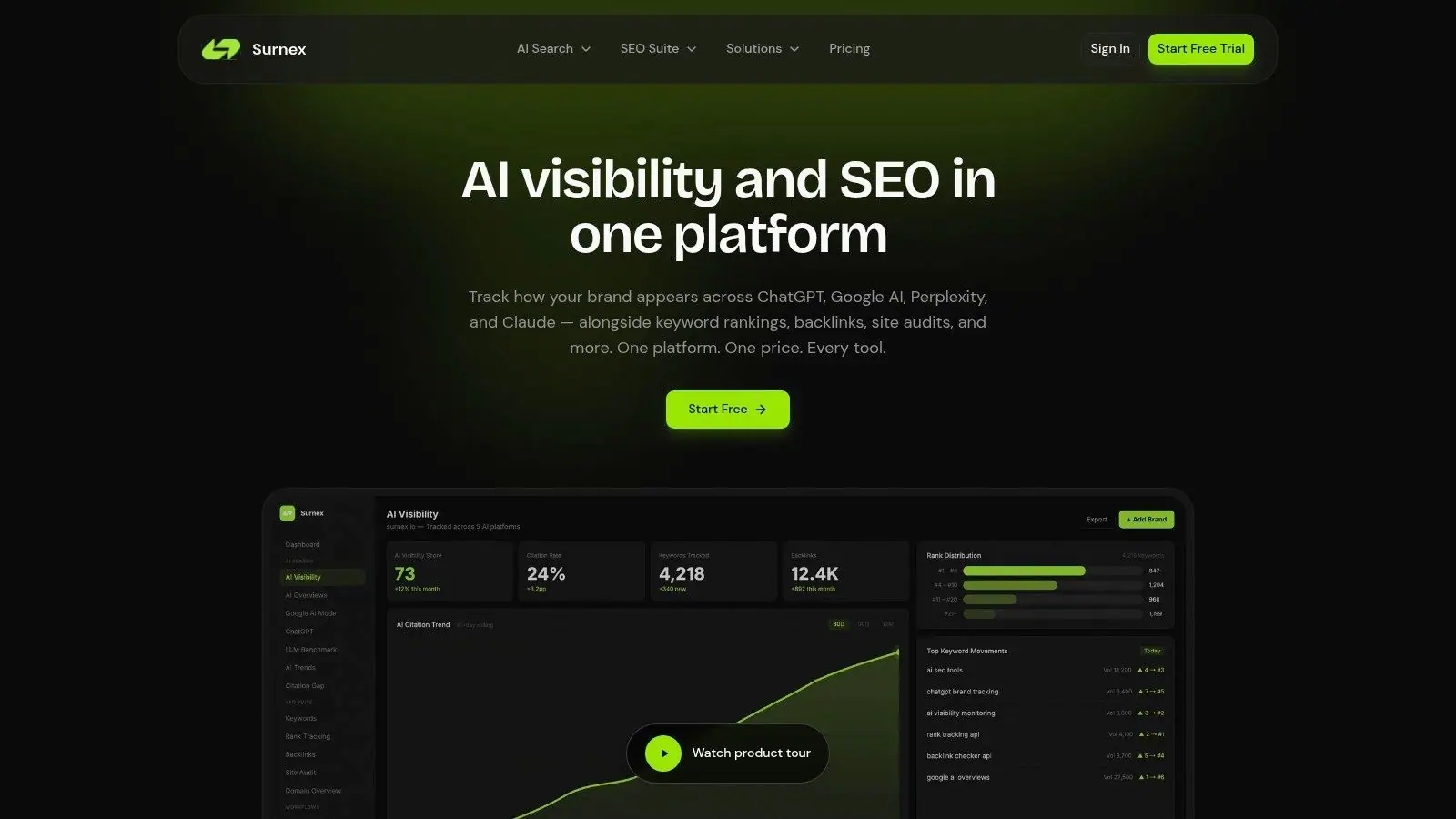
An agency handling both AI search visibility and conventional SEO needs one workflow for turning citation gaps into assigned work. Surnex monitors brand presence across ChatGPT, Google AI Overviews and AI Mode, Perplexity, and Claude, alongside keyword research, rank tracking, backlinks, site audits, Core Web Vitals, and domain overviews through Surnex.
The practical benefit is the connection between diagnosis and execution. If a competitor appears in an AI answer while the client does not, the team can investigate whether the gap relates to missing content, weak authority, technical accessibility, or an unclear entity footprint. Citation gap analysis can then lead to specific pages, topics, and authority signals for the SEO team to address.
Where Surnex fits an agency workflow
LLM benchmarking gives account teams evidence for client reviews. They can compare model answers, inspect cited domains, and identify differences in the client's presence across AI systems. That makes AI visibility easier to discuss alongside rankings, technical health, and content performance.
The REST API is the strongest operational differentiator. Developers can place search intelligence inside internal dashboards, automated audits, products, agents, or reporting pipelines, while marketers use the dashboard without writing code. White-label reporting supports client delivery. Unlimited clients, projects, and users also avoid the seat and account limits that can complicate agency growth.
Practical rule: Track AI citations beside the conventional ranking and technical metric that explains what the team can change next.
Economics and trade-offs
Surnex offers four monthly plans priced from $49 to $399, with unlimited users and projects on every plan and no seat charges. A 14-day trial of the Growth plan requires no credit card. Plans differ by usage limits, so managers should estimate how many keywords, AI prompts, and research lookups they need before choosing one, which takes more work than budgeting for a simple per-seat subscription. Further pricing details are available on the Surnex pricing page.
The product has less public validation than established enterprise suites. The site does not present named customer case studies or public award listings, so procurement teams should test reporting, data coverage, and API behavior with representative client accounts.
Surnex fits agencies that want API access, repeatable reporting, and connected AI and SEO workflows without assembling several specialist subscriptions. A specialist tool may be a better choice for unusually detailed content scoring, enterprise governance, or technical log analysis. Migration effort should still be assessed, especially where an agency already has established dashboards, historical tracking, and automated client reports.
2. Semrush
Semrush remains a practical choice for agencies that already use a broad SEO suite and want to add AI visibility without rebuilding every established workflow. Its platform combines keyword research, site audits, backlink analysis, position tracking, content, PR, and AI Search or AI Visibility monitoring across Google AI Overviews and leading LLM experiences through Semrush.
The agency advantage is standardization. A strategist can research a market, an SEO can review technical issues, a content lead can work from competitive data, and an account manager can assemble reporting inside a familiar multi-project environment. That breadth reduces the need to move data manually between separate tools.
Semrush is also a sensible fit for agencies with multiple specialists because its project and user structure supports collaboration. The trade-off is operational cost and configuration. As projects, tracked limits, seats, and advanced modules grow, the platform can become expensive and harder to forecast. Some capabilities also sit behind higher tiers or additional modules, so the advertised entry point won't necessarily reflect the stack a mature agency needs.
AI visibility versus execution depth
Semrush has invested actively in AI search visibility, but agencies should still define what they need to report. “AI visibility” can mean prompt coverage, mention frequency, citations, sentiment, model comparisons, or a blend of these. Before migration, confirm that the selected configuration exposes the exact query-level and citation details the client report requires.
For teams comparing specialist workflows, this overview of AI search visibility tools is useful alongside a hands-on Semrush trial. Semrush works best for a broad agency roster that values mature SEO coverage and collaboration. It may be less attractive when API-first automation, low-friction usage economics, or highly detailed LLM benchmarking is the primary buying criterion.
3. Ahrefs
Ahrefs is the research-heavy choice in this list. Agencies use it for its deep link index, keyword exploration, competitor analysis, site audits, and rank tracking. Newer AI helpers and prompt research extend that work into conversational discovery through Ahrefs.
The platform fits strategy and diagnosis especially well. A strategist can compare competitor link profiles, find overlapping content, inspect keyword opportunities, and turn research into a prioritized SEO brief quickly. That speed helps agencies with competitive accounts, where the harder task is often deciding which evidence deserves action rather than assembling another report.
Ahrefs has added AI prompt research and tracking across a large prompt dataset, based on its product positioning. This gives teams a way to investigate how brands and competitors appear in conversational search. Prompt volume still needs careful interpretation. It does not establish that a client was cited in a particular answer or that the visibility produces commercial value.
Where Ahrefs wins
Ahrefs suits agencies whose advantage comes from data quality and competitive research. Technical SEO specialists, link teams, and senior strategists are likely to gain more from its depth than a content team seeking guided writing and production controls.
The trade-off appears when agencies assess the entire operating model. Premium pricing and higher limits can put pressure on account economics, while advanced capabilities may require upper plans. Content briefing is less central than in content-first platforms, and agencies may need separate tools for white-label reporting, AI visibility measurement, or recurring programmatic workflows.
Migration is relatively straightforward for teams using Ahrefs mainly for research, but broader replacement requires mapping rank tracking, reporting, user access, and exports before changing systems. Teams planning internal integrations should also define whether they need occasional exports or recurring API workflows. This SEO tool API integration guide helps frame that decision.
Ahrefs is a strong specialist platform for research-led agencies. An API-first unified system may reduce tool switching for a mixed client roster, while Ahrefs remains the better fit when backlink intelligence and competitive analysis are the agency's primary requirements.
4. Surfer
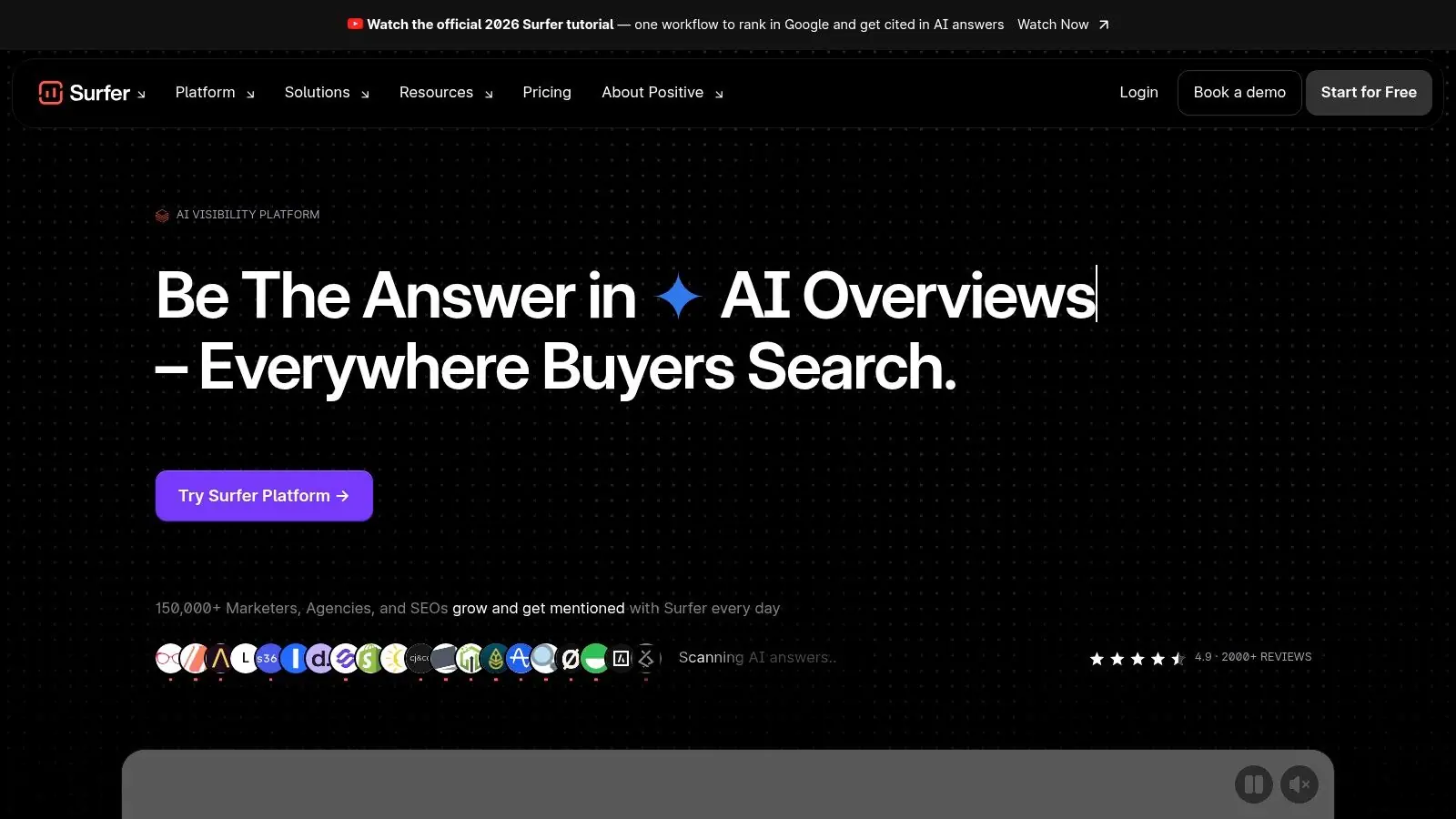
Surfer targets agencies that need to turn SEO research into publishable content. Its Content Editor combines NLP-based guidance, scoring, and real-time recommendations, helping writers and SEO practitioners adjust pages against competing search results through Surfer.
The workflow fits a production team: a strategist prepares the brief, a writer drafts in the editor, and an SEO reviews the page before publication. Content audits support refresh programs, while briefs give account teams a repeatable way to convert search findings into assignments. For agencies managing several client accounts, that structure can reduce subjective edits and shorten the path from strategy to draft.
The content scaling trade-off
Surfer's AI Visibility module adds monitoring for brand mentions in AI answers and LLM experiences. Content teams can use that view to assess whether page changes improve recognition and citation by AI systems, alongside conventional search performance.
The main operating risk is score-driven editing. Writers may treat suggested terms as mandatory and produce repetitive copy, so senior editors still need to protect accuracy, differentiation, brand voice, and useful structure.
API and MCP integrations suit agencies building automated workflows, while workspace features support team coordination. Costs can increase as production volume rises, so model usage by account before making it a standard across the roster. Surfer fits teams whose delivery model depends on repeatable content planning, drafting, and optimization. Agencies with broader technical execution, backlink analysis, or unified AI benchmarking may need to connect it with other systems or choose an API-first platform such as Surnex.
5. MarketMuse
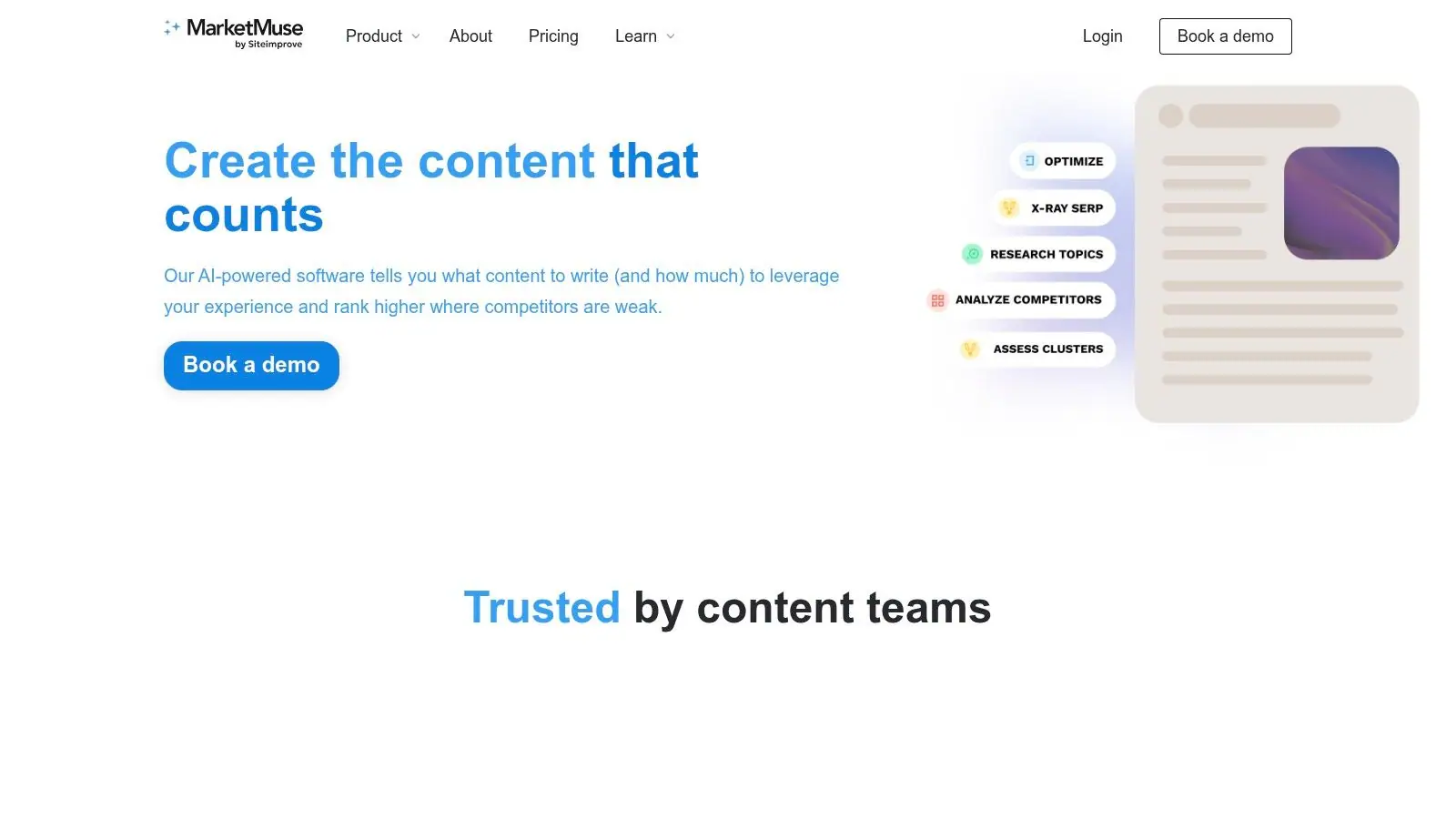
MarketMuse is a content strategy platform for agencies that need to decide what deserves production attention before assigning work to writers. It uses topic modeling, content inventories, page scoring, briefs, and opportunity analysis to surface gaps and prioritize creation or updates through MarketMuse.
The most valuable part of the workflow is prioritization. Instead of asking a team to publish more articles, MarketMuse helps identify topic areas where the existing site lacks coverage, where pages need improvement, and where an update may have more strategic value than another new draft. That supports agencies managing editorial calendars for clients with large content libraries.
Best use inside a multi-client team
AI-generated briefs and strategy documents can standardize how different strategists prepare work. That matters when an agency has several writers or regional teams and wants consistent research quality across accounts. Topic and page scores also give account managers a clearer explanation for why one content opportunity should precede another.
MarketMuse is not a complete agency SEO stack. It is primarily content-focused, so teams will probably need separate systems for backlink monitoring, technical audits, rank tracking, and AI citation reporting. Pricing and usage limits can also require a sales conversation, which complicates straightforward margin planning.
A useful comparison is this guide to the best AI SEO tools for agencies, particularly for teams deciding whether to buy a content specialist or a unified platform. MarketMuse is a strong choice when the agency sells content strategy as a serious discipline. It is less suitable as the only operational system for an agency that must report rankings, technical health, links, and AI visibility together.
6. BrightEdge
BrightEdge is aimed at enterprise SEO environments where governance matters as much as feature access. It combines sitewide SEO management, research, recommendations, and tracking for how content appears in emerging AI experiences through BrightEdge.
An agency supporting large websites or multi-brand portfolios may value the platform's governance layer. Enterprise stakeholders often need controlled workflows, standardized reporting, enablement, and a shared source of recommendations rather than another standalone dashboard. BrightEdge's community and education resources can help teams roll out new search practices across departments.
The enterprise buying question
BrightEdge makes sense when the client roster includes complex sites, multiple stakeholders, and formal adoption requirements. The platform's value isn't only in the data. It also sits inside a broader process of governance, training, and decision support.
That strength creates the central trade-off. Enterprise pricing and sales engagement make BrightEdge difficult to evaluate as a casual add-on for a small agency or a limited client roster. The implementation burden may also exceed the needs of teams that mainly want prompt tracking, citation gaps, and white-label reports.
Agencies should ask whether the client will use the governance and enablement capabilities. If the answer is yes, BrightEdge can support a structured enterprise rollout. If the agency needs a lighter platform that developers can connect to quickly, an API-first alternative may involve less migration effort and lower operational overhead.
7. Conductor
Conductor connects AI search monitoring, classic SEO, content creation, collaboration, and reporting into an enterprise-oriented workflow through Conductor. Its appeal lies in the handoff between research and execution. Teams can use live search data to inform briefs, content improvements, and stakeholder reporting without treating each activity as a separate system.
That workflow suits agencies serving large brands where content, SEO, brand, and marketing operations share responsibility for organic visibility. AI-assisted content creation and briefing can reduce the distance between an identified search opportunity and an assigned production task. Reporting and collaboration tools then give account teams a way to explain progress to stakeholders who don't work inside SEO every day.
The image URL above is not valid and is omitted to avoid inventing a source.
Adoption and reporting
Conductor is strongest when the agency wants one governed workflow for AEO, AI search, and traditional SEO. It can help larger teams keep strategy, creation, monitoring, and reporting connected instead of allowing each department to build its own interpretation of search performance.
The cost is complexity. Pricing is handled through sales, and implementation and training are part of the buying decision. New users may find the interface deep rather than immediately intuitive, so account teams need a defined onboarding plan. An agency that buys the platform without assigning workflow ownership could end up with another underused dashboard.
Choose Conductor when enterprise clients need breadth, collaboration, and governance around changing search surfaces. Choose a lighter tool when the agency's main requirement is a focused AI visibility report or rapid API integration.
8. seoClarity
seoClarity is designed for agencies and enterprise teams handling heavy data, large sites, and customized reporting. Its platform brings together AI Overviews insights, technical SEO, content, rank tracking, automation, exports, and configurable workflows through seoClarity.
The operating advantage is scale with support. Large agencies often need more than a dashboard. They need data exports, custom views, repeatable processes, training, and onboarding that help several teams use the same system correctly. seoClarity's subscription model includes onboarding and training, which can be important when the platform becomes part of a formal delivery operation.
Data access versus simplicity
seoClarity is a good fit for agencies that need large-scale reporting and automation across many substantial websites. Its AI Overviews capabilities can sit alongside the traditional technical, content, and rank tracking work required to diagnose performance.
The trade-off is platform depth. Customizable plans and enterprise pricing make the buying process less transparent, while the interface may require onboarding before a team can use the full value. That isn't necessarily a weakness for a complex client portfolio, but it does increase migration effort.
An agency should map its recurring exports, dashboards, audit schedules, and client-facing metrics before implementation. If those requirements are highly customized, seoClarity's depth may justify the effort. If the team wants a unified subscription with faster adoption and a REST API available across the product, a simpler API-first platform could be more efficient.
9. Botify
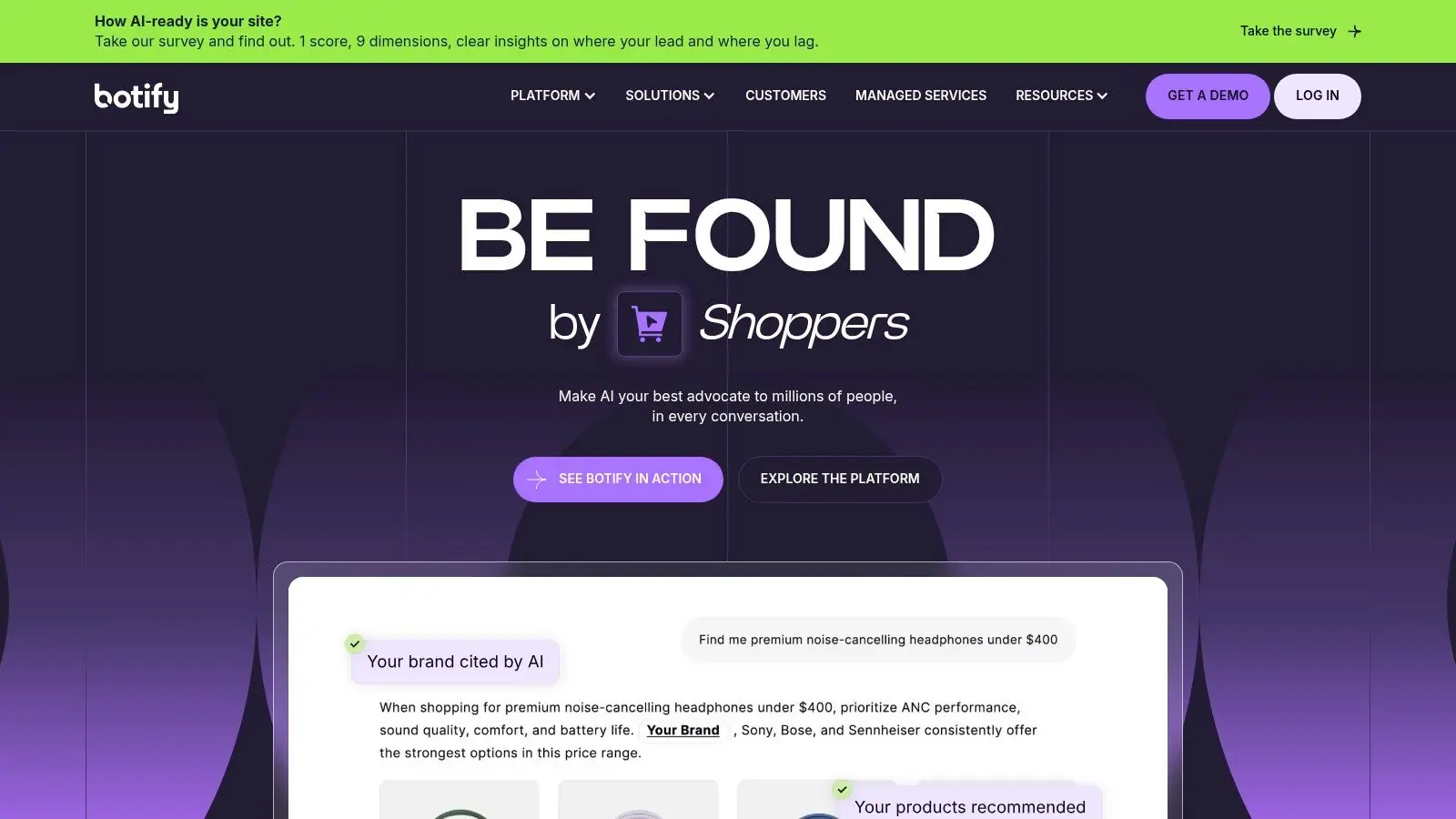
Botify is the technical specialist for large and complex websites. Its full-funnel approach covers crawling, log analysis, keyword tracking, forecasting, activation, and machine-learning-driven prioritization through Botify.
For an enterprise agency, the key benefit is not another content editor. It's the ability to connect crawling and server behavior with prioritization and execution. Technical teams can investigate how search engines access a site, identify important problems, and use the intelligence layer to focus engineering resources on the issues most likely to matter.
Where technical depth pays off
Botify fits agencies working with extensive inventories, complicated templates, international structures, or engineering-heavy SEO programs. Forecasting and activation workflows can help turn analysis into a prioritized delivery queue rather than another audit document that waits for a developer.
The limitation is scope. Botify's content-creation capabilities are narrower than those of content-first platforms, and enterprise onboarding and pricing require planning. It also may not be the easiest choice for a generalist agency that wants a simple client dashboard combining AI citations, rankings, backlinks, and content opportunities.
Use Botify when crawl data, logs, technical prioritization, and automation determine client value. Pairing it with a content or AI visibility specialist may be justified when the agency needs deeper coverage outside technical SEO. For a smaller or mixed roster, the implementation effort can outweigh the benefit of its technical depth.
10. SEOmonitor
SEOmonitor is built around agency operations, particularly rank tracking, forecasting, scenario planning, proposals, and client reporting through SEOmonitor. Its purpose is less about being an all-in-one SEO suite and more about helping agencies explain expected outcomes, set goals, and manage campaigns across clients.
Forecasting is useful during both sales and account management. Teams can build scenarios, connect goals with revenue projections, and use AI-generated summaries to explain performance and forecast changes. That gives account managers a structured narrative for client conversations instead of forcing them to translate raw ranking data manually.
A forecasting-led stack
SEOmonitor's rank tracking supports granular segmentation and recent methodology updates, while dashboards and configurable pricing support multi-client operations. Transparent pricing is an advantage for agencies that need to protect margins and build repeatable proposals.
The trade-off is coverage. SEOmonitor isn't a complete technical, backlink, content, or AI citation platform, so most agencies will pair it with other tools. Some capabilities also depend on tracked campaigns or higher usage tiers, which means the team should model campaign volume before standardizing on it.
This comparison of automated SEO platforms can help agencies decide whether forecasting should remain a specialist function or sit inside a broader SEO and AI visibility workflow. SEOmonitor is the right choice when proposal confidence, scenario planning, and client communication lead the operating model. It is not the natural single platform for teams that need LLM benchmarking and citation-gap analysis alongside technical execution.
AI-Driven SEO Tools for Agencies, Top 10 Comparison
| Product | Core features / capabilities | Quality ★ | Price / Value 💰 | Target 👥 | Unique selling points ✨ |
|---|---|---|---|---|---|
| Surnex 🏆 | AI visibility (Google AI Overviews, ChatGPT, Perplexity, Claude), rank tracking, backlinks, audits, LLM benchmarking, citation gap analysis | ★★★★☆ | 💰 Four plans $49–$399/mo; 14‑day trial; unlimited projects/users | 👥 Agencies, in‑house SEO, developers, AI builders | ✨ Unified AI+SEO + API‑first, LLM benchmarking, citation gap insights, white‑label reporting |
| Semrush | All‑in‑one SEO: AI visibility, keyword research, audits, backlinks, content & PR tools | ★★★★ | 💰 Tiered plans; can get expensive at scale | 👥 Agencies & teams needing broad coverage | ✨ Breadth of tools + AI visibility & collaboration |
| Ahrefs | Industry‑leading backlink & keyword datasets, site audit, rank tracking, AI helpers | ★★★★★ | 💰 Premium pricing; higher limits on upper tiers | 👥 Competitive & technical SEOs, agencies | ✨ Massive link index, fast data for competitive research |
| Surfer | Real‑time Content Editor (NLP), content briefs, audits, AI visibility module | ★★★★ | 💰 Usage‑based; costs add up with high volume | 👥 Content teams & agencies scaling production | ✨ Real‑time editor + NLP scoring for on‑page optimization |
| MarketMuse | Topic modeling, content briefs, page/topic scoring, content gap/opportunity analysis | ★★★★ | 💰 Complex, often sales‑assisted pricing | 👥 Content strategists & agencies prioritizing topics | ✨ Deep topic modeling & prioritization for content ROI |
| BrightEdge | Enterprise SEO + AI insights, sitewide governance, real‑time recommendations | ★★★★ | 💰 Enterprise pricing & sales engagement | 👥 Large enterprises, multi‑brand portfolios | ✨ Enterprise enablement, governance & upskilling support |
| Conductor | Unified AEO/AI + classic SEO, AI‑assisted content creation, reporting & collaboration | ★★★★ | 💰 Sales pricing; implementation & training required | 👥 Agencies serving larger brands | ✨ Workflow tying live search data to content & stakeholder reporting |
| seoClarity | Technical SEO, content, rank tracking, AI Overviews, automation & large data exports | ★★★★ | 💰 Enterprise/custom pricing | 👥 Agencies managing many large sites | ✨ Scalable data access, automation & onboarding/training |
| Botify | Crawl → conversion platform: crawl, log analysis, ML prioritization, forecasting | ★★★★ | 💰 Enterprise pricing & onboarding | 👥 Technical SEO teams for large/complex sites | ✨ ML‑driven prioritization + activation & forecasting |
| SEOmonitor | Forecasting, scenario planning, rank tracking, AI summaries, dashboards | ★★★★ | 💰 Transparent pricing/credits model | 👥 Agencies focused on forecasting, proposals & multi‑client ops | ✨ Forecast‑driven proposals, clear pricing for agencies |
Choose the Stack Your Agency Can Operate
There isn't one universal winner. The right tool depends on what your agency promises, how many client workflows it runs, how much data the team needs, and whether AI visibility is a reporting layer or a standalone service.
Surnex is the most practical recommendation for agencies that want AI visibility tracking, LLM benchmarking, citation-gap analysis, traditional SEO metrics, white-label reporting, and REST API access in one subscription. Its unified model suits digital marketing agencies, web development agencies, in-house teams, consultants, and developers building automated workflows. The central advantage is operational continuity. A team can monitor where a client appears in AI answers, inspect competing citations, review rankings and backlinks, run audits, and package the findings for a client without stitching together several specialist products.
That matters because AI adoption alone is no longer a differentiator. In a 2026 survey of 97 SEO professionals, 87% said they use AI regularly in core SEO workflows or as a central part of delivery, while only 1% said their work is fully automated, according to the state of AI and automation in SEO report. Among agency and service-provider respondents, 63% said AI was embedded across several core workflows or central to delivery, and 26% mentioned APIs connecting SEO data to other systems. The agency opportunity is therefore less about adding an AI writing button and more about measuring outcomes, standardizing delivery, and integrating the data into systems people already use.
Choose Surfer when content production is the agency's main growth engine and writers need a practical editor with optimization guidance. Choose MarketMuse when the higher-value problem is content inventory, topic prioritization, briefs, and deciding what to create or update. Both are stronger content specialists than general agency operating systems.
Choose Ahrefs when competitive research, backlinks, and technical investigation are the core differentiators. Choose SEOmonitor when forecasting, proposals, scenarios, and client reporting shape the commercial workflow. These specialist choices can be excellent, but they typically need partners for broader AI visibility, content execution, or technical coverage.
For enterprise governance, BrightEdge, Conductor, seoClarity, and Botify deserve serious consideration. BrightEdge is well suited to large portfolios that need education and governance. Conductor fits teams that want strategy, content creation, monitoring, and stakeholder collaboration in one enterprise workflow. seoClarity is designed for large-scale data access, customizable reporting, training, and automation. Botify is the strongest technical choice when crawling, log analysis, forecasting, and engineering prioritization drive the engagement.
The market is also moving toward more deliberate service design. In one 2026 agency dataset, 41% of agencies had at least one AI agent in production, up from 9% in the first quarter of 2025, while 58% were still piloting agentic AI and 1% had not explored it, according to agency AI adoption data. The same dataset reported a median monthly token spend per active agent of $1,800, with a top-quartile figure of $4,200 and a bottom-quartile figure of $420. These figures show why agencies need to evaluate implementation economics, not just feature lists. Automation can improve margins, but only when the workflow is repeatable and the team understands usage.
A lower-risk migration plan
Start by inventorying current tools, reports, recurring audits, exports, permissions, and API dependencies. Mark which outputs clients receive and which dashboards the team maintains only because the data lives there.
Next, choose a small client cohort with different needs. Include one content-led account, one technically complex site, and one client that is already asking about AI search. Run AI visibility measurements alongside existing ranking and traffic baselines rather than replacing the old reporting immediately.
Then map the recurring workflow. Decide who owns prompt sets, citation review, technical follow-up, content prioritization, report assembly, and client explanation. Train account teams to distinguish classic rank from AI answer presence, because a client needs to understand what each metric means and what action follows.
Adoption works when the new platform produces a client-ready deliverable, not when the team simply activates another dashboard.
Expand only after the pilot produces reliable reports, repeatable audits, clear handoffs, and acceptable usage economics. Agencies that need a framework for assessing this new layer can also use an answer engine readiness checker during discovery. The goal isn't to replace every specialist tool immediately. It's to build a stack the agency can operate, explain, integrate, and scale without making every client report a manual research project.
Surnex brings AI visibility tracking across Google AI experiences, ChatGPT, Perplexity, and Claude together with rankings, backlinks, audits, citation gaps, LLM benchmarking, white-label reporting, and a REST API. Visit Surnex to test whether a unified, API-first workflow can simplify your agency's next generation of SEO reporting and delivery.