The biggest mistake in "best ai seo tools 2025" roundups is treating every platform like it solves the same problem. It doesn't. An AI writer, a content optimizer, a rank tracker, and an AI visibility platform belong to different parts of the workflow. If you buy them as if they are interchangeable, your team ends up with overlapping subscriptions, messy reporting, and more manual work than before.
That gap shows up fast inside agencies.
A strategist builds briefs in one tool. Writers optimize in another. Account managers pull rankings from a third. Then someone has to explain why traffic is flat while the client is showing up more often in AI answers. Without a stack built around actual SEO operations, each handoff creates friction and each report needs manual cleanup.
Search also changed. Traditional SEO signals still matter, but they no longer describe the full picture. Teams now need to track how brands appear in AI Overviews, ChatGPT, Perplexity, Claude, and similar answer engines, alongside rankings, backlinks, audits, and content performance. That is why I no longer group AI SEO tools by feature count alone. I group them by workflow.
For 2025, that workflow usually breaks into three categories:
- AI Visibility. Monitoring brand mentions, citations, answer inclusion, and presence across AI search environments. Tools in this bucket include platforms built for AI visibility tracking across answer engines.
- Content Optimization. Building briefs, improving topical coverage, refining on-page signals, and speeding up production without lowering editorial quality.
- Automation. Handling audits, recurring tasks, reporting, and cross-client processes that would otherwise eat up account time.
This structure is more useful than a flat top-10 list because it matches how agencies work. Some teams need one primary platform plus a few specialists. Others need a modular stack because enterprise reporting, content production, and AI search monitoring sit with different owners.
If you're evaluating tools this year, judge them on fit, not feature volume. The right stack reduces switching, shortens reporting cycles, and makes it easier to connect SEO performance with AI discovery instead of treating them as separate channels.
1. Surnex
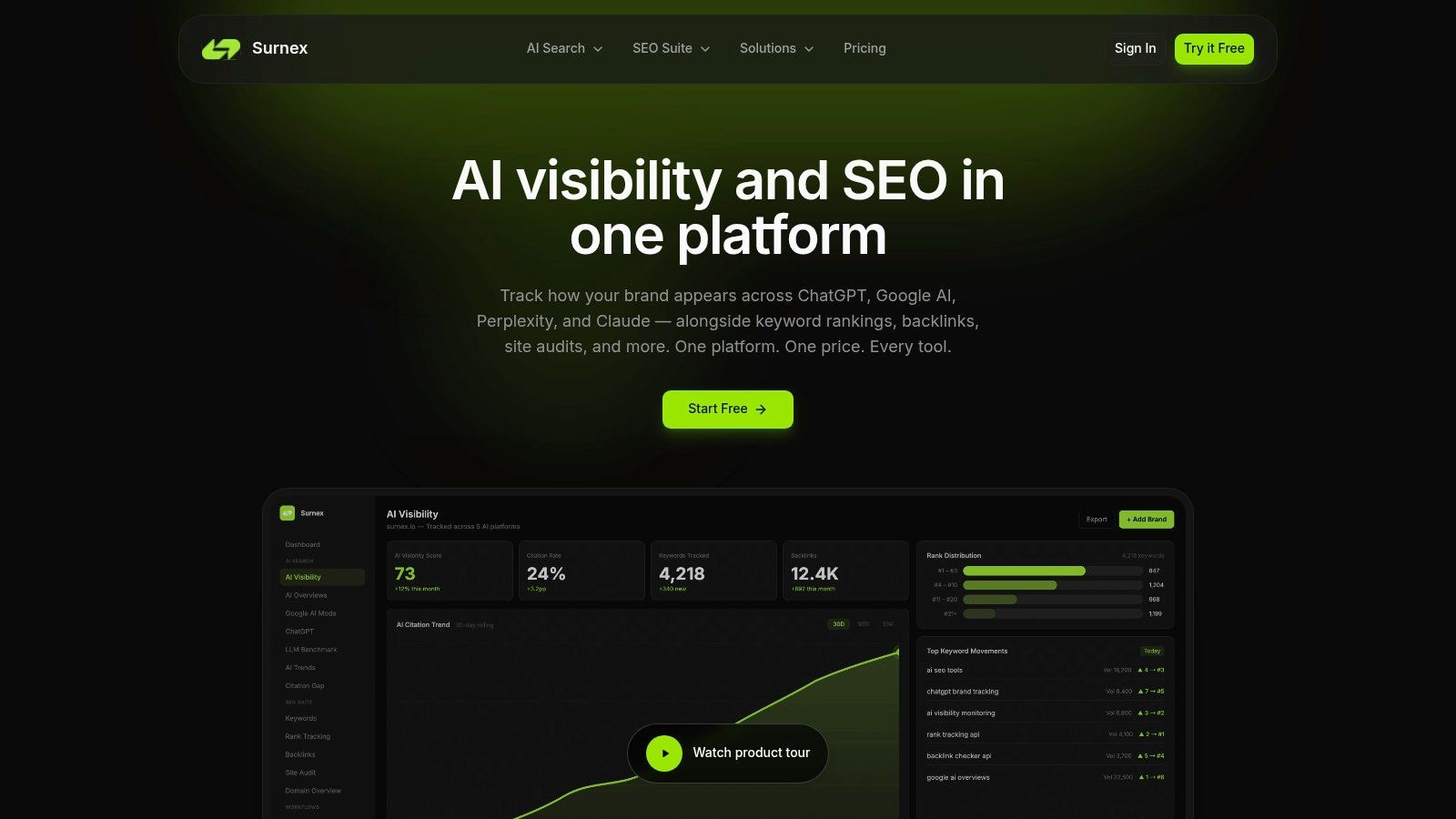
Surnex earns a different evaluation than the rest of this list because it sits in the AI Visibility layer first, then pulls traditional SEO operations into the same system. That matters more in 2025 than another content score or another keyword database.
A lot of teams still treat AI search as a reporting side project. Rankings live in one tool, backlinks in another, technical issues somewhere else, and AI answer monitoring gets handled with manual checks and screenshots. That setup breaks down fast once clients want a consistent view of how they appear across Google AI Overviews, ChatGPT, Perplexity, Claude, and standard organic search.
Where it fits best
Surnex fits agencies and in-house teams that need one operating view across search discovery, not just one more specialist app. It is especially useful when strategy, reporting, and implementation sit with different people and someone has to connect the dots without rebuilding the story every month.
The strongest use case is fragmented accounts. If organic traffic is flat, branded searches are rising, and AI answer inclusion is improving, teams need to explain all three in one place. Surnex is built for that kind of workflow.
What works in real agency workflows
The platform combines LLM benchmarking, citation gap analysis, AI trends, rank tracking, backlinks, audits, Core Web Vitals, local SEO, and keyword trend data. On paper, that sounds broad. In practice, the value comes from how those pieces support one review process instead of forcing teams to jump between dashboards.
Its AI visibility tracking across answer engines is the reason it belongs at the top of the AI Visibility category in this guide. Agencies can see where competitors are cited, where their own brand is missing, and which topics deserve content, link, or technical follow-up.
That changes the conversation with clients.
Instead of answering, "Are we showing up in AI search yet?" with scattered examples, teams can review inclusion patterns, citation sources, and supporting SEO signals inside one system. For agencies running multiple accounts, that structure is easier to standardize than a stack of disconnected point tools.
White-label reporting helps too. So do structured audits. Those features are less exciting than AI monitoring, but they save account managers real time because they do not have to translate raw outputs into client-ready reporting from scratch.
Trade-offs
Surnex is not the right pick for every buyer.
- Pricing transparency is limited: Larger teams will probably need a sales conversation before they can model full cost across users, clients, and workflows.
- AI search tracking is still a moving target: Answer engines change quickly, so measurements will never feel as stable as classic rank tracking.
- It is broader than pure content tools: Solo operators who mainly want article briefs or on-page recommendations may not use enough of the platform to justify it.
I would shortlist Surnex when the main problem is stack sprawl across AI Visibility, technical SEO, and reporting. I would not choose it just to polish blog drafts. In other words, it is a platform decision, not a writing assistant purchase.
2. Semrush
Semrush earns its place on this list because agencies rarely buy it for one task. They buy it to reduce tool switching across research, audits, rank tracking, reporting, and competitive analysis.
That strength also creates the main risk. A wide platform can tighten operations for one team and become expensive shelfware for another.
Best use case
Semrush fits agencies that want a central operating system for core SEO workflows, then layer in specialist tools only where the gaps are obvious. In a 2025 stack, I put it in the broad platform bucket rather than the pure AI Visibility or pure Content Optimization bucket. It covers enough of each workflow to support delivery, but its real value comes from how those workflows connect inside one account structure.
The AI Writing Assistant and ContentShake AI help with draft support and content ideation. The stronger reason to pay for Semrush is everything around them: keyword research, site audits, position tracking, backlink analysis, traffic estimates, reporting, and team onboarding. That matters in agencies because process consistency usually saves more time than any single AI feature.
If your team already handles authority work in a separate system, a dedicated backlink workflow in Surnex can complement Semrush reporting without forcing every account into the same link analysis process.
Real trade-offs
Semrush works well when someone on the team owns setup, naming conventions, reporting templates, and module adoption. Without that, agencies often end up using a fraction of the suite while paying for the idea of consolidation.
Cost is the second issue. Semrush pricing climbs as teams add users, reporting needs, local functionality, content features, and newer AI modules. For a small agency, the platform can solve stack sprawl and still create a budgeting problem.
I also would not treat Semrush as the strongest option in every micro-category. Its value is coverage. Teams that need the deepest backlink investigation, the most specialized content scoring, or a more focused AI answer engine workflow may still pair it with narrower tools.
That is the practical way to evaluate Semrush in this guide. It is less a single "AI SEO tool" than a hub for multiple SEO workflows. Agencies get the best return when they use it as the center of the stack, not as a promise that one subscription will solve every SEO problem by itself.
3. Ahrefs
Ahrefs still earns its place in 2025 for one reason. It helps teams answer hard competitive questions fast.
I use it less as an all-purpose SEO platform and more as a specialist tool inside the stack. If the workflow is competitor research, link risk review, content gap analysis, or technical triage, Ahrefs is usually one of the fastest ways to get to a usable answer. The interface also stays focused. You open Site Explorer, Keywords Explorer, or Site Audit with a clear job in mind, which matters in agencies where analysts are switching between accounts all day.
Best use case
Ahrefs is strongest in authority-led SEO workflows. It gives agencies a reliable way to inspect backlink profiles, compare domains, trace ranking movements, and find search demand patterns that deserve a closer look. For teams building strategy before content production starts, that matters more than having an AI writer built into the same subscription.
It also fits the workflow model in this guide better than a simple feature checklist suggests. Ahrefs belongs in the research and diagnosis layer of an agency stack. It supports AI Visibility work by showing where a site already has authority, where competitors are gaining traction, and which topics are realistic targets. It supports Content Optimization by improving the inputs. Better keyword selection, better SERP analysis, and better gap analysis usually produce better briefs.
If your team needs a second system for topic discovery and prioritization, a keyword research workflow in Surnex can complement Ahrefs data without forcing strategy, reporting, and execution into one interface.
Real trade-offs
Ahrefs has added features tied to newer search behavior, including brand and search visibility views. Useful, yes. Still, I would not buy it as my primary AI SEO platform.
The practical value is still in the crawler, the backlink index, and the speed of competitive analysis. That makes Ahrefs a strong choice for agencies with established sites, link-sensitive industries, or prospects who need a sharp teardown before signing. It is less useful as the operating system for content teams that need briefs, scoring, approvals, and writer collaboration in one place.
Cost and access control matter too. Ahrefs is easiest to justify when strategists and technical SEOs are the main users. It is harder to justify when account managers, writers, and clients all need regular logins, because the product is built for investigation more than broad team coordination.
Use Ahrefs when backlink quality, competitor structure, and technical findings shape the strategy. Choose a different primary tool if your main bottleneck is content production or AI reporting across many client accounts.
Ahrefs is still one of the sharpest tools in this category. In a 2025 agency stack, it works best as the research engine, not the whole system.
4. Surfer
Surfer earns its place in agency stacks for a simple reason. It reduces editorial ambiguity fast.
Writers open a draft, see a score, review topic coverage, and know what to revise without waiting on a strategist. That makes Surfer one of the more useful tools in the Content Optimization part of a 2025 SEO stack, especially for teams producing service pages, blog updates, and refreshes at scale.
What it does well
Surfer is built for on-page execution. The content editor, SERP-based recommendations, and AI drafting workflow help teams move from outline to optimization-ready draft with less back-and-forth.
That matters in agencies because content bottlenecks usually show up in production, not in strategy decks. Surfer gives editors a shared standard for coverage and structure, which makes review cycles faster and easier to manage across multiple writers.
I have found it most useful when the target query, page type, and search intent are already clear. In that scenario, Surfer saves time. It helps writers hit the brief more consistently, and it gives content leads a practical QA layer before publication.
Where it fits, and where it doesn't
Surfer belongs in the execution layer, not the planning layer.
Agencies run into trouble when they expect it to choose the right keyword, validate business value, or solve authority gaps. It can improve a page that deserves to rank. It cannot fix weak targeting, thin differentiation, or a site with no competitive footing in the SERP.
That distinction matters if you are building a usable 2025 stack instead of collecting overlapping subscriptions. Surfer handles Content Optimization well. It does not replace the systems you use for AI visibility tracking, topic prioritization, or account-level reporting.
For broader planning, a dedicated keyword research workflow for topic prioritization is a better complement than stretching Surfer beyond its job.
Practical limitations
The first limitation is operational. Usage caps and content credits can become a real budgeting issue once multiple writers, editors, and account teams are working across several clients.
The second is strategic. Surfer's recommendations can push teams toward score-chasing if nobody owns the brief quality. Pages start to look optimized on paper while saying little that is new, useful, or differentiated. That is a process problem, but Surfer can expose it quickly.
Used well, Surfer speeds up production and improves consistency. Used poorly, it turns optimization into a checklist exercise.
This is the trade-off. For agencies that already know what they want to rank and need a faster path from brief to publishable draft, Surfer is still a strong choice. For agencies looking for an all-in-one system across AI Visibility, research, and automation, it is one part of the stack, not the whole stack.
5. Clearscope
Clearscope has always done one thing better than most competitors. It gets writers to use the tool without much resistance.
That sounds small until you've tried rolling out SEO software across a content team. Many platforms are technically capable but operationally annoying. Clearscope usually avoids that.
Why editorial teams like it
The interface is clean. Recommendations are easy to understand. Collaboration friction is low. For content leads managing multiple writers and editors, that matters more than an overloaded feature list.
Clearscope has also moved toward AI-search-aware workflows with tracked topics and AI drafting support. That gives teams a way to keep pace with modern search behavior without rewriting their whole editorial process around prompts and experiments.
It isn't the broadest platform on this list, and that's part of its appeal. Teams buy it for editorial quality control, topic coverage, and scalable optimization guidance.
The real downside
The biggest issue is price fit. Clearscope skews toward professional teams, not freelancers trying to optimize a handful of posts each month. For a solo operator, the software can feel expensive relative to how narrow the workflow is.
This is also not the tool to buy if technical SEO, backlink analysis, local SEO, or client-level reporting are high priorities. It doesn't pretend to be that kind of platform, and that's fine. Problems start when buyers expect a content optimizer to behave like an agency operating system.
In a mature stack, Clearscope works best when an editorial lead wants consistency across writers and doesn't want to fight the software. If adoption is your main concern, it's one of the safer bets.
6. MarketMuse
MarketMuse is what I reach for when the primary problem is content planning, not page-level optimization. Agencies often buy writing tools first and realize later that they still lack a clear view of topic gaps, cluster priorities, and where existing content is too thin to support authority.
That puts MarketMuse in a different part of the stack. In a 2025 workflow, I’d classify it under Content Optimization with a strong strategy layer. It helps teams decide what to publish, what to refresh, and which topics deserve deeper coverage before writers start drafting.
Where it earns its keep
MarketMuse is strongest on content inventories, topical depth analysis, cluster planning, and AI-assisted briefs. The value increases with site size because the software has more material to evaluate, compare, and organize into a usable roadmap.
This matters for agencies building integrated stacks, not just buying isolated tools. If Semrush or Ahrefs handles research and demand signals, MarketMuse can turn that input into a publishable plan tied to topic authority, internal linking opportunities, and content refresh priorities. That is a different job from scoring a draft in an editor.
It is especially useful during strategy engagements. A large site with years of uneven publishing usually has hidden waste. MarketMuse helps surface where coverage is fragmented, where multiple articles compete for the same intent, and where a client thinks they own a topic but only covers the basics.
Where teams get stuck
MarketMuse expects process discipline.
If the team does not maintain a content calendar, assign refresh owners, or publish in clusters, the platform can feel heavier than it should. The software is not the bottleneck in those cases. Execution is.
That is the trade-off. MarketMuse gives better direction than lighter optimization tools, but it asks for someone who can turn topic models into briefs, briefs into production, and production into a measured content program. Small businesses and reactive teams often will not use enough of it to justify the cost.
For agency workflows, I would not use it as a standalone answer. It fits best as the planning layer inside a broader system. Pair it with rank tracking, technical auditing, and an AI visibility audit workflow if clients also care about how their brand appears in AI-driven answer surfaces, not just what should be published next.
MarketMuse is a strong choice for content strategy maturity. It is a weaker fit for teams that need faster wins, lighter tooling, or an all-in-one platform.
7. Frase
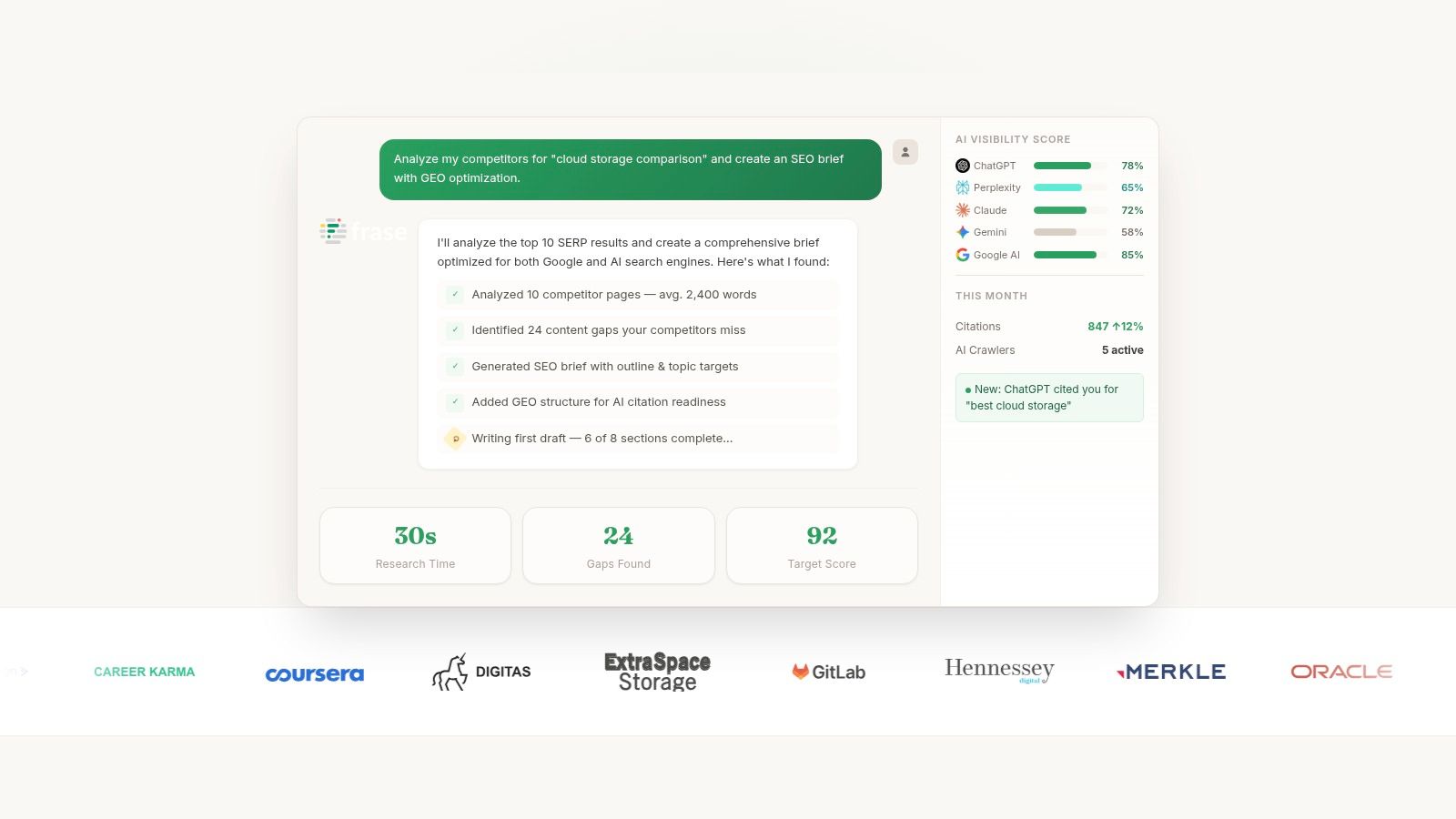
Frase works best for teams that need one operating layer for content production, not another specialist platform to manage. That distinction matters in 2025. Agencies are increasingly splitting their stack by workflow: AI visibility tools for answer-surface monitoring, content optimization tools for briefs and on-page improvement, and automation tools for repeatable production. Frase sits in the middle of those categories and tries to cover enough of each to keep day-to-day work moving.
That makes it a practical choice for smaller agencies and in-house teams with limited headcount.
The strength is workflow consolidation. Frase can support research, briefing, drafting, optimization, content refresh work, and AI agent or API-driven processes without forcing the team to stitch together five separate subscriptions. If account managers, writers, and SEO strategists all touch the same content pipeline, that simplicity has real value. Fewer handoffs usually means fewer missed updates, less version confusion, and faster turnaround on routine content work.
Its limits are also easy to spot once volume grows.
Frase is not the tool I would choose as the primary system for technical SEO, backlink analysis, or large-scale reporting. It is better viewed as a content operations tool with some adjacent capabilities, not a full replacement for platforms built for audits, link data, or enterprise governance. Agencies that treat it as an all-in-one SEO stack usually hit that ceiling fast.
A more realistic way to use Frase is inside a layered setup. Use it for the content optimization and production workflow. Keep rank tracking, technical auditing, and AI visibility monitoring in the tools that handle those jobs best. That division of labor tends to hold up better than expecting one platform to own every SEO workflow.
Best use case
Frase fits lean agencies, fractional SEO teams, and content marketers who need to publish consistently without building a heavy process around multiple tools. It is especially useful when the bottleneck is briefing, draft development, and getting pages updated on schedule.
What to watch
The trade-off is plan limits. Article caps, audit allowances, and AI-related usage thresholds can become restrictive faster than expected if you manage several active clients or publish at a high cadence. The entry pricing can look efficient, then become less attractive once production volume rises.
Frase earns its place in a best ai seo tools 2025 shortlist because it matches how many teams operate. It will not replace every specialist platform. It can reduce tool sprawl, speed up content operations, and give agencies a cleaner content workflow if they are clear about where it fits in the stack.
8. Scalenut

Scalenut has leaned hard into GEO, or generative engine optimization, and that's exactly why it's interesting right now. Instead of acting like AI search is just a minor extension of classic SEO, it organizes parts of the workflow around generative discovery.
For teams trying to operationalize AI-search content work, that's useful.
Best use case
Scalenut fits content-led teams that want AI search visibility tracking, content optimization, audits, internal linking, and publishing support in one environment. The WordPress and Shopify integrations also make it practical for ecommerce and fast-moving publishing teams.
Its pitch makes sense if your content process already revolves around briefs, drafts, refreshes, and internal link cleanup. You can keep that structure and add AI-search-aware monitoring rather than rebuilding everything from scratch.
What to watch
I wouldn't buy Scalenut without validating how its tracking coverage aligns with your actual targets. GEO language is attractive, but teams still need to confirm which engines, prompts, refresh cadences, and report limits matter for their accounts.
That isn't a criticism unique to Scalenut. It's true across the category. AI visibility features are evolving fast, and naming can outrun practical reporting depth.
For the right buyer, though, Scalenut can reduce complexity. It gives content teams one place to create, optimize, audit, and improve AI-search readiness without buying a heavyweight enterprise platform.
If your workflow is content-first and AI-search curious, it's a sensible tool to trial. If your workflow is technical SEO first, you may still need stronger support elsewhere.
9. Outranking
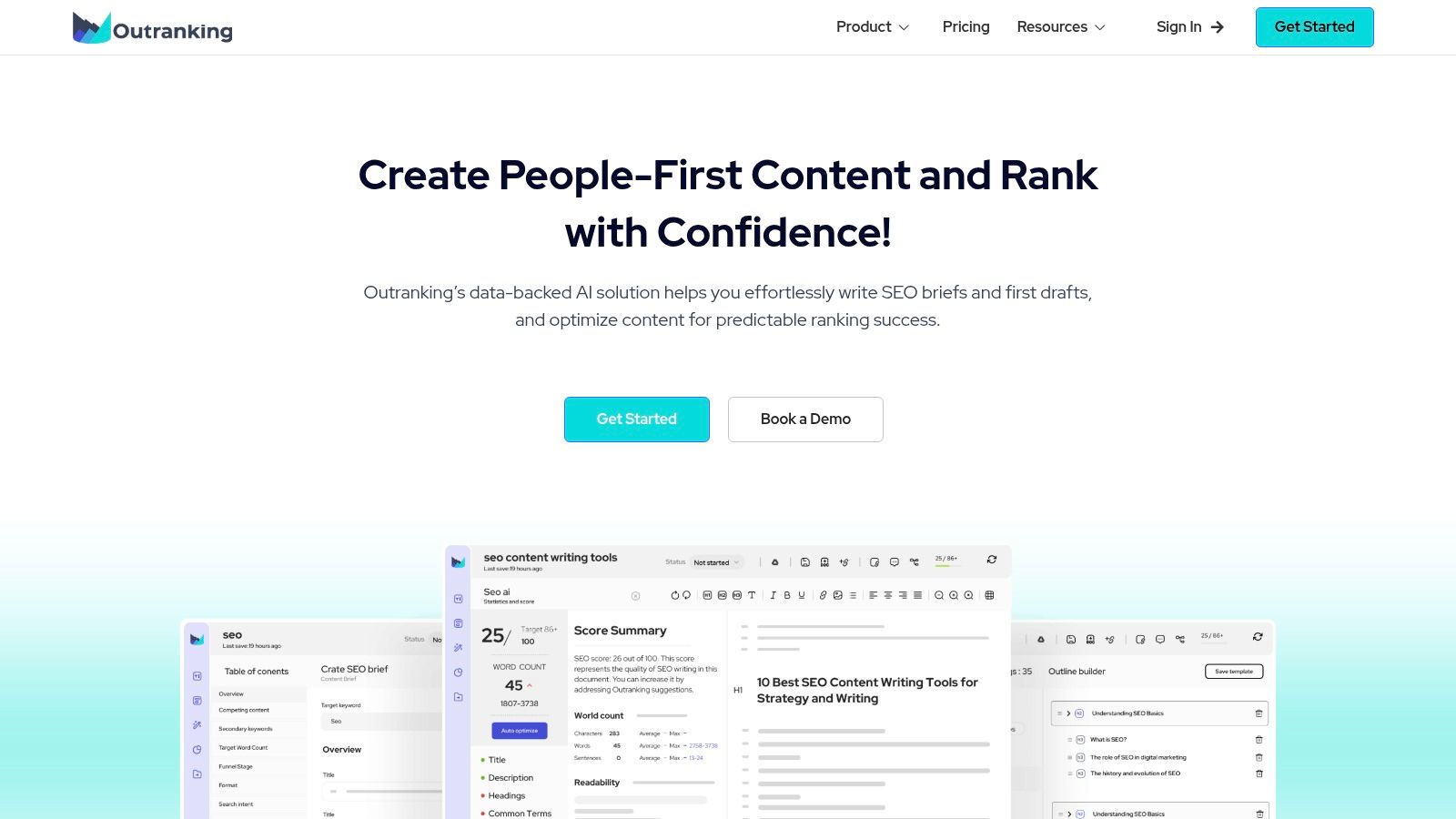
Outranking is built for teams that like predictable, document-based production. Some people see that as less advanced than a full content operating system. I see it as a strength when the team needs consistency more than complexity.
You open a document, build the brief, generate a draft, optimize it, and move on. That keeps the workflow clear.
What it handles well
Outranking is good at first drafts, structured briefs, competitor-informed optimization, and internal linking support. It's a solid fit for small teams publishing recurring article types, service pages, or comparison pages on a regular schedule.
The advantage isn't that every output is perfect. The advantage is that the process is repeatable.
If your bottleneck is getting from "topic approved" to "draft ready for edit," document-centered tools often beat broader platforms with too many moving parts.
That matters in agencies where writers, editors, and account managers all touch the same asset at different moments. A predictable workflow reduces review friction.
Where it falls short
Outranking doesn't replace a full SEO suite. Technical SEO coverage is lighter. Site-wide diagnostics aren't the core value. Advanced reporting and multi-layer competitive tracking aren't where it shines.
That makes it a good production tool, not a complete search intelligence platform.
For a lean content team, that's perfectly fine. For a full-service agency, it usually works better as part of a stack than as the entire stack. Buy it when content throughput is the pain point. Don't buy it expecting deep technical or AI visibility coverage across the business.
10. NeuronWriter
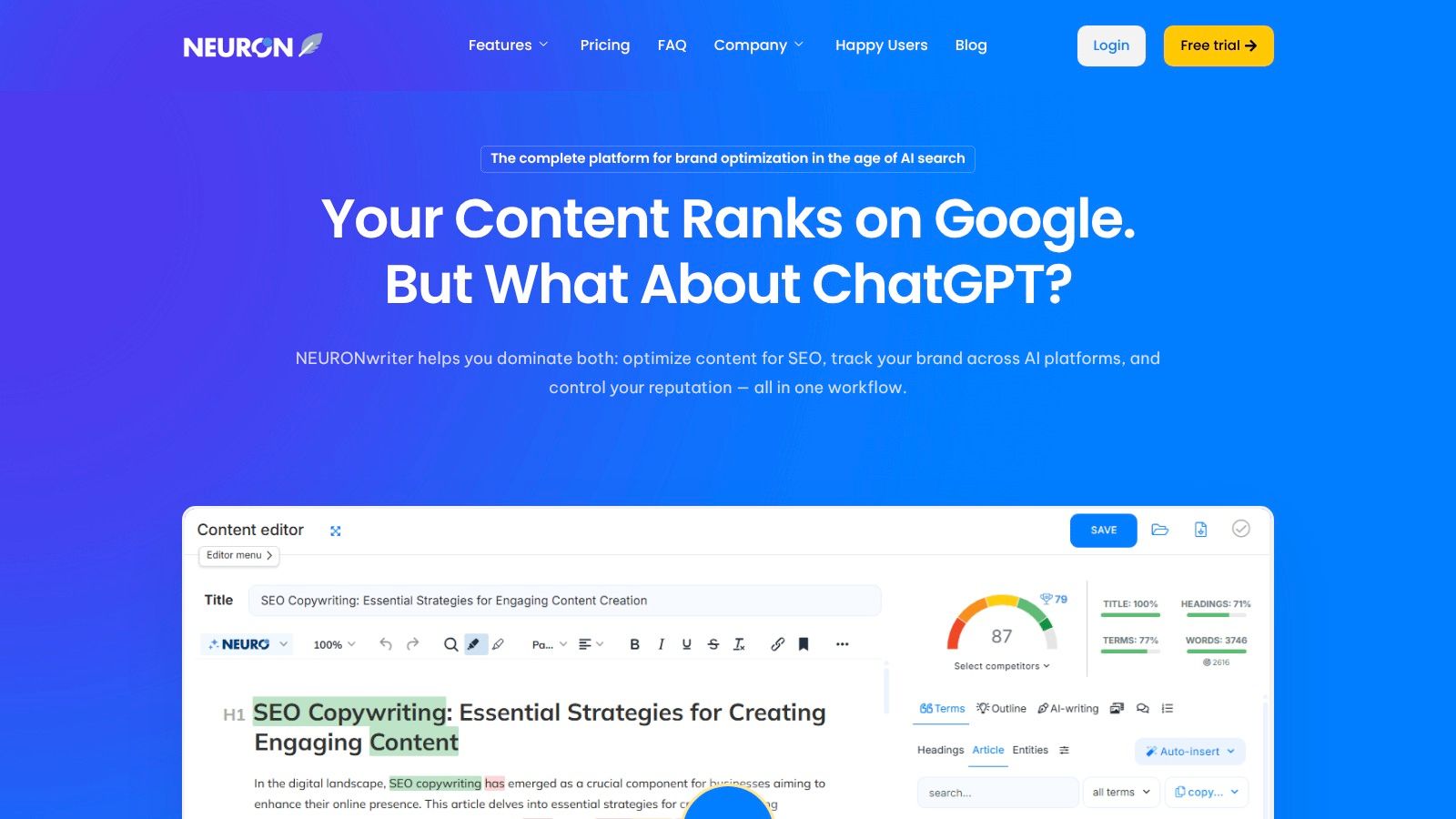
NeuronWriter is the budget-friendly option I mention when a team wants real optimization help without jumping straight into enterprise pricing.
It isn't flashy, but it solves a common problem well. Writers need clearer guidance, basic semantic coverage, and an easier way to improve drafts before publication.
Why it earns a spot
NeuronWriter offers NLP-driven content suggestions, outline help, internal linking recommendations, plagiarism checks, and the option to connect your own LLM API keys for generation. That last part is useful for teams that want more control over their AI writing setup without switching platforms entirely.
For lean teams, it covers enough ground to be useful. You can improve article quality, create more consistent outputs, and give non-SEO writers a framework they can follow.
The right expectation
NeuronWriter should be viewed as an editor companion, not a full SEO command center.
It won't replace enterprise reporting, large-scale backlink analysis, or advanced technical SEO tooling. It also won't solve messy strategy. If the site targets the wrong topics, no optimization editor can fix that.
Still, the value proposition is clear. Teams that don't need complex reporting or multi-client infrastructure can get meaningful editorial support without overbuying.
That makes NeuronWriter one of the more practical inclusions in the best ai seo tools 2025 discussion. Not every team needs a giant platform. Some just need a reliable editor that helps content get better before it goes live.
Top 10 AI SEO Tools 2025 Comparison
| Product | Core focus | UX & Quality (★) | Pricing & Value (💰) | Target (👥) | Unique selling points (✨) |
|---|---|---|---|---|---|
| Surnex 🏆 | API-first AI + SEO visibility (LLM benchmarking, citation gaps, ranks, backlinks, audits) | ★★★★★ | 💰 Free trial · plans $49–$399/mo | 👥 Agencies, in‑house SEO, marketers, developers | ✨ Unified AI+SEO dashboard; API & automation; LLM benchmarking; citation gap analysis |
| Semrush | Comprehensive SEO + AI suite (Semrush One, Writing Assistant, market intel) | ★★★★☆ | 💰 $$ · modular add‑ons | 👥 Agencies, enterprises, in‑house teams | ✨ Deep competitive data; broad integrations & reporting |
| Ahrefs | Backlink & keyword intelligence + emerging AI visibility modules | ★★★★☆ | 💰 $$ premium | 👥 SEOs, backlink-focused teams, agencies | ✨ Massive crawler; industry‑leading backlink index; Brand Radar AI |
| Surfer | On‑page/content optimization (Content Editor, SERP Analyzer, audits) | ★★★★☆ | 💰 $ (credits/limits) | 👥 Content teams, agencies, writers | ✨ NLP term suggestions; fast editor feedback; SERP-driven guidance |
| Clearscope | Editorial content optimization with AI‑tracked topics & drafts | ★★★★☆ | 💰 $$ (team/enterprise) | 👥 Editorial teams, content agencies | ✨ Clean UX; scalable collaboration; reliable recommendations |
| MarketMuse | Topic modeling & content strategy (briefs, inventories, planning) | ★★★★☆ | 💰 $$ (advanced tiers) | 👥 Content strategists, enterprises | ✨ Topic clusters, briefs & inventory for topical authority |
| Frase | End‑to‑end AI content + SEO platform with AI Agent & API access | ★★★★☆ | 💰 $ accessible (plan limits) | 👥 SMBs, agencies, content teams | ✨ AI Agent (80+ skills); consolidated research→writing→optimization |
| Scalenut | GEO‑centric AI visibility & content workflows (GEO content, audits) | ★★★☆☆ | 💰 $‑$ competitive | 👥 GEO-focused teams, SMBs | ✨ GEO-first workflows; WP/Shopify integrations; weekly visibility refresh |
| Outranking | AI-first drafts, briefs & optimization with auto internal linking | ★★★☆☆ | 💰 $ document-based pricing | 👥 Small teams, content shops | ✨ Automated first drafts; internal linking; doc-based workflows |
| NeuronWriter | Affordable content editor with NLP suggestions & API key generation | ★★★☆☆ | 💰 $ budget-friendly | 👥 Freelancers, lean content teams | ✨ Use your own LLM keys, plagiarism checks, CMS integrations |
Final Thoughts
Teams shopping for the best ai seo tools 2025 list usually overbuy and under-integrate. The problem is rarely feature depth. It is buying tools before defining the workflow they need to support.
A better approach is to build the stack in the same order work breaks down inside an agency.
Start with AI Visibility if clients are asking why impressions, mentions, and traffic no longer move in sync. Add Content Optimization when writers need tighter briefs, faster edits, and clearer on-page standards. Add Automation when account managers and analysts are wasting hours on recurring audits, exports, and reporting handoffs.
That framework matters more in 2025 because SEO work now spans three connected systems: classic search, answer engines, and the internal operations that keep campaigns moving. As noted earlier, AI search behavior is changing what teams can measure directly and what they need to explain in reports. Visibility does not always turn into a click. Rankings do not tell the whole story. Agencies need tools that help them track presence across surfaces, then connect that data back to business outcomes.
That is why the strongest products in this guide fit different jobs instead of competing as one-size-fits-all platforms.
- For unified AI visibility and SEO operations: Surnex
- For broad all-in-one traditional SEO depth: Semrush
- For backlinks and competitor intelligence: Ahrefs
- For content scoring and on-page execution: Surfer and Clearscope
- For topic authority planning: MarketMuse
- For consolidation on a smaller budget: Frase and Scalenut
- For document-based content production: Outranking
- For affordable editorial optimization: NeuronWriter
Automation is increasing, but editorial judgment still decides whether output is usable. As noted earlier, marketers still review AI-assisted content before publishing, and they should. These tools are good at speeding up research, clustering, outlining, optimization, and repetitive reporting. They are less reliable at prioritizing opportunities, matching search intent across a full funnel, or protecting brand voice without oversight.
My recommendation is practical. Buy for the bottleneck first.
For some agencies, that means using one platform as the system of record, then adding a specialist editor or planning tool only where the workflow improves. For others, it means replacing a pile of disconnected subscriptions with a tighter stack built around AI Visibility, Content Optimization, and Automation as separate functions.
If you want a broader view of AI software beyond SEO-specific platforms, the Aitop10 AI tools directory is a useful place to explore adjacent tools and categories.
If your team needs one platform to track rankings, backlinks, audits, keyword opportunities, and AI visibility across modern search experiences, Surnex is worth a close look. It fits agencies and in-house teams that want fewer disconnected tools, cleaner reporting, and repeatable workflows across traditional SEO and AI-driven discovery.