A model can move from near the top of an AI leaderboard to several places lower because the benchmark changed. One large-scale evaluation found that judge rankings shifted by up to 14 positions across benchmarks, while more than half of the 21 evaluated models moved by four or more places when tested on a different benchmark (large-scale benchmark evaluation). That makes the usual question, “Which model is number one?”, less useful than it sounds.
For an agency, this distinction affects real decisions. A strategist might recommend a model because it leads a public chart, then discover that it struggles with a client's product language, produces inconsistent citations, or costs too much for the intended workflow. AI benchmark ranking is a measurement instrument, not a purchase order. Read it as evidence about a bounded test, then verify whether that evidence transfers to the prompts, search engines, and outcomes your team manages.
What AI Benchmark Ranking Really Measures
A common agency meeting starts with a confident slide: a selected language model sits in the top three on a public leaderboard, so the strategist recommends it for content production, research, or an AI search project. The slide may be accurate, yet the recommendation can still be premature. The ranking answers only a narrow question: how did that model perform under that benchmark's specific conditions?
A benchmark is a controlled evaluation built from three ingredients:
- A fixed task set: Questions, documents, conversations, code problems, or other inputs.
- A model output: The answer, classification, summary, or action produced by the system.
- A scoring rule: A human judge, automated checker, exact match, rubric, or composite metric.
The ranking compresses many outputs into an ordered list. That compression helps a busy team compare systems without reading every response, but it also removes context. A model can rank highly because it performs exceptionally on the benchmark's subject mix, prompt style, or scoring method, while another model may fit a client's workflow better.
Three layers sit beneath every leaderboard
Start with the questions. Do they test academic knowledge, short language judgments, long-context prediction, tool use, factual retrieval, or summarization? The task distribution defines the capability being sampled.
Then inspect the model setup. A “model” may include a particular version, system prompt, retrieval layer, tool harness, decoding configuration, or response limit. Two evaluations can use the same model family and still measure different systems.
Finally, examine the metric. Exact-match scoring rewards one type of answer. A human or language-model judge rewards another. A multidimensional evaluation may value safety, fairness, efficiency, and accuracy together. Those choices can change the apparent order.
Practical rule: Before discussing rank, write down the task set, model configuration, run procedure, and scoring rule. If any of those are missing, the leaderboard is an incomplete signal.
A useful introduction to the broader discipline is this guide to performance benchmarking, which frames benchmarking as a repeatable comparison process rather than a single headline number. That mindset matters for agencies because a benchmark should support a decision, not replace one.
The Major LLM Leaderboards Worth Knowing
Different leaderboards behave like different exams. Comparing their results without understanding the exam is like choosing a marketing analyst because they topped a vocabulary test, then assuming they can also conduct customer research, build a forecast, and explain attribution.
MMLU is closest to a broad standardized exam. It covers many academic subjects and gives teams a rough view of general knowledge across domains. That breadth is useful when you want to filter out models that lack a wide information base, but it doesn't fully test the depth of reasoning, tool use, or domain-specific judgment required in a production workflow.
GLUE and SuperGLUE are suites of focused natural-language tasks. They test language understanding through well-defined exercises rather than open-ended interaction. Their strength is comparability. Their limitation is narrowness, especially for agencies evaluating long-form content, brand nuance, multi-step research, or source selection.
HELM, developed as a multidimensional evaluation approach, is useful when accuracy isn't the only concern. It can place performance alongside factors such as fairness, bias, toxicity, and efficiency, helping teams avoid treating one score as a complete description of model quality.
LAMBADA tests whether a model can predict a final word while using broader context. It offers a useful lens on contextual language modeling, but a strong result there doesn't automatically demonstrate reliable factual answers or good citation behavior.
For readers comparing current model options across business scenarios, the guida ELECTE all'AI per imprese provides additional context for thinking about models as tools with different trade-offs rather than interchangeable leaderboard entries.
Major LLM Benchmarks at a Glance
| Benchmark | What It Tests | Strength | Limitation |
|---|---|---|---|
| MMLU | Broad academic knowledge across subjects | Useful breadth signal | Doesn't represent every real-world workflow |
| GLUE | Focused natural-language understanding tasks | Clear, standardized comparisons | Narrow task formats |
| SuperGLUE | More demanding language understanding tasks | Stronger challenge for language reasoning | Still bounded by its task design |
| HELM | Accuracy plus broader responsible-use dimensions | Makes trade-offs more visible | Composite interpretation can be complex |
| LAMBADA | Context-aware last-word prediction | Probes longer-range context tracking | Doesn't establish production reliability |
The business question determines which benchmark deserves attention. MMLU can help with broad capability screening. GLUE and SuperGLUE are more relevant to structured language understanding. HELM is useful when governance and efficiency matter alongside accuracy. LAMBADA can inform context analysis, but it shouldn't decide a client-facing deployment by itself.
For agencies measuring the downstream effect of model behavior on search discovery, a separate monitoring workflow is necessary. A guide to tools for monitoring AI Overviews is relevant because benchmark literacy and visibility tracking answer different questions.
How Evaluation Methodology Shapes the Leaderboard
The rules behind an evaluation can move a model up or down the board even when its underlying capability hasn't changed. The most obvious example is run count. Language models can produce different answers from the same prompt under stochastic decoding, so a single result may reflect one favorable or unfavorable sample rather than a stable capability level.
A study that re-evaluated eight state-of-the-art models on an AI4Math benchmark found that 10 of 12 slices, or 83%, inverted at least one pairwise rank when compared with a three-run majority. Averaging two runs removed about 83% of those inversions (AI4Math re-evaluation study). The operational lesson is straightforward: don't treat a one-run jump as a dependable change in model quality.
Methodology Choices That Move Rankings
| Methodology Choice | How It Works | Effect on Ranking |
|---|---|---|
| Single run | Scores one sampled response per item | Sensitive to decoding variance and prompt effects |
| Multi-run evaluation | Repeats tasks and aggregates results | Produces a more stable ordering |
| Static benchmark | Uses a frozen test set | Easier to compare over time, but exposure can reduce freshness |
| Dynamic benchmark | Rotates or refreshes questions | Better protection against memorization, harder to compare directly |
| Public evaluation | Questions and procedures are visible | Transparent, but providers can optimize toward the format |
| Private or holdout evaluation | Test items remain hidden from model developers | Stronger test of transfer, with less external reproducibility |
Static and public benchmarks offer accessibility. Anyone can inspect the task design, reproduce a run, and compare published results. That transparency is valuable, but it also creates incentives to optimize for familiar formats. Dynamic, private, or holdout evaluations reduce that exposure, although they require more governance and make independent verification harder.
Prompt construction matters as well. Small changes in instructions, answer format, context length, or judge rubric can alter the result. A ranking that omits these details shouldn't be read as precise.
For executives, a practical framework for AI testing for CEOs can help translate technical evaluation choices into business decisions. Agency teams should ask not only which model scored highest, but whether the test resembles the client's actual work.
Decision rule: Trust a ranking more when it reports repeated runs, uncertainty, task definitions, version details, and scoring procedures. Treat unexplained single-run positions as directional.
Competitive monitoring adds another layer. Competitive intelligence can help teams place model evaluation inside the wider market context, but it shouldn't blur the difference between public performance evidence and client-specific validation.
Why Top Rank Can Be Misleading
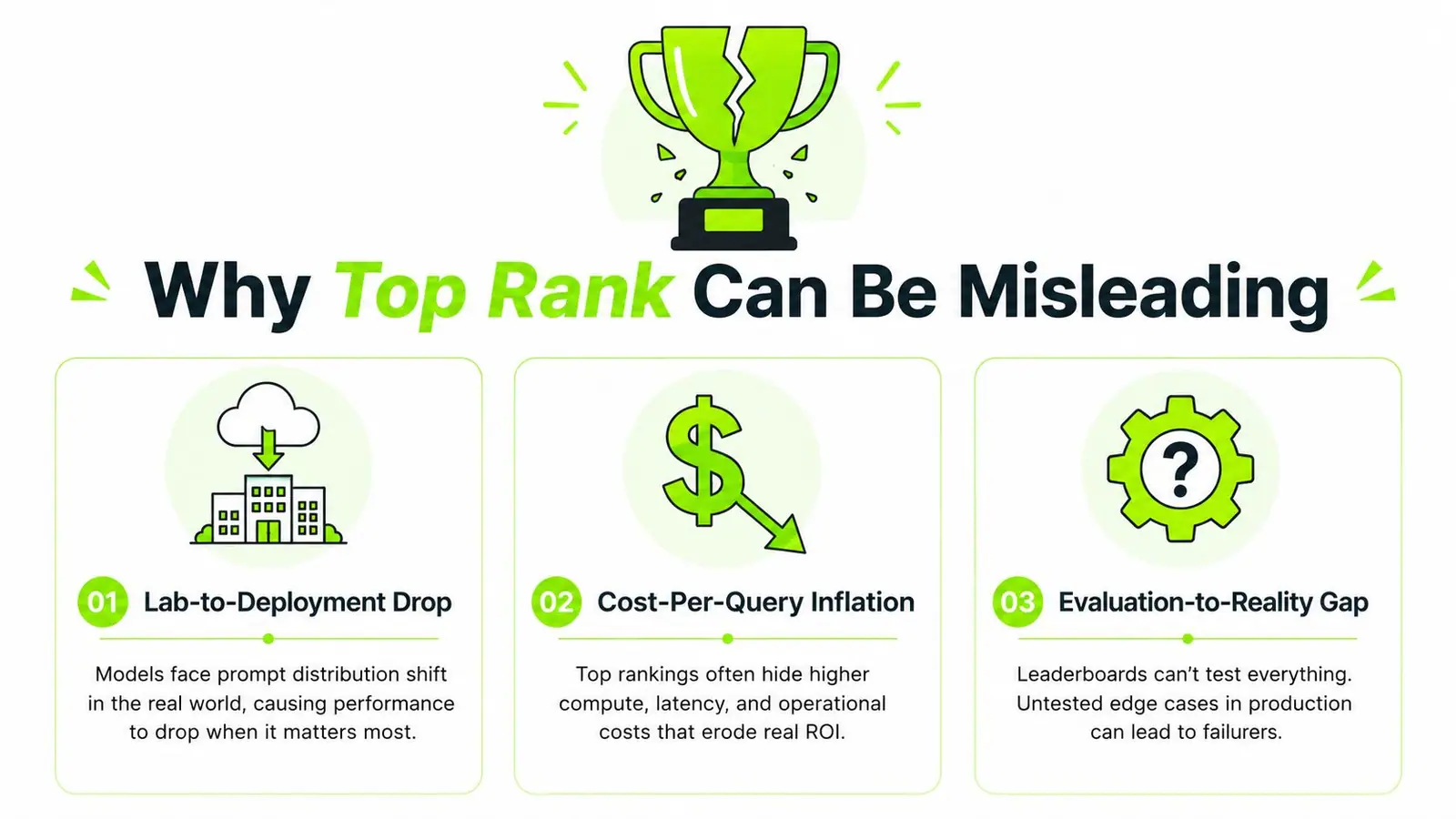
A top-ranked model has demonstrated strength on a defined evaluation. It hasn't automatically demonstrated production readiness. Three gaps explain why the ranking can overstate practical value: the lab-to-deployment gap, the cost gap, and the evaluation-to-reality gap.
Independent reporting on 2025 to 2026 research describes an enterprise agentic AI gap of 37% between benchmark performance and real-world deployment, while comparable accuracy can involve up to 50x cost variation (2026 AI benchmark guide). Those figures don't tell an agency which model to choose, but they do show why score and operating value must be separated.
The lab-to-deployment gap
A public benchmark uses a particular distribution of prompts and expected outputs. A client uses product names, internal terminology, messy source material, changing offers, and ambiguous questions. That distribution shift can expose failures that a clean test doesn't reveal.
A model might summarize general information accurately but omit a qualification when describing a regulated product. It might follow a short instruction well but lose the brand's preferred framing inside a long research prompt. These aren't contradictions of the leaderboard. They're evidence that the leaderboard measured a different environment.
Cost changes the winner
A flagship model may produce slightly stronger benchmark answers but require more expensive inference, longer responses, or additional retries. A mid-tier model may deliver adequate quality at a more sustainable operating cost. For a high-volume content or customer-support workflow, the model that ships may not be the model that tops the chart.
Teams should compare quality, latency, reliability, and cost on the same client tasks. A rank can narrow the candidate list, but it can't calculate the value of a workflow without those operating variables.
Contamination and edge cases
Public test items can become familiar through training exposure, tuning, or benchmark-focused optimization. Static scores can also miss long-context hallucinations, brand-name confusion, source selection errors, and prompt injection risks. Private or dynamic tests are useful complements because they make it harder for a system to succeed through memorization alone.
A visibility score for SEO should be interpreted similarly. It can organize a complex signal, but the agency still needs to inspect the underlying prompts, citations, and business relevance.
Agency standard: Use rank as a screening signal. Use audited client prompts to make the recommendation.
From Lab Scores to AI Search Visibility
Benchmark results become more useful for marketers when they're translated into a discovery workflow. A model's ability to recall facts, follow instructions, reason over structure, and summarize source material can influence how it answers a user who asks for product comparisons, vendor recommendations, or category explanations.
The path from prompt to citation has several stages. A user asks a question. The AI search experience interprets the intent, retrieves or weighs available information, forms an answer, and may cite selected pages. A site can lose visibility at any point. The model may misunderstand the query, fail to recognize the page's structure, prefer another source, or summarize the page inaccurately.
Benchmark categories offer leading indicators, not guarantees:
- Factual recall can suggest whether a system handles information-rich questions.
- Instruction following can inform structured prompts with constraints such as audience, geography, or format.
- Reasoning performance can indicate how a model handles comparisons and multi-step decisions.
- Summarization fidelity matters when an engine turns a page into a short answer.
- Context handling matters when the answer depends on several passages or qualifications.
Those indicators must be tested against the engines that matter to the audience. ChatGPT-driven discovery, Perplexity, Google AI Overviews, and other AI experiences may retrieve different sources and present different wording for the same prompt. A model can perform well in a lab category while a client's pages remain absent from the generated answer.
Map the signal to an owned outcome
Start with the client's priority prompts. Then connect each prompt to the desired outcome, such as a citation, a favorable brand description, inclusion in a comparison, or a path to a commercial page. This turns an abstract score into an observable search question.
Track the source URLs that appear, not just whether the brand name appears. A model might mention a company while citing a directory, outdated article, or competitor page. The source distribution tells the SEO team where the information gap sits.
The result is a layered measurement model:
- Benchmark evidence indicates general capability under published conditions.
- Prompt monitoring shows whether the target engine retrieves and describes the brand.
- SEO analysis identifies the pages, entities, and content gaps behind citation patterns.
- Business reporting connects visibility changes to actions the agency can control.
That last layer protects teams from overclaiming. A benchmark movement doesn't prove a visibility movement, and a visibility movement doesn't prove a conversion movement. Each requires its own evidence.
Tracking LLM Visibility for Clients in Practice
AI visibility tracking becomes actionable when an agency treats it as an operating process, not a single score. The workflow can sit beside traditional rank tracking and give each client a consistent way to examine how models describe the brand.
Step 1, build a client prompt bank
Create a curated prompt set for each account. Include category questions, comparison queries, problem-based searches, product questions, local or market-specific variations, and prompts that mention competitors. Tag each prompt by intent and link it to a relevant source-of-truth URL.
Keep wording stable enough for comparison over time, while maintaining a version history. If someone edits a prompt, record the change. Otherwise, a revised question can look like a visibility trend when it is a measurement change.
Step 2, define target engines
Choose the AI experiences used by the client's audience. The set may include ChatGPT, Perplexity, Google AI Overviews, and Copilot, but the mix should reflect the client's market and reporting needs.
Record the model or experience version whenever it is available. A model swap can change citation behavior even when the prompt remains unchanged, much like changing the instrument halfway through a test.
Step 3, run and review the queries
Automate recurring prompt sweeps where possible, then inspect a sample manually. Capture whether the brand appears, how the answer describes it, which URLs receive citations, whether competitors appear, and whether the response contains a material factual error.
A platform like Surnex can combine AI visibility monitoring with traditional SEO signals, including rankings, backlinks, audits, content opportunities, and an agent-ready API. Use those signals as inputs to the measurement system, then apply analyst judgment before recommending a client action.
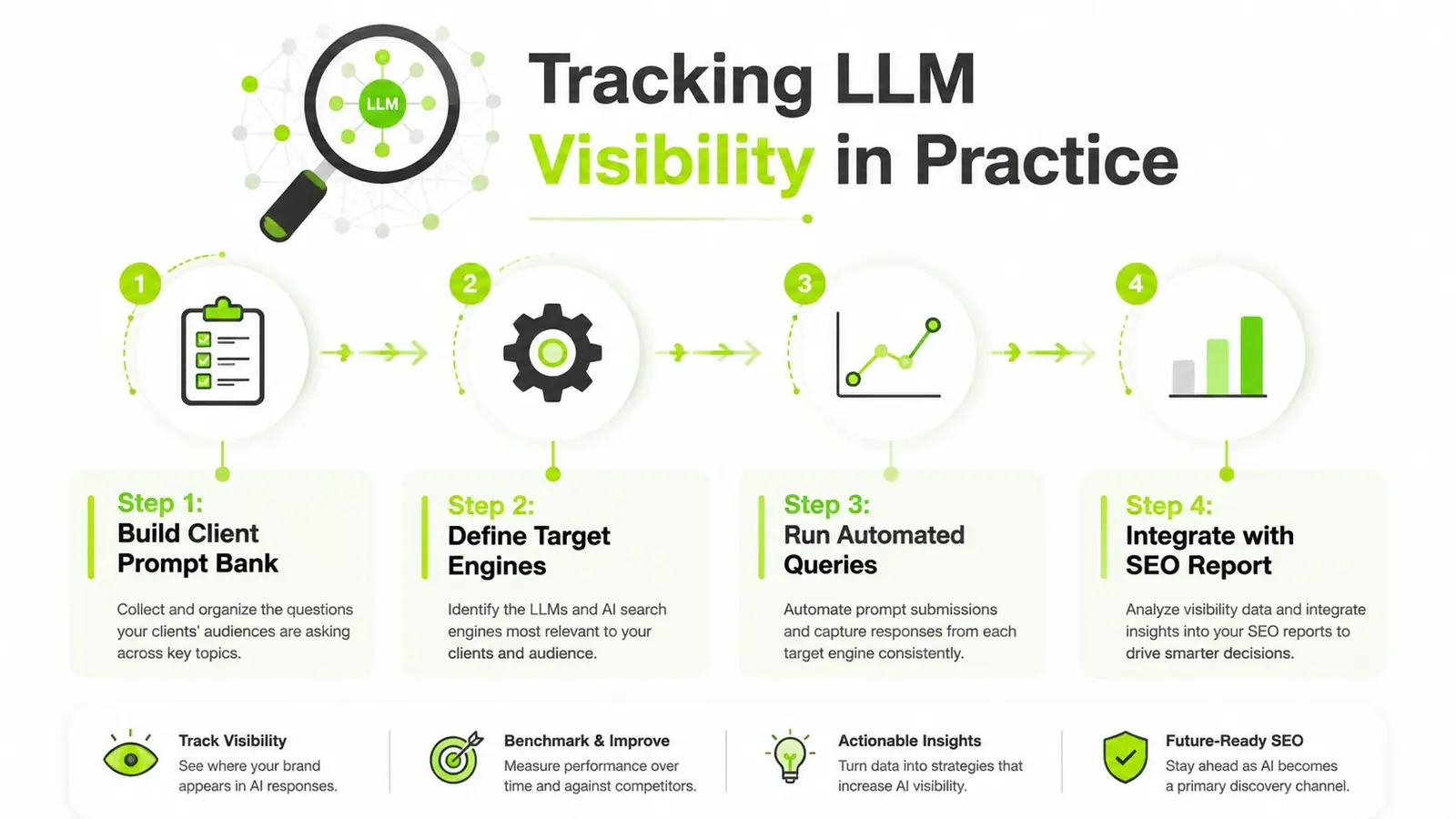
Step 4, integrate the findings into SEO reporting
A client dashboard should show the evidence behind a visibility score:
- Citation share: How often the client's pages appear among cited sources for the tracked prompt set.
- Brand sentiment and framing: Whether the response presents the brand accurately and favorably.
- Source-of-truth distribution: Which URLs earn citations and which important pages remain absent.
- Baseline movement: How current results compare with the agreed starting point.
- Change notes: Prompt edits, model swaps, site releases, and content updates that may affect interpretation.
Run weekly prompt sweeps for operational awareness, monthly audits for diagnosis, and quarterly benchmark refreshes against published evaluations. Explain changes to stakeholders as observed movement, then connect them to actions the agency can test. A benchmark can challenge assumptions, while client monitoring shows what changed in the discovery experience. Neither should be copied as a scoreboard without examining its conditions and evidence.
Frequently Asked Questions About LLM Rankings
How quickly can AI benchmark rankings change?
They can change whenever the benchmark, prompt setup, model version, decoding process, or scoring method changes. Stanford's 2026 AI Index reports that the top 15 models are separated by only about 3 percentage points on each benchmark (Stanford AI Index technical performance). Small score differences can therefore produce noticeable ordering changes.
Decision rule: Recheck important comparisons quarterly and whenever a major model release appears. Don't interpret a sudden position change as meaningful until the evaluation has been repeated under comparable conditions.
Can teams trust public leaderboards?
Public leaderboards are useful for initial screening, broad capability orientation, and tracking visible model progress. They become risky when teams treat them as direct evidence of client performance, especially if the test is static, public, lightly documented, or based on a single run.
Decision rule: Trust the methodology before the rank. Look for repeated runs, uncertainty reporting, fresh or held-out tasks, clear scoring, and model-version details.
When should an agency ignore benchmarks?
Ignore public rankings as the final decision tool when the use case is niche, highly regulated, brand-sensitive, retrieval-heavy, or tied directly to conversion paths. Build a private evaluation using the client's prompts, approved sources, failure criteria, and operating constraints.
Decision rule: If the benchmark doesn't resemble the work, use it only to eliminate clearly unsuitable candidates. Let controlled, repeatable client testing decide the recommendation.
What should a client report show?
Show the benchmark context, prompt-level visibility, citations, source quality, brand framing, and notable changes in the evaluation environment. Avoid presenting one score as proof that a model or content strategy caused a business outcome.
A leaderboard can tell you where to investigate. Your own monitoring should tell you what to do.
Surnex helps agencies compare how AI search experiences answer the same prompts, track brand citations across platforms such as Google AI Overviews and ChatGPT-driven discovery, and connect those findings with core SEO data. Visit Surnex to build a repeatable visibility baseline for each client and turn leaderboard noise into decisions your team can defend.