Your team starts Monday with five client accounts, five logins, and five different versions of the truth. One dashboard shows rankings, another contains backlink data, a crawler flags technical issues in a spreadsheet, and a reporting tool packages metrics that don't quite match the numbers your strategist discussed with the client. Then a client asks a simple question: “Are we appearing in AI search?”
That question exposes the core problem. An agency SEO platform isn't merely a larger keyword tracker or a prettier dashboard. It's the operating layer that connects traditional SEO, AI visibility, client reporting, and team accountability. Google's AI Overviews now appear across a substantial share of tracked searches, while citation sources don't reliably match the pages ranking in the organic top 10, according to analyses from Digital Applied and OmniBound. Agencies therefore need to manage more than blue-link positions.
Why Agencies Outgrow Disconnected SEO Tools
A small agency can manage separate tools while it serves a few accounts. The account manager checks rankings, a technical specialist exports a crawl, the content lead researches topics elsewhere, and the strategist assembles the monthly report from screenshots and spreadsheets. The routine breaks down when several clients need answers at the same time.
Consider a local service business, a SaaS company, an ecommerce brand, and two professional-services firms. Each has different keywords, competitors, conversion goals, and technical risks. A traffic decline for one may follow a template change. Another may be absent from AI answers because relevant pages are not being cited. A third may need content that addresses questions customers ask in conversational search. With separate tools, every specialist must rebuild the account's context before deciding what to do.
That reconstruction creates three operational costs:
- Time loss: Specialists move data between systems instead of diagnosing the underlying problem.
- Client confusion: Different date ranges, naming conventions, and measurement methods make reports harder to trust.
- Missed ownership: A visibility change may be visible in a dashboard, yet no one is assigned to investigate, approve, or resolve it.
Search now produces more signals for an agency to manage. Traditional SEO reporting covers rankings, clicks, impressions, backlinks, and technical health. AI search introduces inclusion, brand mentions, answer-engine citations, prompt coverage, and changes in the sources selected for responses. These signals become useful when the team can connect them to pages, campaigns, and accountable owners. The broader data integration challenges explain why disconnected systems create duplicated work and inconsistent decisions.
Tool sprawl changes the client conversation
Clients want an explanation they can act on. They need to know what changed, why it changed, and what the agency will do next. Presenting organic rankings in one meeting and AI visibility in another makes the work look like separate projects, even when both affect the same search strategy.
The platform choice therefore sets the agency's workflow and accountability model. Each account needs a shared record that links an observed issue to a recommended action, a responsible team member, and a client-ready explanation. That structure turns reporting into a working plan rather than a collection of charts.
Practical rule: If a metric cannot lead to a clear owner and next action, keep it in an analysis workspace instead of placing it on the front page of a client report.
Rank tracking remains necessary, but it no longer describes the full picture of search visibility. Agencies must protect organic performance while monitoring where clients appear in AI-generated answers. A unified operating rhythm lets the team measure both, assign follow-through, and explain the relationship to clients without forcing everyone to reconcile separate systems.
What an Agency SEO Platform Does
An agency SEO platform functions as a coordination layer for multiple client accounts. It gives the team one view of search performance, technical risks, priorities, and reporting responsibilities, while keeping each account's data separate. That structure matters more as agencies track both traditional rankings and visibility in AI-generated answers.
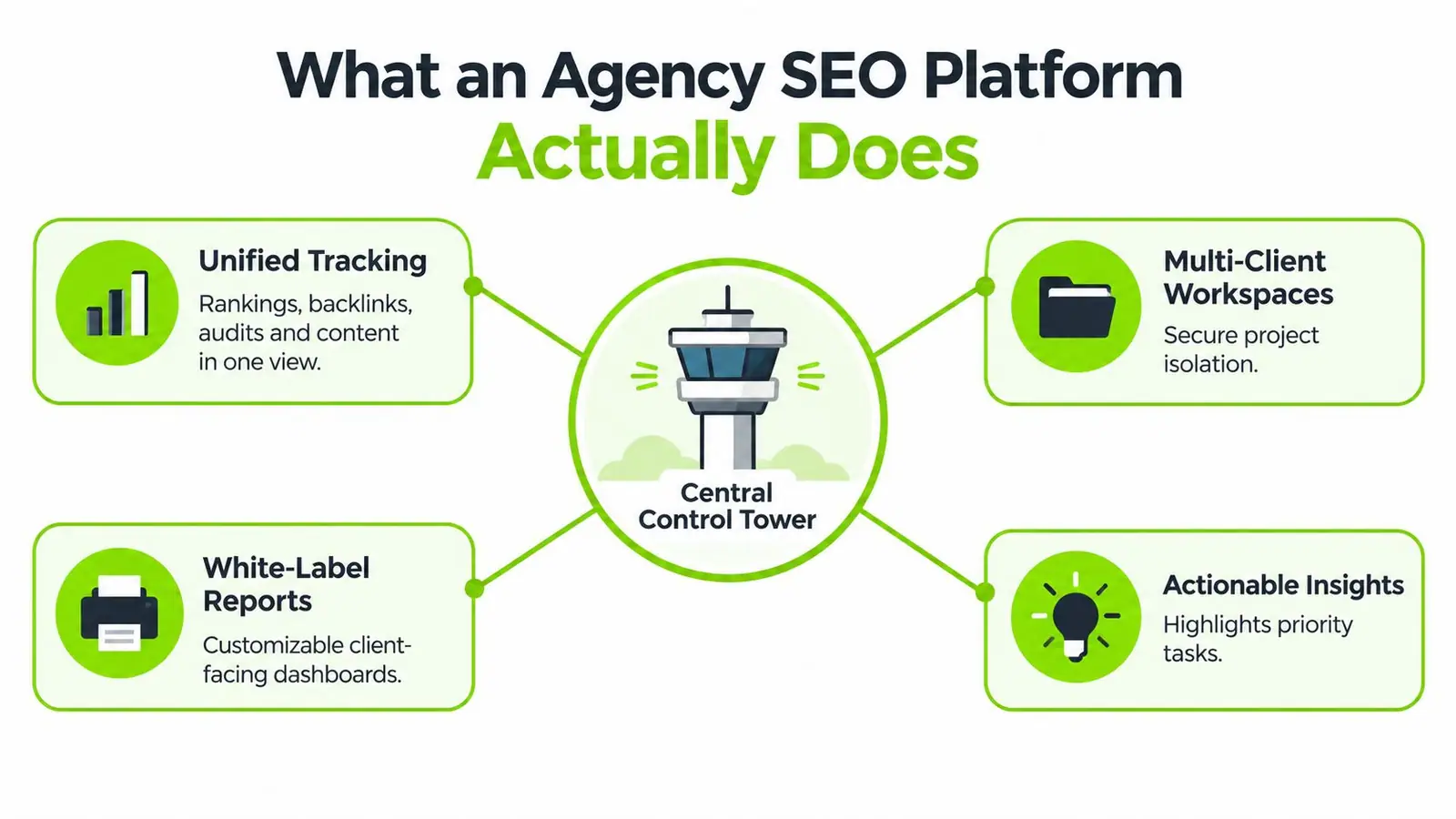
A useful platform connects four jobs.
It gathers the signals
The first job is data collection. The platform should bring together organic rankings, backlinks, technical audit findings, content opportunities, and relevant performance data. The benefit comes from interpreting those sources together, rather than checking each one in isolation.
A ranking decline means something different when the affected pages also show indexing errors, lost internal links, or a competitor gaining referring domains. A content opportunity becomes more actionable when the team can see whether it supports a commercial page, a related article, or an AI citation gap.
It keeps accounts separate
The second job is multi-client isolation. An agency platform should give every client separate projects, settings, users, data, and reporting views. A strategist can then switch between accounts without risking a cross-client mistake.
Agency software guidance describes the need for separate projects and scheduled reports across portfolios, alongside crawl monitoring, template analysis, rendering checks, and API integrations. These requirements are outlined in agency SEO software guidance. Shared infrastructure should simplify management without creating shared client data.
It turns information into work
The third job is prioritization. A list of errors does not tell a team what to fix first. The platform should help distinguish a broken indexation directive from a low-priority metadata suggestion, or a citation gap tied to a valuable prompt from an observation with little effect on the client's goals.
That connection turns monitoring into an operating process. An issue can move from detection to investigation, assignment, and follow-up without being copied between unrelated tools.
It produces an explanation
The fourth job is communication. White-label dashboards, scheduled reports, permissions, notes, and exports help the agency turn technical findings into a consistent client experience. Account teams should not need to rebuild the narrative from raw exports each month.
Watch the embedded overview for a visual explanation of how these functions fit together:
The architectural distinction is straightforward. A single-site SEO tool helps one team investigate one property. An agency SEO platform manages multiple properties through a shared data layer, preserves account boundaries, and connects traditional SEO monitoring with AI visibility, decisions, and client communication.
Core Features Every Agency Should Expect
Feature lists become useful only when they map to real jobs. Ask what your team must do during onboarding, weekly delivery, technical QA, reporting, and scale. Then evaluate whether the platform removes manual steps or adds another place to check.
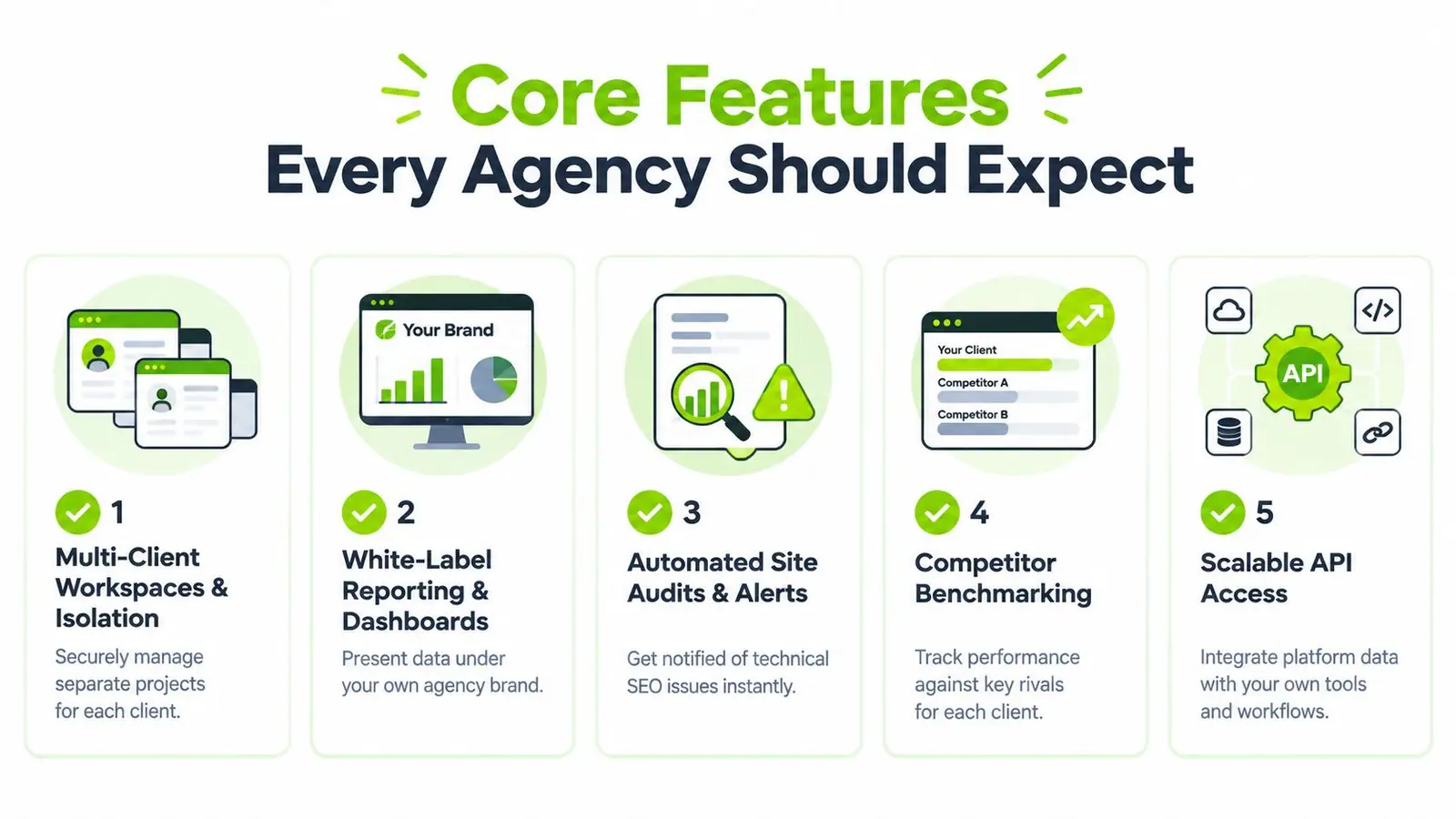
Multi-client workspaces and isolation
Client workspaces should support separate domains, keyword sets, competitors, integrations, users, and report templates. Look for account-level permissions, because a freelancer working on one client's content shouldn't automatically see another client's financial or performance data.
The platform should also make onboarding repeatable. A team lead needs a standard setup process that captures business goals, locations, search themes, competitors, conversion events, and reporting preferences without rebuilding the project structure from scratch.
White-label reporting and scheduled delivery
Reporting is a delivery product, not an administrative afterthought. A useful system lets agencies apply their branding, choose the metrics relevant to each client, add commentary, schedule delivery, and preserve a history of prior reports.
The report should answer three questions:
- What changed?
- Why does it matter?
- What will the team do next?
That logic is more valuable than a page filled with charts. For broader guidance on reducing manual monitoring work, see automated SEO monitoring practices.
Technical audits and alerts
A crawler should identify technical issues, but agency-scale auditing needs more than a one-time error list. Enterprise requirements include crawl-budget monitoring, template-level performance analysis, and detection of server or rendering bottlenecks, as outlined in the agency SEO software reference.
Alerts should also be actionable. A notification that says “errors increased” creates another investigation. A notification that identifies affected templates, URLs, severity, and likely owner helps the team respond.
Rankings, backlinks, and benchmarks
Rank tracking still matters for priority queries, locations, devices, and competitors. Backlink tracking adds context about authority, lost links, new referring domains, and competitor acquisition patterns. Benchmarking should remain account-specific, because a useful competitor set for a regional clinic won't resemble one for a software company.
If your agency evaluates visibility across different language models, a separate technical resource for teams that need to compare AI model performance can help with model-level testing. The agency platform itself should still connect those observations to client prompts, content, and reporting.
API access and automation
An API lets developers connect platform data to internal dashboards, project-management systems, alerts, and client portals. Integrations with Search Console and analytics systems are especially important because first-party performance data should sit beside third-party rankings and backlink signals.
Use this checklist during a vendor review:
- Account structure: Can each client have isolated projects and permissions?
- Delivery: Can reports be branded, annotated, scheduled, and exported?
- Technical control: Can the team monitor recurring crawls, templates, and regressions?
- Search coverage: Can it track rankings, backlinks, content opportunities, and AI visibility?
- Extensibility: Can developers access the data through an API and automate routine actions?
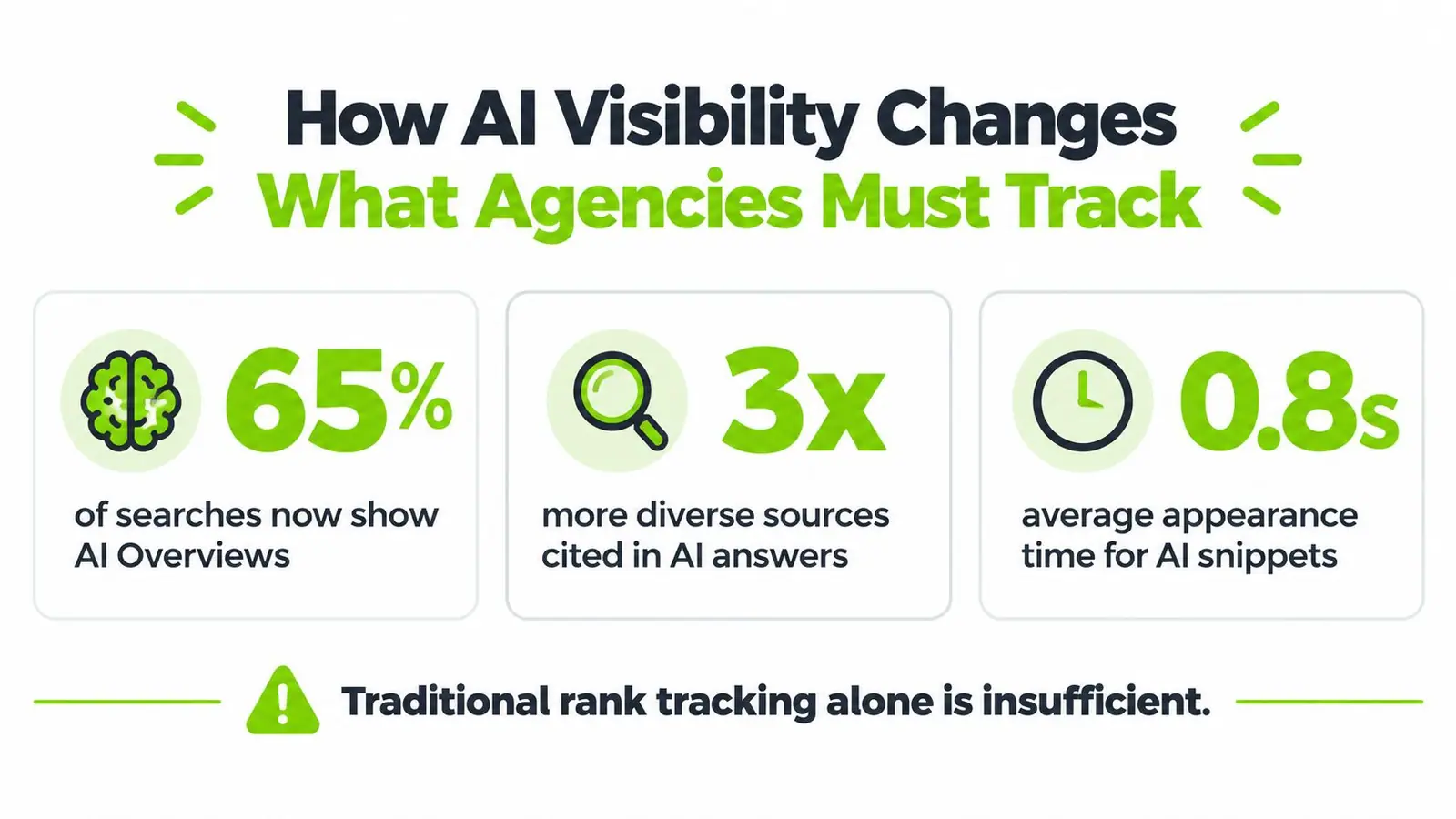
How AI Visibility Changes What Agencies Must Track
A client can hold a strong organic position and still disappear when a buyer asks an AI system for a recommendation. The reverse can happen too: a page outside the traditional top results may become a cited source. Agency reporting must therefore measure two connected outcomes, discoverability through ranked pages and inclusion in generated answers.
AI Overview coverage has expanded rapidly. One 2026 analysis reported AI Overviews on 48% of all search queries in March 2026, up from 34.5% in December 2025, while another study measured about 25.11% of 21.9 million searches in Q1 2026. The studies used different samples and methods, so neither figure should serve as a universal benchmark. Regardless of the exact figure, both studies confirm that AI Overviews appear on a significant share of queries, making dedicated tracking necessary for agencies. The first analysis also reported an average of 4.6 source citations per AI Overview and estimated reach of about 1.7 billion monthly users, as discussed by Digital Applied.
Rank position and citation ownership are different signals
Organic ranking and citation ownership answer different questions. A page may rank well yet receive no citation in an AI answer. Another page may rank outside the organic top 10 and still be selected as a source. A 2026 analysis found that only about 17% of AI Overview citations came from pages already ranking in the organic top 10, according to OmniBound's AI SEO analysis.
The reporting model should keep existing SEO measures, including clicks, impressions, technical health, and conversions, while adding an AI visibility layer:
- Inclusion: Whether the client appears for target prompts and relevant query themes.
- Citation ownership: Which client pages, publications, or external sources AI systems cite.
- Brand presence: Whether the brand appears in ChatGPT-driven discovery and other answer environments.
- Prompt coverage: Which customer questions produce useful, accurate visibility.
- Citation gaps: Where competitors or third-party sources appear while the client remains absent.
- Trend direction: Whether visibility is strengthening, weakening, or changing across surfaces.
Turn visibility into assigned work
A report that says “the brand was not mentioned” gives a team no next action. The strategist should connect each gap to an intervention. A missing citation might require a clearer product page, a stronger comparison section, an expert-led article, updated facts, or coverage from a credible publication. A misleading answer may call for coordinated content, public relations, and brand communication.
Teams studying AI visibility for SaaS marketing can use that context to assess visibility beyond blue-link clicks. For a repeatable measurement process, generative engine optimization measurement helps define what to collect, compare, and report instead of relying on occasional screenshots.
The agency platform should make this measurement accountable. A strategist identifies the gap, assigns the work, and reports whether the change improved visibility. Organic SEO protects discoverability through ranked pages, while AI tracking shows whether the brand enters the answer, the citation set, and the buyer's consideration process.
How to Evaluate and Compare Agency SEO Vendors
A vendor demo can make every platform look capable. The practical test is whether your team can complete a real client workflow without exporting data, switching tools, or asking support to explain basic account structure.
Start with a representative account. Use a site with meaningful technical complexity, a defined competitor set, existing reporting expectations, and questions that could surface in AI search. Ask the vendor to show the entire path from data collection to client-ready action.
Test the workflow, not the feature inventory
Give the vendor a scenario such as this: a key template loses organic visibility, a competitor gains citations for a commercial prompt, and the client's monthly report is due. Can the platform identify the change, connect it to affected URLs and sources, assign a next step, and produce a branded explanation?
Evaluate these dimensions:
- Data unification: Do rankings, audits, backlinks, content, conversions, and AI visibility share context?
- Account scalability: Can the structure support a growing portfolio without making permissions and reporting difficult?
- Workflow maturity: Can people assign, review, annotate, and close work inside the operating process?
- Reporting depth: Can the agency separate executive outcomes from specialist diagnostics?
- Automation potential: Can scheduled collection, alerts, exports, and API workflows run reliably?
- Collaboration: Can SEO, content, PR, brand, and client teams work from shared goals?
The market structure supports the need for this kind of platform. An Ahrefs-based industry summary reports typical monthly SEO agency pricing of around $3,200, compared with about $3,250 for consultancies and roughly $1,350 for freelancers, as summarized by Reboot Online's SEO statistics. Those figures are historical market signals, not a price recommendation. They show why agencies need repeatable delivery and enough operational control to justify a packaged, recurring service.
Use a decision matrix
| Evaluation Criteria | What Good Looks Like | Red Flag to Avoid |
|---|---|---|
| Workflow maturity | Issues connect to owners, priorities, notes, and follow-up | The dashboard only displays metrics |
| Reporting depth | White-label reports explain outcomes, causes, and actions | Reports require manual exports and slide rebuilding |
| AI and SEO integration | Organic and AI visibility appear in one account workflow | AI data sits in a separate silo |
| Agency scalability | Client isolation, permissions, templates, and automation work together | Shared settings create cross-client risk |
| API readiness | Documented access supports internal tools and scheduled processes | API access exists but lacks useful account-level data |
| Technical insight | Audits reveal template patterns, regressions, and priority | The system produces long lists with no triage |
| Collaboration | Content, SEO, PR, and brand teams can use shared objectives | Only one specialist can interpret the data |
During the demo, ask how the vendor handles missing data, changing search surfaces, historical comparisons, prompt management, client access, and failed integrations. You can also review the wider market through SEO reporting tools for agencies, but judge every option against your actual delivery process.
How Surnex Unifies SEO and AI Search for Agencies
Surnex brings the two measurement layers into one agency workflow. Its platform combines AI visibility tracking with rankings, backlinks, audits, and content opportunities, so the team can investigate traditional performance and emerging answer-surface exposure within the same client context.
A team lead can begin with a monitoring question: did an important page lose rankings, disappear from a citation set, or experience a technical regression? The next step is interpretation. Surnex monitors appearance in Google's AI Overviews and newer AI modes, tracks brand presence in ChatGPT-driven discovery, benchmarks visibility across leading large language models, and surfaces citation gaps and trends over time.
That sequence supports a practical client conversation. Instead of telling a client that “AI search is changing,” the strategist can show where the brand appears, which prompts matter, which sources are being cited, and what content or authority work could close the gap. Traditional SEO recommendations remain visible alongside the AI findings, which helps the agency avoid replacing a proven workflow with an isolated experiment.
From observation to delivery
The platform's single-dashboard approach is most useful when paired with agency routines:
- Monitor: Collect organic, technical, backlink, content, and AI visibility signals for each account.
- Interpret: Identify changes that affect the client's commercial priorities or brand presence.
- Prioritize: Separate urgent technical regressions from strategic content and citation opportunities.
- Coordinate: Give the relevant task to SEO, content, PR, development, or brand owners.
- Report: Explain the finding and action through a consistent client-facing view.
- Automate: Use the agent-ready API and automation capabilities to connect recurring work with internal systems.
This model addresses the operational gap identified in research from Semrush, which reported that only 22% of marketers say their SEO and AI search efforts are fully integrated across strategy, execution, and reporting. The same research found that only 28% of marketers who view AI search as an extension of SEO use one shared workflow across both. The implication for agency leaders is clear: integration isn't just a product checkbox. It determines whether the team can explain, execute, and prove the work consistently.
Choosing the Right Platform and Moving Forward
Choose an agency SEO platform based on the work your team must perform, not the number of cards on its homepage. The right system should connect client data, diagnosis, ownership, automation, and reporting across classic search and AI-driven discovery.
A sensible pilot starts with one or two clients that represent your normal delivery challenges. Before expanding, verify that the team can:
- Onboard cleanly: Create isolated workspaces, permissions, integrations, competitors, and reporting goals.
- Monitor consistently: Track organic rankings, technical health, backlinks, content opportunities, and relevant AI visibility.
- Act on findings: Turn citation gaps, ranking changes, and audit alerts into assigned work.
- Report clearly: Explain outcomes without forcing clients to understand the agency's internal tools.
- Prove continuity: Compare changes over time and show how actions relate to observed visibility.
Don't ask whether a platform has AI tracking in isolation. Ask whether it helps your agency coordinate content, SEO, PR, development, and brand around shared client goals. Scrunch's 2026 survey found that 45% of respondents were testing visibility across AI platforms, while 58% weren't updating content to improve citation likelihood and 63% weren't mapping content, press, or campaigns to real prompts, according to its AI search survey. Those findings point to a process gap, not merely a missing dashboard.
The strongest choice will help your team preserve traditional SEO discipline while building a repeatable approach to AI visibility. Pilot the workflow, inspect the handoffs, involve the people who deliver and explain the work, then scale only after the process feels dependable.
Surnex brings rankings, backlinks, audits, content opportunities, AI visibility, citation gaps, client reporting, and an agent-ready API into one workflow for modern agencies. Visit Surnex to see how your team can replace tool hopping with a clearer operating model for traditional and AI-era search.