Your agency is living in the same mess most growing teams hit. Five clients turn into fifteen. One reporting tool turns into three. Then the spreadsheets show up because no single platform covers rankings, backlinks, audits, conversions, and the client-friendly view your account team needs. By the time the monthly report goes out, half the work was moving data from one place to another.
The client conversation is changing again. They are not just asking where they rank. They are asking why they are not showing up in AI Overviews, why branded search feels different, and why traffic looks flat even when rankings seem stable. A clean keyword report and a GA4 screenshot do not answer that anymore.
That is the core problem behind most searches for seo reporting tools for agencies. You are not just buying charts. You are buying a workflow. You need something your team can operate without constant hand-holding, something clients can understand without a long call, and something flexible enough to cover both classic SEO and the newer AI-driven search surfaces that are starting to reshape visibility.
The good tools reduce manual work. The better ones help you tell a clearer story. The best ones also help you answer the question clients will keep asking more often over the next year. “Where are we visible now?”
That matters even more if your services are already blending channels. The agencies getting the best client conversations tend to connect search reporting with the rest of demand generation, not treat SEO like a silo. If that is your model, this piece on PPC and SEO working together is worth reading alongside your reporting stack decisions.
Below is the short list I would consider, grouped by how agencies work. All-in-one suites, dedicated reporting dashboards, and specialized trackers.
1. Surnex
A client asks why a competitor keeps appearing in Google AI Overviews while their site still ranks well for the same topic. Standard rank tracking does not answer that. Neither does a clean traffic report.
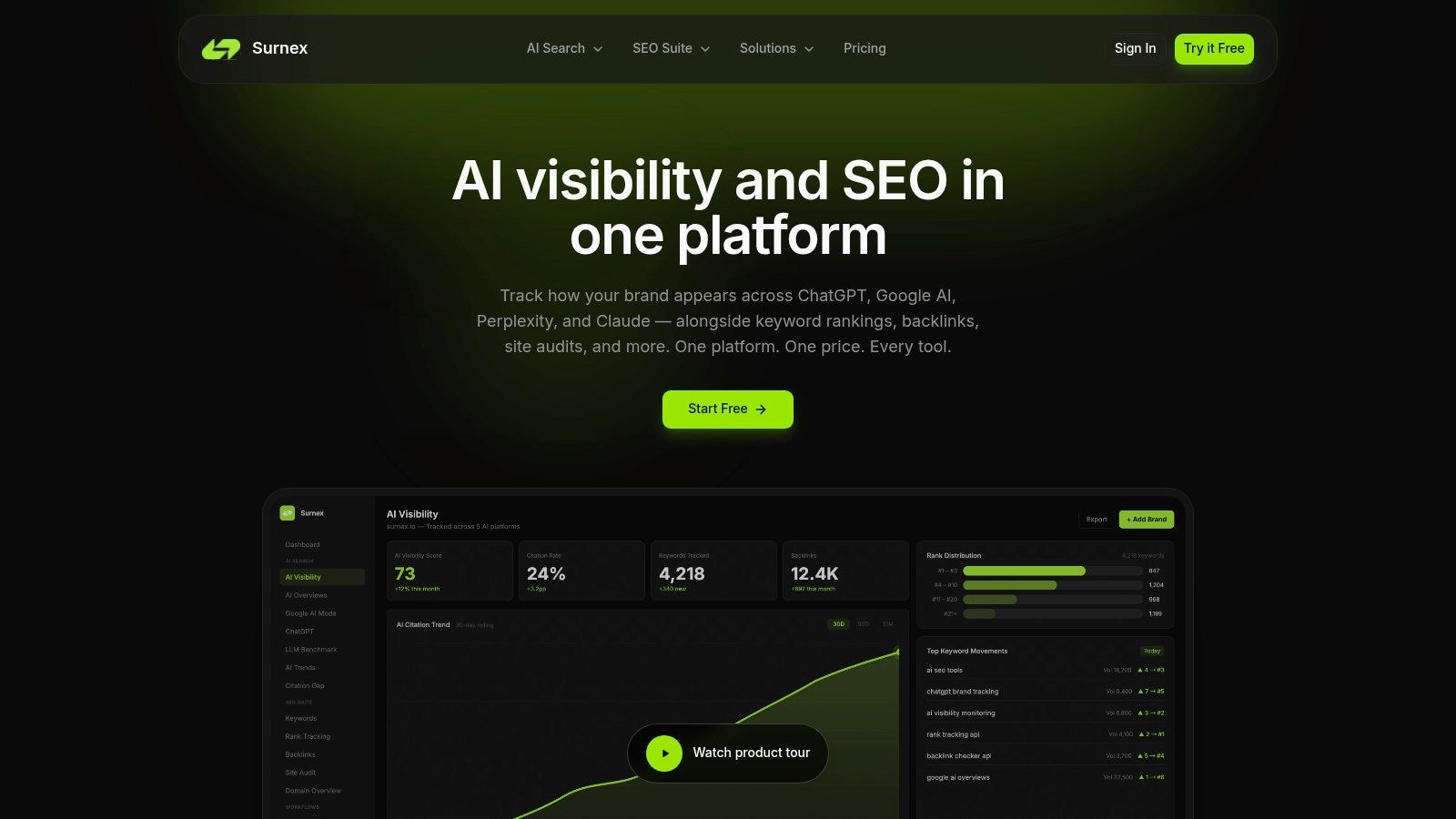
That reporting gap is why Surnex stands out in this list. It combines traditional SEO reporting with visibility tracking across AI-driven search surfaces, including Google AI Overviews, ChatGPT, Perplexity, and Claude, so agencies can explain what is happening across both channels without stitching together separate tools.
It also fits the way agencies operate. Instead of forcing teams to choose between an SEO suite and a newer AI visibility product, Surnex brings keyword tracking, backlink analysis, site audits, Core Web Vitals, local SEO, domain snapshots, and AI citation monitoring into one workflow.
The practical value shows up in client strategy. Citation gap analysis helps teams spot where competitors are being referenced in AI answers and where a client is absent. That gives account managers and strategists something concrete to act on, whether the next step is a new content brief, entity work, or digital PR outreach.
LLM benchmarking is another useful feature. Teams can compare how different models respond to the same prompt and which domains they cite, which is far more useful in client meetings than broad commentary about AI search changing behavior.
Agencies that want a clearer view of how the platform is positioned for client delivery can review the Surnex platform for marketing agencies.
When clients ask about AI Overviews and your current stack only shows Google rankings, it creates a significant reporting gap that your account team feels every month.
What works and what does not
What works well:
- Unified reporting across AI and SEO: One interface covers AI visibility, rankings, backlinks, audits, and fundamental technical SEO signals.
- Actionable workflow features: Citation gap analysis and model benchmarking turn reporting into clear strategic next steps.
- API-first setup: Teams can use the same data in custom dashboards, automations, and internal workflows.
- Agency-friendly structure: The product supports repeatable audits, rank reviews, and client reporting better than tools built mainly for one-off research.
- Quick rollout: Agencies can get started without a long implementation cycle.
What to watch:
- Public pricing is limited: Teams that need line-by-line pricing before a sales conversation may find that frustrating.
- It may be broader than necessary for small shops: Solo consultants or very small agencies with basic monthly reporting needs may not use the full feature set.
For agencies that need to report on AI search visibility alongside traditional SEO, Surnex addresses a real operational problem instead of adding another standalone dashboard.
2. AgencyAnalytics
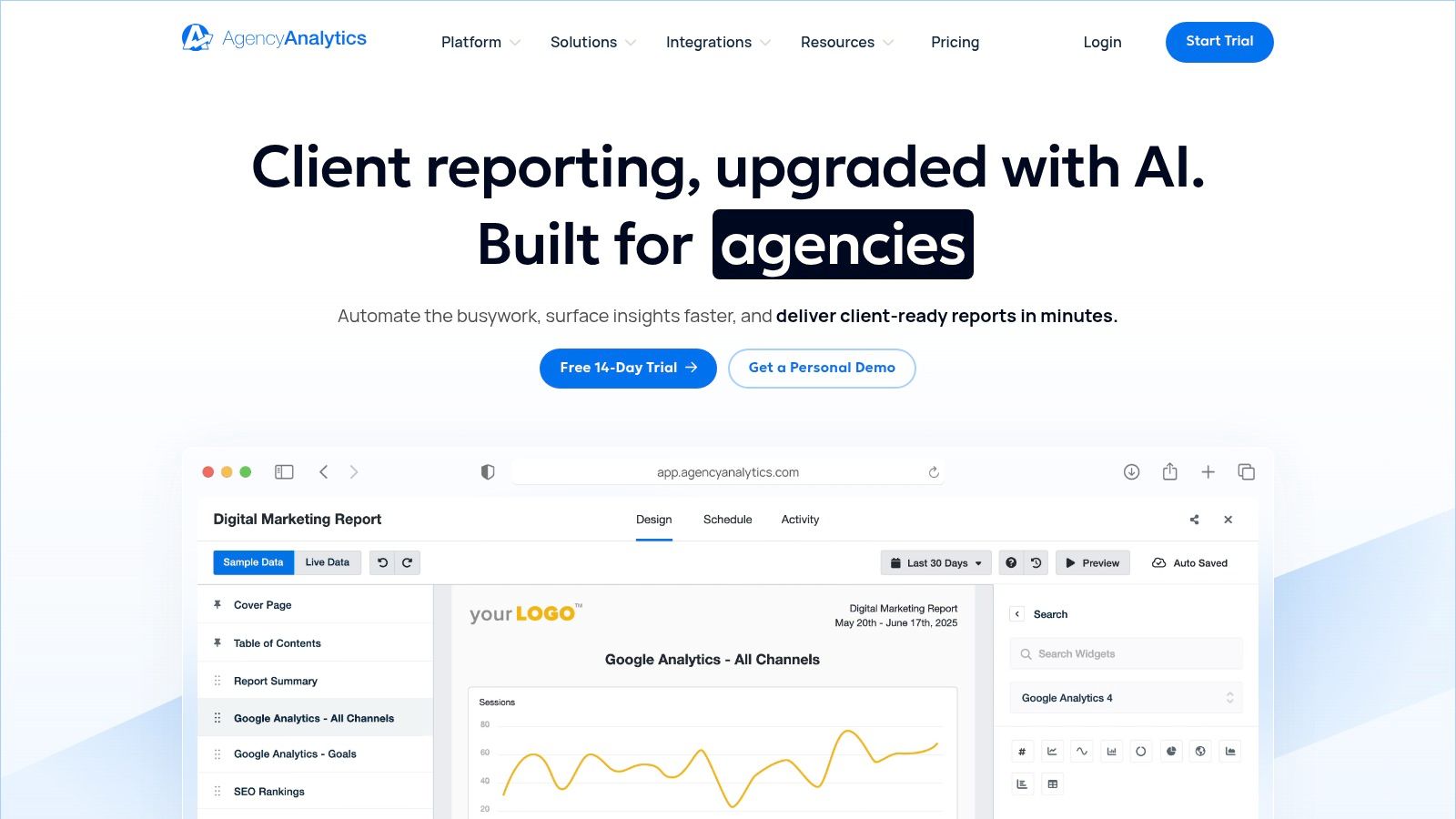
AgencyAnalytics is a reporting-first tool. That distinction matters.
Some platforms start with SEO research and add reports later. AgencyAnalytics starts with the agency workflow. White-label dashboards, client portals, scheduled reports, and permissions are the core product, which is why account managers get comfortable with it faster than they do with larger SEO suites.
One of its biggest strengths is connector depth. AgencyAnalytics supports over 80 integrations, which is why it works well for agencies that need one client report to pull from SEO, PPC, social, email, and analytics sources without a lot of manual stitching (AgencyAnalytics integration depth noted by AIOSEO).
Best use case
This tool fits agencies that already have their data sources and need a clean delivery layer.
If your SEO team works in Semrush or Ahrefs, your paid team lives in Google Ads and Meta, and your account team needs branded client reports on a schedule, AgencyAnalytics is easy to justify. It keeps the client-facing layer organized and keeps less technical team members out of raw data interfaces.
A practical advantage is that it handles multi-client operations cleanly. You can templatize reports, manage permissions, and maintain a consistent deliverable without rebuilding the same dashboard every month.
Trade-offs
Where it works:
- Multi-client reporting is the product, not a side feature
- White-label dashboards and portals are polished
- Non-technical teams can move quickly
- Broad connector library helps reduce platform-hopping
Where it falls short:
- Rank tracking is not the main reason to buy it
- Deep modeling is limited compared with BI tools
- It still depends on external sources for many core SEO inputs
- It does not solve the AI visibility reporting gap
That last point matters. AgencyAnalytics is strong at consolidating existing channels, but if your clients are asking where they appear in AI search experiences, you will still need another source of truth.
Website: AgencyAnalytics
3. Semrush
A common agency scenario is simple. The team needs one platform that can support audits, keyword tracking, competitor research, and a client report without stitching five tools together. Semrush usually makes the shortlist for that reason.
It has the breadth agencies expect from an all-in-one suite. You can handle rank tracking, site audits, backlink analysis, local SEO work, and reporting in one place. That matters when the goal is operational consistency across multiple clients, not just isolated SEO tasks.
Why agencies keep buying it
Semrush works well for agencies that want the reporting layer close to the SEO work itself.
The My Reports builder is the practical advantage. It pulls in Semrush data alongside connected Google properties and turns that into branded reports your account team can send. For monthly reporting cycles, that saves real time and reduces the usual spreadsheet cleanup that appears when data lives in too many systems.
The platform also benefits from maturity. Teams already know the workflows, documentation is easy to find, and new hires are less likely to get stuck than they would in a more fragmented stack. For an agency lead, that lowers the cost of standardizing process across accounts.
Where the trade-offs show up
Cost is the first pressure point.
Semrush can start as a reasonable subscription, then become expensive once you add users, projects, historical data needs, and extra reporting expectations. That pricing curve is manageable for agencies with strong retainers. It is harder to justify for shops serving smaller accounts at volume.
The second trade-off is presentation. Semrush reports are useful, but larger agencies often still pair it with a dedicated dashboard tool when clients expect cleaner portals, broader channel coverage, or executive views adapted to specific needs.
Semrush is also adapting to the rise of AI. According to one industry write-up, the platform had about 117,000 paying users in early 2025, and many companies reported better SEO results after adopting AI-assisted features in platforms like Semrush (Semrush adoption and agency positioning). That shows where the product is heading. For agencies that need to report on AI search visibility, including appearances in Google AI Overviews or other LLM-driven discovery surfaces, Semrush fits better as a broad SEO operating system than a dedicated AI visibility reporting platform.
That distinction matters for client communication. If a client asks for rankings, technical health, backlinks, and competitor movement, Semrush can cover a lot of ground. If the client now asks, "Are we showing up in AI answers, and how often?", you will likely need a specialized tracker alongside it.
Semrush is a strong backbone for agency SEO operations. It is a less complete answer for agencies trying to make AI visibility reporting a core client deliverable.
Website: Semrush pricing and plans
4. SE Ranking
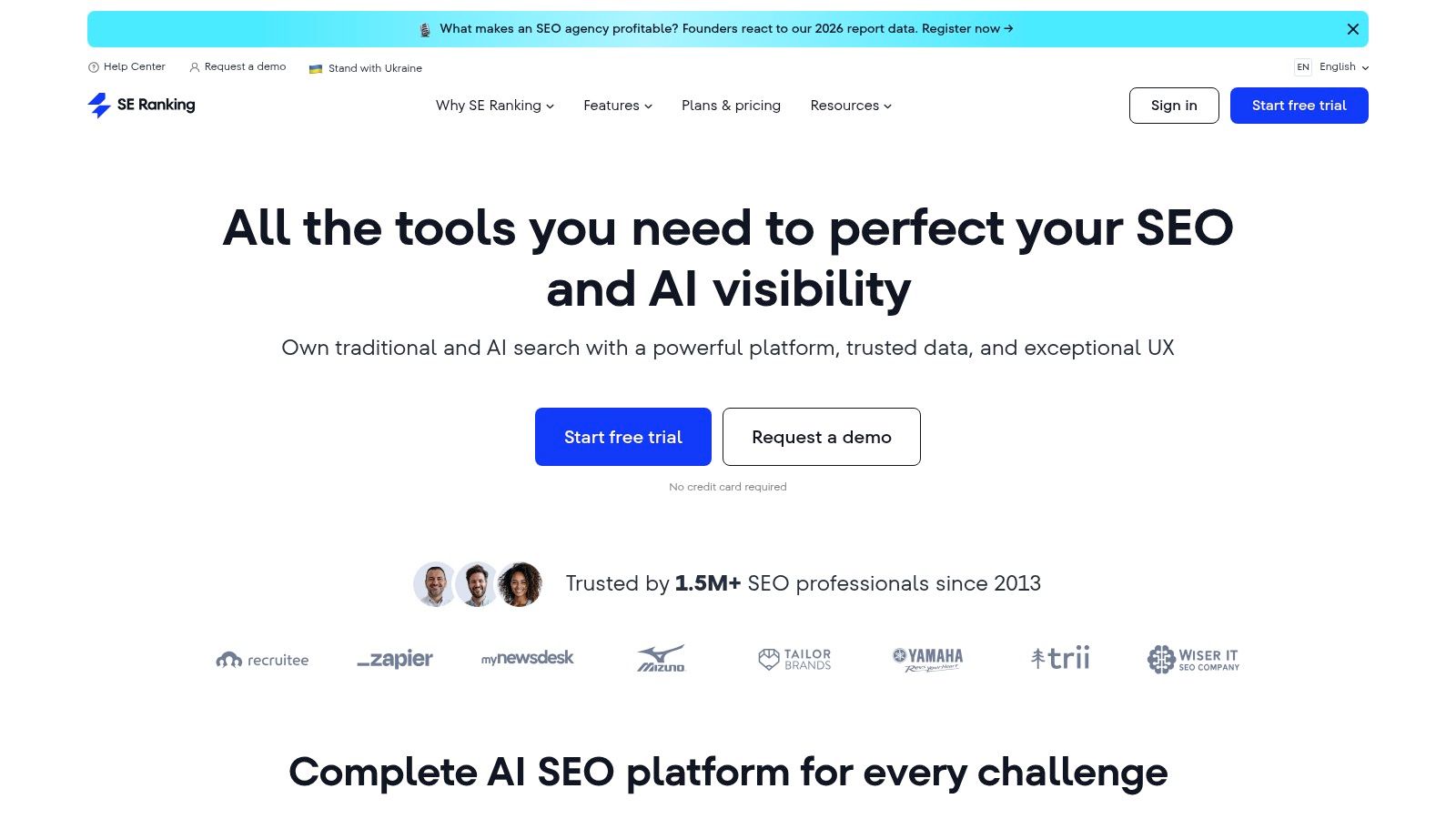
SE Ranking makes the shortlist when an agency wants solid breadth without stepping straight into enterprise-style cost and complexity.
It covers the expected base well. Rank tracking, site audits, backlink monitoring, competitive research, automated reports, and white-label delivery are all there. For smaller and mid-sized agencies, that balance is appealing because you can run a lot of the workflow in one place without paying for a giant platform you will only half use.
Why teams like it
The biggest advantage is clarity.
SE Ranking tends to be easier to understand operationally than some of the larger suites. Limits are more transparent, the interface is less intimidating for mixed teams, and the reporting side is usable enough that an account manager can participate instead of handing everything back to an SEO specialist.
It is also one of the more practical choices for agencies that are still standardizing process. If you are moving from manual reporting into something more repeatable, SE Ranking feels easier to implement than a heavier stack.
Where it can feel smaller
The trade-off is depth.
You may not get the same scale of data or the same level of competitive research depth you would expect from top-end suites. If your team does a lot of heavy competitor analysis, large-scale backlink work, or high-volume multi-market tracking, you may start to notice the ceiling.
There is another issue that matters for the 2026 agency workflow. SE Ranking is a strong traditional SEO option, but it does not close the AI search reporting gap that many agencies now face. That is not a knock on the platform specifically. It is the broader category problem. If the client asks about AI Overviews or LLM discovery, you will likely need another system.
SE Ranking is best when the agency needs strong fundamentals, white-label reporting, and a cleaner learning curve than larger suites.
Website: SE Ranking
5. AccuRanker
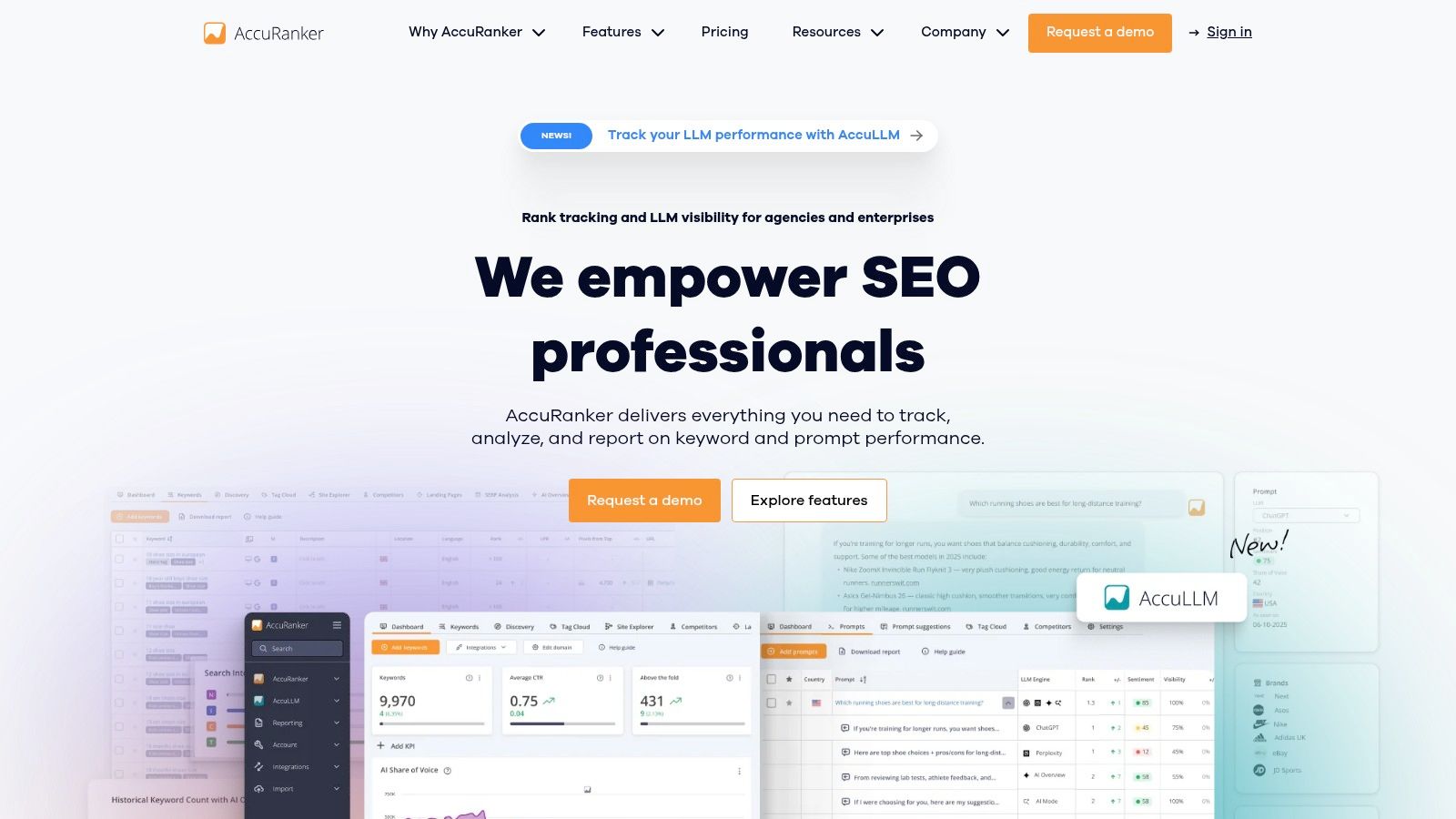
If rankings are the product you sell, AccuRanker deserves attention.
This is a specialist tool, not an all-in-one SEO suite. That is the point. It is designed for agencies that need clean, dependable rank tracking with strong segmentation, exports, and reporting hooks into other systems. When clients have a strong interest in keyword movement across locations, device types, or market segments, specialist rank trackers still beat generalist platforms.
Where AccuRanker shines
AccuRanker is built for precision and speed in rank monitoring.
That makes it a good fit for agencies managing large keyword sets or clients with reporting needs that go far beyond a top-line visibility chart. Tagging, segmentation, and exporting are all important here because they help the team tell a useful story. Not just “rankings moved,” but “non-brand mobile rankings improved in this region while map-driven terms dropped in another.”
The platform also makes sense when your reporting layer lives elsewhere. If you already use Looker Studio or a custom BI stack, a strong rank-tracking source with API and export options can be more valuable than another all-in-one subscription.
Why it is not for everyone
The downside is obvious. AccuRanker does rank tracking first.
You will still need other tools for backlinks, site audits, and broader technical SEO work. That means this is best for agencies that already know they want a best-of-breed stack, not a single platform.
Pricing also tends to follow keyword volume. That is normal for a rank tracker, but agencies should plan for growth. A tool that feels affordable at one stage can become a larger line item as client portfolios expand.
Use AccuRanker when ranking data is central to your service model and you care more about precision than platform breadth.
Website: AccuRanker
6. Nightwatch
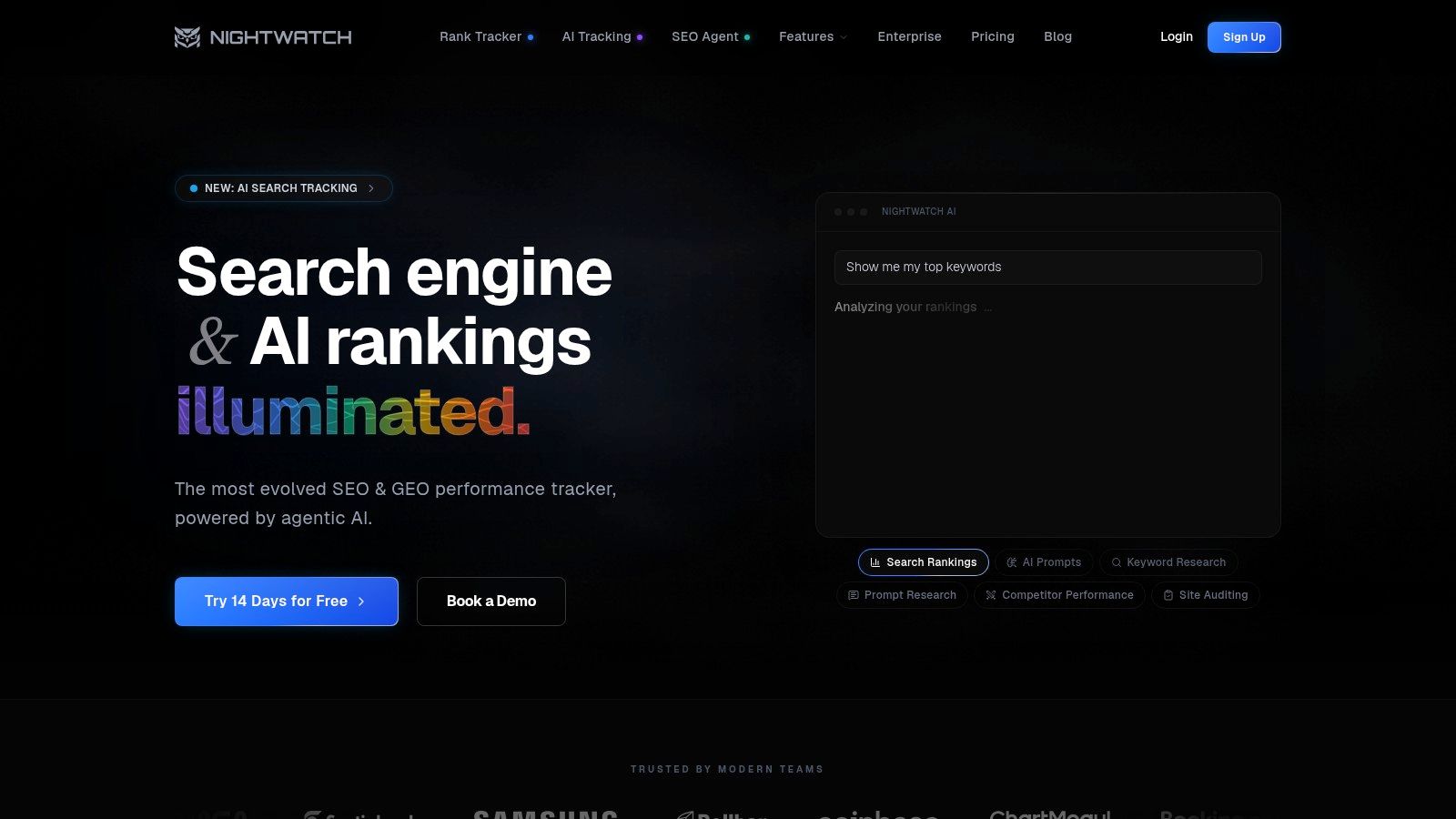
Nightwatch sits in a useful middle ground. It is narrower than a full SEO suite, but broader in agency reporting feel than many pure rank trackers.
That makes it attractive for agencies with local clients, franchise groups, or businesses that care about visibility across specific places rather than just national averages. Granular geolocation tracking is where Nightwatch becomes more than “another ranking tool.”
Practical fit
For local and multi-location reporting, Nightwatch is easy to work with.
The white-label reporting and client portal setup are particularly agency-friendly. Teams that need to push branded reports on a schedule without building a custom dashboard stack can get a lot done here. There is less friction than with a general SEO platform where reporting feels bolted on.
Another plus is channel spread within rankings. Agencies that care about Google, Bing, and YouTube visibility get a clearer reporting layer in one place.
What to keep in mind
Nightwatch is still a visibility tracker.
If you need a full SEO operating system with technical audits, backlink analysis, content research, and broad competitor intelligence, you will outgrow it quickly or need to pair it with other tools.
That pairing can still make sense. Some agencies intentionally use a specialist rank platform plus a separate dashboard or audit suite because each tool does its job better. The mistake is assuming Nightwatch will replace every other part of the stack.
For agencies serving local businesses and wanting polished white-label ranking reports, Nightwatch is a strong option. For agencies trying to unify AI visibility, technical SEO, and broader client reporting in one place, it is too narrow.
Website: Nightwatch
7. Whatagraph
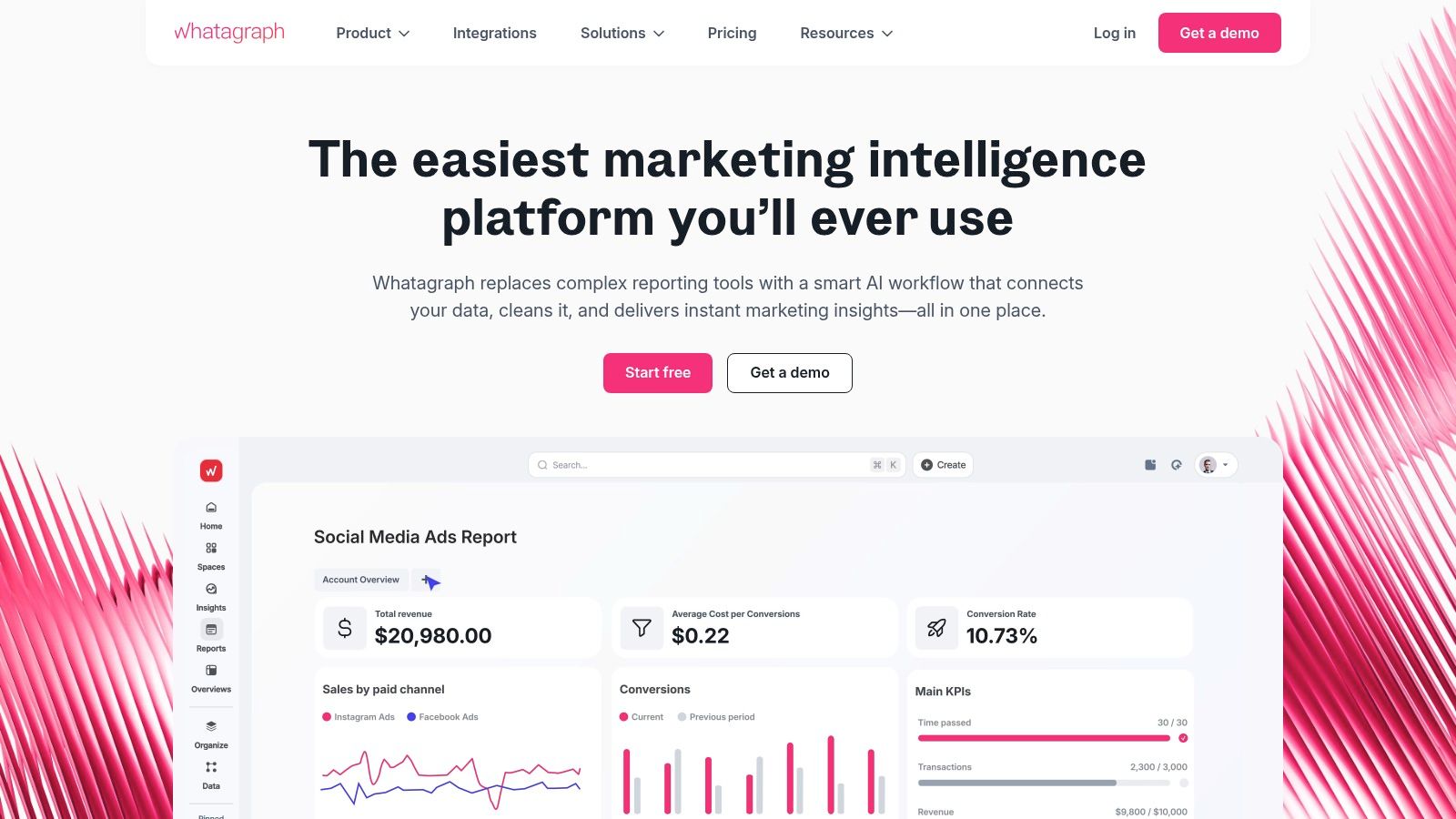
Some agencies do not need another SEO platform. They need a better client reporting layer across all marketing channels. That is where Whatagraph fits.
It is best treated as a reporting and visualization platform for agencies that already pull data from several systems and want one client-facing output. SEO, PPC, paid social, ecommerce, and analytics all need to roll up into one report. Whatagraph handles that kind of narrative better than most SEO-native tools.
Why agencies buy it
The strongest use case is cross-channel reporting.
If your client asks whether SEO is assisting paid search efficiency, or whether organic landing pages support conversion performance from other campaigns, a dedicated reporting platform helps more than a pure SEO suite. Whatagraph is useful because it emphasizes dashboard building, scheduled delivery, and data transformations instead of trying to be the primary source for every metric.
It also connects with common SEO data providers such as Semrush and Ahrefs, which is helpful for agencies that want to preserve specialist tooling while still standardizing the final report.
The trade-off
This is not the cheapest path to better reporting, and it is not a substitute for real SEO operations software.
You still need source systems. You still need someone on the team who understands which metrics belong together. And if your data setup gets complicated, you may still run into ETL or modeling issues that push you toward a more custom stack.
Whatagraph works best for agencies that have already accepted a multi-tool environment and want to make that environment client-presentable. It is less useful for teams hoping one purchase will solve rank tracking, audits, backlink analysis, and AI visibility in one move.
Website: Whatagraph
8. DashThis
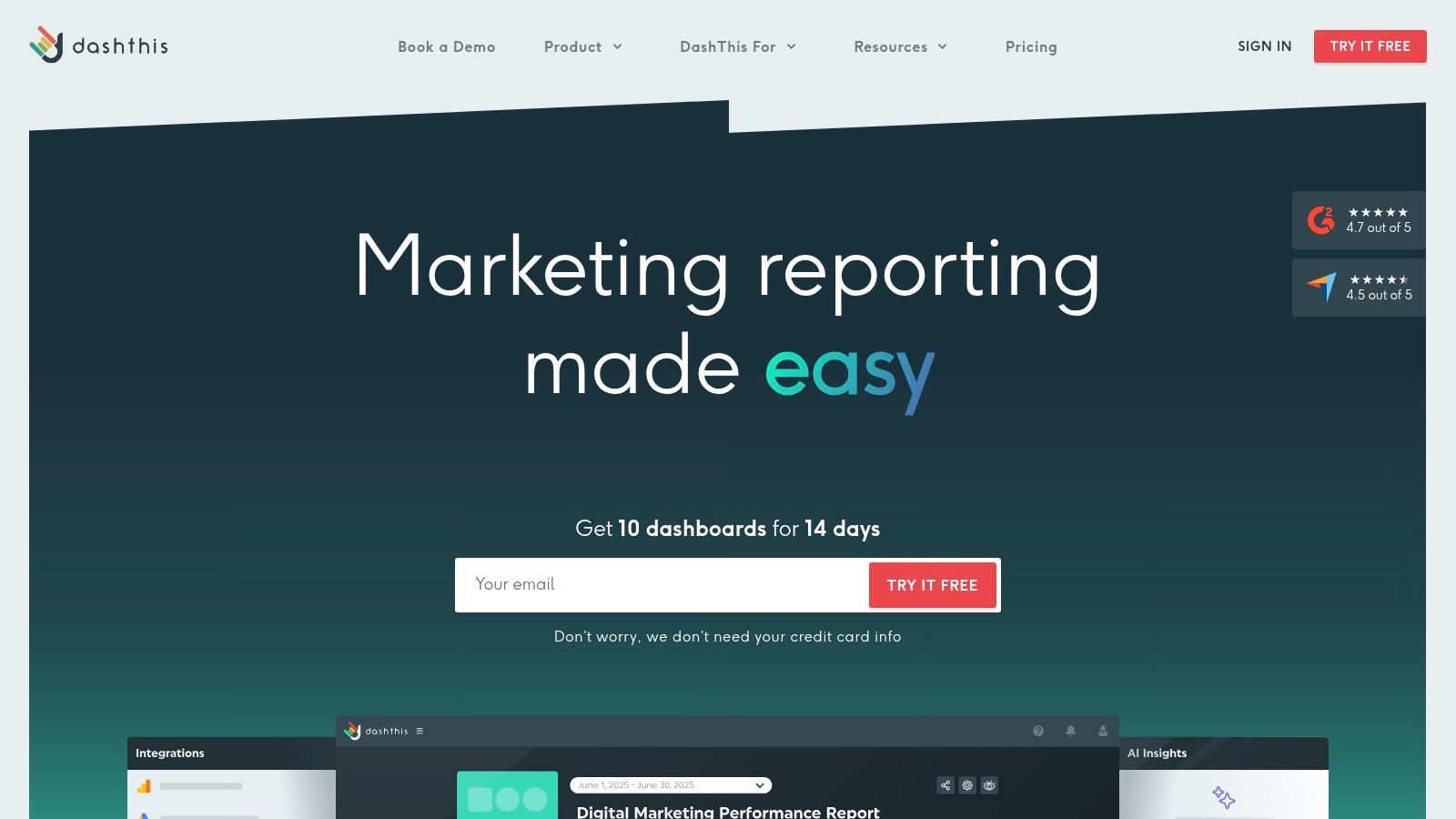
DashThis is one of the easier tools on this list to hand to a busy account team.
That is its appeal. You do not buy DashThis because you want the most advanced SEO data model in your stack. You buy it because reports need to go out on time, clients need a clean dashboard, and your team does not have hours to spend configuring custom views every week.
Where it helps
The platform is best for simple, repeatable client reporting.
Template-driven setup is useful for agencies with standardized service packages. If your monthly deliverable follows a familiar pattern across SEO, paid media, and analytics, DashThis can get you to a presentable report quickly. This matters more than many teams admit. A tool that is slightly less powerful but used consistently beats a more complex one that only one specialist understands.
Responsive support and agency-friendly onboarding also matter in this category. For teams that are not trying to become BI experts, ease of use is the deciding factor.
Limits to expect
The downside is flexibility.
If your agency needs advanced blending, custom metric logic, or unusual reporting structures, DashThis can start to feel restrictive. It is a practical reporting layer, not an open-ended analytics environment.
It does not address the newer AI search reporting problem. Like many dashboard tools, it is only as good as the sources feeding it. If no source is tracking AI visibility properly, DashThis will not solve that on its own.
Choose DashThis when speed, simplicity, and repeatability matter more than deep customization.
Website: DashThis
9. BrightLocal
BrightLocal is not trying to be your complete SEO stack, and that is a good thing.
For agencies that manage local businesses, map visibility, reviews, citations, and Google Business Profile performance matter more than broad national keyword research. BrightLocal is useful because it is built around that reality instead of treating local SEO as a minor add-on.
Best use case
This is a strong fit for local SEO agencies and multi-location brands.
Local rank tracking with map pack visibility, review monitoring, citation management, and GBP-focused reporting all belong in one operational flow. BrightLocal handles that flow better than general SEO suites that offer local reporting as one module among many.
For agencies with dentists, law firms, home service brands, restaurants, clinics, or franchise groups, that focus is practical. The reports line up with what local clients care about.
If your client wins or loses business based on map visibility, review reputation, and listing accuracy, a general SEO dashboard will miss the story that matters most.
Where it stops
BrightLocal is intentionally narrow.
You will still need broader SEO tooling for full technical audits, larger-scale backlink work, content research, or enterprise competitor analysis. That is not a flaw. It just means BrightLocal belongs in a local-first stack, not as a complete replacement for every SEO workflow.
Costs can also build as location counts rise. Agencies with large multi-location portfolios should think in terms of account structure and operational process before assuming any local platform stays “simple” at scale.
For local SEO reporting, though, BrightLocal is one of the clearest specialist choices on this list.
Website: BrightLocal
10. SEOmonitor
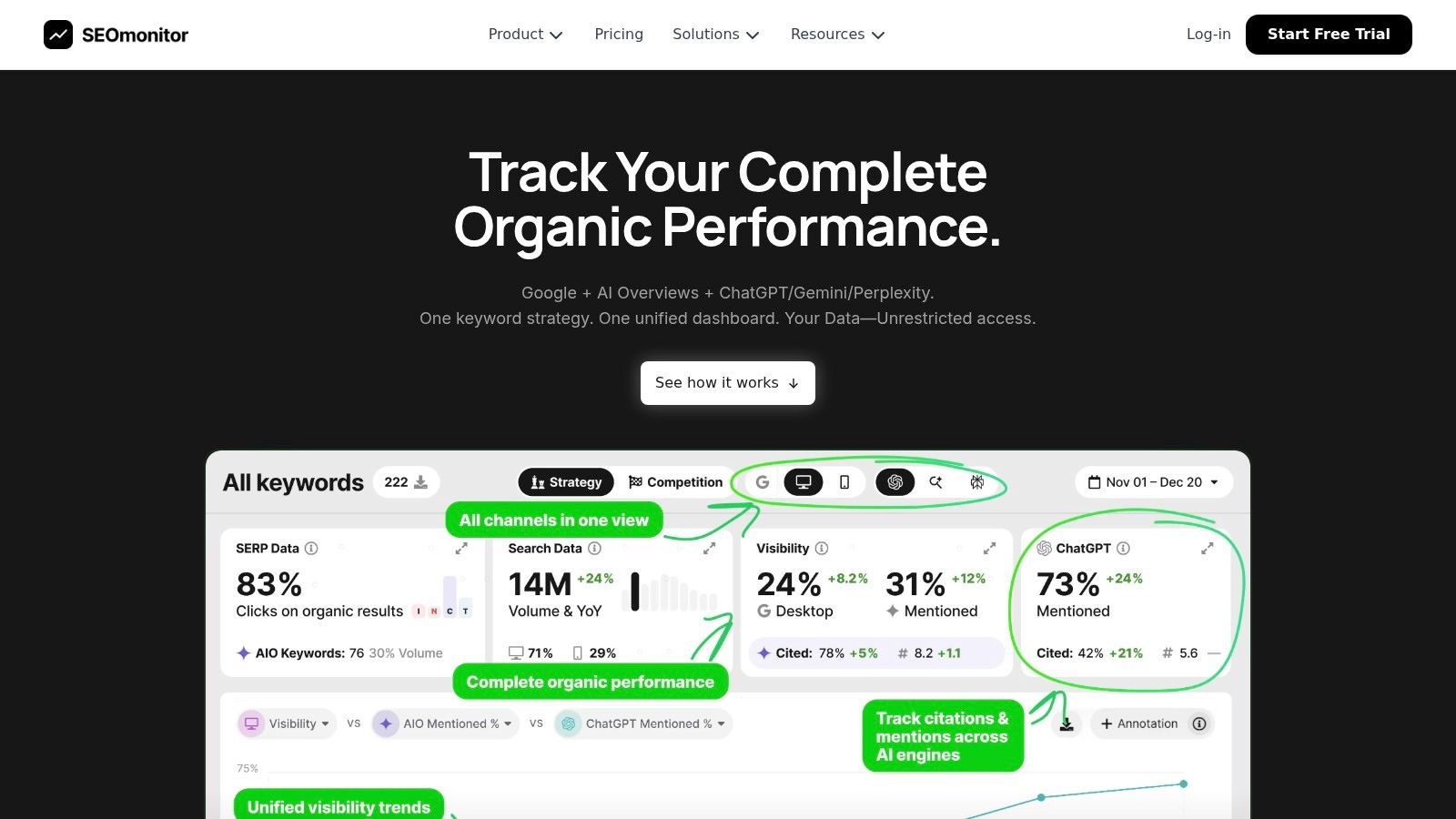
A common agency problem shows up right before a client review. Rankings are stable, traffic is mixed, and the client wants an answer to a harder question: are we on track, and what should happen next quarter? SEOmonitor is built for that conversation better than many tools that stop at rank charts and exported PDFs.
It fits agencies that need reporting tied to planning. Forecasting, visibility metrics, campaign workflows, and unlimited seats make it easier to connect strategy, delivery, and client communication in one place.
Why agencies like it
Unlimited seats matter more than many software buyers expect.
Strategy leads, account managers, freelancers, executives, and client-facing teams often need access to the same account. With SEOmonitor, that usually creates less licensing friction than platforms that gate collaboration behind extra user costs. For growing agencies, that affects process as much as budget.
The other strength is how the platform supports forward-looking reporting. Instead of limiting the conversation to monthly ranking movement, teams can use forecasting and visibility trends to frame expected outcomes, opportunity size, and pacing. That is useful in proposals, quarterly business reviews, and retention-focused client accounts where expectation setting is part of the job.
Trade-offs
SEOmonitor is still a traditional SEO platform at heart.
Agencies that rely on very broad competitor databases, heavier backlink investigation, or cross-channel research will often keep a larger suite in the stack. SEOmonitor is stronger in agency planning and performance forecasting than in being the widest research database on the market.
There is also a category gap that matters more now than it did a year ago. If your agency has started reporting on AI search visibility, such as Google AI Overviews, SEOmonitor will not cover that emerging workflow the way a newer specialist platform can. That does not reduce its value for traditional SEO reporting. It just changes where it fits in an agency stack.
For agencies dividing tools by workflow, this puts SEOmonitor in the all-in-one traditional SEO group, not the AI visibility layer. If client reporting now needs to show both classic rankings and AI search presence, you will likely pair it with another tool rather than ask it to handle both jobs.
Website: SEOmonitor
Top 10 Agency SEO Reporting Tools, Comparison
| Platform | Core & USP ✨ | UX & Quality ★ | Value / Pricing 💰 | Target Audience 👥 |
|---|---|---|---|---|
| Surnex 🏆 | Unified AI + SEO visibility (Google AI Overviews, ChatGPT, LLM benchmarking), citation‑gap analysis, API‑first ✨ | Agency workflows, client‑ready reports, fast setup ★★★★☆ | Free trial; plans $49–$399/mo 💰 | Agencies, in‑house teams, developers 👥 |
| AgencyAnalytics | White‑label dashboards, 85+ integrations, scheduled PDF/HTML reports ✨ | Non‑technical teams build reports quickly ★★★★☆ | Tiered plans; rank tracking is an add‑on 💰 | Multi‑client agencies needing branded reporting 👥 |
| Semrush | Full SEO/SEM suite: audits, keyword research, backlinks, My Reports ✨ | Mature data sources and broad tooling ★★★★★ | Feature‑rich but cost rises with add‑ons/tier 💰 | Agencies handling SEO + PPC + content at scale 👥 |
| SE Ranking | Rank tracking, site audits, backlink monitoring, white‑label API ✨ | Strong price‑to‑capability, easy scaling ★★★★☆ | Transparent, modular pricing, good value 💰 | Small‑to‑mid agencies and budget‑focused teams 👥 |
| AccuRanker | High‑precision daily rank updates, SERP analysis, extensive API ✨ | Very fast, accurate rank data with deep filters ★★★★★ | Priced by keyword volume; specialized tool 💰 | Agencies needing large‑scale, accurate rank tracking 👥 |
| Nightwatch | Daily keyword tracking w/ geolocation, unlimited branded reports ✨ | Great local/segment tracking for ROI stories ★★★★☆ | Mid‑tier pricing; some API/features on higher plans 💰 | Multi‑location clients and local SEO agencies 👥 |
| Whatagraph | Cross‑channel automated reports, data transformations, many integrations ✨ | Strong for rolling up multi‑channel metrics ★★★★☆ | Higher entry price; credits and planning needed 💰 | Agencies needing consolidated client dashboards 👥 |
| DashThis | White‑label dashboards, templates, AI insights, fast onboarding ✨ | Very quick setup; responsive support ★★★★☆ | Predictable plans; new source‑based pricing to monitor 💰 | Agencies wanting fast, automated client dashboards 👥 |
| BrightLocal | Local rank tracking, review management, citation builder ✨ | Purpose‑built local tools with clear reporting ★★★★☆ | Cost‑effective per location; pay‑as‑you‑go options 💰 | Local SEO agencies & multi‑location brands 👥 |
| SEOmonitor | Forecasting, share‑of‑visibility, campaign management, unlimited seats ✨ | Planning & forecasting focus for proposals/QBRs ★★★★☆ | Predictable agency pricing; some AI tracking usage‑based 💰 | Agencies focused on forecasting and client planning 👥 |
Your Next Step Future-Proof Your Agency's Reporting
A client opens the monthly report and asks a fair question: “If rankings are stable, why are leads softer, and where are we showing up in AI answers?” If your team cannot answer that inside the same reporting workflow, the problem is not presentation. It is coverage.
Agency reporting now has to do two jobs at once. It has to explain traditional SEO performance clearly, and it has to account for AI search visibility, including surfaces like Google’s AI Overviews, where brand presence is less obvious and harder to report cleanly. That is why the right choice usually comes down to workflow fit.
Reporting-first tools such as AgencyAnalytics, Whatagraph, and DashThis help agencies that need faster delivery, cleaner white-label output, and less manual assembly each month. All-in-one platforms such as Semrush and SE Ranking make more sense when the team wants research, tracking, and reporting in one system. Specialized products such as AccuRanker, Nightwatch, BrightLocal, and SEOmonitor earn their place when precision matters more than breadth, whether that means rank accuracy, local reporting, or forecasting for client planning.
The gap is AI visibility.
Many agencies already have a usable stack for rankings, traffic, and conversions. Fewer have a dependable way to show whether a client appears in AI-generated search experiences, how often competitors are cited, or where visibility is slipping outside the classic ten blue links. That gap becomes obvious in QBRs, renewal calls, and any account where clients are watching branded search closely.
I use four filters when evaluating seo reporting tools for agencies:
- Can account managers pull answers without waiting on an SEO specialist?
- Can the system scale across clients without adding manual exports and one-off workarounds?
- Does it support both client-facing reporting and internal operational use?
- Can it report on AI search visibility alongside traditional SEO metrics?
Those questions eliminate a lot of tools quickly.
For agencies that need one reporting layer for classic SEO and newer AI visibility tracking, Surnex stands out for a practical reason. It combines standard SEO reporting with AI search reporting in the same workflow, which helps reduce tool sprawl and gives clients a fuller view of where they appear. If that is the reporting gap your team is trying to close, Surnex is a sensible place to start.
If you want another strong perspective on improving client communication and measurable reporting, read Mastering Agency Client Reporting for Measurable Results.