The safest SEO guarantee often sounds weak at first: no agency can ethically guarantee a specific ranking. That isn't a dodge. It's the honest starting point for a channel that depends on Google, competitors, site quality, and user behavior that no agency controls.
That matters because SEO isn't a side purchase anymore. The global SEO services market is projected at $108.28 billion in 2026 according to Research and Markets. When that much budget is flowing into search, loose promises get expensive fast.
Clients still want certainty, and that's reasonable. They need forecasts, accountability, and a clear path from SEO work to business outcomes. The mistake is asking for certainty in the wrong place. A rank promise is usually theater. A well-structured performance agreement is useful.
The Problem with an SEO Services Guarantee
Most buyers search for an SEO services guarantee because they're trying to reduce risk. They've heard SEO takes time, they've seen vague retainers, and they don't want to pay for activity that never turns into leads or revenue. That instinct is right.
The problem is the market trained people to ask for the wrong kind of guarantee.
A guarantee tied to a ranking sounds concrete, but it usually ignores the one fact that matters most: the agency doesn't own the platform that decides rankings. Google can change result layouts, introduce new search features, rewrite how snippets appear, or adjust how it interprets intent. Competitors can publish better pages, improve internal links, or invest harder in technical cleanup. Your own site can have indexing issues, JavaScript rendering problems, or weak conversion paths that hold back results even when visibility improves.
What businesses actually want
Most companies don't want position tracking for its own sake. They want confidence that:
- Work will happen on schedule
- The strategy will match business goals
- Progress will be visible in reporting
- The agency will adapt when search changes
- Results will be judged by business impact, not vanity metrics
That's a very different conversation from “Can you guarantee page one?”
Practical rule: If an agency leads with rankings before it understands your sales cycle, conversion points, and margin structure, it's selling SEO as a scoreboard, not as a growth channel.
Where the tension comes from
SEO sits in an awkward middle ground. It's not as immediate as paid search, but it's not random either. Good teams can improve technical health, publish stronger content, earn better links, and strengthen entity and brand signals. Those actions raise the odds of better performance. They don't create a lawful promise of a fixed outcome.
That's why the strongest modern “guarantee” is narrower and more useful. It covers scope, reporting, accountability, and business-focused KPIs. It doesn't pretend anyone can sign a contract with Google's algorithm.
Why Most Ranking Guarantees Are Red Flags
A ranking guarantee is like a financial advisor promising a stock will hit a fixed price by a certain date. The advisor can control research, portfolio construction, and risk management. The advisor can't control the market.
SEO works the same way.

An agency can control audits, content briefs, internal linking, page speed improvements, schema implementation, backlink outreach process, and reporting cadence. It cannot control Google's final ranking decisions, your competitors' moves, or how search demand shifts over time.
What these agencies usually leave out
When someone promises “guaranteed rankings,” read the fine print. The promise often depends on one of these tricks:
- Easy keywords: They choose low-value terms nobody on your team cares about.
- Brand terms: They report wins for queries you already ranked for.
- Tiny geography slices: They guarantee rankings in a narrow location that won't move business results.
- Shallow pages: They publish thin content quickly just to create apparent momentum.
- Opaque methods: They won't explain links, content sources, or technical changes.
A local business owner comparing providers can spot this pattern in a lot of city-based pitches too. If you've reviewed offers similar to some Los Angeles SEO services proposals, you've probably seen how often “guaranteed results” appears before any real discovery work.
The real danger is the method, not the slogan
The slogan is bad. The delivery method is worse.
Some agencies use black-hat tactics to force short-term movement. That can mean manipulative links, stuffed pages, scraped content, or spammy automation built to impress a client before the damage surfaces. According to SeoProfy's review of guaranteed SEO services, 63% of sites penalized by black-hat SEO tactics require 6 to 12 months to recover, and some never regain their previous traffic share.
A fast win that leaves a site under a spam cloud isn't a win. It's deferred cost.
A better reading of “confidence”
A serious agency should sound confident about its process, not about controlling Google. Confidence looks like clear technical recommendations, realistic timelines, reporting by page and query, and a willingness to be judged against agreed business goals.
That sounds less flashy in a sales call. It's far safer in a contract.
From Bad Promises to Good Commitments
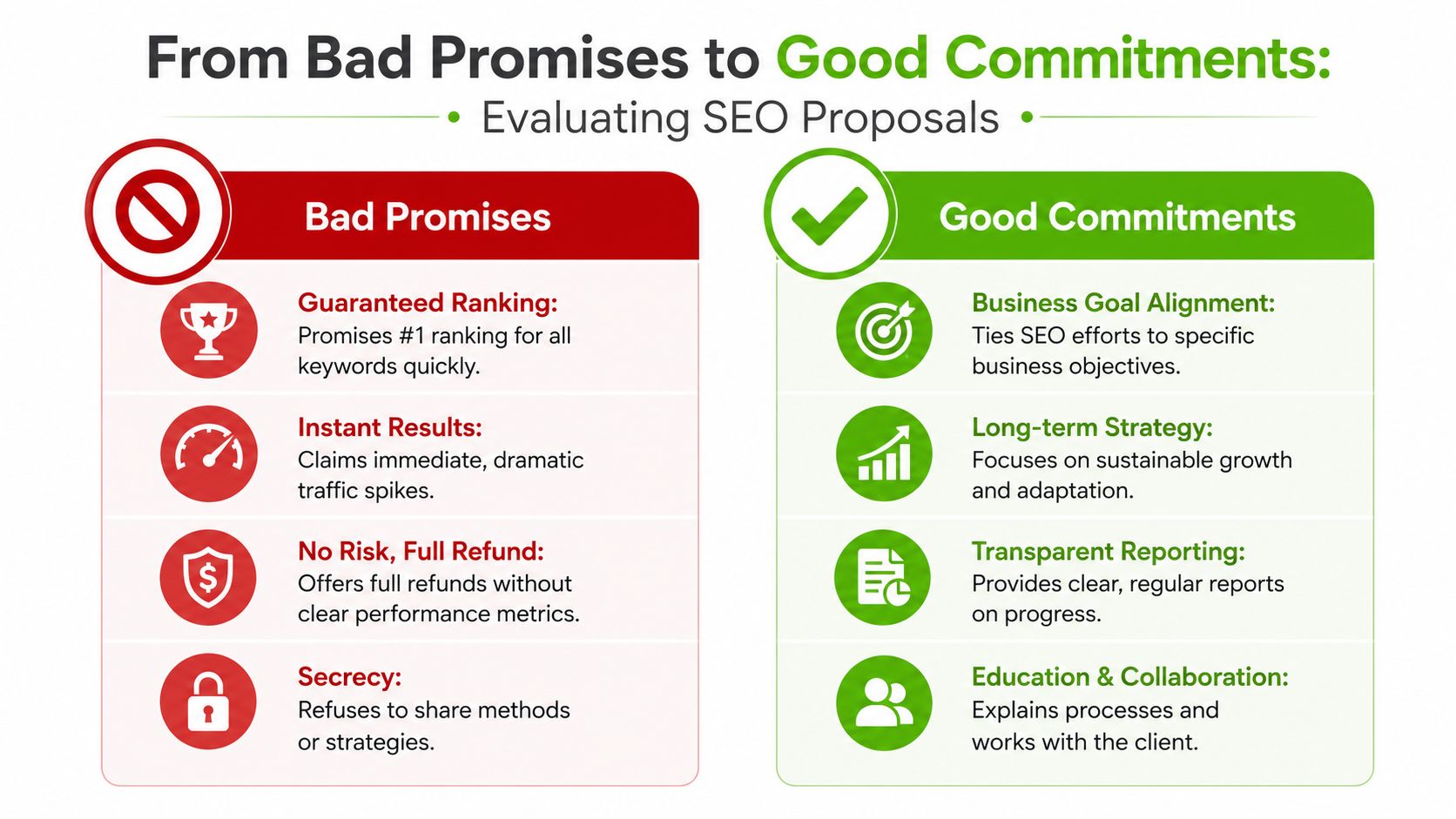
The easiest way to judge an SEO proposal is to sort every promise into one of two buckets: claims the agency can't control and commitments the agency can deliver.
The bad side of the spectrum
These are the phrases that should slow a deal down:
| Bad promise | Why it's a problem |
|---|---|
| Guaranteed #1 rankings | No agency controls Google's output |
| Instant traffic spikes | Usually ignores indexing, competition, and conversion lag |
| Full refund with vague terms | Sounds safe, but often hides weak definitions of success |
| Secret methods | Often a cover for tactics you wouldn't approve if explained |
The biggest issue isn't just that these claims are unrealistic. It's that they train the client to judge SEO by the wrong standard. SEO isn't a magic trick. It's execution across technical health, content quality, site architecture, authority building, and measurement.
The good side of the spectrum
A professional proposal usually commits to things like:
- Defined deliverables: audits, briefs, page updates, reporting, implementation support
- Business alignment: target pages and keywords tied to products, services, or lead stages
- Visibility into work: what was done, why it matters, and what changed
- Review cycles: regular checkpoints for performance, blockers, and priorities
- Adaptation: changes in plan when data shows the current approach isn't enough
That's the frame I trust.
A proposal should leave no doubt about what work will be completed and how progress will be reviewed. It should also say what the agency needs from the client, such as development support, SME access, approvals, and analytics access. A one-sided promise usually hides a two-sided dependency.
Here's a useful way to interpret common language:
- “We guarantee rankings.” Walk away.
- “We guarantee activity.” Better, but incomplete.
- “We commit to a documented strategy, defined deliverables, transparent reporting, and agreed performance targets.” That's the language of a mature engagement.
A short explainer can help teams visualize that shift:
Activity guarantees still need context
There's nothing wrong with promising effort. In fact, effort commitments belong in every contract. But they need framing.
“Four articles per month” only matters if those articles target the right topics, satisfy intent, support commercial pages, and get indexed. “Ten backlinks” only matters if the links are relevant, credible, and earned in a way that won't create future risk.
What to look for: A good commitment names the deliverable, the standard, the owner, and the review method.
That's what turns SEO from a hopeful retainer into accountable work.
Adopt a Performance-Based SLA Instead
The better replacement for an SEO guarantee is a performance-based SLA, or Service Level Agreement. This changes the contract from “we promise rankings” to “we agree on what success means, what work supports it, how it will be measured, and what happens if targets aren't met.”
That shift matches how serious buyers already think. According to Ahrefs' discussion of SEO guarantees, 78% of enterprises now prioritize ROI over vanity metrics, and that aligns with Google's guidance to write for users, not algorithms.
What belongs in an SEO SLA
A useful SEO SLA usually covers four layers.
Business outcomes
These are the goals leadership cares about, such as qualified leads, pipeline contribution, booked demos, or organic revenue. Not every business can measure these perfectly at first, but the contract should point there.
Leading indicators
These show whether the work is moving in the right direction before revenue catches up. Examples include non-branded visibility, impressions, indexed page growth, and technical health improvements.
Agency responsibilities
This is the delivery engine. It should list workstreams, timelines, reporting cadence, implementation support, and decision rights. If the agency needs client approvals within a certain time frame, write that down too.
Escalation rules
A contract gets stronger when it explains what happens if targets slip. Maybe the agency reallocates effort, adds a deeper technical audit, revises content strategy, or increases review frequency. Good contracts define response, not excuses.
Why this model works better
An SLA creates a partnership around evidence. It also protects both sides from fantasy expectations.
The client gets clarity on what they are buying and how performance will be judged. The agency gets room to do real work without being cornered into bad tactics just to satisfy a flawed headline promise.
This model also handles uncertainty better. Search changes. AI summaries change click behavior. Competitors react. A performance-based agreement doesn't pretend those realities don't exist. It bakes adaptation into the relationship.
The right SEO contract doesn't eliminate uncertainty. It assigns responsibility inside uncertainty.
A practical shift in language
Ask an agency this question instead of “What can you guarantee?”
“What are you willing to put in writing about deliverables, measurement, reporting, and business impact?”
That one question usually separates strategic operators from sales-led shops.
Key Metrics for a Modern SEO Agreement
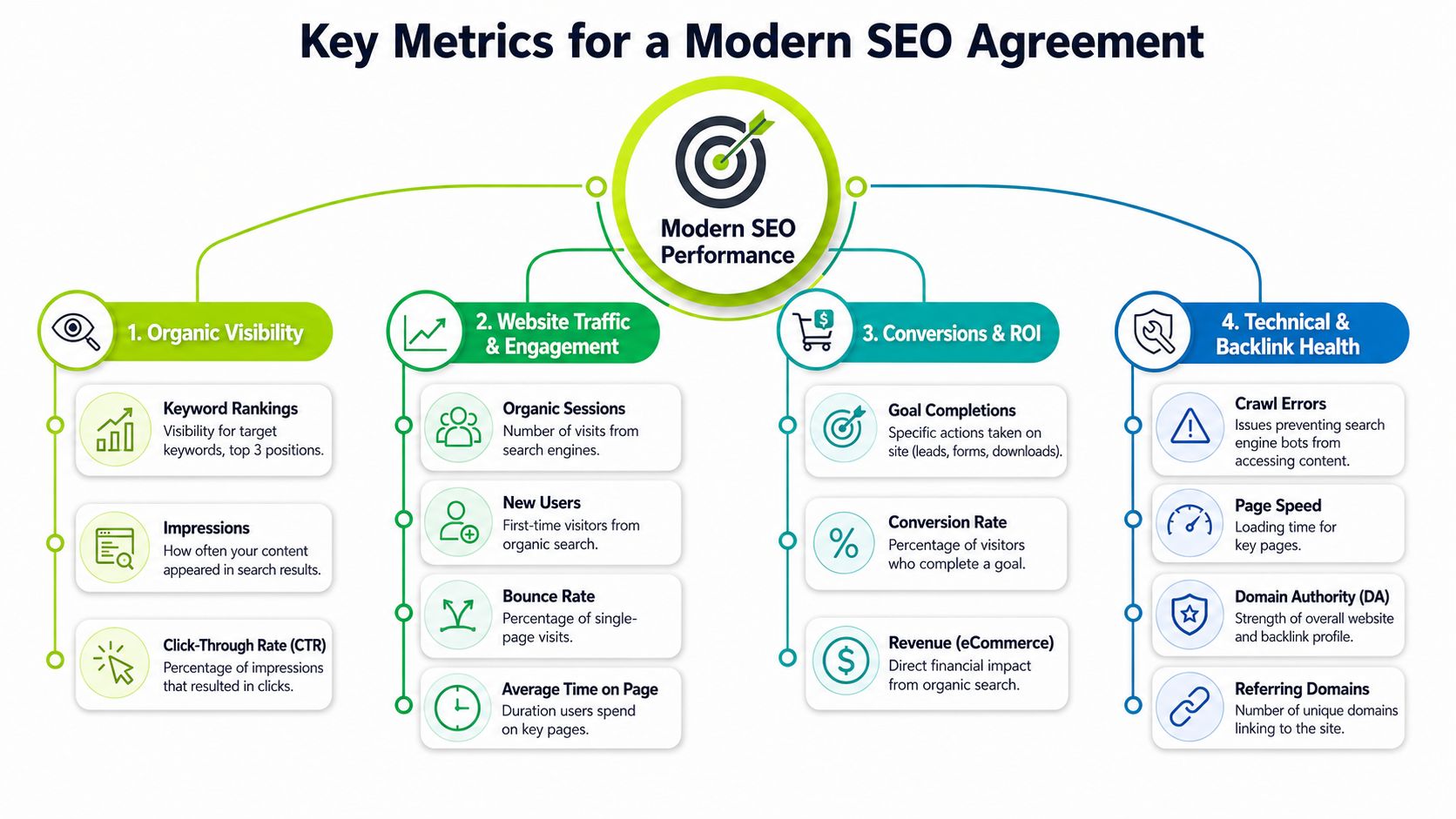
A modern SEO agreement needs more than rankings and traffic. It needs a measurement stack that reflects how search works today, including AI-driven result formats, technical health, and conversion quality.
Start with leading and lagging metrics
These two categories should be separated in every report.
| Metric type | What it tells you |
|---|---|
| Leading indicators | Whether the foundation is improving |
| Lagging indicators | Whether business results are showing up |
Leading indicators often move first. Lagging indicators usually take longer because they depend on rankings, traffic quality, offer strength, and sales follow-up.
Leading indicators worth putting into the agreement
The strongest early signals usually include:
- Indexed page growth: Are important pages entering Google's index?
- Impressions for non-branded queries: Is visibility expanding beyond your existing brand demand?
- Core Web Vitals and page performance: Technical friction often slows everything else.
- Crawl health: Broken paths, rendering issues, and wasteful crawl patterns can lead to unnoticed growth limitations.
- Ranking distribution: Not just “did we rank,” but whether target pages are moving into stronger visibility bands.
For teams that want to normalize search visibility across many SERPs and entities, a framework like visibility score SEO can help reduce overreliance on one or two trophy keywords.
Lagging indicators that prove value
These are the numbers that matter in review meetings with finance or leadership:
- Organic conversions
- Qualified leads from organic sessions
- Organic-assisted revenue
- Conversion rate on SEO landing pages
- Pipeline influence for high-intent pages
Not every program can tie every sale perfectly to SEO. That's normal. But the agreement should still define a conversion model and a reporting method in GA4 and CRM systems.
AI search changes what “good” looks like
Traditional CTR expectations don't hold the same way when Google inserts AI-generated summaries. According to AIOSEO's SEO statistics roundup, when an AI Overview appears, only 8% of users click regular results, yet 52% of sources cited in AI Overviews rank in the top 10. That means classic optimization still matters, but the visible outcome may shift from blue-link clicks to citation presence and assisted discovery.
This is also where supporting data infrastructure matters. If your team is building custom reporting around SERP features, creator results, and adjacent social discovery signals, a guide on choosing a SERP API for social data can help shape the technical side of measurement.
Don't lock an SEO contract to one metric that search interfaces can distort. Use a basket of visibility, traffic, conversion, and technical indicators.
Keep the KPI set tight
A contract with too many KPIs creates noise. Pick a short list that reflects your business model, then review performance by page type, query type, and device. That's where real accountability starts.
How to Vet and Negotiate an SEO Contract
A strong contract usually comes from a strong discovery call. If the agency doesn't ask sharp questions before it proposes terms, expect shallow terms.
Questions worth asking before you sign
Use these in the sales process and again during redline review:
- How do you define success for this account?
- Which metrics are leading indicators, and which are lagging?
- What exactly will you deliver each month or quarter?
- What access do you need from our team to do the work?
- How often will you report, and what tools will you use?
- How do you handle underperformance against agreed targets?
- What tactics are off-limits in your process?
- Who owns content, data, and deliverables if the engagement ends?
The answers should be direct. If you get slogans instead of specifics, keep digging.
Weak clause versus useful clause
Here's the kind of language that should make you nervous:
Agency will perform SEO services to improve rankings and traffic.
That clause is vague on scope, vague on accountability, and vague on measurement.
A healthier version sounds more like this:
Agency will complete scheduled technical audits, maintain a documented keyword and content roadmap, report on agreed performance metrics, and review progress against business goals at a defined cadence. Client will provide agreed access, approvals, and implementation support needed for delivery.
That's still not legal advice. It is operationally clearer.
Negotiate around responsibility, not hype
The best negotiations focus on practical issues:
- Approval timelines: What happens when content waits in review?
- Implementation ownership: Who fixes technical issues?
- Content sourcing: Who provides subject matter expertise?
- Attribution rules: Which conversions count?
- Exit terms: What happens to assets and reporting access?
If your team wants help drafting or reviewing contract language before sending it to counsel, tools like LegesGPT AI Legal Assistant can speed up document prep and issue spotting.
For a working reference point, it also helps to compare your draft against a practical SEO contract template so you can see whether your agreement defines deliverables, reporting, ownership, and remedies clearly enough.
Red flags in negotiation behavior
Watch the behavior, not just the document.
If the agency resists defining deliverables, avoids naming tools like GA4 or Google Search Console, refuses to explain link acquisition standards, or treats reporting as optional, the problem isn't the paperwork. The problem is how the engagement will run after signature.
Ensuring Transparency with Unified Reporting
Even a smart SLA fails if the client and the agency look at different numbers in different tools and argue over whose spreadsheet is right.
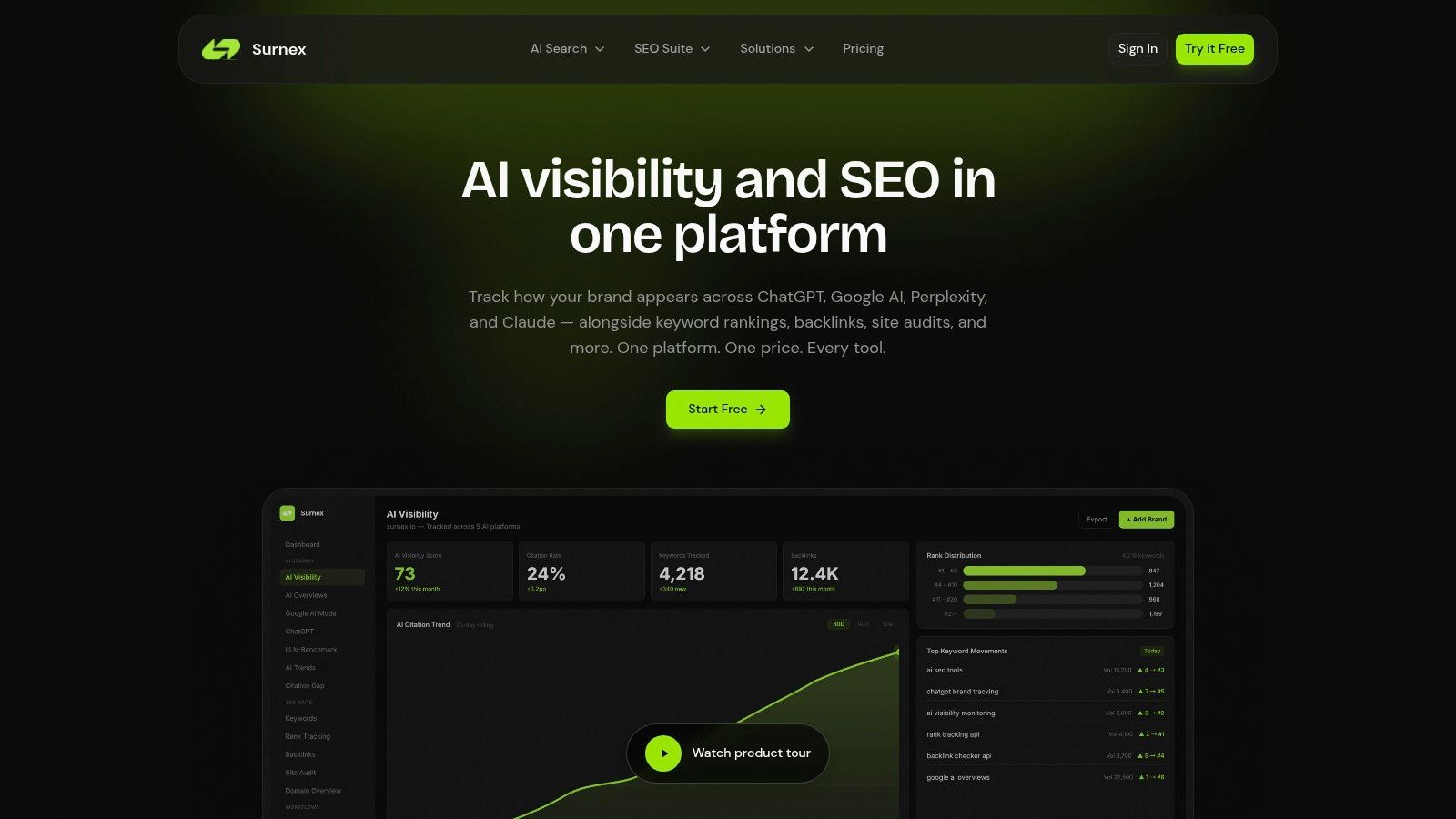
That's why unified reporting matters. Expert benchmarks for SEO validation call for a framework that combines GA4, Google Search Console, and rank trackers, with accountability tied to metrics like organic traffic, indexed pages, non-branded rankings, and Core Web Vitals according to OuterBox's guide to measuring SEO performance.
What a unified view fixes
When reporting is fragmented, teams waste time on reconciliation instead of action. A unified setup helps in a few practical ways:
- One source of truth: Everyone reviews the same KPI definitions.
- Faster diagnosis: You can connect ranking shifts to technical issues, indexing changes, or content updates.
- Cleaner client communication: Reports become easier to explain and defend.
- Better SLA management: Targets stay visible instead of disappearing into separate vendor dashboards.
This matters even more as search expands beyond classic results pages. Brands now need visibility into standard rankings, technical health, and AI-surface presence without juggling a stack of disconnected tools.
Reporting should reduce debate
The point of reporting isn't to overwhelm clients with charts. It's to make decisions easier.
A mature reporting system should answer simple questions quickly. What changed? Why did it change? Which pages drove it? What needs attention next? Revenue teams have already moved in this direction, and there's a useful parallel in how teams streamline reporting with RevOps to standardize definitions and reduce internal friction.
Good reporting doesn't just prove work happened. It shows whether the work moved the metrics that matter.
For agencies managing many accounts, branded dashboards also help maintain trust and consistency. A solid example of that reporting discipline shows up in this guide to branded SEO reporting, which reflects the kind of clarity clients now expect.
If you want a cleaner way to track modern search performance, Surnex brings together AI visibility, rankings, backlinks, audits, and reporting in one place so agencies and in-house teams can manage SEO with fewer tools and clearer accountability.