
We’ve all been there: staring at a blank document, trying to conjure up a client agreement from scratch. An SEO contract template is your starting point, a professional framework that saves you from that headache and lets you focus on tailoring the specifics for each new project.
Why Generic SEO Agreements Are A Business Risk
Think of your SEO agreement as the rulebook for your client relationship. A vague, copy-paste contract is a ticking time bomb, practically inviting misunderstandings, scope creep, and frustrating payment disputes down the line.
It’s a classic story. The client thinks “improving rankings” means they’ll be number one for every keyword imaginable. You, on the other hand, planned to start with a deep technical audit and a six-month content strategy. Without a crystal-clear contract, that disconnect is where good partnerships go to die.
Before you know it, small "out-of-scope" requests start piling up. Suddenly, your team is burning unbilled hours on tasks that were never agreed upon, killing your profit margins and leading straight to burnout. This isn't just a possibility; it's what happens when your agreement is built on assumptions instead of specifics.
The Real Cost of Vague Contracts
The damage goes beyond just wasted time. When an agreement is fuzzy, payments get delayed. Clients start questioning the value you're providing because it doesn't match their unspoken expectations. The endless back-and-forth sucks up your resources and erodes the trust you need for any real, long-term success.
This has become a massive issue. By 2026, solid SEO contracts are no longer optional—they're essential for survival. Clear agreements are helping agencies navigate disputes that now impact up to 40% of all SEO projects. In fact, agencies saw a staggering 65% jump in scope creep complaints after Google's AI Overviews rolled out, all because their initial deliverables weren't locked down. Assembly has some great insights on these industry shifts.
A strong SEO contract isn't about mistrust. It's about mutual respect. It shows you’re a professional who values clarity, accountability, and the client's investment. You're setting the stage for a partnership, not just another transaction.
Building a Foundation for Success
A great SEO contract template does more than just list services; it creates a shared vision of what success actually looks like. It’s a communication tool that gets everyone on the same page from day one.
By documenting everything, you create a single source of truth to refer back to. This nips potential conflicts in the bud, letting you focus on what you do best: getting incredible results for your clients.
A well-drafted agreement really comes down to four core jobs:
- Defines the Scope: It explicitly lists every service, whether it's keyword research, on-page SEO, content creation, or link building. No gray areas.
- Sets Clear Expectations: It outlines deliverables, timelines, and the exact metrics you'll use to measure performance.
- Establishes Payment Terms: It details your pricing model, when you get paid, and what happens if payments are late or extra work is needed.
- Protects Both Parties: It includes the boring but crucial clauses—termination, confidentiality, and liability—so there’s a clear exit strategy if things don't work out.
At the end of the day, using a solid SEO contract template is just smart business. For more on managing client relationships and scaling your agency, check out our guide on solutions for SEO consultants. It helps turn a potentially messy process into a smooth, professional onboarding experience that builds trust from the very beginning.
Defining Your Core Services And Deliverables
This section is where your SEO agreement goes from a handshake deal to a rock-solid business document. I've seen it a hundred times: vague promises like "we'll improve your SEO" or "get you more traffic" are the fastest way to an unhappy client and endless scope creep.
This is your chance to get brutally specific. You need to translate your high-level strategy into a clear, tangible list of what you will actually do and deliver. No ambiguity, no wiggle room. Instead of promising "content marketing," your contract should spell it out: "four 1,200-word, keyword-optimized blog posts per month on client-approved topics." See the difference? One is a vague idea; the other is a measurable commitment.
Getting this right is what separates smooth, long-term partnerships from constant disputes.
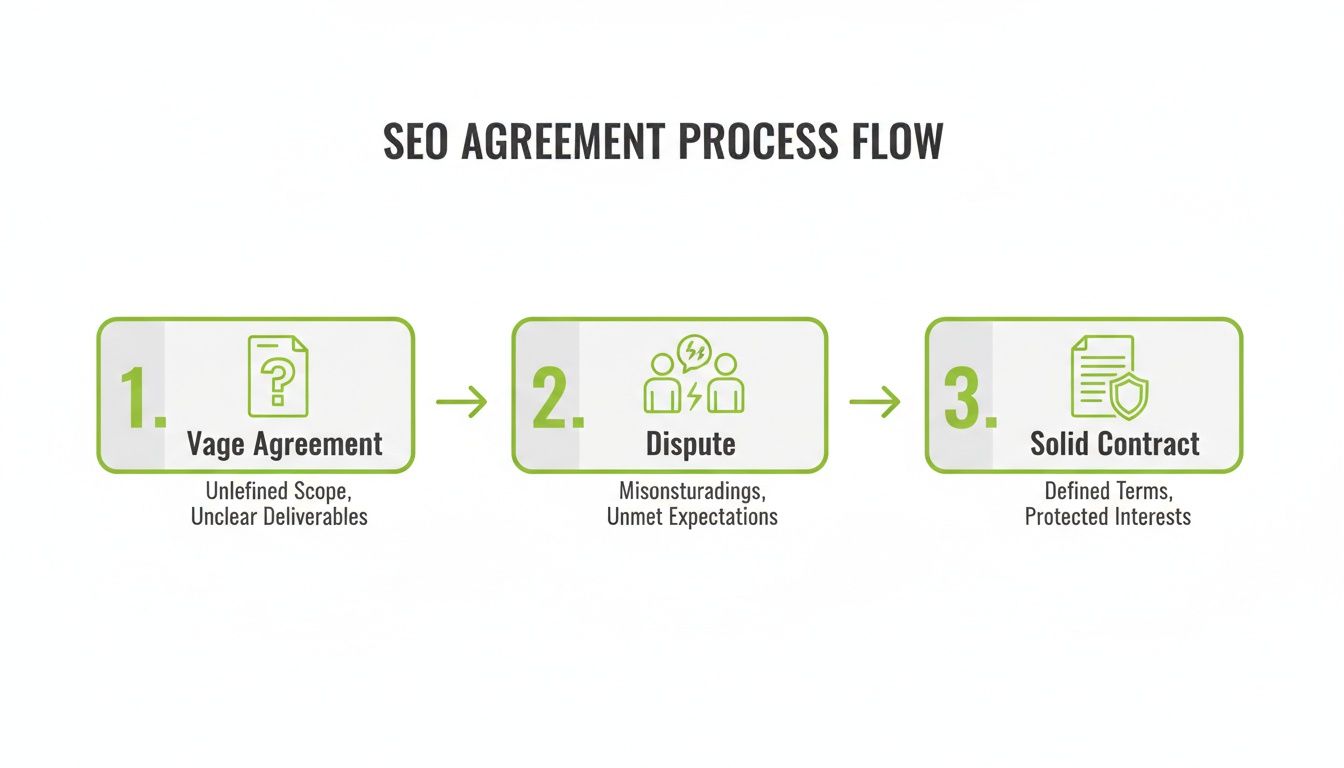
This process really boils down to two paths. One is paved with fuzzy language that leads straight to conflict. The other is built on a foundation of clarity that protects everyone involved.
Categorizing Your SEO Services
To make your scope of work easy for clients to digest (and for your team to execute), I've always found it best to break services down into logical buckets. This structure helps everyone understand exactly what they’re paying for and what to expect each month.
Most SEO campaigns can be organized into these core categories:
- Technical SEO: All the foundational work that makes sure a site is healthy and accessible to search engines.
- On-Page & Content SEO: This is about optimizing individual pages and creating new content assets that attract and convert.
- Off-Page SEO: Primarily, this covers authority-building activities like earning high-quality backlinks.
- Reporting & Analytics: This defines how you'll track progress and communicate results back to the client.
Under each of these headings, you'll list out the specific, tangible deliverables.
A great rule of thumb is this: A deliverable is well-defined if the client can ask, "Was this done?" and the only possible answer is a simple "yes" or "no." If there's any gray area, you haven't been specific enough.
Take a technical SEO task, for example. Don't just list "site audit." Instead, define it as a "comprehensive technical site audit delivered as a PDF report within the first 30 days, covering crawlability, indexation, site speed, and schema markup." If you want to see what goes into a truly professional audit, our guide on a proper site audit breaks it down.
Sample SEO Deliverables And Timelines
To give you a clearer picture, here’s a table showing how you can structure these deliverables in your contract. This format makes it incredibly easy for a client to see exactly what to expect and when.
| Service Area | Specific Deliverable | Timeline / Frequency |
|---|---|---|
| Technical SEO | Comprehensive site audit & implementation plan | Delivered within first 30 days |
| Technical SEO | Monthly crawl error monitoring & fix report | Monthly |
| On-Page SEO | Keyword research & mapping for 25 core pages | Delivered in Month 1 |
| On-Page SEO | Optimization of title tags & meta descriptions | Completed by end of Month 2 |
| Content SEO | 2 x 1,500-word blog articles (researched & written) | Monthly |
| Off-Page SEO | 3 high-authority link acquisitions | Monthly |
| Reporting | Monthly performance report & strategy call | First week of each month |
Using a table like this in your scope of work section removes all guesswork and sets crystal-clear expectations from day one. It becomes a simple checklist for accountability.
By listing everything out this way, you also create clear boundaries. If a client suddenly asks for video production or a full website redesign, you can point back to the agreed-upon scope and start a new conversation about an add-on project.
Incorporating Modern SEO Metrics
Finally, your contract needs to show that you're on top of the ever-changing world of search. Clients hear about AI and new features from Google, and they want to know their agency is prepared. Your deliverables section is the perfect place to demonstrate that you are.
Consider adding a few forward-thinking clauses to your reporting deliverables:
- AI Overview Visibility Tracking: Mention that you'll be monitoring the client’s brand and URL presence within Google's AI Overviews for their most important keywords.
- Generative Engine Optimization (GEO): State that your content strategy is built around E-E-A-T (Experience, Expertise, Authoritativeness, Trustworthiness), a critical factor for ranking in both traditional and AI-driven search results.
Including these points does more than just cover your bases. It shows the client you're a true partner who is already navigating the future of SEO, building trust and confidence right from the start.
Structuring Clear Payment Terms And Pricing
If your payment terms are fuzzy, you're asking for cash flow headaches and awkward client calls down the road. Getting the financial section of your SEO contract template right from the start means you get paid on time and can focus on the work, not on chasing invoices.
It all begins with picking the right pricing model for the job.
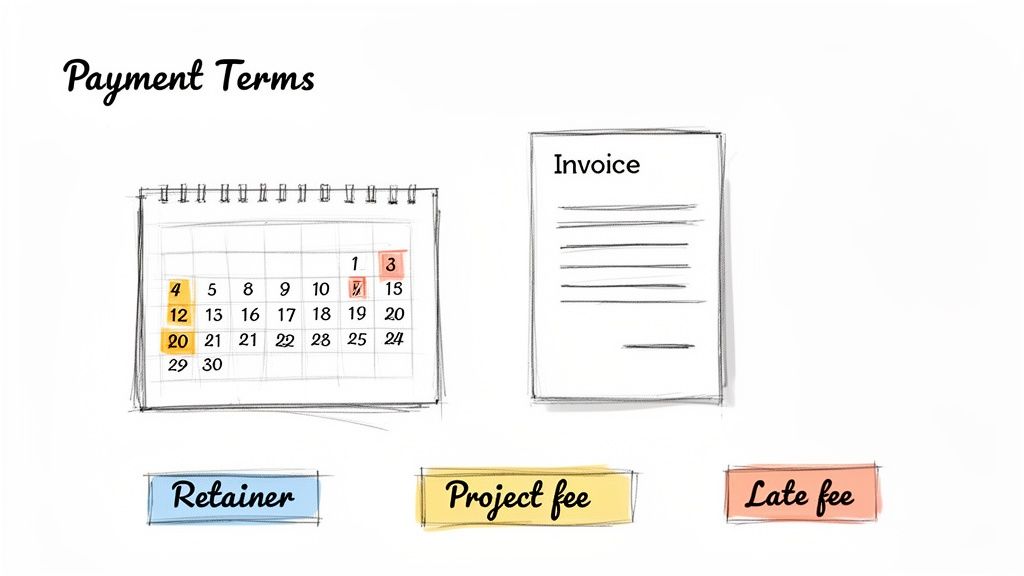
This part of your agreement needs to be rock-solid, with zero room for misinterpretation. You’re not just listing a price; you're setting the financial foundation for the entire partnership.
Selecting Your Pricing Model
The right model really depends on the project's scope, how long you'll be working together, and frankly, how your agency likes to operate. Each approach has its pros and cons, and one will likely feel like a better fit for the specific client engagement.
-
Monthly Retainer: This is the bread and butter for most SEO agencies, and for good reason. It gives you predictable revenue and lets the client budget consistently. It’s perfect for the long-haul SEO campaigns that require ongoing work with content, link building, and technical monitoring.
-
Project-Based Fee: Got a one-off task with a defined finish line? This is your go-to. Think of a deep-dive technical site audit, a complex site migration, or a messy penalty recovery. You scope the work, name your price, and get it done.
-
Performance-Based Hybrid: This one can be a powerful motivator. You blend a lower monthly retainer with bonuses tied to hitting specific goals. For instance, you could structure a deal with a base fee plus a bonus for driving a 20% increase in organic conversions. A word of caution: if you go this route, your KPIs must be ridiculously specific to avoid any arguments later.
Defining The Payment Schedule And Process
Once you’ve settled on a model, you need to spell out exactly how and when you expect to get paid. Vagueness is the enemy here.
A solid payment clause for a monthly retainer might look something like this: "Client agrees to a monthly retainer of $3,500. The first payment is due upon signing, with all future payments due on the 1st of each month for the upcoming month's services."
Don't stop there. You also need to detail the mechanics. Which payment methods do you accept—ACH, credit card? How does invoicing work? You could add that "Invoices will be sent via email seven (7) days prior to the due date." It’s a small detail that prevents a lot of friction.
One of the most important, and often forgotten, pieces is a late fee policy. This isn't about being punitive; it's about protecting your cash flow. A simple, professional clause does the trick: "Payments not received by the due date will incur a late fee of 1.5% per month on the outstanding balance."
Handling Out-of-Scope Work
Scope creep happens. It's a fact of agency life. But it doesn't have to sink your profitability. Your contract needs a clear process for handling those "can you just..." requests that fall outside the original agreement.
Your clause should lay out a simple, no-fuss process. First, you identify that a request is out-of-scope. Then, you provide a separate quote or addendum that details the extra work and the cost. Finally, you make it clear that no extra work will start until you have written approval on that new quote.
This simple workflow turns a potential conflict into a new revenue stream.
By defining these financial ground rules in your SEO contract, you’re building a professional relationship based on transparency. Clear terms are a cornerstone of great client management, a subject we cover in more detail in our resources for agency marketing solutions.
Setting Realistic Performance Metrics And Reports
The quickest way to kill a client relationship is to make promises you can't keep. The classic, fatal mistake I see in so many SEO contracts is guaranteeing a #1 ranking for some big, competitive keyword. It's a tempting sales pitch, I get it, but it’s a house of cards. Search algorithms are a black box, constantly changing and completely out of our control.
A professional SEO contract sidesteps that trap entirely. Instead of focusing on uncontrollable outcomes, you shift the conversation to the processes you can control and the progress you can measure. This is where you get granular about what success actually looks like, building trust with tangible, data-driven KPIs.
Your contract needs a clause that explicitly states that while you’re committed to improving search performance, specific rankings can't be guaranteed. This isn't just about protecting your agency; it’s about educating the client on how SEO really works. Once that's clear, you can introduce the metrics you will be held accountable for.
Choosing The Right KPIs For Your Contract
The KPIs you choose need to tie directly back to the services you just outlined. You have to draw a clear, straight line from the work you’re doing to the client's business growth. Think of it as telling a story with data.
Here are the core KPIs that should be the foundation of your performance reporting:
- Organic Traffic Growth: This is the big one. It’s the most straightforward indicator that more people are finding their site from search. Your clause should specify measuring this both month-over-month and year-over-year to iron out any seasonal wrinkles.
- Keyword Visibility: Forget chasing a single keyword. You should report on the overall visibility of a whole group of target terms. Frame it as "an increase in the number of target keywords ranking on the first page of Google."
- Backlink Profile Quality: Counting links is a rookie move. Your contract should focus on the quality and relevance of the links you build. For instance, "acquiring backlinks from websites with a Domain Authority of 50 or higher."
- Organic Conversion Rate: This is where you connect your work to their bottom line. Tracking the percentage of organic visitors who fill out a form, make a purchase, or take another key action proves the value of the traffic you’re driving.
Pro tip: Your job isn't just to hand over a spreadsheet of numbers. It’s to provide context. A great report explains why the numbers are what they are and what your next strategic move is. That’s how you turn a data dump into a valuable consultation.
Specifying Reporting Frequency And Format
Once you've nailed down what you'll measure, you need to be just as specific about how and when you'll report on it. Any ambiguity here makes clients feel like they're in the dark, and that’s a fast track to them questioning your value.
Your contract must state the reporting cadence clearly. For most retainer clients, a monthly schedule is the gold standard. A clause might read something like, "A comprehensive performance report will be delivered by the fifth business day of each month, detailing the previous month's activities and results."
Next, get specific about the format. Is it a PDF? A link to a live dashboard? A scheduled video call to walk them through it? Honestly, a combination is usually best.
For example, you could write: "The monthly report will be delivered as a PDF and accompanied by a 30-minute review call to discuss performance, key insights, and the strategic plan for the upcoming month." This guarantees you have dedicated time to explain your work and reinforce your value proposition.
Integrating Modern Reporting Tools
Your contract is also a great place to showcase the sophisticated tools you use, showing you're on top of industry changes. Today's SEO goes way beyond just tracking a list of blue links.
You can, for instance, include language about tracking performance in newer search formats. A powerful addition would be something like: "Reporting will include visibility metrics from Google's AI Overviews, tracking the client's brand and URL mentions for core keywords within generative AI results."
This proves you aren't stuck doing yesterday's SEO. Platforms like Surnex are built to pull all this data together, making it much easier to deliver insightful, modern reports without juggling a dozen different tools. If you want to get ahead of the curve, you can explore workflows for creating client-ready reporting that bake these advanced metrics right in.
By meticulously defining your metrics and reporting process in the contract, you turn what could be a simple chore into a powerful client retention tool. You set clear, achievable expectations from day one and consistently prove your worth with clear, compelling data.
Including Essential Clauses To Protect Your Agency
Alright, you’ve hammered out the scope of work and agreed on pricing. Don't stop there. The next part of your contract is what separates an amateur agreement from a professional one that truly protects your agency. These clauses are your safety net—the guardrails that manage risk and define the boundaries of the relationship.
Think of it this way: the scope defines what you’ll do, but these clauses define how you’ll work together professionally. They’re the stuff that saves you when things inevitably get complicated.

Skipping these because they feel a bit formal is a rookie mistake. Trust me, you’ll be glad you have them when you need them.
Terms of Termination
Every good partnership needs a clear exit strategy. Things change. Clients pivot, budgets get slashed, or sometimes the working relationship just doesn't click. A solid termination clause prevents a messy, awkward breakup.
The most important piece here is the notice period. For most of our retainers, a 30-day written notice is the standard. This gives you enough time to tie up loose ends, deliver a final report, and hand over the keys without scrambling. It also gives your agency a crucial window to adjust your team’s workload and forecast your finances.
Your clause should also spell out that the final invoice will cover all work completed up to the termination date. No ambiguity, no surprises.
Confidentiality and Non-Disclosure
You're going to be deep inside your client's business—accessing everything from sales data to internal strategy documents. A confidentiality clause (often called an NDA) is your legal promise to keep that sensitive information under lock and key.
This isn't just a formality; it's a massive trust-builder. It shows the client you’re a professional partner, not just a vendor. I always make this a mutual clause, meaning the client also agrees to keep your agency's proprietary methods and strategies confidential.
This two-way street is critical. Your reporting templates, your unique processes, your keyword research methodology—that’s your intellectual property. The last thing you want is for a client to pass your playbook to their next agency.
Intellectual Property Ownership
This one trips up a lot of people. Who actually owns what? Getting this crystal clear from day one will save you major headaches down the road. A well-drafted SEO contract template needs to break this down.
Here’s how we typically structure it:
- Client-Owned Materials: The client always keeps ownership of their existing assets. This includes their logo, brand guides, website, and any content they had before you came along.
- Agency-Owned Materials: Your agency retains the rights to its own tools, software, and proprietary processes. You're licensing their use to the client for the project, not selling them.
- The Deliverables: Once the client has paid in full, they get ownership of the specific work you created for them. Think blog posts, landing page copy, and the custom reports you built.
Laying this out leaves no room for debate about who can use what once the project is over.
Limitation of Liability
Frankly, this might be the single most important clause protecting your agency. It puts a financial cap on your liability if something goes wrong. Nobody goes into a project expecting disaster, but this clause protects your business from a worst-case scenario.
For example, what happens if a major Google update tanks a client's rankings despite your best efforts? SEO has inherent risks. A limitation of liability clause ensures you can't be held financially responsible for damages that vastly exceed the contract's value.
We usually cap our liability at the total fees paid by the client over the last three or six months. It's a reasonable, standard practice for any service business, and it allows you to sleep at night.
Answering Your Toughest SEO Contract Questions
Even with a solid template in your hands, you're going to have questions. It’s completely normal. An SEO contract has a lot of moving parts, and the difference between a good one and a great one is all in the details.
This is where we tackle the most common sticking points and gray areas I see agencies wrestling with. Think of this as your quick-reference guide to putting the final, confident touches on your own SEO contract template. Let's clear up the confusion so you can get back to doing what you do best.
What's the Single Most Important Clause in an SEO Contract?
Every part of the contract is there for a reason, but the Scope of Work and Deliverables section is the absolute MVP. This is the heart and soul of your agreement. Any ambiguity here is a direct invitation for disaster.
I've seen more client relationships sour over a fuzzy scope of work than any other single issue. It is the number one cause of scope creep, hands down.
A bulletproof scope clause is brutally specific. It should clearly list every single activity you'll perform, from the initial technical audit to the exact number of blog posts and link-building targets each month. It also needs to define what you won't be doing, which sets crucial boundaries from day one.
Most importantly, you need a simple, pre-defined process for handling out-of-scope requests. This way, when a client asks for "just one more thing," you have an agreed-upon method to scope it, price it, and get paid for the extra work. Without this, you're basically signing up for unpaid labor.
How Do I Handle Guarantees for SEO Rankings?
The short answer? You don't. A modern, professional SEO contract should never, ever guarantee specific keyword rankings. It’s just not possible. Search engine algorithms are a black box—they're complex, they change constantly, and they are completely outside of your control. Promising a #1 spot isn't just unethical; it's a recipe for failure.
Instead, your contract has to guarantee the things you can control: your processes and your deliverables. Frame your Key Performance Indicators (KPIs) around metrics that directly show the quality and impact of your work.
Promise these things instead of rankings:
- Measurable improvements in organic traffic.
- Growth in overall keyword visibility (the total number of keywords ranking on the first few pages).
- Higher click-through rates (CTR) from the search results.
- Better organic conversion rates, proving the traffic you're driving is actually valuable.
Shifting the conversation from risky ranking promises to tangible business metrics immediately positions your agency as a strategic partner, not a gambler. You’re focused on real growth, not vanity metrics.
How Often Should I Update My SEO Contract Template?
It’s just smart business to give your SEO contract template a thorough review at least once a year. The world of search moves fast, and your agreements need to keep up. Big industry shifts are another major trigger for a contract review.
A perfect example is the rollout of Google's AI Overviews. That change alone demanded immediate updates to how agencies define and report on search "visibility." Your contract needs to evolve to reflect new services you offer, updated best practices, or even just changes in your own internal workflow.
Keeping your template current isn't just about staying relevant. It protects your agency from new challenges and makes sure the contract accurately reflects the sophisticated value you're bringing to the table.
Is It Okay to Use a Free SEO Contract Template I Found Online?
Absolutely. Starting with a well-vetted, free template is a great way to save a ton of time. But—and this is a big but—it should never be used "as-is." Think of it as a foundation, not a finished house.
You have to customize any template to fit your agency’s specific services, your pricing model, and the unique goals of each client. No two projects are the same, and your contract has to reflect that reality.
Finally, and I can't stress this enough: always have your finalized contract reviewed by a qualified lawyer in your area. This is a small investment that can save you from colossal legal and financial headaches later. It’s the final, non-negotiable step to ensure your agreement is not just comprehensive but legally airtight.
Ready to stop worrying about contracts and start scaling your agency with confidence? Surnex provides one unified platform for modern search intelligence, combining AI visibility tracking with core SEO workflows. Deliver smarter reporting, prove your value, and manage every client from a single, powerful dashboard.