You're probably in one of two situations right now. Your business already has a website, maybe even some content and a Google Business Profile, but leads from organic search feel inconsistent. Or you're talking to SEO agencies in Los Angeles and hearing the same recycled pitch from all of them.
That's where most companies get stuck. They don't need another checklist about title tags and keywords. They need to know what makes Los Angeles SEO services different, what an agency should be doing behind the scenes, and how search is changing as Google and other AI systems summarize answers instead of sending every searcher to a blue link.
Why SEO in Los Angeles Is a Different Game
A Los Angeles business rarely competes in just one clean market. It competes across neighborhoods, service areas, languages, device types, and intent levels all at once. A law firm in Century City, a med spa in West Hollywood, and a home services company serving the Valley are all dealing with different search behavior, even if they operate under the same city label.
That's why generic SEO advice underperforms here. “Rank for Los Angeles keywords” sounds fine in a proposal, but real search demand breaks into far more specific patterns. Buyers often search with neighborhood terms, service modifiers, and near-me intent. A broad city page alone usually won't carry the load.

There's also a newer problem that many agencies still treat as an afterthought. As Built In LA's discussion of Los Angeles SEO agencies notes, the practical unanswered issue for businesses is not just how to rank in LA, but how to stay visible when search systems extract and summarize content across Google AI Overviews and other AI interfaces.
Visibility now depends on more than rankings
If your content is vague, inconsistent, or poorly structured, AI systems have less reason to cite it. If your business details conflict across your site, your Google Business Profile, and location pages, you weaken entity clarity. That hurts traditional local SEO and can also reduce your visibility in AI-mediated discovery.
Good Los Angeles SEO services now have two jobs. Help you rank, and help search systems understand enough about your business to cite you.
That's a big reason to look beyond a standard local package. If you want a useful benchmark for what local optimization should include at a practical level, this guide to best local SEO services is a good comparison point before you sign anything.
The Five Pillars of Los Angeles SEO Services
A company in Los Angeles can spend months publishing content, paying for web updates, and collecting reports, then find out the underlying problem was simpler. Google could not clearly connect the business, its locations, its services, and its credibility. In LA, that gap shows up fast because competitors are already covering the basics.
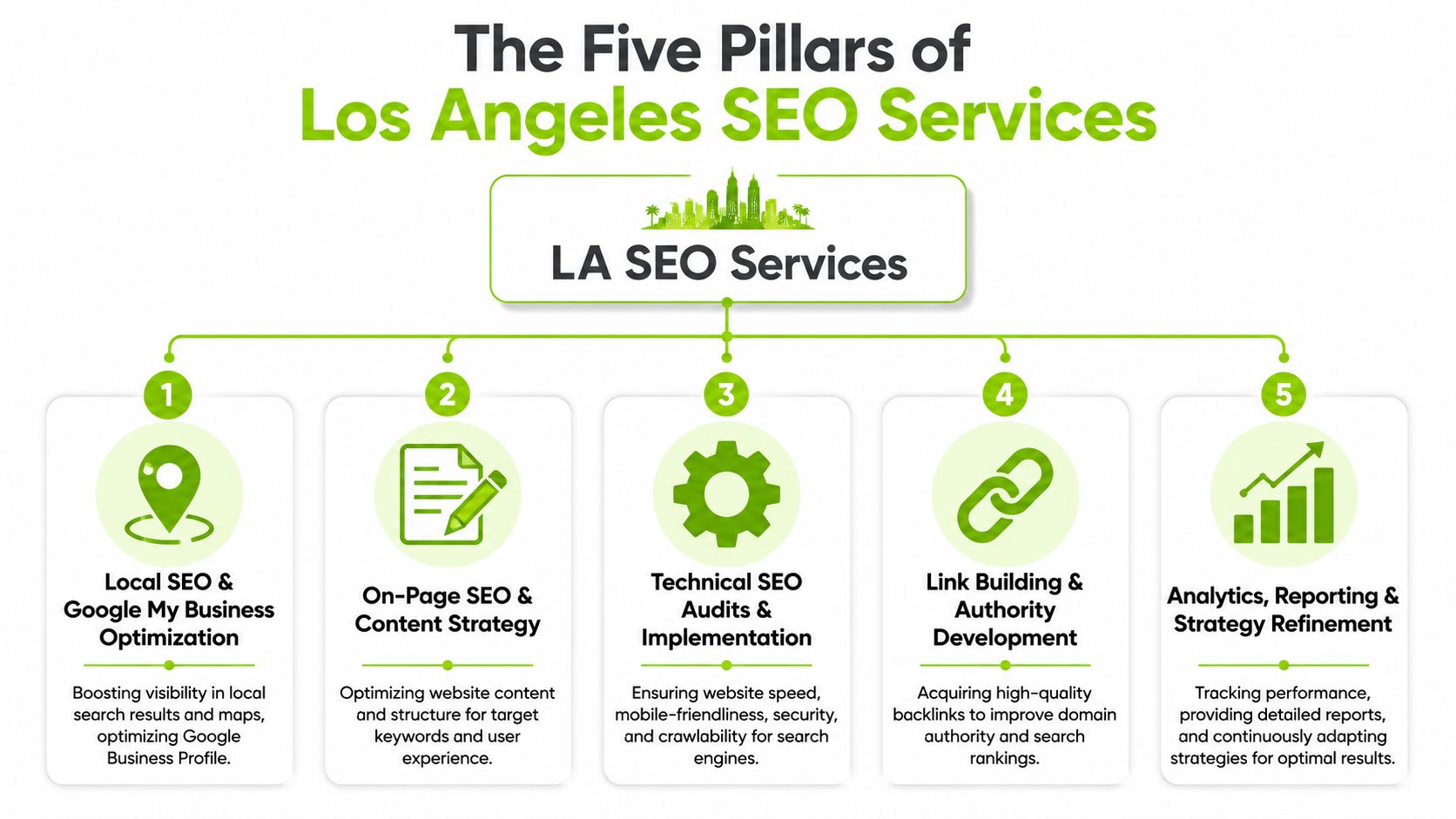
The strongest SEO programs in LA rest on five connected pillars. If one is weak, the others lose force. That matters even more now that Google AI Overviews and other AI-driven results often pull from businesses with clear structure, strong entity signals, and consistent local data, not just pages that happen to rank.
Local SEO and Google Business Profile
Local SEO is the operating center for many LA businesses. Salesgenie's local SEO research reports that 84% of consumers search online for local businesses daily, 45% default to Google for location-specific searches, 89% expect business owners to respond to reviews, and 39% estimate that at least 41% of their searches focus on local businesses.
Good local execution goes well beyond filling out a profile.
An agency should be managing category choices, service definitions, photos, review response processes, and the connection between your Google Business Profile and the right landing pages. It should also be checking whether your business details match across your site, your profile, and your major directory listings. If those details drift, rankings can slip and AI systems have a harder time understanding which facts to trust.
Strong local work usually includes:
- Profile control: Accurate categories, service lists, business descriptions, photos, and update workflows
- Location intent mapping: Pages built around how people search by neighborhood, city, suburb, or service area
- Reputation operations: A repeatable review request and response process owned by someone internally
- Consistency checks: Matching business name, hours, contact details, and service information across key properties
For teams comparing tools and workflows, a platform for local SEO management can help centralize visibility tracking and follow-through.
Technical SEO and infrastructure
Technical SEO is where weak agencies get vague. “We optimized the site” can mean anything from compressing a few images to ignoring indexation problems that block revenue pages.
The actual work is more specific. Search engines need to crawl your pages, index the right versions, understand page relationships, render the mobile experience correctly, and process structured data without contradictions. If your site has duplicate location pages, broken canonicals, thin internal links, slow templates, or important pages buried in navigation, content production will not solve the bottleneck.
This also affects AI visibility. Systems that summarize businesses tend to favor pages with clear structure, consistent details, and obvious topical relevance. Technical disorder makes that harder.
Here's a useful visual overview before we move deeper into the service mix:
Content strategy that matches LA search intent
Content strategy in Los Angeles is usually an architecture problem before it becomes a writing problem. The agency needs to decide which pages are meant to rank, which pages are meant to support them, and which pages exist to convert visitors who are comparing providers.
A useful mix often includes:
| Page type | What it should do |
|---|---|
| Core service pages | Capture bottom-funnel demand for your main offers |
| Location pages | Target neighborhood, city, or service-area variants |
| Support content | Answer buyer questions that help conversion later |
| Proof pages | Show experience through examples, process, team, and FAQs |
Mediocre agencies fill the blog with generic posts because they are cheap to produce and easy to report on. Better agencies improve service pages, connect them with internal links, and publish supporting content that helps both rankings and sales conversations.
In LA, content also has to help search systems identify your business as a credible local entity. That means clear service scope, visible geography, firsthand examples, and language specific enough that an AI summary can cite you without guessing what you do.
Link building and authority development
Authority still matters. Judgment matters more.
Cheap directory submissions and bulk guest posts can make a monthly report look busy while doing very little for the pages that drive leads. In some cases, they create a cleanup problem later. A better LA link strategy usually focuses on relevant local mentions, industry publications, digital PR, partnerships, and citations that reinforce the services and locations you want to rank.
I would rather see a smaller set of links tied to strong service or location pages than a long spreadsheet full of low-context placements. The real question is whether the agency can explain why each link type supports your market position.
A link report with lots of rows can still hide weak judgment.
Trust signals and entity clarity
This pillar has become more important as search platforms summarize brands instead of only listing them. Your site needs to make basic facts easy to verify. Who runs the company, what services you provide, where you operate, which locations you serve, and what proof supports your claims.
That includes visible company information, consistent branding, author or team identity where it matters, structured data where it helps, and copy that sounds like a real business with actual experience. If your pages look interchangeable with every other templated site in LA, users trust them less, and AI systems have less reason to surface them.
Great Los Angeles SEO services treat these five pillars as one operating system. Local signals, technical structure, content, authority, and trust have to support each other. If an agency only sells one piece, you are probably buying activity, not traction.
Navigating the Unique LA Market Maze
A company opens in Culver City, gets reviews that mention West LA, serves clients in Santa Monica and Beverly Hills, and wants to rank for all of it. Six months later, the site has overlapping location pages, the Google Business Profile points in one direction, citations say something else, and AI-generated search summaries pull mixed details about where the business operates. That is a common Los Angeles SEO problem.
Los Angeles search demand is fragmented by neighborhood, city, freeway pattern, and service model. Searchers do not behave like they are shopping one clean metro area. They search by proximity, urgency, neighborhood identity, parking convenience, and whether you serve their side of town. A company can say it serves Los Angeles and still miss the queries that matter.
LA competition exposes weak operating models fast
A crowded agency market is one signal. Semrush's Los Angeles SEO agency directory shows how many firms compete for the same buyers and how aggressively they market proof, specialization, and process. That pressure exists on the client side too. If your SEO program is built on vague service-area claims and thin location targeting, stronger operators will outrank you.
The hard part is not publishing more pages. It is keeping every local signal aligned as the business grows.
Multi-location and service-area businesses usually run into the same friction points:
- Location scope: Which neighborhoods do you want to win, and which ones are too far, too weak operationally, or too expensive to support?
- Page logic: Which areas deserve dedicated pages based on real demand, proof, and staffing, and which should stay part of broader service pages?
- Business data control: Who owns public-facing names, hours, categories, and service descriptions across profiles and citations?
- Review routing: How will you collect reviews for the right office or team without creating mixed signals?
- Implementation ownership: Who updates pages, schema, internal links, and profile details when the business changes?
If nobody owns those decisions, SEO turns into drift. Rankings fluctuate, leads get misrouted, and AI Overviews have a harder time trusting your brand details because your web presence keeps contradicting itself.
Neighborhood intent beats broad city vanity terms
For many companies, "Los Angeles" is the headline keyword and the wrong operating target. It may bring impressions, but neighborhood-level intent often converts better because it maps to how people typically choose providers in LA. Someone searching "personal injury lawyer Pasadena" or "med spa Studio City" is usually closer to action than someone typing a broad city term.
That changes page strategy. Strong campaigns build around real demand clusters, not every place name a team can stuff into a template. The test is credibility. Can the business show local proof, relevant reviews, useful service details, and a clear reason to rank for that area?
I also watch whether the structure can survive six months of growth. If a company adds new services, opens another office, or expands service boundaries, the site should still make sense. Teams that want a useful reference for process design can study how agencies structure delivery models in guides like how to start a SEO business, then adapt the parts that matter for internal ownership and execution.
AI is raising the bar for local clarity
Google is no longer just ranking pages. It is summarizing businesses. That creates a second visibility problem in LA. You need pages that rank, and you need brand information that AI systems can verify quickly.
That means clearer service definitions, cleaner location relationships, stronger review signals, consistent entity details, and fewer pages that say nearly the same thing with different neighborhood names swapped in. Thin local pages were already weak. In AI Overviews, they are even less useful because they give search systems very little original evidence to work with.
The practical shift is simple. Build fewer, better local assets. Tie each one to real operations. Make it obvious where you work, who you serve, and why that page exists. In Los Angeles, that discipline separates companies that stay visible from companies that create noise and call it SEO.
Budgeting for Success Typical Pricing and Timelines
Most buyers ask about price too late and scope too vaguely. That's how they end up comparing proposals that look similar on paper but include very different levels of work.
In Los Angeles, pricing usually reflects three things. Site complexity, competitive pressure, and how much actual implementation the agency handles. A retainer that includes strategy only is a different product from one that includes technical fixes, content production, location-page work, reporting, and review operations.
Common pricing models
You'll usually see one of these structures:
| Pricing model | Best fit | What to watch |
|---|---|---|
| Monthly retainer | Ongoing SEO programs | Make sure deliverables are specific |
| Project fee | Audits, migrations, cleanup work | Confirm what happens after launch |
| Hourly consulting | Internal teams needing guidance | Useful, but execution may still bottleneck |
Retainers are common because SEO is operational. Rankings shift, pages age, reviews come in, competitors publish, and technical issues appear over time. A one-time audit can help, but most LA businesses need continuous attention.
What affects cost
Prices rise when any of these are true:
- You have multiple locations: Each one increases page, profile, and consistency management.
- Your site has technical debt: Bad templates, indexing issues, and weak architecture take time to fix.
- Your category is crowded: Legal, healthcare, real estate, home services, and ecommerce usually require deeper work.
- You expect full execution: Writing, publishing, schema work, reporting, and coordination cost more than advice alone.
Many business owners ask for a “ballpark” before they've defined goals. That's backwards. First decide whether you need lead growth, map visibility, recovery from a traffic drop, support for expansion, or better AI-era discoverability. Then the budget conversation gets clearer.
Timelines that are realistic
SEO rarely moves in a straight line. You may see technical cleanup and improved crawl behavior first. Then impression growth. Then more stable rankings for the pages that were already close. Revenue impact usually takes longer because it depends on conversion quality, not just traffic.
A practical timeline often looks like this:
- Early phase: Audit, page mapping, technical fixes, and local profile cleanup.
- Middle phase: Content revision, internal linking, location-page rollout, and review process improvements.
- Later phase: Authority building, content expansion, and refinement based on query data.
If an agency promises fast domination of the LA market, be skeptical. If they can explain sequencing, trade-offs, and what they'll prioritize first, that's a better sign. If you're studying agency economics from the provider side as well, this breakdown on how to start a SEO business gives helpful context on why retainers are structured the way they are.
How to Evaluate and Choose an LA SEO Agency
A familiar LA scenario. You hire an agency after a strong pitch, three months pass, and the work turns out to be rank trackers, broad traffic charts, and recycled content that could apply to any city in the country. Meanwhile, your real problems stay untouched: overlapping service areas, weak location pages, messy Google Business Profile coordination, and no plan for how your brand shows up in AI-generated answers.
The right agency can explain how it will handle those details before you sign.
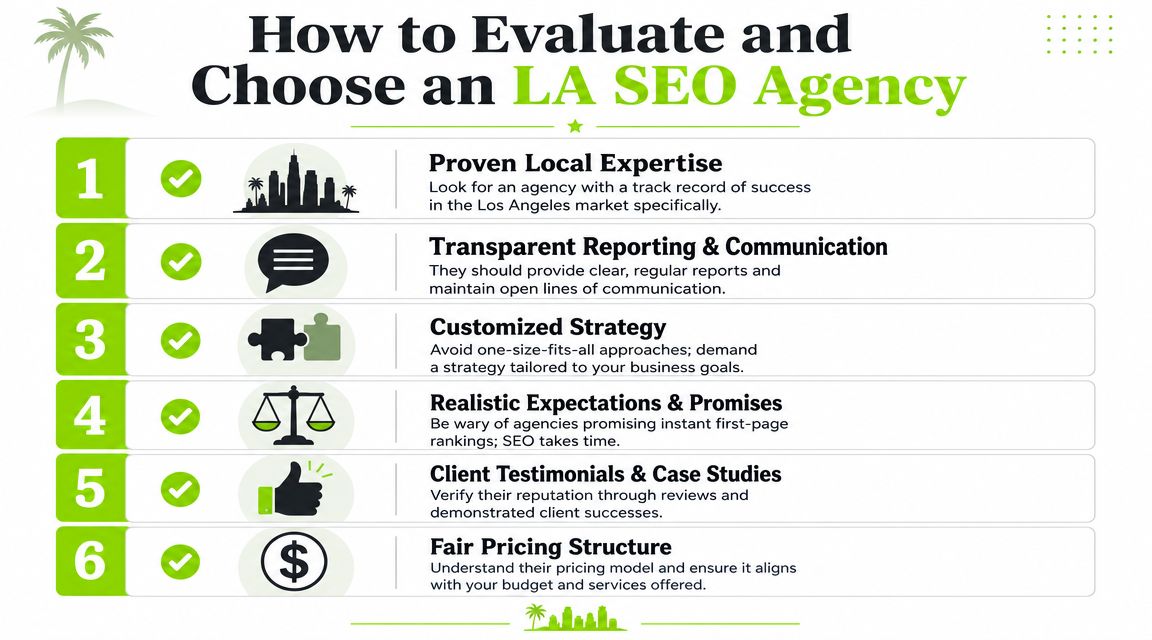
Questions that reveal real capability
Use the sales call to test how the team thinks under real operating constraints. Ask direct questions, then let them answer in full:
- How would you structure location pages for a business serving multiple LA neighborhoods without creating near-duplicate pages?
- How do you decide whether a page should target Los Angeles as a whole, a district like Koreatown or Venice, or a nearby city with separate intent?
- Who owns implementation when fixes require developers, writers, designers, or franchise operators?
- How do you report progress when rankings fluctuate but lead quality and local visibility are improving?
- What are you doing differently now that AI Overviews can intercept clicks for local-intent searches?
- How do you improve the odds that our brand, services, and locations are cited accurately in AI-generated search results?
Strong agencies answer with process, examples, and trade-offs. Weak agencies fall back on generic audits, posting frequency, and promises about page-one rankings.
Test them on your actual operating model
The best hiring test is simple. Give the agency your real footprint and ask how it would build the account.
For a multi-location company, that means hours, naming conventions, service overlap, practitioner pages, review generation, local landing page ownership, and Google Business Profile governance. For a single-location company that serves a wide radius, it means a different set of decisions. How much should live on city pages versus service pages? Which neighborhoods justify dedicated pages? Where does hyperlocal targeting become thin content? Good agencies have clear answers because they have seen the failure modes before.
This matters even more in Los Angeles because the market does not behave like one city. Search behavior splits by neighborhood, language, commute pattern, and device context. An agency that cannot map your business model to that reality will usually overproduce pages, under-specify technical work, and create reporting that hides the problem.
A practical hiring rule: if the team cannot explain your service area structure back to you in plain English, do not expect them to execute local SEO well.
What to look for in reporting and tools
Reporting should help you make decisions. It should not force you to decode screenshots and vanity metrics.
A solid agency should show:
| What to assess | What good looks like |
|---|---|
| Business alignment | Reports connect search work to calls, form fills, qualified leads, or sales pipeline |
| Local visibility | You can review performance by location, service area, or page type instead of one blended average |
| Technical status | Open issues, fixes completed, dependencies, and blocked items are visible |
| AI search monitoring | If AI search affects your category, the agency tracks brand mentions, citation accuracy, and visibility in AI-led results |
Tool stacks differ. The point is not which logo appears in the proposal. The point is whether the agency can tie data to action.
Some teams use Google Search Console, Google Analytics, Ahrefs, Semrush, Screaming Frog, and Looker Studio. Some also add AI visibility tracking. Surnex is one example. It tracks AI Overviews, citations, rankings, backlinks, audits, and related SEO data in one dashboard and API. That setup can help a company monitor both standard search performance and newer AI discovery signals without stitching together multiple disconnected reports.
If you want a broader framework for vetting outside help, review this guide to search engine marketing consultants before final interviews.
Red Flags and SEO Guarantees to Question
A Los Angeles company signs with an agency after hearing the right pitch. Fast rankings. More leads in 60 days. Full local domination. Three months later, the site has new blog posts, the Google Business Profile is barely touched, technical issues are still open, and AI Overviews cite competitors instead. That pattern is common because weak agencies sell certainty where good operators talk about constraints, sequencing, and odds.
Guarantees that should make you pause
Treat these promises as sales language, not strategy:
- Guaranteed rankings: No agency controls who else enters the market, what Google rewrites, or how local packs and AI results shift.
- Guaranteed traffic growth: More sessions do not help if they come from the wrong neighborhoods, weak service intent, or irrelevant informational queries.
- Guaranteed leads without conversion work: Search can bring visitors. It cannot fix a weak offer, slow intake, poor forms, bad call handling, or location pages that do not build trust.
- Instant recovery or rapid local dominance: Indexing, reprocessing, review signals, citation cleanup, content updates, and GBP changes all take time. In LA, competition stretches that timeline further.
Strong agencies set expectations in ranges. They explain what can move fast, what usually moves slowly, and which dependencies sit with your team.
Technical vagueness is a serious warning sign
Ask an agency a simple question: what would you check first if a location page is not getting impressions? A capable team can answer plainly. They will talk about indexation, internal links, duplicate intent across pages, weak local signals, Core Web Vitals, structured data, and whether Google is choosing another URL instead.
If the answer turns into jargon or vague talk about "optimizing the backend," press harder.
Technical work gets hand-waved in a lot of LA proposals because content is easier to sell. But on a messy site, publishing more pages often creates waste. Google may not crawl them well, may not trust the page type, or may fold their value into another URL. AI Overviews raise the stakes. If your entity signals, service-area relevance, and site structure are unclear, your brand becomes harder to cite or summarize even when you have decent traditional rankings.
As noted earlier, technical SEO is foundational. An agency should be able to tell you what is broken, why it matters, who needs to fix it, and what likely happens after the fix.
Other warning signs buyers miss
Some red flags are operational, not flashy.
- They want control of your core assets: Keep ownership of your domain, CMS, analytics, Search Console, and Google Business Profile. Agency access is fine. Agency ownership is a risk.
- They avoid hard prioritization: Every audit looks long. Good agencies can say which three issues matter now and which can wait.
- They sell one template to every client: A personal injury firm in LA, a multi-location home services brand, and a venture-backed SaaS company need different local, technical, and content strategies.
- They ignore AI search behavior: If your category is showing AI Overviews or AI-assisted local discovery, the agency should have a plan for citation consistency, entity clarity, first-party proof, and content that earns mention-level visibility, not just blue-link rankings.
- They promise output, not decisions: Ten blogs a month, twenty citations, or a batch of backlinks means little without a clear reason those actions fit your market and site condition.
One more warning sign matters in Los Angeles. Agencies that talk like every neighborhood behaves the same usually do shallow work. Search demand, competition, and service intent vary widely across the city and surrounding areas. A firm that cannot explain how it will handle that reality usually falls back to generic deliverables.
You are hiring judgment. The work changes as Google changes, as local competitors invest, and as AI starts answering more of the query before the click. Confidence is cheap. Clear thinking is what you pay for.
Your Actionable Hiring and Briefing Checklist
A good hiring process starts before the first agency call. If your own goals are fuzzy, every proposal will sound reasonable.
Hiring steps
Use this short sequence:
-
Define the business outcome Decide what matters most. More qualified leads, better map visibility, stronger location-page performance, recovery from a drop, or preparation for AI-overview visibility.
-
List your operating constraints Note how many locations you manage, who controls the website, who handles reviews, and whether developers are available.
-
Shortlist a small number of agencies Keep the list tight. Too many calls create noise instead of clarity.
-
Run the same questions with each agency Use the same evaluation prompts so comparisons stay fair.
-
Ask for a sample action plan Not a full free strategy. Just the first-priority issues they'd address and why.
Briefing essentials for the agency you choose
The more context you give upfront, the faster the work gets useful.
Bring these into kickoff:
- Access and ownership details: Analytics, Search Console, CMS, Google Business Profile, and any call tracking or CRM setup.
- Business priorities: Which services, locations, or categories matter most.
- Operational rules: Approved naming conventions, hours update process, and who signs off on content.
- Existing assets: Location pages, service pages, brand guidelines, review workflows, and internal subject matter experts.
- Known issues: Site migration history, duplicate pages, old agencies, or inconsistent listings.
The last check before signing
Before you approve the contract, ask one final question. “If this campaign underperforms after the first phase, what are the first three things you'll review?”
The answer matters. Good agencies have a diagnosis process. Weak ones repeat the original sales pitch.
If you approach Los Angeles SEO services this way, you'll hire with more confidence and waste less time cleaning up after the wrong partner.
If your team needs a clearer way to track both traditional SEO and emerging AI search visibility, Surnex provides one platform for rankings, backlinks, audits, AI Overviews monitoring, and citation visibility across newer search experiences. It's built for agencies, in-house teams, and developers that need practical search intelligence without stitching together a stack of separate tools.