You're probably dealing with one of two situations right now.
Either your paid search account is running, but results feel stuck. Leads come in unevenly, costs drift upward, and every change seems to create a new problem somewhere else. Or your team knows search matters, but nobody has enough time to manage bids, keyword intent, landing page alignment, reporting, and the new reality of AI-shaped search behavior at the level it now demands.
That's where search engine marketing consultants can help. The right one won't just tune a Google Ads account. They'll bring discipline to targeting, cleaner measurement, sharper landing page strategy, and a clearer view of how your brand shows up across both traditional search and AI-mediated discovery.
The wrong one will sell activity, hide behind jargon, and leave you with nicer-looking dashboards but no better decision-making.
Knowing When to Hire an SEM Consultant
A lot of teams wait too long to get help.
They keep trying to fix SEM with small adjustments. New ad copy this week. Broader keywords next week. A landing page refresh after that. None of those moves are wrong on their own, but they rarely solve the deeper issue, which is usually a strategy and measurement problem.

If you're running campaigns in-house and performance has flattened, that's often the moment to bring in outside expertise. The same applies when your team is competent but stretched. Good SEM management is detail-heavy, and it gets harder when one person is also handling SEO, analytics, content, and stakeholder reporting.
The signs usually show up before the crisis
You don't need to wait for a full collapse in performance. In practice, businesses hire search engine marketing consultants when they notice patterns like these:
- Results have plateaued: campaigns still produce traffic, but lead quality or sales quality isn't improving.
- Scaling feels risky: every budget increase seems to bring weaker traffic rather than better outcomes.
- Internal reporting is too shallow: the team can report clicks and spend, but not explain what's driving qualified conversions.
- Search has become cross-functional: paid search now depends on landing pages, CRM tracking, analytics setup, and collaboration with content or product teams.
- AI search is creating confusion: rankings or ad metrics may look steady while overall search-driven business impact changes.
Practical rule: Hire a consultant when your team can still describe the symptoms, but can't clearly explain the cause.
That's no longer an edge case. In the United States, the SEO & Internet Marketing Consultants industry reached $119.4 billion in 2026, growing at a 21.9% compound annual rate from 2020 to 2025, according to IBISWorld's industry analysis. That matters because it shows consulting support is no longer a niche purchase for big brands. It's become a normal operating decision for companies trying to compete online.
A consultant should remove bottlenecks, not add another layer
The best hires create clarity fast. They audit your account structure, challenge weak assumptions, and tell you where money is leaking. They also help internal teams focus on the right work. For many brands, that means using specialist support alongside in-house marketing teams rather than replacing them.
A good consultant is usually the right move when you need one or more of the following:
| Situation | Why outside help makes sense |
|---|---|
| Stagnant campaign performance | Fresh diagnosis usually spots structural issues internal teams have normalized |
| New market or product launch | Setup quality matters more than most teams expect |
| Reporting confusion | A consultant can rebuild tracking and attribution discipline |
| Team bandwidth limits | SEM often suffers when it becomes a side responsibility |
| Search landscape shift | Legacy PPC habits don't cover AI visibility questions |
Search has become too expensive, too dynamic, and too visible to leave on autopilot.
Defining Your Goals and Sourcing Candidates
Most bad SEM hires start with a weak brief.
A company realizes performance isn't where it should be, opens a browser, searches for a consultant, and starts booking calls. That almost guarantees a messy process because the candidates end up defining the scope for you. When that happens, you're judging presentation skills more than fit.
Start with a working brief, not a wishlist
Before you speak to anyone, write down what success means in business terms. Not “improve Google Ads.” Not “grow traffic.” Those are channel outputs. They're not outcomes.
A useful SEM brief usually includes:
-
Primary business goal State what the campaign exists to drive. Qualified leads, booked demos, online sales, location visits, or pipeline contribution.
-
Priority audience segments List the buyers you care about most. Include geographies, service lines, customer types, and any exclusions.
-
Offer and conversion path Explain what the traffic lands on and what action you want people to take.
-
Current stack Include Google Ads, Google Analytics, CRM, call tracking, landing page platform, and reporting tools.
-
Constraints Note compliance issues, approval bottlenecks, limited creative resources, or landing page limitations.
-
Known problems Be honest. Weak conversion tracking, mixed intent traffic, duplicated campaigns, no negative keyword process, poor reporting cadence. Put it all in.
Experienced search engine marketing consultants stand out in these situations. The strong ones won't jump straight to ad ideas. They'll ask how leads are defined, what happens after form fill, where attribution breaks, and whether your landing pages match search intent.
Build the brief around the actual workflow
A best-practice SEM workflow involves identifying high-intent keywords, using negative keywords to prevent budget waste, and continuously optimizing through A/B testing, as outlined in this SEM ROI guide. That sequence should shape your hiring brief.
If your brief only says “we need more leads,” you'll attract generic operators. If it says you need better separation of commercial and informational queries, stronger negative keyword discipline, and a test plan for ad copy and landing pages, you'll attract people who know what they're doing.
For teams that need help tightening the search side of the brief, a structured keyword research workflow is useful because it forces clarity on intent before campaign buildout starts.
The quality of the brief usually predicts the quality of the shortlist.
Where better candidates actually come from
Top consultants rarely come from the first page of a generic search alone. They often come from narrower channels where reputation is easier to verify.
Good sourcing paths include:
- Referrals from operators you trust: ask marketing leaders who manage similar budgets or sales models.
- Specialist communities: look for paid search and search strategy communities where practitioners share account-level thinking.
- Partner ecosystems: analytics firms, CRM consultancies, and landing page specialists often know who does strong SEM work.
- Selective agency networks: some independent consultants work as senior specialists behind the scenes for agencies.
A portfolio matters, but how a consultant talks through trade-offs matters more. You're listening for judgment. Do they know when to narrow match types, when to hold spend, when to kill a keyword that drives traffic but weak leads, and when a landing page problem is the actual bottleneck?
A simple filter before first interviews
Use this quick screen before you take a call:
- Can they explain success without defaulting to clicks?
- Do they ask about conversion quality early?
- Do they care about access to analytics and CRM data?
- Can they talk about search intent in a way that matches your business model?
- Do they sound like they want to diagnose first, then prescribe?
If the answer is no, keep looking.
How to Vet Consultants for Modern Search
Most companies still vet SEM consultants like it's a pure Google Ads buying decision.
That's outdated. Paid search still matters, but modern search performance now includes zero-click behavior, AI summaries, and brand visibility in places where the user never visits your site directly. If your consultant can only talk about CPC, CTR, and ad structure, you may be hiring for the last version of search.

A major challenge for SEM in 2026 is the rise of zero-click searches, where AI Overviews summarize results. A modern consultant must be evaluated not just on CPC or ROAS, but on their ability to measure and improve a brand's visibility and citation share within these AI-generated answers, as discussed in this analysis of the modern search engine marketing consultant role.
The old checklist isn't enough
Yes, you should still check references, account experience, and platform familiarity. But those checks won't tell you whether the consultant understands how search behavior is changing.
A stronger interview looks for three things:
Strategic adaptability
Ask how they'd respond if branded traffic softens while rankings stay steady. A legacy PPC manager may blame seasonality or competition by default. A modern consultant should at least consider AI answer surfaces, zero-click behavior, assisted discovery, and shifts in user journey design.
Measurement maturity
Ask what they would report if fewer users click through from search, but branded demand appears to rise later. Good candidates will talk about visibility, citations, assisted paths, and downstream conversion signals. Weak candidates will keep retreating to last-click reporting.
Platform awareness beyond ad buying
Ask what they monitor outside the ad account. The answer should include landing page alignment, query intent patterns, analytics integrity, CRM feedback, and some view of AI search presence. Tools differ, but the capability matters. Teams using platforms such as AI visibility tracking can inspect whether a brand appears in AI-generated search experiences alongside traditional search metrics.
If a consultant says AI search “doesn't matter yet” for your category, ask how they verified that. Don't accept a shrug as strategy.
Questions that expose current thinking
Use questions that force specifics:
- How do you diagnose a drop in traffic when rank and spend look stable?
- Which search behaviors now produce value without a click?
- How would you measure brand presence inside AI-generated summaries?
- What would you change in reporting for a client whose executive team cares about pipeline, not ad metrics?
- When do you prioritize presence and citations over raw click volume?
- How do you separate a keyword problem from a landing page problem?
A capable consultant doesn't need perfect answers to every emerging-search question. But they should show that they've thought about them, tested approaches, and built reporting that reflects reality rather than nostalgia.
This short video gives useful context on how search behavior is shifting and why older SEM assumptions break down faster now than one might anticipate.
What good vetting sounds like
Strong consultants sound concrete. They'll mention query classes, negative keywords, landing page message match, funnel leakage, and reporting gaps. They'll admit where data is imperfect. They won't pretend every business needs the same tactic stack.
Weak ones tend to hide in broad claims:
- “We optimize holistically.”
- “We use a proprietary framework.”
- “We'll maximize exposure across the funnel.”
That language often means very little unless they can map it to actions, tools, and reporting logic.
The right hire should sound like someone who can explain what changed in search, what that means for your business, and how they'll prove whether their work is helping.
Comparing SEM Engagement Models and Pricing
The pricing model shapes the relationship more than most buyers expect.
Two consultants with similar skill levels can feel completely different to work with because one is structured for ongoing management and the other is built for one-off strategic projects. If you choose the wrong model, you'll create friction even with a strong operator.
What businesses usually buy
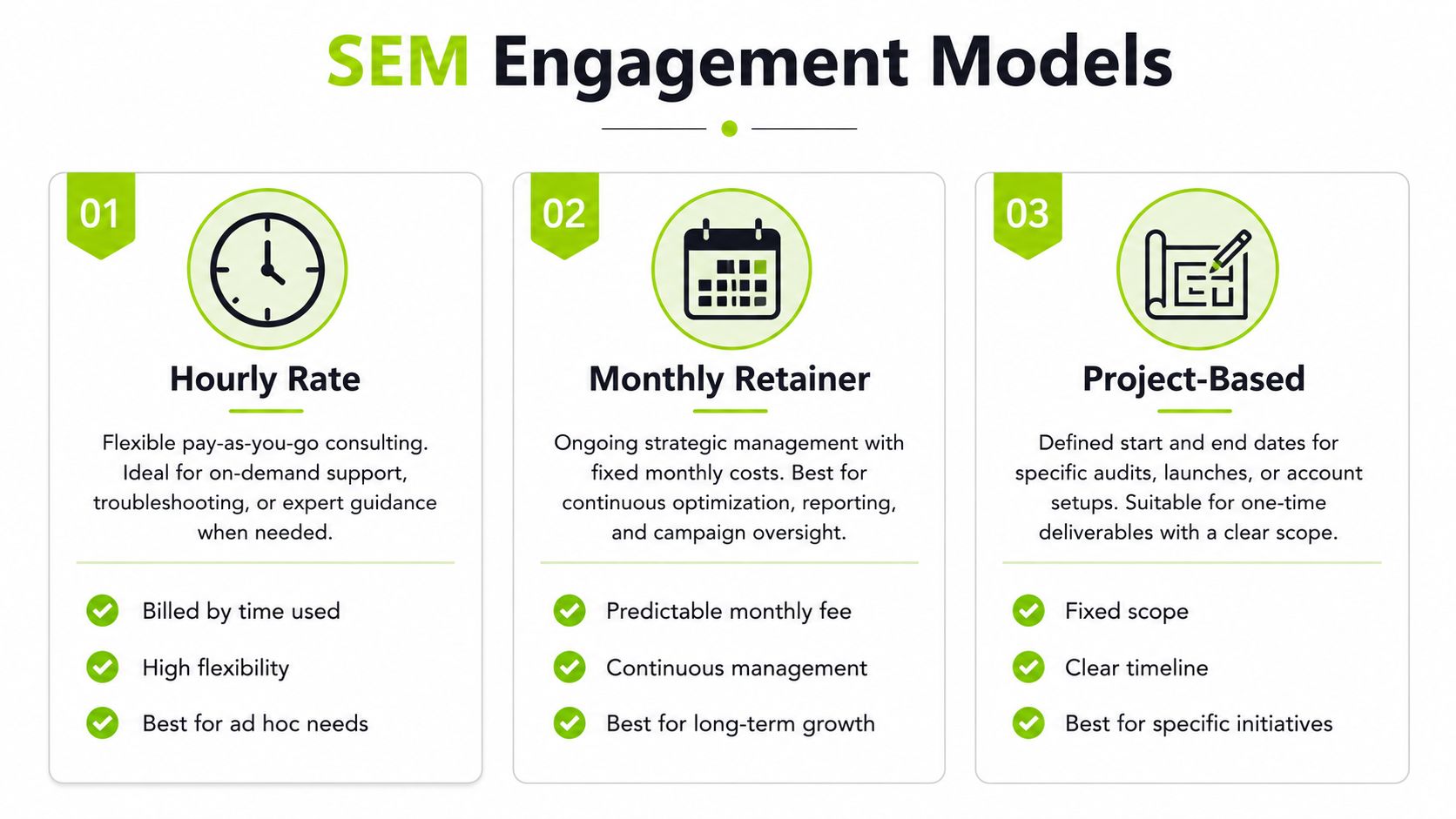
Most search engine marketing consultants work in one of three models:
-
Hourly rate You pay for time used. This works for advisory sessions, troubleshooting, executive reviews, or occasional account audits.
-
Monthly retainer You pay a fixed monthly fee for ongoing management, optimization, reporting, and strategic support.
-
Project-based You pay for a defined scope with a clear start and finish, such as an account rebuild, launch plan, audit, or tracking cleanup.
SEM Consultant Engagement Models Compared
| Model | Best For | Cost Structure | Pros | Cons |
|---|---|---|---|---|
| Hourly Rate | Short-term advice, audits, troubleshooting, second opinions | Pay for time used | Flexible, low commitment, useful for senior review | Costs can become unpredictable if scope expands |
| Monthly Retainer | Ongoing campaign management and optimization | Fixed recurring monthly fee | Predictable cadence, stronger accountability, better for iterative testing | Can feel expensive if goals or responsibilities are unclear |
| Project-Based | Launches, migrations, tracking fixes, account restructuring | Fixed fee for defined deliverable | Clear scope, clear deadline, good for contained work | Often stops before ongoing optimization work starts |
How to choose the right structure
The right model depends less on budget size and more on the kind of problem you need solved.
Choose hourly if your internal team can execute but wants expert guidance. This model works well when a director or in-house specialist needs a sharp outside perspective without handing off day-to-day control.
Choose a retainer if you need continuous optimization. SEM rewards repeated testing, cleanup, and adaptation. If the consultant is expected to monitor search terms, adjust bids, revise ads, and collaborate with your team monthly, a retainer is usually the cleanest setup.
Choose project-based when the issue is clearly bounded. Common examples include account audits, conversion tracking repair, campaign launches, or landing page-message alignment work before a new push.
Buying advice: Don't ask which model is cheapest. Ask which model best matches the decisions that need to be made every week.
Keep the pricing conversation tied to scope
The easiest way to overpay is to agree on a fee before defining responsibilities.
Spell out who owns:
- campaign build and restructuring
- ad copy creation
- keyword research and negative keyword maintenance
- landing page recommendations
- analytics and conversion tracking checks
- reporting and meeting cadence
- coordination with sales or CRM owners
If the consultant says “we handle everything,” push for detail. In many engagements, “everything” still excludes creative approvals, CRM feedback loops, landing page implementation, or AI visibility measurement.
The cleaner the scope, the less painful the invoice discussion becomes.
Onboarding, Integration, and Measuring Success
Once the contract is signed, many providers make one big mistake. They treat onboarding like an access checklist instead of an operating setup.
Access matters, but it's only the start. A consultant can't do strong work if they're disconnected from the people, systems, and definitions that shape search performance.
What to set up in the first weeks
Give the consultant the practical context they need early:
- Platform access: ad accounts, analytics, tag manager, CRM, call tracking, landing page tools
- Commercial context: target products or services, margin reality, sales cycle, lead qualification rules
- Team map: who approves ads, who owns landing pages, who validates lead quality, who manages analytics
- Reporting schedule: weekly working session, monthly performance review, and clear owner for follow-up actions
This is also the time to define what counts as a win. Don't wait until month two to argue about whether a form fill is a good lead.
Measure more than traffic acquisition
Since top Google results can capture over 54% of clicks and searchers rarely go past page one, consultants must measure both auction position and post-click conversion quality to avoid winning traffic that never converts, according to this paid search guide on click distribution and conversion quality.
That's the key point many teams miss. Search performance is not just about acquiring visits. It's about whether the traffic matches intent, lands on the right experience, and produces real business movement.
A solid KPI set often includes:
| KPI area | What to watch |
|---|---|
| Search visibility | Impression presence, query coverage, brand appearance in key search experiences |
| Traffic quality | Query intent, bounce patterns, engagement by landing page |
| Conversion performance | Lead submissions, calls, booked demos, sales actions |
| Downstream quality | Sales acceptance, close relevance, revenue contribution where available |
| Reporting quality | Speed, clarity, and consistency of performance explanations |
Good SEM reporting explains decisions. It doesn't just export metrics.
For teams redesigning reporting, the Riff Analytics SEM reporting playbook is a useful reference because it focuses on how to present performance in a way stakeholders can act on.
Integrate modern search visibility into reporting
Many onboarding plans have yet to catch up. They track ad metrics and organic rankings, but they don't account for AI-mediated search visibility. If users are getting answers before the click, your consultant should have a method for monitoring whether your brand is present, cited, or absent in those experiences.
That doesn't mean every business needs an elaborate new dashboard on day one. It means the consultant should define how they'll watch for visibility shifts beyond classic paid metrics. Some teams use client-ready reporting workflows to combine traditional performance reporting with AI search monitoring in one reporting process.
The operating rhythm matters
A good engagement usually has a simple rhythm:
- one tactical working session for active issues
- one recurring report review
- one place where action items live
- one agreed definition of qualified outcomes
When that rhythm is missing, the engagement drifts. The consultant starts optimizing what they can see. Your team judges results based on partial information. Small disconnects turn into “SEM isn't working,” when the actual issue is poor integration.
Red Flags and Essential Interview Questions
Some consultants are easy to reject. Others sound polished enough to get through the process and then underperform for months.
That's why the final interview should pressure-test how they think, not just what they claim to do.
With Google holding about 89.6% of the global search market and worldwide search ad spending reaching $351 billion in 2025, promises of guaranteed rankings are a major red flag in a highly competitive, auction-based environment, as noted in this search marketing statistics roundup.
Red flags worth taking seriously
These are the warning signs I pay attention to most:
-
They guarantee rankings or easy wins Search is competitive and auction-driven. Serious operators don't promise certainty where none exists.
-
They won't give transparent account access If they want to own the account without visibility for your team, walk away.
-
They talk only about top-of-funnel metrics Clicks and impressions matter, but they're not enough.
-
They avoid hard questions about lead quality If they never ask what happens after the click, they're probably optimizing the wrong thing.
-
They treat all keywords like equal opportunities Intent, commercial fit, and landing page alignment matter more than keyword volume alone.
-
They can't explain reporting in plain language Complexity is sometimes real. Confusion as a sales tactic is not.
A practical companion resource here is Cometly's piece on optimizing ad spend for consulting firms, especially if you want another perspective on tying ad performance back to business outcomes rather than platform vanity metrics.
Questions that help you make the final call
Ask a few direct questions and listen for specificity:
- What would you audit first in our account, and why?
- How do you decide whether a campaign problem is targeting, offer, landing page, or tracking?
- What signals tell you traffic is increasing but lead quality is getting worse?
- How do you report progress when clicks are down but business impact may still be improving?
- What do you need from our sales or CRM team to do this well?
- Tell me about a situation where you recommended spending less, not more.
- How do you handle modern search experiences where users get answers without visiting the site?
The best answer isn't the most impressive one. It's the one that shows disciplined thinking, clear trade-offs, and comfort with accountability.
Search engine marketing consultants can deliver significant value for a business. But only if you hire for judgment, modern search awareness, and operational fit, not just channel familiarity.
If your team needs a clearer way to evaluate search performance across both traditional results and AI-driven discovery, Surnex gives agencies and in-house teams a way to track rankings, citations, and visibility in one place so consultants and stakeholders can work from the same picture.