You're probably in one of two places right now. You know SEO well enough to help real businesses, but you're still selling yourself like a freelancer. Or you've decided you want an agency, not a job with extra admin attached, and you're trying to figure out what that looks like.
That difference matters.
A lot of people learn how to rank pages, run audits, and clean up title tags, then call that a business. It isn't. A real SEO business has positioning, delivery systems, pricing logic, legal structure, onboarding, reporting, and a point of view about where search is heading next.
That last part matters more now than it used to. If you're learning how to start a seo business today, you can't build around rankings alone and bolt AI search on later. You need to build a firm that can explain visibility across traditional search and newer AI-driven surfaces from day one. That changes what you sell, how you report, and why clients keep paying you.
Laying Your Business Foundation
Before you pitch anyone, build the company.
That sounds obvious, but it's the line that separates a sustainable SEO business from a string of client gigs held together by invoices and good intentions. Wolters Kluwer's guide to starting an SEO business notes that a formal business plan should define goals, services, management structure, and financing requirements, and that a well-crafted plan can help attract partners and secure financing.
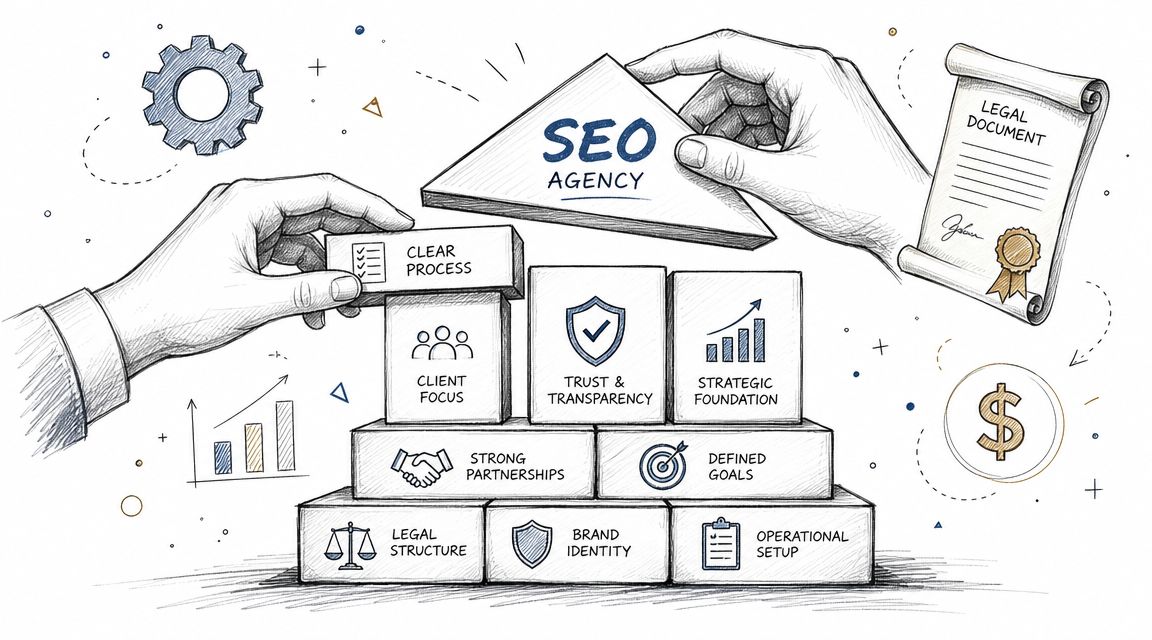
If you skip that step, you'll make bad decisions fast. You'll underprice work because you haven't mapped delivery costs. You'll say yes to random services because you haven't defined your offer. You'll mix personal and business finances because you haven't treated the agency like an actual company.
Build the plan before the brand
Your first business plan doesn't need polished slides. It needs useful answers.
Write down:
- What you sell: Keyword research, technical audits, on-page optimization, reporting, local SEO, content briefs, AI search visibility monitoring, or a tighter subset.
- Who you serve: Local businesses, e-commerce brands, SaaS teams, medical practices, law firms, or another niche you understand.
- How work gets delivered: Who handles audits, content briefs, implementation, QA, client communication, and reporting.
- How money works: What you need to charge to cover software, contractor time, taxes, and your own pay.
A founder who can explain service lines clearly will make better hiring, pricing, and sales decisions. That's true whether you stay solo for a while or want a small team.
Practical rule: If you can't explain your service in one sentence and your delivery in five steps, you're not ready to sell it.
Choose structure like an owner, not a side hustler
Wolters Kluwer also notes that your choice of business structure affects taxes and personal-asset risk, and that most businesses need licenses and registrations regardless of entity type. That's not admin fluff. It shapes how safely and cleanly you operate.
You'll need to decide how the business exists on paper, how it accepts money, and how it handles liability. The wrong setup can create tax headaches, contract problems, and personal exposure you didn't intend to take on.
Three practical decisions come first:
-
Separate the business from yourself Open business banking, route income through the business, and keep expenses clean from day one.
-
Get the paperwork right Register the business properly in your jurisdiction, then confirm any local license or registration requirements.
-
Use real agreements Scope, payment terms, deliverables, ownership, revisions, and timelines need to be written down before work starts. A solid SEO contract template is a useful starting point when you're building your client paperwork.
Set up operations that can survive growth
Most new agencies don't fail because the founder is bad at SEO. They fail because delivery lives in the founder's head.
Create a simple operating baseline:
- Client intake form
- Proposal template
- Contract and invoice workflow
- Kickoff checklist
- Monthly reporting checklist
- Offboarding process
That may feel early. It isn't.
If you build these systems while the stakes are low, you won't have to rebuild the agency in the middle of client work. That's the genuine beginning of how to start a seo business that lasts. You are not just selling search work. You're building an operating company that happens to deliver SEO.
Defining Your Niche and Modern Service Offerings
Most new agencies make the same positioning mistake. They offer “SEO services for any business” and wonder why sales conversations feel muddy.
General offers create weak demand because buyers can't tell whether you understand their market, their search behavior, or the kind of outcomes they care about. A niche fixes that. It gives you sharper messaging, tighter processes, and better referrals.
If you need a clean primer for less technical stakeholders, this short guide on what is search engine optimization is useful because it frames SEO in plain language you can also borrow for client conversations.
Pick a market you can understand faster than competitors
A niche doesn't have to be narrow forever. It just has to be specific enough that your offer stops sounding generic.
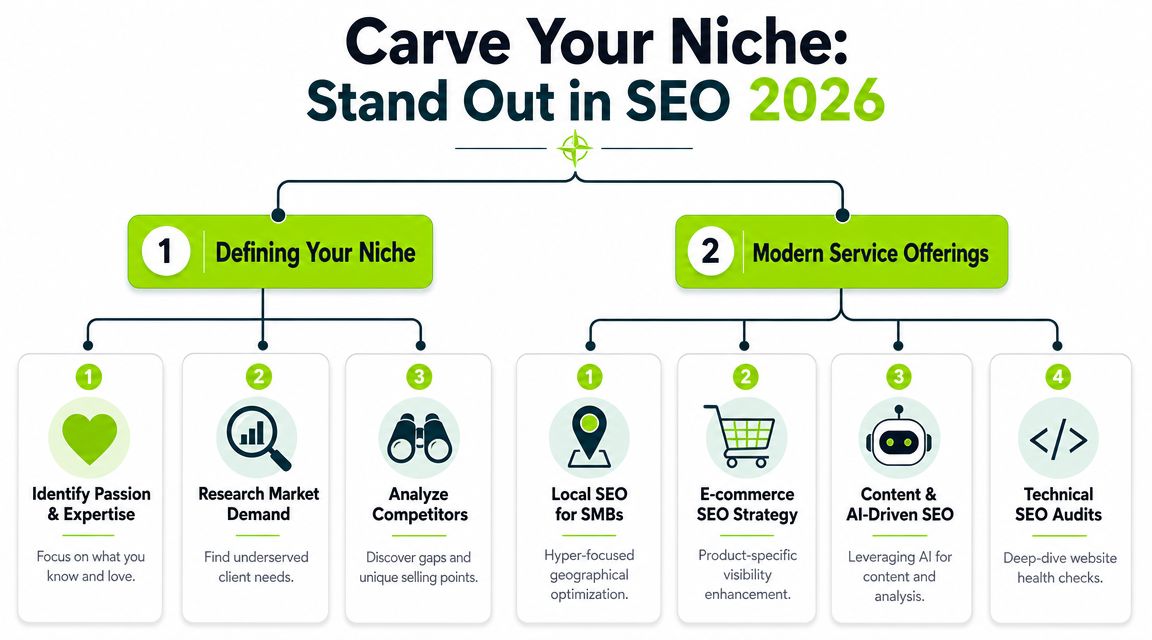
Good early niches usually come from one of three places:
- Past experience: You've worked in e-commerce, legal, healthcare, SaaS, real estate, or multi-location local businesses.
- Operational fit: You know how to deliver repeatable work for that kind of client.
- Commercial clarity: You understand how those clients make money and what search traffic is supposed to do.
What doesn't work is choosing a niche because it “seems profitable” while knowing nothing about the buyer, the site structure, or the sales cycle. You'll feel that gap in every audit and every proposal.
Sell solutions, not task lists
Clients don't buy keyword research because they love spreadsheets. They buy clarity on how search can support revenue, pipeline, leads, booked calls, or qualified discovery.
That means your service menu should be packaged around problems.
A practical early lineup might look like this:
- Local search package for service businesses that need stronger presence in location-based queries
- Technical SEO package for sites with crawl, indexation, internal linking, and performance issues
- Content-led growth package for brands that need structured topic targeting and on-page execution
- E-commerce SEO package for category, collection, and product visibility
- AI search visibility package for brands that need to understand how they appear across AI-driven discovery
That last one is where newer agencies can position themselves better than older ones.
The Marketing Agency's discussion of starting an SEO agency points to an underserved opportunity: founders should package services around measurable visibility across Google Search, AI Overviews, and emerging assistant-driven discovery, because Google's expanding use of AI-generated answers is materially affecting organic traffic patterns and older reporting models are no longer enough.
Build your offer for the search market you're actually entering
This is the future-proof part.
Traditional SEO still matters. Technical health matters. Content relevance matters. Authority matters. But if you only report rankings and clicks, some clients will eventually ask the question you need to be ready for: “Why are rankings stable if traffic behavior is changing?”
Your agency should have an answer built into the offer.
A modern service stack can include:
- Search visibility audits across traditional results and AI-generated surfaces
- Citation and mention gap reviews to identify where a brand isn't being surfaced
- Entity and brand clarity work so site content explains who the company is, what it does, and why it's credible
- Content refresh strategy aimed at both search rankings and AI retrieval usefulness
- Executive reporting that explains why search presence now spans more than blue links
A niche should make delivery easier, not just sales easier.
If you're building with scale in mind, consider whether you'll execute everything in-house or expand through partnerships. For agencies that want to add fulfillment without building every specialty internally, white-label SEO options can help, but only if your core offer and quality standards are already defined.
The strongest new agencies don't win by offering more services than everyone else. They win by making a narrower promise, serving a clearer market, and packaging SEO around how people discover brands now.
Pricing Your Services and Crafting Proposals
Pricing gets messy when founders confuse effort with value.
If you charge only by how long tasks take, you'll box yourself into low-margin work. If you charge purely on confidence without understanding delivery cost, you'll create scope problems you can't fix later. Good pricing sits in the middle. It reflects the work, the complexity, and the business value of solving the client's problem.
The three models most agencies start with
Each pricing model has a place. The mistake is using one model for every situation.
| SEO Pricing Model Comparison | Best For | Pros | Cons |
|---|---|---|---|
| Monthly retainer | Ongoing SEO programs, content, technical improvements, recurring reporting | Predictable revenue, better client retention, room to improve over time | Harder to sell without a clear roadmap, can invite scope creep |
| Project fee | Audits, migrations, site cleanups, strategy builds, one-time implementations | Clear scope, easier to estimate delivery, good for defined outcomes | Revenue is less predictable, projects end unless you upsell |
| Hourly rate | Consulting, advisory calls, troubleshooting, small tasks | Simple to quote, useful for short engagements | Caps upside, rewards slowness, weak fit for agency scaling |
Most real agencies use a mix. They land work through a project or short engagement, then convert the client into a retainer when ongoing work is obvious.
What works and what doesn't
What works:
- Price around the job to be done
- Scope deliverables in plain language
- Include assumptions and exclusions
- Tie proposals to the client's goals
What doesn't:
- Offering custom pricing with no internal logic
- Bundling too many services into one vague monthly fee
- Using low hourly pricing to win deals
- Writing proposals that read like an SEO glossary
If a client can't tell what changes after they hire you, the proposal won't sell.
Write proposals that reduce doubt
A strong proposal does four things well.
First, it reflects the client's situation back to them. Show that you understand the site, the market, and the friction points.
Second, it defines the work clearly. Not “full SEO support.” Say what happens: audit, research, prioritization, implementation support, reporting, content planning, technical fixes, or AI visibility tracking.
Third, it explains the boundaries. If development implementation isn't included, say so. If content writing is separate, say so. Hidden assumptions create bad clients.
Fourth, it makes the next step easy. Signature, payment terms, kickoff timeline, and required access should be obvious.
A practical proposal structure looks like this:
- Business context
- Observed issues or opportunities
- Recommended scope
- Deliverables and cadence
- Pricing and payment terms
- Assumptions and exclusions
- Next steps
New agency owners often think cheaper proposals close faster. Usually the opposite happens. Vague, cheap work attracts buyers who compare on price alone. Clear proposals attract buyers who want a competent partner.
Building Your Agency Tech Stack
A bloated stack is one of the fastest ways to squeeze your margin before the agency is stable.
New founders often buy tools the way they buy reassurance. They subscribe to a keyword tool, a crawler, a rank tracker, a reporting layer, an AI workflow app, and two more platforms they have not fully learned yet. Then they spend more time reconciling exports than improving client outcomes.
Build the stack around the service model you want to deliver a year from now, not the one-off tasks you can sell this month. If your agency is supposed to be future-proof, your tools need to support traditional search performance and AI search visibility from the start. Retrofitting that later usually creates messy reporting, unclear scope, and avoidable tool costs.
Cover the core jobs first
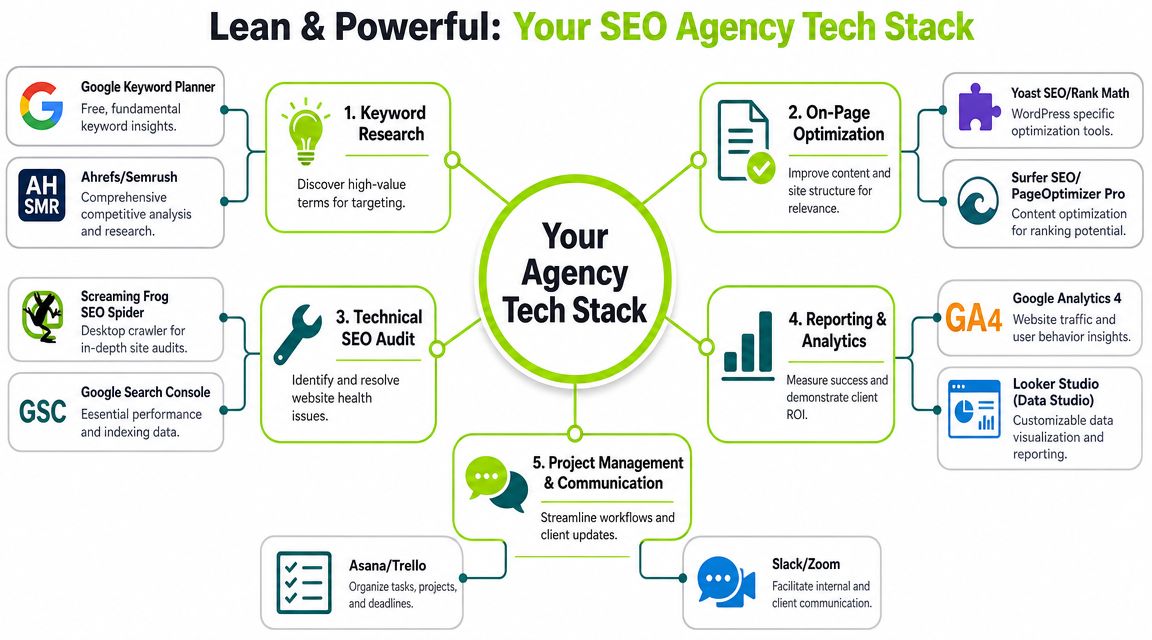
Your stack should handle five jobs well.
Research and discovery
You need a way to find topics, search terms, competitors, and intent patterns. Early on, that can be a mix of Google Keyword Planner, Search Console data, and one paid research platform if budget allows. The goal is not endless keyword exports. The goal is finding opportunities you can turn into actions.
Technical analysis
You need a crawler, access to indexation data, and a reliable way to review site health. Without that, agencies drift into surface-level title tag work and call it strategy.
Performance monitoring
You need to track rankings, page-level visibility, query movement, and trend changes without rebuilding the same spreadsheet every month. This matters even more if you plan to report on both classic search results and AI-assisted discovery.
Reporting
Clients are paying for interpretation, prioritization, and next actions. Reporting should help your team explain what changed, why it matters, and what gets worked on next.
Operations
Project management, documentation, and communication tools affect retention more than many founders expect. Good work delivered through a messy process still feels unreliable to clients.
Start with the free Google tools
Before you pay for a larger stack, make sure your agency knows how to use the tools clients already trust:
- Google Search Console for queries, indexing, coverage issues, and page-level search performance
- Google Keyword Planner for initial keyword validation and topic sizing
- Google Analytics 4 for engagement, conversion paths, and business context
That baseline is enough to start doing useful work for a small set of clients. It also forces discipline. Founders who skip straight to expensive software often end up with more dashboards, not better decisions.
If your team is also adapting to newer workflows, this overview of AI SEO best practices and tools is a useful read because it frames how AI-assisted optimization can fit into an agency process without replacing core SEO work.
Reduce tool sprawl before it becomes process sprawl
Every added platform creates another login, another export format, another place where numbers can conflict. That is not just an efficiency problem. It becomes a trust problem when a client sees one ranking number in a report and another in a dashboard.
I have found that early agencies do better with one primary research suite, one crawler, one reporting setup, and a small operations stack. Add tools only when they remove manual work, improve decision-making, or support a service you already know how to sell.
For agencies that want to track both standard SEO performance and newer answer-engine visibility, AI search visibility tools for agencies are worth reviewing. Surnex is one example. It combines AI visibility tracking with rankings, backlinks, audits, and content opportunity data, which helps agencies report across traditional search and AI-driven discovery without stitching together multiple systems.
One platform should not do every job. But every platform should earn its place.
A lean stack makes delegation easier too. When your workflows live in fewer systems, new hires ramp faster, handoffs are cleaner, and quality control gets much simpler.
Acquiring and Onboarding Your First Clients
A new agency usually hits the same wall early. You can do the work, but you still have to convince someone to trust you with revenue, lead flow, and a website they may already feel burned by.
That first client rarely comes from broad brand awareness. It usually comes from proximity and specificity. Former colleagues, past clients, trusted peers, and partner firms already have context on how you work. They do not need a polished origin story. They need to believe you can diagnose problems clearly, communicate well, and run a process that does not create chaos.
For a new SEO business, that matters more now because buyers are sorting through two layers of confusion at once. They want stronger organic performance, and they are hearing nonstop claims about AI search, answer engines, and zero-click discovery. A future-proof agency wins early by treating those shifts as part of the service from day one. Do not present AI visibility as an add-on you will figure out later. Build it into your pitch, your discovery questions, and your reporting expectations from the first conversation.
Where your first clients usually come from
The strongest early channels are still relationship-driven, but they need structure.
Start with people who have seen your work up close. Past coworkers, freelance collaborators, web developers, paid media consultants, designers, and copywriters often know business owners who need search help and do not know who to trust. Ask for introductions with a clear offer, not a vague “let me know if you hear of anyone.”
Public proof helps too. Short teardown posts, local SEO observations, before-and-after examples, and plain-English explanations of technical issues show how you think. That attracts better-fit conversations than generic posting about rankings.
Partnerships are usually underrated. Design shops, development firms, and branding studios often need SEO support for client retention, but they do not want to build an internal team yet. White-label or referral relationships can get you revenue faster than chasing cold prospects one by one.
Outbound still has a place if you keep it targeted and credible. ReachInbox for SEO client acquisition is a useful reference for building a more disciplined outreach process.
Random “free audit” blasts to businesses you have not researched are a weak starting point. They train prospects to treat your work like spam, and they pull you into low-trust sales cycles with buyers who shop on price.
Run the first sales call like a working session
Early agency calls go wrong when the founder tries to sound impressive instead of useful.
A strong first call is diagnostic. Ask where leads come from now, how search contributes today, what has already been tried, which pages matter commercially, and how the company defines a win. Then ask one question many new agencies skip: where is search behavior changing in this market? In some niches, that means local packs. In others, it means product comparison content, AI Overviews, or branded queries becoming more important than generic traffic.
Those questions separate an operator from a vendor.
Do not sell “more traffic” as the core outcome. Sell clearer visibility, better-qualified demand, cleaner measurement, and a realistic plan. If you work with businesses that care about pipeline, say that. If they need stronger brand discoverability in both classic search and AI-assisted results, say that too. The industry is moving toward blended visibility, and your sales process should reflect it.
Onboarding sets the tone for retention
The sale gets agreement. Onboarding gets confidence.
Clients are watching for signs that they made a safe decision. If the first week feels disorganized, trust drops fast. If the process feels calm, structured, and informed by their business goals, retention gets easier later.
A solid onboarding flow usually includes:
-
Kickoff call Confirm goals, stakeholders, approvals, communication cadence, and what success needs to look like in business terms.
-
Access collection Get analytics, Search Console, CMS, tag manager, ad accounts if relevant, and any prior SEO reports or content plans.
-
Baseline review Document current organic performance, branded versus non-branded demand, priority pages, technical risks, and any signs of AI search visibility already appearing.
-
Initial findings summary Send a short summary of what you found, what you are prioritizing first, and what the client should expect over the next 30 days.
Search Console should be part of that baseline immediately, as noted earlier in the article. It gives you a practical starting point for impressions, queries, page visibility, and click behavior. Use that data to ground the conversation in reality instead of assumptions.
One more point matters here. Set expectations for what you will measure before work begins. If you wait until month two to define success, you will spend the rest of the engagement arguing about the scoreboard. I prefer to lock in a small set of primary metrics early, then explain which supporting indicators matter for context. For many agencies, that means classic organic performance plus selected AI visibility signals where relevant.
A first month that feels controlled
Your first month does not need theatrics. It needs order.
A simple structure works well:
- Week one: Kickoff, access, baseline review, quick technical or tracking fixes
- Week two: Audit findings, opportunity prioritization, stakeholder alignment
- Week three: Roadmap, implementation plan, content and technical execution starts
- Week four: Status update, baseline benchmarks, next-step decisions
That rhythm gives the client something many agencies fail to provide early. A sense that there is a plan, the team is paying attention, and the work is tied to outcomes rather than random tasks.
Presentation matters here too. Even your early documents should look client-ready. A clean kickoff deck, a simple action tracker, and a clear first report all strengthen trust. If you need a model for presenting performance in a more polished way, review these examples of branded SEO reporting for agencies.
Founders who want to build a real agency, not just a solo service business, should treat onboarding as operating infrastructure. It is where you standardize communication, define metrics, and show clients that your agency understands where search is headed. That includes traditional rankings, but it also includes how the brand appears in AI-driven discovery. Build that expectation from day one, and you will attract better clients and keep them longer.
Reporting Results and Scaling Your Operations
Reporting is not admin. It is client retention work.
Most agencies lose trust in reporting, not because the work is bad, but because the story is missing. They send dashboards full of charts, rankings, and task lists, then expect the client to connect the dots. Clients usually don't. They see activity, but not meaning.
Report like a strategist, not a software export
A useful report answers five questions:
- What changed
- Why it changed
- What your team did
- What matters next
- Where the client should pay attention
That's it.
Rankings can appear in the report, but they shouldn't run the report. Same with raw traffic charts. If those numbers move, explain the likely drivers. If they don't move yet, explain what groundwork was completed and what leading indicators you're watching.
One of the simplest upgrades you can make is turning your reports into a short narrative:
- Executive summary
- Key observations
- Work completed
- Priority opportunities
- Next month's actions
That structure keeps the client focused on decisions, not just data.
Use reporting to educate clients on changing search behavior
This allows modern agencies to separate themselves.
If a client only sees “ranking position” and “organic sessions,” they may miss how search visibility is fragmenting across classic results and AI-assisted discovery experiences. Your reporting should help them understand that the search channel now includes more than the old set of metrics.
That doesn't mean inventing complexity. It means translating reality.
For example, if branded visibility is holding while click behavior shifts, explain that clearly. If content is appearing more often but traffic patterns are uneven, explain the search context behind that. If the client is relying on old assumptions about rankings alone, your reporting should correct that gently and consistently.
For teams that want to present a cleaner client-facing view, branded SEO reporting can help standardize presentation and reduce the mess of sending different exports from different tools.
Clients stay when they understand the direction of the work, even before they understand every technical detail.
Scale by standardizing, not by doing more yourself
The first bottleneck in most agencies is the founder. Every proposal, audit, meeting, report, and client message runs through one person. That works until it doesn't.
Scaling starts with repeatable systems:
- Templates for proposals, kickoffs, audits, and reports
- Checklists for onboarding, monthly delivery, QA, and renewals
- Defined roles for strategy, execution, communication, and review
- Clear service boundaries so accounts don't turn into custom chaos
Hiring comes after that.
If you hire before your workflows are documented, you'll spend your time correcting inconsistency. If you document first, even a contractor can slot into the process with less friction.
Know what to delegate first
The founder should usually keep these longer:
- Sales conversations
- Strategy calls
- Final proposal review
- Senior client communication
The founder should usually delegate these sooner:
- Repetitive audits
- Data collection
- Report assembly
- Project management follow-up
- Some implementation tasks
That shift is uncomfortable because founders often tie quality to personal involvement. But if every task depends on you, you haven't built a business. You've built a skilled bottleneck.
The agencies that last are not the ones that stay busiest. They're the ones that become legible. Buyers understand the offer. Team members understand the process. Clients understand the value. That is how you grow without breaking delivery.
If you're building an SEO business for the market search is becoming, not the market it used to be, Surnex is worth a look. It gives agencies and in-house teams a way to track traditional SEO performance alongside AI search visibility, so you can report more clearly, reduce tool sprawl, and build services around how brand discovery is changing.