You've done the basics. Your Google Business Profile is claimed. Your site mentions Los Angeles. You've collected some reviews. Yet when someone searches from Brentwood, Highland Park, Koreatown, or Sherman Oaks, your business is nowhere near the map pack, and AI summaries keep surfacing other brands.
That's the part generic local SEO advice misses. Los Angeles doesn't behave like a single city in search. It behaves like dozens of micro-markets stitched together by neighborhoods, service areas, traffic patterns, and mobile intent. A page optimized for “Los Angeles” often feels too broad to win where actual buying decisions happen.
Why Winning at Local SEO in Los Angeles Is Different
Los Angeles local SEO is harder because “local” in LA rarely means the whole city. It usually means a neighborhood, a cluster of adjacent neighborhoods, or a very specific service area. Someone looking for a dentist in Los Feliz is not searching the same way as someone looking in Pasadena or Marina del Rey, even if both are technically in the same metro area.
The upside is big. The local SEO market is projected to reach $80 billion by 2025, and nearly 46% of all Google searches carry local intent, according to Amra & Elma's local SEO statistics roundup. That same source notes that businesses investing in local SEO for three or more years generate 2.7 times more local organic traffic than newcomers. In LA, that compounding effect matters because competitors don't disappear after one round of optimization. They keep publishing, earning reviews, and tightening neighborhood relevance.
A lot of businesses get stuck in the middle. They're not invisible, but they're not chosen. They rank for their brand name, show up sporadically for a few service terms, and wonder why calls still go to another company with a weaker-looking website.
LA search intent is fragmented
The fastest way to lose in LA is to optimize at city level only. A broad “Los Angeles” strategy can help with coverage, but it usually won't create enough local relevance to win neighborhood-driven searches. That's why agencies working on city-spanning brands often need systems built to boost multi-location visibility without flattening every location into the same template.
There's also a practical split between service-area businesses and storefronts. A storefront in Silver Lake can lean on proximity. A home service company covering West LA, the Valley, and parts of the Eastside has to build relevance through pages, reviews, GBP configuration, citations, and on-page signals.
Practical rule: In Los Angeles, “close enough” optimization usually isn't close enough.
AI search makes that gap wider. Google and other AI-driven experiences are summarizing local options instead of sending every click to a website. If your business data is vague, your location signals are thin, or your pages don't clearly map services to neighborhoods, AI systems have less to work with.
For teams that want a broader view of how agencies package this work, Los Angeles SEO services is a useful reference point. But the real work starts with an audit, because most LA local campaigns underperform for boring reasons first.
Your Foundational Los Angeles SEO Audit
Most local SEO problems in LA aren't advanced. They're messy. The wrong phone number on one listing, business hours that don't match, a Google Business Profile linked to the homepage instead of the right service page, or neighborhood terms buried nowhere on the site.
Start there.
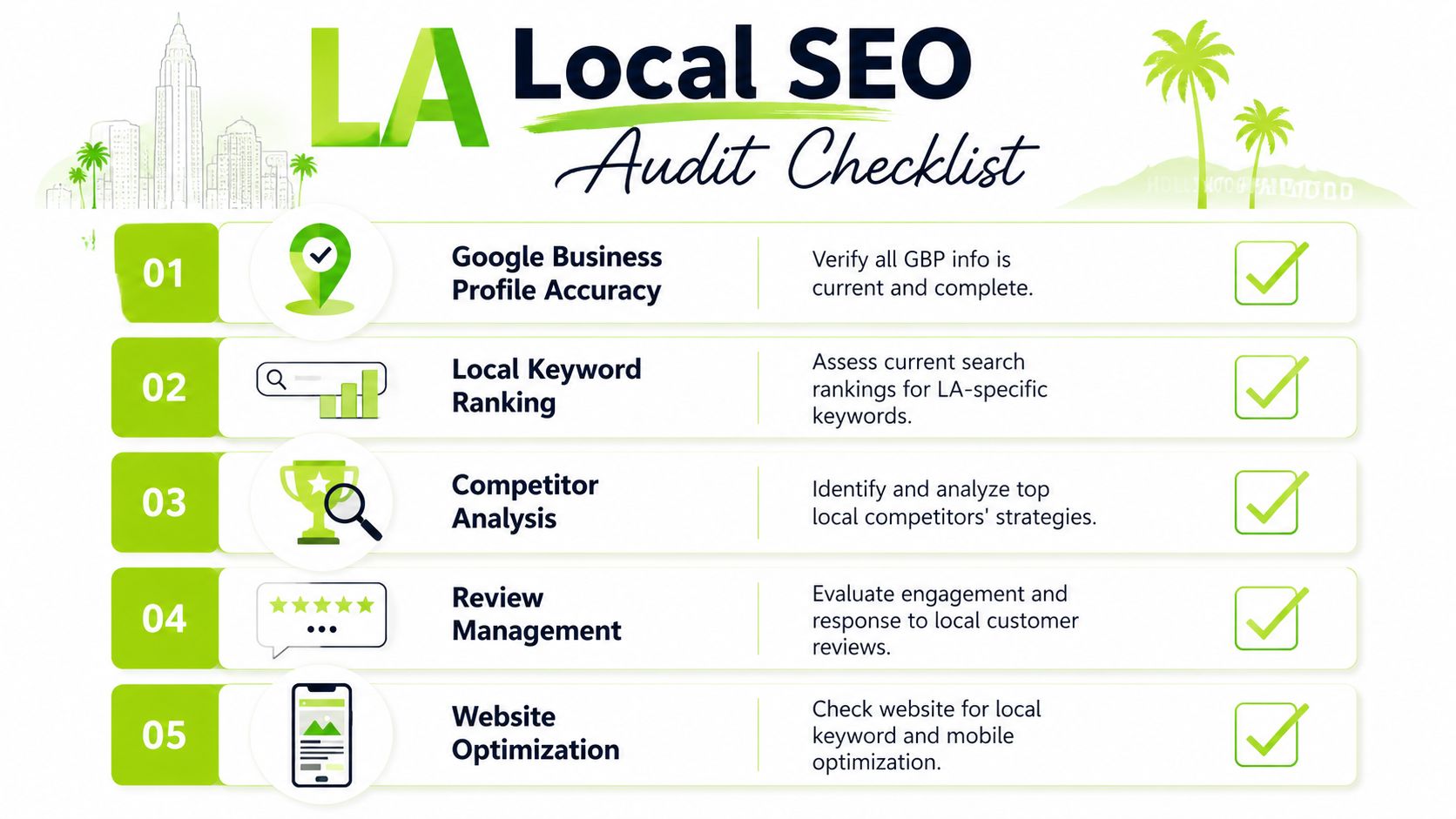
Check NAP and operating details first
Your name, address, and phone number have to match anywhere a customer or search engine can find them. In LA, I also check business hours, holiday hours, suite numbers, and service area wording because those mismatches create confusion fast.
Audit these properties manually before you touch tools:
-
Google Business Profile Confirm the primary phone number, hours, categories, website URL, and service areas match your current setup.
-
Your website Make sure the footer, contact page, location pages, and schema reflect the same business details.
-
Major third-party profiles Yelp, Apple Maps, Bing Places, industry directories, and social profiles should mirror the same core business data.
If you're building an audit workflow across client accounts, a process like this local audit framework can help improve local search visibility without skipping the obvious issues.
Grade your GBP like a storefront
A claimed GBP isn't an optimized GBP. Review it the way a stranger would.
Look for gaps such as:
- Missing services
- Weak business description
- No recent photos
- Unanswered Q&A
- No review response pattern
- Wrong landing page link
In LA, customers often compare several map results quickly on mobile. If your listing looks stale, incomplete, or generic, you lose attention before your website even has a chance.
Review on-page local signals
A lot of LA businesses undercut themselves. Their site says “serving Los Angeles” and nothing else. That's too thin.
Check whether your website includes:
| Audit item | What to look for |
|---|---|
| Title tags | Service plus a real location target, not just the brand name |
| Headings | Clear mention of services and service areas |
| Location pages | Useful, distinct pages for priority neighborhoods or cities |
| Internal links | Links between service pages and relevant neighborhood pages |
| Mobile usability | Pages that load cleanly and display well on phones |
Run a competitor reality check
Don't compare yourself to the biggest brand in LA first. Compare yourself to the businesses already showing in your target neighborhoods.
Search your core terms from different locations and note:
- Which page they link from GBP
- Whether their reviews mention neighborhoods
- How specific their service pages are
- What photos and categories they use
- Whether they publish neighborhood-focused content
Most local audits fail because they collect data without producing a fix list. Yours should end with three buckets: urgent cleanup, relevance gaps, and authority gaps.
If you need a broader process for that, this guide on how to do an SEO audit is a good companion. The key is prioritization. Fix trust problems first, then relevance, then expansion.
Optimizing Your Google Business Profile for LA
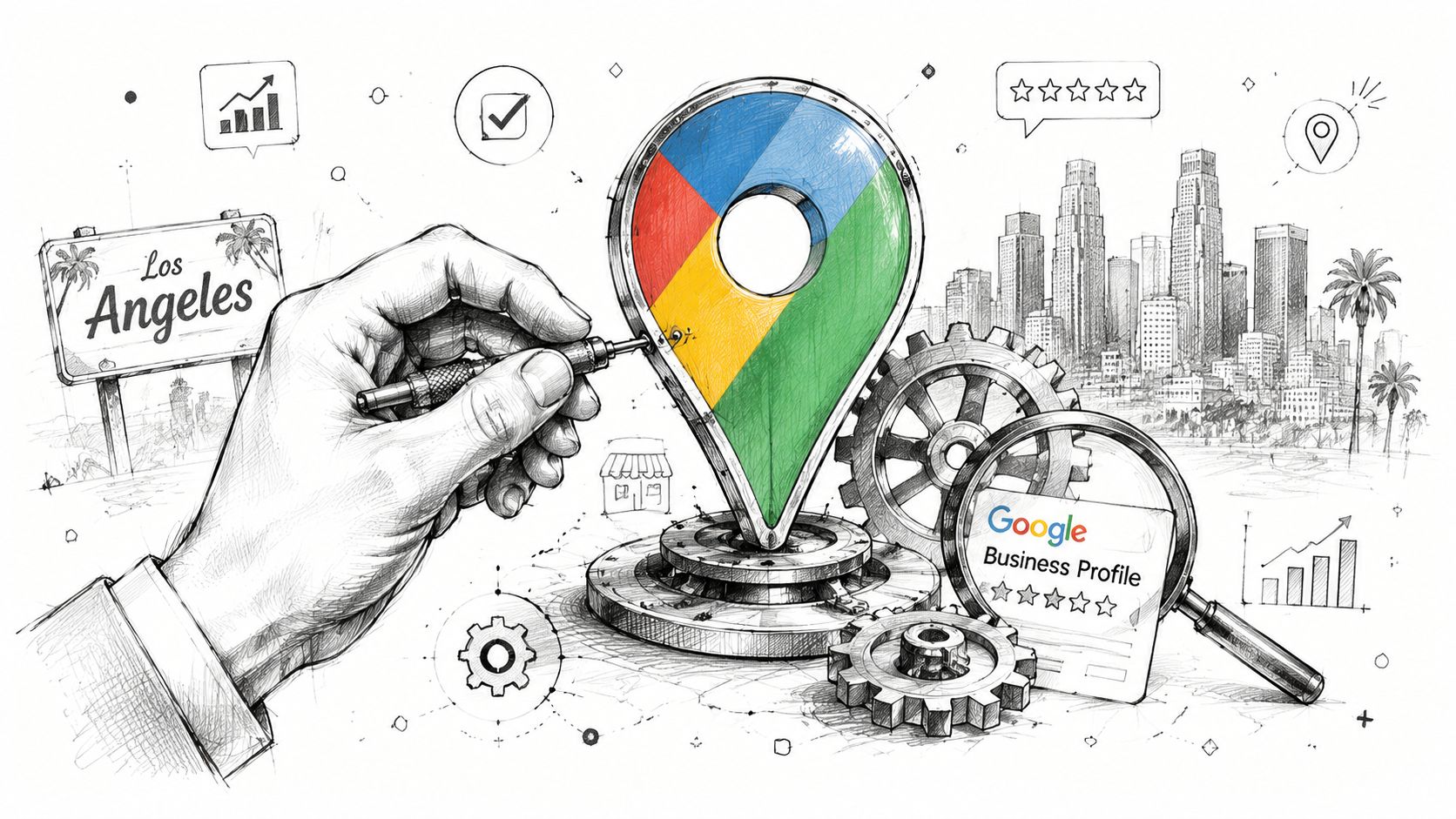
Your Google Business Profile is your working storefront in local search. In Los Angeles, it also acts like your neighborhood translator. It tells Google what you do, where you're relevant, and whether customers trust you enough to deserve map visibility.
Get the category strategy right
The primary category carries more weight than most businesses think. Don't choose the broadest term just because it has more volume. Choose the category that best matches the service you most want to rank for.
A few examples of the trade-off:
- A med spa shouldn't default to a vague health category if a more precise spa-related category fits the core service.
- A gardener in LA may need categories that reflect the actual local demand mix, not just a generic gardening label.
- A contractor should avoid stuffing unrelated secondary categories just to appear for more terms.
Your secondary categories should expand relevance, not confuse it.
Fill in the parts most businesses ignore
The strongest GBPs in LA don't stop at business name, phone number, and a few reviews. They complete the details customers compare.
That includes:
- Services
- Attributes
- Products if relevant
- Service areas
- Business description
- Q&A
- Photos and short videos
A detailed walkthrough like Machine Marketing's GBP optimization guide is useful for the mechanics. What matters in LA is tailoring those fields to the way local customers decide.
For example, attributes can influence clicks when they match the local context. A restaurant may need to highlight outdoor seating. An auto-related business may benefit from showing EV-related convenience if it applies. A clinic may need to clarify accessibility and appointment options.
Use Q&A to pre-handle local friction
Q&A is one of the easiest places to add useful local context. Most businesses leave it empty.
Add and answer questions that reduce hesitation, such as:
- Do you serve clients in West Hollywood or only Beverly Grove?
- Is parking available near the storefront?
- Do you handle same-day service in Santa Monica?
- Do you work on older homes common in certain neighborhoods?
- Can customers book online?
These aren't filler questions. They create direct, readable relevance.
Here's a useful refresher on how local business discovery works across search surfaces, maps, and intent: local business search.
After the core setup, visual proof matters.
Treat photos like conversion assets
Don't upload random images. Build a library that proves location, quality, and legitimacy.
Use a mix of:
- Exterior context shots that show the storefront or surrounding area
- Interior or team photos that make the business feel active and current
- Service-in-action images that show real work, not stock visuals
- Neighborhood cues when appropriate, so the listing feels grounded in a real LA context
If your GBP looks like it was set up once and forgotten, customers notice it immediately.
The businesses that win map clicks in LA usually look current, precise, and easy to trust. That's the standard.
Hyper-Local Content and AI-First On-Page SEO
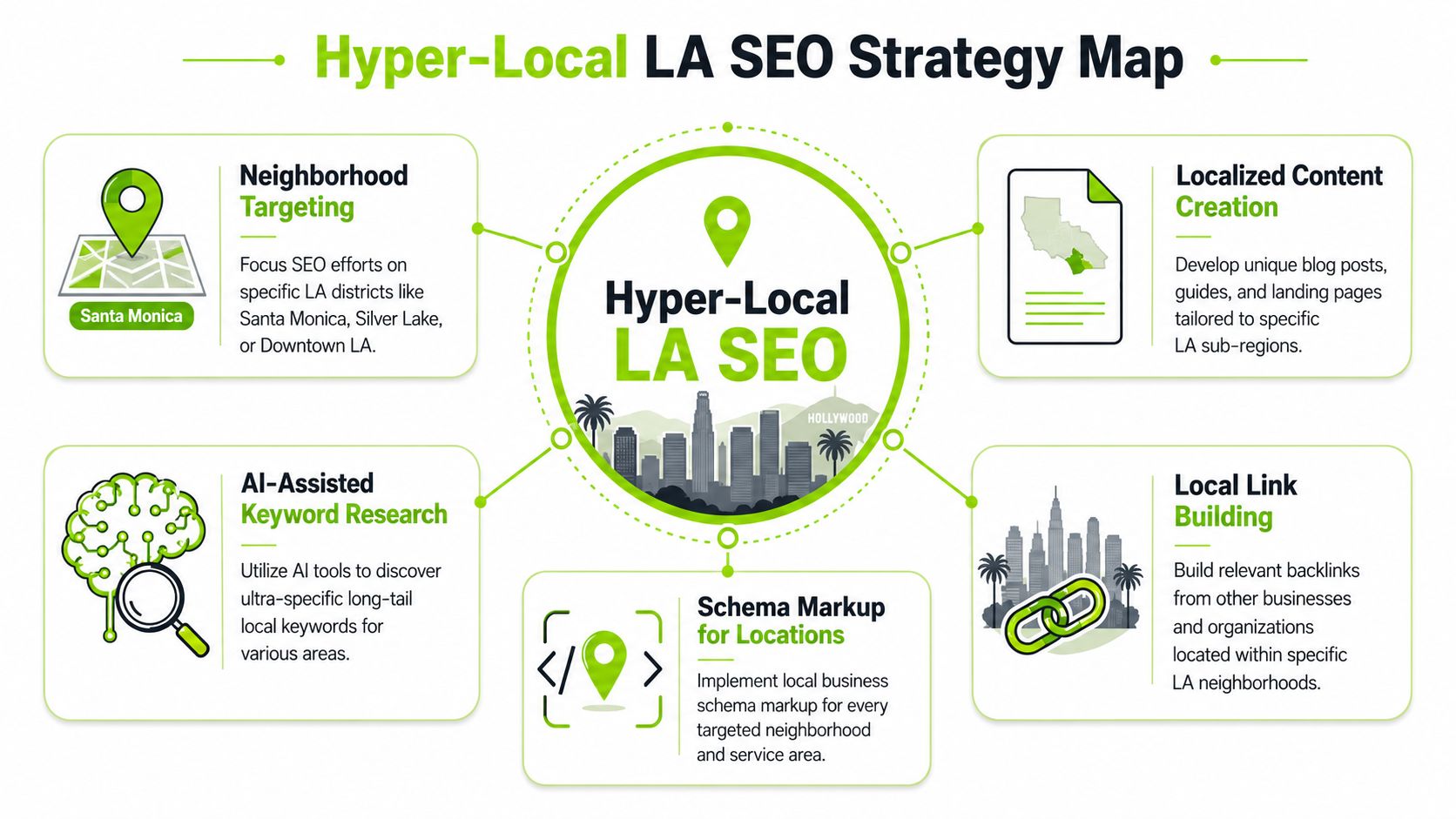
Most Los Angeles local SEO campaigns still fail on the website layer. They build one “Los Angeles” service page, maybe one generic location page, and expect that to cover Echo Park, Studio City, Venice, West Adams, and Glendale. It won't.
LA search behavior is too segmented for that. The businesses pulling ahead build content around micro-location intent, not just city intent.
In Los Angeles, hyperlocal keyword targeting that includes neighborhood names and adjacent cities can drive 23.8% to 33.4% higher Google 3-pack presence, according to Net Success USA's Los Angeles local SEO page. The same source says over 70% of local searches in Los Angeles occur on smartphones, and sites that aren't mobile responsive can suffer up to 40% lower engagement and conversion rates.
Why neighborhood pages matter more now
A city page says you operate in Los Angeles. A neighborhood page helps prove you're relevant in a specific pocket of Los Angeles.
That distinction matters even more in AI search. That Agency's article on local SEO in Los Angeles points out an important gap: the impact of LA's fragmented neighborhood intent on AI Overviews and LLM citations still isn't well addressed. It also notes that 60% of LA mobile searches are neighborhood-specific, while most advice stops at “create neighborhood pages” and doesn't explain how to structure them for AI-driven discovery.
That's where most sites fall short. They create neighborhood pages, but they don't make those pages citation-worthy.
What makes a neighborhood page useful
A good LA neighborhood page doesn't just swap the place name in a template. It should sound like it belongs to that area.
Include:
-
The specific service tied to the neighborhood “Family dentist in Los Feliz” is stronger than “dentist Los Angeles.”
-
Nearby landmarks, streets, or local cues Mentioning recognizable context helps the page feel geographically grounded.
-
Common property or customer context A roofer might reference the housing styles common in an area. A plumber might mention older pipe issues common in certain neighborhoods.
-
Clear service logistics Explain availability, travel range, scheduling realities, or storefront access.
-
Relevant internal links Connect the neighborhood page to the core service page and related nearby areas.
Write for extraction, not just ranking
AI systems often favor content that is easy to parse. That doesn't mean robotic writing. It means clear answers, logical structure, and explicit local relationships.
Use this pattern on key pages:
| Element | Better approach |
|---|---|
| H1 | Service plus neighborhood |
| Intro | State what you do and who you serve in that area |
| Subheadings | Answer practical local questions |
| FAQ | Use direct, concise responses |
| Internal links | Point to service hubs and related areas |
A page that says “we serve Los Angeles” is broad. A page that explains how you help homeowners in Echo Park, what issues are common there, and how customers can book is usable by both people and AI systems.
Mobile isn't a supporting detail
In LA, mobile shapes local behavior. If someone finds your neighborhood page on a phone and the page is clunky, slow-feeling, or hard to scan, the content won't carry its weight.
The practical test is simple:
- Can a visitor understand the offer in a few seconds?
- Is the tap path to call or book obvious?
- Does the page feel native on a phone?
- Are location cues visible without hunting for them?
Hyper-local content wins when it combines real neighborhood relevance, strong mobile UX, and clean information architecture. That's how you improve your odds in traditional local packs and in AI surfaces that need clear geographic signals to cite a business confidently.
Building Authority with Citations Reviews and Local Links
Citations, reviews, and local links are usually treated as separate tasks. In practice, they work better as one trust system.
A citation confirms you exist. A review confirms customers trust you. A local link confirms other local entities recognize you. When those three line up, your business looks more credible across maps, organic search, and AI-assisted discovery.
Citations should confirm, not clutter
Most businesses don't need a huge pile of directory listings. They need accurate listings in the places that matter for their industry and market.
For LA campaigns, I focus on:
- Core platforms such as Google, Apple Maps, Bing Places, Yelp, and major data aggregators
- Industry-specific directories that fit the business type
- Local relevance sources such as neighborhood chambers, association pages, or vetted community directories
The mistake is chasing quantity with inconsistent data. Ten clean citations beat a messy sprawl of low-quality profiles with old numbers and outdated addresses.
Reviews do more than influence buyers
Review strategy is where many local campaigns either build momentum or stall. You don't need a gimmick. You need a repeatable ask process tied to real customer moments.
Good review systems usually have:
- A request triggered after the service is completed or the customer confirms satisfaction
- A direct path to leave a review
- Staff guidance so the ask sounds natural
- A response routine that shows the business is active
The review itself also sends local signals when customers naturally mention neighborhoods, services, and context. Don't script that language word for word. Just make it easy for real customers to describe what happened.
Reviews are local content written by customers. That's why they carry more weight than many businesses realize.
Local links often start with reputation work
The three pieces connect, making a business with good reviews and a visible local footprint much easier to pitch for local coverage, partnerships, and mentions.
Strong LA link opportunities usually come from:
- Community involvement
- Sponsorships
- Neighborhood events
- Local podcasts or blogs
- Business associations
- Collaborations with complementary local businesses
A restaurant with active reviews and community buzz can get picked up by local food writers. A contractor with strong neighborhood pages and visible project coverage can earn mentions from local publications or community resources. A wellness brand with a real local audience can get featured through event partnerships.
Think in loops, not tasks
Here's the system that works:
- Clean citations support trust.
- Better trust supports conversions.
- More customers create more review opportunities.
- Strong reviews improve local credibility.
- Credibility makes local PR and link outreach easier.
- Local links strengthen your overall authority.
Businesses that treat this as one loop usually outperform businesses that hand citations to one vendor, reviews to front-desk staff, and link building to a disconnected outreach freelancer.
Tracking Performance in the AI Search Era
Old local SEO reporting focused too much on rank positions and not enough on visibility across the full search journey. That's a problem now because rankings alone don't explain what customers see.
In 2026, 43% of local searches trigger AI Overviews, and those results reference Google Business Profile data 67% of the time, according to Digital Applied's 2026 local SEO statistics. The same source says AI Overview results cause a 31% reduction in website clicks. It also notes that improving a rating from 3.5 to 3.7 stars can boost conversion rates by nearly 120%.
That changes what you measure.
Track the right local SEO KPIs
For Los Angeles local SEO, I care about four layers of performance:
| Layer | What to monitor |
|---|---|
| GBP visibility | Calls, direction requests, website visits, photo activity, review trends |
| Local pack presence | Priority keywords by neighborhood and service area |
| Website behavior | Landing pages that attract local visitors and generate actions |
| AI visibility | Whether the brand appears in AI Overviews and similar discovery surfaces |
A business can lose website clicks and still improve real local performance if GBP engagement, calls, and conversion quality go up. That's why reporting needs context. A drop in clicks isn't always a collapse. Sometimes it means users got what they needed earlier in the search path.
Watch neighborhoods, not just city terms
In LA, broad ranking reports hide the truth. You need to know whether you appear for the neighborhoods that matter to your business.
Track:
- Service plus neighborhood searches
- Map pack movement by service area
- Review recency and rating trend
- Whether AI summaries mention your brand or competitors
- Which landing pages support those appearances
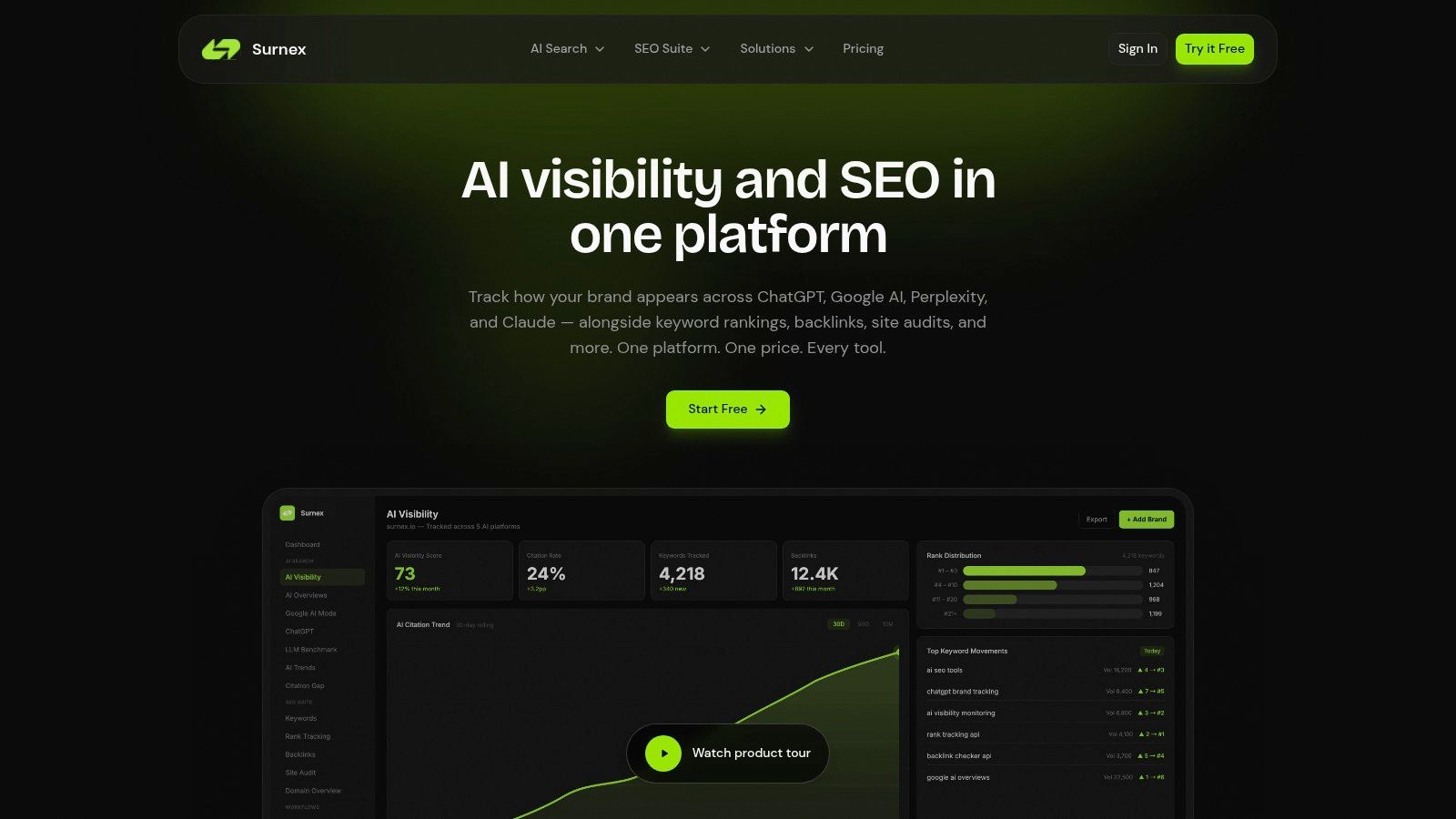
This is also where a single reporting environment helps. One option is Surnex's AI Overview tracker, which is relevant if you want to monitor AI visibility alongside more standard SEO metrics instead of splitting that work across multiple tools.
Use reporting to drive the next fix
Good local SEO reporting should answer three practical questions:
- Where are we visible?
- Where are we missing?
- What action is most likely to improve that?
If a neighborhood page ranks but doesn't convert, improve the offer and UX. If the GBP gets views but few calls, tighten categories, photos, Q&A, and reviews. If AI summaries mention competitors, look for citation gaps, weak local phrasing, or missing neighborhood specificity on your site.
The AI search era doesn't make local SEO less measurable. It makes shallow reporting less useful.
Los Angeles local SEO still rewards the same businesses that are the clearest, most trusted, and most locally relevant. The difference now is that you need to measure visibility where customers discover you, not just where you hope they click.
If you're managing local SEO across clients or trying to understand how your brand appears in both traditional search and AI-driven results, Surnex gives teams a way to track those signals in one place. That's useful when Los Angeles visibility depends on more than blue links.