At its core, a white label report is a ready-made, data-rich report from a third-party tool that you can put your own brand on. You simply add your logo, match your brand colors, and layer in your expert analysis. In a flash, a generic report becomes a polished, professional document that looks like your team built it from scratch.
What Are White Label Reports and Why They Matter
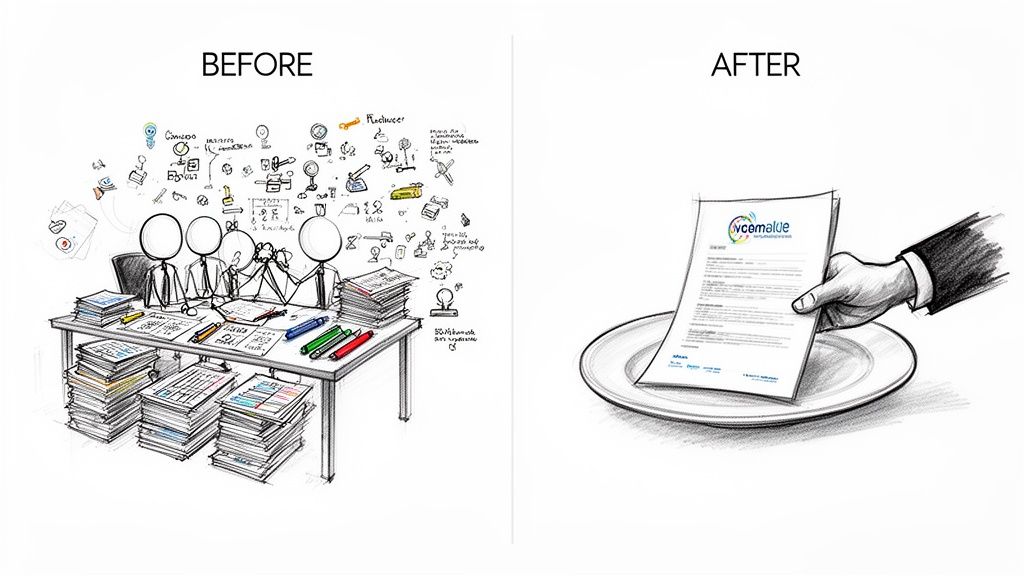
If you run an agency, you know the drill. Your team spends hours, sometimes days, buried in spreadsheets. They’re manually pulling data from Google Analytics, Search Console, and a half-dozen social media and ad platforms, trying to piece together a coherent story for each client. It’s a tedious, soul-crushing process that drains productivity.
This is exactly the problem white label reports are designed to solve.
Think of it this way: a high-end chef doesn't grow their own wheat or raise their own cattle. They source the best possible ingredients to create a signature dish. The white label report is that high-quality ingredient. The platform provides the powerful data engine, but it’s your agency’s branding and strategic insights that make the final product special. You get to deliver impressive, data-backed results without the massive cost of developing your own reporting software.
Ending the Manual Reporting Grind
The real value here is getting your team out of the data-entry business. When you stop dedicating countless hours to just collecting and formatting data, your experts can finally focus on what they do best: analyzing performance, spotting opportunities, and building stronger client relationships. You shift their role from data wrangler to strategic partner, and that’s a game-changer for growth.
This isn’t just a small time-saver, either. Some agencies using automated platforms save over 38 hours per analyst per week by eliminating manual data collection from sources like Google Analytics 4, Google Ads, and Meta Ads. That’s essentially getting a full-time employee back to focus on high-value work. You can dig deeper into these numbers and the impact on marketing agency reporting workflows.
The difference between the old manual process and a modern white label approach is night and day. Let's break it down.
Manual Reporting vs White Label Reporting
| Aspect | Manual Reporting | White Label Reporting |
|---|---|---|
| The Process | Manually copying data from 5+ tools into spreadsheets or slide decks. | Data is automatically pulled from all sources into one branded dashboard. |
| Time Spent | 8-10 hours per client, per month, just on assembly. | 1-2 hours per client, per month—mostly adding your insights. |
| Branding | Inconsistent, often messy, and full of other companies' logos. | Fully branded with your agency’s logo, colors, and even a custom domain. |
| Scalability | Brutal. More clients means hiring more people just to build reports. | Effortless. Onboard new clients without adding significant reporting work. |
| Client Perception | Can look unprofessional, disjointed, and hard for clients to follow. | Appears polished, cohesive, and reinforces your agency’s authority. |
As you can see, the benefits go far beyond just saving time. It's about fundamentally changing how your agency is perceived and how it operates.
Building Unbreakable Client Trust
Ultimately, white label reports help you prove your value consistently and professionally. They create a reliable, impressive touchpoint that builds client confidence and reduces churn. When clients get clear, beautifully branded reports that tell a story of real progress, they stop seeing you as a vendor and start seeing you as an essential partner. This is especially critical for marketing agencies aiming to scale their services without ever sacrificing that high-quality client experience.
The Real Payoff: Why White Label Reports Are a Game-Changer
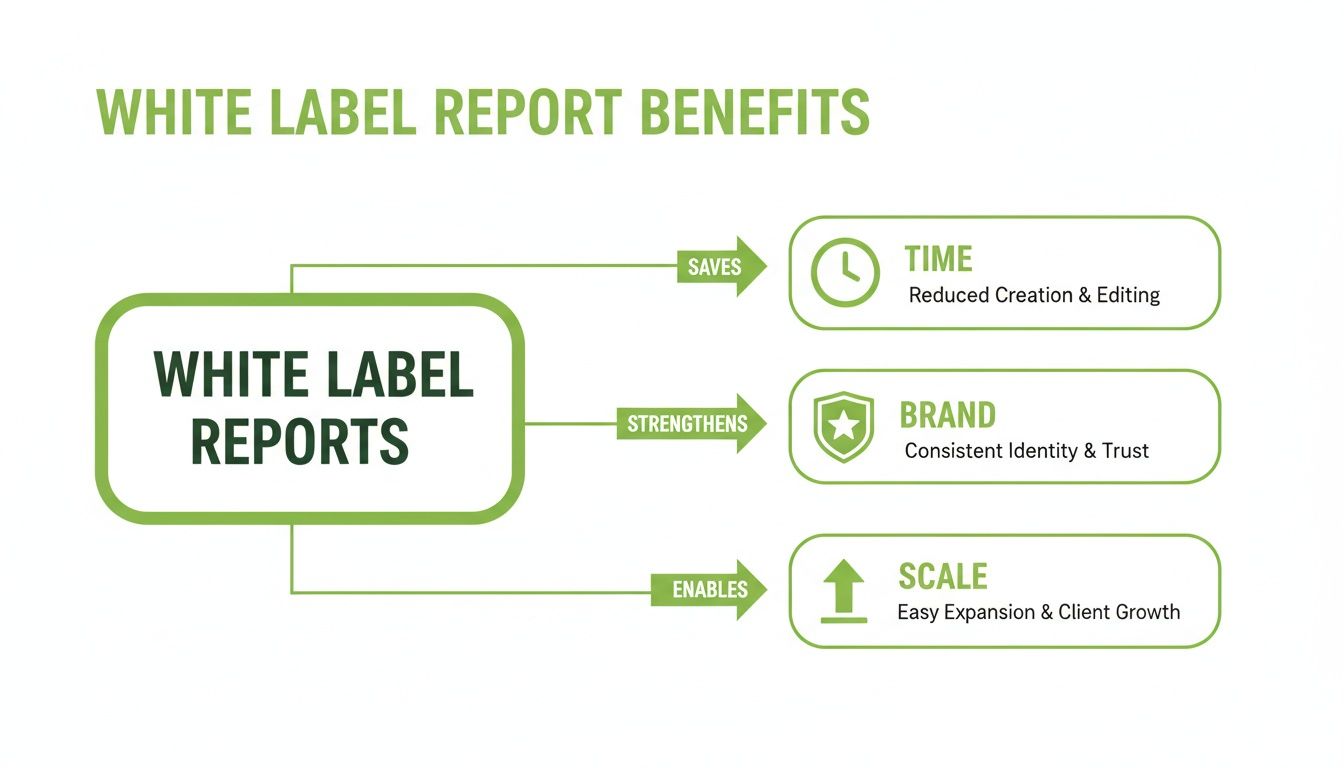
Switching to white label reports is about more than just slapping your logo on a dashboard. It's a fundamental shift that transforms how your agency operates, proves its value, and grows. The benefits boil down to three things every agency leader cares about: saving a massive amount of time and money, looking like the expert you are, and being able to grow without breaking everything.
Let’s be honest, manual reporting is a soul-crushing time drain. Your best minds get stuck in a copy-paste nightmare, pulling numbers from a dozen different tools and wrestling with spreadsheets. They should be crafting brilliant client strategies, not building charts.
White label reporting completely automates that grind. It pulls data from Google Search Console, analytics platforms, and ad networks into one clean, professional report. Suddenly, all those hours spent on tedious data entry are freed up for the work that actually keeps clients happy and paying: finding insights and giving smart advice.
Save Time and Reinvest in What Matters: Strategy
Think about how those saved hours add up. If you spend eight hours a month building just one client's report, ten clients will cost you 80 hours of team time. With a white label solution, you can slash that by over 90%. That’s hundreds of hours a year you can pour back into your business.
This isn't just about efficiency; it's about reinvesting that time where it truly counts. With reporting on autopilot, your team can:
- Go Deeper on Strategy: Spend more time analyzing trends and finding those game-changing opportunities for clients.
- Have Better Conversations: Talk with clients about strategy and results, not just at them with data points.
- Build What's Next: Start developing new services, like reporting on AI search visibility, to keep your agency ahead of the curve.
This is how you stop being seen as just a service provider and become the strategic partner your clients can't imagine leaving.
Build Your Brand Authority and Earn Trust
Every single thing you send a client is a reflection of your brand. A sleek, professional report with your logo, your colors, and your analysis screams competence and quality. It’s a world away from a generic, third-party export.
This consistency is how you build real client trust. When a client sees their performance data presented clearly and professionally under your name, it reinforces that you are the expert they hired. This is what reduces churn and turns one-off projects into long-term partnerships.
For example, an agency using a platform like Surnex can show traditional SEO wins right alongside new metrics like visibility in AI Overviews. Delivering that complex information in a simple, beautifully branded report shows clients you’re not just keeping up with the future of search—you’re guiding them through it.
Scale Your Agency Without the Headaches
Finally, white label reporting is your secret weapon for sustainable growth. Manual reporting creates an impossible bottleneck. As you sign more clients, the administrative load gets heavier and heavier. You’re forced to either hire more people just to create reports or watch the quality of your work suffer.
White label reporting breaks that cycle. Since the process is automated, adding a new client to your reporting system takes minutes, not days. You can finally grow your client roster without the usual growing pains, knowing every single client is getting the same high-quality, professional report—whether they’re your first or your fiftieth.
This model is proving its worth everywhere. In fact, the private label market is projected to hit $282.8 billion in sales by 2025, growing faster than national brands. This trend confirms a simple business truth: using proven, high-quality "white labeled" solutions is a smart and powerful way to grow. You can dive into the numbers by checking out the latest private label market report.
What Metrics Should Go in Your SEO and AI Search Reports?
A report that just spits out numbers is useless. A great report tells a story—a story that shows a client exactly how your work is making a difference. With search changing so fast, that story now has to weave together traditional SEO wins with your client's growing footprint in AI search.
The goal is to create white label reports that connect the dots between your efforts and their bottom line. It’s about moving past fluff and focusing on data that actually means something for their business. Think of your report as a roadmap, showing them not just the progress you've made, but the exciting places you're about to go together.
The Foundation: Core SEO Performance Metrics
Before we even touch on AI, your reports need to nail the fundamentals. These are the classic, hard-working metrics that prove your core SEO strategy is delivering real value. They answer the simple, direct question every client has: "Is this investment paying off?"
Make sure these are always front and center:
- Keyword Rankings That Matter: Don’t just throw a list of keywords at them. Group rankings by user intent (like "buy now" vs. "how to") and tie them directly to results. For example, show them how climbing the ranks for "24-hour AC repair" led to a spike in calls. That’s a story they’ll understand.
- Organic Traffic That Converts: The number of visitors is just one part of the picture. Show them the quality of that traffic. Are people sticking around? Are they viewing multiple pages? Most importantly, are they filling out forms or making purchases? You're not just bringing traffic; you're bringing the right traffic.
- Backlink Profile and Authority: Backlinks are still a massive signal of trust to search engines. Your report should highlight the awesome new links you've earned and explain how they boost the site's authority. It's also smart to mention any toxic links you've cleaned up, showing you're protecting their brand.
- Technical Site Health (in Plain English): Your clients don't need a lecture on Core Web Vitals. They just need to know the outcome. Frame it simply: "We made the site 2 seconds faster, which makes customers happier and helps Google rank it higher."
Automating the grunt work of pulling this data frees you up to focus on what clients really pay for—your strategic insight.
The Future: AI Search Visibility Metrics
This is where you get to show clients you're ahead of the curve. Tracking visibility in AI-powered search results turns a confusing, new-fangled concept into something tangible they can actually see and measure. You're not just an SEO; you're their guide to the future of search.
Your white label report should be the very first place a client sees how they're performing in this new world. It’s your chance to turn a complex technology into a clear, measurable part of their marketing plan.
Tools like Surnex are making it possible to track these brand-new KPIs. Here are the AI metrics you should start weaving into your reports right away:
- Visibility in AI Overviews: This is the big one. Are they being mentioned or cited in Google’s AI Overviews for their most valuable keywords? This is the new "position zero," and tracking it is non-negotiable.
- Brand Mentions in LLM Chats: How often is their brand, content, or product being referenced by large language models like ChatGPT? This shows their influence is extending beyond the search results page and into direct AI conversations.
- AI Share of Voice: As new AI search tools pop up, you need to benchmark where your client stands. Show them how their visibility compares to their competitors across these new platforms to spot both risks and opportunities.
When you bring these two worlds together, the story becomes incredibly powerful. You can draw a direct line showing how your work on content and backlinks (classic SEO) resulted in them being cited in an AI Overview (a huge AI visibility win). This holistic view is what makes for truly compelling white label reports. To get a better handle on this, you can learn more about measuring AI search visibility and see how it ties back to everything you're already doing.
How to Implement Your White Label Reporting Strategy
Alright, so you're sold on the idea of white label reports. The big question now is: how do you actually make it happen in your own workflow? You've got a few different paths you can take, and the right one really depends on your team's size, your budget, and how fast you're trying to grow.
Let's walk through the options, from the simple starting points to the fully automated systems, so you can figure out what makes the most sense for you.
Starting with Manual Templates
When you're just getting started, the go-to method is often building reports by hand. This usually means creating a master template in something like Google Sheets or Looker Studio. You design it with your branding, plug in the right charts, and then just copy it for each new client.
It’s an easy and cheap way to dip your toes in the water, which is why so many agencies start here. The problem is, this approach doesn't scale. At all.
- It’s a Time Sink: Manually updating data every single month is fine for a handful of clients. But once you hit ten, twenty, or more, it becomes a soul-crushing task that eats up hours of valuable time.
- Human Error is Inevitable: All that copying and pasting is a recipe for mistakes. One wrong number in a report can instantly damage the trust you’ve worked so hard to build with a client.
- Limited Data: Trying to pull in specific metrics, like visibility on new AI search engines, can be a technical nightmare with basic templates. The connections are often clunky and break easily.
Think of manual templates as training wheels. They get you moving, but you'll outgrow them quickly if you’re serious about scaling up.
Leveraging Dedicated Automated Platforms
This is where you graduate from the manual grind. Dedicated platforms are built from the ground up to automate the entire reporting process. You connect your tools—Google Analytics 4, Search Console, social media accounts, you name it—and the platform does the heavy lifting.
With a tool like Surnex, for example, you set up the data connections once. From then on, the platform automatically pulls the latest numbers into beautiful, client-ready reports that already have your branding on them. This single step can eliminate 90% of the manual work. Your team is suddenly free to focus on what clients actually pay for: strategy and insights.
The real magic here is getting to deliver incredible value right away. You can produce reports that seamlessly combine classic SEO stats with emerging AI search metrics, all under your own brand, without writing a single line of code.
For most growing agencies, this is the sweet spot. It offers the perfect blend of power, ease of use, and scalability.
Building Custom Solutions with APIs
If you have developers on your team or you want absolute control over every pixel, building a custom solution with an API is the way to go. An agent-ready API gives you a clean, organized stream of data that you can plug into anything.
This means you could build a completely unique reporting dashboard inside your own client portal, feed the data into a business intelligence tool like Tableau, or create custom alerts. The flexibility is unmatched. The trade-off, of course, is that it requires a serious investment in development time upfront, plus ongoing work to maintain it.
Choosing your path is a critical decision. While manual templates might seem like the easy choice to start, investing in an automated platform or a powerful API is what truly sets your agency up for growth. It allows you to deliver consistent, high-quality insights to every client, especially for complex tasks like a technical site audit that you can learn more about here, where automation and accuracy are non-negotiable.
Best Practices for Delivering Reports That Impress Clients
Let’s be honest: a great report isn't just a data dump. It’s a conversation starter, a trust-builder, and the single best way to prove your value. The difference between a good agency and a great one often comes down to turning a spreadsheet of numbers into a clear story of progress.
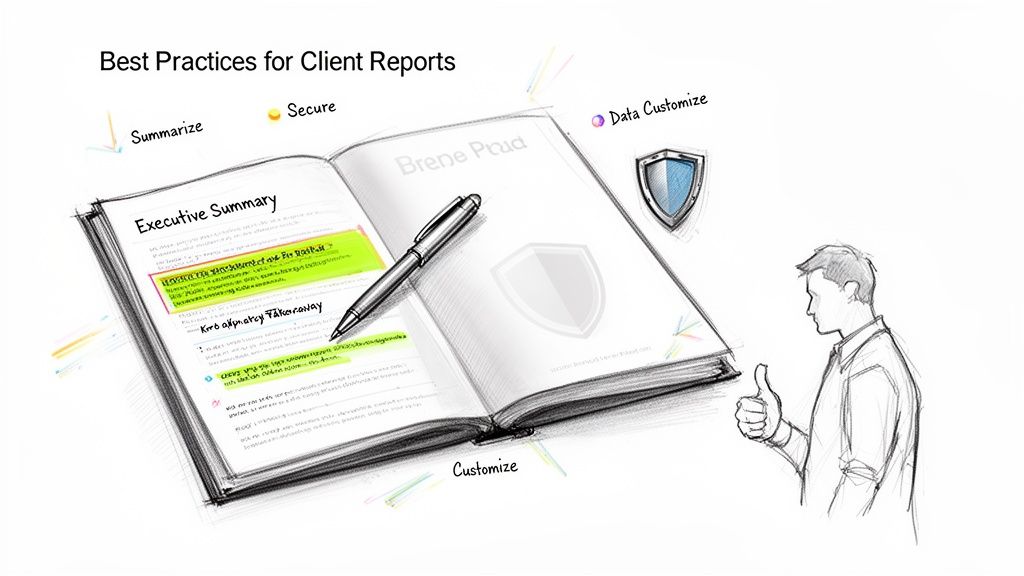
It all starts with customization that goes deeper than just slapping your logo on the top. Use your client's brand colors in the charts and graphs. This small detail goes a long way, making the report feel like an internal update, not just another document from an outside vendor. It shows you’re thinking about their brand as if it were your own.
This kind of polished presentation is quickly becoming the standard. The white labeling market, currently valued at $28.3 billion, is expected to explode to $75 billion by 2033. Why the massive jump? Because more and more agencies are using branded, scalable services to keep up with client expectations and get an edge. You can dive into the numbers yourself in the full market growth analysis.
Write Executive Summaries That Actually Get Read
Your executive summary is the most critical part of the entire report. A busy client might only read this one section, so it needs to be concise, insightful, and tell them what they need to know. Never open with raw data.
Instead, frame your summary like a quick, strategic update:
- Lead with the Big Wins: Start with the most impressive results. For instance, "This month, our new content strategy drove a 15% increase in organic traffic to your key service pages."
- Explain the 'Why': Briefly connect those wins to your work. "We achieved this by publishing three new blog posts targeting high-intent keywords and landing two backlinks from industry authorities."
- Outline What’s Next: Show them you're already thinking ahead. "Our focus for next month is to optimize the landing pages to turn this new traffic into qualified leads for your sales team."
This simple structure changes the report from a backward-looking document into a forward-looking strategy discussion, cementing your role as a proactive partner.
Set Clear Expectations and Reinforce Security
Consistency is the bedrock of trust. Set a firm delivery schedule—whether it’s the first Monday of the month or every other Friday—and hit that deadline every single time. It's a simple thing, but that reliability shows you're professional and organized.
A report isn't just a deliverable; it's a promise. By delivering on time, every time, you demonstrate that your agency is dependable and organized, making clients feel secure in their investment.
That feeling of security should also apply to their data. If you’re using a white label platform, make sure it has serious security protocols. Reassure clients that their performance data is kept confidential and handled with care. Simply stating your commitment to data privacy adds a layer of trust that’s tough for competitors to match.
For a closer look at how to put these pieces together, check out our guide on building client-ready reporting workflows. When you get these practices right, your report becomes one of your most effective tools for keeping clients happy and engaged for the long haul.
Common Questions About White Label Reports
Thinking about using white label reports in your agency? You’re bound to have some questions. It’s a move that touches everything from your budget to your client conversations. Let's walk through the most common ones so you can feel confident about the path forward.
How Much Does White Label Reporting Software Cost?
The price for white label reporting tools is all over the map, so it’s better to think in terms of value, not just cost. You can find simple platforms aimed at smaller agencies for around $50 to $150 per month, usually with a cap on how many clients you can manage. They’re a great starting point.
For more powerful solutions that pull together data from SEO, paid ads, and newer metrics like AI visibility, you could be looking at a few hundred to several thousand dollars a month. These platforms are usually built on a tiered model, so the cost grows as your agency does.
But here’s the right way to think about it: what’s the return on that investment? If a tool saves your team 30+ hours a month on manual reporting and helps you keep clients longer, it pays for itself almost immediately. The real cost isn't the software fee; it's the billable hours your team loses forever to mind-numbing spreadsheet work.
When you see it as an investment in efficiency and client retention, not just another expense, the right choice becomes much clearer.
Can I Fully Customize Reports With My Agency's Branding?
Yes, and you absolutely have to. That’s the entire point of "white label." Any decent platform will let you drop in your logo, match the charts and graphs to your brand colors, and even host the reports on a custom domain (like reports.youragency.com).
This simple step completely changes the dynamic. It stops looking like a report from a third-party tool and starts looking like your agency's own proprietary software. It’s a subtle but powerful way to reinforce your brand every time you talk to a client.
But the best platforms take it even further. True customization means you can:
- Edit Dashboards: Hand-pick the exact data widgets each client sees. No more overwhelming them with metrics they don’t care about.
- Build Custom Templates: Design report layouts for specific goals, whether it’s a local business focused on GMB or an e-commerce site obsessed with conversions.
- Shape the Narrative: You decide which numbers to spotlight, making sure the data tells the story you want it to tell.
This isn't just about looking good. It’s about proving you offer a high-value, bespoke service, not just a generic data dump.
Is It Difficult to Integrate My Existing Tools?
It used to be, but not anymore. The days of wrestling with clunky, unreliable integrations are mostly over. Modern white label platforms are designed to be plug-and-play, with simple, one-click connections to the tools you use every day.
You can usually connect to all the big ones:
- Google Analytics 4
- Google Search Console
- Google Ads
- Meta Ads (Facebook & Instagram)
- LinkedIn Ads
- Major SEO tools (like Ahrefs or Semrush)
The whole idea is to connect your data sources once. After that, the platform does all the heavy lifting, automatically pulling in and refreshing the data. No more exporting CSVs. Ever.
And if you have unique needs or your own internal dashboards, many platforms offer an API. This lets your developers pull the clean, organized data directly into your own systems. You get the benefit of automated data collection without the headache of maintaining dozens of separate connections yourself.
How Do Reports Help Explain New Concepts Like AI Search to Clients?
This is where a great reporting tool really shines. Trying to explain concepts like visibility in Google’s AI Overviews or brand mentions in chatbot answers can make a client’s eyes glaze over. A good report makes these abstract ideas concrete and measurable.
Instead of just telling them AI search is important, you can show them. Imagine sending a report—with your logo on it—that includes:
- A chart showing their brand's share of voice in AI-generated answers over the past 90 days.
- A scorecard comparing their visibility in AI search to their top three competitors.
- A list of new article ideas pulled directly from AI-driven search trends.
All of a sudden, AI search isn't some fuzzy, futuristic concept. It's a real, measurable KPI that you are actively improving for them. This instantly positions your agency as a strategic partner who is ahead of the curve, not just a vendor who executes tasks. It shows you’re not just keeping up with the future of search—you’re leading them through it.
Ready to deliver impressive, automated reports that combine SEO and AI search intelligence? With Surnex, you can unify all your performance data into a single, beautifully branded dashboard. Start saving time and showing your full value today. Explore the platform at Surnex.io.