An SEO report isn't just a spreadsheet full of data; it's your website's story told through numbers. It’s the document that shows you how your site is performing in search engines, helping you track progress and uncover new opportunities.
What Is an SEO Report and Why It Matters
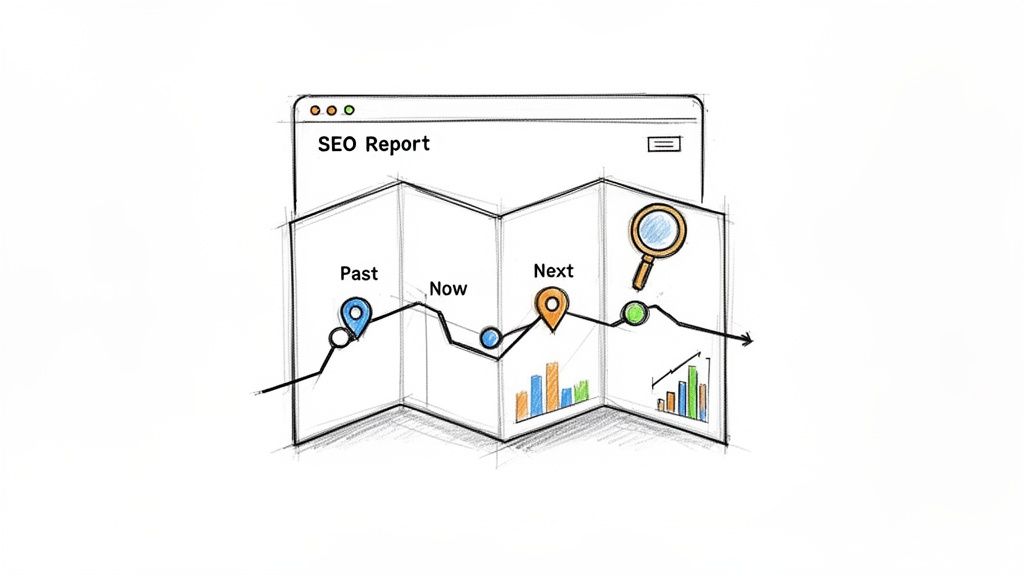
Think of an SEO report as a GPS for your online business. It clearly shows where you’ve been, where you are right now, and the best path forward. A great report does more than just list metrics; it translates all that complex performance data into simple, actionable insights.
At its heart, an SEO report makes sense of your search optimization efforts. It organizes key data points into a clear narrative that shows progress, proves value, and helps shape your future strategy. Without one, you’re flying blind. You can't connect your team's hard work to tangible results like traffic growth, new leads, or sales.
The Core Functions of an SEO Report
An SEO report does different jobs for different people. For an agency, it's the primary tool for proving ROI to a client. For an in-house team, it aligns marketing work with the goals set by leadership. And for a developer, it can pinpoint technical problems that are hurting performance.
A good SEO report can do more than just measure progress; it helps everyone understand the value of their work. Here’s a quick look at its main roles.
| Function | What It Measures | Why It's Important |
|---|---|---|
| Performance Tracking | Organic traffic, keyword rankings, conversion rates. | Provides a clear baseline to see what’s working and what’s not over time. |
| Accountability | The impact of SEO activities on business goals. | Justifies budgets and proves the value of your SEO investment to stakeholders. |
| Strategic Planning | Competitor performance, content gaps, new opportunities. | Helps you make informed decisions to stay ahead and adapt your strategy. |
These functions come together to create a powerful feedback loop that drives real growth.
Regular reporting is the backbone of any smart SEO strategy. We've seen that businesses prioritizing it often see significant gains—studies show average organic traffic can increase by 20-30% year-over-year when reports are used to address key issues. For agencies, delivering reports with clear executive summaries can boost client retention by up to 35% by tying SEO wins directly to business outcomes. You can read more about these reporting findings on semrush.com.
An SEO report answers three simple but critical questions: What happened? Why did it happen? And what should we do next? It moves your team from just looking at data to making smart decisions.
A well-crafted report doesn’t just throw numbers at you. It tells a story. It celebrates your wins, diagnoses your challenges, and uncovers opportunities your competitors might be missing, turning abstract metrics into a clear roadmap for growth.
A Tool for Alignment and Strategy
Ultimately, an SEO report is a communication tool. It’s how you get everyone—from the marketing team to the C-suite—on the same page and speaking the same language.
By showing performance trends and connecting them to company goals, it ensures that every stakeholder understands the real impact of your SEO investment.
Here’s a breakdown of its primary roles:
- Performance Tracking: It gives you a consistent benchmark for measuring progress over time, clearly showing what’s working and what isn’t.
- Accountability and Justification: The report delivers concrete proof of the value SEO brings, justifying budgets and resource allocation.
- Strategic Planning: By analyzing trends, you can identify new content opportunities, spot competitive threats, and fine-tune your strategy on the fly.
The Key Metrics Inside Every SEO Report
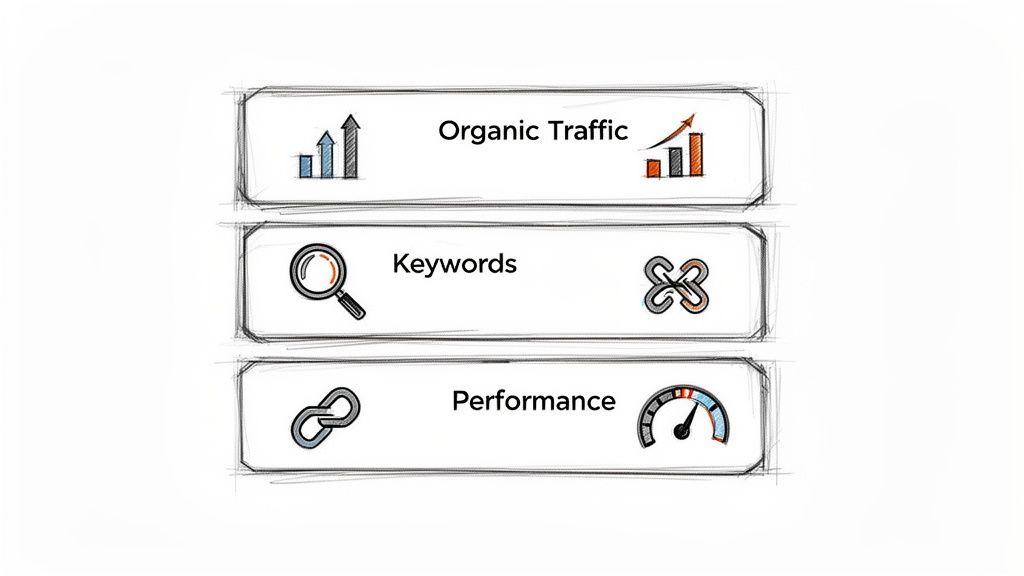
Opening an SEO report for the first time can feel a little intimidating. You’re hit with a wall of charts, percentages, and unfamiliar terms. But don't get lost in the jargon—think of these metrics as the vital signs for your website's health.
Each number tells a piece of a larger story about how you're performing online. By focusing on a few key areas, you can quickly figure out what's working, what's not, and where to point your efforts next.
Organic Traffic and User Engagement
The first and most fundamental metric is organic traffic. This is simply the count of people who find your website through a search engine without you paying for an ad. It’s the clearest sign of your overall visibility. If that number is steadily climbing, your SEO efforts are paying off.
But traffic alone isn't enough. You need to know what people do once they land on your site. That's where user engagement metrics come in, telling you about the quality of your traffic.
- New vs. Returning Visitors: Are you attracting fresh faces or bringing back loyal fans? A healthy balance of both is what you're aiming for.
- Engagement Rate: A key metric in Google Analytics 4, this shows what percentage of visitors actually interacted with your site. It’s a much smarter way to measure interest than the old bounce rate.
- Conversions: This is the bottom line. How many visitors filled out a form, bought a product, or signed up for your newsletter? This metric connects your SEO work directly to real business goals.
Seeing lots of traffic but very few conversions? That’s a red flag. It often means your content isn't quite hitting the mark for what searchers were hoping to find.
Keyword Performance and Rankings
While traffic shows you the "what," keyword performance shows you the "how." These are the specific search terms people typed into Google to find you. Tracking your rankings is less about vanity and more about understanding what's driving your most valuable traffic.
Don't sweat the small daily fluctuations. What you really want to see is a gradual upward trend for your most important keywords. On the flip side, a sudden, sharp drop can be an early warning of a technical problem or a bold new move by a competitor.
An SEO report should go beyond just listing top-ten rankings. The real insight comes from knowing which keywords bring in customers versus those that just attract window shoppers. That distinction is how you prove the tangible value of SEO.
Digging into this data helps you spot opportunities everywhere—from high-value keywords your competitors are sleeping on to brand-new content ideas your audience is already searching for.
Backlink Health and Authority
Think of backlinks—links from other websites to yours—as referrals or votes of confidence. In the eyes of a search engine, a link from a major, trusted site is like a glowing recommendation from a respected industry leader. It carries far more weight than dozens of links from tiny, unknown blogs.
Your SEO report should give you a clear picture of your backlink profile.
- New Referring Domains: This counts the number of unique websites linking to you for the first time. Seeing this number grow consistently is a fantastic sign that your site's authority is building.
- Lost Backlinks: It’s normal to lose links here and there. A good report helps you spot when a particularly valuable link disappears so you can try to get it back.
- Toxic Links: Unfortunately, not all links are good. Some links from spammy or low-quality sites can actually hurt your rankings. Your report should flag these so you can tell Google to ignore them.
By keeping an eye on your backlink health, you get a real sense of your website's reputation online and can make smarter decisions about your off-page SEO strategy.
Understanding Keyword Rankings and Search Visibility
Tracking your keyword rankings is a classic part of any SEO report, but it's so much more than just a vanity check to see if you’re number one. A better way to think about your keywords is as digital real estate. Owning the top spots for terms your customers are searching for is like having a flagship store on the busiest street in town.
This is all about measuring what really moves the needle—your total presence and influence in the search results. We'll go beyond just looking at a list of rankings and dig into how you can measure your true market share in search. This helps you see not just where you stand, but how you stack up against everyone else fighting for your audience.
Moving Beyond Simple Rank Tracking
Let’s be honest: knowing your website is at position #3 for a keyword is only half the story. The real gold is in understanding what that position actually means for your business. This is where a metric like click-through rate (CTR) comes into play. CTR simply tells you what percentage of people who saw your page in the search results went on to actually click it.
A high ranking with a stubbornly low CTR is a huge red flag. It could mean your page title and meta description just aren't cutting it—they aren’t compelling enough to earn the click, even if Google sees your content as a great match. By analyzing CTR, you can start optimizing how your site appears in search, turning that hard-earned visibility into real website traffic.
Ranking high is the first step, but winning the click is what drives business. A great SEO report connects keyword positions to click-through rates to show not just how visible you are, but how effectively you're capturing searcher interest.
For instance, data from just a couple of years ago showed that pages in position 1 captured a massive 27.6% of all clicks. That number plummets to a tiny 2.5% by the time you hit position 10. Seeing that sharp drop-off really drives home why every single spot you can climb matters. You can find more on reporting stats like these and what they mean at yoast.com.
Gauging Your Market Share with Share of Voice
If you want a more sophisticated way to measure your keyword performance, you need to look at Share of Voice (SoV). This metric gives you an estimate of your website's visibility across a whole set of important keywords, all while benchmarking you against your competitors. Instead of just looking at your own report card, SoV gives you a bird's-eye view of the entire market.
Imagine you and three competitors are all vying for the same 50 keywords. Share of Voice calculates what percentage of all the potential clicks and eyeballs you’re getting from that keyword group compared to your rivals. Any comprehensive answer to what is an seo report should include SoV, as it helps you answer critical business questions:
- Are we gaining or losing ground against our main competitor?
- Which topics do we own, and where are we getting beat?
- Is there a new player on the scene that we need to start watching?
Tracking SoV turns your rank tracking from a simple to-do list into a powerful competitive intelligence tool. It gives you a clear, honest benchmark of your influence in your space.
The New Frontier: Tracking Visibility in AI Search
The world of search is changing fast, and our reporting has to keep up. With Google’s AI Overviews and other AI-powered answer engines becoming more common, those traditional "blue link" rankings no longer guarantee you'll be seen. You can have the #1 organic spot and still be totally invisible because an AI-generated summary answered the user's question at the very top of the page.
This creates a brand new "visibility gap" that modern SEO reports must account for. We now need advanced tools that can tell us when and how our brand is showing up inside these AI snippets. Here in 2026, with AI Overviews already appearing in about 15% of US queries, reports are starting to track this new kind of visibility. The payoff is huge: sites optimized for it see 35% higher brand recall.
Monitoring your presence in AI search is no longer optional; it's essential for future-proofing your entire SEO strategy. Our guide on advanced rank tracking methodologies dives deeper into how to tackle this new challenge.
Your SEO strategy really comes down to two things: how authoritative your site is and how well it works for users. This is where we need to look at your backlink profile and your site's technical health. These two areas are the bedrock of any solid SEO report, explaining not just where you rank, but why—and what to do next.
Think of it like this: your website is a building. Technical SEO is the foundation, the plumbing, and the electrical wiring. If that's not solid, nothing else matters. Backlinks, on the other hand, are the word-of-mouth recommendations and positive reviews that make your building the most popular spot in town. A great report shows you how both are working together.
What's the Story with Your Backlink Profile?
Backlinks are simply links pointing to your site from other websites. Search engines see them as votes of confidence, but it's not a numbers game anymore. The golden rule has always been quality over quantity. Honestly, one single link from a well-respected industry publication is worth more than a hundred links from random, unknown blogs.
A good SEO report cuts through the noise and gives you a clear picture of your backlink profile, focusing on a few key things:
- New & Lost Backlinks: Seeing new links pop up is a great sign that your authority is growing. Just as important is keeping an eye on lost links, especially the valuable ones, so you can try to get them back.
- Referring Domains: This is the number of unique websites linking to you. You want to see this number climbing steadily—it’s a clear signal of a growing online reputation.
- Link Quality: The report needs to separate the good from the bad. It should highlight the high-authority links that are giving you a real boost and flag any potentially "toxic" links from spammy sites that could get you in trouble with Google.
Getting a handle on these metrics is your first step toward building a backlink strategy that actually moves the needle. If you want to go deeper, our guide on how to analyze your backlinks is a great next read.
This isn’t just about counting links; it’s about understanding your site's reputation. We saw this with a client in a 2025 case study. After they earned 150 high-quality backlinks each quarter, their domain rating shot up from 45 to 62, and their organic traffic grew by 42%. On the flip side, we know that by 2023, Google's spam updates had already penalized 25% of audited sites for having unnatural-looking anchor text. A clean profile is critical, especially now that brands showing up in AI-generated answers can see a 28% jump in discovery traffic. You can find more on how modern reporting tracks these trends at databox.com.
Keeping Your Site’s Technical Health in Check
Technical SEO is the foundation everything else is built on. If your site is slow, confusing for search engines to crawl, or riddled with errors, you can have the best content and backlinks in the world and still get nowhere.
Your report’s job is to turn all that complicated technical stuff into clear, actionable advice.
Think of technical errors like a leaky roof. You might not notice it at first, but over time it can cause serious structural damage. An SEO report is your regular inspection, helping you spot and fix these issues before they become major problems.
Because getting this right is so critical, many businesses bring in experts for comprehensive SEO audit services. This gives them a detailed diagnostic of their site's performance and a clear roadmap for what to fix.
Key Metrics for Backlink and Technical Audits
A great SEO report doesn’t just dump data on you; it organizes it to tell a clear story about your site's health. The table below breaks down the essential metrics you'll want to see for a complete picture of your technical and backlink status.
Key Metrics for Backlink and Technical Audits
| Category | Key Metric | What It Indicates |
|---|---|---|
| Backlink Authority | Domain Rating / Authority | Your website's overall "link power" on a 0-100 scale. |
| Backlink Growth | New Referring Domains | The rate at which unique new websites are linking to you. |
| Link Quality | Toxic Link Score | The percentage of your links that may be harmful to your SEO. |
| Site Performance | Core Web Vitals (LCP, INP, CLS) | How quickly your pages load and respond to user interaction. |
| Crawlability | Crawl Errors (e.g., 404s) | How many broken or inaccessible pages search engines found. |
| Site Structure | Indexation Status | The number of your pages included in Google’s search index. |
By watching these numbers, you can directly connect the dots between your actions and your results. You’d be surprised how much growth can be unlocked just by fixing a single site speed issue or cleaning up a batch of toxic links.
How to Create Reports for Different Audiences
A pile of SEO data is just noise. It only becomes useful when you frame it for the person reading the report. Sending a detailed technical crawl log to your CEO is a surefire way to get ignored, just as a high-level ROI summary won’t help a developer squash a bug. A one-size-fits-all report is a recipe for confusion and inaction.
The trick is to speak the language of your audience. You have to translate the complex data into a clear, compelling story that focuses only on what matters to them—and what they can actually do about it.
The Agency Report for Clients
When you're reporting to a client, they're really only asking one question: “Is our investment paying off?” Your report’s entire purpose is to answer that question by connecting your work directly to their business goals.
This isn't the time to talk about "crawl budget" or "schema validation." Instead, you need to show them the money.
- Organic Traffic Growth: Frame this as the number of new potential customers finding their website through search.
- Lead and Sales Volume: This is the heart of the report. Show them the tangible results—the contact forms filled out, the phone calls made, or the products sold thanks to organic search.
- Return on Investment (ROI): If you can track it, this is your knockout punch. Calculate the actual revenue generated from your SEO efforts and put it right next to what they spent.
A great client report tells a simple story: "You invested X, and our work brought you Y in return." It’s about building trust by showing tangible results that impact their business.
At its core, great SEO boils down to two key areas: building trust with search engines (Authority) and making your site a pleasure to use (Experience).
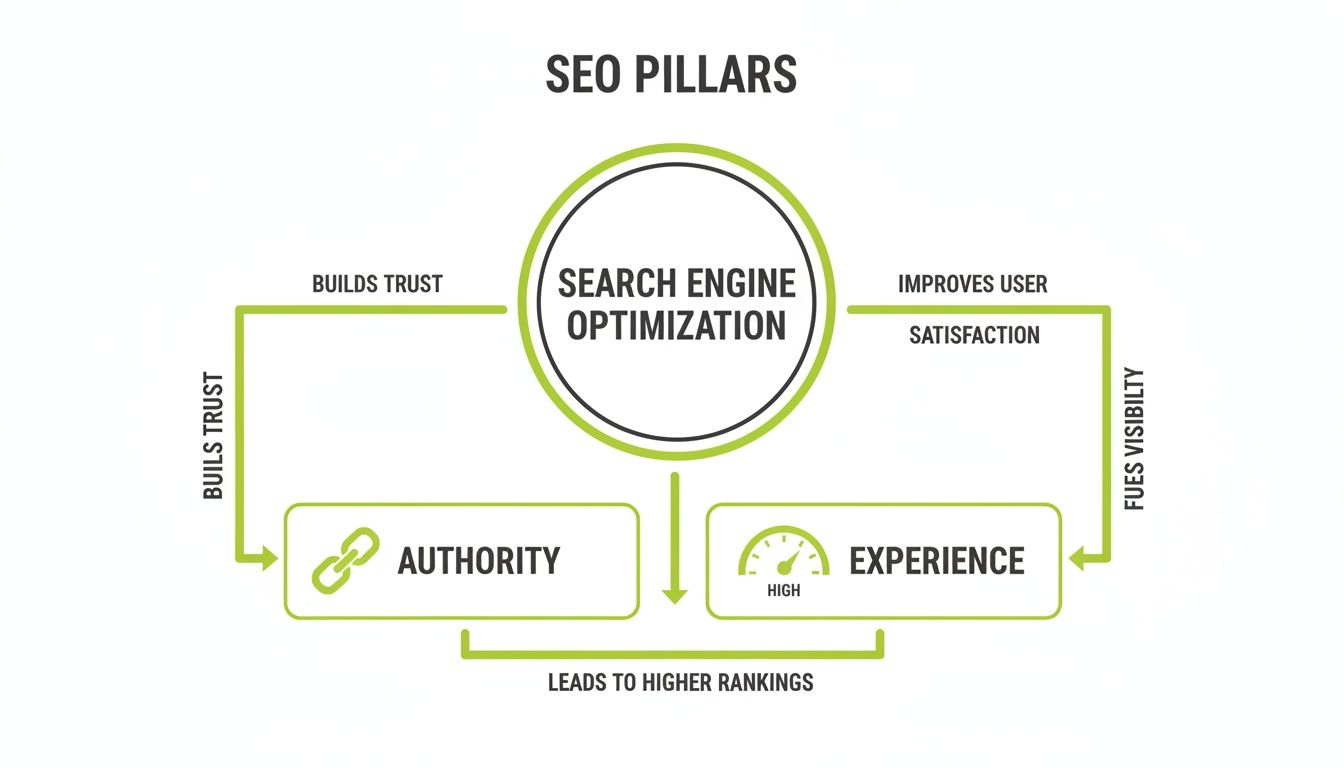
When you improve both of these, your rankings naturally follow.
The In-House Report for Leadership
Reporting to your own company’s leadership requires a slightly different angle. ROI is still king, of course, but executives are also thinking about market position and how your work fits into the bigger picture.
Your report should zoom out to show competitive wins and progress on major company goals.
- Share of Voice: How much of the search conversation do you own compared to your top three competitors? This metric shows if you're gaining or losing ground.
- Key Project Milestones: Give them a quick status update on major initiatives, like a recent site migration or a big content marketing campaign.
- Goal Alignment: Connect your SEO wins to broader company KPIs. For example, show how your keyword gains support the goal to "increase market share in the enterprise segment by 10%."
Executives are busy. Always start with a one-page executive summary that gives them the most important takeaways in less than a minute. You can see how to build these efficiently with platforms offering client-ready reporting workflows.
The Technical Report for Developers
Finally, when you're talking to your developers or IT team, it's time to get granular. They don't need the business context; they need a precise, actionable to-do list. Think of your report as a prioritized set of repair orders.
Focus squarely on site health and performance issues they can fix.
- Core Web Vitals Performance: Don't just say a page is slow. Pinpoint pages failing LCP, INP, or CLS tests and explain the specific user impact.
- Crawl Errors: Hand them a list of critical errors like 404s or server errors (5xx) that are actively hurting the site.
- Indexation Issues: Flag important pages that Google isn't indexing and suggest the specific technical fix needed to get them back on the map.
For this report, precision is everything. Give them URLs, screenshots, and even code snippets. The goal isn’t just to point out a problem—it's to give them everything they need to solve it.
The Future of SEO Reporting in an AI World

Search is changing right under our feet, and AI is the driving force. This isn't just a minor update; it's fundamentally altering what we need to measure in our SEO reports. For years, the goal was simple: climb the ladder of blue-link search results. But that’s not the whole story anymore.
The most significant change is how people get answers. With tools like Google’s AI Overviews and ChatGPT, a user can get a complete answer to their question without ever seeing a traditional search result, let alone clicking on your website. This is the new reality of search, and our reporting has to catch up.
The Rise of AI Visibility Tracking
In this new world, you could be ranking #1 organically and still be completely invisible to a huge number of users. This creates a dangerous "visibility gap" that older reporting tools were never built to see. If you aren't tracking whether your brand shows up in these AI-generated summaries, you're flying blind.
Modern SEO reports have to start answering questions that would have sounded like science fiction just a few years ago:
- Does our brand get mentioned as a solution in AI Overviews?
- Are we cited as a source when ChatGPT answers questions about our industry?
- How often are our competitors showing up in AI answers when we aren’t?
Getting a handle on this data is critical for growth. An appearance in an AI-generated answer is like a powerful, third-party endorsement. It builds brand trust and authority, even if it doesn't lead to a direct click. To dig deeper, check out our complete guide on the latest AI search trends.
The goal of a future-focused SEO report is no longer just to measure traffic from search, but to measure influence within search. It’s about tracking your brand’s presence wherever answers are being formed.
Keeping an eye on your performance here means your reports need to pull in data from these new AI-driven experiences. This is where modern tools come into play, including some of the best AI rank tracker tools that are specifically designed to see inside these new search formats.
Unifying Traditional Metrics with AI Insights
So, should you throw out your old reports? Absolutely not. Metrics like organic traffic, keyword rankings, and backlinks are still the bedrock of a healthy site. They signal authority and relevance to search engines.
The next generation of SEO reporting is all about unification. It’s about bringing your tried-and-true metrics together with new AI visibility data to tell a single, complete story.
Imagine a dashboard where your core keyword rankings are sitting right next to a chart tracking your brand's mentions in AI Overviews. This integrated view shows you the whole picture. You can finally connect the dots and see where your strong traditional SEO is paying off by influencing AI answers—and more importantly, pinpoint where it isn't.
This unified approach gives you the clarity to not only report on today's performance but also to build a strategy that’s ready for whatever comes next. You'll be able to adapt, optimize for new answer formats, and prove the full value of your work in a world where search never stops evolving.
Common Questions About SEO Reports
Once you start digging into SEO reporting, a few questions always seem to come up. Getting straight answers is key to connecting the dots between theory and what actually works in the real world. Let's tackle a few of the most common ones I hear.
How Often Should I Run an SEO Report?
For most businesses, a monthly report hits the sweet spot. It gives you enough data to see real trends taking shape and make smart decisions, all without getting lost in the tiny, day-to-day ups and downs that don't mean much. Think of it as the perfect rhythm for steady analysis and planning.
Of course, that's not a hard-and-fast rule. Sometimes you need to pick up the pace.
- Weekly Reports: These are your best friend during a big website launch, a site migration, or a major marketing campaign. When the stakes are high, you need to keep a close eye on performance.
- Daily Dashboards: Many teams I've worked with use live dashboards just to get a quick pulse check on core metrics. It's great for spotting immediate fires, but they still rely on that deeper monthly report for strategy and talking to leadership.
What Is the Difference Between an SEO Report and an Audit?
This one trips a lot of people up, but the difference is actually pretty simple. I like to use a health analogy:
An SEO audit is like a complete, one-time physical exam. The doctor checks everything to find any underlying problems and creates a long-term health plan. An SEO report, on the other hand, is your regular check-up to monitor your progress—like tracking blood pressure to see if the plan is actually working.
An audit is a big, front-loaded project to diagnose every existing issue, from hidden technical errors to gaps in your content. It results in a master to-do list. The report is the recurring check-in that shows how you’re progressing against that master plan by tracking key metrics over time.
Which Tools Are Best for Creating SEO Reports?
There’s no single "best" tool that does it all. A truly great report pulls data from a few different places to paint the full picture. A few platforms, though, are pretty much essential.
- The Essentials (Free): You absolutely have to start with Google Search Console and Google Analytics 4. They give you the foundational data on your site's traffic, user behavior, and performance—straight from Google itself.
- The Professional Toolkit: To get a real edge with competitor insights, backlink analysis, and richer keyword data, you’ll need a comprehensive platform. Pros almost always turn to tools like Semrush or Ahrefs.
- The Modern Necessity: The new frontier is tracking how visible you are in AI-generated search results. As of 2026, you simply can't get a complete performance picture without specialized tools that measure your presence in this critical, growing space.
Ready to build reports that tell the whole story—from traditional rankings to AI visibility? Surnex unifies all your SEO and AI search data into one clear platform. See how Surnex can transform your reporting.