So, what exactly is LLM brand visibility?
Put simply, it’s about how often—and how accurately—your brand shows up in the answers generated by Large Language Models like ChatGPT or Google’s AI Overviews. It’s no longer just about ranking; it's about becoming a trusted, go-to source that the AI itself relies on when someone asks for help. When the AI speaks, you want your brand to be part of that conversation.
The New Rules of Discovery in AI Search
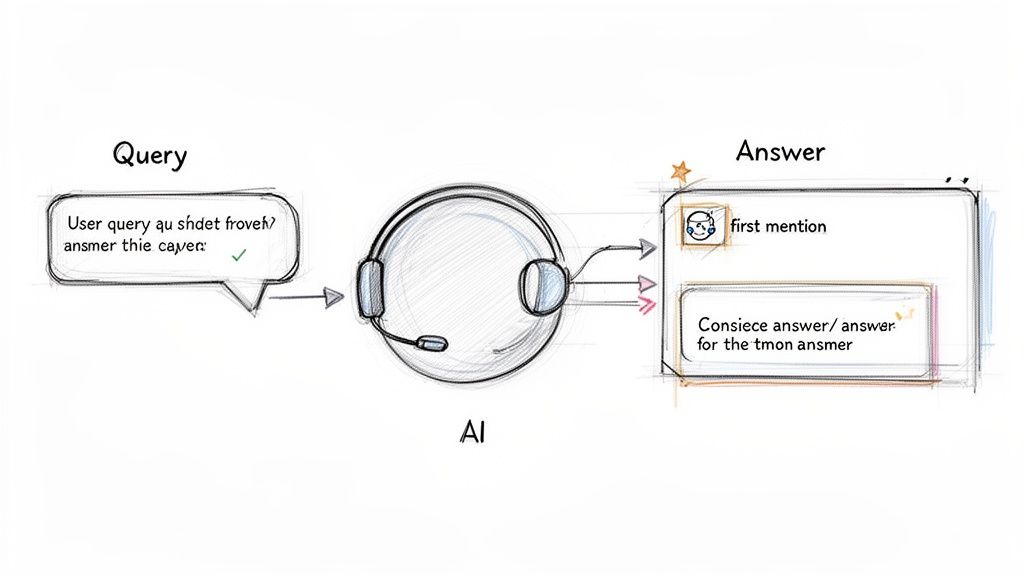
Think of the new search landscape like this: instead of a list of links, the user is having a conversation with an expert—the AI. In this new world, if that expert doesn't mention you, you’re invisible. It’s a fundamental change in how people discover brands and information. Success isn't just about showing up on a results page anymore; it’s about being a citable source in the AI's answer.
We're already seeing user journeys shift away from scanning blue links toward consuming direct, AI-generated summaries. This change gives the first-mention advantage incredible power, especially for capturing users who are ready to make a decision. Being the "expert in the room" in the AI's mind is the new frontier.
A New Paradigm for Visibility
This shift completely redefines what it means to be "visible" online. We've moved beyond keyword density and into an era of informational authority and verifiability. AI models pull from countless sources to craft their responses, so your presence on authoritative third-party sites, forums, and even your own structured data all feed into the machine. To really get a handle on this, you need to understand the core concept of Answer Engine Optimization (AEO).
The challenge is straightforward: if you aren't part of the AI's generated answer, you simply don't exist for a growing number of users. LLM brand visibility is your ticket to being heard.
Recognizing this change is the first step in future-proofing your digital strategy. The table below breaks down the key differences between the old rules and the new ones. For a deeper dive into how these changes are playing out, check out our guide on the latest https://surnex.io/ai-search/ai-trends.
Traditional SEO vs LLM Brand Visibility
As we move from a search-based model to an answer-based one, the metrics and tactics we use have to evolve. This table gives a clear, high-level look at just how different this new world is.
| Metric | Traditional SEO | LLM Brand Visibility |
|---|---|---|
| Primary Goal | Rank on a search engine results page (SERP) to earn clicks. | Get cited or mentioned directly in AI-generated answers. |
| Key Tactic | Keyword optimization, backlink building, and technical SEO. | Structured data, entity optimization, and verifiable content. |
| Measurement | Rank position, click-through rate (CTR), organic traffic. | Share of Voice (SoV) in AI, citation frequency, brand sentiment. |
| User Interaction | User browses a list of links to find an answer. | User receives a direct, synthesized answer from the AI. |
The takeaway is clear: while the fundamentals of creating great content remain, the way we measure success and optimize for visibility has fundamentally changed. The focus is now on direct influence within AI-generated responses, not just earning a click from a list of links.
Why LLM Visibility Is Your New Competitive Edge
It’s easy to look at your analytics dashboard, see a tiny percentage of traffic coming from AI, and just dismiss it. But that would be a huge mistake. We're witnessing the biggest shift in how people find information in more than a decade.
The people using AI to get answers aren’t just browsing. They are high-intent users, often at the very end of their buying journey, looking for one last piece of validation before they pull the trigger.
Ignoring LLM brand visibility today is like telling the phone company not to list your business in the Yellow Pages back in the day. It’s willingly making yourself invisible on the new digital main street. While the traffic numbers might look small now, the value of each visit is off the charts. Getting mentioned in an AI answer puts your brand in the spotlight at the most critical moment of a customer's decision.
The Market Is Consolidating, Fast
The world of AI-powered discovery is quickly boiling down to a handful of major players. You don't have to look far to see where things are headed.
A recent, eye-opening study showed that while AI traffic is just 0.13% of total sessions right now, it punches way above its weight, driving users to high-intent pages where buying decisions are made. The same report found that ChatGPT is absolutely dominant, owning a massive 84.2% of all AI discovery sessions.
At the same time, Google AI Overviews are becoming a major force, with their appearance rate in search results jumping by 102%, from 6.49% to 13.14%. If you want to see just how quickly this space is evolving, you can dig into the full 2025 State of AI Discovery Report from Previsible.
The numbers don't lie. This isn't some "wait and see" situation. Making sure you show up on platforms like ChatGPT and in Google's AI answers is no longer a future-looking strategy—it's essential for staying relevant right now.
The bottom line is that AI is the new front door to your brand. If the big models aren't talking about you, a growing group of your most valuable customers won't even know you exist.
And don't think for a second that this is about luck. Showing up in these AI summaries is the direct result of smart, intentional work. These models aren't just picking brands out of a hat; they are programmatically piecing together answers based on signals of trust, authority, and credibility they find all over the web.
Your New Competitive Mandate
Think about it like this: for years, everyone poured money into SEO to land on the first page of Google. Now, the "first page" is often a single, definitive answer at the very top. The game has been reset.
The brands that figure this out first will build a lead that’s incredibly difficult for others to overcome. So, what are these AI models looking for?
- Authoritative Content: They need to see that your website is a source of clear, factual, expert-driven information that is easy to understand and verify.
- Structured Data: Using schema markup is like giving the AI a cheat sheet. It helps the model instantly grasp what your products are, who they're for, and what problems they solve.
- Third-Party Validation: This is huge. Mentions on respected industry sites, glowing reviews on platforms like G2, and even organic discussions on forums like Reddit all act as powerful votes of confidence.
By focusing on these signals, you're not just feeding a machine. You're building a fundamentally stronger, more trusted brand. You’re actively shaping the AI’s "opinion" of your market and positioning your company as the go-to answer. This is how you secure your spot in the next era of discovery.
How to Measure Your Brand's Share of Voice in AI
So, you understand why you need to show up in AI answers. Great. But how do you actually measure it? This is where things get tricky.
Your old SEO playbook—tracking rankings and click-through rates—just doesn't apply here. AI-generated answers are fluid, conversational, and don't fit neatly into a top-ten list. To get a real grip on your performance, you need a completely new way of measuring success.
Think of it less like checking your business's spot in the Yellow Pages and more like listening in on conversations about your brand at a coffee shop. Are people talking about you? What are they saying? Are they recommending you? That’s the kind of insight we need, and it requires a different set of metrics.
The Core Metrics for LLM Visibility
The first step is to stop obsessing over simple keyword positions and start thinking more holistically. The real goal is to figure out how often—and how well—your brand is featured when a potential customer asks a relevant question.
This boils down to a few key performance indicators for LLM brand visibility:
- Share of Voice (SoV): This is the big one. For a given set of prompts, what percentage of AI answers mention your brand versus your competitors? A high SoV means you’re the go-to source in your niche.
- Citation Frequency: A simpler count. How many times is your brand cited as a source across different AI platforms like ChatGPT and Google AI Overviews? This gives you a baseline for your overall presence.
- Citation Quality: Not all mentions are created equal. This metric looks at the context of the citation. Is the AI painting your brand in a positive light? Is the information accurate? Does it match your core messaging?
Tracking these three metrics gives you a clear, actionable picture. For example, a high citation frequency but low quality is a major red flag—it tells you the AI models know you exist but misunderstand what you do.
Navigating Volatility with Citation Drift
Here's one of the biggest headaches with tracking AI visibility: it’s constantly changing. Unlike traditional search rankings, which are fairly stable, AI-generated answers are incredibly volatile. An answer that features your brand today might recommend a competitor tomorrow.
This phenomenon is called citation drift. And it’s not a small shift. One recent study found that the monthly citation drift can be a staggering 54.1% in ChatGPT and 59.3% in Google AI Overviews. That means more than half the brands cited one month could be gone the next. Your hard-won visibility can vanish if you’re not paying attention.
AI responses are not static rankings; they are a statistical lottery. Measuring visibility requires tracking your appearance rate across hundreds of queries over time to get a true sense of your prominence.
This is why getting a high LLM brand visibility is such a powerful advantage. It helps you consistently connect with high-intent users, establish your market leadership, and solidify your brand's authority.
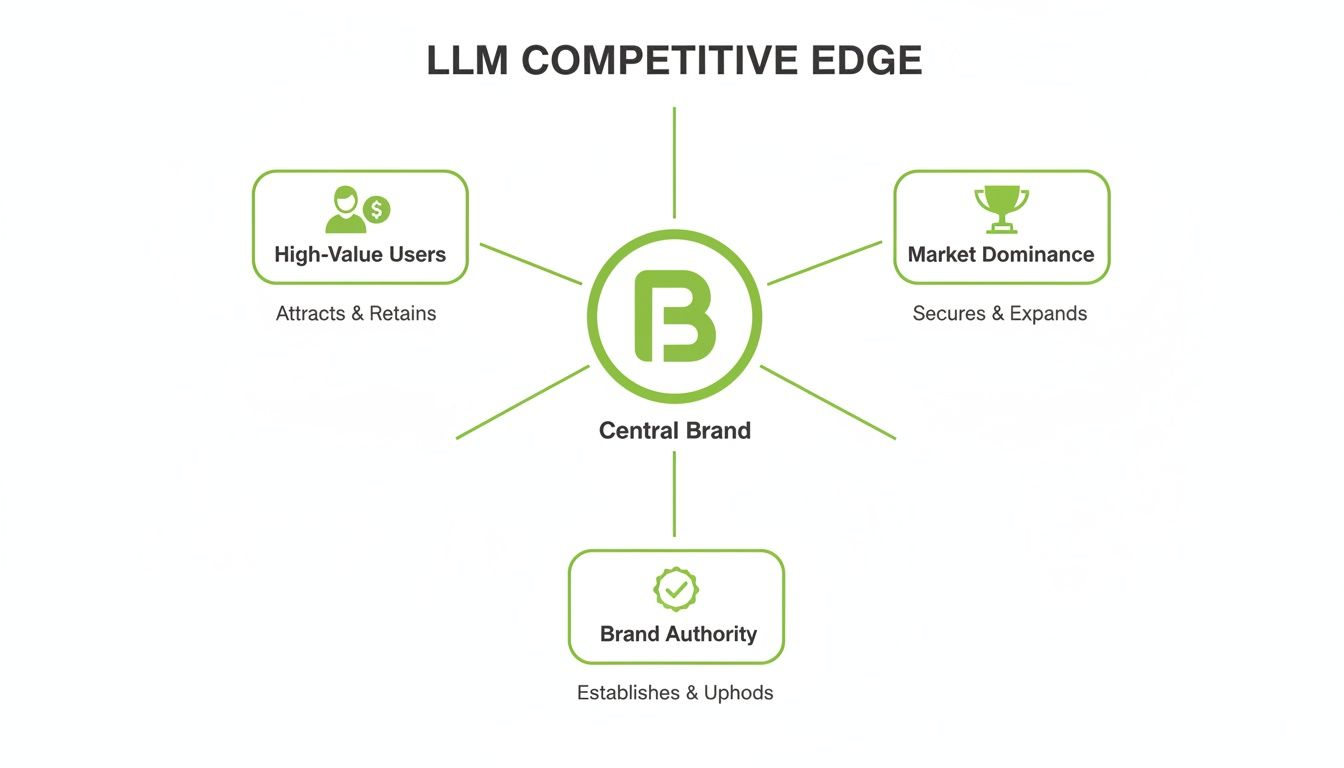
As you can see, becoming a trusted source for AI models is a direct path to capturing the most valuable customers and cementing your place at the top.
Leading Indicators and Latent Risks
So, how do you stay ahead of these constant changes? Interestingly, research from the 2025 AI Visibility Report by The Digital Bloom found that the best predictor of LLM citations wasn't backlinks, but brand search volume. The more people are actively searching for your brand by name, the more likely AI models are to talk about you.
The same report also found that brands present on four or more platforms were 2.8 times more likely to be included in AI answers. Learn more about the latest AI citation findings.
But with this opportunity comes a serious risk: AI hallucinations. These are instances where an LLM just makes things up, generating false or misleading information about your brand. This can be incredibly damaging to your reputation, turning your measurement efforts into a critical brand safety exercise.
This is why it's so important to have a solid measurement framework. You need to know where you stand, what competitors are doing, and how to spot and fix inaccuracies. By continuously monitoring your presence, you can benchmark LLM performance and identify these risks, proving the real-world value of your optimization work.
How to Actually Improve Your LLM Brand Visibility
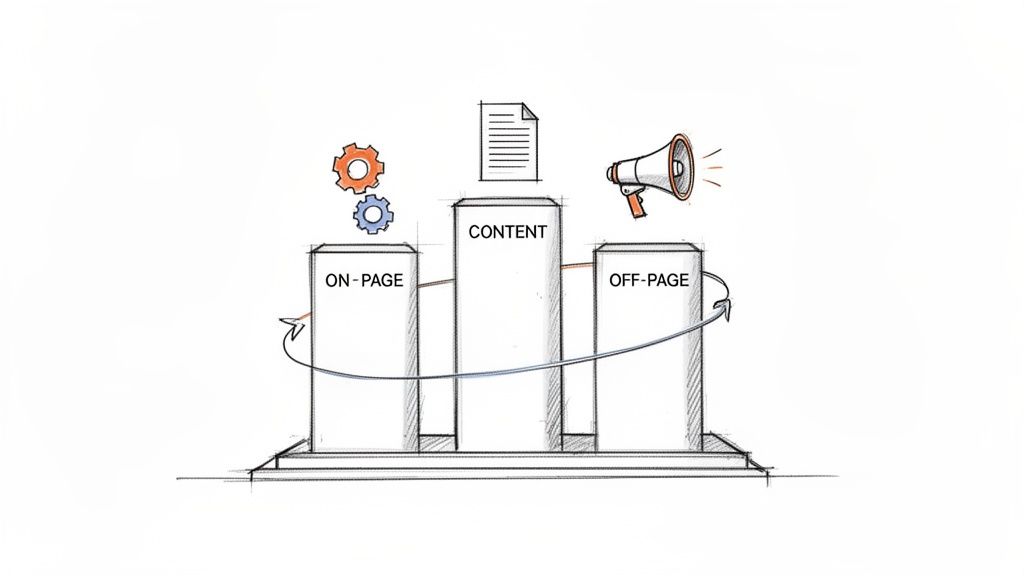
Alright, so you know how to measure your LLM brand visibility. That's a huge first step. But how do you actually move the needle? It’s not about trying to trick an algorithm; it's about making your brand so clear, authoritative, and trustworthy that AI models have to talk about you.
The best way to do this is to get back to basics, but with an AI-first twist. We’re going to focus on three areas: sharpening your site’s technical signals, creating content that answers AI-driven questions, and building your reputation across the web. Get these right, and you'll give LLMs all the proof they need to feature you.
Start with a Strong On-Page and Technical Foundation
Before you even think about creating new content, you have to make sure the AI bots can make sense of what you already have. Their job is to gather and understand information, so making their job easier is your fastest path to getting noticed.
The place to start is with structured data, also called Schema markup. Think of it like putting clear, easy-to-read labels on all the important information on your website. It explicitly tells an AI what something is—this is a product, that’s our company, and here’s a customer review—which removes all the guesswork.
Seriously, implementing structured data is one of the most effective things you can do for a quick win. It feeds AI models clear, unambiguous facts they can immediately understand and use.
Next up is entity optimization. This is all about clearly defining who you are and what you do, consistently, across your entire website. Your "About Us" page, your author bios, and your company descriptions should all be detailed and aligned. This helps the AI connect the dots and build an accurate picture of your brand.
Imagine your website is a library. Structured data labels every book with its genre, author, and topic. Entity optimization makes sure the main card catalog entry for your brand is complete and correct. It makes you incredibly easy for an AI to find and recommend.
Create Content That’s Optimized for Prompts
Your content strategy needs a refresh for the age of AI. While expertise and quality are still king, you now have to think in terms of prompts, not just keywords. You need to create content that directly answers the kinds of complex questions people are asking their AI assistants.
Stop writing articles that just target a single term. Instead, build comprehensive guides and data-packed analyses that walk a user through a problem from start to finish. For example, instead of an article on "best accounting software," a much better piece would be "How to Choose the Best Accounting Software for a Small Retail Business."
To get an AI to trust your content, it has to be rock-solid and verifiable.
- Use Verifiable Stats: Back up every claim with a number, and always link back to the original source. This proves you’ve done your homework.
- Include Expert Quotes: Weave in insights from well-known leaders in your field. This shows the AI that your content is authoritative and respected.
- Keep It Accurate: Make a habit of auditing and updating your content. Outdated or incorrect information is a massive red flag for LLMs.
This strategy turns your website into a reliable source that AI models feel confident citing. And don't forget that creating helpful resources can be part of this. For instance, an AI caption generator can help you create better social content faster, which in turn boosts your brand’s voice online.
Build Authority with Off-Page Signals
What other people say about you online has never been more important. AI models lean heavily on what third parties say to figure out if a brand is credible and authoritative. Your reputation on other websites directly impacts your LLM brand visibility.
Start by building a solid presence on high-authority platforms that LLMs use as training data. This includes places like:
- Third-Party Review Sites: Get your happy customers to leave detailed reviews on G2, Capterra, Trustpilot, and other industry-specific sites.
- Industry Forums and Communities: Be an active, helpful voice in discussions on Reddit, Quora, and other niche communities. Establish yourself as an expert.
- Digital PR: Earn mentions and links from respected publications in your space. Every mention is another vote of confidence in your favor.
Don’t just take our word for it. Recent data from Erlin.ai's 2026 report on LLM visibility found that brands appearing on five or more trusted third-party sites are highly likely to be cited in AI answers. The report also gives some real-world timelines: you can see 28-34% gains in coverage within just 14-21 days from structured data alone, while building out your full third-party presence typically takes 60-90 days.
Building this kind of off-page authority is a marathon, not a sprint, but it's a critical investment. By creating a broad, positive footprint across the web, you're not just getting seen in ChatGPT—you're building a brand that's more resilient and reputable for the long haul. If you want to dive deeper into this, check out our guide on how to track and improve your ChatGPT visibility.
Building Your Modern Monitoring Workflow
Knowing which LLM brand visibility metrics to track is one thing. Actually tracking them is a whole different beast. If you're running a busy agency or are part of an in-house team, the thought of manually typing hundreds of prompts into different AI models and logging the results in a spreadsheet is enough to give you a headache. It's just not practical.
The old ways of doing things—jumping between different tools and running a few spot-checks here and there—simply won't cut it anymore. You'll be chasing ghosts. To get a real handle on this, you need a workflow that brings all this new data into one coherent picture.
It all comes down to a simple idea: stop juggling and start integrating. Instead of having one tool for rank tracking, another for backlinks, and now a third for monitoring AI, you need a single source of truth. The goal is to see your AI visibility right alongside the core SEO metrics you already live and breathe.
Consolidating Your Tech Stack
The first, most practical step is to simplify your toolset. Relying on a patchwork of different platforms creates data silos, wastes hours of your team's time, and leads to messy, inconsistent reports. A unified platform makes LLM brand visibility a core part of your strategy, not some forgotten add-on.
Imagine this: you log in and see your brand's performance in Google's AI Overviews right next to your keyword rankings. You could benchmark your share of voice in ChatGPT against your rivals without ever leaving the dashboard you use for content audits.
This is exactly why we built Surnex. It’s designed to bring these two worlds together, giving you a clear, unified view of your entire search performance.
A Workflow for the AI Era
Once you have the right platform, you can build a workflow that’s both repeatable and scalable. This is how you shift from just reacting to AI-driven changes to proactively shaping your strategy.
So, what does that look like day-to-day?
-
Set Up Automated Tracking: First, you connect your properties to automatically monitor every brand mention, citation, and sentiment shift across major AI models like ChatGPT and Google's AI Overviews. This replaces tedious manual checks with reliable, 24/7 data.
-
Benchmark Against the Competition: Next, pick your top 3-5 competitors and track your LLM Share of Voice against theirs. This gives you the critical context to know if you're winning the conversation or falling behind.
-
Find Your Citation Gaps: Use the platform to pinpoint where competitors are getting cited but you aren't. These gaps are golden opportunities. They show you exactly where to focus your efforts, whether that’s creating new content or updating what you already have.
-
Automate Your Reporting: Finally, set up clear, automated reports that show your progress. A good report visualizes key metrics like citation frequency and Share of Voice, making it dead simple to show clients or executives the return on your efforts.
Visualizing Your AI Visibility
A huge part of a successful workflow is being able to see what's happening at a glance. A dashboard that pulls your AI and traditional SEO metrics together lets you spot trends and opportunities without getting lost in spreadsheets.
This screenshot from the Surnex platform shows exactly what that unified view looks like, tracking AI share of voice next to other key performance indicators.
With a view like this, you can immediately see which brands are dominating the AI space, helping you react quickly to both threats and opportunities.
By putting a structured workflow in place, you turn the complex new world of LLM brand visibility into a manageable, measurable part of your marketing operations. If you're ready to get started, our guide on conducting an AI visibility audit offers a complete, step-by-step framework. It’s the key to scaling your efforts, proving your impact, and staying ahead of the curve.
Your LLM Brand Visibility Action Plan
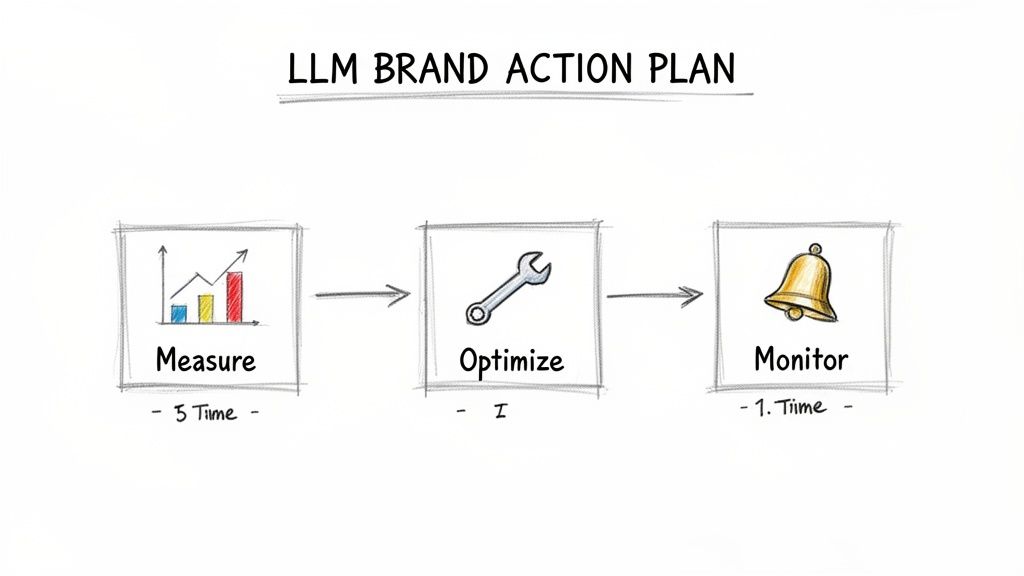
Alright, we've covered the what and the why. Now, let's get down to the how. Turning this knowledge into real results is what matters, and it all comes down to a clear, repeatable process.
Think of it as a simple, three-part cycle: Measure, Optimize, and Monitor. This isn't a one-and-done task, but a continuous loop that will help you build and defend your brand's presence in the new world of AI search.
Measure Your Starting Position
You can't know if you're winning if you don't know the score. Before you touch a single page on your site, you need a clear picture of where you stand right now. This initial measurement is your baseline, the benchmark against which you'll track all your progress.
Your first goal is simple: find out how often AI models are actually talking about your brand.
- Benchmark Your AI Share of Voice: Use a platform like Surnex to see how often your brand gets cited in Google AI Overviews and ChatGPT for 10-15 of your most important commercial prompts. Then, run the same search for your top three competitors. This gives you a clear view of the current landscape.
- Identify Your Main Competitors: Pay close attention to who shows up when you don't. These are the brands that LLMs currently view as the authorities in your niche.
Optimize Your Digital Assets
Once you have your data, it's time to get to work. The optimization phase is all about making your brand the most obvious, trustworthy choice for an AI to recommend. You want to send unambiguous signals about who you are and why you're the expert.
Start with the quick wins—the tasks that give you the biggest bang for your buck.
The key here is clarity and verifiability. Make it incredibly easy for an AI to understand your value and trust your information. That’s the most direct path to better LLM visibility.
- Implement Schema Markup: This is non-negotiable. Add
Product,Organization, andReviewschema to your key pages. It's like handing the AI a cheat sheet about your business, written in its native language. - Update Authoritative Content: Go back to your best-performing articles and guides. Update them with fresh, verifiable stats and new quotes from experts. Every claim you make should be easily fact-checked.
- Strengthen Third-Party Profiles: AI models don't just trust what you say about yourself. They heavily weigh third-party sources. Audit and polish your company profiles on essential platforms like G2, Capterra, and even Wikipedia.
Monitor and Refine Your Strategy
Finally, you need to understand that this is a moving target. Your competitors are going to react, and the AI models themselves are updated constantly. If you're not monitoring your position, you could lose ground without even realizing it.
The goal is to set up a system that keeps you in the loop automatically. No more manual spot-checking.
- Set Up Automated Alerts: Use your tools to create notifications that fire when something important changes. You'll want to know immediately about any significant drops in your mentions (citation drift) or when a competitor's Share of Voice suddenly spikes.
- Schedule Regular Reviews: Block off time each month to sit down with your LLM brand visibility dashboard. Look at the trends, see what's working (and what's not), and adjust your strategy for the month ahead.
Got Questions? We've Got Answers.
Let's tackle some of the most common questions marketers have about this new world of AI-driven search. Here are the clear, straight-up answers to help you make sense of it all.
What’s the Real Difference Between SEO and LLM Optimization?
Think of it this way: traditional SEO is about climbing a ladder. You're trying to get your website to the top of a search results list so people will click on your link. It’s a game of ranking for visibility.
LLM optimization is entirely different. The goal isn't to get a click; it's to become the answer. You want AI models like ChatGPT or Google's AI Overviews to cite your brand, mention your products, or use your data directly in their generated responses. You're aiming to be the trusted source the AI relies on.
While both still need great content and a solid reputation, optimizing for LLMs puts a much heavier emphasis on structured data, verifiable facts, and your authority on third-party sites that these models use for training.
How Can I Actually Track My Brand’s Visibility in ChatGPT?
You can't do it by hand, that's for sure. Popping into ChatGPT and asking a few questions is not a strategy. We've seen from recent research that AI responses are all over the place; you can ask the same question twice and get two totally different answers. Relying on spot-checks is just going to mislead you.
AI responses are not static rankings; they are a statistical lottery. To really know if you're visible, you have to track how often you appear across hundreds of queries over time.
This is exactly why you need a specialized tool. Platforms like Surnex were built for this. They systematically query LLMs with thousands of relevant prompts, tracking exactly when and how your brand shows up. This gives you the consistent data you need to benchmark against competitors, analyze sentiment, and build a real strategy.
What Tactic Will Give Me the Fastest Results for LLM Visibility?
If you're looking for the quickest win, start with structured data (like Schema markup). Based on what we're seeing, adding it to your website can produce noticeable improvements in as little as 14-21 days.
Why so fast? Because you're essentially spoon-feeding the AI. Structured data formats your information in a way that machines can instantly understand and trust, removing all the guesswork.
Of course, a big-picture content and digital PR strategy is crucial for long-term dominance and building true LLM brand visibility. But for a fast, measurable impact right out of the gate, structured data is the best place to put your efforts first.
Ready to stop guessing and start measuring your brand's presence in AI search? Surnex provides the unified platform you need to track your AI Share of Voice, benchmark against competitors, and build a winning strategy. See where you stand today at https://surnex.io.