
Most advice about a yahoo ranking check is either outdated or too simplistic. One side says Yahoo is dead, so ignore it. The other side treats Yahoo like just another checkbox in a rank tracker. Both approaches waste time.
The practical answer in 2026 is narrower. Track Yahoo when it maps to a real market, a real client need, or a real reporting gap. Ignore it when it doesn't. And if you do track it, use a workflow that scales across organic search, local search, and the newer AI-shaped discovery layer instead of bolting one more legacy task onto an already crowded SEO stack.
Why Bother with a Yahoo Ranking Check in 2026
The common assumption is that Yahoo no longer deserves any attention. That’s too blunt.
BrightLocal made a defining industry call when it announced on February 5, 2020 that it would stop tracking Yahoo rankings, citing Yahoo’s “depleted importance to the point of insignificance” in its reporting workflow, as explained in BrightLocal’s announcement about streamlining reports. That decision was rational. It also clarified something important. Yahoo tracking should be strategic, not automatic.

A senior team shouldn’t ask, “Is Yahoo relevant?” The better question is, “Where does Yahoo still influence visibility enough to justify measurement?” That changes the workflow completely.
When Yahoo is worth tracking
A yahoo ranking check still makes sense in a few situations:
- Regional dependence: Some markets still have meaningful Yahoo usage, especially where Yahoo operates differently from the U.S. default assumptions.
- Client reporting requirements: Enterprise clients sometimes ask for coverage beyond Google, even when Yahoo is secondary.
- Local search blind spots: Teams often monitor Google local results closely and leave Yahoo local visibility unmeasured.
- Search intelligence completeness: Agencies that benchmark multiple engines may need Yahoo data to explain why traffic or branded visibility differs by market.
Practical rule: If Yahoo data won’t change decisions, don’t track it.
That sounds obvious, but many teams still inherit bloated reporting templates built for a different era. They keep collecting low-value rank data because it has always been there. In modern SEO, especially with AI search products changing how users discover brands, the discipline is deciding what not to track.
What this means for SEO teams now
Yahoo belongs in a selective monitoring model. Track it for specific countries, specific client categories, and specific SERP surfaces. Don’t build your whole reporting system around it. Don’t pretend it deserves the same operational weight as Google.
That selective mindset is what makes a yahoo ranking check useful in 2026 instead of purely nostalgic.
Conducting a Manual Yahoo Ranking Check
Manual checking still has value, but only in narrow cases. It’s good for spot validation, troubleshooting a sudden change, or checking one keyword before you invest time in automation. It’s bad for recurring reporting.
A clean manual process reduces noise, but it doesn’t eliminate it.
A practical manual process
Use a repeatable routine:
- Open a private browsing session. Incognito or private mode helps reduce carryover from prior searches.
- Clear cookies and local session signals if needed. That won’t remove all personalization, but it helps.
- Set your location intentionally. If the query matters in a specific city or country, use a VPN or location-matched environment.
- Choose device context before searching. Desktop and mobile Yahoo results can differ, so decide which one you’re validating.
- Search the exact keyword without extra modifiers. Keep your test query clean unless the user query includes location terms.
- Record the page, position range, and visible SERP features. Don’t just note rank. Note whether the result appears alongside local packs, quick answers, or other crowded elements.
Manual checks become more useful when paired with keyword selection discipline. If the keyword set itself is sloppy, the rank check won’t tell you much. A structured workflow starts upstream with keyword research workflows built for search intent and prioritization.
What manual checks do well
Manual checking is useful for:
- Spot audits: Confirming whether a result is really present.
- SERP inspection: Seeing the page layout instead of only a numeric rank.
- Client screenshots: Capturing evidence for a one-off discussion.
- Debugging: Comparing how a page appears by device or region.
A manual check is for verification, not for measurement at scale.
Where manual checking breaks down
The weaknesses show up fast:
- Personalization still leaks in: Private mode helps, but it isn’t a full lab environment.
- Location simulation is imperfect: A VPN can approximate geography, but not every ranking signal.
- SERPs shift constantly: You may validate a position that changes later the same day.
- No history exists unless you document it manually: That makes trend analysis slow and messy.
- Team consistency is poor: Two people often search slightly differently and produce different conclusions.
For one or two queries, that’s tolerable. For agencies managing multiple clients, it becomes a reporting liability. The biggest mistake is turning a manual yahoo ranking check into a weekly ritual. At that point, you’re spending human time on a task software handles better and more consistently.
Choosing Your Yahoo Rank Tracking Approach
A good tracking setup isn’t about finding the most features. It’s about matching the method to the actual job. The right choice for a solo marketer validating a small keyword set isn’t the right choice for an agency handling multiple markets and dozens of reporting cycles.
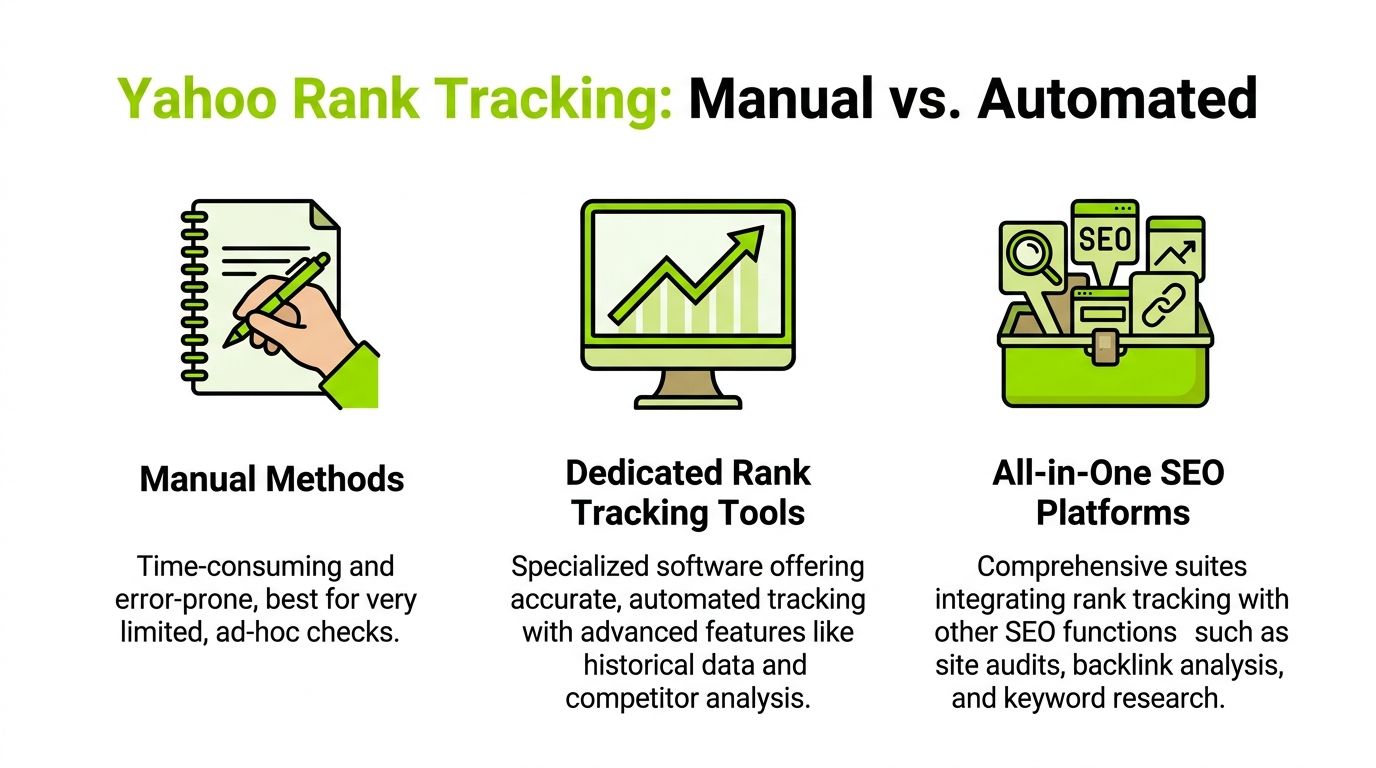
Professional rank trackers work because they automate a job that humans do poorly. They issue requests to Yahoo endpoints, use rotating proxies, collect up to 200 results, and aggregate rankings daily. That process delivers over 90% accuracy in position reporting, and the same research notes that older domains can rank 2.5x higher while exact keyword matches in titles can produce a 35% better lift than semantic variants alone on Yahoo, based on the KDD paper on large-scale ranking analysis and tracking methodology.
Method comparison
| Method | Best For | Scalability | Cost | Accuracy |
|---|---|---|---|---|
| Manual methods | Ad hoc checks and debugging | Low | Low direct cost, high labor cost | Inconsistent |
| Dedicated rank tracking tools | Agencies and SEO teams that need recurring Yahoo data | High | Moderate | High |
| All-in-one SEO platforms | Teams that want ranking data tied to broader workflows | High | Moderate to high | High |
Manual methods
Manual checking is still the cheapest way to confirm a single result. It’s useful when a client says, “I can’t find us for this term,” and you need to inspect the SERP yourself.
Its weakness is operational, not conceptual. It doesn’t scale, it creates inconsistent documentation, and it gives you snapshots instead of a dependable history.
Dedicated rank tracking tools
Dedicated tools are usually the right choice when Yahoo tracking is a standing requirement. They handle the repetitive work, preserve historical trends, and let teams compare movement over time instead of debating one screenshot.
This approach is strongest when:
- You manage multiple clients
- You need daily or scheduled updates
- You care about competitors in the same view
- You want rank change alerts instead of manual checking
A strong implementation usually includes a clear rank tracking layer connected to the rest of your reporting stack, such as a centralized rank tracking system that can sit beside audits and visibility analysis.
All-in-one SEO platforms
All-in-one platforms make sense when Yahoo isn’t the main event but still belongs in the wider picture. That’s often the best fit for in-house teams and full-service agencies. They want one environment for rankings, site issues, backlinks, and content planning rather than another silo.
The advantage is workflow cohesion. When rankings move, the team can quickly inspect page health, internal competition, or content gaps without exporting data into another system.
The trade-off is specialization. If Yahoo rank tracking is highly specific, such as a market-by-market reporting requirement with unusual local nuances, a dedicated tool or custom setup may still fit better.
Direct SERP APIs and custom builds
Some teams should skip dashboards and go straight to infrastructure. That’s usually developers, data engineers, or product teams embedding search visibility into internal systems.
A custom approach works when you need:
- Data in your own warehouse
- Custom alerting logic
- Integration with BI tools
- Search intelligence embedded inside another product
This route offers control, but it also creates maintenance work. Proxies, parsing, retries, normalization, and QA all become your responsibility. If the business doesn’t need that level of control, a managed tool is often the better trade.
The best yahoo ranking check system is the one your team will maintain consistently. Elegant complexity still fails if nobody trusts the output.
Advanced Tracking for Geolocation and SERP Features
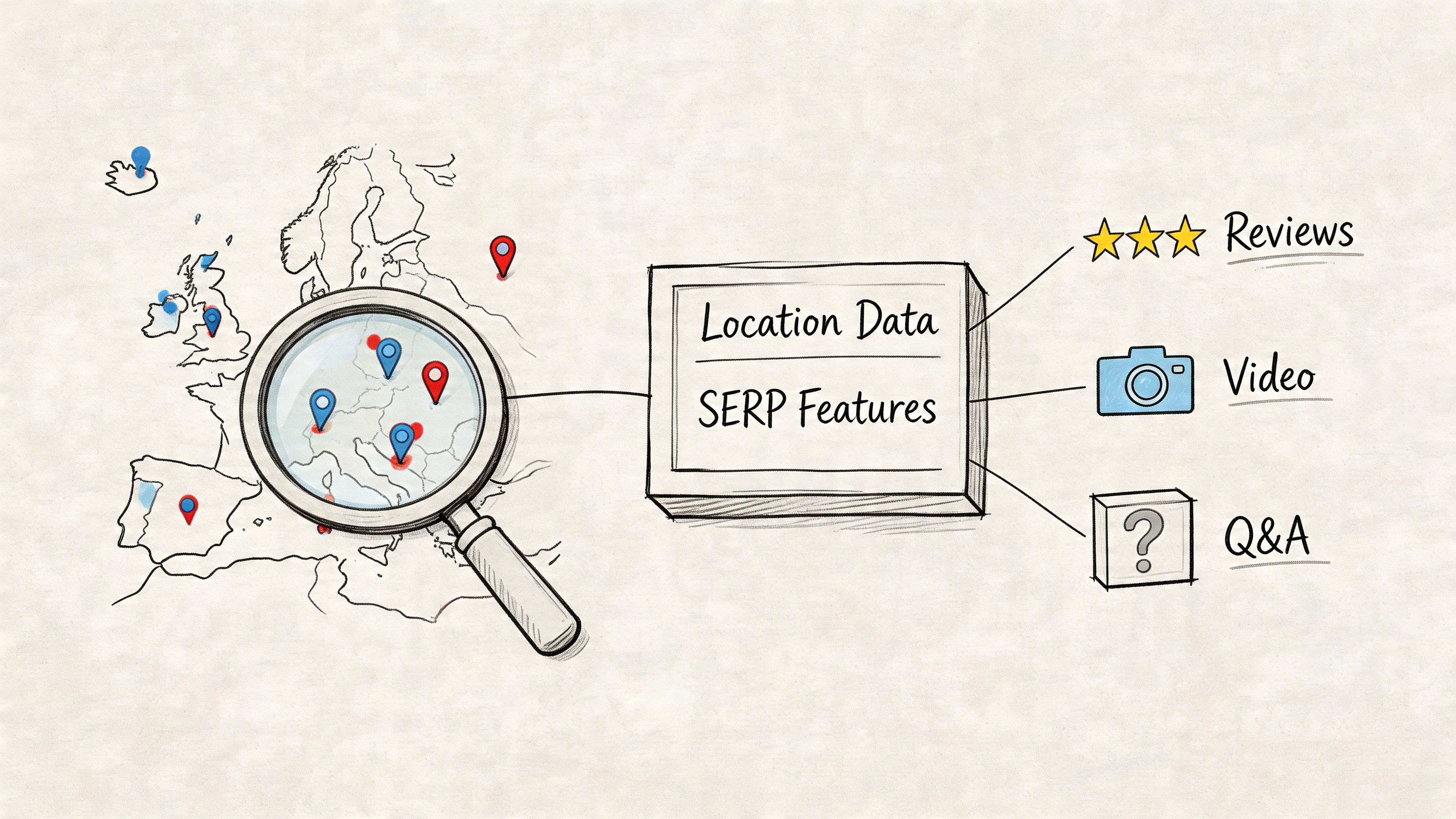
A rank number without context is only half useful. Yahoo results vary by country, by device, and by SERP layout. If you ignore those layers, your data looks tidy but leads to weak decisions.
Track by market, not by assumption
The first question in advanced Yahoo tracking is geographic. A U.S. ranking check is not a stand-in for another country, and it definitely isn’t a stand-in for Yahoo Japan behavior.
That means your setup should define:
- Target country
- Target language
- Local versus national intent
- Market-specific domains or search environments
Many teams often make an error. They run a default U.S. check and assume it represents Yahoo performance globally. It doesn’t.
Split desktop and mobile on purpose
Device segmentation matters on Yahoo. If you collapse mobile and desktop into one reporting line, you hide meaningful differences in how pages appear.
Use separate tracking when:
- The client gets meaningful mobile traffic
- Local intent is involved
- The SERP includes maps, answer modules, or dense feature blocks
- The page template behaves differently by device
A practical reporting setup usually starts with desktop for baseline validation, then adds mobile where rankings affect conversion paths or local discovery.
Don’t ignore the Yahoo Local Pack
This is the most overlooked part of a yahoo ranking check. Existing coverage often focuses on standard organic positions and skips local pack verification entirely. That creates a blind spot for agencies with multi-location clients.
According to Link Assistant’s overview of Yahoo rank checking and local tracking gaps, 78% of agencies track Google local rankings while only 12% track Yahoo, even though Yahoo’s Local Pack can deliver a 28% higher CTR for top spots because of lower competition.
That gap matters because local visibility isn’t only about ranking a website page. It’s also about whether a business appears in the local interface at all.
A useful local workflow includes:
- Choose location-specific keywords tied to services, not just brand terms.
- Check both organic and local surfaces for the same query.
- Record pack presence, not only website rank.
- Review business data consistency if local visibility is weak.
- Monitor changes after updates to core business information or local landing pages.
For teams that already manage map visibility elsewhere, Yahoo local checks fit naturally into a broader local SEO workflow for multi-location tracking.
Yahoo local visibility is easy to ignore because the reporting market over-focuses on Google. That’s exactly why some teams find opportunity there.
Watch SERP features, not just blue links
When you check Yahoo results, log feature presence. A page that ranks lower but appears in a cleaner SERP can still outperform a higher position trapped under heavier modules. The practical view is to measure screen presence, not just raw position.
That matters more in 2026 because search behavior keeps moving toward interfaces that summarize, cluster, and compress information. Rank tracking still matters, but SERP feature awareness is what makes the data usable.
Automating Workflows and Avoiding Costly Pitfalls
Once Yahoo tracking is justified, the next job is removing manual effort. The winning workflow is boring in the best sense. It runs on schedule, alerts the right people, and feeds a reporting system without forcing analysts to babysit it.
Build the workflow around exceptions
Teams generally don’t need to stare at Yahoo rankings every day. They need to know when something changes enough to investigate.
A practical automation setup includes:
- Scheduled collection: Daily for volatile keyword groups, weekly for slower-moving sets
- Change alerts: Notify the team when rankings move sharply or local visibility disappears
- Segmented views: Separate market, device, and keyword group so reports stay readable
- Report routing: Send the right summary to account managers, analysts, or clients
- Historical storage: Keep clean trend data for comparisons over time
For teams that want rank shifts routed into broader operating workflows, a setup like rank monitoring and changes automation is usually more useful than static exports.
Pitfalls that create bad decisions
Automation only helps if the inputs are clean. The most common mistakes are process errors, not software bugs.
- Regional mismatch: Teams track the wrong Yahoo environment and think a ranking drop happened when they just changed location context.
- Device collapse: Desktop and mobile data get merged into one line, hiding actual visibility changes.
- SERP feature blindness: Analysts report “rank stable” while a local pack or answer module pushes the result lower on screen.
- Over-collection: Teams track too many low-value Yahoo keywords because nobody pruned the list after setup.
For developers building custom scrapers or internal rank systems, proxy management and request hygiene matter. If your team is handling collection infrastructure directly, this guide to expert advice for data engineers is a useful companion resource for maintaining reliable data collection practices.
Paid and organic confusion wastes time
One expensive misunderstanding shows up often. Teams assume Yahoo’s ad-side quality metric behaves like a ranking factor they should optimize around more broadly.
Official Yahoo Ads documentation states that Quality Index is diagnostic only and does not influence Ad Position, which is determined by bid and CTR, as documented in Yahoo Ads help for Quality Index and Ad Position. Even inside paid search, that metric doesn’t work the way many marketers assume. It definitely shouldn’t be treated as an organic ranking lever.
Watch for this mistake: ad platform diagnostics can inform campaign review, but they don’t explain organic Yahoo rankings.
That distinction saves teams from pointless testing. In a modern workflow, paid data and organic data can sit in the same dashboard, but they still need separate logic.
Building Your Modern Yahoo Tracking Strategy
A modern Yahoo strategy starts with restraint. Don’t track Yahoo by default. Track it because a market, client, or search surface justifies the effort.
The cleanest decision framework is simple.
Use this decision model
Ask three questions:
- Does Yahoo matter in this target market or business context?
- Will Yahoo visibility data change actions, reporting, or budget decisions?
- Can the team collect and review that data without creating tool sprawl or analyst drag?
If the answer to any of those is no, skip it.
Match effort to importance
For low-priority cases, use occasional manual checks. For recurring needs, automate rank collection and local verification. For technical teams building wider search intelligence systems, fold Yahoo into the same data model as Google, Bing, and emerging AI-driven surfaces.
That last point matters more every year. Search is no longer one interface. Users discover brands through classic SERPs, local packs, summaries, assistant-style answers, and platform-specific search experiences. Yahoo isn’t the center of that world, but it can still be one input inside a broader visibility model.
A key skill in 2026 isn’t tracking everything. It’s building a selective, efficient, modern system that tracks what matters and ignores what doesn’t.
Frequently Asked Questions about Yahoo Rank Checking
A few practical questions usually come up once teams start deciding whether Yahoo belongs in their reporting stack. For smaller companies especially, this often sits inside a larger education process about what SEO still means now. If you need a plain-language companion on that point, this article on understanding SEO for small business growth is a useful reference.
Quick answers that help teams act
| Question | Answer |
|---|---|
| Should every business run a yahoo ranking check? | No. Use it selectively when Yahoo affects a target market, a client requirement, or a local visibility gap worth measuring. |
| Is manual checking enough? | It’s enough for spot checks and debugging. It isn’t enough for recurring reporting or multi-client operations. |
| Should I track Yahoo desktop and mobile separately? | Yes, when device behavior affects visibility, local discovery, or SERP layout. |
| Does Yahoo local tracking matter? | Yes for local businesses and agencies that want fuller visibility coverage beyond Google. |
| Can I combine Yahoo data with broader search reporting? | Yes. That’s usually the most efficient approach, especially when teams also monitor AI-shaped discovery surfaces. |
The questions I hear most from teams
How often should I check Yahoo rankings? Check based on business need, not habit. High-priority keyword sets may deserve daily monitoring. Lower-priority Yahoo terms often work fine on a weekly cadence.
Is Yahoo tracking mainly about organic listings? Mostly, yes. But local pack visibility can matter too, especially for service businesses and agencies managing location-based clients.
Should developers build custom Yahoo tracking? Only if they need full control over collection, storage, and downstream analytics. Otherwise, managed tooling is usually easier to maintain.
Does AI search make Yahoo tracking obsolete? No. It changes the context. Yahoo becomes one part of a wider search visibility system rather than a default core engine.
If your team needs a cleaner way to monitor traditional rankings alongside AI search visibility, Surnex brings those workflows into one platform. Agencies, in-house teams, and developers can track what matters, reduce reporting sprawl, and build a search intelligence process that fits where discovery is going next.