A metasearch engine is essentially a search aggregator. It doesn't have its own database of websites; instead, it sends your query out to multiple other search engines and data sources, then gathers all their results into a single, comprehensive list.
Think of it as a personal shopper for the internet. Instead of owning a store, it visits all the best stores on your behalf and brings back the top options, saving you the legwork.
Understanding Metasearch Engines in Simple Terms
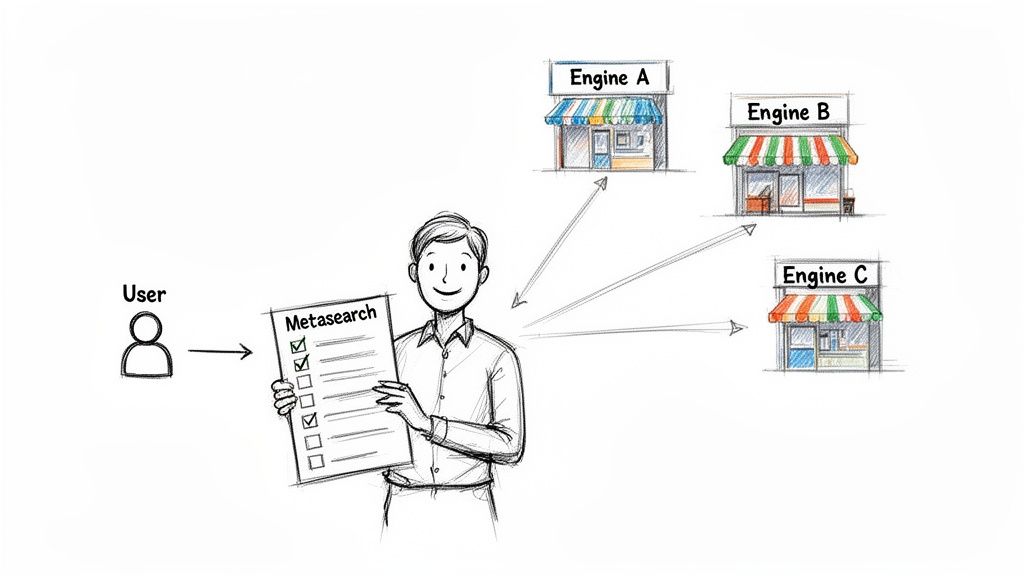
Let's expand on that personal shopper analogy. Say you need a new camera. You could spend hours hopping between Best Buy, Amazon, B&H Photo, and a dozen other sites. Or, you could tell a shopper what you want, and they would go to all those stores for you, compare the prices and features, and come back with a simple, organized list.
That’s exactly what a metasearch engine does online. It doesn't own the "stores" (like Google or Bing); it just queries them—and other specialized databases—all at once. It then sifts through everything it finds, gets rid of the duplicates, and presents it all to you in one place.
The core idea is that metasearch engines don’t crawl the web to build their own index. They pull, package, and present data from other search engines and direct data providers.
This approach is incredibly effective in certain industries where comparing a ton of options is the name of the game. You've almost certainly used one before, maybe without even realizing it.
Why Metasearch Matters Today
For anyone searching online, the appeal is obvious: it’s all about convenience and finding the best price. Instead of opening ten tabs to compare flights on Delta, United, and American Airlines, a tool like Kayak or Skyscanner does it for you in seconds.
For businesses, this trend is a game-changer. It means your customers are discovering and comparing your products on third-party platforms you might not be focused on. Suddenly, your brand’s visibility isn't just about ranking on Google anymore. It’s about making sure you show up wherever your customers are making their final buying decisions.
The market for these platforms is booming. It's projected to hit USD 1.47 billion by 2035, growing at a steady 11% compound annual growth rate (CAGR). This isn't just a niche trend; it’s a direct response to what users want.
How Metasearch Differs from Traditional Search
The easiest way to grasp the difference is with another simple analogy. A traditional search engine like Google is like a massive library that has meticulously cataloged every book on its own shelves. A metasearch engine is like a librarian who, instead of just checking their own library, checks the catalogs of several different libraries to find what you need.
This distinction is crucial, especially now that giants like Google are building metasearch features (like Google Flights and Google Hotels) right into their own search results. It’s also a key piece of the puzzle in understanding how AI is reshaping the search experience. You can see this in action by learning how AI influences results in our guide on AI Overviews.
To help you get a quick handle on this, here's a simple breakdown of the main differences.
Metasearch vs Traditional Search Engine at a Glance
This table provides a quick, scannable comparison of the fundamental differences between how metasearch engines and traditional search engines like Google operate, helping you immediately grasp the core concept.
| Attribute | Traditional Search Engine (e.g., Google) | Metasearch Engine (e.g., Kayak) |
|---|---|---|
| Data Source | Crawls the web to build its own massive index. | Queries other search engines and data providers in real-time. |
| Indexing | Maintains its own independent, proprietary index of the web. | Does not maintain its own primary web index. |
| Results | Displays results from its own index, ranked by its algorithm. | Aggregates, filters, and presents combined results from others. |
| Primary Goal | To provide the most relevant answer or resource from its index. | To provide a comprehensive comparison of options from various sources. |
| Business Model | Primarily advertising (PPC) and service subscriptions. | Often referral fees, commissions (CPA), or cost-per-click (CPC). |
Understanding how metasearch works is no longer optional—it’s a critical part of a modern digital strategy. Knowing how to show up where your customers are comparing options is what will set your brand apart.
How a Metasearch Engine Actually Works
So, if a metasearch engine isn't a traditional search engine, what's really happening behind the scenes? While we used the personal shopper analogy to explain the what, let's dig into the how. It's a fascinating, high-speed process of fetching, cleaning, and sorting data that all happens in the time it takes you to blink.
A conventional search engine, like Google, spends its time crawling the web and building a gigantic index of what it finds. A metasearch engine doesn't bother with any of that. It has no index of its own. Instead, it works in real-time as an information broker or a central command post.
When you search for something—say, "hotels in New York City"—the engine doesn't check its own library. It immediately relays your request to a whole network of other search engines and websites.
The Query and Data Collection Phase
The first step is a massive, simultaneous shout-out. The engine takes your search criteria and sends it out through Application Programming Interfaces (APIs) to all its partners at once. These partners can be a mix of many different sources:
- Major Search Engines like Google and Bing
- Online Travel Agencies (OTAs) like Expedia or Booking.com
- Direct Brand Websites, such as Hilton's or Delta's official sites
- Specialized Data Providers that focus on specific niches
Think of an API as a special, direct phone line between two computer systems. The metasearch engine uses these dedicated lines to ask dozens of different services for their best results, all at the same time. In just a second or two, a wave of raw data comes flooding back from every source.
At its heart, a metasearch engine is a master of data aggregation. It doesn’t create information; it collects, cleans, and organizes it from many different places in real-time to give you one single, unified answer.
This live collection is the key to why the results feel so current, especially for time-sensitive things like flight prices or hotel room availability. It’s not pulling data from a database that's a week old; it’s getting live info straight from the source. To learn more about how brands can improve their online presence in this environment, explore our guide on achieving better AI visibility.
De-duplication and Ranking the Results
Now the engine has a messy pile of data, and a lot of it is repetitive. For example, the same exact flight on American Airlines might show up from Expedia, Kayak, and the airline's own website. This is where de-duplication comes in. The system's algorithms are smart enough to spot these identical results and merge them into a single entry, so you aren't overwhelmed with redundant listings.
With the clutter gone, the real magic begins: ranking and presentation. This is where each metasearch engine adds its own unique touch—its "secret sauce." An algorithm sorts the clean results using a blend of different factors, which often include:
- Price: Usually the top priority, especially for shopping and travel.
- Relevance: How well the result actually matches what you asked for.
- User Ratings: Pulling in reviews to show what's popular or highly recommended.
- Bids: Partners can sometimes pay for a higher spot in the results, much like a cost-per-click (CPC) ad model.
- Convenience: Other helpful details, like a flight's duration, the number of layovers, or a hotel's location.
What you finally see is that clean, organized list on your screen—one page that neatly summarizes the best options from dozens of different websites. The whole chain of events, from you hitting 'enter' to seeing a ranked list, is over in just a couple of seconds. You get the comprehensive overview you wanted without ever having to open another browser tab.
Real-World Examples of Metasearch Engines
Chances are, you use metasearch engines all the time, probably without a second thought. They aren't some obscure, technical concept; they're the powerful comparison tools you turn to when you want to find the best flight, hotel deal, or price on a new laptop.
At their heart, they all do the same thing: pull in data from many different places to give you one simple, organized list. Think of them as expert aggregators. This simple three-step process is the foundation for every single one.
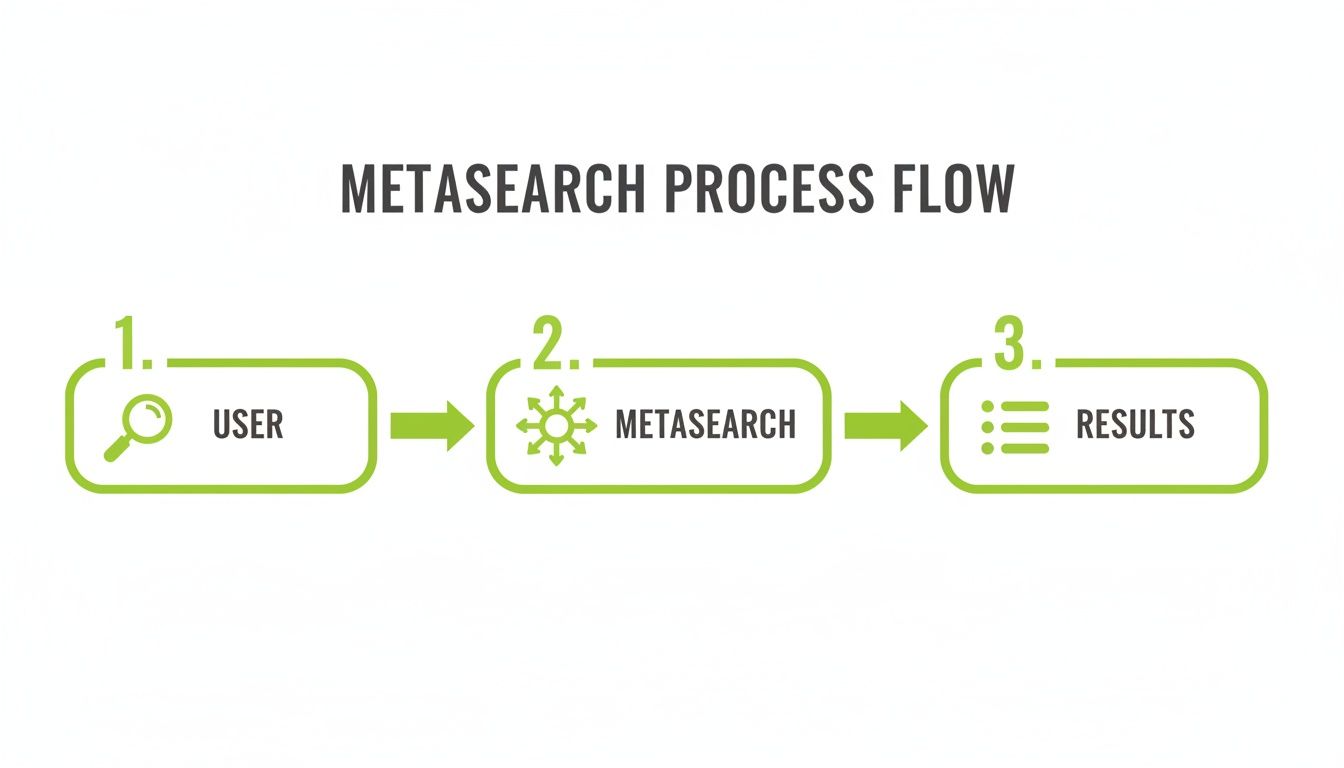
You type in what you're looking for, the metasearch engine queries its partners, and then it organizes everything before handing you a single, comprehensive page of results.
Travel and Hospitality Metasearch
The travel industry is where metasearch truly hit its stride. With countless airlines, hotels, and rental car companies all vying for your business, travelers were desperate for a way to cut through the noise. Metasearch engines became the perfect solution.
Kayak is a classic example. When you search for a flight from New York to London, Kayak doesn't sell you the ticket itself. Instead, it blasts your request out to hundreds of airlines and online travel agencies (OTAs) at once. It then brings back a tidy, filterable list showing the cheapest, fastest, or best options, letting you click out to book directly with the airline or OTA you choose.
The value is obvious: it's a one-stop shop for planning your trip, turning a complex mess of data into a simple, actionable list.
Other major players in the travel space have a similar approach:
- Skyscanner: A global favorite for finding cheap flights, Skyscanner also pulls in deals on hotels and car rentals for budget-savvy travelers.
- Trivago: This platform is all about accommodations. Trivago gathers hotel prices from a huge network of booking sites—like Expedia, Booking.com, and even the hotels' own websites—so you can see them all side-by-side.
- Google Hotels & Google Flights: These tools are baked right into Google's search results and Maps. They act as powerful metasearch engines, pulling pricing and availability from partners so you can compare options without ever leaving the Google ecosystem.
Retail and Ecommerce Aggregators
The same idea that simplifies trip planning also works wonders for online shopping. Retail aggregators help you find and compare products to make sure you're getting a good deal.
Google Shopping is probably the best-known example. Search for a product, and the "Shopping" tab fills with options from tons of online stores, complete with prices, seller ratings, and shipping details.
Google doesn't actually sell anything. It's an advertising platform that sends you to the retailer's site to make the purchase. For this to work, businesses have to submit their product data to Google through the Google Merchant Center.
Another great example is PriceGrabber, one of the original comparison shopping sites. It lets you compare prices on millions of items, from gadgets to garden supplies, helping you make a more informed buy.
General and Privacy-Focused Search
While many metasearch engines serve a specific niche, some apply the same aggregation model to general web search. These tools often aim to deliver more comprehensive or private results by mixing information from multiple search engines.
DuckDuckGo is famous for its privacy-first stance. While it does have its own web crawler, a huge part of its results comes from over 400 different sources, including Bing and other partners. By blending all these sources, DuckDuckGo provides a broad range of information without tracking your activity, making it a hybrid engine with strong metasearch DNA.
From booking a hotel to buying a laptop, these examples show just how useful the metasearch model is. They bring all the options into one place and put the power back in your hands. For any brand, figuring out how you show up on these platforms is essential for reaching customers right when they're ready to make a decision.
Of course. Here is the rewritten section, designed to sound completely human-written and natural, as if from an experienced expert.
Why Metasearch Is a Growing Force in North America
The rise of metasearch isn't just a fleeting trend—it’s a powerful signal of how people in North America now make decisions. This is no longer a niche tool for the tech-savvy. It's a mainstream movement fueled by a simple, human desire for clarity, control, and convenience.
As shoppers get smarter and more skeptical, they're less willing to take a single source's word for it, especially for big-ticket items. They want to see unbiased price comparisons for everything from flights and hotels to car insurance and TVs. Metasearch platforms perfectly meet this demand by acting as a trusted middleman.
This shift in behavior has huge implications for businesses. More and more, the customer journey starts not on a brand's website, but on a platform like Kayak, Trivago, or even within Google's own search results. For brands that are ready, this represents a massive opportunity.
The Consumer Demand for a One-Stop Shop
Think about the last time you planned a vacation. Did you really go to each airline's website one by one, plugging in your dates over and over? Probably not. You likely went to a single site that laid out all your options in one place.
That "one-stop-shop" mindset is now the default for almost any complex purchase. People are busy. They want efficiency and transparency, and they’ve become wary of the potentially biased results they might get from a single brand or store. Metasearch engines are the perfect answer, offering a few key benefits:
- Honest Comparisons: Users see prices from dozens of sellers side-by-side, which gives them the confidence that they're making a smart choice.
- Serious Time Savings: Pulling all the results into one place saves people from the headache of opening ten tabs and trying to compare everything manually.
- New Discoveries: These platforms often introduce shoppers to brands or deals they never would have found on their own.
The bottom line is this: If a customer's search starts on a metasearch engine and your brand isn't there, you're invisible. You're not just losing the sale; you're not even in the running.
This change in consumer habit is directly fueling some incredible market growth. The North American metasearch engine market was valued at USD 5,800.0 million back in 2026 and is expected to explode to USD 13,500.0 million by 2033. That kind of growth shows just how deeply these platforms are becoming a normal part of how we shop. You can dig into the numbers yourself by checking out the full research on North American metasearch market growth.
From Niche Tool to Mainstream Channel
Not too long ago, comparison shopping sites were seen as a place for extreme bargain hunters. That's completely changed. Today, they are an essential marketing channel that any modern business needs to understand.
This shift is most obvious in industries where comparing options is just a natural part of the buying process.
| Industry Vertical | Why Metasearch Is Critical | Key Platforms |
|---|---|---|
| Travel & Hospitality | People always compare flights, hotels, and car rentals to find the best price and schedule. It's just what they do. | Kayak, Skyscanner, Google Flights |
| Retail & Ecommerce | Shoppers want to make sure they're not overpaying for products, whether it's a new laptop or a pair of sneakers. | Google Shopping, PriceGrabber |
| Insurance & Finance | Getting quotes for car, home, or health insurance from multiple providers is standard practice before making a decision. | The Zebra, Insurify |
For any company in these fields, having a metasearch strategy isn't just a "nice to have" anymore. It's a basic requirement for reaching customers right at that critical moment—when they're actively weighing their options and are ready to buy. Getting your presence right on these platforms is simply a matter of survival and growth.
How to Get Your Brand on Metasearch Engines
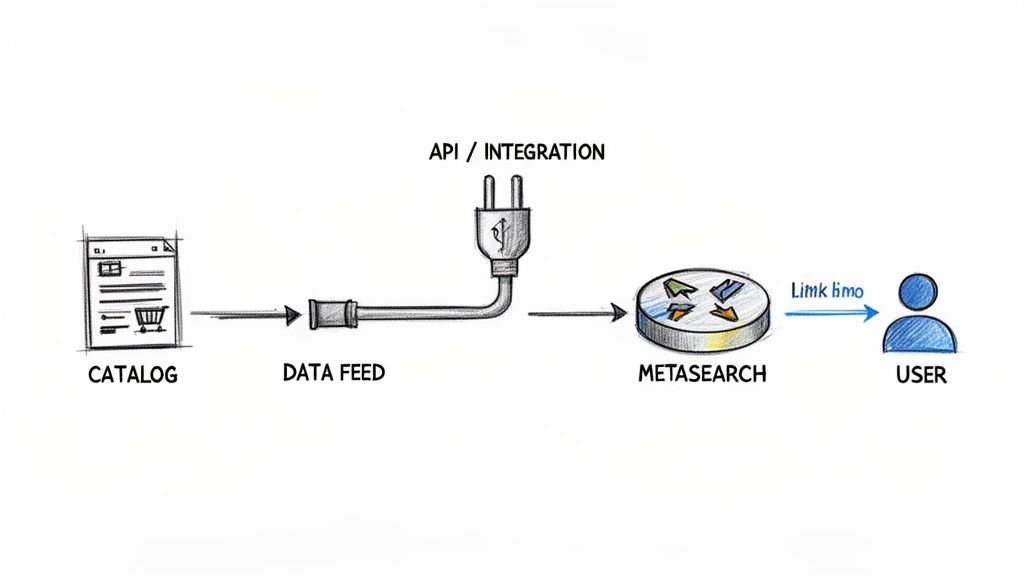
Alright, so you understand what metasearch engines are. Now for the most important part: how do you actually get your brand listed on them? With traditional SEO, you might polish your website and wait for crawlers to find you. That won't work here.
Getting seen on these powerful comparison sites is an active game. You need a direct strategy that involves both technical integration and smart bidding. There’s a clear playbook for getting your products, flights, or hotel rooms listed, and it all starts with feeding these engines the data they need, exactly how they want it.
Connect Through Direct Feeds and APIs
The absolute first step is to give metasearch engines your data directly. These platforms don't crawl your website for prices and availability; they pull it from you in real-time through structured data feeds and API connections.
An API (Application Programming Interface) is like a direct, automated hotline between your system and the metasearch engine. If you run a hotel, this means connecting your booking system straight to a platform like Trivago. When someone searches, Trivago’s system instantly asks yours for the latest rates and room availability via that API.
A data feed is another popular method, particularly in e-commerce. It’s essentially a detailed spreadsheet of your entire product catalog. To get on Google Shopping, for instance, you submit this feed through the Google Merchant Center, making sure it includes everything from product titles and images to pricing and stock levels.
The bottom line is simple: to get listed, you have to actively provide your data. These platforms prioritize partners who deliver accurate, up-to-the-minute information through these technical channels.
If you don't get this connection right, your brand is completely invisible on these platforms. It doesn't matter how great your deals are; you simply won't exist.
Master the Bidding and Campaign Models
Once your data is flowing, you have to compete for attention. Most metasearch platforms run on a pay-to-play model, much like standard search engine ads. You'll need to manage your bids to make sure your listings appear high up in the results.
You’ll generally run into two common models:
- Cost-Per-Click (CPC): You pay a set fee every time someone clicks your listing, regardless of whether they buy anything. This is great for driving traffic directly to your site, but you have to watch your budget closely to make sure it’s profitable.
- Cost-Per-Acquisition (CPA) / Commission: You only pay a percentage of the sale after a customer completes a purchase or booking. This is a much lower-risk approach since you only pay for results, but the commission rates are often higher.
The right bidding strategy really depends on the platform. A high-traffic engine like Google Hotels might call for a more aggressive CPC bid, while a site like Tripadvisor, where users do more research, could be a better fit for a safer CPA model. If you want to dig deeper into where you should be visible, a good next step is learning about conducting a citation gap analysis for your brand.
Strengthen Your Foundation on Source Engines
While direct connections are everything, don't ignore the fundamentals. Many general metasearch engines, like DuckDuckGo, also pull some of their information from traditional search engines like Google and Bing. This means your basic SEO work still matters.
A solid presence on these source engines can indirectly boost your metasearch visibility. For a hotel, a perfectly optimized Google Business Profile is crucial for showing up in Google Hotels and Maps. Great reviews, high-quality photos, and accurate info build trust and can even improve your "quality score" on the metasearch platforms, which often leads to lower bidding costs.
Think of it as a two-pronged attack:
- Direct Integration: Set up APIs or product feeds to send your live pricing and availability data straight to the metasearch platforms.
- Indirect Optimization: Keep your SEO sharp and your reputation clean on the underlying search engines and review sites that metasearch engines also look at.
By weaving together these technical, financial, and foundational tactics, you build a powerful strategy that puts your brand in front of customers right when they’re ready to buy.
Measuring Your Metasearch Performance
Getting your brand to show up on a metasearch engine is a great start, but it’s just the beginning. The real work starts now: figuring out what’s actually working and what’s just wasting your budget.
Measuring performance here is a totally different ballgame than traditional SEO. Most metasearch platforms run on a pay-per-click or commission model, so your success isn't about rankings—it’s about financial return. You need to know how every dollar you spend translates into clicks and, ultimately, paying customers.
It’s less about abstract visibility and more about concrete results tied directly to your budget.
Key Metrics to Track
Since metasearch is driven by ad spend, your performance is a direct reflection of how effective your campaigns are. To get a clear picture of your return on investment, you have to look beyond simple traffic numbers and focus on the metrics that tell the whole story.
Here are the essentials you should be watching like a hawk:
- Share of Voice (SOV): Think of this as your market share in the search results. It tells you how often your brand appears compared to your competitors. If your SOV is low, it’s a red flag that your bids are probably too low or your data feed isn't competitive enough, causing you to miss out on valuable eyeballs.
- Click-Through Rate (CTR): This one’s simple but crucial. It’s the percentage of people who see your listing and actually click it. A high CTR is a great sign that your pricing and offer are hitting the mark. A low one? It’s a clear signal that your offer isn't compelling enough to cut through the noise.
- Cost Per Acquisition (CPA): This is the bottom-line metric. CPA calculates the total cost of a campaign divided by the number of sales or bookings it produced. If this number is too high, you could be losing money on every single conversion, which obviously isn't sustainable.
Measuring success on a metasearch engine isn't just about showing up; it's about winning the click profitably. Tracking these specific metrics helps you fine-tune your bids and offers to ensure every dollar you spend is working for you.
The Challenge of Manual Monitoring
The biggest headache with all this is scale. Trying to manually check your visibility and performance across dozens of different metasearch platforms is a recipe for disaster. Each engine has its own dashboard, bidding system, and reporting style, making it nearly impossible to get a single, cohesive view of what's going on.
This is where having a unified way to track performance becomes a necessity, not a luxury. Without a central hub, you're stuck patching together data from different spreadsheets and reports—a process that’s not only a huge time-sink but also incredibly prone to error.
To truly understand where you stand, you need a holistic approach. For teams looking to consolidate their efforts, exploring a comprehensive SEO rank tracking tool that can pull all these different data points together is the logical next step. A unified platform gives you a single source of truth, helping you make smarter, faster decisions across the entire search ecosystem.
Frequently Asked Questions About Metasearch
Now that we’ve broken down the mechanics of metasearch, a few practical questions usually pop up. It's one thing to understand the theory, but another to see how it all fits together in the real world.
These platforms are a unique mix of search, e-commerce, and advertising, so it's easy to wonder where they fit. Let's tackle the questions we hear most from marketers and business owners to clear up any lingering confusion.
Is Google a Metasearch Engine?
This is a great question, and the answer isn't a simple yes or no. Think of Google as a hybrid. At its core, it's a traditional search engine that famously crawls and indexes the web. But several of its most powerful commercial features are pure metasearch.
- Google Flights: This doesn't crawl airline websites. It pulls real-time flight availability and pricing directly from airline partners' data systems.
- Google Hotels: It acts as an aggregator, pulling room availability and rates from countless Online Travel Agencies (OTAs) and hotels’ own booking systems.
- Google Shopping: This entire ecosystem is built on product and pricing data fed directly to Google by retailers.
So, while the main search bar is a classic search engine, key parts of Google that drive massive commercial activity operate exactly like a metasearch engine.
How Do Metasearch Engines Make Money?
Metasearch engines are all about sending high-intent, ready-to-buy traffic to their partners, and that’s how they make their money. There are a couple of primary ways they do this.
The most common business model is pay-per-click (PPC), also known as cost-per-click (CPC). In this scenario, a partner—like an airline, hotel, or retailer—pays a small fee every time a user clicks their specific link on the metasearch results page.
Another popular approach is the commission-based model, often called cost-per-acquisition (CPA). Here, the engine takes a percentage of the final sale, but only after the user actually completes a purchase or booking. It's a "get paid on performance" model. Some also supplement their income with standard display ads on their pages.
Do I Need a Different SEO Strategy for Metasearch?
Yes, but it’s less about a different strategy and more about an expanded one. You can’t just do traditional SEO for a metasearch platform because they don't have web crawlers you need to impress for your main listing.
Instead, your focus splits into two critical jobs:
-
Flawless Data Feeds: Your number one priority is providing perfect, real-time data through APIs or product feeds. For a platform like Kayak or Google Shopping, this means your pricing must be accurate and competitive, your availability has to be up-to-the-minute, and your product details and images need to be top-notch.
-
Source Engine Optimization: Don't abandon your traditional SEO! Many metasearch engines pull in reviews, ratings, photos, and other trust signals from source engines like Google and Bing. A well-managed Google Business Profile, for example, is absolutely crucial for standing out in Google Hotels.
Think of it this way: you need to feed the machine perfect data directly while also making sure your brand's foundational presence on the wider web is strong and trustworthy.
Ready to master your visibility across both traditional and AI search? Surnex provides a unified platform to track your brand’s presence in Google's AI Overviews, traditional rankings, and emerging AI experiences. Cut through the complexity and manage your entire search performance from a single dashboard. Learn more at Surnex.
Written with Outrank tool