Most advice on seo audit report format gets one thing wrong. It treats the audit like the deliverable.
It isn't. The deliverable is an approved action plan.
A tool export with every warning, notice, and crawl anomaly might look exhaustive, but most of those reports die in someone's downloads folder. They don't get budget. They don't get developer time. They don't get content updates. They don't get discussed outside the SEO team.
The bigger problem is that many audit templates still act like search is only ten blue links. That's outdated. Traditional components still matter, but modern reports are missing a critical layer. Existing formats heavily cover technical SEO, Core Web Vitals, and content, yet they often ignore visibility in AI search experiences even though AI modes were projected to influence up to 30% of queries in major markets as of early 2026.
A strong audit today has to do two jobs at once. It has to diagnose what blocks organic growth, and it has to show where the brand is absent from AI Overviews, LLM citations, and AI-assisted discovery. If your report can't explain both, it's incomplete.
Beyond the Checklist Audits That Drive Action
Most audit templates reward volume. More tabs. More screenshots. More issue types. More exported CSVs.
That approach fails because clients don't buy lists of problems. They buy clarity. They approve work when the report tells a simple story: what is broken, why it matters, what to fix first, and what each team needs to do next.
Why most audits get ignored
A bad audit usually has three flaws:
- It leads with tools, not outcomes. The first pages show crawl counts and health scores instead of business impact.
- It treats every issue as equal. A minor metadata inconsistency sits next to an indexation problem as if both deserve the same urgency.
- It stops at SEO mechanics. It says nothing about how the brand appears, or doesn't appear, in AI-generated answers.
That last point matters more than many agencies admit. Search behavior has shifted, but reporting hasn't kept up.
Practical rule: If a stakeholder can't answer "what should we do next week?" after reading your audit, the format failed.
The fix is simple. Build the report like a decision document, not a forensic archive. Keep your source data in appendices, spreadsheets, or dashboards. In the main report, only show what supports a recommendation.
What a useful report actually does
A modern seo audit report format should answer five questions in order:
- Where are we losing visibility right now
- What's causing the loss
- Which issues deserve action first
- What does each team need to own
- How will we track change after implementation
That structure changes the tone of the conversation. The report stops being a technical event and becomes an operating plan.
For agencies, this is also how you avoid endless presentation calls where everyone asks for "the short version." Build the short version first. Then support it with detail. If your team needs a cleaner operational workflow for that kind of reporting, a client-ready reporting workflow helps standardize the narrative before the deck is built.
The missing layer in 2026-era audits
Most reports still separate SEO into technical, on-page, content, links, and UX. That's still useful. It just isn't enough.
A modern audit also needs an AI search visibility section. Not as a novelty slide. As a reporting category with its own findings, gaps, and actions. If you leave that out, you're telling clients only part of the search story.
The Core Components of a Modern SEO Audit Report
The best seo audit report format is simple to explain. It has four core pillars, and each one should answer a distinct set of questions. When teams blur these together, reports become messy fast.
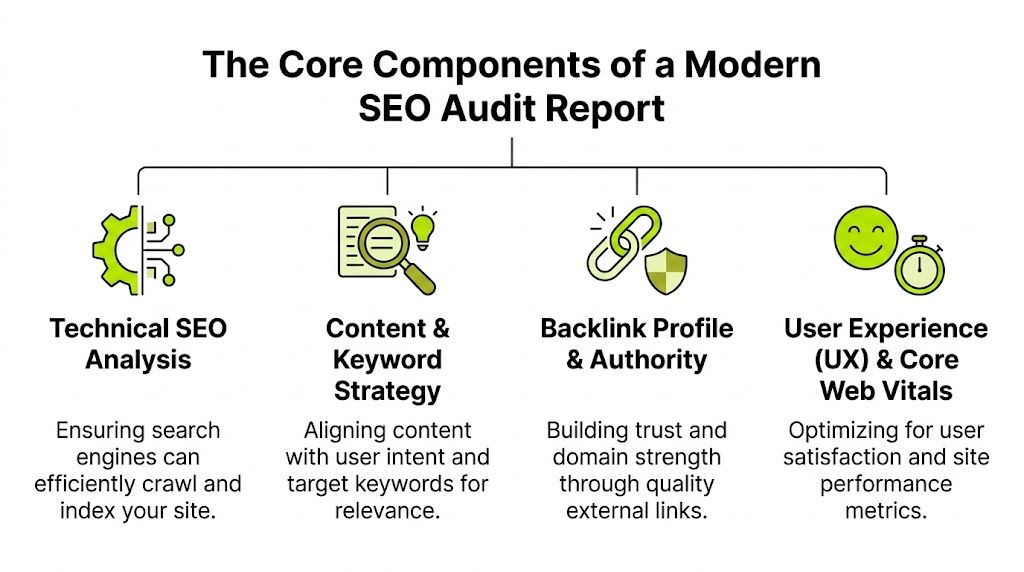
Technical SEO analysis
This is the foundation. If search engines can't crawl, render, understand, or index the site correctly, every other recommendation sits on weak ground.
Your technical section should answer questions like:
- Can search engines access the important pages
- Are the right pages indexed
- Are there crawl traps, redirect chains, broken pages, or duplicate variants
- Is performance harming discoverability or usability
- Do site architecture and internal linking support the important sections
This part should stay focused. Don't dump every crawler warning into the report. Pull the patterns that explain real visibility loss.
I usually break technical findings into three buckets:
- Access and indexation
- Performance and rendering
- Architecture and internal signals
That keeps the conversation cleaner with developers. It also makes implementation easier, because each bucket usually maps to a team or sprint.
For practitioners using multiple tools, a dedicated site audit workspace makes it easier to keep technical findings tied to priority rather than isolated scans.
On-page and content analysis
This pillar covers the pages themselves. Titles, headers, content quality, internal links, search intent alignment, duplicate themes, and conversion friction all belong here.
The common mistake is to make this section subjective. Don't write "content could be improved" and move on. Show the exact pattern.
One reliable example is title tag quality. In one audit example, 55.3% of pages were missing titles, 26.8% had short titles, and 15.5% had duplicate titles, with the report noting that addressing these issues can boost organic CTR by up to 30%. That's the kind of finding stakeholders understand immediately. It is concrete, fixable, and tied to outcome.
What this section should include
- Metadata quality: Missing, duplicate, weak, or misaligned titles and descriptions
- Intent fit: Whether pages match the query type they're trying to rank for
- Content depth: Thin pages, overlap between pages, stale content, or unanswered questions
- Internal linking: Whether authority and relevance are flowing to the pages that matter
- Page-level structure: Heading hierarchy, scannability, and content organization
Good on-page findings are page-type based, not page-by-page trivia. Group product pages together. Group location pages together. Group blog templates together.
That format helps clients see system-level problems instead of isolated defects.
Backlink profile and authority
This section isn't just a domain rating check. It should explain whether the site has the authority signals to compete, where the gaps are, and whether any off-page issues are distorting performance.
A strong backlink section usually covers:
| Focus area | What to look for | Why it matters |
|---|---|---|
| Referring domains | Relevance, consistency, and concentration | Shows whether authority is broad or fragile |
| Link quality | Editorial links versus low-value placements | Separates real authority from noise |
| Anchor patterns | Over-optimization, brand imbalance, weak topical anchors | Helps explain off-page risk and missed relevance |
| Competitor gaps | Domains citing or linking to rivals but not you | Gives outreach and PR direction |
Keep this section diagnostic. If you turn it into a giant backlink export, nobody reads it.
UX and conversion signals
Many audits stop at rankings. That leaves money on the table.
SEO doesn't end when a page gets the click. A report should show whether the experience helps users complete the next action. Navigation, template friction, weak calls to action, poor mobile layouts, and confusing information architecture all belong here.
This doesn't mean turning the audit into a full CRO engagement. It means calling out the UX problems that block SEO value from turning into business value.
A practical UX section often covers:
- Template friction on high-intent pages
- Mobile usability issues
- Confusing navigation and page hierarchy
- Weak conversion paths from informational to commercial pages
A page can rank well and still underperform. When that happens, the audit should say so directly.
The strongest reports connect these four pillars into one narrative. Technical issues explain discoverability. On-page issues explain relevance. Backlinks explain authority. UX explains whether traffic turns into something useful.
From Data to Diagnosis A Repeatable Audit Workflow
A solid seo audit report format depends less on design and more on process. If the workflow is inconsistent, the report will be inconsistent too. That's why teams end up with one great audit and five average ones.
The cleanest workflow moves through four stages. Gather. Reduce. Prioritize. Present.
Gather from a fixed source stack
Use the same core sources every time unless the scope clearly changes. For most agency and in-house audits, that means a crawler, Search Console, analytics, backlink data, and manual review of key templates.
My baseline stack is usually:
- Screaming Frog or Sitebulb for crawl data and structural issues
- Google Search Console for indexing, query patterns, and page-level search signals
- Google Analytics 4 for landing page behavior and conversion context
- Ahrefs or Semrush for backlinks, visibility context, and competitor comparison
- Manual SERP review for intent mismatch and layout realities the tools won't show
The mistake here is over-collecting. Teams often export everything because they assume they might need it later. That's how audits become bloated before analysis even starts.
A better rule is simple. Pull enough data to support a recommendation. Save the rest for backup.
For teams building a repeatable process across accounts, a technical site audit workflow helps keep data capture standardized before the reporting layer starts.
Reduce the issue list fast
Every crawl returns a long tail of issues. Most of them aren't where the significant gains come from.
One crawl-data-based approach found that fixing the top 12 to 15 technical issues can drive 75% of ranking improvements and lead to up to 30% better positions in the right contexts, according to this SEO audit prioritization analysis. That's the right mindset for audit writing. You are not trying to document everything equally. You are trying to isolate the few things worth action.
Build a prioritization matrix
Once the issue list is reduced, score every recommendation by impact and effort, allowing raw analysis to become management-ready.
| Priority | Quadrant | Description | Action |
|---|---|---|---|
| P1 | High impact, low effort | Fast fixes that remove obvious barriers | Do first and assign immediately |
| P2 | High impact, high effort | Strategic fixes that need planning or dev work | Scope into roadmap and secure owner |
| P3 | Low impact, low effort | Housekeeping items that improve quality | Batch into maintenance cycles |
| P4 | Low impact, high effort | Expensive fixes with limited upside | Defer unless tied to another initiative |
This matrix does two useful things. It gives clients a sequence, and it gives internal teams permission to ignore low-value noise.
How to score issues in practice
I don't score every issue with a rigid formula. I use a set of questions:
- How many important pages are affected
- Does this block crawling, indexation, or ranking potential
- Does it hit revenue-driving or lead-driving templates
- Can one implementation fix the issue at scale
- Does this require one team or three teams
If the answer points to broad impact and easy implementation, it's a quick win. If the impact is broad but the implementation is messy, it belongs in the roadmap.
The best prioritization model isn't the most mathematical one. It's the one your client team will actually use in a planning meeting.
Write the executive summary before the body
It's common to write the summary last. I don't recommend it.
Write a draft summary as soon as the diagnosis is clear. That forces you to decide what matters before you start filling slides or pages. If you can't summarize the audit in a few sharp points, your analysis is probably still too broad.
A useful executive summary usually includes:
- Current state
- The main causes of underperformance
- The top priorities
- What each team needs to do next
That summary should stand on its own. A CEO might only read that page. A dev lead might skip straight to implementation notes. Your format has to work for both.
Keep evidence close to the recommendation
Don't make readers hunt. If you say a section is underperforming because of indexation waste, show the evidence in the same area of the report. If you say a page template is mismatched to intent, include the page type and the observed pattern nearby.
This sounds obvious, but many reports separate charts, screenshots, and recommendations into different sections. That forces stakeholders to assemble the logic themselves. They won't.
The Missing Piece Integrating AI Search Visibility
The old seo audit report format assumes the report ends with rankings, pages, links, and technical health. That assumption no longer holds.
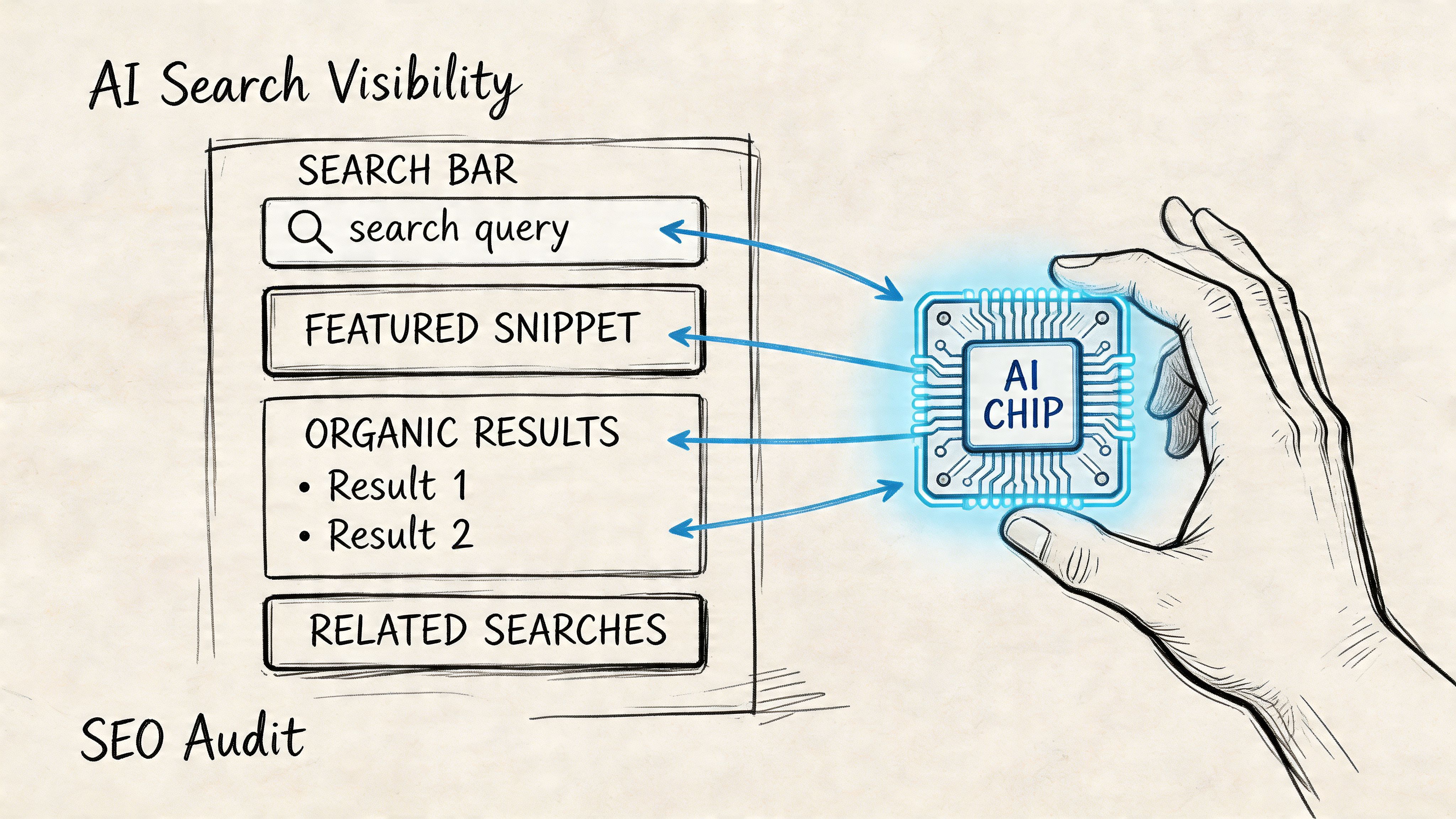
If a brand isn't appearing in AI-generated answers, AI Overviews, or citation patterns tied to LLM-driven discovery, the audit is missing a live visibility layer. That's not a side note. It's part of modern search performance.
Why AI visibility belongs in the audit
The main objection I still hear is that AI search is too new or too unstable to report on cleanly. That misses the point.
Audits have always dealt with evolving systems. You still report on what can be observed. Where the brand appears. Which pages are cited. Which topics trigger competitor mentions. Which content types get surfaced. Which entities are associated with the brand. That is enough to turn vague concern into a usable operating view.
The strongest argument for adding this layer is practical. When crawl-based audits show that fixing a small set of issues can create most of the ranking lift, you learn to focus on what yields the most impact. The same principle applies here. You don't need dozens of AI metrics. You need the few signals that explain presence or absence.
What to track
A useful AI visibility section should include a short set of observations, not a wall of experimental data.
Track things like:
- Brand presence in AI Overviews: Does the brand appear, and for which query themes
- LLM citation gaps: Which competitor pages or publisher pages get cited instead
- Page eligibility patterns: Which content formats seem more likely to be surfaced
- Entity clarity: Whether the site clearly explains who the brand is, what it does, and where it has authority
- Content gaps tied to answer generation: Missing explainer pages, comparison pages, glossary content, or source-worthy references
A dedicated AI visibility tracking layer helps keep reporting grounded in observable appearances instead of guesswork.
If your audit says "optimize for AI" without showing where visibility is absent, it isn't an audit. It's a trend memo.
How to present it in a client-friendly way
Don't bury AI search findings in the appendix. Give them their own report block with the same structure you use for technical or content findings:
| Finding type | What you show | What the action looks like |
|---|---|---|
| Presence gap | The brand is absent for key informational prompts | Build or improve source-worthy pages |
| Citation gap | Competitors are cited where the brand is not | Target the topics and references driving citation |
| Entity weakness | The site is unclear about expertise, offering, or brand identity | Strengthen structured clarity and supporting content |
| Format mismatch | Existing pages aren't built for synthesis-friendly answers | Rework layout, headings, and answer-first copy |
A short walkthrough can help teams understand how this layer changes reporting expectations:
The competitive advantage of adding this section
Most agencies still hand over audits that look almost identical to what they used a few years ago. The team that can explain both organic search performance and AI discovery has a stronger strategic position immediately.
This doesn't require abandoning traditional SEO. It requires extending the report so it reflects how people now find information.
From Document to Decision Presenting Your Audit
A report can be right and still fail.
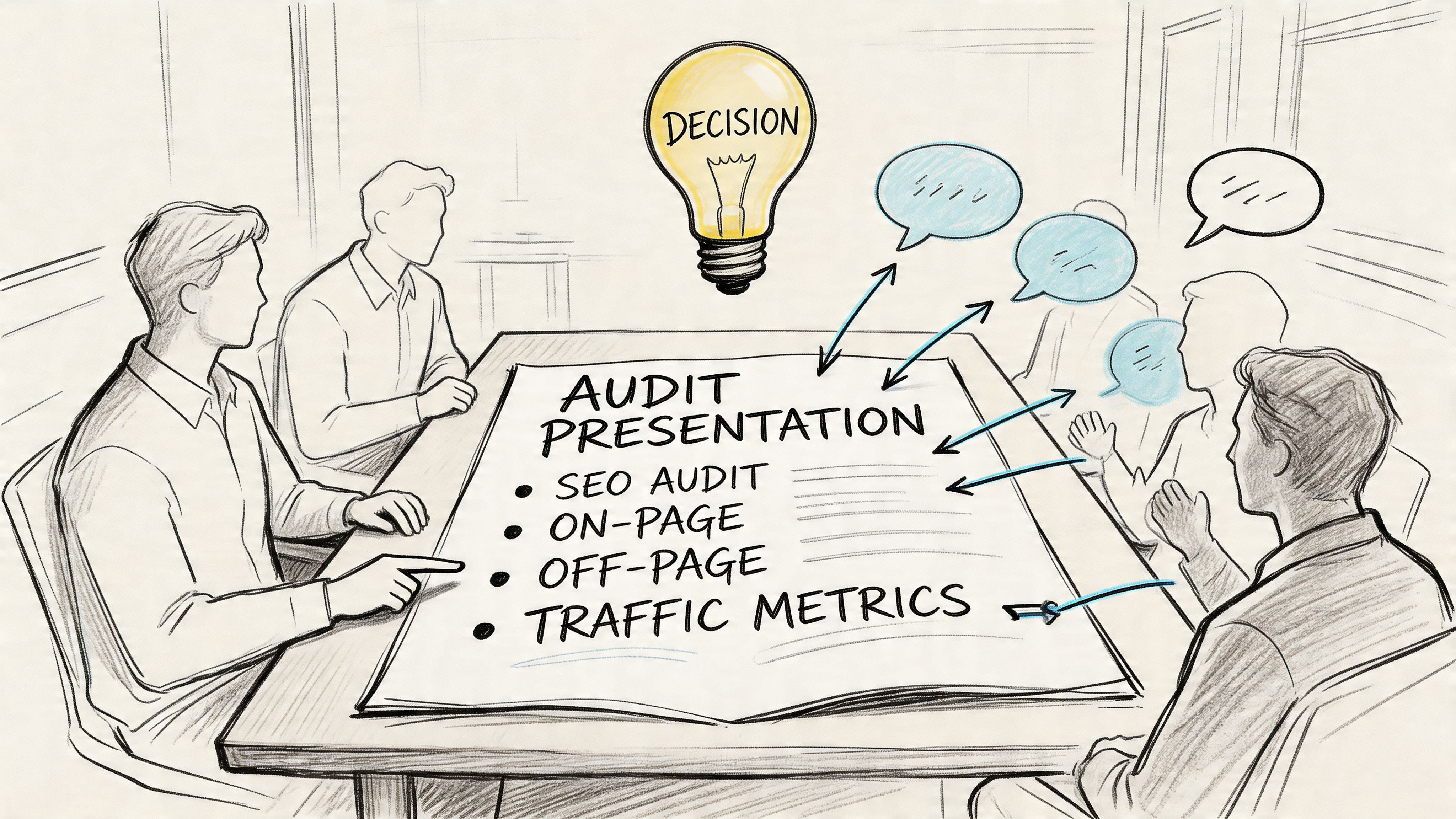
Failure usually happens in the meeting. The deck is overloaded. The SEO lead explains every detail. The client team gets lost halfway through. Nobody knows what is needed this month versus next quarter. The audit is praised and then parked.
Present to roles, not to "the client"
A CEO, a marketing lead, a content manager, and a developer don't need the same report depth.
That's why one presentation should usually have layered views:
- Executives need decisions. Lead with risk, upside, key blockers, and budget implications.
- Marketing leads need sequencing. Show page groups, content priorities, and dependencies.
- Developers need precision. Give them issue definitions, affected templates, and implementation notes.
- Content teams need examples. Show what to rewrite, merge, expand, or reposition.
If everyone gets the same level of detail, the room either gets bored or overwhelmed.
Use the audit like a roadmap review
Don't present an audit as a reading exercise. Present it as a set of choices.
I prefer a meeting structure that moves through these questions:
- What is the main problem
- What caused it
- What should be fixed first
- Who owns each stream
- What gets measured after launch
That keeps the discussion practical. It also helps when stakeholders challenge priorities. You're not defending every line item. You're discussing the roadmap.
The audit meeting should end with owners and next steps, not with "send us the deck and we'll review internally."
Make recommendations implementation-ready
The phrase "improve internal linking" isn't a recommendation. It's a category.
Strong recommendations have three parts:
- The issue
- The affected scope
- The next action
For example, don't say a template has weak metadata. Say category pages are reusing similar titles, which weakens differentiation, and assign title rewrites by template rules rather than one-off edits.
That level of specificity reduces follow-up friction. It also makes it easier for project managers to create tickets without rewriting your work.
Anticipate the objections
Most objections aren't about the findings. They're about capacity.
You'll hear versions of these questions every time:
- Can we phase this
- What if dev can't take this this quarter
- Which fixes matter if we only do a few
- Can content handle part of this without engineering
A good presentation already answers those questions. That's why the prioritization matrix matters so much. It turns the audit from a technical diagnosis into a planning tool.
Automating and Scaling Your SEO Audit Process
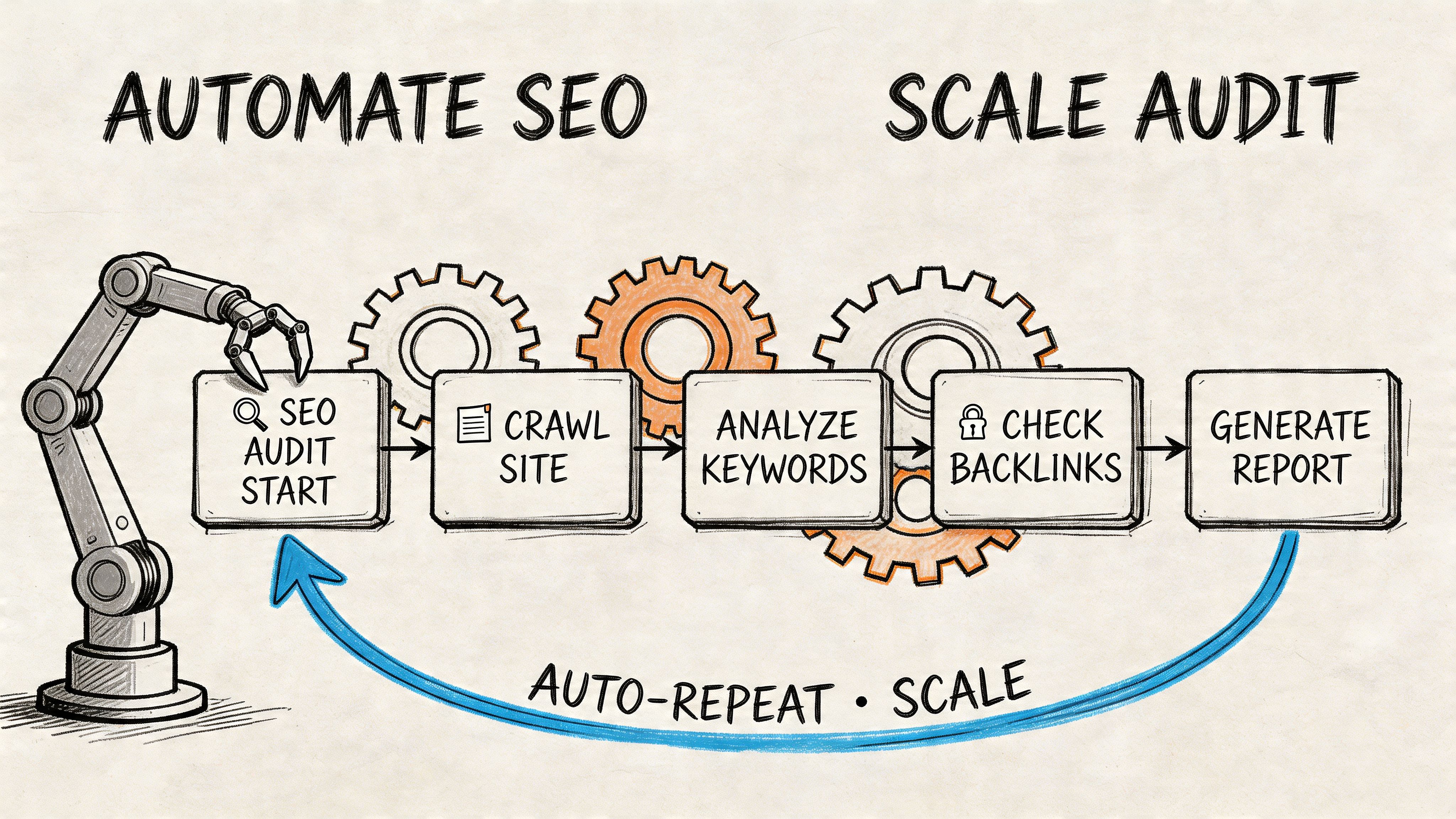
If your team rebuilds every audit from scratch, quality drifts and margins get worse. The answer isn't reducing the depth of analysis. It's standardizing the process around reusable components.
Build one core template, then branch by use case
Typically, three versions of the same audit service are needed:
- Prospecting audit: Short, persuasive, issue-led
- New client audit: Broader diagnosis with implementation roadmap
- Retainer audit: Deeper, segmented, tied to ongoing priorities
The structure can stay mostly consistent. What changes is depth, evidence, and the level of implementation detail.
Automate collection, not judgment
The best use of automation is at the data and formatting layer. Pull crawl results, backlink summaries, Search Console patterns, and template-level outputs into a repeatable reporting system. Leave diagnosis, prioritization, and narrative to a human operator.
This matters even more now that teams are adding AI workflows to SEO delivery. If your agency is changing how people work with automation, this guide on how to make a team AI-native is a useful operational read because it focuses on adoption habits, not just tools.
Where automation actually helps
A scalable audit process usually automates these parts:
| Workflow area | What to standardize | Human role |
|---|---|---|
| Data pulls | Crawl exports, ranking inputs, backlink snapshots | Validate anomalies and edge cases |
| Report scaffolding | Section order, slide templates, table formats | Tailor the narrative to the account |
| Issue tagging | Template groups, severity labels, ownership tags | Approve priorities and action sequence |
| Follow-up tracking | Status dashboards and recurring reviews | Interpret movement and adapt plan |
Automation should save analysts from copying data, not from thinking.
Keep the system light enough to use
Overbuilt reporting systems fail for the same reason overbuilt audits fail. They ask for too much discipline.
Use a template your team can follow. Use integrations that reduce manual work. Keep the scorecards simple enough that account leads can explain them in one call. The process has to survive real agency conditions, not just look clean in a Notion doc.
Frequently Asked Questions About SEO Audit Reports
What tools are essential for a comprehensive SEO audit
Use a stack, not a single platform.
For technical crawling, Screaming Frog and Sitebulb are the usual starting points. For search performance and indexing signals, Google Search Console is essential. For behavior and page context, Google Analytics 4 still matters. For backlinks and competitive context, Ahrefs or Semrush are the practical choices.
No single tool gives you a complete audit. The report gets stronger when you combine crawler evidence, search data, backlink context, and manual review.
What should a good seo audit report format include
At minimum, it should cover technical SEO, on-page and content analysis, backlink profile review, UX or conversion friction, an executive summary, and a prioritized action plan.
For modern reporting, add an AI search visibility section. That includes AI Overview presence, citation gaps, and whether key content is structured well enough to be surfaced in AI-assisted discovery.
How do you price an SEO audit
Price by complexity, not by a flat label.
The main variables are site size, number of templates, international complexity, CMS constraints, reporting depth, and whether the engagement includes stakeholder presentation and implementation planning. A five-page service business and a large ecommerce catalog shouldn't be priced with the same logic.
The cleanest pricing model is scope-based. Define what's included, what sources you'll use, what the final deliverable looks like, and whether the audit includes workshops or post-audit support.
How often should a business run a full audit
There isn't one perfect schedule.
Run a full audit after migrations, redesigns, major CMS changes, large content overhauls, traffic drops, or indexation shifts. For established sites, many teams also benefit from regular review cycles because technical debt and content drift accumulate over time.
For ongoing retainers, don't wait for one giant annual report. Break audits into themes and review sections of the site throughout the year.
What's the difference between an audit and an automated health check
An automated health check lists issues detected by a system. An audit explains which issues matter, why they matter, and what to do first.
That distinction matters. A tool can tell you there are duplicate titles or redirect chains. It can't reliably tell you whether those issues are suppressing important page groups, whether they deserve sprint time right now, or how they connect to content and conversion performance.
How long should the report be
As short as possible, as detailed as necessary.
For most stakeholders, the core report should stay concise and decision-oriented. Put heavy exports, raw crawl data, and long URL lists in appendices or companion sheets. The better rule isn't page count. It's readability. If the main report can't be understood in one sitting, it's too heavy.
Should the report include every issue found
No.
Include the issues that support diagnosis and prioritization. Keep the full exports available for implementation teams, but don't mistake completeness for usefulness. The point of an audit is not to prove the crawler worked. It's to help people act.
Surnex helps agencies and in-house teams report on both traditional SEO and emerging AI search visibility in one place. If you need a clearer way to track rankings, audits, backlinks, AI Overviews, and LLM citation gaps without juggling separate tools, take a look at Surnex.