Most advice on pay per click keyword research is too narrow. It treats Google Ads like the whole search world and assumes the value of a keyword starts and ends with whether you can bid on it profitably.
That view is already behind reality.
Search behavior is spreading across classic search results, AI Overviews, and LLM-driven discovery. A keyword can still matter commercially while losing click value in a traditional SERP. Another keyword might look weak in SEO tools but remain strong for paid search because the user still wants a vendor, demo, quote, or product page. If you only look at keyword volume, CPC, and match type, you miss the actual question that matters: where does this query create business value now?
That's why modern pay per click keyword research needs a wider lens. You still need strong Google Ads fundamentals. You also need to understand intent, landing page fit, organic coverage, and where AI experiences are intercepting or reshaping the journey.
Why Your PPC Keyword Research Is Already Outdated
Most PPC teams still follow advice built for an older search model. They brainstorm seed terms, pull ideas from Google Ads tools, sort by search volume and CPC, then build campaigns. That process still matters. It's just no longer enough.
The blind spot is simple. Most guidance focuses almost entirely on Google Ads and doesn't address how keyword strategy changes as AI Overviews and LLM-driven search capture more attention. That creates a real gap for agencies and brands because traditional research assumes a search journey that's increasingly being reshaped by AI experiences, as noted by Midsummer's analysis of the PPC to AI search gap.
The old assumption breaks in two places
First, not every commercially interesting query deserves a paid search bid anymore. Some searches are now resolved earlier, before the user reaches the click stage you used to count on. If the result page answers the question directly, the keyword may still matter, but not in the same way.
Second, some terms still deserve aggressive bidding even if they look less exciting in keyword tools. High-intent searches tied to product comparisons, pricing, implementation, demos, or urgent problem solving often keep their value because the user wants a next step, not just an explanation.
Your keyword list shouldn't answer only, “Can we buy traffic for this?” It should also answer, “Where does this query still create visit-level value?”
This changes how you evaluate keywords. You're no longer building a list for one platform. You're deciding whether a query belongs in paid search, organic content, AI visibility work, or some mix of the three.
Why teams need a unified view
A modern PPC strategist has to think beyond auction mechanics. If a term is heavily informational, frequently summarized by AI, and weak at producing qualified sessions, it may not deserve more budget. If another term consistently signals vendor selection or purchase research, you protect it.
That's why it helps to watch broader search behavior trends, not just account-level metrics. Teams tracking AI search trends and shifts in discovery behavior get a clearer picture of which keywords are losing click value and which ones still pull real commercial intent.
Old-school PPC keyword research asks, “What can we target?”
Modern PPC keyword research asks, “What should we target, where should we compete, and what part of the journey are we buying?”
Laying the Strategic Foundation Before You Search
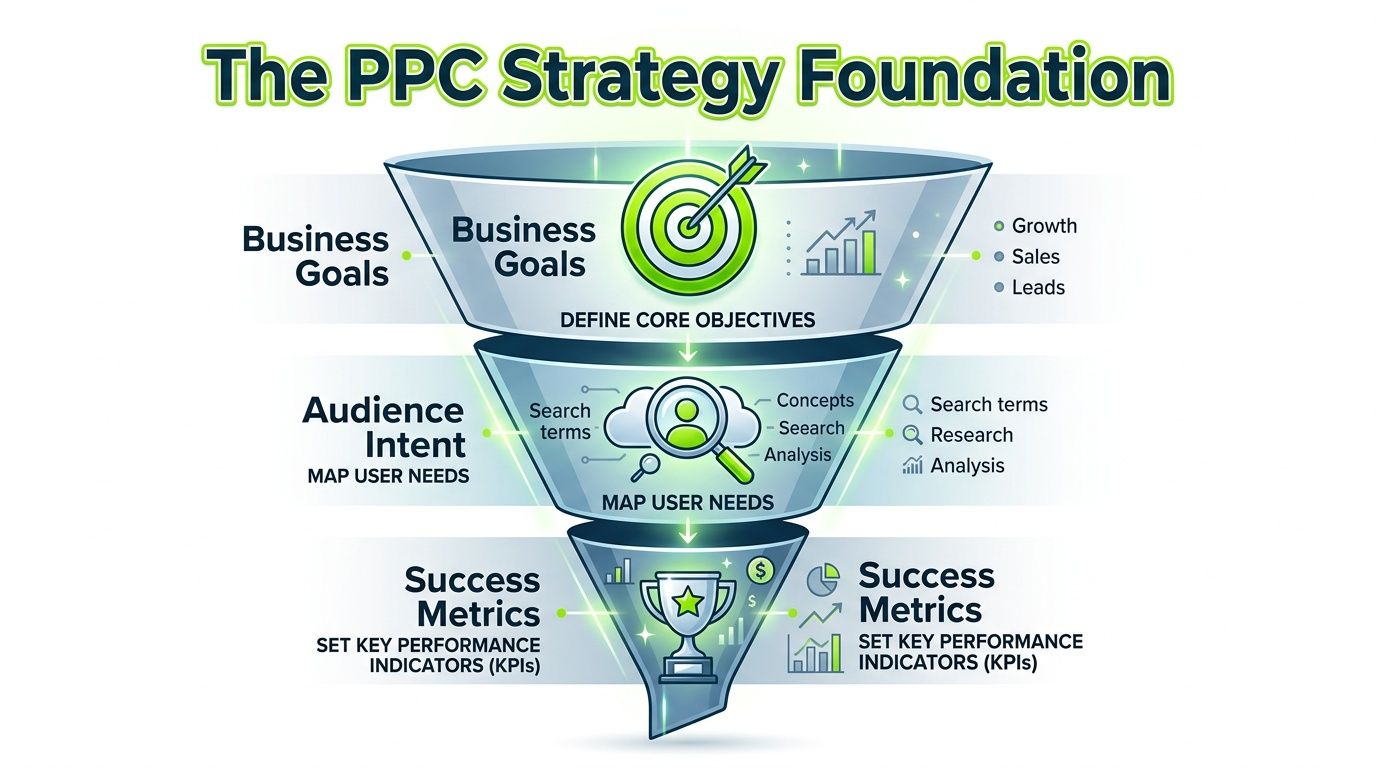
Good PPC keyword work starts before you open Google Keyword Planner, Semrush, or any AI tool. If you skip strategy, you'll build a big keyword list that looks active in a spreadsheet and underperforms in-market.
Keyword research is not a one-time setup task. 57% of PPC specialists conduct keyword research weekly and 38% do it monthly, which shows how central it is to performance management. The same source notes that ongoing work helps teams handle limited data and intent ambiguity, improves Quality Score, lowers average CPC, and supports an average 200% ROI from PPC according to We Can Track's PPC statistics roundup.
Start with the business outcome
A new team member's first mistake is usually chasing keyword opportunity before defining the business target. Don't start with keywords. Start with the conversion that matters.
That could be:
- Lead generation for demo requests, contact forms, or booked calls
- Direct purchase for ecommerce product and category campaigns
- Pipeline support for high-consideration B2B offers
- Brand defense when competitors bid on your brand or adjacent solution terms
A keyword only becomes “good” when it can support one of those outcomes. If it can't, it's noise.
Map intent to funnel stage
Not every search belongs in the same campaign type, bid model, or landing page path. You need a simple funnel map before research begins.
- Top funnel terms usually describe a problem, category, or educational need. These can be useful, but they often need tighter budget control and stronger exclusion lists.
- Mid funnel queries often contain comparison language, role-based needs, or product category detail. These are often better discovery targets than broad awareness terms.
- Bottom funnel searches tend to signal vendor evaluation or transaction intent. These usually deserve the closest scrutiny and the best landing page alignment.
Practical rule: If you can't name the landing page and offer for a keyword before you bid on it, you're not ready to add it.
Define success before tool output clouds judgment
Once your funnel map is clear, decide how you'll judge viability. That includes acceptable CPC ranges, expected conversion behavior, and whether the keyword should assist a sale or close one.
For in-house teams, alignment often breaks at this stage. Brand teams want reach. Demand gen wants leads. Sales wants qualified pipeline. Finance wants efficiency. Shared keyword criteria fixes a lot of that. Teams that need a tighter operating model often benefit from a more unified workflow across search disciplines, especially when they're managing campaigns internally across regions or product lines. Platforms designed for in-house marketing teams working across search performance fit naturally in those environments.
Before you search, write down three things for every planned campaign: the conversion event, the buyer stage, and the page that will receive the click. That one discipline prevents a lot of wasted spend.
Discovering and Expanding Your Keyword Universe
Most weak keyword lists come from one source. Usually that source is a keyword tool. That's a problem.
Good pay per click keyword research pulls language from multiple places because users don't search the way marketers label things internally. They search with urgency, confusion, product shorthand, competitor comparisons, job-to-be-done language, and feature-specific pain points. Your job is to collect those patterns before you filter them.

Start with terms your buyers already use
The fastest way to improve a keyword list is to stop relying on your own naming conventions.
Look at sources like:
- Sales call notes for phrases prospects use when describing the problem
- Support tickets for feature names, setup issues, and recurring objections
- On-site search logs for product language and navigational behavior
- Customer reviews for wording around value, frustration, and alternatives
- Search term reports from existing PPC campaigns for real user phrasing
Search term reports are especially useful because they reveal where your current targeting is too broad, too narrow, or unexpectedly valuable. They also expose hidden commercial modifiers you might not think to seed manually.
Use competitor coverage as a clue, not a template
Competitor analysis is useful when you treat it as reconnaissance, not imitation. Review competitor ad copy, landing pages, offer framing, and obvious keyword themes. You're looking for gaps in positioning, not a list to copy into your own account.
A strong companion read here is this agency guide to winning PPC auctions, which helps frame competitive PPC analysis in practical terms. It's useful for seeing how auction behavior, message overlap, and SERP pressure affect your keyword choices.
What works in this step:
- Identifying competitor category terms they repeatedly support with dedicated landing pages
- Spotting comparison patterns such as “alternative,” “vs,” or use-case-specific language
- Reviewing offer structure to understand whether the keyword likely maps to trial, demo, pricing, or consultation intent
What doesn't work is copying a competitor's visible keywords without checking whether your offer, funnel, and landing page experience can support the same click.
If a competitor bids on a term, that tells you it matters to them. It doesn't tell you it should matter to you.
Use LLMs for expansion, not for final selection
AI tools are useful in ideation because they can widen the language set quickly. They are less useful as a final authority on which terms deserve budget. Use them to generate variants, not to make bidding decisions in isolation.
Useful prompt patterns include:
-
Role-based variation Ask for the same core problem phrased by a buyer, practitioner, manager, and procurement stakeholder.
-
Use-case expansion Ask for long-tail searches tied to onboarding, migration, reporting, compliance, integrations, or troubleshooting.
-
Comparison framing Ask for “best,” “alternative,” “compare,” “for teams,” and “for industry” variations around your core offer.
-
Objection mining Ask for searches a skeptical buyer would use before switching vendors or requesting a demo.
A dedicated workflow for keyword research across SEO and emerging search behavior proves useful for these situations. It helps teams keep ideation connected to actual search priorities instead of dumping hundreds of disconnected suggestions into a sheet.
Build one master list before you judge anything
At this stage, don't trim too early. Keep one working list with source labels such as sales, support, competitor, AI ideation, and existing search terms. That label matters later because it tells you where the idea came from and how much trust to place in it.
A clean raw list is better than a prematurely “optimized” one. Expansion first. Qualification later.
Classifying Intent and Estimating Financial Value
A large keyword sheet is only raw material. Success begins when you classify what the searcher wants and decide whether that click can create enough value to justify a bid.
Too many teams jump from discovery to campaign build. That's how you end up paying for curiosity when you meant to pay for buying intent.
Four intent types that matter in PPC
Use a simple classification model. It keeps judgment consistent across accounts and makes campaign structure easier later.
| Intent Type | User Goal | Example Keywords | Typical Value |
|---|---|---|---|
| Informational | Learn, define, understand | how to improve landing page relevance, what is quality score | Usually better for education, remarketing, or selective testing |
| Navigational | Reach a known brand or destination | brand login, company pricing page, vendor dashboard | High value for brand defense and low-friction conversion paths |
| Commercial | Compare options before choosing | best CRM for agencies, email platform alternatives | Strong value when ad copy and landing pages match evaluation intent |
| Transactional | Take action now | buy accounting software, book PPC audit, request demo | Highest direct value when the offer and page remove friction |
Intent classification is also where you should think about AI behavior. Some informational keywords are increasingly handled inside AI experiences, while commercial and transactional terms often still produce valuable clicks because the user needs a vendor, proof, pricing, or a next step. Teams trying to evaluate that crossover need a view into AI visibility across search journeys, not just traditional keyword metrics.
Read the query, not just the metric
A keyword can have attractive traffic estimates and still be weak for paid search. Another can look small and become a top performer because the wording signals urgency or budget authority.
Read for modifiers like:
- Comparison language such as best, top, alternatives, versus
- Action language such as buy, book, hire, demo, quote
- Constraint language such as for enterprise, for Shopify, for legal teams
- Problem language such as fix, reduce, improve, migrate, replace
That's the difference between list building and actual strategy.
Some keywords are expensive because they attract buyers. Some are expensive because they attract everyone. Learn the difference before you bid.
Build a value estimate with simple logic
You don't need a complex model at the start. You need a disciplined one.
Score each keyword against a few practical questions:
- Does the query match a landing page with one clear action?
- Can the offer satisfy the intent without extra explanation?
- Is the user likely researching broadly, or narrowing down suppliers?
- Would a sales team want more of this traffic if it converted at a normal rate?
Then sort the list into three buckets:
- Bid now for clear commercial or transactional fit
- Test carefully for mixed-intent or early-stage terms
- Don't buy yet for informational terms that belong in SEO, content, or AI visibility work
This step is where many wasted clicks are prevented. Good pay per click keyword research is less about finding more terms and more about refusing the wrong ones for the right reasons.
Building a High-Performance Keyword Architecture
A strong keyword list can still fail if the account structure is sloppy. Relevance lives in the architecture. If the keyword, ad, and landing page drift apart, Quality Score suffers, queries broaden, and the account becomes harder to optimize.
This is why experienced PPC teams spend so much time on structure. They know the build determines how much control they'll have later.

Group keywords by theme, not by convenience
Don't dump fifty loosely related terms into one ad group because they share a product category. Group them by a tight theme the ad can speak to directly.
That's why many practitioners prefer STAG-style organization. In the verified data, 40% of PPC experts prefer Single Theme Ad Groups, reflecting the value of clustering related terms tightly for relevance and CTR, as summarized in the earlier We Can Track source.
Examples of strong grouping:
- “crm for agencies”
- “agency crm software”
- “best crm for marketing agencies”
Those terms belong together because one ad can address the same need.
Examples of weak grouping:
- “crm for agencies”
- “project management software”
- “email automation tools”
Those are adjacent categories, not one theme.
Match type is a control system
Match types aren't just a technical setting. They're how you manage discovery versus precision.
According to the paid search metrics reference from KPU Pressbooks, experts use exact match for precision with 4% to 6% CTR, phrase match for balance with CPC 20% lower than broad, and broad match for discovery capped at 20% of budget. The same source notes that negative keywords can eliminate 15% to 25% of irrelevant queries, and that long-tail keywords can yield 2 to 3 times higher ROI than generic short-tail terms.
Use that guidance in practical terms:
- Exact match belongs on terms where intent is proven and the landing page fit is high.
- Phrase match is often the best place to scale while keeping some control.
- Broad match can discover new demand, but it needs disciplined query review and budget limits.
Negative keywords should exist before launch
Most junior PPC work treats negatives like cleanup after waste appears. That's backward.
Start every campaign with a baseline negative list built from obvious mismatches such as jobs, free, template, definition, course, and support, if those don't fit your offer. Then add campaign-specific exclusions tied to product lines, audience tiers, and unwanted use cases.
A practical negative workflow looks like this:
- Pre-launch exclusions based on known irrelevant themes
- Weekly search term review to catch drift
- Shared negatives for repeat account-wide waste
- Campaign-level negatives where intent differs across similar terms
Broad match without active negatives is not exploration. It's leakage.
Keep architecture readable
The best account structures are easy to explain on a whiteboard. If a new strategist can't tell why keywords are grouped the way they are, the structure is too messy.
A readable architecture usually includes clear campaign intent, tightly themed ad groups, dedicated landing page mapping, and a visible negative strategy. That setup improves optimization speed because the team can see what each part of the account is supposed to do.
Integrating AI and SEO Signals for Smarter Bidding
Modern pay per click keyword research separates itself from old playbooks. A keyword is no longer just a paid media input. It's a search asset that may generate value through ads, organic rankings, AI summaries, brand mentions in LLM workflows, or a mix of all three.
If you don't connect those signals, you'll overbid on some terms and underinvest in others.

The AI side is no longer niche. 88% of specialists now use AI tools to find profitable keywords, and that matters because AI can help forecast metrics like search volume and CPC, and help interpret intent across longer, more specific searches. The same verified source notes that 95.88% of Google searches are four or more words long and that 65% of clicks on commercial keywords are sponsored, based on Semrush's overview of AI in PPC keyword research.
When organic strength should affect paid bidding
If you already rank strongly for a keyword, don't assume you should stop bidding. Ask a better set of questions.
- Does the paid ad improve control over messaging?
- Is the keyword brand-sensitive or vulnerable to competitor conquesting?
- Does the organic result satisfy the same intent as the paid landing page?
- Does the SERP push organic listings down with ads, shopping units, or AI elements?
Sometimes a paid ad on a strong organic term still makes sense because it protects high-intent traffic and gives you a conversion-focused entry point. Sometimes it doesn't, especially when the keyword is informational and your organic asset already answers it well.
Where AI visibility changes the decision
AI experiences can change the economics of a keyword without changing the keyword itself. A query may still be searched often while producing fewer visits because users get enough of an answer before clicking. That doesn't make the query worthless. It changes how you should pursue it.
Use a simple decision frame:
| Signal pattern | Likely action |
|---|---|
| Strong paid intent, weak organic coverage, click still matters | Bid aggressively and improve page relevance |
| Strong organic presence, weak incremental paid value | Test lower paid pressure or reserve for defense |
| Informational term answered early by AI | Shift effort toward content and AI visibility, not heavy PPC spend |
| Commercial query appearing across paid and AI touchpoints | Coordinate ad copy, page messaging, and brand evidence |
A short walkthrough helps here.
Use one keyword list for three channels
A mature team doesn't maintain separate realities for PPC, SEO, and AI discovery. It maintains one keyword universe with channel-level decisions.
For each priority term, decide:
- Primary channel where you expect the main return
- Supporting channel that reinforces visibility or captures adjacent intent
- Content asset or landing page that serves both discovery and conversion
- Message angle that stays consistent across ad copy, page copy, and organic snippets
The smartest bid is sometimes a content update. The smartest content idea is sometimes a paid search term you almost cut.
This approach keeps paid search connected to what's happening in the rest of search, which is the only way bidding decisions stay rational as AI-mediated discovery keeps expanding.
Your Framework for Measurement and Iteration
Keyword research isn't a setup task. It's an operating rhythm.
The teams that keep winning aren't the ones with the biggest keyword lists. They're the ones that keep refining intent assumptions, query coverage, negatives, and landing page alignment after launch. That's why weekly review habits matter so much in PPC.
Use a lightweight loop:
- Review search term reports to find new negatives, missed variants, and intent drift
- Watch CTR and conversion rate together because a high CTR keyword can still be low value
- Track Quality Score directionally to spot relevance problems between keyword, ad, and page
- Reclassify keywords when market behavior changes or AI search starts absorbing the informational click
- Trim duplication across PPC, SEO, and content so channels support each other instead of competing blindly
Measurement quality matters as much as bidding quality. If tracking is broken, your keyword decisions will be wrong no matter how good the strategy looks. For teams tightening their analytics process, this guide to finding errors in your PPC measurement is a useful reference because it focuses on how audit tools expose data problems before they distort optimization decisions.
The practical standard is simple. Keep the list alive. Keep intent assumptions honest. Keep removing waste. Good pay per click keyword research is ongoing because search behavior keeps changing, and now it's changing across more than one interface.
Surnex helps agencies, in-house teams, and technical marketers track how keywords perform across both traditional search and emerging AI discovery. If you need one place to monitor AI visibility, SEO signals, and the search shifts that affect PPC decisions, explore Surnex.