The most common advice on how to find serp feature opportunities is still too manual. Open an incognito tab. Search a keyword. Note the snippet. Repeat.
That still has value, but it breaks fast once you manage more than a small keyword set, more than one market, or any serious AI search workflow. Search results now shift by device, location, query intent, and result type. A single spot check can show you one version of the truth, not the operating reality your team needs.
A workable process today has to do two things at once. It has to identify traditional SERP feature gaps such as featured snippets, People Also Ask, image packs, and video results. It also has to surface emerging AI search gaps, especially where your brand isn't being cited or surfaced in AI Overviews and similar discovery layers.
That changes the job. You're not just reviewing rankings. You're building a repeatable opportunity system.
Why Manual SERP Feature Tracking Is No Longer Enough
Manual SERP review is still useful for context. It isn't enough for planning.
In 2023, an analysis of 40,000 keywords found that related searches appeared on 83.67% of SERPs, making them the most prevalent SERP feature in that dataset, according to GetSTAT's SERP feature analysis. When features show up this often, treating them like occasional extras is a mistake.

What manual checks still do well
A senior SEO should still inspect live results. Manual review helps you catch formatting patterns, intent mismatches, and awkward result blends that tools flatten into labels.
Use manual review for:
- Result interpretation: You can see whether the snippet is a paragraph, list, or table.
- Intent diagnosis: You can spot when a commercial page is trying to rank in an informational SERP.
- AI search sanity checks: You can compare what rank trackers report against what appears in live search.
Where manual tracking fails
The problem isn't that manual review is wrong. The problem is that it's incomplete.
One person checking a keyword in one browser session can't reliably answer:
- How often does this feature appear?
- Who owns it across markets and devices?
- Did we lose it last week or never have it at all?
- Is the opportunity tied to classic SERP features, AI Overviews, or both?
- Which client or business unit should fix it first?
Those questions require logs, history, and automation. That's why teams eventually move from screenshots and notes to structured tracking through platforms like rank tracking workflows.
Practical rule: Manual checks should validate a system, not replace one.
A reactive workflow leaves hidden gaps untouched. The team sees rankings, assumes visibility is fine, and misses the fact that a competitor owns the answer box, the PAA entry, and the AI citation layer above them. That isn't a ranking issue. It's a visibility issue.
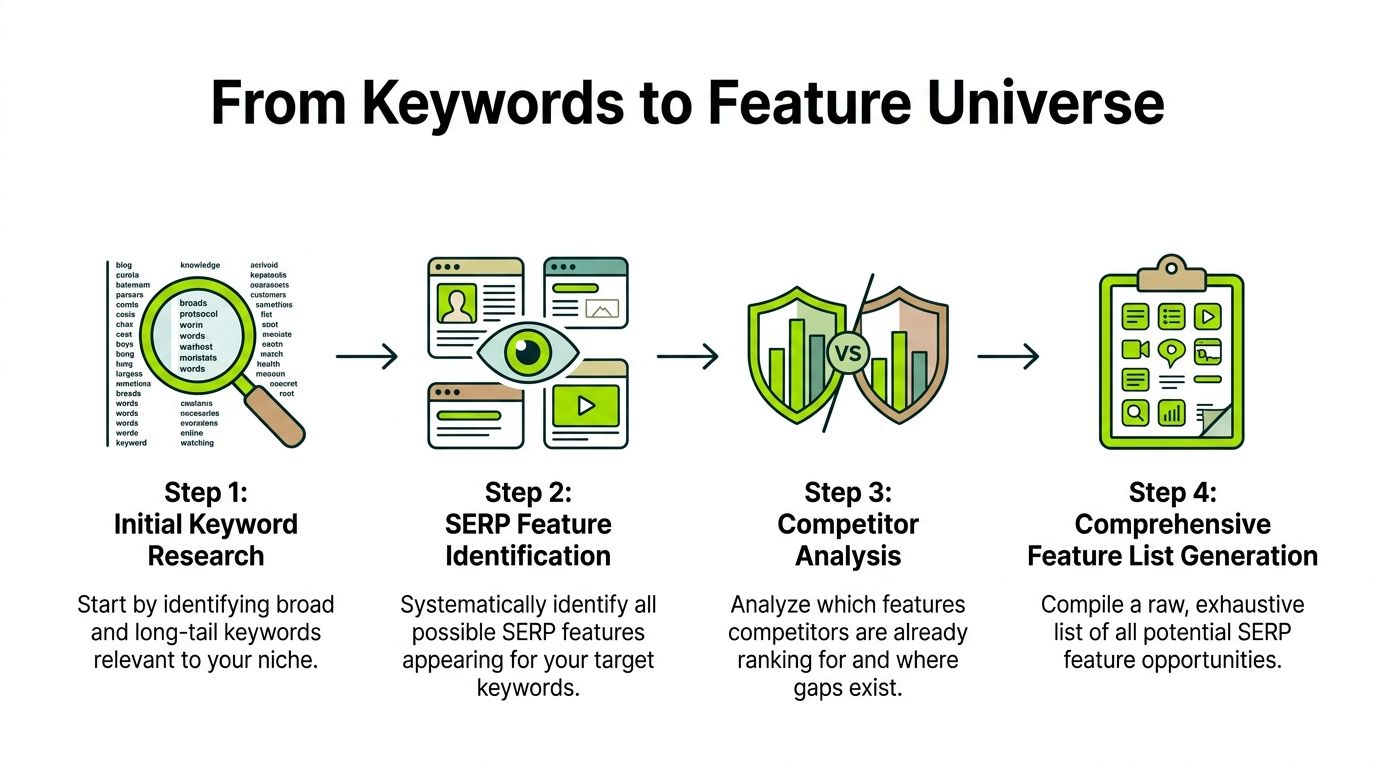
Building Your Opportunity Universe from Keywords to Features
Before you prioritize anything, you need a complete inventory. Many often skip this step and jump straight into “which snippet should we target?” That narrows the field too early.
The better approach is to build a raw opportunity universe. Pull in keywords from every useful source, enrich them with feature data, and only then decide what matters.
Start with keyword inputs, not tools
Your opportunity universe should combine first-party data, planned targets, and competitor visibility.
Use three inputs first:
-
Google Search Console queries Export queries with strong impressions but weak click performance. These often indicate that something else on the page is attracting attention before the organic result.
-
Existing keyword maps Pull category terms, blog targets, product queries, and help-center topics. Many teams already have a keyword plan but haven't attached feature data to it.
-
Competitor feature terms Use keyword research datasets or third-party tools to identify terms where competitors appear in result enhancements that you don't own.
Enrich each keyword with SERP feature data
Here, the process becomes scalable.
Semrush's 2023 update enabled tracking of 50 distinct SERP features with separate positions and traffic estimates, which makes it easier to identify where competitors have visibility your site misses, as described in Semrush's SERP feature update.
That matters because a keyword isn't just a keyword anymore. It can trigger multiple visibility layers at once.
For each keyword in your universe, log:
- Feature presence: featured snippet, PAA, image pack, video carousel, local pack, AI Overview, related searches, and any others relevant to your market
- Feature owner: your domain, direct competitor, publisher, forum, marketplace, or reference site
- Organic position: your page and the winning page
- Intent type: informational, commercial, navigational, support, comparison, local
- Device and locale: because some features appear differently depending on where and how the query runs
Use APIs when volume gets real
A manual workflow can handle dozens of terms. Agencies and enterprise teams usually manage hundreds or thousands.
That means you need a repeatable collection layer. In practice, teams use a combination of:
- SERP APIs or scraping services to fetch result layouts at scale
- Platform exports from Semrush or Ahrefs for feature-triggering keyword sets
- Internal warehouses to store keyword, URL, feature, and date snapshots
- Scheduled jobs to rerun checks daily or weekly for priority terms
A simple data model works well:
| Field | What to store |
|---|---|
| Keyword | Exact query |
| Market | Country, device, language |
| URL ranking | Your URL, if any |
| Organic position | Your current position |
| Features present | All triggered features |
| Feature owner | Domain or URL holding each feature |
| Intent label | Human-reviewed or rules-based |
| Snapshot date | For trend analysis |
Keep one manual layer in the process
Automation finds the pattern. Manual review explains the pattern.
For your top terms, open an incognito browser and verify what the page really looks like. Record unusual details that tools may not classify well:
- Mixed intent pages: transactional query, informational answer box
- AI result interference: AI Overview present, but no classic snippet
- Visual dominance: image or video results pushing blue links far down
- Brand ambiguity: review sites or forums owning trust-heavy real estate
A useful dataset doesn't just tell you that a feature exists. It tells you who owns attention before the user reaches your result.
Add AI search fields from the start
It's common practice to bolt AI search tracking on later. That's a mistake.
If you're serious about modern search visibility, log AI-specific fields in the same dataset:
- Brand mentioned in AI Overview
- URL cited in AI result
- Competitor cited instead
- Prompt or query category
- Answer framing, such as definition, comparison, recommendation, or step-by-step explanation
This gives agencies and in-house teams one operating view instead of separate spreadsheets for SEO and AI search.
The outcome should be simple. One master sheet or database where every target keyword is attached to every visible feature layer. That's the primary starting point for how to find serp feature opportunities at scale.
A Framework for Prioritizing High-Impact Opportunities
Once you have a large opportunity universe, the next problem appears fast. There are too many possible wins.
Teams waste time. They chase every visible gap, even when the feature doesn't fit the page, the query doesn't match the business goal, or the work required is bigger than it looks.
A practical model needs to score opportunities against impact, fit, and effort.
The three factors that matter
Not every feature gap deserves attention. A useful prioritization model should ask three questions.
First, how valuable is the feature if you win it? Second, does the query intent fit the page or content type you can credibly publish? Third, how hard is it to take the feature from the current owner?
One detail matters here. Spreadsheet analysis can reveal stronger gaps when informational sites with DA 70-90 hold features while direct competitors with DA 40-60 do not, and those gaps can produce 35% higher win rates per the data cited in Passionfruit's guide on SERP feature opportunities.
That doesn't mean you should chase every Wikipedia-owned snippet. It means those patterns can signal places where Google wants an informational answer and your category hasn't produced a strong commercial-adjacent resource yet.
A scoring table you can actually use
Score each opportunity from 1 to 5 across the first three columns. In the Effort column, use an inverted score. A 5 means low effort and a 1 means high effort.
| Opportunity (Keyword + Feature) | Potential Impact (1-5) | Intent Fit (1-5) | Effort (1-5, inverted) | Total Score (out of 15) |
|---|---|---|---|---|
| project management software comparison + featured snippet | 5 | 5 | 4 | 14 |
| crm pricing guide + PAA | 4 | 5 | 4 | 13 |
| best accounting software + AI Overview citation | 5 | 4 | 2 | 11 |
| how to migrate cms + video carousel | 3 | 4 | 3 | 10 |
| invoice template + image pack | 2 | 3 | 4 | 9 |
How to judge each score
Potential impact
This is not just search volume. It includes how dominant the feature is on the page and whether it changes click behavior.
A featured snippet on a core informational term can matter more than a lower-visibility image pack on a marginal query. A PAA result can matter more than a weak organic move if it opens several related question paths.
Intent fit
Many campaigns fail at this point.
If the SERP is informational and your page is a product landing page, the odds drop unless you add or create a content format that satisfies the intent. The same goes for AI search. An AI Overview often rewards pages that provide citable explanations, not just conversion copy.
Effort
Low effort usually means one of these conditions is true:
- You already rank well: the page is visible and only needs reformatting or clearer answer blocks
- The current winner is weak: thin structure, poor formatting, or outdated information
- The content exists: you can revise instead of creating a new asset
High effort usually means new templates, net-new media, or a major intent mismatch.
Use trend data to avoid stale priorities
A priority score shouldn't stay static for months. Feature opportunities move.
If a feature is volatile, it may be worth more attention than a stable result held by a dominant player. Teams tracking trend movement through tools such as SERP and visibility trends can spot windows where a result changes ownership often enough to justify action.
Working heuristic: Prioritize pages that already rank, match the query intent well, and sit under a feature currently owned by a weaker or misaligned result.
A practical order of attack
Typically, the best sequence looks like this:
- Quick wins first: top-ranking pages without owned features
- Intent-aligned content updates: especially question-led informational assets
- AI citation targets: pages with concise, trustworthy sections that can be quoted
- High-effort formats last: complex media or broad new topic clusters
This scoring model keeps the roadmap honest. It prevents the team from confusing “visible gap” with “good opportunity.”
Executing the Plan Capturing Your Targeted Features
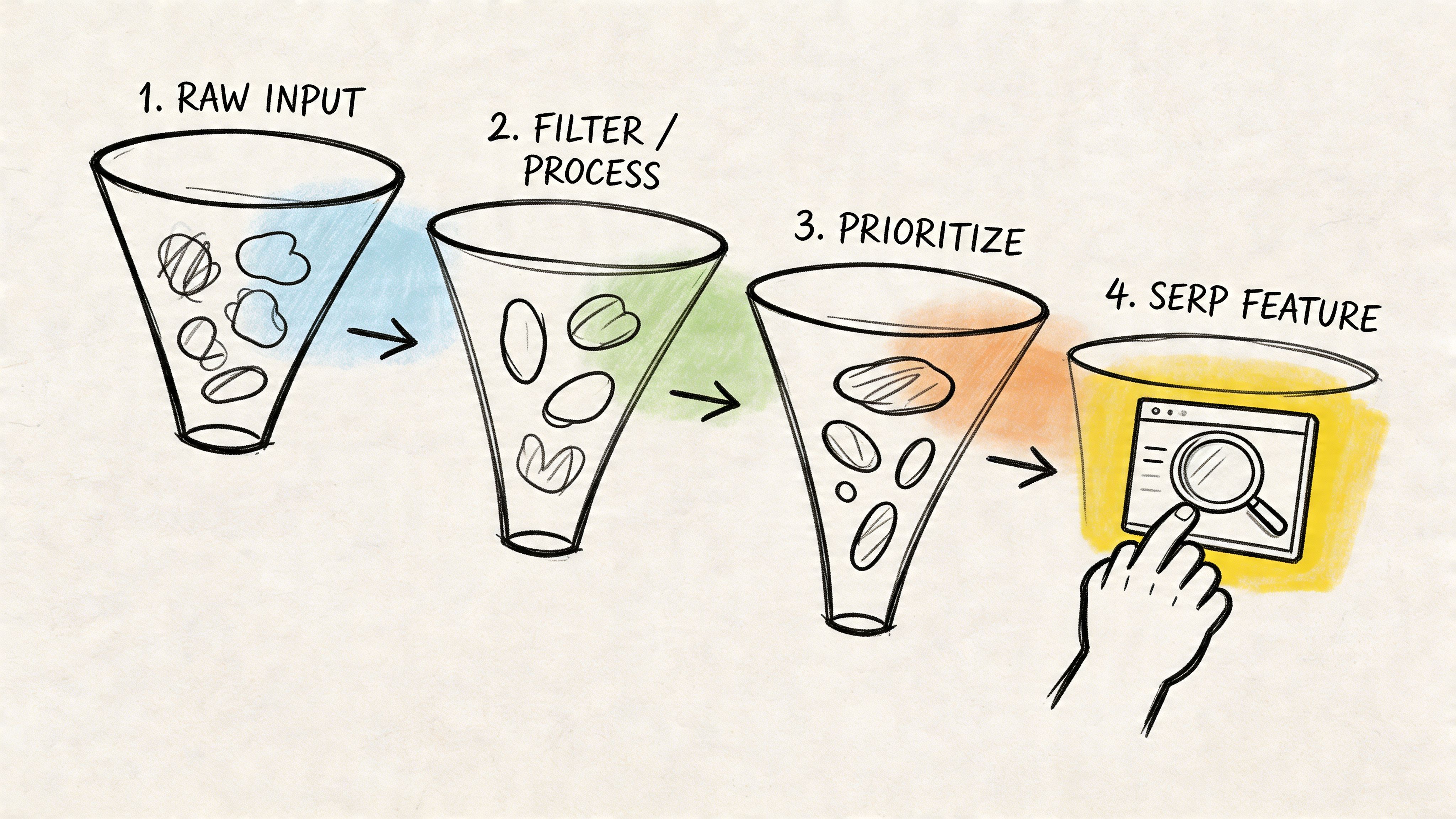
Once you've chosen the right opportunities, execution becomes a formatting problem, a content problem, and a monitoring problem.
Teams often overcomplicate this stage. They rewrite entire pages when the primary fix is structure. Or they add schema to pages that still don't answer the query clearly enough to deserve the feature.
For featured snippets, tighten the answer first
A lot of snippet work comes down to one discipline. Answer the query cleanly before expanding.
According to HubSpot's breakdown of SERP feature opportunities, the average featured snippet source is 42 words, and content using lists is 2.1x more likely to be featured. That's useful because it tells you what to inspect in live winners.
A practical snippet block often looks like this:
- Question heading: use the query or close variant as an H2 or H3
- Direct answer: a short paragraph that resolves the question plainly
- Expansion: extra context, examples, or steps below the short answer
- Format matching: if the current result is a list or table, match that format
If you want a strong tactical companion resource, Outrank has a solid guide on how to get featured snippets that pairs well with this workflow.
For People Also Ask, build modular answers
PAA wins often come from pages that are easy to extract from.
That means:
- Question-led subheads: each subtopic should read like a real query
- Short answer blocks: answer first, elaborate second
- Clear internal structure: don't bury the response under long intros
- FAQPage schema where appropriate: only when the page genuinely follows a Q&A pattern
A simple JSON-LD example:
<script type="application/ld+json">
  {
    "@context": "https://schema.org",
    "@type": "FAQPage",
    "mainEntity": [
      {
        "@type": "Question",
        "name": "How do you find SERP feature opportunities?",
        "acceptedAnswer": {
          "@type": "Answer",
          "text": "Start with high-impression queries, review live SERPs, identify triggered features, compare ownership, and prioritize opportunities based on impact, intent fit, and effort."
        }
      }
    ]
  }
</script>
Schema helps eligibility. It doesn't rescue weak content.
Use structured data to clarify what the page contains, not to pretend the page is something it isn't.
For video and visual features, don't treat media as decoration
Video carousels and image-heavy results usually reward assets built for search retrieval, not embedded afterthoughts.
If a target keyword repeatedly triggers visual features, review:
- Whether the page needs an original video
- Whether the video title and on-page context align with the query
- Whether the transcript helps the page answer the query
- Whether VideoObject or image-related markup is present and valid
A quick visual walkthrough helps when training teams on this production mindset:
Reformat before you rewrite
This is one of the biggest efficiency gains in feature work.
When a page already ranks and broadly matches the query, try reformatting before rebuilding it. In practice, that means:
- Move the answer higher on the page
- Convert prose into a list or comparison table if the SERP prefers that
- Split mixed sections into cleaner question blocks
- Add supporting schema only after the content structure is fixed
- Monitor whether the feature begins testing your page
Build execution into a repeatable workflow
Agencies and in-house teams need an operational loop, not one-off edits. A feature capture workflow usually includes:
| Stage | What the team does |
|---|---|
| Audit | Review current winner, format, and intent |
| Brief | Define answer type, structure, and required assets |
| Update | Edit page, add schema, improve headings and answer blocks |
| Validate | Check rendering, indexability, and feature eligibility |
| Monitor | Track ownership changes and AI citation visibility |
For teams working across classic search and AI search together, AI visibility audit workflows are useful because they force the same discipline onto AI citation tracking. Which page is being surfaced, what statement is being cited, and where is the brand absent?
Execution works when the page becomes easier for both search engines and AI systems to extract, trust, and display.
Advanced Tactics for AI Search and Niche Gaps
Manual SERP checks miss the opportunities that now matter most.
Teams still reviewing a handful of keywords in a browser can spot featured snippets and PAA boxes. They usually miss where AI Overviews cite competitors, where query phrasing shifts the answer format, and where narrow intent gaps exist outside standard rank tracking. That blind spot gets expensive fast, especially for agencies managing large keyword sets across multiple clients.
Current guidance still undercovers emerging AI search surfaces such as Google AI Overviews, and teams need API-based tracking to monitor brand mentions and citation gaps across LLMs, as discussed in this analysis of AI search tracking gaps.
Treat AI Overviews like a citation system
AI Overviews reward pages that are easy to quote, verify, and summarize. A page can fail to win the traditional blue link click and still influence the answer if its content supplies the definition, comparison, or decision criteria the model needs.
That changes how teams should assess opportunity. The question is no longer limited to whether a page ranks. It includes whether the page is cited, whether its framing shows up in the answer, and whether a competing source can be displaced with a clearer source passage.
Pages that perform well in AI-generated answers usually share a few traits:
- Clear factual statements: concise claims with specific wording
- Strong information hierarchy: headings that separate definitions, comparisons, steps, and caveats
- Extractable formatting: lists, tables, short summary blocks, and direct answers
- Statement-level traceability: content that makes it easy to identify which passage likely earned the citation
This is more editorial discipline than traditional on-page tuning. If a paragraph mixes explanation, opinion, and product messaging, AI systems have less clean material to reuse.
Use search operators to expose niche gaps at scale
Standard keyword tools flatten intent. Operators help recover the nuance.
The useful pattern is to compare how the SERP behaves across adjacent query framings, then map the weak spots into content briefs or page updates. intitle: is especially useful for checking whether Google heavily favors one angle, such as reviews, alternatives, pricing, or tutorials. site: shows how extensively a competitor has covered a topic cluster. related: helps surface adjacent entities and supporting topics that often feed AI summaries.
A practical audit looks like this:
intitle:review "product category"intitle:pricing "product category"intitle:alternatives "product category"intitle:how to choose "product category"
If one framing has thin coverage, weaker pages, or poor source diversity, that gap can support both classic SERP features and AI citations. We use this method when a head term looks saturated but the underlying decision journey is not. It works well for B2B, healthcare, SaaS, and other categories where users need explanation before purchase.
Combine feature strategy with GEO
Feature optimization and AI visibility should sit in the same workflow. Both depend on retrieval, extractability, and trust signals.
That is the core logic behind Generative Engine Optimization (GEO). The practical takeaway is simple. Build pages so search engines can rank them, AI systems can cite them, and both can understand exactly which section answers which question.
For agency teams, that often means producing one brief that includes:
- target query variants
- likely feature formats
- candidate citation passages
- schema requirements
- entity references
- competitor sources currently appearing in AI answers
One workflow reduces duplicate work. It also prevents the common failure mode where the SEO team updates rankings pages while the content team separately writes thought-leadership pieces that never become citation assets.
Build a scalable detection layer
This work breaks down if teams rely on ad hoc spot checks. The scalable version uses automated collection across both classic SERPs and AI-generated results.
| Layer | What to automate |
|---|---|
| Query ingestion | Priority keywords, prompt variants, modifiers, and topic clusters |
| SERP capture | Feature presence, owner URLs, layout changes, and result snapshots |
| AI answer collection | Citation URLs, brand mentions, recurring answer patterns, and source overlap |
| Gap scoring | Missing feature ownership, missing citations, weak competitor pages, and intent mismatch |
| Alerts | New AI Overview appearance, lost citations, feature swaps, and competitor gains |
The trade-off is setup time versus visibility. Manual review is faster to start. API collection wins once the query set grows, once clients want repeatable reporting, or once AI search becomes material enough that missing one citation pattern affects pipeline.
One unified platform can help. Surnex tracks AI visibility and traditional SEO signals together, including AI Overview presence and feature ownership, so teams do not have to stitch together separate monitoring systems.
The advantage comes from combining operator research, structured content, and automated collection. That is how teams find niche gaps before they become obvious in standard SEO tools.
Measuring ROI and Reporting on SERP Feature Wins
Rank movement alone is a weak ROI model for SERP feature work.
A page can hold the same position and still gain more visibility by winning a snippet, showing in PAA, or getting cited in AI Overviews. The reverse happens too. Teams sometimes celebrate a ranking lift while missing the fact that a competitor owns the click-driving feature above them. Reporting has to reflect how search results operate now, especially for agencies and in-house teams tracking both classic SERPs and AI-generated answers.
Start with a baseline that ties each target keyword to a business outcome. For every page or query set, record:
- Organic position before changes
- Feature ownership before changes
- Brand mentions or citations in AI search surfaces
- Search Console clicks, impressions, and CTR
- Page sessions, qualified conversions, and assisted revenue where available
That baseline matters because feature wins rarely show up as one clean metric change. A featured snippet might lift CTR without changing rank. An AI citation might increase branded searches or assist conversions later in the journey. If reporting only looks at one column, the team will understate the return.
A useful scorecard separates performance into four reporting layers:
| Metric group | What to measure |
|---|---|
| Search presence | Organic rank, feature ownership, AI citation presence |
| SERP response | Impressions, clicks, CTR changes |
| Page outcome | Sessions, engaged visits, conversions |
| Delivery | Opportunities identified, pages revised, features captured |
This structure helps explain trade-offs. Updating a page to win a snippet often produces faster results than building a new asset for an unserved comparison query. AI citation work can create visibility before classic rankings catch up. Both are valuable, but they should not be judged on the same timeline.
Report wins by opportunity type, not just by URL.
That shift sounds small, but it changes how stakeholders read the work. A content lead can quickly see whether the team is getting traction from snippet recapture, PAA expansion, AI citation growth, or recovery work after a feature loss. For agency reporting, this also makes monthly reviews easier to defend because it connects execution to the original opportunity class instead of dumping page-level metrics into a spreadsheet.
Examples:
- Featured snippet captures on existing top-five rankings
- PAA gains from support articles
- AI citation gains on comparison and definition pages
- Feature recoveries after structure, heading, or intent fixes
The "why this target" note belongs in the report too. If a team chose a page because the current SERP showed weak competitor formatting, thin answers, or a clear intent mismatch, say that plainly. That context shows the work was based on a repeatable gap analysis process, not random page edits. For AI search, this matters even more because citation patterns often reward answer format, entity clarity, and source fit before they reward raw domain authority.
Monthly reporting does not need to be long. It needs to help the next sprint.
Use five parts:
- Opportunity summary. What the team targeted and why.
- Execution summary. What changed on the page or in supporting assets.
- Visibility change. Features won, lost, retained, or newly triggered.
- Traffic and conversion impact. What changed after release.
- Next action. Defend, expand, test, or drop.
At Surnex, we usually push teams toward a simple operating view: feature gain, traffic response, conversion response, and follow-up action. That keeps reporting tied to decisions. If a page gained AI citations but did not improve clicks, the next step might be stronger on-page conversion paths, not another round of FAQ edits. If a snippet win lifted CTR but conversions stayed flat, the issue may be landing-page alignment rather than search visibility.
Good SERP feature reporting proves value. Better reporting tells the team where to spend the next hour.
Frequently Asked Questions About SERP Feature Strategy
Which SERP feature should most teams target first
Start where your site already has traction. If a page ranks well and the query triggers a featured snippet or PAA result, that's usually the cleanest first move.
Don't start with the flashiest feature. Start with the one your existing content can credibly win fastest.
How often should you run this analysis
For high-priority keyword sets, review feature ownership and AI visibility on a regular schedule. Agencies with multiple clients usually need a standing workflow with automated collection and a manual review layer for priority terms.
For lower-priority keyword groups, batch reviews work fine. The important part is consistency.
What should you do after losing a feature
Check the live SERP first. Confirm whether the feature still exists, whether the format changed, and whether a different content type replaced your result.
Then compare your page against the current winner. In many cases, the fix is structural. The answer may have become less direct, the heading may no longer match the query, or another page now fits the intent better.
Do you need expensive tools to do this well
Not always. You can do meaningful work with Search Console, manual SERP reviews, spreadsheets, and selective exports from third-party tools.
The pressure point is scale. Once you're tracking many clients, markets, or AI search surfaces, automation and APIs stop being nice to have.
Are AI Overviews a separate workflow from SERP feature strategy
They shouldn't be.
AI Overviews, snippets, PAA, and related result layers are all visibility surfaces tied to retrieval and answer selection. The content patterns overlap more than many teams expect. Clear definitions, structured comparisons, concise answer blocks, and strong page semantics help in both places.
Should you create new pages or update old ones
Usually update first, create second.
If a page already ranks and broadly matches the query intent, revise the structure, answer blocks, and schema before building something new. Create a new page when the current asset can't satisfy the intent without becoming confusing or unfocused.
How do agencies keep this manageable across clients
Standardize the workflow. Keep one collection process, one scoring model, one implementation brief format, and one reporting template.
The agencies that struggle with SERP feature work usually don't lack insight. They lack repeatable operations.
Surnex helps agencies, in-house teams, and developers track search visibility across traditional SERP features and emerging AI search in one place. If you need a clearer view of where your brand appears, where competitors are winning answer surfaces, and where AI citation gaps are opening up, take a look at Surnex.