Your Google Ads account is probably telling the same story a lot of teams are seeing right now. Costs keep climbing. Impression share slips on the terms that matter. Competitors appear on your core searches with sharper offers, cleaner messaging, and landing pages built for comparison.
That usually leads to a bad response. People copy a rival’s keyword list, add broad match, and hope volume solves the problem. It rarely does.
Competitor keywords AdWords work when you treat them as market intelligence, not theft. The point isn’t to mirror a rival. The point is to understand where they spend, which search intents they care about, where their positioning is weak, and how search behavior is shifting across both classic results and AI-driven discovery.
The teams winning with competitor campaigns in 2026 aren’t just “spying.” They’re building a repeatable system. They identify real SERP competitors, filter for buying intent, write ads around specific weaknesses, and watch how the same topics show up in Google Ads, AI Overviews, and LLM answers.
Beyond Basic Spying in Google Ads
When marketers say competitor research “isn’t working,” the problem usually isn’t the idea. It’s the method.
They export a pile of paid keywords from a tool, drop them into campaigns, and end up buying expensive clicks from people who were never likely to convert. That’s lazy competitor analysis. It creates noise, not advantage.
Why this matters more now
Google Ads is more automated and less transparent than it used to be. Match types are looser. Search themes influence coverage. Ad placements blend more tightly with organic results. If you don’t know where competitors overlap with your demand, you’ll keep paying for auctions you don’t fully understand.
A 2025 WordStream analysis of over 16,000 campaigns found that 65% of industries improved conversion rates despite higher CPCs, which supports a simple point: smart strategy beats cheap clicks.
That’s the lens to use for competitor keywords adwords. Don’t ask, “What are they bidding on?” Ask better questions:
- Where are they forcing auction pressure?
- Which comparison searches reveal a buyer close to switching?
- What benefits do they push repeatedly in ad copy?
- Which searches should you avoid because the intent belongs to them, not you?
A useful primer on leveraging competitor keywords in AdWords can help frame the basics, but the advantage comes from how you interpret the data.
What good competitor analysis actually looks like
Strong analysis has three layers.
-
Auction visibility You need to know who appears beside you, not just who sells similar products.
-
Intent mapping A keyword like a competitor’s brand name is usually too broad by itself. A search for “reviews,” “pricing,” or “alternative” is much more useful.
-
Message extraction Keywords tell you where demand exists. Ad copy tells you how competitors convert it.
Practical rule: If you can’t explain the user intent behind a competitor term, you shouldn’t bid on it yet.
One extra habit separates experienced operators from everyone else. They check the wider domain before they judge a single keyword. Looking at the full site footprint through a domain-level view such as https://surnex.io/seo-suite/domain-overview helps expose whether a rival is pushing one isolated campaign or backing that term with a broader content and landing-page strategy.
The old playbook that stopped working
What doesn’t work anymore:
- Copying head terms only because they look important
- Using broad match too early and letting Google guess
- Mixing competitor traffic into generic campaigns so performance becomes impossible to read
- Ignoring landing page context and sending comparison traffic to a homepage
Competitor analysis should make your account more selective, not wider. The best campaigns usually get tighter as research improves.
Uncovering Your Competitors' Paid Keyword Strategy
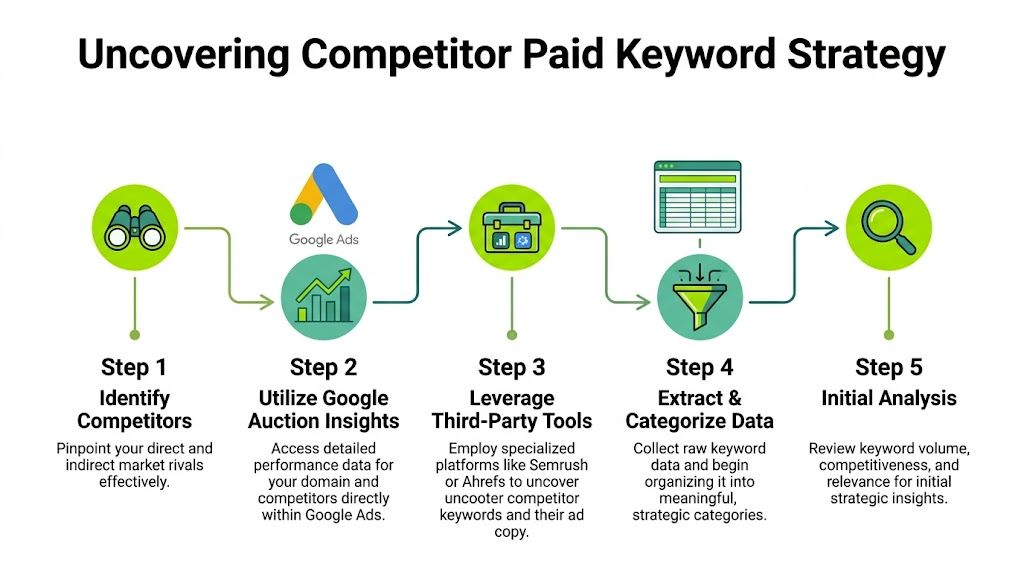
A competitor keyword file should be built like an intelligence brief. Not a scrape dump. Not a one-tool export. A real working document that tells you who you’re competing with, what they buy, and where their strategy is thin.
Start with SERP competitors, not boardroom competitors
Most accounts go wrong first here.
Your sales team may name three “main competitors.” Google may show five entirely different domains on the searches that make you money. In PPC, the SERP competitor matters more because that’s who takes the click.
If you sell SEO services, your true paid rivals might not be the agencies you mention in pitches. They may be publishers, software companies, or marketplaces that dominate the same commercial queries.
Build your list from three places:
- Google search results for your core commercial terms
- Auction Insights inside Google Ads
- Third-party tools like SEMrush, Ahrefs, and SpyFu
Use each one differently. Search results show who appears. Auction Insights shows who overlaps with you in live auctions. Third-party tools help expand the picture beyond the searches you currently buy.
Pull data from Google before you trust external tools
Google Ads gives you the cleanest first signal because it reflects your own market overlap.
Check Auction Insights on campaigns and ad groups tied to your highest-intent non-brand terms. You’re looking for patterns, not one-off appearances. If the same domains show repeatedly, move them into your competitor set.
Then review your own search terms reports. Competitor pressure often shows up there before it shows up in strategy decks. A term may look generic on paper but function like a competitive battleground in practice because several brands crowd it.
Use SEMrush, Ahrefs, and SpyFu for different jobs
Each tool gives a different angle.
SEMrush for ad copy and paid positions
SEMrush is useful when you want to see which paid keywords trigger ads, the landing pages attached to them, and what ad messaging keeps repeating. Its Advertising Research view is especially strong for understanding themes across a competitor’s account.
Watch for:
- repeated benefit claims
- repeated CTA language
- dedicated comparison or alternative pages
- clusters around pricing, demos, reviews, or integrations
Ahrefs for gap discovery
Ahrefs helps surface paid keyword gaps and estimate where rivals may be getting traffic from their bids. It’s handy when you already know the core category but need to find overlooked terms around sub-features, use cases, or niche intent.
SpyFu for expansion
SpyFu is often useful for widening the list, especially when you want more branded and adjacent terms to review manually. It shouldn’t be your only source, but it can help you spot patterns you missed.
If you want another practical walkthrough on finding competitor PPC keywords, that guide is worth scanning for tactical ideas on discovery workflow.
Build one master sheet, then categorize immediately
Don’t leave keyword exports raw. Categorize them as soon as you pull them.
A workable structure looks like this:
| Category | What goes in it | Why it matters |
|---|---|---|
| Core non-brand | Generic transactional terms | Shows direct category competition |
| Competitor brand | Brand names only | Usually high cost and mixed intent |
| Comparison | alternatives, vs, reviews, pricing | Often strongest buying signal |
| Feature-led | use case or capability terms | Good for differentiated offers |
| Long-tail | narrower multi-word phrases | Often cleaner intent and less waste |
| Defensive | your own brand plus modifiers | Protects demand from rival poaching |
This is also the point where a dedicated research workspace helps. A toolset like https://surnex.io/seo-suite/keyword-research is useful when you want keyword discovery and grouping in one place instead of juggling exports.
Don’t keep every keyword because a tool found it. Keep the ones that match a specific buyer stage.
Look at ad copy and landing pages, not just keywords
A competitor’s keyword list tells you where they show up. Their ad and landing page tell you what they think converts.
Review each rival’s visible pattern:
- Are they selling low price or premium quality?
- Do they push support, setup speed, integrations, or guarantees?
- Do they send comparison traffic to dedicated pages or generic pages?
- Are they attacking a market leader directly or skirting around the name?
That tells you where to challenge and where to avoid. If a competitor owns a message because it’s their strength, don’t echo it. Move to the weakness.
Don’t ignore the economics of overlap
A Pixis analysis of nearly $1 billion in ad spend reported that average search CPC reached $5.26 across industries by March 2025, driven largely by overlapping keyword competition. That’s why sloppy competitor targeting gets expensive fast.
Long-tail terms matter here. They usually reveal narrower intent, cleaner expectations, and more room to differentiate.
A simple discovery routine
Use this weekly or biweekly:
- Review Auction Insights for overlap changes.
- Export paid keyword sets from SEMrush, Ahrefs, or SpyFu.
- Tag keywords by intent before they ever enter Google Ads.
- Capture ad copy themes and landing page angles.
- Mark weak spots where rivals overpromise, underspecify, or send traffic to poor pages.
That gives you something usable. Not just a spreadsheet. A map.
From Raw Data to Actionable Intelligence
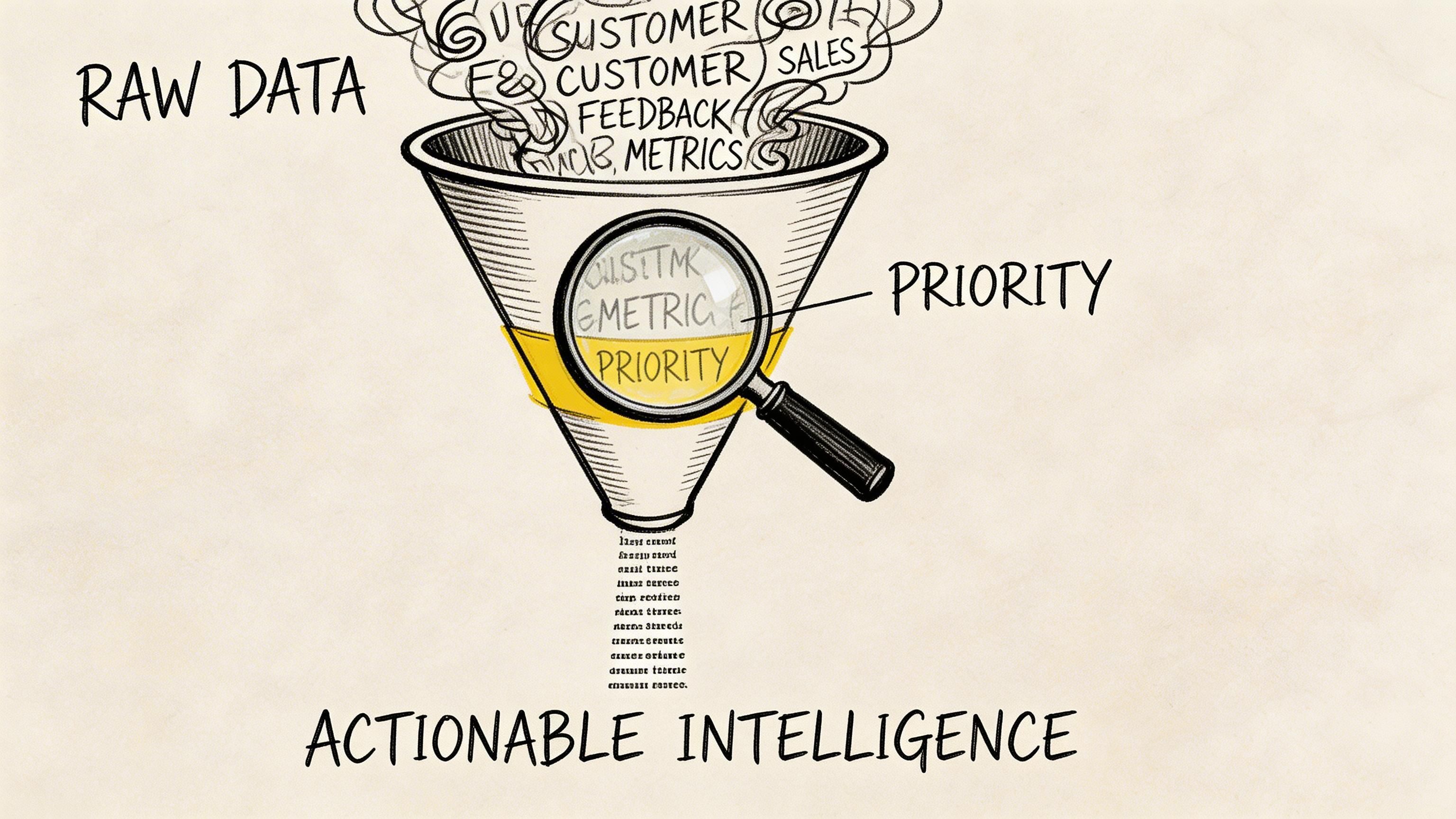
A giant list of competitor terms feels productive. It isn’t. Until you rank those terms by intent, weakness, and fit, the file is just clutter.
Intent beats volume in competitor campaigns
Competitor keyword work rewards discipline. The strongest terms are rarely the broadest. They’re usually the searches typed by someone evaluating options right before a decision.
That’s why uncertainty modifiers matter so much.
A verified example from LowFruits notes that bidding on searches like “[competitor] alternatives” or “[competitor] reviews” can bring in higher-quality leads, and cites Monday.com using this tactic against Salesforce.
Those searches matter because the user has already narrowed the category. They’re not learning what the product type is. They’re trying to decide who to trust.
Sort your list into decision-stage buckets
Most raw exports improve once you force them into a short framework.
Comparison intent
This is your highest-priority bucket in many accounts.
Examples include:
- competitor alternatives
- competitor vs your brand
- competitor pricing
- competitor reviews
- competitor for [specific team or use case]
These searches often justify dedicated ad groups, custom ad copy, and dedicated landing pages.
Problem-driven switching intent
Some users search because they’re frustrated.
This bucket often includes terms related to setup issues, support, contract pain, missing features, or migration concerns. You won’t always target these directly in ads, but they should inform your copy.
If reviews repeatedly say a rival is slow to support onboarding, your ad angle shouldn’t be “best platform.” It should be a concrete promise around support and implementation.
Broad rival brand intent
This is the noisiest bucket.
A plain competitor brand search can include customers looking for login pages, current users needing support, job seekers, investors, or people trying to reach the company. That doesn’t make it useless, but it does make it risky. These terms often need tighter match control and stronger exclusions.
Validate with real weakness signals
Keyword tools tell you what competitors target. Reviews, forums, SERPs, and landing pages tell you why buyers hesitate.
Look for repeated complaints and gaps such as:
- weak customer support
- missing integrations
- confusing pricing
- slow setup
- poor fit for certain team sizes
- limited reporting
- rigid contracts
Then turn those gaps into ad themes and landing page proof.
A competitor keyword is only valuable when you can answer the user’s hidden objection better than the competitor can.
This is also where monitoring matters. Search behavior and competitor pages change. A workflow like https://surnex.io/workflows/rank-monitoring-and-changes helps track shifts in visibility and page movement so your prioritization doesn’t age out.
A practical scoring model
You don’t need a complicated formula. Use a simple priority score with three questions:
| Filter | High priority if | Low priority if |
|---|---|---|
| Intent | Search suggests evaluation or purchase | Search is vague or informational |
| Fit | Your offer clearly beats the competitor on a real point | You can’t honestly claim an advantage |
| Page readiness | You can send traffic to a tailored page | Traffic would hit a generic homepage |
If a term scores high on all three, test it. If it scores high on only one, hold it.
What to cut from the list
Experienced teams delete more than they keep.
Cut keywords when:
- the user likely wants the competitor specifically
- the search intent doesn’t match your product
- your only angle is “we also do this”
- legal or brand risk outweighs the upside
- there’s no landing page built for comparison traffic
That last point matters more than people think. Comparison traffic is skeptical by default. Sending it to a generic homepage wastes the click.
Turn findings into creative briefs
Before launch, convert your priority list into short briefs for execution.
Each brief should include:
- target keyword cluster
- user intent
- competitor being challenged
- weakness to exploit
- ad angle
- landing page angle
- exclusions or negatives to protect relevance
That process sounds simple because it is. The difference is that it forces every keyword to earn its place. Once you do that, competitor keywords adwords stop being an expensive curiosity and become a controlled acquisition channel.
Launching Your Counter-Offensive in AdWords
Many accounts lose discipline here. The research is solid, the opportunities are real, and then the campaign build gets sloppy.
They combine competitor terms with generic acquisition. They let broad match roam. They write soft ad copy that says nothing. Then they blame the tactic.
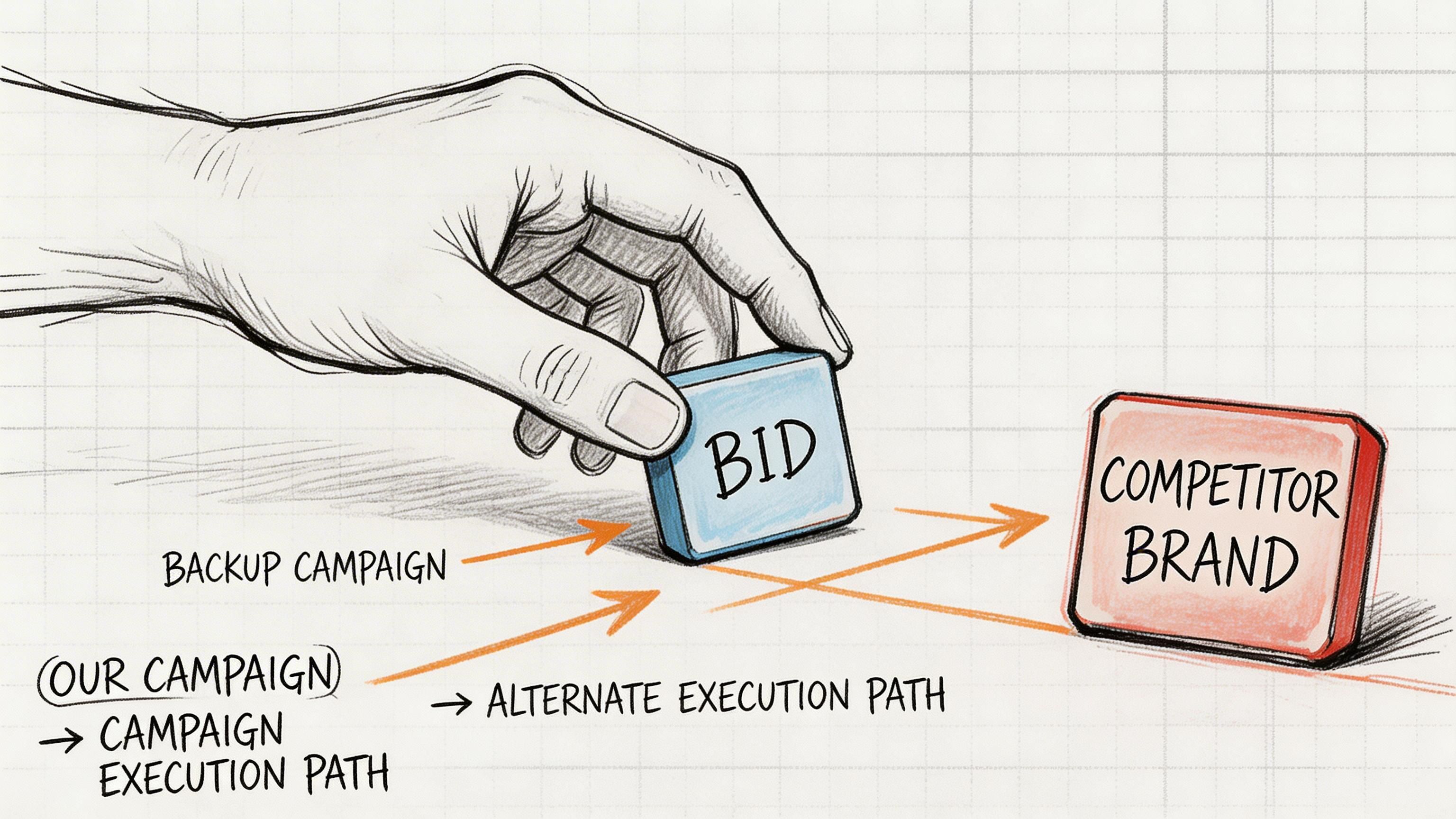
Bid surgically, not emotionally
Bidding on a competitor’s brand can work. It can also become a vanity exercise that burns budget while making the account harder to read.
The mistake is treating every competitor term as equally important. They aren’t.
Best practice is usually to separate competitor campaigns completely from your generic campaigns. Keep budgets, match types, search terms, ad copy, and landing pages isolated. That gives you clean reporting and lets you cut waste without touching your broader acquisition engine.
Match type is where discipline shows up
Competitor campaigns are one of the clearest cases for staying tight.
Verified data from One Base Media shows that mixing exact and phrase match can lift CTR by 15-25% and ROAS by 1.5-3x in enterprise accounts, while broad match can trigger irrelevant queries that cut conversions by 30-50%.
That aligns with what seasoned PPC teams already know. Competitor traffic is fragile. Relevance matters more here than in many generic campaigns.
What to use first
- Exact match for direct, high-intent comparison terms
- Phrase match for controlled expansion around review, pricing, and alternative searches
- Broad match only after you’ve built strong negatives and understand the search-term behavior
Field note: If you launch competitor keywords adwords on broad match from day one, you’re not testing the tactic. You’re testing Google’s guesswork.
Structure campaigns around intent, not around brands alone
A weak structure lumps all rival terms into one campaign with one ad group per competitor. That seems organized, but it hides the reason people searched.
A better structure groups by intent class:
Alternative and switcher terms
These deserve the most custom treatment. Searchers are actively comparing and are often open to a change.
Pricing and value terms
These users are evaluating cost, contract shape, or bundled value. Your ad copy should address economics directly if that’s your edge.
Review and proof terms
These users want validation. Send them to pages with evidence, not slogans.
Generic rival brand terms
Treat these carefully. Use tighter budgets and stronger negatives because intent is mixed.
Ad copy should challenge, not mimic
The worst competitor ads try to sound like the brand being searched. That creates confusion, weak CTR quality, and compliance risk.
Your ad copy should do three things:
- State who you are clearly
- Acknowledge the comparison intent
- Lead with one specific advantage
Good angles often come from weakness-based positioning:
- faster onboarding
- clearer pricing
- stronger support
- better fit for certain company sizes
- easier migration
- more flexible contracts
Avoid vague claims like “best solution” unless the page proves it immediately.
The landing page does most of the work
Competitor traffic is skeptical and comparison-minded. A homepage rarely closes that gap.
A dedicated page works better because it can continue the exact story from the ad:
- headline that matches the comparison intent
- side-by-side explanation without deception
- proof points tied to the user’s likely objection
- CTA that fits evaluation, such as demo, trial, consult, or migration review
A clean comparison page can also lower friction for compliance and brand clarity. The user knows who they clicked. Google sees stronger relevance. Your conversion rate usually benefits from the tighter message match.
Know the trade-offs before you bid on brand names
Here’s a practical comparison table for common approaches.
| Strategy | Description | Best For | Risk/Cost |
|---|---|---|---|
| Defensive own-brand bidding | Bid on your own brand and core modifiers to protect branded demand | Brands seeing competitor encroachment on their name | Lower risk, but adds spend to traffic you may already capture organically |
| Direct competitor brand bidding | Bid on a competitor’s brand name alone | Mature advertisers testing aggressive conquesting | Mixed intent and potentially expensive traffic |
| Modifier-based competitor bidding | Target terms like alternatives, reviews, pricing, and vs | Teams with clear differentiation and tailored pages | Stronger relevance, but needs careful ad and page alignment |
| Feature-led conquesting | Target use-case terms where your offer beats a rival | Products with a real edge in a niche workflow | Requires sharper segmentation and proof |
| Broad conquesting | Use broad match around competitor themes | Rarely the first move | Highest waste risk if not heavily controlled |
A short walkthrough can help anchor campaign mechanics before rollout.
Negatives are not optional
Competitor campaigns often fail because of neglected negatives, not because the keywords were wrong.
Add negatives aggressively for:
- jobs and careers
- login and support intent
- free downloads if you don’t offer them
- documentation intent
- unrelated product lines
- brand confusion from close variants
Review negatives regularly. Old negative lists can also block good terms, so keep them audited.
Don’t use one success metric
If you judge competitor campaigns only by last-click CPA, you may kill terms that influence serious buyers earlier in the comparison cycle.
Watch a mix of signals:
- search-term quality
- CTR quality
- assisted conversions
- landing-page engagement
- conversion rate by intent cluster
- branded search lift after sustained visibility
The right way to launch a counter-offensive isn’t louder spend. It’s tighter intent, cleaner structure, and sharper messaging.
The New Frontier Competitor Analysis in AI Search
Traditional PPC intelligence no longer shows the full battlefield. Competitors can shape discovery before a user ever clicks an ad.
That shift matters because buyers now encounter brands inside AI-generated summaries, recommendation-style answers, and LLM-driven research flows. If your competitor shows up there and you don’t, your Google Ads reports won’t fully explain the loss.
Why AI visibility changes competitor research
An Exploding Topics reference highlights an important blind spot: AI Overviews influence 30-40% of queries in major markets, and AI visibility tracking can reveal where competitors appear in AI results even when traditional AdWords analysis misses the pattern.
That changes how you should think about competitor keywords adwords.
A competitor may dominate:
- the paid ad auction
- the organic result set
- the AI Overview citation layer
- follow-up discovery in LLMs
If you inspect only one of those, your diagnosis will be incomplete.
Search visibility is no longer one report. It’s a combined view of ads, organic rankings, AI summaries, and brand mentions across assisted discovery.
What unified search intelligence looks like
A modern workflow connects three views of the same topic:
| Layer | What you check | What it tells you |
|---|---|---|
| Paid search | competitor bids, ad copy, landing pages | where they buy attention |
| Organic search | ranking pages, topic coverage, supporting content | where they earn demand |
| AI search | citations, overview presence, repeated brand mentions | where they shape shortlist formation |
This matters most for long-tail, high-intent searches. Many specific queries now trigger some form of AI response before a user clicks deeper. That creates openings for marketers willing to track the overlap.
A visibility view like https://surnex.io/ai-search/ai-visibility makes sense in that context because it lets teams inspect AI appearance alongside more familiar search metrics instead of splitting the work across disconnected tools.
Where the practical opportunity sits
The best opportunity is often not “replace your PPC process with AI.” It’s use AI visibility as an extra filter for prioritization.
For example:
- If a rival bids on a term but doesn’t appear in AI summaries, that may be a content and credibility gap you can exploit.
- If a topic appears heavily in AI results but has weak paid competition, it may be a low-friction test area.
- If comparison queries trigger both ads and AI citations, you need ad copy and landing pages that align with the informational framing users already saw.
A stronger review routine
Add these checks to your competitor research cycle:
- Track brand presence across AI Overviews and related experiences
- Compare AI citations against paid keyword clusters
- Look for overlap gaps where no clear winner exists
- Create pages for specific comparison intent that can support both ad traffic and AI citation potential
Teams gain an edge early here. PPC-only reporting explains the click. Unified visibility explains the journey that produced it.
Building a Sustainable Competitive Edge
The useful version of competitor analysis is repetitive by design.
You research. You validate. You launch. You measure. Then you do it again with better exclusions, sharper pages, and a clearer view of where buyers compare options.
Keep the loop simple
A sustainable workflow usually looks like this:
- Research the actual SERP and auction competitors
- Validate intent before adding terms to campaigns
- Act with dedicated ad groups, controlled match types, and specific landing pages
- Measure search terms, conversion quality, and message fit
- Repeat after every meaningful market shift
That loop matters because competitors don’t stand still. They change copy, budgets, pages, offers, and positioning. AI-generated discovery adds another moving layer on top.
What durable advantage actually looks like
It isn’t winning one auction. It’s building a system that keeps finding profitable gaps.
That system gets stronger when your team can answer these questions quickly:
- Who is taking share on our key buying searches?
- Which comparison terms deserve dedicated spend?
- What weaknesses can we credibly own in ad copy?
- Where are competitors showing up in AI-led discovery before the click?
The strongest search programs don’t chase every rival move. They react selectively and with evidence.
That’s the key takeaway for competitor keywords adwords in 2026. The brands that win won’t be the ones collecting the most competitor data. They’ll be the ones turning that data into faster decisions across paid search, landing pages, and AI visibility.
Frequently Asked Questions
Is it legal to bid on competitor brand names in Google Ads
In many markets, advertisers do bid on competitor brand terms. The key issue is usually whether the ad is deceptive or improperly uses trademarked language in the ad copy. This is a business and legal judgment, not just a PPC decision, so it’s smart to review risk with counsel before rolling out aggressive conquest campaigns.
How much budget should I put into competitor campaigns
Start small and isolate the budget. Competitor campaigns behave differently from generic search campaigns, so they need their own testing lane. Give them enough spend to generate meaningful search-term and conversion data, then scale the parts that show clear intent and strong page fit.
Will competitor keywords always increase CPC
Not always, but they often create tougher auctions and lower relevance than your own brand or tightly aligned non-brand terms. Costs can rise quickly when multiple advertisers overlap on the same buying searches. That’s why tight match types, negatives, and optimized landing pages matter so much.
Should I bid on a competitor’s brand name or only modifier terms
Modifier terms are usually the cleaner starting point. Searches like alternatives, pricing, reviews, and comparisons often show stronger evaluation intent than a plain brand search.
If your team needs a clearer view of how competitors show up across both traditional search and AI-driven discovery, Surnex is built for that job. It helps agencies, in-house teams, and technical operators track AI visibility, rankings, backlinks, and search performance from one place so competitor analysis becomes a repeatable system instead of a spreadsheet exercise.