You're probably in one of two situations right now. Either Google results feel more crowded than useful, or you're trying to understand whether ad free search engines matter for SEO and brand visibility at all. Both are fair questions.
The search market is still overwhelmingly shaped by ad-funded platforms. In April 2026, Google held 90.02% of worldwide search engine market share, which tells you why most search experiences are built around ads, scale, and monetization first. Ad free search engines sit outside that model. They usually fund themselves through subscriptions, privacy-first services, token access, or open-source communities instead of the usual ad auction.
That difference changes the product. It also changes the audience. People who choose these tools often care more about cleaner results, privacy, source control, and less commercial noise than raw mainstream convenience. If you're also tightening your broader privacy setup, this guide to online privacy is a useful companion.
From a strategist's perspective, the bigger takeaway is this: these engines won't replace Google for most brands, but they can shape discovery in niche, high-intent, and research-heavy moments. That matters more now because search behavior is fragmenting across classic search, AI interfaces, and privacy-led alternatives.
1. Kagi Search
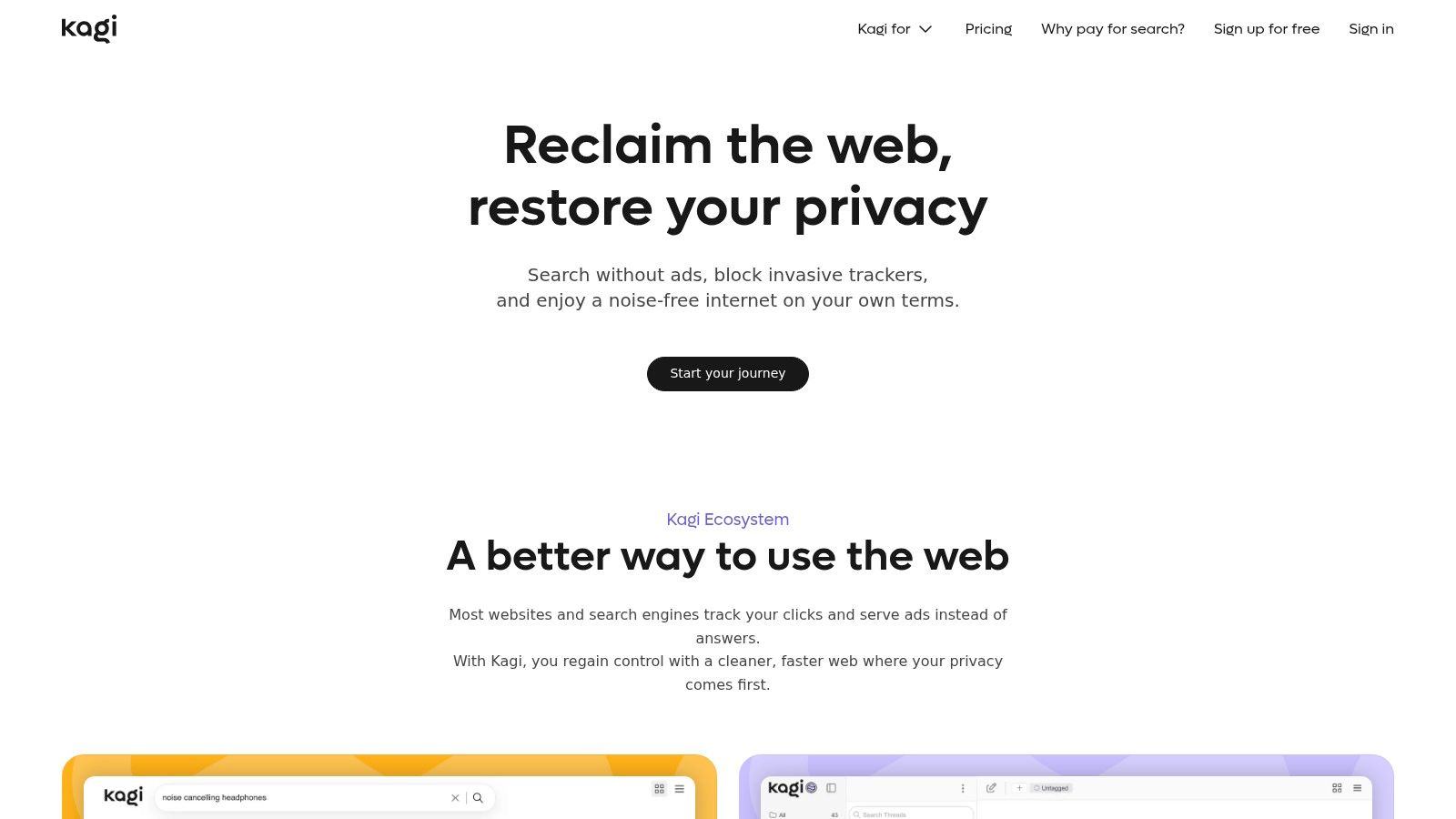
Open Kagi after spending a day inside Google and the shift is immediate. The page is quiet, the results feel less crowded, and research goes faster because commercial modules are not competing for attention.
Kagi Search is one of the clearest examples of a search engine built for paying users instead of advertisers. In practice, that changes more than the interface. It changes what the product is trying to optimize for. Kagi can focus on search quality, filtering, and user control because subscription revenue does not depend on pushing sponsored placements into the page.
That control is Kagi's real advantage. Domain boosts, blocks, and Lenses let you tune results around how you work. For analysts, SEOs, founders, and developers who run dozens of queries a day, that has clear value. You spend less time clearing out weak sources and more time comparing credible ones.
Where Kagi stands out
Kagi fits heavy-search workflows better than casual browsing. I see the strongest fit with people doing repeat research, brand checks, competitive analysis, and source discovery.
- User-funded business model: Kagi's own pricing page lays out paid plans directly, which makes the trade-off easy to evaluate before you commit.
- Result customization that affects daily workflow: Blocking low-trust domains and boosting strong ones sounds small until you use it for a week. Then it becomes hard to give up.
- Useful for visibility checks outside ad-heavy SERPs: Kagi is a smart reference point when you want to see how a brand appears in a cleaner environment with different ranking cues.
Practical rule: If search is part of someone's job, a paid engine can cost less than the hours lost to noisy results.
The trade-off is straightforward. Kagi is a paid product after the trial, so the value shows up fastest for people with a clear research workflow. Casual users may not feel enough improvement to justify another subscription. Fresh or highly niche queries can also be uneven, which is common with smaller search products.
For SEO and brand visibility, Kagi matters less as a traffic engine and more as a signal check. It can reveal whether your site earns trust when ads and aggressive commercial ranking factors are stripped back. I treat it as part of a broader visibility review alongside AI interfaces and alternative discovery channels. If your team already monitors how brands surface in conversational search, this guide to ChatGPT visibility tracking fits naturally into the same workflow.
2. Brave Search
Brave Search is the ad-free option I recommend most often to people who already live inside the Brave browser. The free version still includes ads, but the Premium path removes them while keeping Brave's privacy-first positioning.
What makes Brave more important than many niche tools is index independence. Brave says it is the only global, private, independent search engine built on its own index, and that matters because independent indexes tend to create different visibility patterns than engines that repackage Bing or Google.
Best-fit use cases
Brave works well for users who want privacy without jumping into a fully unfamiliar search environment. It feels closer to mainstream search than some experimental engines, which reduces the learning curve.
- Independent infrastructure: That's the big story with Brave. It's not just a cleaner interface. It's a separate retrieval layer.
- Goggles feature: Community-curated ranking views are useful if you want to reshape what “relevant” means for certain query types.
- Developer-friendly ecosystem: The API and broader Brave tooling make it more practical for technical teams than many privacy-first engines.
A limitation is that Premium ad-free search works within the Brave browser experience, so it's not as universal as some users expect. If your team is spread across multiple browser preferences, that can slow adoption.
Brave is one of the few engines where “alternative search” can still feel operationally normal for a non-technical team.
For brand visibility, Brave deserves attention because independent indexes can highlight gaps that Google-centric reporting misses. If your brand is well-optimized for Google but weak in source diversity, Brave may expose that. Teams already tracking ChatGPT visibility often benefit from checking Brave too, because both environments reward cleaner source patterns more than pure legacy SEO habits.
3. Swisscows Pro
Swisscows Pro is a practical choice if you want an ad-free search experience but don't need deep power-user customization. Its core appeal is simple: privacy posture, family-friendly defaults, and straightforward controls for hiding or demoting domains you don't want cluttering results.
That domain control matters more than it may seem. For many users, a significant problem with search isn't only ads. It's seeing the same low-value publishers, junk affiliate pages, or sensational sources repeated across every query.
What works well
Swisscows Pro is easiest to recommend in households, schools, and small teams where a calmer search experience matters more than maximum index breadth. It also helps people who want fewer knobs than Kagi but still want some say over result quality.
- Cleaner paid experience: The Pro tier removes ads and adds more personalization.
- Simple source management: Hiding or downranking domains is useful for everyday search hygiene.
- Privacy-forward positioning: That remains the product's main appeal.
The trade-off is dependence. In some locales and query classes, Swisscows relies on Bing-assisted indexing, which means you're not always getting a fully independent view of the web. That doesn't make it bad. It just makes it less interesting if your goal is discovering distinctly different result sets.
From an SEO standpoint, Swisscows is less important as a standalone channel and more useful as a diagnostic lens. If your brand performs poorly in environments that lean on external indexes plus strong filtering, that usually points to authority, crawlability, or source trust issues rather than ad optimization problems. It's a better fit for testing resilience than for chasing volume.
4. MetaGer
Open a search tool on a shared laptop, a work VPN, or a browser you do not want tied back to your identity, and MetaGer's model starts to make sense fast. MetaGer uses MetaGer Key for ad-free anonymous search, so access is not built around the usual account-and-subscription setup.
That trade-off is real. A flat monthly plan is easier to explain and easier to budget for. MetaGer asks users to accept a token system in exchange for less account linkage, which is a fair swap for privacy-sensitive researchers, journalists, and users who want cleaner search without building another profile somewhere else.
Why MetaGer is different
MetaGer is a metasearch engine. Its results come from combining upstream sources rather than ranking against one tightly controlled proprietary index. In practice, that gives it a different kind of value than Kagi or Brave. Breadth can be solid on general queries, but consistency shifts by topic, and some result sets feel more like a privacy-filtered blend than a distinct editorial view of the web.
MetaGer's funding changes also matter. As noted earlier in the article, the service moved away from ad-supported economics toward tokenized access. That matters because it reflects a broader market reality. If a search engine strips out ads, tracking, and aggressive monetization, it still needs a credible way to pay for infrastructure.
- Anonymous access: Useful for users who want search activity decoupled from a persistent account.
- Practical platform coverage: Browser, web, and app access make it workable across devices.
- Privacy-first design: This is the main reason to choose it, not raw index independence.
I would not treat MetaGer as a major traffic channel. I would use it as a visibility check.
For SEO and brand monitoring, MetaGer is helpful because it reduces some of the personalization and commercial bias that can hide weak discoverability. If your brand disappears or slides badly here, that often points to poor entity recognition, weak source authority, or overreliance on paid visibility elsewhere. It also fits well into broader tracking of AI search behavior and discovery trends, especially if your team is trying to understand how brand presence holds up outside the standard Google ad-driven path.
5. GOOD Search
GOOD Search is one of the clearest examples of how the category is changing. Older privacy search narratives often implied you could get a clean, ethical, ad-free engine at no meaningful cost. That's getting harder to sustain.
GOOD moved from free to paid in late 2024, according to category coverage, and that shift says a lot about where the market is heading. “Ad-free” increasingly means “subscriber-funded” rather than “free but somehow sustainable.”
What to expect
GOOD is a reasonable option for users who want a simple, low-friction paid search tool with a mission-driven angle. It emphasizes privacy, cleaner results, and a more explicit explanation of how the service is funded.
The weakness is index dependence. GOOD currently uses independent index feeds rather than operating a fully self-built web index, so result quality is tied to upstream sources. For many users, that's fine. For strategists, it means GOOD is better viewed as a refined interface and business-model alternative than as a separate map of the web.
- Clear revenue logic: Subscription support makes the ad-free promise more believable.
- Clean experience: The product feels focused and uncluttered.
- Best for values-led users: It tends to resonate with people who care about the model as much as the interface.
If I'm auditing search exposure for a brand, I don't treat GOOD as a must-track engine on its own. I treat it as evidence of a broader market shift. The essential question isn't only whether a tool has ads. It's whether the business can keep operating without falling back into surveillance advertising later.
6. SearXNG
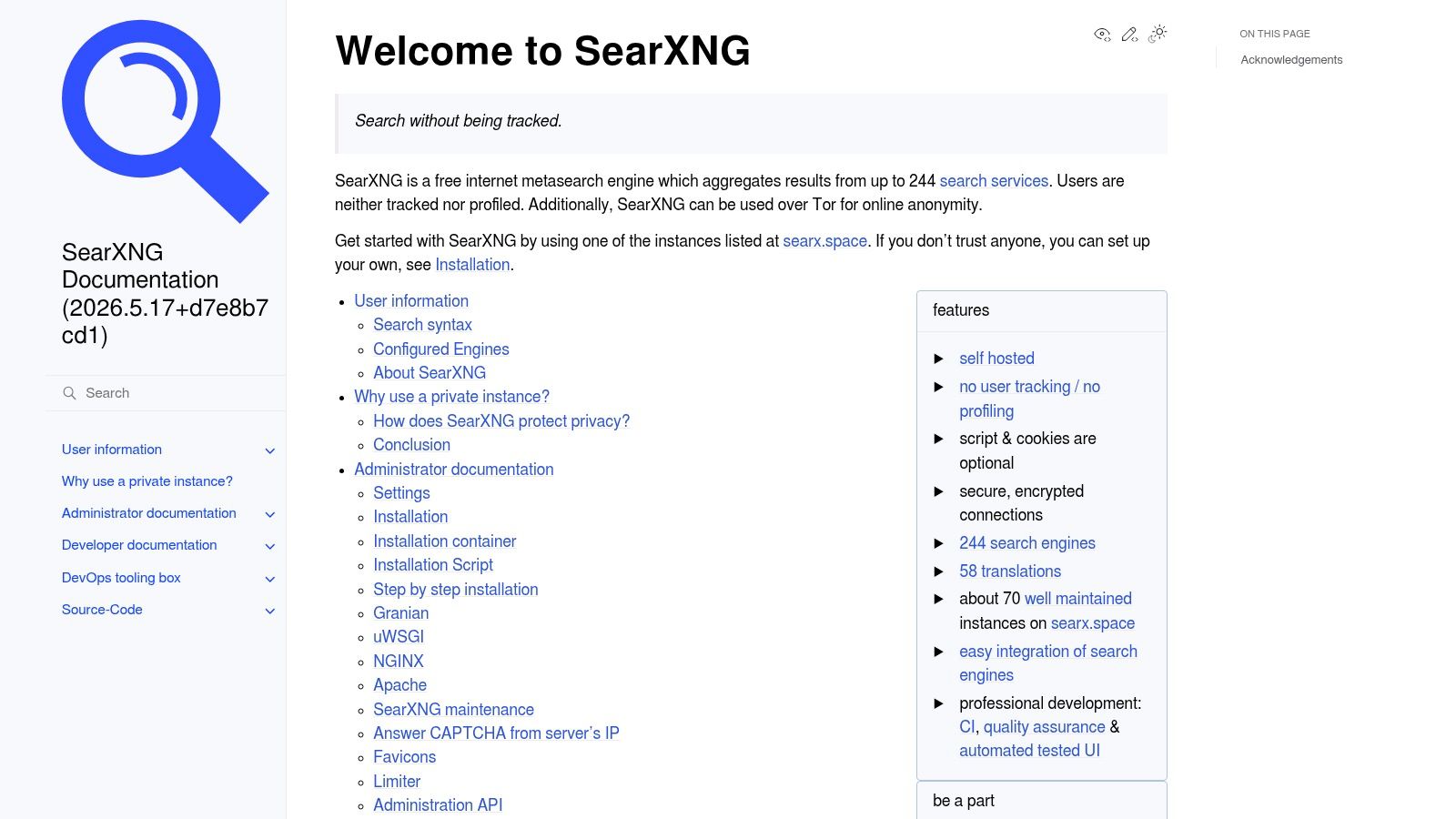
SearXNG is what I recommend when someone says, “I want ad-free search, but I also want to control the stack.” It's open source, usually ad-free in practice, and highly configurable. That makes it less of a product and more of a framework for building your own search experience.
For technical teams, that's the appeal. For general users, it's often too much work.
Where SearXNG shines
SearXNG aggregates many sources and lets you control which engines and categories contribute to your results. That flexibility is useful for research workflows, internal tools, privacy-conscious browsing, and custom vertical search setups.
- Open-source codebase: You can inspect it, run it, and adapt it.
- Source-level control: Per-source toggles are excellent for custom research workflows.
- API output: Useful if you want search results inside another application or dashboard.
The downside is consistency. Public instances vary. Source availability varies. Result quality also changes based on how the instance owner configures upstream engines.
Operator note: SearXNG is excellent when someone on your team is willing to own it. It's much less excellent when nobody wants the maintenance burden.
From an SEO and brand-monitoring perspective, SearXNG is valuable because it shows how your presence holds up across mixed-source retrieval. If your pages only perform when one major engine favors them, SearXNG often exposes that fragility fast. It's one of the better testing environments for teams building custom intelligence workflows around search data.
7. Whoogle Search
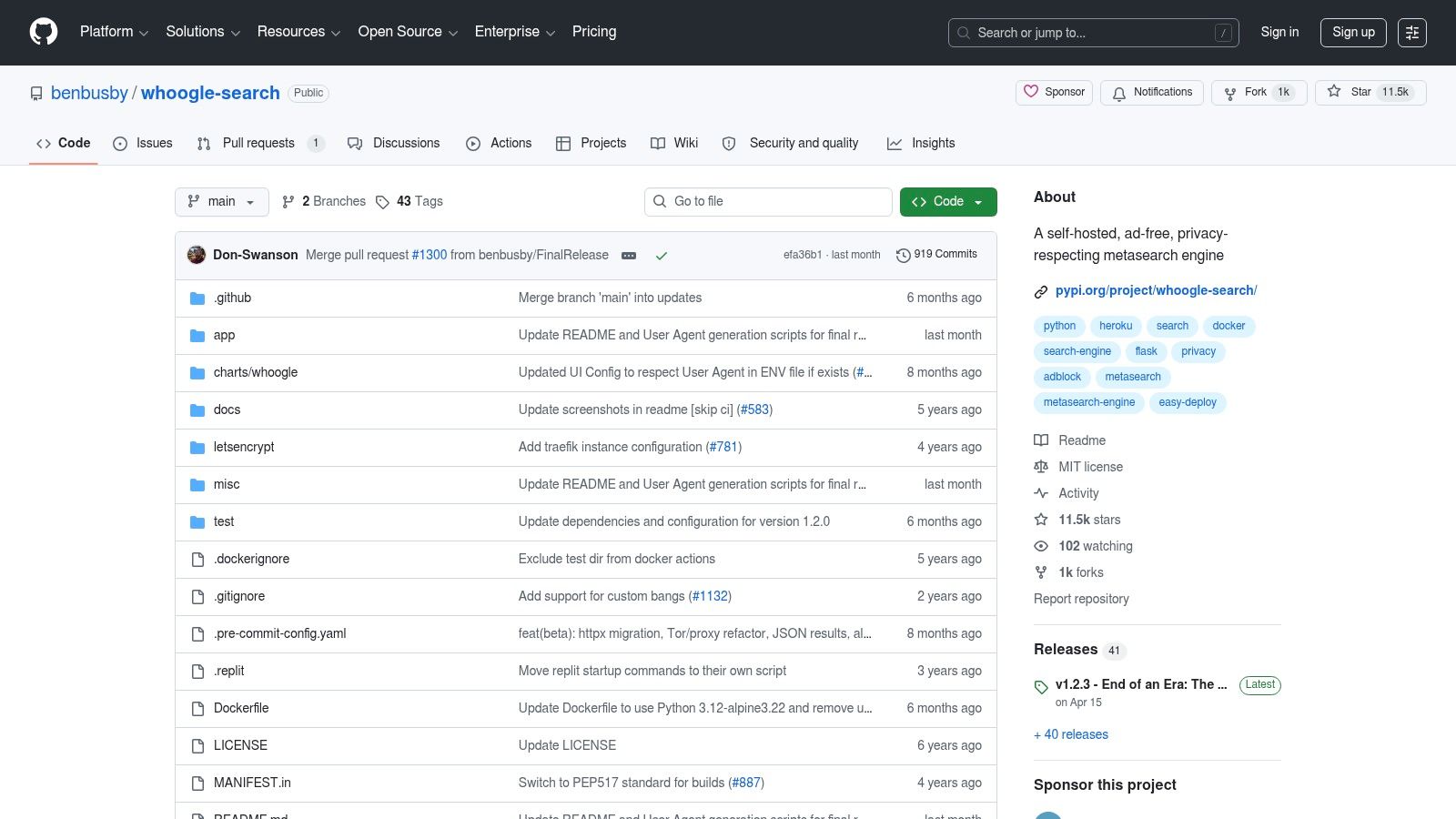
Whoogle Search solves a very specific problem. Some users want Google-style results without the surrounding ads, tracking, JavaScript overhead, AMP layers, and cookies. Whoogle acts as a self-hosted proxy for that experience.
When it works, it's elegant. You get familiar relevance with far less clutter. When it breaks, it usually breaks because the upstream provider doesn't love being proxied.
The real trade-off
Whoogle is for technical users. If you're comfortable with Docker and basic self-hosting, it's relatively easy to deploy. If you're not, it's probably the wrong tool.
The maintenance picture also matters. The project issued a final release notice in April 2026, so while the code and images remain available, you shouldn't treat it like an actively evolving product with ongoing official support.
- Best part: Familiar Google-style output without ads.
- Main risk: Reliability depends on upstream tolerance and your own hosting setup.
- Who should use it: Developers, privacy tinkerers, and teams running controlled internal instances.
For SEO work, I use Whoogle more as a comparative lens than a primary search destination. It can help isolate what your content looks like when classic Google relevance is stripped away from paid placements and personalization layers. But because it depends on an upstream service and a now-static maintenance path, it isn't something I'd build a core workflow around.
8. Marginalia Search
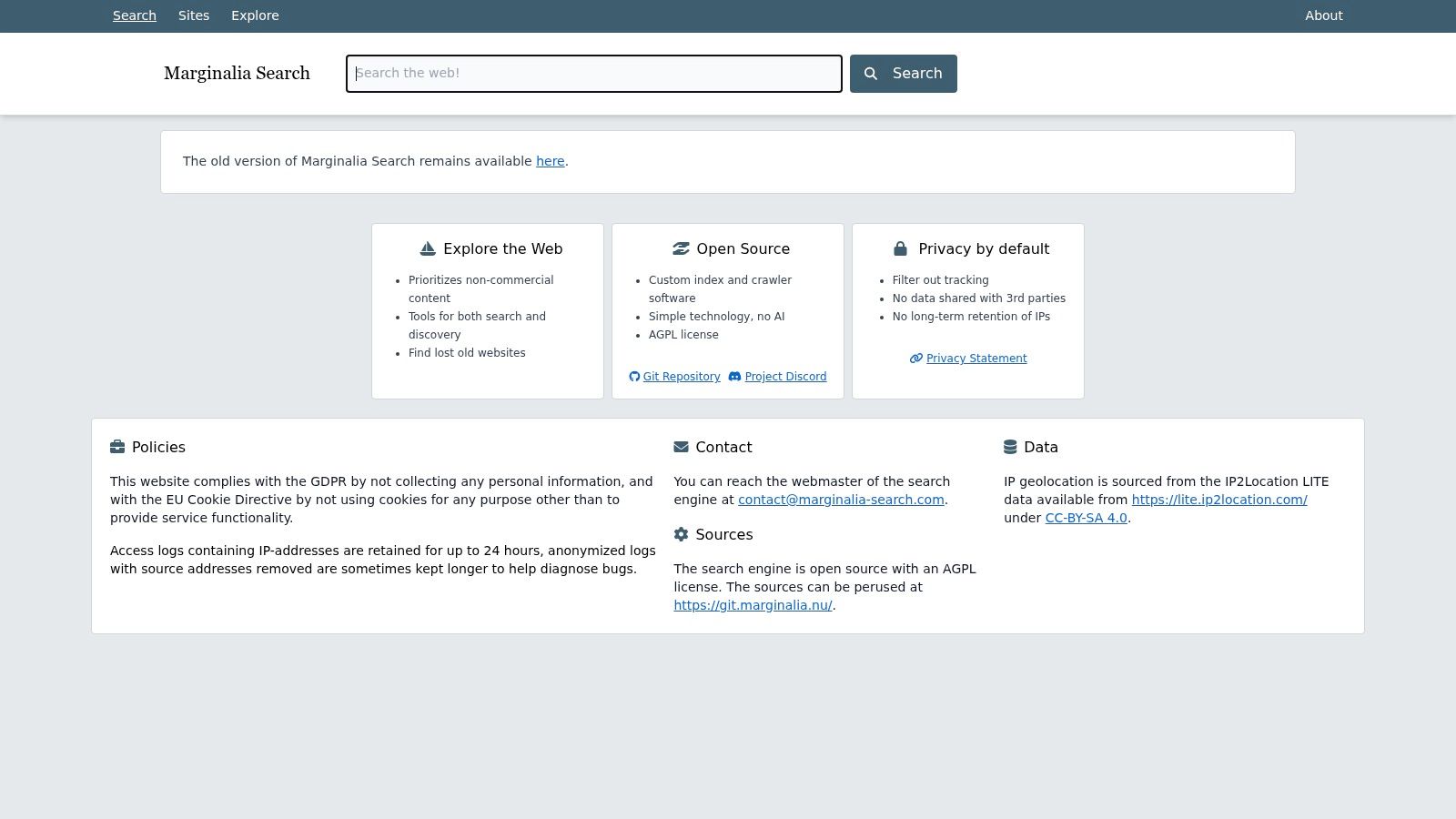
Marginalia Search is the most interesting engine on this list if you're tired of commercially optimized content. It doesn't try to be a general-purpose replacement for Google. It tries to surface the kinds of text-heavy, non-commercial, smaller websites that mainstream search often buries.
That makes it valuable for research, content discovery, and editorial exploration. It also makes it very revealing for marketers.
Why strategists should care
Marginalia shows what happens when commercial web patterns lose influence. Thin affiliate pages, JS-heavy clutter, and formulaic SEO publishing tend to matter less here than original, readable, informative content.
If your brand only wins when the search environment rewards scale and optimization mechanics, Marginalia won't flatter you. If your site publishes substantive material, it may surface surprisingly well.
- Great for discovery: Especially for niche topics and older web content.
- Clean by design: The interface is fast and focused.
- Not ideal for commerce-first intent: Product-heavy and very fresh topics can be weaker.
I wouldn't tell a client to optimize specifically for Marginalia. I would tell them to use it as a quality mirror. It highlights whether your content still deserves to be found when algorithmic attention shifts away from mainstream SEO patterns and toward genuine informational value. That's increasingly relevant across AI-led discovery too.
9. YaCy
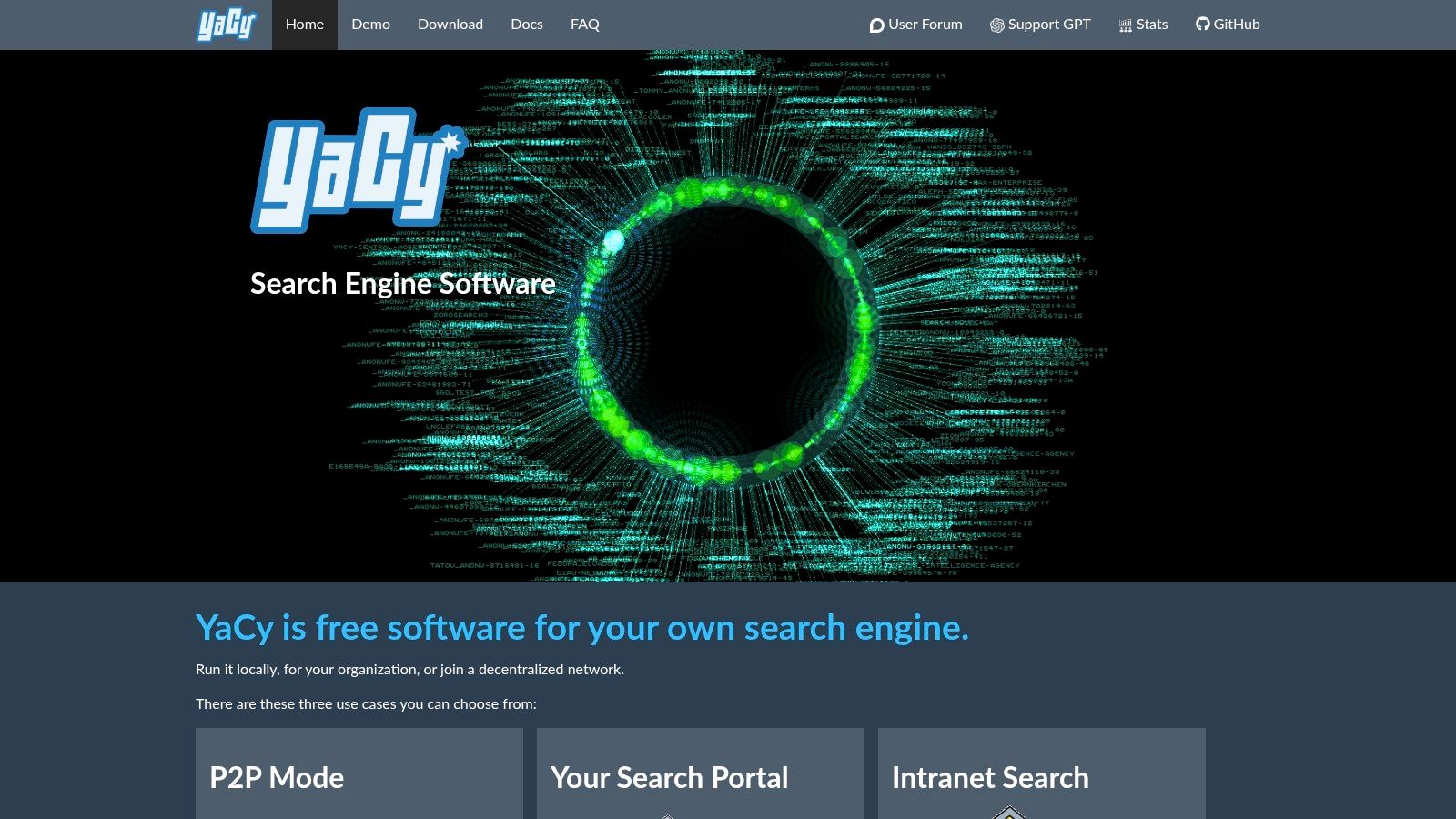
YaCy sits in a very different category from polished consumer search engines. It's decentralized, peer-to-peer, open source, and ad-free by design. Each node contributes to crawling and indexing, which means there is no single company sitting in the middle of the system.
That architecture is the point. People use YaCy because they want independence, censorship resistance, or a private search layer for an organization or research setup.
When YaCy makes sense
For normal web users, YaCy is overkill. For archivists, researchers, privacy communities, and teams building search inside controlled environments, it can be a smart fit.
- No central operator: That's its defining strength.
- Useful in private environments: Intranets and internal document discovery are good fits.
- Flexible access: Web interface and APIs make it adaptable.
The cost is complexity. Relevance, freshness, and administrative effort depend on how the network and your node are configured. This is not the engine you hand to a typical marketing team and expect instant adoption from.
Still, YaCy matters in any serious discussion of ad free search engines because it proves there are models beyond subscriptions and premium consumer plans. It's less about convenience and more about infrastructure choice. That distinction matters if you're thinking beyond surface UX and into how search is controlled in the first place.
10. Andi
Andi is the easiest recommendation on this list for people who want search to feel more like asking a smart assistant than using a classic results page. It's ad-free, conversational, and built around direct answers with citations.
That changes the interaction pattern immediately. Instead of opening ten tabs, you often start with a synthesized overview and only click out when you need to verify or go deeper.
Where Andi fits
Andi is strong for quick research, top-of-funnel learning, and exploratory questions. It's less reliable for very deep long-tail technical work, where smaller indexes and AI summarization limits become more obvious.
A broader shift in search behavior makes tools like this worth watching. HubSpot reports that nearly 24% of marketers are exploring SEO strategy updates for generative AI search, while over 92% plan to use SEO for both traditional and AI-powered search engines. That doesn't mean Andi is suddenly a mass-market search leader. It means search workflows are spreading across more interfaces.
- Best part: Fast, low-friction answer discovery.
- Useful feature: Reader mode keeps pages cleaner when you do click through.
- Watch-out: Long-tail depth can still lag larger search ecosystems.
Search visibility is no longer only about ranking blue links. It's also about whether your brand becomes part of the answer layer.
That's why Andi matters for SEO teams. If your content doesn't summarize well, cite well, or communicate authority clearly, AI-first search tools may underrepresent you. Monitoring that kind of presence alongside AI Overviews visibility gives you a more realistic picture of modern discovery.
Top 10 Ad-Free Search Engines Comparison
| Product | Core features ✨ | UX / Quality ★ | Price / Value 💰 | Target 👥 | Standout 🏆 |
|---|---|---|---|---|---|
| Kagi Search | Ad-free results, per-domain boosts/blocks, private AI assistant | ★★★★★, clean, consistent SERPs | 💰 Subscription; fair‑billing credits | 👥 Power users, devs, agencies | 🏆 Granular ranking control |
| Brave Search (Premium) | Independent index, Goggles, Search API, ad‑free with Premium | ★★★★, mature index, privacy‑focused | 💰 Low‑cost Premium (Brave browser) | 👥 Brave users, privacy fans, devs | 🏆 Community‑curated ranking |
| Swisscows Pro | Ad‑free Pro, domain demote/hide, personalization | ★★★, family‑friendly, privacy posture | 💰 Inexpensive subscription | 👥 Families, privacy seekers | 🏆 Simple domain demotion |
| MetaGer (MetaGer Key) | Token-based anonymous ad‑free access, no logging | ★★★★, strong anonymity, variable sources | 💰 Pay‑as‑you‑go tokens (no account) | 👥 Privacy/anonymity focused users | 🏆 Anonymous, cross‑device tokens |
| GOOD Search | Ad‑free for subscribers, privacy‑first, uses independent feeds | ★★★, clean SERPs, socially minded | 💰 Very low subscription; funds projects | 👥 Socially conscious users & orgs | 🏆 Subscription supports causes |
| SearXNG | 250+ sources, no logging, highly configurable, API | ★★★, flexible; quality varies by config | 💰 Free / self‑host or community instances | 👥 Technical users, self‑hosters | 🏆 Open‑source, multi‑source agnostic |
| Whoogle Search | Google‑style proxy, strips tracking/JS, self‑hostable | ★★, familiar results but fragile (rate limits) | 💰 Free / self‑host (Docker) | 👥 Technical users wanting Google UI | 🏆 Google‑like ad‑free experience |
| Marginalia Search | Indie crawler, surfaces non‑commercial/text‑heavy sites | ★★★★, fast, research‑friendly UI | 💰 Free / ad‑free | 👥 Researchers, archivists, explorers | 🏆 Surfaces non‑SEO content |
| YaCy | Decentralized P2P indexing, privacy by design | ★★★, censorship‑resistant; depends on network | 💰 Free (peer‑run) | 👥 Privacy advocates, intranet/site search admins | 🏆 Fully decentralized index |
| Andi | Conversational AI answers with citations, reader mode | ★★★★, chat‑style summaries, low clicks | 💰 Free to use (smaller index) | 👥 Users wanting quick AI overviews | 🏆 Conversational answers + citations |
Final Thoughts
Ad free search engines are still a niche category, but they're a meaningful niche. They exist because the dominant search experience was built around ads, tracking, and scale first. Alternatives are proving that search can also be funded by subscriptions, tokens, open-source communities, and privacy-led models.
That doesn't mean every tool here is equally practical. Kagi is the most polished paid option if you want a daily driver with strong ranking control. Brave Search is the easiest bridge from mainstream search into a cleaner, privacy-first setup. MetaGer, SearXNG, Whoogle, and YaCy each make sense for more specialized privacy or technical use cases. Marginalia is excellent when you want discovery beyond SEO-heavy publishing. Andi is where the category starts to blend with AI answer engines.
The biggest mistake I see teams make is treating these platforms as either irrelevant or game-changing. They're neither. They won't replace Google as the core traffic source for most brands, especially when mainstream search still dominates usage at scale. But they do reveal useful things about how discoverable your brand really is when ads, personalization, and platform defaults are reduced.
That matters more now because search visibility is fragmenting. Some users still search traditionally. Others rely on AI-generated summaries, browser-native assistants, private search tools, or smaller engines with different ranking logic. A brand that looks strong in one environment can be nearly invisible in another. The gap usually comes from source quality, crawlability, entity clarity, citation patterns, and whether your pages are useful once commercial bias is stripped back.
For agencies and in-house teams, the practical move isn't to obsess over every small engine individually. It's to monitor the wider discovery layer. Check where your brand appears. Check how it's framed. Check whether independent or AI-driven systems can retrieve and trust your content. Then fix the gaps that show up across multiple environments.
That's where tools like Surnex become useful. Instead of guessing whether your visibility extends beyond classic rankings, you can track how your brand surfaces across traditional search and newer AI experiences in one place. That gives you a more realistic search strategy for 2026. Not just “where do we rank,” but “where are we being found, cited, and recommended.”
If you need a clearer view of how your brand appears across modern search, Surnex helps you track traditional SEO performance alongside emerging AI visibility, including Google AI experiences, ChatGPT-driven discovery, and broader citation trends, without juggling a stack of disconnected tools.